 |
|---|
 Georgien-Portal |
In der Republik Georgien fand am 31. März 1991 ein Unabhängigkeitsreferendum statt . Es wurde von 99,5 % der Wähler befürwortet. [ 1 ]
Hintergrund
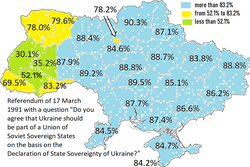
Das Referendum wurde vom Obersten Rat Georgiens genehmigt , der bei den ersten Mehrparteienwahlen im sowjetischen Georgien im Oktober 1990 gewählt worden war und von einem pro-unabhängigen Block namens „Runder Tisch – Freies Georgien“ unter der Führung des sowjetischen Dissidenten Swiad Gamsachurdia dominiert wurde . Nachdem Georgien das gesamtunionsweite Referendum über den Fortbestand der Föderation und die Verhandlungen über einen neuen Unionsvertrag am 17. März weitgehend boykottiert hatte [ 2 ], war es nach den drei baltischen Staaten ( Litauen am 9. Februar 1991 sowie Lettland und Estland am 3. März) die vierte Sowjetrepublik, die ein Referendum zur Frage der Unabhängigkeit organisierte. [ 3 ]
The only question of the referendum asked: "Do you support the restoration of the independence of Georgia in accordance with the Act of Declaration of Independence of Georgia of May 26, 1918?" The official results showed over 99% in favor with a 90.6% voter turnout.[1] Due to the ongoing ethnic discord, the polls were largely boycotted by the non-Georgian population in Abkhazia and South Ossetia, although local Georgian population of these regions participated in the vote.[3][4]
Four days after the final results were announced, the Georgian Supreme Council unanimously passed the declaration of independence on the second anniversary of the Soviet army crackdown on peaceful protests in Tbilisi on 9 April 1989.[5][6]
The referendum coincided with a private visit of the former U.S. PresidentRichard Nixon who visited a few polling stations in Georgia’s capital Tbilisi before his departure to Moscow later that day.[7]
Results
| Choice | Votes | % | |
|---|---|---|---|
| For | 3,295,493 | 99.49 | |
| Against | 16,917 | 0.51 | |
| Total | 3,312,410 | 100.00 | |
| Valid votes | 3,312,410 | 99.59 | |
| Invalid/blank votes | 13,690 | 0.41 | |
| Total votes | 3,326,100 | 100.00 | |
| Registered voters/turnout | 3,672,403 | 90.57 | |
| Source: Nohlen et al., Direct Democracy | |||
References
- ^ abDieter Nohlen, Florian Grotz & Christof Hartmann (2001) Elections in Asia: A data handbook, Volume I, p394 ISBN 0-19-924958-X
- ^Although polling were opened in parts of Abkhazia and South Ossetia where the voters opted to remain in the renewed Union. Imogen Bell (2002), Eastern Europe, Russia and Central Asia, p. 171. Taylor & Francis, ISBN 1-85743-137-5.
- ^ abCornell, Svante E., Autonomy and Conflict: Ethnoterritoriality and Separatism in the South Caucasus – Case in GeorgiaArchived June 30, 2007, at the Wayback Machine. Department of Peace and Conflict Research, Report No. 61. p. 163. University of Uppsala, ISBN 91-506-1600-5.
- ^Jonathan Wheatley (2005), Georgia from National Awakening to Rose Revolution, p. 64. Ashgate Publishing, Ltd., ISBN 0-7546-4503-7.
- ^Eastern Europe, Russia and Central Asia, p. 171.
- ^ Suny, Ronald Grigor (1994), Die Entstehung der georgischen Nation , S. 326. Indiana University Press , ISBN 0-253-20915-3Die
- ^ Sowjetgeorgier stimmen über Unabhängigkeit ab. The Boston Globe , 1. April 1991.