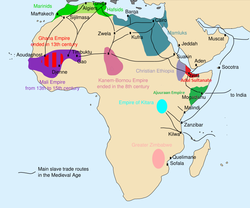
Abeed oder abīd ( عبيد , Plural von ʿabd, عبد ) ist ein arabisches Wort und bedeutet „ Diener “ oder „ Sklave “. Der Begriff wird üblicherweise in der arabischen Welt verwendet und dient als Schimpfwort für Sklaven, was auf den arabischen Sklavenhandel zurückgeht . In den letzten Jahrzehnten ist die Verwendung des Wortes aufgrund seiner rassistischen Konnotationen und Ursprünge, insbesondere in der arabischen Diaspora , umstritten geworden . [ 1 ]
Verwendung
Verwendung in Palästina
Die Praxis der Sklaverei durch Araber im britischen Mandatsgebiet Palästina und Jordanien wurde mindestens bis in die 1930er Jahre praktiziert. [ 2 ] Viele dieser Sklaven waren afrikanischer Abstammung, weshalb auch viele der heutigen Afro-Palästinenser selbst afrikanischer Abstammung sind. [ 3 ] Heute betonen viele Palästinenser die Gleichheit und Einheit der Palästinenser (einschließlich der Afro-Palästinenser), [ 4 ] [ 5 ] doch das Erbe des Sklavenhandels ist in den heutigen palästinensischen Gebieten weiterhin sichtbar: Der Begriff „Abeed“ (Sklave) wird mitunter verwendet, um dunkelhäutige Palästinenser zu bezeichnen. Darüber hinaus sind Afro-Palästinenser in ihrer Partnerwahl eingeschränkt [ 4 ] und haben weniger berufliche Möglichkeiten. [ 4 ] Die afro-palästinensischen Viertel werden mitunter mit dem Begriff „Abeed“ bezeichnet. Beispielsweise leben im Gaza-Stadtteil Al-Jalla Afro-Palästinenser in einem Viertel, das manchmal als „Harat Al-Abeed“ bezeichnet wird, was so viel wie „Sklavenviertel“ bedeutet. [ 4 ] Auch in Jericho wird ein afro-palästinensisches Viertel noch immer als „Sklavenviertel von Duyuk“ bezeichnet. [ 5 ]
Verwendung im Sudan
In North Sudan, the terms "Abeed" and "Junubi" are commonly used to refer to South Sudanese people (mostly Dinka and Nuer ), who are considered by many North Sudanese as a "slave tribe" due to their enslavement during the trans-Saharan slave trade. Usage of the term "Abeed" in North Sudan is considered derogatory in nature and has fallen into relative disuse in recent decades. In South Sudan, people from North Sudan are in turn referred to derogatorily as "Jalaba" and "Mundukuru" (meaning untrustworthy).[6][7] However, Ugandan historian Mahmood Mamdani has noted that the north–south ethnic conflict in Sudan does not reflect Western preconceptions of "race" and the Western view of the conflict as a conflict between "Arabs" and "Black Africans" is simplistic and inaccurate.[8]
South Sudanese politician Francis Deng framed an allegorical microcosm of British colonial rule in Sudan as Britain stating to the North Sudanese that "You Northerners are slave traders and you treat the Southerners like Abeed. Don't call them Abeed! They are slaves no longer."[9]
South Sudanese scholar Jok Madut Jok has argued that slavery in Sudan remains widespread in the 21st century despite being ostensibly outlawed on paper, claiming that South Sudanese people who work in North Sudan in low-paying working class jobs are regarded as "Abeed" due to the social standing which is gained from being in such occupations. Jok noted that South Sudanese labourers who only make enough money to feed themselves are commonly treated as the property of North Sudanese landowners and merchants. According to him, "Displaced Southerners are at the bottom of the racial hierarchy in Northern Sudan", as they depend upon patronage and exploitative relationships with power brokers, with relations ranging from servitude through bonded work to serving as attractants for resources from foreign aid agencies. "The lines dividing slavery and cheap labor", as he writes, "are blurred."[10]
See also
- List of ethnic slurs
- Indian Ocean slave trade
- Red Sea slave trade
- Trans-Saharan slave trade
- Abd (Arabic)
References
- ^"Arabic Speakers on Twitter Campaign to Make 'Abeed' the New 'N-Word'" .
- ^ [1] Clarence-Smith, W. (2020). Islam and the Abolition of Slavery. USA: Hurst.
- ^ Buessow, Johann. „Hausangestellte und Sklaven im späten osmanischen Palästina zum Zeitpunkt der Abschaffung der Sklaverei: Überlegungen zu Semantik und Handlungsfähigkeit.“ Slaves and Slave Agency in the Ottoman Empire (2020): 373–433. Web.
- ^ a b c d „Schwarze Palästinenser sind in Gaza subtilem Rassismus ausgesetzt“ . gulfnews.com . 05.05.2017 . Abgerufen am 29.10.2024 .
- ^ a b Qous, Yasser. „Die Afrikaner von Jerusalem: Entfremdung und Gegenentfremdung“ . Goethe-Institut Kairo/Perspektiven . Chris Somes-Charlton. Archiviert vom Original am 19. Oktober 2020. Abgerufen am 16. Juni 2021 .
- ^ Bixler, Mark (2005). Die verlorenen Jungen des Sudan: Eine amerikanische Flüchtlingsgeschichte . University of Georgia Press. S. 52. ISBN 0-8203-2499-XDie
- ^ Peter Russell und Storrrs McCall (1973). „Kann die Sezession gerechtfertigt sein?“. In: Dunstan M. Wai (Hrsg.). Der Südsudan: Das Problem der nationalen Integration . Routledge. S. 105. ISBN 0-7146-2985-5Die
- ^ „Analyse des Definitionskonflikts in Darfur: Interview mit Professor Mahmood Mamdani“ . Archiviert vom Original am 17.02.2011 . Abgerufen am 30.09.2018 .
- ^ John Obert Voll (1991). Sudan: Staat und Gesellschaft in der Krise . Indiana University Press. S. 78. ISBN 0-253-20683-9Die
- ^ Jok Madut Jok (2001). „Die Bevölkerungsvertreibung zwischen Süd und Nord“. Krieg und Sklaverei im Sudan . University of Pennsylvania Press. 129 Seiten . ISBN 0-8122-1762-4Die