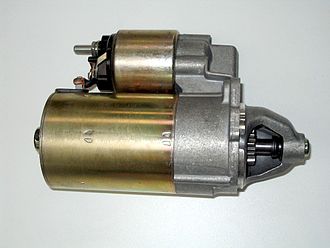
An air-start system is a power source used to provide the initial rotation to start large diesel engines and gas turbines.
Diesel engines
Direct starting
Compared to a gasoline (petrol) engine, a diesel engine has a very high compression ratio, an essential design feature, as it is the heat of compression that ignites the fuel. An electric starter with sufficient power to turn a large diesel engine would itself be so large as to be impractical so there is a need for an alternative system.
An air start system has three main components along with various safety components, namely the air start injector, the distributor and the air receivers. When the system is initiated, starting air from the receivers is distributed by the distributor unit to each respective air start valve according to the firing order of the engine’s cylinders. Safety components include flame traps, to prevent air line explosions, a turning gear interlock which ensures that air-start cannot be initiated when the turning gear is engaged, relief valves and isolation valves, as well as drain valves at certain points along the system. Control components include the control valves and remote air-start valves.[1] A direct start system as used on a marine slow-speed diesel is required to have up to 12 starts on a non-reversing engine or 6 starts on a reversible, or geared, engine.
When starting the engine, compressed air is admitted to whichever cylinder has a piston just over top dead center, forcing it downward.[2] As the engine starts to turn, the air-start valve on the next cylinder in line opens to continue the rotation. After several rotations, fuel is injected into the cylinders, the engine starts running and the air is cut off.
To further complicate matters, a large engine is usually "blown over" first with zero fuel settings and the indicator cocks open, to prove that the engine is clear of any water build up and that everything is free to turn. After a successful blow ahead and a blow astern, the indicator cocks are closed on all the cylinders, and then the engine can be started on fuel. Significant complexity is added to the engine by using an air-start system, as the cylinder head must have an extra valve in each cylinder to admit the air in for starting, plus the required control systems. This added complexity and cost limits the use of air-starters to very large and expensive reciprocating engines.
Starter motor
Another method of air-starting an internal combustion engine is by using compressed air or gas to drive a fluid motor in place of an electric motor.[3] They can be used to start engines from 5 to 320 liters in size and if more starting power is necessary two or more motors can be used. Starters of this type are used in place of electric motors because of their lighter weight and higher reliability. They can also outlast an electric starter by a factor of three and are easier to rebuild. Engines operating in underground mining activities tend to operate on this type of starter system to reduce the risk of an electrical system igniting flammable material.
All vane type air starters should have a lubricator installed to insure long-life and maximum performance.[4] Lubricators give the moving parts a needed friction barrier, reduce metal corrosion and keep vanes sealed properly against the cylinder walls. Even the so-called lube-free air starters require lubrication to prolong trouble free life. Two basic lubricator devices are typically employed. One is an in-line or reservoir type that typically stores up to 2 quarts of lubricant, and is installed along the air supply line. The second style of lubricator is a small one shot device that dispenses a measured amount of lubricant every time the starter is engaged. Installed directly onto the air inlet of the starter, the in-line lubricators are self priming pneumatic pumps that require a 1/4″ lubrication line piped from as far away as 4 feet. Air Starter lubricators perform best using misting type, non-detergent oils such as diesel fuel or Marvel Mystery oil. If emissions are a concern, there are environmentally friendly type lubricants available on the market.
Not all air starters require lubrication. Turbine type air starters do not require air motor lubrication, although some turbine air starters do use an oil filled transmission that may require periodic inspections and maintenance.
Gas turbines

Compressed air has been used to start gas turbine engines using air impingement starting (in which air is directed at the engine turbine blades through nozzles in the turbine casing, used on US Navy General Electric J79 engines). It is much more efficient to use an air turbine starter (ATS) which is usually mounted on an accessory gearbox.[5] An early axial compressor turbojet had an ATS located in the compressor nose cone (eg particular variants of the J79).
Die Druckluftstartanlage wurde nach der F-4B, A-5A [ 6 ] und F-5 nicht mehr für US-Militärflugzeuge verwendet, da der pneumatische Energiebedarf um ein Vielfaches höher war als bei der Verwendung eines Luftturbinenstarters. Der für den Start eines J79-Triebwerks mit Druckluftstartanlage benötigte Gasturbinenverdichter reichte aus, um in einer B-58 mit Luftturbinenstartern zwei J79-Triebwerke gleichzeitig zu starten. [ 7 ]
Ein ATS (Air-Turbine System) verfügt über eine eigene Turbine und ein eigenes Getriebe, um am Triebwerksaufhängungspunkt das niedrige Drehmoment und die hohe Drehzahl in eine niedrige Drehzahl und ein hohes Drehmoment umzuwandeln. Weitere Zahnräder im Triebwerksgetriebe sind mit der Triebwerkswelle (Hochdruckwelle bei Mehrwellentriebwerken) verbunden. Die Druckluft für die ATS-Turbine wird von der Hilfsenergieanlage des Flugzeugs ( Zapfluft vom Gasgenerator oder von einem Leerlaufverdichter, z. B. PW901 APU), von einem bereits laufenden Triebwerk (Zapfluft) bei mehrmotorigen Flugzeugen oder von einem am Boden montierten Luftverdichter zugeführt .
Druckluftstarter weisen im Vergleich zu Elektrostarter ein höheres Leistungsgewicht auf und werden daher bei großen Motoren eingesetzt, da ein Elektrostarter zu groß und mit seinen Kabeln zu schwer und teuer wäre. Für kleinere Motoren, die weniger Startleistung benötigen, ist ein Elektrostarter jedoch besser geeignet. Er fungiert bei Drehzahlen, ab denen der Motor keine Starthilfe mehr benötigt, zusätzlich als Generator (sogenannter Starter/Generator). [ 8 ]
Siehe auch
- Inhaltsverzeichnis der Luftfahrtartikel
- Luftstarteinheit
- AVPIN – Ein Monofuel-Kraftstoff zur Stromversorgung von Anlassermotoren für Turbojets.
- Coffman-Motorstarter – Ein ähnliches System, das eine Sprengstoffpatrone zur Erzeugung von Gasdruck verwendet.
- Flugzeugtriebwerksstart
- Komponenten von Strahltriebwerken
- Flammenhalter
Referenzen
- ^ „Startluftsystem für Schiffsdieselmotoren“ . MachinerySpaces.com. Archiviert vom Original am 15. Dezember 2022. Abgerufen am 6. März 2023 .
- ^ „Das Druckluftstartsystem auf marinediesels.co.uk: Wie ein Schiffsdieselmotor mit Druckluft gestartet wird“ . Marinediesels.info. Archiviert vom Original am 28.04.2013 . Abgerufen am 15.04.2013 .
- ^ „Luftstarter“ . GALI . galigrup.com . Abgerufen am 7. November 2023 .
- ^ „Häufig gestellte Fragen“ . Komponenten des Luftstarters .
- ^ Das Strahltriebwerk, 3. Auflage, Juli 1969, Publikationsreferenz TSD1302, S. 128/129
- ^ A5A Flugzeug NATOPN Flughandbuch, NAVWEPS 01-60ABA-1, S. 14 Startsystem
- ^ Pneumatische Anlasssysteme, Robert J. Von Flue, The Garrett Corporation, ASME-Publikation 67-GT-15, S. 3-5
- ^ Elektrische Systeme für Flugzeuge, dritte Auflage, Pallett, ISBN 0 582 98819 5, S. 157