The Argentine Centennial International Exhibition (Spanish: Exposición Internacional del Centenario Argentino) was an exhibition held between May and November 1910 in Buenos Aires, to commemorate the Centennial of the May Revolution in Argentina (the formation of the first local government on May 25, 1810). With a population of around 1.2 million, Buenos Aires was then the largest urban complex in Latin America, the eighth city in the world, and one of the richest. As the capital city and main port of the young Argentine Republic at the height of its economic expansion, the city was growing rapidly with the successive waves of European immigration.
Summary
A total of 20 pavilions were built specially for the exhibition.[1] A number of young Italian architects, including Virginio Colombo, Francisco Gianotti and Mario Palanti who designed the Italian pavilion, went on to establish successful careers in Buenos Aires working in a number of styles, including Art Nouveau. Their buildings were some of the most important of the 20th century in Buenos Aires and those that remain continue to play a significant role in defining the city's architectural landscape.
Each pavilion feature a different theme, such as:
- Agriculture and Cattle Raising – Organised by the Sociedad Rural Argentina, this was housed in a pavilion within the organisation's house in Palermo. It and contained an exhibition of agricultural activities and products from various parts of the country.
- Industry – This was located on what today is Del Libertador Avenue near El Rosedal, and featured industrial machinery much of which had never been seen before in Argentina. The only major pavilion still standing from any of the expositions is the Postal Service Pavilion from the Industrial Exhibition.
- Railways and Overland Transport – An exhibition of the latest automobiles from Europe, yachts, aeroplanes, railway locomotives, carriages and wagons. The pavilion, designed by Italian architect Virginio Colombo,[1] was located near the Hipódromo de Palermo. It was the most attended exhibition.
- Hygiene - diese Einrichtung befand sich im Garten der Residenz Unzué, wo heute die argentinische Nationalbibliothek untergebracht ist .
- Die Abteilung für Schöne Künste befand sich im „Argentinischen Pavillon“, einer Stahlkonstruktion, die mit Keramik und mehrfarbigem Glas verkleidet war und vom französischen Architekten Albert Ballu für die Weltausstellung 1889 in Paris entworfen wurde . Dort stand sie neben dem neu erbauten Eiffelturm . Um 1910 wurde der Pavillon auf die Plaza San Martín gegenüber dem Plaza Hotel verlegt . Der Pavillon wurde 1933 abgebaut. [ 2 ]
Darüber hinaus gab es Pavillons für verschiedene argentinische Provinzen , darunter Córdoba, Mendoza, Salta, Jujuy und Tucumán, sowie für Länder wie Spanien, Italien, Deutschland, England, die Schweiz, die österreichisch-ungarische Monarchie und Paraguay. Der Jugendstil prägte die Gestaltung vieler Gebäude maßgeblich.
Galerie
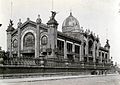 Der argentinische Pavillon auf der Ausstellung der Schönen Künste
 Eisenbahnausstellungspavillon
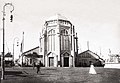 Deutschland-Pavillon
 Italienischer Pavillon
 Paraguay-Pavillon
 Argentinischer Postpavillon
 Ballonrennen
 Werbeillustration von Adriano Minardi
Siehe auch
Bibliographie
- Mimi Böhm, Buenos Aires, Jugendstil , Ediciones Xavier Verstraeten, Buenos Aires, 2005.
- El Pasado en Bilder. Die internationale Ausstellung des Hundertjährigen. Ferrocarriles y Transportes Terrestres , Zeitschrift Ciencia Hoy
Referenzen
- ^ El único pabellón que quedó del festejo del Centenario, olvidado y en mal estado , Clarín , 28. Januar 2010
- ^ Exposiciones históricas en la Argentina III. De la Exposición Internacional del Centenario (1910) a la creación del Salón Nacional (1911) , von Gutiérrez Viñuales, Rodrigo, Mai 2005, Website der Universidad de Granada


