
A fossil track or ichnite (Greek "ἴχνιον" (ichnion) – a track, trace or footstep) is a fossilized footprint. This is a type of trace fossil. A fossil trackway is a sequence of fossil tracks left by a single organism. Over the years, many ichnites have been found, around the world, giving important clues about the behaviour (and foot structure and stride) of the animals that made them. For instance, multiple ichnites of a single species, close together, suggest 'herd' or 'pack' behaviour of that species.
Combinations of footprints of different species provide clues about the interactions of those species. Even a set of footprints of a single animal gives important clues, as to whether it was bipedal or quadrupedal. In this way, it has been suggested that some pterosaurs, when on the ground, used their forelimbs in an unexpected quadrupedal action.
Special conditions are required, in order to preserve a footprint made in soft ground (such as an alluvial plain or a formative sedimentary deposit). A possible scenario is a sea or lake shore that became dried out to a firm mud in hot, dry conditions, received the footprints (because it would only have been partially hardened and the animal would have been heavy) and then became silted over in a flash storm.
The first ichnite found was in 1800 in Massachusetts, US, by a farmer named Pliny Moody, who found 1-foot (31 cm) long fossilized footprints. They were thought by Harvard and Yale scholars to be from "Noah's Raven".[1]
A famous group of ichnites was found in a limestone quarry at Ardley, 20 km Northeast of Oxford, England, in 1997. They were thought to have been made by Megalosaurus and possibly Cetiosaurus. There are replicas of some of these footprints, set across the lawn of Oxford University Museum of Natural History (OUMNH).
A creature named Cheirotherium was, for a long time and still may be, only known from its fossilized trail. Its footprints were first found in 1834, in Thuringia, Germany, dating from the Late TriassicPeriod.
The largest known dinosaur footprints, belonging to sauropods and dating from the early Cretaceous were found to the north of Broome on the Dampier Peninsula, Western Australia, with some footprints measuring 1.7 m.[2][3] The 3D digital documentation of tracks has the benefit of being able to examine ichnite in detail remotely and distribute the data to colleagues and other interested personnel.[4]

Fossil trackways
Many fossil trackways were made by dinosaurs, early tetrapods, and other quadrupeds and bipeds on land. Marine organisms also made many ancient trackways (such as the trails of trilobites and eurypterids like Hibbertopterus).
Some basic fossil trackway types:

The majority of fossil trackways are foot impressions on land, or subsurface water, but other types of creatures will leave distinctive impressions. Examples of creatures supported, or partially supported, in a water environment are known. The fossil "millipede-type" genus Arthropleura left its multi-legged/feet trackways on land.
Hominid trackways
Africa
Tanzania

Some of the earliest trackways for human ancestors have been discovered in Tanzania.[6] The Laetoli trackway is famous for the hominin footprints preserved in volcanic ash. After the footprints were made in powdery ash, soft rain cemented the ash layer into tuff, preserving the prints.[6] The hominid prints were produced by three individuals, one walking in the footprints of the other, making the original tracks difficult to discover. As the tracks lead in the same direction, they might have been produced by a group – but there is nothing else to support the common reconstruction of a nuclear family visiting the waterhole together.
South Africa
In South Africa, two ancient trackways have been found containing footprints, one at Langebaan and one at Nahoon. Both trackways occur in calcareous eolianites or hardened sand dunes. At Nahoon, trackways of at least five species of vertebrates, including three hominid footprints, are preserved as casts.[7] The prints at Langebaan are the oldest human footprints, dated to approximately 117,000 years old.[8]
Australia
New South Wales
Twenty six human fossil trackways have been found in the Willandra Lakes area adjacent to Lake Garnpung, consisting of 563 human footprints from 19,000 to 20,000 years ago.[9]
Early Tetrapod
The earliest land creatures (actually land-marine coastal-riverine-marshland) left some of the first terrestrial trackways. They range from tetrapods to proto-reptilians and others.
A possible first connection of a trackway with the vertebrate that left it was published by Drs. Sebastian Voigt and David Berman and Amy Henrici in the 12 September 2007 issue of Journal of Vertebrate Paleontology. The paleontologists who made the connection were aided by unusually detailed trackways left in fine-grained Lower Permian mud of the Tambach Formation in central Germany, together with exceptionally complete fossilised skeletons in the same 290-million-year-old strata. They matched the two most common trackways with the two most common fossils, two reptile-like herbivores known as Diadectes absitus (with the trackway pseudonym Ichniotherium cottae) and Orobates pabsti (with the trackway pseudonym of Orobates pabsti).[10]
The Permo-Carboniferous of Prince Edward Island, Canada contains trackways of tetrapods and stem-reptiles.[11] Macrofloral and palynological information help date them.
Ireland hosts late Middle Devonian tetrapod trackways at three sites on Valentia Island within the Valentia Slate Formation.[12][13]
The earliest fossil trackway of primitive tetrapods in Australia occurs in the Genoa River Gorge, Victoria, dating from the Devonian 350 million years ago.[14]
Dinosaur trackways

Dinosaurs lived on the continents before grasses evolved (the "Age of the Grasses" evolved with the "Age of the Mammals"); the dinosaurs lived in the Triassic, Jurassic, and Cretaceous and left many trackways, both from plant-eaters and the meat-eaters, in various layers of mud and sand.
With scientific analysis, dinosaur specialists are now analyzing tracks for the walking-speeds, or sprint-running speeds for all categories of dinosaurs, even to the large plant eaters, but especially the faster 3-toed meat hunters. Evidence ofherding, as well as pack hunting are also being investigated.
Bolivia
- Cal Orck'o, Cretaceous park, Sucre, Bolivia
- From an investigation that began in the 1960s, it wasn't until December 2025 that paleontologists from Loma Linda University in California discovered 16,600 footprints left by theropods, the dinosaur group that includes the Tyrannosaurus rex. After six years of regular field visits, this finding sets the highest number of theropod footprints ever discovered in the world. The footprint sizes indicated that giant creatures roughly 10 meters (33 feet) tall, while also finding tiny theropod footprints the size of a chicken, 32 centimeters (1 foot) tall at the hip. Interestingly enough, the scientist who found it in 1960 wanted to prove to kids that those prints weren't made by a monster, but by a dinosaur.[15]
Brazil
- Valley of the Dinosaurs, Paraíba, Brazil
Africa
Namibia

In north-central Namibia there is a dinosaur trackway in sandstone on what is now the private farm Otjihaenamparero. Larger footprints are of a ceratosauria and smaller ones of syntarsus. The prints are believed to be around 190 million years old.[16][17]
Zimbabwe
In the Lower Zimbabwe Rift Valley there is a trackway in 140 Ma rose-coloured sandstone of Chewore Area. The small footprint size, with both manus and pes, implies that it is a trackway of a juvenile, a probable carnosaur.[18]
North America

Die westlichen Regionen Nordamerikas, insbesondere der westliche Rand des Western Interior Seaway , sind häufig für Dinosaurierfährten bekannt. In Wyoming wurden Dinosaurierfährten aus der späten Kreidezeit (vor 65 Millionen Jahren) gefunden. [ 19 ] (Für Präsentationszwecke wurde ein Modell dieser dreizehigen Fährte aus Wyoming angefertigt.) [ 20 ]

In den Vereinigten Staaten wurden Dinosaurier- Fußabdrücke und -Fährten in der Glen-Rose-Formation gefunden . Die bekannteste Fundstätte ist die Paluxy-River- Fundstelle im Dinosaur Valley State Park . Es handelte sich um die ersten wissenschaftlich dokumentierten Sauropoda- Fußabdrücke, die 1969 zum National Natural Landmark der USA erklärt wurden . Einige weisen einen Durchmesser von bis zu einem Meter auf. Man geht davon aus, dass die Abdrücke ursprünglich in einem Watt oder einer Lagune erhalten geblieben sind . [ 21 ] Es gibt Spuren von zwei Dinosaurierarten. Die erste Art stammt von einem Sauropoden und wurde von einem 9 bis 15 Meter langen Tier hinterlassen, möglicherweise einem Brachiosaurier wie Pleurocoelus . [ 21 ] Die zweite Art stammt von einem Theropoda , einem 6 bis 9 Meter langen Tier, möglicherweise einem Acrocanthosaurus . Zur Erklärung der Spuren wurden verschiedene Szenarien vorgeschlagen, die höchstwahrscheinlich zwölf Sauropoden repräsentieren, „wahrscheinlich als Herde, gefolgt etwas später von drei Theropoden, die möglicherweise auf der Pirsch waren – aber sicherlich nicht angriffen.“ [ 21 ]
Weitere Beispiele sind:
- Dinosaurierspuren in der Nähe von Moab, Utah [ 22 ]
- Dinosaurier-Fußabdruck-Reservat in Holyoke, Massachusetts , USA
- Dinosaurier-Fährtenfundstätte Red Gulch , Wyoming
- Nationaldenkmal für prähistorische Fährten in der Nähe von Las Cruces, New Mexico
- Gleisanlagen im Connecticut River Valley , in Neuengland
- Dinosaurierfährten im Clayton Lake State Park in der Nähe von Clayton, New Mexico
- Dinosaurierspuren am West Gold Hill im Uncompahgre National Forest nahe Ouray, Colorado
Asien
China
Die Dinosaurierfährten von Gansu im Nationalen Dinosaurier-Geopark Liujiazia in Yanguoxia, China, enthalten Hunderte von Fährten, darunter 245 Dinosaurier-, 350 Theropoden-, 364 Sauropoden- und 628 Ornithopodenfährten. [ 23 ]
Thailand
Der Phu Pha Man Nationalpark in Thailand beherbergt eine der ältesten Dinosaurierfährten Asiens . [ 24 ] Die im Januar 2024 entdeckten Fährten wurden von Paläontologen des thailändischen Ministeriums für Bodenschätze auf ein Alter von etwa 225–220 Millionen Jahren (späte Trias) datiert. [ 25 ] Die Fährte enthält Spuren verschiedener Dinosaurierarten, darunter Theropoden, Sauropoden und Archosaurier. [ 26 ]
Australien
Die Lark Quarry Trackway in Queensland enthält dreizehige Spuren, die von einer Herde Ornithopoden beim Überqueren eines Flusses hinterlassen wurden. Man ging einst davon aus, dass es sich um Spuren eines großen Raubtiers handelte, das eine gemischte Herde kleiner Ornithopoden und Theropoden jagte, diese Annahme wurde jedoch 2011 widerlegt. [ 27 ]
Europa
Portugal
- Das Naturdenkmal Lagosteiros in Sesimbra mit Theropoden- und Ornithopodenfährten aus der frühen Kreidezeit .
- Das Naturdenkmal „Dinosaurierspuren der Aire-Bergkette“ in der Nähe von Torres Novas . Im Jahr 1994 wurden im Steinbruch Pedreira do Galinha etwa 20 Sauropodenfährten aus dem mittleren Jura entdeckt .
England
In a Bathonianlimestone quarry site at Ardley, Oxfordshire more than 40 sets of footprints, with some trackways reaching up to 180 metres in length, were discovered in 1997. These prints are largely only preserved in replicas and photographic records due to quarrying and subsequent restoration. Theropod tracks have been tentatively assigned to the ichnogenusMegalosauripus, possibly from Megalosaurus. The sauropod tracks could be grouped into wide-gauge trackways, associated with early titanosauria or brachiosauridae, and narrow-gauge ones, possibly from Cetiosaurus or a basal diplodocoid.[28] In 2024 at nearby Dewars Farm Quarry,[29] five new extensive Middle Jurassic trackways dating back about 166 Ma were discovered, with evidence of more in the neighbourhood. The longest continuous trackway measured more than 150 metres. Four of the trackways were made by large sauropods, most likely again Cetiosaurus. The fifth one was identified as made by the carnivorous theropodMegalosaurus, based on its distinctive three-toed feet with claws. One area of the site shows the carnivore and herbivore tracks crossing over, suggesting the predator followed up on the steps of the sauropod.[30][31]
Mammal trackways
Mammal trackways are among the least common trackways. Mammals were not often in mud, or riverine environments; they were more often in forestlands or grasslands. Thus the earlier tetrapods or proto-tetrapods would yield the most fossil trackways. The Walchia forest of Brule, Nova Scotia has an example of an in situ Walchia forest, and tetrapod trackways that extended over some period of time through the forest area.
United States
A 1.5km-long Late Pleistocene Age trackway of human (child and adult) fossilized footprints, as well as mammoth and giant ground sloth tracks have been found at White Sands National Park near Alamogordo, New Mexico.[32][33]
Australia
A recent marsupial trackway site at Colac in the Australian state of Victoria contains marsupial trackways as well as kangaroo and wallaby tracks.[34]
Pterosaur trackways
Frankreich
Der Pterosaur Beach war am Ende des Jura ein Wattgebiet , das bei Flut überschwemmt wurde. Es lag in einer Meereslagune in einem Golf , der zwischen Bordeaux und der Insel Oléron in den Atlantik mündete . Dort suchten Tiere nach Nahrung. [ 35 ] An der Fundstelle befinden sich Hunderte von versteinerten Fährten. [ 36 ]
Bildergalerie
 Spurenfossil von Cheirotherium , ausgestellt im Naturhistorischen Museum der Universität Oxford
 Querschnitt von Mammutfußabdrücken aus dem Pleistozän an der Mammoth Site, Hot Springs , South Dakota
 Eubrontes , ein Dinosaurierfußabdruck aus der unterjurassischen Moenave -Formation an der Dinosaurierfundstätte St. George auf der Johnson Farm im Südwesten Utahs.
 Fossile Flugsaurier- Fußabdrücke, Flugsaurierstrand (Frankreich)
 Kamelartiger Fußabdruck ( Lamaichnum alfi Sarjeant und Reynolds, 1999; konvexes Hyporelief) aus der Barstow-Formation ( Miozän ) des Rainbow Basin , Kalifornien
 Saurichnites intermedius
 Eine Fährte eines fleischfressenden Theropoden aus der Kreidezeit in der Nähe von Enciso, La Rioja , Spanien

 Der Hauptpfad für Dinosaurier am Naturdenkmal Lagosteiros , Portugal
 Moa -Fußabdrücke in der Nähe des Manawatu-Flusses, Neuseeland
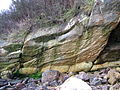 Hibbertopterus -Fährte: Negativreliefbild , eine mit Sand verfüllte Rinne erscheint als Bergrücken
Siehe auch
- Ichniten , eine Art von Ichnit
- Liste stratigraphischer Einheiten mit Dinosaurierspuren
- Formationen mit Ichniten
- Liste der Artikel über fossile Fährten von Nicht-Dinosauriern
- Liste der Fossilienfundstätten
Referenzen
- ^ „Noahs Rabe“ . Archiviert vom Original am 25.07.2009 . Abgerufen am 21.02.2010 .
- ^ Devlin, Hannah ; Agenturen (28.03.2017). „Die größten Dinosaurier-Fußabdrücke der Welt in Westaustralien entdeckt“ . The Guardian . ISSN 0261-3077 . Abgerufen am 01.12.2017 .
- ^Salisbury, Steven W.; Romilio, Anthony; Herne, Matthew C.; Tucker, Ryan T.; Nair, Jay P. (2016-12-12). "The Dinosaurian Ichnofauna of the Lower Cretaceous (Valanginian–Barremian) Broome Sandstone of the Walmadany Area (James Price Point), Dampier Peninsula, Western Australia". Journal of Vertebrate Paleontology. 36 (sup1): 1–152. Bibcode:2016JVPal..36S...1S. doi:10.1080/02724634.2016.1269539. hdl:1959.11/58119. ISSN 0272-4634.
- ^Romilio, Anthony; Dick, Roslyn; Skinner, Heather; Millar, Janice (2020-02-13). "Archival data provides insights into the ambiguous track-maker gait from the Lower Jurassic (Sinemurian) Razorback beds, Queensland, Australia: evidence of theropod quadrupedalism?". Historical Biology. 33 (9): 1573–1579. doi:10.1080/08912963.2020.1720014. ISSN 0891-2963.
- ^Stössel, I, Williams, E.A. & Higgs, K.T. 2016. Ichnology and depositional environment of the Middle Devonian Valentia Island tetrapod trackways, south-west Ireland. Palaeogeog., Palaeoclimatol., Palaeoecol., 462, 16–40
- ^ ab"Laetoli Footprint Trails". The Smithsonian Institution's Human Origins Program. January 1978. Retrieved 2022-08-29.
- ^Last Interglacial Hominid and Associated Vertebrate Fossil Trackways in Coastal Eolianites, South Africa, 2008
- ^South Africa West Coast article on Langebaan footprints
- ^Westaway, Michael C.; Cupper, Matthew L.; Johnston, Harvey; Graham, Ian (June 2013). "The Willandra Fossil Trackway: Assessment of ground penetrating radar survey results and additional OSL dating at a unique Australian site". Australian Archaeology. 76 (76): 84–89. doi:10.1080/03122417.2013.11681969. hdl:10072/55451. JSTOR 23621961. S2CID 107464142.
- ^Science Daily, "Who Went There? Matching Fossil Tracks With Their Makers", 15 September 2007.
- ^Calder, J.H., Baird, D. & Urdang, E.B. 2004. On the discovery of tetrapod trackways from Permo-Carboniferous redbeds of Prince Edward Island and their biostratigraphic significance. Atlantic Geology, 40, 217–226. [1]
- ^Stössel, I. 1995. The discovery of a new Devonian tetrapod trackway in SW Ireland. J. Geol. Soc. Lond. 152, 407–413.
- ^Stössel, I, Williams, E.A. & Higgs, K.T. 2016. Ichnology and depositional environment of the Middle Devonian Valentia Island tetrapod trackways, south-west Ireland. Palaeogeog., Palaeoclimatol., Palaeoecol., 462, 16–40
- ^Warren, J.W. & Wakefield, N.A., 1972. Trackways of tetrapod vertebrates from the Upper Devonian of Victoria, Aust. Nature 238, 469-470.
- ^"Scientists document largest trove of dinosaur footprints in central Bolivia". ABC News. Retrieved 2025-12-12.
- ^Lockley, M. G. (1991). Tracking dinosaurs : a new look at an ancient world. Cambridge: Cambridge University Press. p. 238. ISBN 0-521-39463-5. OCLC 23176761.
- ^"Guest Farm Namibia – Dinosaur Tracks-Footprints National Monument von Namibia". www.dinosaurstracks-guestfarm.com. Retrieved 2021-11-06.
- ^"Walking with baby dinosaurs", manus and pes prints
- ^"Dinosaur Hunting in Wyoming, photo: Arlene and Gabe at the trackways.".
- ^"Dinosaur Hunting in Wyoming, photo: trackways for presentation.".
- ^ abcMartin Lockley & Adrian P. Hunt, Dinosaur Tracks and Other Fossil Footprints of the Western United States, Columbia U. Press, New York (1995)
- ^"Area with 200-plus dinosaur tracks opening to public soon". Fox News. Retrieved 2014-08-25.
- ^Fujita, Sato; Lee, Yuong-Nam; Azuma, Yoichi; Li, Daqing (2012). "Unusual Tridactyl Trackways with Tail Traces from the Lower Cretaceous Heikou Group, Gansu Province". PALAIOS. 27 (8): 560–570. doi:10.2110/palo.2012.p12-015r. JSTOR 41692731. S2CID 128491569.
- ^"250 million year old dinosaur footprints discovered in thailand". Retrieved 2024-01-25.
- ^Boyle, Gary (15 January 2024). "Dinosaur track find could be a first for Thailand". Bangkok Post. Retrieved 2024-01-25.
- ^ „Über 225 Millionen Jahre alte Dinosaurier-Fußabdrücke in Thailand entdeckt“ . nationthailand . 14.01.2024 . Abgerufen am 25.01.2024 .
- ^ Romilio, Anthony; Salisbury, Steven W. (01.04.2011). „Eine Neubewertung großer Theropoden-Dinosaurierfährten aus der mittelkretazischen (spätes Albium–Cenomanium) Winton-Formation von Lark Quarry, Zentralwest-Queensland, Australien: Ein Fall von Fehlidentifizierung“. Cretaceous Research . 32 (2): 135–142 . Bibcode : 2011CrRes..32..135R . doi : 10.1016/j.cretres.2010.11.003 . ISSN 0195-6671 .
- ^ Day, JJ; Norman, DB; Gale, AS; Upchurch, P.; Powell, HP (2004). „Eine Dinosaurierfährtenfundstelle aus dem mittleren Jura in Oxfordshire, Großbritannien“ . Palaeontology . 47 (2): 319–348 . Bibcode : 2004Palgy..47..319D . doi : 10.1111/j.0031-0239.2004.00366.x .
- ^ „Steinbruch Ardley Dewars Farm“ . Abgerufen am 3. Januar 2025 .
- ^ „Bedeutende neue Fußabdruckfunde auf Großbritanniens ‚Dinosaurier-Highway‘“" . Neuigkeiten und Veranstaltungen der Universität Oxford . 2. Januar 2025 . Abgerufen am 2. Januar 2025 ."
- ^ „Großbritanniens größte jemals entdeckte Dinosaurier-Fußabdruckstätte“ . BBC Science & Health . Abgerufen am 2. Januar 2025 .
- ^ „Die längsten versteinerten menschlichen Fährten der Welt wurden im White Sands Nationalpark entdeckt“ . Las Cruces Sun News. 9. Oktober 2020. Abgerufen am 11. Oktober 2020 .
- Bennett, Matthew R.; Bustos, David; Odess, Daniel; Urban, Tommy M.; Lallensack, Jens N.; Budka, Marcin; Santucci, Vincent L.; Martinez, Patrick; Wiseman, Ashleigh L.A.; Reynolds, Sally C. (1. Dezember 2020). „ Wandern im Schlamm: Bemerkenswerte pleistozäne menschliche Fährten aus dem White Sands Nationalpark (New Mexico)“ . Quaternary Science Reviews . 249 106610. Bibcode : 2020QSRv..24906610B . doi : 10.1016/j.quascirev.2020.106610 . S2CID 225132473 .
- ^ Unvergleichlicher Fossilienfund, The Cola Herald
- ^"Des traces de ptérosaures mises au jour dans le Lot prouvent que ce reptile volant marchait à quatre pattes". France 3. 7 August 2013.
- ^A prehistoric 'runway' used by flying reptiles, NBC News, August 18, 2009.
External links
- Texts on natural casts of dinosaur tracks found in Utah coal mines
- . The American Cyclopædia. 1879.
- Wyoming 3-toed trackways
- Zimbabwe juvenile dinosaur trackway
- Redbeds of Prince Edward Island, Permo-Carboniferous
Dinosaur trackways:
- Photo-High Res – (Outdoor photo); Article Photo from Dakota Formation, Colorado
Early Tetrapods:
Australia