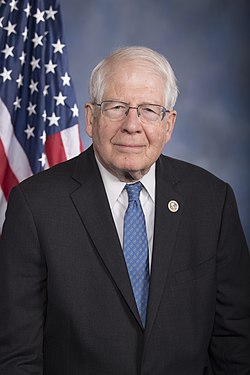
Lawrence M. Mead III (geb. 1943) ist Professor für Politikwissenschaft und öffentliche Politik an der New York University (NYU). [ 1 ]
Ausbildung
Mead wurde in Huntington, New York , geboren und schloss sein Studium am Amherst College 1966 mit einem Bachelor of Arts (BA) als Mitglied von Phi Beta Kappa ab. An der Harvard University erwarb er 1968 und 1973 einen Master of Arts (MA) und einen Doktortitel (Ph.D.). [ 2 ]
Karriere
Mead lehrt seit 1979 an der New York University (NYU). Er war Gastprofessor an der University of Wisconsin (1987), der Harvard University (1993–94) und der Princeton University (1994–95). Er war Gastwissenschaftler in Princeton (1995–96, 2001–02) und an der Hoover Institution in Stanford (1988). Mead war 1978–79 stellvertretender Forschungsdirektor des Republican National Committee , von 1975 bis 1978 wissenschaftlicher Mitarbeiter am Urban Institute , 1974–75 Redenschreiber für Außenminister Henry Kissinger und von 1973 bis 1975 Politikberater im US-Gesundheitsministerium. [ 2 ]
Mead hat über Armut und Sozialhilfe in den Vereinigten Staaten geschrieben. In seinen zwischen 1986 und 2004 verfassten Büchern lieferte er die theoretische Grundlage für die amerikanische Sozialreform der 1990er Jahre, die die Erwerbstätigkeit erwachsener Sozialhilfeempfänger als Bedingung für den Bezug von Leistungen vorschrieb. Seine Bücher haben die Sozialreformen in Europa, Australien und Neuseeland beeinflusst. [ 3 ]
Mead hat sechs Bücher verfasst, drei weitere mitverfasst und zwei weitere herausgegeben bzw. mit herausgegeben. Alle Werke befassen sich mit Armut und/oder staatlicher Sozialpolitik. Seine Studie „Government Matters“ zur Sozialreform in Wisconsin wurde 2005 mit dem Louis-Brownlow-Buchpreis der National Academy of Public Administration ausgezeichnet . [ 4 ] Mead hat zahlreiche Artikel zu Armut, Sozialhilfe, Programmumsetzung und verwandten Themen in Fachzeitschriften wie dem „ Journal of Policy Analysis and Management“ , der „Public Administration Review“ , „The Public Interest“ und den „Annals of the American Academy of Political and Social Science“ veröffentlicht . Seine Buchrezensionen und Kommentare erschienen unter anderem in der „New York Times“ und der „Washington Post“ . [ 2 ]
Theorien zu Wohlfahrt und Armut
Mead ist der Ansicht, dass Sozialleistungen bedarfsabhängig sein sollten, um Leistungsempfänger zu Verhaltensweisen zu motivieren, die ihre Armut lindern. Laut Mead tritt extreme Armut häufiger in Minderheitengruppen auf, nicht etwa aufgrund mangelnder Arbeitsmoral . Vielmehr argumentiert er, dass ihr Glaube an die Bedeutung von Arbeit ihr Handeln leider nicht ausreichend beeinflusst. Diese Einschätzung deckt sich mit J. D. Vances Analyse armer, weißer Appalachenbewohner in seinem Buch „Hillbilly Elegy“ . Daher argumentiert Mead: „Das Ideal im Sozialwesen … ist es, Leistungen so eng wie möglich an Arbeit zu knüpfen. Dies erfordert einen klaren Arbeitstest, den erwerbsfähige Leistungsempfänger sofort nach Antragstellung bestehen müssen, nicht erst später. Ebenso wichtig ist es, dass ausreichende Leistungen zur Unterstützung von Erwerbstätigkeiten vorhanden sein müssen, insbesondere für Kinder- und Gesundheitsversorgung.“ [ 5 ]
On July 21, 2020, Mead published a commentary in the journal Society titled "Poverty and Culture" based on ideas from his 2019 book Burdens of Freedom but also found in his 1983 book, Beyond Entitlement.[6] In the paper, he wrote that extreme poverty is found amongst Black and Hispanic people in the United States more often than white people because they "typically respond only weakly to chances to get ahead through education and work" due to cultural differences in adapting to the United States' "individualist culture", a culture he posits derives from Europe. He repeated his hypothesis that while impoverished minorities do value work, their values do not sufficiently guide their actions.[7] The paper drew widespread outrage[8][9] from the academic community for allegedly perpetuating racist, xenophobic and classist stereotypes,[10] and multiple petitions circulated requesting a retraction.[9] NYU issued a statement expressing its rejection of "false, prejudicial, and stigmatizing assertions about the culture of communities of color in the United States" in his paper.[11] The journal publisher launched an investigation, and on July 31 the editor-in-chief retracted the paper and apologized for publishing it.[7]
Books
- Books authored
- Mead, Lawrence M. (1986). Beyond Entitlement: The Social Obligations of Citizenship. New York: Free Press. ISBN 978-0-7432-2495-6.
- Mead, Lawrence M. (1993). The New Politics of Poverty: The Nonworking Poor in America. New York: Basic Books. ISBN 978-0-465-05069-7.
- Mead, Lawrence M. (2004). Government Matters: Welfare Reform in Wisconsin. Princeton, NJ: Princeton University Press. ISBN 978-0-691-12380-6.
- Mead, Lawrence M. (2011). From Prophecy to Charity: How to Help the Poor. Washington, DC: AEI Press. ISBN 978-0844743806.
- Mead, Lawrence M. (2011). Expanding Work Programs for Poor Men. Washington, DC: AEI Press. ISBN 978-0844743974.
- Mead, Lawrence M. (2019). Burdens of Freedom. Princeton, NJ: Encounter Books. ISBN 978-1641770408.
- Books co-authored
- Bane, Mary Jo; Mead, Lawrence M. (2003). Lifting Up the Poor: A Dialogue on Religion, Poverty & Welfare Reform. Washington, DC: Brookings Institution Press. ISBN 978-0-8157-0791-2.
- Edited
- Mead, Lawrence M.; Deacon, Alan, eds. (1997). From Welfare to Work: Lessons from America. London, UK: Institute of Economic Affairs. ISBN 978-0-255-36399-0.
- Mead, Lawrence M., ed. (1997). The New Paternalism: Supervisory Approaches to Poverty. Washington, DC: Brookings Institution Press. ISBN 978-0-8157-5651-4.
- Mead, Lawrence M.; Beem, Christopher, eds. (2007). Welfare Reform and Political Theory. New York: Russell Sage Foundation Publications. ISBN 978-0-87154-588-6.
References
- ^"Wilf Family Department of Politics". as.nyu.edu. Retrieved 2024-06-19.
- ^ abc"Lawrence M. Mead III Curriculum Vita". March 2007. Retrieved January 19, 2011.
- ^Ramesh, Randeep (2010-06-16). "Does getting tough on the unemployed work?". The Guardian. ISSN 0261-3077. Retrieved 2024-06-19.
- ^"Academy Honors Three Books with the 2005 Louis Brownlow Award". National Academy of Public Administration. December 9, 2005. Archived from the original on 2008-11-27. Retrieved May 14, 2009.
- ^Statement of Lawrence M. Mead, Welfare reform: Reauthorization of work and child care: Hearing before the Subcommittee on 21st Century Competitiveness of the Committee on Education and the Workforce, U.S. House of Representatives. 109th Cong., 1st Sess. Retrieved August 29, 2005.
- ^Mead, Lawrence (2019). Burdens of freedom : cultural difference and American power (First American ed.). New York: Encounter Books. ISBN 978-1641770408.
- ^ abMead, Lawrence M. (2020-07-29). "Poverty and Culture". Society. doi:10.1007/s12115-020-00496-1 (inactive 1 July 2025). ISSN 1936-4725. S2CID 220844755.
{{cite journal}}: CS1 maint: DOI inactive as of July 2025 (link) (Retracted, see doi:10.1007/s12115-020-00496-1, Retraction Watch) - ^ „Führende Stimme der Sozialreform des Rassismus beschuldigt“ . www.insidehighered.com . 28. Juli 2020. Abgerufen am 30. Juli 2020 .
- ^ a b „Hunderte bezeichnen die Arbeit als ‚unwissenschaftlich‘ und ‚rassistisch gewalttätig‘“" . Medscape . Abgerufen am 30.07.2020 .
- ^ Marcus, Adam (27.07.2020). „Hunderte fordern die Rücknahme einer Arbeit, die sie als „unwissenschaftlich, offen rassistisch“ und voller „rassistisch gewalttätiger Erzählungen“ bezeichnen.“" . Retraction Watch . Abgerufen am 30.07.2020 .
- ^ „Stellungnahme der Fakultät für Geistes- und Naturwissenschaften und der Wagner-Leitung bezüglich Professor Lawrence Mead“ . NYU . Abgerufen am 30. Juli 2020 .