Charles Dillon „ Casey “ Stengel ( / ˈstɛŋɡəl / ; 30. Juli 1890 – 29. September 1975) war ein US-amerikanischer Baseballspieler ( Right Fielder ) und Manager der Major League Baseball (MLB). Bekannt wurde er vor allem als Manager der New York Yankees, die in den 1950er Jahren die Meisterschaft gewannen, und später der neu gegründeten New York Mets . Er trug den Spitznamen „ Ol’ Perfessor “ und wurde 1966 in die Baseball Hall of Fame aufgenommen .
Stengel wurde 1890 in Kansas City, Missouri , geboren . 1910 begann er seine über ein halbes Jahrhundert währende Profi-Baseballkarriere. Nach fast drei Saisons in den Minor Leagues schaffte Stengel Ende 1912 als Outfielder den Sprung in die Major League zu den Brooklyn Dodgers . In seinen sechs Spielzeiten dort feierte er einige Erfolge, unter anderem spielte er 1916 für das Meisterteam der Dodgers in der National League . Während dieser Zeit erwarb er sich auch den Ruf eines Spaßvogels. Nach wiederholten Gehaltsstreitigkeiten mit dem Besitzer der Dodgers, Charlie Ebbets , wurde Stengel 1918 zu den Pittsburgh Pirates transferiert . Im Sommer desselben Jahres meldete er sich jedoch freiwillig zur Marine und diente bis zum Ende des Ersten Weltkriegs. Nach seiner Rückkehr zum Baseball setzte er seine Gehaltsstreitigkeiten fort, was zu Transfers zu den Philadelphia Phillies (1919) und den New York Giants (1921) führte. Dort lernte er viel über Baseball von Manager John McGraw und erlebte einige Höhepunkte seiner Karriere, darunter einen Inside-the-Park-Homerun im ersten Spiel der World Series 1923, der den Sieg gegen die Yankees sicherte. Seine Spielerkarriere in der Major League endete 1925 bei den Boston Braves , woraufhin er eine Laufbahn als Manager einschlug.
Die ersten zwanzig Jahre von Stengels zweiter Karriere verliefen größtenteils erfolglos, insbesondere während seiner Zeit als Manager in der MLB bei den Dodgers (1934–1936) und den Braves (1938–1943). Danach feierte er einige Erfolge in den Minor Leagues, und im Oktober 1948 verpflichtete ihn George Weiss, der General Manager der Yankees , als Manager. Stengels Yankees gewannen fünf Jahre in Folge (1949–1953) die World Series – ein bis heute unerreichtes Kunststück. Obwohl das Team in seinen zwölf Saisons zehn Meisterschaften und sieben World Series gewann, verliefen seine letzten beiden Jahre weniger erfolgreich: 1959 belegten sie den dritten Platz und 1960 verloren sie die World Series . Im Alter von 70 Jahren wurde er kurz nach der Niederlage von den Yankees entlassen.
Stengel war während seiner Zeit bei den Yankees für seine humorvolle und bisweilen etwas sprunghafte Art zu sprechen bekannt geworden. Diese Showman-Qualitäten kamen den neu gegründeten Mets zugute, als sie ihn Ende 1961 engagierten. Er vermarktete das Team unermüdlich und führte es zu einer Bilanz von 40 Siegen und 120 Niederlagen – die meisten Niederlagen eines MLB-Teams im 20. Jahrhundert. In allen vier Jahren seiner Amtszeit belegte das Team den letzten Platz, profitierte aber von der großen Unterstützung der Fans. Stengel ging 1965 in den Ruhestand und war bis zu seinem Lebensende eine feste Größe bei Baseballveranstaltungen. Obwohl Stengel mitunter als einer der größten Manager in der Geschichte der Major League bezeichnet wird, stellten andere seinen Erfolg bei den Yankees seinem Misserfolg in anderen Zeiten gegenüber und kamen zu dem Schluss, dass er nur dann ein guter Manager war, wenn ihm gute Spieler zur Verfügung standen. Stengel wird als eine der schillerndsten Persönlichkeiten der Baseballgeschichte in Erinnerung bleiben.
Frühen Lebensjahren
Charles Dillon Stengel wurde am 30. Juli 1890 in Kansas City, Missouri , geboren . Seine Vorfahren waren deutscher und irischer Abstammung. Seine Eltern, Louis Stengel und Jennie (Jordan) Stengel, stammten aus der Quad Cities- Region in Illinois und Iowa und waren kurz nach ihrer Hochzeit 1886 nach Kansas City gezogen, da Louis dort eine Stelle bei einer Versicherung annahm. „Charlie“ war das jüngste von drei Kindern und der zweite Sohn. Schon als Kind spielte Charlie Stengel Baseball auf Bolzplätzen und später auch Baseball, Football und Basketball an der Central High School in Kansas City . Seine Basketballmannschaft gewann die Stadtmeisterschaft, die Baseballmannschaft die Staatsmeisterschaft. [ 1 ] [ 2 ] [ 3 ]
Als Teenager spielte Stengel in mehreren Halbprofi -Baseballmannschaften. [ 4 ] In den Sommern 1908 und 1909 spielte er für das Wanderteam Kansas City Red Sox, das bis nach Wyoming reiste und einen Dollar pro Tag verdiente. Die Kansas City Blues, ein Minor-League-Team, boten ihm einen Vertrag über 135 Dollar im Monat an – mehr als sein Vater verdiente. Da der junge Stengel noch minderjährig war, musste sein Vater zustimmen, was er auch tat. Louis Stengel erinnerte sich: „Also legte ich mein Papier hin und unterschrieb. Den Jungen konnte man sowieso nicht umstimmen.“ [ 5 ]
Spielerkarriere
Minor Leagues

Before reporting to spring training for the Blues in early 1910 at Excelsior Springs, Missouri, Stengel was approached by his neighbor, Kid Nichols, a former star pitcher, who advised him to listen to his manager and to the older players, and if he was minded to reject their advice, at least think it over for a month or so first.[6] Stengel failed to make the ball club, which was part of the American Association, considered one of the top minor leagues. Kansas City optioned Stengel to the Kankakee Kays of the Class D Northern Association, a lower-level minor league, to gain experience as an outfielder. He had a .251 batting average with Kankakee when the league folded in July. He found a place with the Shelbyville Grays, who moved mid-season and became the Maysville Rivermen, of the Class D Blue Grass League, batting .221.[1][7] He returned to the Blues for the final week of the season, with his combined batting average for 1910 at .237.[8]
I want to thank my parents for letting me play baseball, and I'm thankful I had baseball knuckles and couldn't become a dentist.
Uncertain of whether he would be successful as a baseball player, Stengel attended Western Dental College in the 1910–1911 offseason. He would later tell stories of his woes as a left-handed would-be dentist using right-handed equipment. The Blues sold Stengel to the Aurora Blues of the Class C Wisconsin–Illinois League. He led the league with a .352 batting average. Brooklyn Dodgersscout Larry Sutton took a trip from Chicago to nearby Aurora, noticed Stengel, and the Dodgers purchased his contract on September 1, 1911. Brooklyn outfielder Zach Wheat later claimed credit for tipping off Sutton that Stengel was worth signing. Stengel finished the season with Aurora and returned to dental school for the offseason.[1][10]
The Dodgers assigned Stengel to the Montgomery Rebels of the Class A Southern Association for the 1912 season. Playing for manager Kid Elberfeld, Stengel batted .290 and led the league in outfield assists. He also developed a reputation as an eccentric player. Scout Mike Kahoe referred to Stengel as a "dandy ballplayer, but it's all from the neck down".[1] After reporting to Brooklyn in September and getting a taste of the big leagues, he spent a third offseason at dental school in 1912–1913. He did not graduate, though whenever his baseball career hit a bad patch in the years to follow, his wife Edna would urge him to get his degree.[11]
Brooklyn years (1912–1917)
They brought me up to the Brooklyn Dodgers, which at that time was in Brooklyn.
In later years, Casey Stengel told stories of his coming to Brooklyn to play for the Dodgers; most focused on his naïveté and were, at least, exaggerated.[13] Wheat was from the Kansas City area and watched over Stengel, getting the young player a locker next to his and working with him on outfield technique.[14] Stengel made his MLB debut at Brooklyn's Washington Park on September 17, 1912, as the starting center fielder,[1] and went 4–4 with a walk, two stolen bases and two tie-breaking runs batted in, leading seventh-place Brooklyn to a 7–3 win over the Pirates.[15][16] Stengel continued to play well, finishing the season with a .316 batting average, though hitting .351 when right-handers started against Brooklyn and only .250 when left-handers started.[17]

Nachdem er auf eine höhere Bezahlung gedrängt hatte, unterschrieb Stengel 1913 bei den Dodgers. Er sicherte sich den Stammplatz als Centerfielder. Die Dodgers hatten ein neues Stadion, das Ebbets Field , und Stengel war der Erste, dem dort ein Homerun gelang – zunächst ein Inside-the-Park-Homerun gegen die New York Yankees in einem Eröffnungsspiel und dann ein weiterer in der regulären Saison. Während der Saison 1913 erhielt Stengel den Spitznamen „Casey“. Es gibt verschiedene Geschichten darüber, wie es dazu kam, doch seine Heimatstadt Kansas City spielte wahrscheinlich eine wichtige Rolle – Sportjournalist Fred Lieb berichtete, dass der Baseballspieler „Charles Stengel – KC“ auf seine Taschen aufgemalt hatte. Obwohl er verletzungsbedingt 25 Spiele verpasste, erzielte er in seiner ersten vollen Saison in der Major League einen Schlagdurchschnitt von .272 mit sieben offiziellen Homeruns. Vor dem Frühjahrstraining 1914 trainierte Stengel die Baseballmannschaft der University of Mississippi . Obwohl die Stelle unbezahlt war, wurde er für die Dauer seiner Tätigkeit dort zum Assistenzprofessor ernannt , was möglicherweise der Ursprung von Stengels Spitznamen „Der alte Professor“ war. [ 18 ] [ 19 ]
Die Dodgers waren in Stengels ersten Jahren bei ihnen ein aufstrebendes Team, und er wurde stark von dem Manager Wilbert Robinson beeinflusst, der 1914 zum Team stieß . [ 20 ] Stengel entging 1914 auch einem Streik; Dodgers-Besitzer Charlie Ebbets wollte seine Spieler unbedingt unter Vertrag nehmen, damit sie nicht zur neuen Federal League wechselten , und verdoppelte Stengels Gehalt beinahe auf 4.000 Dollar pro Jahr. [ 21 ] Im Frühjahrstraining trafen die Dodgers auf die Baltimore Orioles aus der Minor League und deren Rookie Babe Ruth , der als Pitcher eingesetzt wurde. Ruth schlug einen Triple über Stengels Kopf, kassierte aber auch zwei Doubles von ihm, und Stengel fing einen weiten Flyball von Ruth ins Right Field – die Dodgers verloren das Spiel. Sowohl Brooklyn als auch Stengel starteten verhalten in die Saison, erholten sich aber schnell und legten eine beeindruckende Serie hin, die die Dodgers nur vier Spiele unter der 50%-Marke brachte – ihre beste Bilanz seit 1903. Stengel beendete die Saison mit einem Schlagdurchschnitt von .316 [ 22 ] , dem fünftbesten der Liga. Seine On-Base-Percentage lag mit .404 an der Spitze der Liga, obwohl dies damals noch keine offizielle Statistik war. [ 23 ] Da die Federal League noch aktiv war, wurde Stengel mit einem Zweijahresvertrag über 6.000 US-Dollar pro Jahr belohnt. [ 24 ]
Stengel reported to spring training ill and thin; he was unable to work out for much of the time the Dodgers spent in Florida. Although the team stated that he had typhoid fever, still common in 1915, Lieb wrote after Stengel's death in 1975 that the ballplayer had gonorrhea. Stengel may have been involved in a well-known incident during spring training when Robinson agreed to catch a baseball dropped from an airplane piloted by Ruth Law—except that it proved not to be a baseball, but a small grapefruit, much to the manager's shock, as he assumed the liquid on him was blood. Law stated that she dropped the grapefruit as she had forgotten the baseball, but Stengel retold the story, imitating Robinson, many times in his later years, with himself as grapefruit dropper, and is often given the credit for the stunt.[25] Stengel's batting average dipped as low as the .150s for part of the season; though he eventually recovered to .237, this was still the worst full season percentage of his major league career.[1]

Soon after the 1916 season started, it became clear that the Dodgers were one of the better teams in the league.[26] Robinson managed to squeeze one more year of productivity out of some older veterans such as Chief Meyers, who said of Stengel, "It was Casey who kept us on our toes. He was the life of the party and just kept all us old-timers pepped up all season."[27] Stengel, mostly playing right field, hit .279 with eight home runs, one less than the team leader in that category, Wheat. Stengel's home run off Philadelphia Phillies pitcher Grover Cleveland Alexander, who won 33 games that year, in the second game of a doubleheader on September 30, provided the margin of victory as the Dodgers went into first place to stay, qualifying for their first World Series, against the Boston Red Sox.[27] Despite getting two hits in a Game 1 loss at Boston, Stengel was benched for Game 2 because the Red Sox were pitching a left-hander, Babe Ruth, and Stengel hit better against right-handers.[28] Stengel, back in the lineup for Game 3, got a hit in Brooklyn's only victory of the series. He was benched again in Game 4 against left-hander Dutch Leonard, though he was inserted as a pinch runner, and got another hit in the Game 5 loss, finishing 4 for 11, .364, the best Dodger batting average of the Series.[29]
Despite the successful season, Ebbets was determined to cut his players' salaries, including Stengel, whom he considered overpaid. By then, the Federal League was defunct, and the reserve clause prevented players from jumping to other major league clubs. The owner sent Stengel a contract for $4,600, and when that was rejected, cut it by another $400. A holdout ensued, together with a war of words waged in the press. With little leverage, Stengel became willing to sign for the original contract, and did on March 27, 1917, but missed most of spring training.[30] Stengel's batting average dropped from .279 to .257 as the defending league champion Dodgers finished seventh in the eight-team league, but he led the team in games, hits, doubles, triples, home runs and runs batted in. After the season, Ebbets sent Stengel a contract for $4,100, and the outfielder eventually signed for that amount, but on January 9, 1918, Ebbets traded him along with George Cutshaw to the Pittsburgh Pirates for Burleigh Grimes, Al Mamaux and Chuck Ward.[1][31]
Pittsburgh and Philadelphia (1918–1921)
The Pirates had been the only National League team to do worse than the Dodgers in 1917, finishing last.[32] Stengel met with the Pirates owner Barney Dreyfuss to seek a salary increase, but found Dreyfuss reluctant to deal until Stengel proved himself as a Pirate. On June 3, 1918, Stengel was ejected for arguing with the umpire, and was fined by the league office for taking off his shirt on the field. The U.S. had been fighting in World War I for a year, and Stengel enlisted in the Navy. His wartime service was playing for and managing the Brooklyn Navy Yard's baseball team, driving in the only run to beat Army, 1–0, before 5,000 spectators at the Polo Grounds. He also occasionally helped paint a ship—he later stated he had guarded the Gowanus Canal, and not a single submarine got into it.[33]
I had many years that I was not so successful as a ball player, as it is a game of skill.
The Armistice renewed the conflict between Stengel and Dreyfuss, and the outfielder held out again to begin the 1919 season. Both wanted to see Stengel traded, but no deal was immediately made.[35] By then, Stengel's position as regular right fielder had been taken by Billy Southworth, and he had difficulty breaking back into the lineup.[36] Stengel played better than he had before he enlisted, and by the time Dreyfuss traded him to the Philadelphia Phillies for Possum Whitted on August 9, he was batting .293 with four home runs.[1][37] But before being traded, Stengel pulled one of his most famous stunts, on May 25 at Ebbets Field, as a member of the visiting Pirates. It was not unusual at Ebbets Field for right fielders of either team, rather than go to the dugout after three were out, to go to the Dodgers' bullpen, in foul territory down the right field line, if they were not likely to bat in the upcoming inning. Stengel did so to visit old friends, and discovered that pitcher Leon Cadore had captured a sparrow. Stengel took it, and quietly placed it under his cap when called to bat in the sixth inning. He received mixed boos and cheers from the Brooklyn crowd as a former Dodger, took a deep bow at the plate, and doffed his cap, whereupon the bird flew away to great laughter from the crowd.[38]
The trade to the Phillies ended Stengel's major league season for 1919, as he refused to report unless he got a raise, and when one was not forthcoming, returned to Kansas City to raise a barnstorming team.[39] In the offseason, he came to terms with William Baker, the owner of the Phillies, and hit .292 in 1920 with nine home runs. However, racked by injuries and no longer young for a ballplayer, he did not play much in the early part of the 1921 season. On June 30, 1921, the Phillies traded Stengel, Red Causey and Johnny Rawlings to the New York Giants for Lee King, Goldie Rapp and Lance Richbourg.[40][41] The Giants were one of the dominant teams in the National League, and Stengel, who had feared being sent to the minor leagues, quietly placed a long-distance call once informed to ensure he was not the victim of a practical joke.[42]
New York Giants and Boston Braves (1921–1925)
I learned more from McGraw than anybody.
When Stengel reported to the Giants on July 1, 1921, they were managed, as they had been for almost 20 years, by John McGraw. Stengel biographer Robert W. Creamer said of McGraw, "his Giants were the most feared, the most respected, the most admired team in baseball".[44] Stengel biographer Marty Appel noted, "McGraw and Stengel. Teacher and student. Casey was about to learn a lot about managing".[45] Stengel had time to learn, playing in only 18 games for the Giants in 1921, mostly as a pinch hitter,[43] and watched from his place on the bench as McGraw led the Giants from a 71⁄2 game deficit on August 24 to the National League pennant.[46] Although he was on the 25-player postseason roster,[47] Stengel did not appear in the 1921 World Series against the Yankees, as McGraw used only 13 players (4 of them pitchers) in beating the Yankees, five games to three.[48] The only contribution Stengel made to the box score was being ejected from Game 5 for arguing.[49]
McGraw brought several outfielders into spring training with the Giants. When Stengel was not included with the starters when the manager split the squad, some sportswriters assumed he would not be with the team when the regular season began. Stengel, at McGraw's request, acted as a coach to the young players on the "B" squad, and worked hard, getting key hits in spring training games, and making the Giants as a reserve outfielder. McGraw and Stengel sometimes stayed up all night, discussing baseball strategy. With two Giant outfielders injured by June, Stengel was put in center field, and hit .368 in 84 games, as McGraw platooned him against right-handers. If Stengel had enough plate appearances to qualify for the league batting championship, he would have finished second to Rogers Hornsby of the St. Louis Cardinals, who hit .401.[1][49][50] The Giants played the Yankees again in the 1922 World Series; Stengel went 1–4 in Game 1, nursing an injured right leg muscle, which he aggravated running out an infield single in his first at bat in Game 2. Stengel was obviously limping when he was advanced to second base on another single, and McGraw sent in a pinch runner. He did not use Stengel again in the Series, which the Giants won, four games to zero, with one tie. After the Series, Stengel and other major leaguers went on a barnstorming tour of Japan and the Far East.[51]

The year 1923 started much the same as the year before, with Stengel detailed to the "B" squad as player and coach in spring training, making the team as a reserve, and then inserted as center fielder when righties pitched. Similar also were Stengel's hot batting streaks, helping the Giants as they contended for their third straight pennant. Stengel was ejected several times for brawling or arguing with the umpire, and the league suspended him for ten games in one incident. McGraw continued to use him as a means of exerting some control over the younger players. During that summer, Stengel fell in love with Edna Lawson, a Californian who was running part of her father's building contracting business;[52] they were married the following year.[1] Near the end of the season, he sustained a mild foot injury, causing McGraw to rest him for a week, but he played the final two games of the regular season to finish at .339 as the Giants and Yankees each won their leagues.[53]
Bis 1923 hatten die Yankees ihre Heimspiele im Polo Grounds der Giants ausgetragen, doch in jenem Jahr eröffneten sie das Yankee Stadium , das am 10. Oktober 1923 Schauplatz des ersten Spiels der World Series war . Casey Stengels Schlag im neunten Inning beim Stand von 4:4 war, wie Appel in seiner Geschichte der Yankees schrieb, „legendär“. [ 54 ] Vor der größten Zuschauermenge, die er je gespielt hatte, schlug Stengel einen Changeup von Joe Bush zu einem Hit, der zwischen den Outfieldern hindurch weit ins linke Centerfield flog. Geplagt von seiner Verletzung und noch mehr, als ihm beim Erreichen der zweiten Base ein Schwamm aus dem Schuh flog, umrundete Stengel langsam die Bases und entkam dem Tag von Catcher Wally Schang zu einem Inside-the-Park-Homerun, der den Sieg sicherte. So ging der erste Homerun der World Series in der Geschichte des alten Yankee Stadiums nicht an Babe Ruth, „diese Ehre fiel, welch Ironie, dem alternden Ersatz-Outfielder Casey Stengel zu“. [ 54 ]
Nach dem Sieg der Yankees im zweiten Spiel im Polo Grounds kehrte die World Series für Spiel 3 ins Yankee Stadium zurück. Stengel gewann es mit 1:0 durch einen Homerun in die Tribüne im rechten Feld . Während die Yankee-Fans Stengel ausbuhten, zeigte er ihnen den Stinkefinger und warf den Yankee-Spielern einen Kuss zu, was den Haupteigentümer des Teams, Jacob Ruppert , empörte. Dieser forderte Baseball-Commissioner Kenesaw Mountain Landis auf, Stengel zu bestrafen oder zu suspendieren. Richter Landis lehnte dies ab und sagte: „Ein Mann, der zwei Spiele mit Homeruns gewinnt, darf sich ruhig etwas übermütig fühlen, besonders wenn er ein Stengel ist.“ [ 55 ] Die Yankees gewannen die nächsten drei Spiele und sicherten sich damit den Titel. Stengel erzielte in den sechs Spielen einen Schlagdurchschnitt von .417 und beendete seine World-Series-Karriere mit einem Durchschnitt von .393. [ 56 ]
Zum Glück habe ich nicht drei Homeruns in drei Spielen geschlagen, sonst hätte McGraw mich in die Three-I League verbannt .
On November 13, 1923, twenty-nine days after the World Series ended, Stengel was traded to the perennial second-division-dwelling Boston Braves with Dave Bancroft and Bill Cunningham for Joe Oeschger and Billy Southworth. Stengel had enjoyed his time in New York and was initially unhappy at the trade, especially since he had become close to McGraw. He soon cooled down, and later praised McGraw as "the greatest manager I ever played for".[56] Despite nagging pains in his legs, Stengel played in 134 games during the 1924 season, the most since his days with the Dodgers, and hit .280 with a team-leading 13 stolen bases, but the Braves finished last. After the season, Stengel joined a baseball tour of Europe organized by McGraw and Charles Comiskey, with Edna Stengel accompanying the team. Casey Stengel met King George V and the Duke of York, later to become King George VI; Edna sipped tea with Queen Mary, an experience that strained her nerves. That winter, the Stengels moved into a house built by Edna's father in Glendale, California, where they would live the rest of their lives.[57] The marriage produced no children.[58]
Early managerial career (1925–1948)
Minor leagues (1925–1931)
Never let a losing pitcher drive the bus—especially a left-hander. A guy who has just blown a tough one shouldn't be allowed behind the wheel.
Stengel started 1925 on the active roster of the Braves, but was used as a pinch hitter and started only once, in right field against the Pirates on May 14, a game in which he got his only MLB hit of 1925, the final one of his major league career, a single. His average sank to .077. Braves owner Emil Fuchs purchased the Worcester Panthers of the Eastern League, and hired Stengel as player-manager and team president.[60] Appel noted that in joining the Panthers, Stengel was "starting out on a managing career that would eventually take him to Cooperstown".[59] With fans enjoying Stengel's on-field antics and his World Series heroics still recent, he was the Eastern League's biggest attendance draw. Between run-ins with the umpires, Stengel hit .302 in 100 games as the Panthers finished third.[1][59]
The Panthers were not a box office success, and Fuchs planned to move the team to Providence, Rhode Island for the 1926 season, with Stengel to remain in his roles. McGraw, with whom Stengel had remained close, wanted him to take over as manager of the Giants' top affiliate, the Toledo Mud Hens of the American Association, at an increase in salary. Stengel was still under contract to the Braves, and Mud Hens president Joseph O'Brien was unwilling to send them money or players in order to get him. When Stengel asked Fuchs what to do if a higher-level club wanted to draft him, Fuchs half-heartedly suggested releasing himself as a player, which would automatically terminate his Braves contract. Stengel took up Fuchs on his suggestion, releasing himself as a player, then firing himself as manager and resigning as president, clearing the way for him to move to the Mud Hens. Fuchs was outraged, and went to Judge Landis, who advised him to let the matter go.[61][62]
People talk about all the money I've made. But they never talk about all the money I've lost.
Stengel's six years in Toledo would be as long as he would spend anywhere as manager, except his time with the Yankees of the 1950s.[64] McGraw sent talented players down to Toledo, and the Mud Hens threatened for the pennant in Stengel's first year before falling back to third. In 1927, the team won its first pennant and defeated the Buffalo Bisons, five games to one, in the Little World Series. Stengel missed part of the 1927 campaign, as he was suspended by the league for inciting the fans to attack the umpire after a close play during the first game of the Labor Day doubleheader.[65] Stengel continued as an occasional player as late as 1931 in addition to his managerial role, hitting a game-winning home run (the last of his professional career) in 1927 for the Mud Hens.[66] Since minor league clubs suffer large turnovers in their rosters, the team's success did not carry over to 1928, when it finished sixth, and then eighth in the eight-team league in 1929. The team recovered for third in 1930, but by then both Stengel and the team (in which he had invested) were having financial problems due to the start of the Great Depression. The team finished last again in 1931, and, after Landis was convinced no money had been skimmed off to benefit Stengel and other insiders, the team went into receivership, and Stengel was fired.[66]
Brooklyn and Boston (1932–1943)

Stengel had approached the new manager of the Dodgers, Max Carey, an old teammate from his time with the Pirates, seeking a job, and was hired as first base coach. Stengel thus ended an exile of seven years from the major leagues: Appel suggested that Stengel's reputation as a clown inhibited owners from hiring him although he was known as knowledgeable and able to manage the press. Sportswriter Dan Daniel described Stengel's hiring as "the return of an ancient Flatbush landmark", which might satisfy old Dodger fans upset at Robinson's dismissal at the end of 1931.[67] Brooklyn finished third and then sixth with Stengel in the first base coaching box. Among the players was catcherAl Lopez; the two became close friends and would be managing rivals in the 1950s American League.[68]
The first thing I want to say is that the Dodgers are still in the National League. Tell that to Bill Terry.
During the winter following the 1933 season, the manager of the world champion Giants, Bill Terry was interviewed by the press about the other teams in the National League. When asked about the Dodgers, Terry responded, "Brooklyn? Gee, I haven't heard a peep out of there. Is Brooklyn still in the league?"[70] This angered Brooklyn's management, and they expected Carey to make a full-throated response. When he remained silent, he was fired. One sportswriter regarded the hiring of Stengel as too logical a thing to happen in Brooklyn, but on February 24, 1934, Stengel faced the press for the first time as the manager of a major league team.[69] McGraw, Stengel's mentor, was too ill to issue a statement on seeing him become a major league manager; he died the following day.[71]
Stengel, hired only days before spring training, had a limited opportunity to shape his new ballclub. The Dodgers quickly settled into sixth place, where they would end the season. Stengel, in later years, enjoyed discussing one 1934 game in Philadelphia's Baker Bowl: with Dodger pitcher Boom-Boom Beck ineffective, Stengel went out to the mound to take out the angry pitcher, who, instead of giving Stengel the baseball, threw it into right field, where it hit the metal wall with a loud noise. The right fielder, Hack Wilson, lost in thought, heard the boom, assumed the ball had been hit by a batter, and ran to retrieve it and throw it to the infield, to be met by general laughter.[72] Stengel got the last laughs on the Giants as well. The Giants, six games ahead of the Cardinals on Labor Day, squandered that lead, and with two games remaining in the season, were tied with St. Louis. The final two games were against Brooklyn at the Polo Grounds, games played in front of raucous crowds, who well remembered Terry's comments. Brooklyn won both games, while the Cardinals won their two games against the Cincinnati Reds, and won the pennant. Richard Bak, in his biography of Stengel, noted that the victories over the Terry-led Giants represented personal vindication for the Dodger manager.[73]
The Dodgers finished fifth in 1935 and seventh in 1936. Dodger management felt Stengel had not done enough with the talent he had been given, and he was fired during the 1936 World Series between the Yankees and Giants.[74] Stengel was paid for one year left on his contract, and he was not involved in baseball during the 1937 season. Stengel had invested in oil properties, as advised by one of his players, Randy Moore, a Texan; the investment helped make the Stengels well-to-do, and they put the profits in California real estate. Stengel considered going in the oil business full-time, but Braves president Bob Quinn offered him the Boston managerial job in late 1937, and he accepted.[75]
Stengel war sowohl Manager als auch Investor der Braves. In seinen sechs Jahren dort (1938–1943) erreichte sein Team nie eine Platzierung in der oberen Tabellenhälfte. Zwischen 1939 und 1942 belegte der Bostoner Club vier Jahre in Folge den siebten Platz, nur weil die Phillies noch schlechter waren. Der Eintritt der USA in den Zweiten Weltkrieg führte dazu, dass viele Topspieler zum Militärdienst eingezogen wurden, doch für die Braves hatte dieser Wechsel kaum Auswirkungen auf die Tabelle. Zu den jungen Spielern, die zu den Braves kamen, gehörte auch Pitcher Warren Spahn , der vom Manager wegen mangelnden Kampfgeistes in die Minor Leagues versetzt wurde. [ 76 ] Spahn, der später eine Hall-of-Fame-Karriere hinlegen sollte, größtenteils bei den Braves, spielte 1965 erneut für Stengel bei den erfolglosen New York Mets und scherzte, er sei der Einzige, der sowohl vor als auch nach Stengels Geniezeit für ihn gespielt habe. [ 1 ] [ 76 ]
Wenige Tage vor Saisonbeginn 1943 wurde Stengel beim Überqueren der Commonwealth Avenue in Boston von einem Auto angefahren und erlitt einen schweren Beinbruch. Er verpasste die ersten beiden Monate der Saison, erhielt viele Genesungswünsche und musste Genesungskarten lesen, die scherzhaft an die psychiatrische Abteilung des Krankenhauses adressiert waren. Stengel humpelte sein Leben lang. Am Ende der Saison entließ ihn das Management der Braves, frustriert über die mangelnden Fortschritte, und er erhielt keine sofortigen Jobangebote. [ 77 ] Fünfzehn Jahre später sagte Stengel vor einem Senatsausschuss über diesen Abschnitt seiner Karriere aus: „Ich war Manager in mehreren Städten der Major League und wurde entlassen. Wir nennen es Entlassung, weil es außer Frage stand, dass ich gehen musste.“ [ 78 ]
Rückkehr in die Jugendmannschaften (1944–1948)

Stengel glaubte, die Saison 1943 würde seine letzte im Baseball sein. Edna drängte ihn, sich voll und ganz den Familienunternehmen zu widmen, und Casey, der schon immer sportlich gewesen war, wollte sich mit seiner noch nicht vollständig verheilten Verletzung nicht im Baseballstadion zeigen. Doch Anfang der Saison 1944 wurde bei den Milwaukee Brewers , einem Minor-League-Team , ein neuer Manager gesucht, da die Chicago Cubs den Brewer-Manager Charlie Grimm abgeworben hatten , der 1919 mit Stengel bei den Pirates gespielt hatte. Grimm erklärte den Cubs, er sei verpflichtet, für einen fähigen Nachfolger bei den Brewers zu sorgen, und drängte sie, Stengel einzustellen. Der Teambesitzer Bill Veeck , der als Marine auf Guadalcanal stationiert war , hielt nicht viel von Stengel als Manager und zögerte sehr, ihm zuzustimmen, als er per Telegramm kontaktiert wurde. Stengel verstand es, gute Beziehungen zu Reportern aufzubauen, und das talentierte Team gewann weiterhin Spiele; Ende Mai gab Veeck schließlich seine Einwände auf. Das Team gewann die Meisterschaft der American Association, verlor aber in den Playoffs gegen Louisville . Veeck, der in die Vereinigten Staaten zurückgekehrt war, bot Stengel an, ihn für 1945 wieder einzustellen, doch Stengel bevorzugte ein anderes Angebot. [ 79 ] Dieses kam von George Weiss von den New York Yankees. Er sollte das Team trainieren, bei dem Stengel seine Karriere begonnen hatte, die Kansas City Blues , die damals ein Farmteam der Yankees waren. Kansas City war Letzter in der American Association geworden, während Milwaukee die Meisterschaft gewann, was für Stengel, der auf eine Rückkehr in die Major League gehofft hatte, einen Rückschlag bedeutete. Dennoch war es in seiner alten Heimatstadt, sodass er Freunde und Verwandte besuchen konnte, und er nahm den Job an. Die Blues belegten 1945 den siebten Platz in der acht Mannschaften umfassenden Liga. [ 80 ]
Jeder Manager möchte sich irgendwann einmal von einer Brücke stürzen, und es ist sehr beruhigend für einen alten Mann zu wissen, dass er nicht 80 Kilometer laufen muss, um eine zu finden.
Obwohl es keine freie Stelle als Manager in der Major League gab, auf die Stengel hätte hinarbeiten können, hatten die Oakland Oaks der Pacific Coast League ihren Manager entlassen und Stengel kontaktiert. Das Niveau des Baseballs in der PCL war fast mit dem der Major League vergleichbar, und die Liga bot vielen alternden Major-League-Spielern die Möglichkeit, ihre Karriere zu beenden. Für Stengel war außerdem attraktiv, dass die Liga drei Teams in Südkalifornien umfasste , sodass er mehr Zeit in seinem Haus in Glendale verbringen konnte. Bis dahin hatte der Club nur eine Meisterschaft gewonnen und galt als das schwächere Schwesterteam seiner Rivalen, den San Francisco Seals , doch Besitzer Brick Laws glaubte, dass Stengel aus den Spielern ein Siegerteam formen könnte. [ 82 ]
Die Oaks belegten 1946 hinter den Seals den zweiten Platz in der Liga. Sie gewannen die erste Playoff-Runde gegen Los Angeles, unterlagen aber im Finale San Francisco. 1947 wurden sie Vierte, schlugen San Francisco in der ersten Runde, verloren aber ebenfalls gegen Los Angeles. Stengel trainierte die Oaks 1948 ein drittes Jahr lang. Der Kader bestand größtenteils aus ehemaligen Major-League-Spielern. Zu den jüngeren Spielern gehörte der 20-jährige Shortstop Billy Martin . Stengel war beeindruckt von Martins Feldspiel, seinem Spielverständnis und seiner Kampfkraft, wenn es auf dem Feld zu Schlägereien kam. Die Oaks sicherten sich am 26. September die Meisterschaft und gewannen den Governors’ Cup gegen Los Angeles und die Seattle Rainiers . Das Magazin „Sporting News“ kürte Stengel zum Minor-League-Manager des Jahres. [ 83 ]
Glanzzeiten: Die Yankee-Dynastie (1949–1960)
Anstellung und Saison 1949
Na und, wenn er nicht mit mir redet? Ich komme schon klar, und er auch. DiMaggio wird nicht dafür bezahlt, mit mir zu reden, und ich auch nicht.
Stengel had been talked about as a possible Yankee manager in the early 1940s, but longtime team boss Ed Barrow (who retired in 1945) refused to consider it.[85] Yankee manager Joe McCarthy retired during the 1946 season, and after the interim appointment of catcher Bill Dickey as player-manager, Bucky Harris was given the job in 1947.[86] Stengel's name was mentioned for the job before Harris got it; he was backed by Weiss, but Larry MacPhail, then in charge of the franchise, was opposed.[87] Harris and the Yankees won the World Series that year, but finished third in 1948, though they were not eliminated until the penultimate day. Harris was fired, allegedly because he would not give Weiss his home telephone number.[86] MacPhail could no longer block Stengel's hiring, as he had sold his interest in the Yankees after the 1947 season. Weiss, who became general manager after MacPhail's departure, urged his partners in the Yankees to allow the appointment of Stengel, who aided his own cause by winning the championship with Oakland during the time the Yankee job stood open. Del Webb, who owned part of the Yankees, had initial concerns but went along.[88] Yankee scouts on the West Coast recommended Stengel, and Webb's support helped bring around co-owner Dan Topping.[89]
Stengel was introduced as Yankee manager on October 12, 1948, the 25th anniversary of his second World Series home run to beat the Yankees. Joe DiMaggio attended the press conference as a sign of team support. Stengel faced obstacles to being accepted—Harris had been popular with the press and public, and the businesslike Yankee corporate culture and successful tradition were thought to be ill matched with a manager who had the reputation of a clown and who had never had a major league team finish in the top half of the standings. Stengel's MLB involvement had been in the National League, and there were several American League parks in which he had neither managed nor played.[89][90][91]
Stengel tried to keep a low profile during the 1949 Yankee spring training at St. Petersburg, Florida,[1] but there was considerable media attention as Stengel shuttled rookies from one position on the field to another, and endlessly shuffled his lineup. He had the advantage of diminished expectations, as DiMaggio, the Yankee superstar, was injured with a bone spur in his heel, and few picked New York to win the pennant. There were other injuries once the season began, and Stengel, who had initially planned a conservative, stable lineup in his first American League season, was forced to improvise.[92] Although platooning, playing right-handed batters against left-handed pitchers and the reverse, against whom they are on average more able to hit, had been known for some years, Stengel popularized it, and his use gave the practice its name, coined by a sportswriter and borrowed from football. For example, in the early part of the 1949 season, Stengel might play Bobby Brown at third base and Cliff Mapes and Gene Woodling in the outfield against right-handers. Against left-handers, Stengel might play Billy Johnson at third with Johnny Lindell and Hank Bauer in the outfield.[93]
After the team blew leads and lost both ends of a doubleheader in Philadelphia on May 15, Stengel called a team meeting in which he criticized the players responsible for the two losses, but also predicted greatness for them, and told the team it was going to win. The team then won 13 of its next 14 games. Yankee sportscaster Curt Gowdy, who was present, later stated, "that speech in Philadelphia was the turning point of the season".[94]
DiMaggio returned from injury on June 28 after missing 65 games. He hit four home runs in three games to help sweep Boston and extend the Yankees' league lead. Despite DiMaggio's return, the lineup remained plagued with injuries. After consulting with Stengel, Weiss obtained Johnny Mize from the Giants, but he was soon sidelined with a separated shoulder. Twelve games behind on the Fourth of July, the Red Sox steadily gained ground on the Yankees, and tied them by sweeping a two-game set at Fenway September 24 and 25, the first time the Yankees had not been in sole possession of first place since the third game of the season. The Red Sox took the lead the following day with a comeback win in a makeup game, as Stengel lost his temper at the umpire for the first time in Yankee uniform; although he was not ejected, he was fined by the league.[95]
Die Saison spitzte sich in zwei Spielen gegen die Red Sox im Yankee Stadium zu. Die Yankees lagen ein Spiel zurück und mussten beide gewinnen. Stengel hatte sich in der Saison 1949 als geschickter im Einsatz von Relief Pitchern erwiesen als seine Kollegen. Als Starter Allie Reynolds im ersten Spiel im dritten Inning die ersten beiden Runs zuließ, brachte der Manager Joe Page . Obwohl Page noch zwei weitere Runs durch Walks zuließ, hielt er die Red Sox im weiteren Spielverlauf in Schach, sodass die Yankees das Spiel mit 5:4 gewannen. Damit kam es zu einem alles entscheidenden Spiel um die Meisterschaft. Die Yankees gingen mit 5:0 in Führung, bevor Boston im neunten Inning drei Runs erzielte. Vic Raschi konnte jedoch weiteren Schaden verhindern und den Yankees die Meisterschaft sichern – Stengels erste als Manager in der Major League. [ 96 ]
In der World Series 1949 , Stengels erster Teilnahme seit 1923, trafen die Yankees auf die Brooklyn Dodgers, die gerade das Team zusammenstellten, das die Yankees während eines Großteils seiner Zeit in New York herausfordern sollte. Die ersten beiden Spiele im Yankee Stadium endeten unentschieden. Vor Spiel 3 im Ebbets Field wurde Stengel gebeten, seine noch lebenden Teamkollegen aus dem Meisterteam von 1916 aus Brooklyn vorzustellen, was er sichtlich bewegt tat. Die Yankees gewannen Spiel 3, und während Spiel 4, das die Yankees ebenfalls gewannen, verließ Stengel die Spielerbank, um Catcher Yogi Berra zuzurufen, er solle den Ball zur zweiten Base werfen. Berra tat dies und warf Pee Wee Reese aus, der versuchte, eine zusätzliche Base zu erreichen. Für diesen Regelverstoß wurde Stengel nach dem Spiel von Commissioner Happy Chandler gerügt . Die Yankees gewannen auch Spiel 5 und damit die World Series. Während der Feierlichkeiten nach dem Spiel sagte Del Webb über Stengel gegenüber der Presse: „Ich wusste, dass er gewinnen würde, egal ob wir noch ein paar Spieler für ihn bekommen oder nicht.“ [ 97 ]
Wiederholter Erfolg (1950–1953)

During the 1949 season, Stengel had been more subdued than he usually was, but being the manager of the defending world champions and the Major League Manager of the Year relieved his inhibitions, and he was thereafter his talkative self. He also was more forceful in running the team, not always to the liking of veteran players such as DiMaggio and Phil Rizzuto. As part of his incessant shuffling of the lineup, Stengel had DiMaggio play first base, a position to which he was unaccustomed and refused to play after the first game. Stengel considered DiMaggio's decline in play as he neared the end of his stellar career more important than his resentment. In August, with the slugger in the middle of a batting slump, Stengel benched him, stating he needed a rest. DiMaggio returned after six games, and hit .370 for the rest of the season, winning the slugging percentage title. Other young players on the 1950 team were Billy Martin and Whitey Ford. The ascendence of these rookies meant more of the Yankees accepted Stengel's techniques, and diminished the number of those from the McCarthy era who resented their new manager. The Detroit Tigers were the Yankees' main competition, leading for much of the summer, but the Yankees passed them in the middle of September to win the pennant by three games. In the 1950 World Series, the Yankees played the Phillies, another of Stengel's old teams. The Yankees won in four games.[1][98]
He's just a green pea out there. But he'll be back soon, and you'll see something.
Vor dem Frühjahrstraining 1950 hatten die Yankees als erste die Idee einer Trainingsschule für Rookies und andere junge Spieler eingeführt. Diese Idee stammte von Stengel und Weiss. Beschwerden anderer Teams, die Yankees würden die Zeitvorgaben für das Frühjahrstraining überschreiten und ihr Geld für Wettbewerbsvorteile nutzen, führten zu Anpassungen, doch das Konzept blieb bestehen und wurde schließlich weit verbreitet. [ 100 ] Unter den Eingeladenen zum frühen Trainingslager 1951 war der 19-jährige Mickey Mantle , dessen Schnelligkeit und Talent Stengel beeindruckten und der das Vorjahr in den Minor Leagues verbracht hatte. [ 101 ] Stengel versetzte Mantle vom Shortstop ins Outfield, da er davon ausging, dass Rizzuto, der Shortstop, noch einige Jahre spielen würde. Sowohl Mantle als auch die Yankees starteten verhalten in die Saison 1951, [ 1 ] und am 14. Juli wurde Mantle nach Kansas City geschickt, um sein Selbstvertrauen am Schlagmal wiederzuerlangen. Er wurde bald wieder zu den Yankees zurückbeordert; obwohl er in der Saison nur einen Schlagdurchschnitt von .267 erreichte, war dies vier Punkte besser als DiMaggio in dessen letzter Saison. Ein Großteil der Verantwortung für den Gewinn der dritten Meisterschaft in Folge lag auf Berra, der eine MVP-Saison hinlegte. [ 102 ] Die White Sox und anschließend die Indians führten die Liga über weite Strecken des Sommers an, doch die Yankees, stets dicht dahinter, spielten einen überragenden letzten Monat der Saison und gewannen die Meisterschaft mit fünf Spielen Vorsprung. [ 1 ]

The Yankee opponent in the 1951 World Series was the Giants, with Game 1 played the day after they won the National League pennant in the Miracle of Coogan's Bluff. On an emotional high,[103] the Giants beat the Yankees in Game 1 at Yankee Stadium. Game 2 was a Yankee victory, but Mantle suffered a knee injury and was out for the Series,[104] the start of knee problems that would darken Mantle's career.[105] The Giants won Game 3, but DiMaggio stepped to the fore, with six hits in the following three games, including a home run to crown his career. The Yankees won Games 4 and 5,[104] and staked Raschi to a 4–1 lead in Game 6 before Stengel had Johnny Sain pitch in relief. When Sain loaded the bases with none out in the ninth, Stengel brought in Bob Kuzava, a left-hander, to pitch against the Giants, even though right-handers Monte Irvin and Bobby Thomson were due to bat. The Giants scored twice, but Kuzava hung on. The Yankees and Stengel had their third straight World Series championship.[106]
DiMaggio's retirement after the 1951 season gave Stengel greater control over the players, as the relationship between superstar and manager had sometimes been fraught. Stengel moved Mantle from right to center field in DiMaggio's place.[107] The Yankees were not the favorites to win the pennant again in 1952, with DiMaggio retired, Mantle still recovering from his injury and several Yankees in military service, deployed in the Korean War. Sportswriters favored the Indians. Younger players, some of whom Stengel had developed, came to the fore, with Martin the regular second baseman for the first time. Mantle proved slow to develop, but hit well towards the end of the season to finish at .311.[108] The Yankee season was also slow to get on track; the team had a record of 18–17 on May 30, but they improved thereafter. Stengel prepared nearly 100 different lineup cards for the 1952 season. The race was still tight in early September, and on September 5, Stengel lectured the team for excessive levity on the train after the Yankees lost two of three to Philadelphia. Embarrassed by the episode, which made its way into print, the Yankees responded by winning 15 of their next 19, clinching the pennant on September 27.[109]
Die World Series 1952 fand gegen die Brooklyn Dodgers statt, die damals ihre Stars der 1950er Jahre wie Jackie Robinson , Gil Hodges und Duke Snider in ihren Reihen hatten und später den Spitznamen „The Boys of Summer“ erhielten. [ 110 ] Die Teams teilten sich die ersten vier Spiele. Da seine Pitcher erschöpft waren, setzte Stengel den erst spät in der Saison verpflichteten Ewell Blackwell als Starter ein . Dieser kassierte jedoch vier Runs in fünf Innings, und die Yankees verloren das Spiel nach elf Innings gegen die Dodgers dank Carl Erskines Complete Game. [ 111 ] Um im Ebbets Field zwei Siege in Folge zu erringen, schickte Stengel in Spiel 6 Raschi auf den Mound, der das Spiel dank eines Saves von Reynolds für sich entschied. Da es in Spiel 7 um alles ging, schickte Stengel vier verschiedene Pitcher auf den Mound. Mantle erzielte mit einem Homerun die Führung nach einem 2:2-Unentschieden, Martin sicherte den Sieg mit einem schwierigen Fang eines Pop-Flys von Robinson, und Kuzava brachte mit den letzten Outs den Serien-Sieg. Die Yankees gewannen 4:2 und feierten damit ihren vierten World-Series-Titel in Folge, womit sie den Rekord der Yankees aus den Jahren 1936–1939 einstellten. [ 110 ]
In Stengels ersten vier Jahren als Manager der Yankees hatten die Sportjournalisten andere Teams als Meister getippt; 1953 tippten sie auf die Yankees, und dieses Mal sollten sie Recht behalten. Eine Siegesserie von 18 Spielen im Juni brachte sie deutlich in Führung, und sie fuhren souverän zu ihrer fünften Meisterschaft in Folge – ein Novum für ein Team. [ 108 ] Die Yankees trafen in der World Series erneut auf die Dodgers . Diesmal verlief die Serie weniger dramatisch als im Vorjahr, da die Yankees in sechs Spielen gewannen. Mantle, Martin, Berra und Gil McDougald – Spieler, die unter Stengel ausgebildet worden waren – ragten dabei heraus. Die Yankees und Stengel gewannen die World Series zum fünften Mal in Folge – ein Kunststück, das bisher nur einem Team gelang. Stengel, der den Trainerrekord für die meisten aufeinanderfolgenden Meisterschaften von McGraw (1921–1924) und McCarthy (1936–1939) sowie für die meisten aufeinanderfolgenden Titel von Letzterem übernommen hatte, sagte: „Wissen Sie, John McGraw war ein großartiger Mann in New York und hat viele Meisterschaften gewonnen. Aber jetzt ist Stengel in der Stadt, und er hat auch viele Meisterschaften gewonnen.“ [ 112 ]
Mittlere Jahre (1954–1958)
Wenn die Yankees die Meisterschaft nicht gewinnen, sollten die Besitzer mich entlassen.
The Yankees started the defense of their title in 1954 with an opening day loss to the Washington Senators in the presence of President Dwight D. Eisenhower.[113] Even though the Yankees won 103 games, the most regular season victories they would have under Stengel, they lost by eight games to the Indians, managed by Stengel's old friend Al Lopez. In spite of the defeat, Stengel was given a new two-year contract at $75,000 per year.[114][115]
By the mid-1950s, Stengel was becoming a national figure,[116] familiar from television broadcasts of the Yankees on NBC's Game of the Week, and from managing in most World Series and All-Star Games during his tenure.[117] National magazines such as Look and Sports Illustrated did feature stories about Stengel, and his turn of phrase became known as "Stengelese" or "Stengelisms". The magazines not only told stories about the manager's one-liners and jokes, but recounted the pranks from his playing days, such as the grapefruit dropped from the plane and the sparrow under the cap.[118] According to Richard Bak in his biography of Stengel, "people across the country grew enamored of the grandfatherly fellow whose funny looks and fractured speech were so at odds with the Yankees' bloodless corporate image".[119]
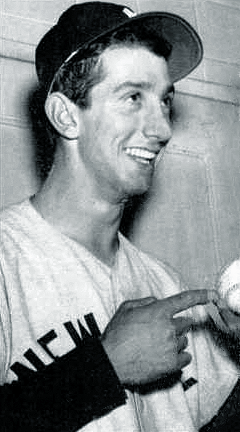
The Yankees won the pennant again in 1955, breaking open a close pennant race in September to take the American League. They played the Dodgers again in the World Series, which the Dodgers won in seven games. The Dodgers won Game 7, 2–0, behind the pitching of Johnny Podres and Stengel, after losing his first World Series as a manager, blamed himself for not instructing his hitters to bat more aggressively against Podres. Billy Martin stated, "It's a shame for a great manager like that to have to lose".[120]
In der American League gab es 1956 kaum einen spannenden Titelkampf, da die Yankees bereits ab der zweiten Saisonwoche die Führung übernahmen. Da die Tabellenführung des Teams von vornherein feststand, richtete sich die Aufmerksamkeit vor allem auf Mantles Schlagleistung. Er unternahm einen ernsthaften Versuch, Babe Ruths damaligen Rekord von 60 Home Runs in einer Saison zu brechen, beendete die Saison mit 52 und gewann die Triple Crown . Am 25. August, dem Old-Timers' Day , trafen sich Stengel und Weiss mit dem kaum eingesetzten Rizzuto, dem letzten der „McCarthy Yankees“, und entließen ihn, um Enos Slaughter verpflichten zu können . Rizzuto, der Stengel nie wohlgesonnen war, war über diese Entscheidung verbittert. [ 121 ] [ 122 ]
Der Gegner in der World Series jenes Jahres waren erneut die Dodgers, die die ersten beiden Spiele im Ebbets Field gewannen. Stengel hielt der Mannschaft vor Spiel 3 im Yankee Stadium eine Standpauke, woraufhin das Team sowohl dort als auch in Spiel 4 gewann. Für Spiel 5 setzte Stengel Don Larsen ein, der in Spiel 2 verletzt ausgewechselt worden war und mit einem Perfect Game antwortete – dem einzigen in der Geschichte der Major League Postseason. Die Dodgers gewannen Spiel 6, als die Serie ins Ebbets Field zurückkehrte. Viele erwarteten, dass Whitey Ford Spiel 7 starten würde, doch Stengel entschied sich für Johnny Kucks , der in dieser Saison 18 Spiele gewonnen hatte und in der Serie bereits zweimal als Relief Pitcher eingesetzt worden war. Kucks warf einen Three-Hit-Shutout, und die Yankees gewannen die Meisterschaft mit 9:0 – Stengels sechste als deren Manager. [ 123 ] [ 124 ]
Die New York Yankees hatten einen schwachen Start in die Saison 1957 und lagen Anfang Juni bereits sechs Spiele zurück. Zu diesem Zeitpunkt sorgte das Team auch abseits des Spielfelds für Schlagzeilen. Einige der Yankees waren dafür bekannt, bis spät in die Nacht zu feiern, was Stengel tolerierte, solange die Mannschaft gute Leistungen brachte. Die Schlägerei am 16. Mai im New Yorker Nachtclub Copacabana, an der Martin, Berra, Mantle, Ford, Hank Bauer und andere Yankees beteiligt waren, führte zur Verhaftung Bauers (die Anklage wegen Körperverletzung wurde später fallen gelassen) und strapazierte die Geduld des Managements mit Martin. Stengel stand Martin, der sehr stolz darauf war, ein Yankee zu sein, nahe, und Topping und Weiss bezogen den Manager nicht in die anschließenden Transferverhandlungen ein. Am 15. Juni wurde Martin zu den Kansas City Athletics transferiert . Martin schrieb in seiner Autobiografie, dass Stengel ihm nicht in die Augen sehen konnte, als der Manager ihm den Transfer mitteilte. Die beiden, einst enge Freunde, sprachen in den folgenden Jahren nur noch selten miteinander. [ 125 ]
The Yankees recovered from their slow start, winning the American League pennant by eight games. They faced the Milwaukee Braves in the 1957 World Series.[1] The Braves (Stengel had managed them when they played in Boston) defeated the Yankees in seven games, with Lew Burdette, who had been a Yankee until traded in 1950, beating New York three times. Stengel stated in an interview, "We're going to have Burditis on our minds next year".[126]
What was seen as a failure to keep discipline on the team hurt Stengel's standing with the Yankee owners, Topping, Weiss and Webb, as did the defeat in the 1957 Series. Stengel was by then aged 67 and had several times fallen asleep in the dugout, and players complained that he was growing more irritable with the years. Former Yankee catcher Ralph Houk, who had been successful as a minor league manager and was Stengel's first base coach, was seen by ownership as the next manager of the Yankees. Stengel's contract, his fifth two-year deal, was up after the 1958 season. As ownership debated whether to renew it, the Yankees led by as many as 17 games,[127] and won the pennant by 10.[1] The Braves were the opponent in the 1958 World Series. The Braves won three of the first four games, but the Yankees, backed by the pitching of Bob Turley (who got two wins and a save in the final three games) stormed back to win the Series. Firing Stengel under such circumstances was not possible, and ownership gave him another two-year contract, to expire after the 1960 season.[127]
Final years and firing (1959–1960)
The Yankees finished 79–75 in 1959, in third place, their worst record since 1925, as the White Sox, managed by Lopez, won the pennant. There was considerable criticism of Stengel, who was viewed as too old and out of touch with the players.[1][128] After the 1959 season, Weiss made a trade with Kansas City to bring Roger Maris to the Yankees. Stengel was delighted with the acquisition and batted Maris third in the lineup, just in front of Mantle, and the new Yankee responded with an MVP season in 1960.[129] Stengel had health issues during the season, spending ten days in the hospital in late May and early June, with the illness variously reported as a bladder infection, a virus or influenza.[130] The Yankees were challenged by the Baltimore Orioles for most of the year but won the pennant by eight games, Stengel's tenth as manager, tying the major league record held by McGraw.[131][132]
The Yankees played the Pittsburgh Pirates, again a team Stengel had played for, in the 1960 World Series. Stengel picked Art Ditmar, who had won the most games, 15, for the Yankees, as the Game 1 starter rather than the established star, Whitey Ford. The Pirates knocked Ditmar out of the box in the first inning, and won Game 1.[131][132] Ditmar was also knocked out of Game 5; Ford won Games 3 and 6 of the seven-game series with shutouts, but could not pitch Game 7, as he might have if Stengel had used him in Games 1 and 5. The Pirates defeated the Yankees in Game 7, 10–9, on a ninth-inning home run by Bill Mazeroski.[133][134]
I'll never make the mistake of being seventy again.
Shortly after the Yankees returned to New York, Stengel was informed by the team owners that he would not be given a new contract. His request, that the termination be announced at a press conference, was granted and on October 18, 1960, Topping and Stengel appeared before the microphones. After Topping evaded questions from the press about whether Stengel had been fired, Stengel took the microphone, and when asked if he had been fired, stated, "Quit, fired, whatever you please, I don't care". Topping stated that Stengel was being terminated because of his age, 70, and alleged that this would have happened even had the Yankees won the World Series.[136]
The Amazins': Casey and the Mets (1962–1965)
Hiring and 1962 season
Two days after dismissing Stengel, the Yankees announced the hiring of Houk as his replacement—part of the reason for Stengel's firing was so that New York would not lose Houk to another team. Stengel returned to Glendale, and spent the 1961 season out of baseball for the first time since 1937. He turned down several job offers to manage, from the Tigers, San Francisco Giants and the expansion Los Angeles Angels.[137] He spent the summer of 1961 as vice president of the Glendale Valley National Bank, which was owned by members of Edna Stengel's family.[1]
As part of baseball's expansion in the early 1960s, a franchise was awarded to New York, to play in the National League beginning in 1962, and to be known as the New York Mets. It was hoped that the new team would be supported by the many former Giant and Dodger fans left without a team when the franchises moved to California after the 1957 season. There were rumors through the 1961 season that Stengel would be the manager, but he initially showed no interest in managing a team that, given the rules for the expansion draft, was unlikely to be competitive. George Weiss had been forced out as Yankee general manager and hired by the Mets. He wanted Stengel as manager, and after talks with the Mets principal owners, Joan Whitney Payson and M. Donald Grant, Stengel was introduced as Mets manager at a press conference on October 2, 1961.[138]Leonard Koppett of The New York Times suggested that Stengel took the job to give something back to the game that had been his life for half a century.[139]
Look at that guy. He can't hit, he can't run, and he can't throw. Of course, that's why they gave him to us.
Weiss was convinced his scouting staff would make the Mets a respectable team in five to six years, but in the interim New York would most likely do poorly. He hoped to overcome the challenge of attracting supporters to a losing team in the "City of Winners" by drafting well-known players who would draw fans to the Polo Grounds, where the Mets would initially play. Thus, the Mets selected a number of over-the-hill National Leaguers, some of whom had played for the Dodgers or Giants, including Gil Hodges, Roger Craig, Don Zimmer and Frank Thomas. Selected before them all was journeyman catcher Hobie Landrith; as Stengel explained, "You have to have a catcher or you'll have a lot of passed balls".[141]
The return of Casey Stengel to spring training received considerable publicity, and when the Mets played the Yankees in an exhibition game, Stengel played his best pitchers while the Yankees treated it as a meaningless game, and the Mets won, 4–3. The team won nearly as many games as it lost in spring training, but Stengel warned, "I ain't fooled. They play different when the other side is trying too".[142] The Mets lost their first nine games of the regular season; in the meantime the Pirates were 10–0, meaning the Mets were already 91⁄2 games out of first place. Some light appeared in May, when the Mets won 11 of 18 games to reach eighth place in the ten-team league. They then lost 17 in a row, returning to last place, where they would spend the remainder of the season.[143]
According to sportswriter Joseph Durso
on days when [Stengel's] amazing Mets were, for some reason, amazing, he simply sat back and let the writers swarm over the heroes of the diamond. On days when the Mets were less than amazing—and there were many more days like that—he stepped into the vacuum and diverted the writers' attention, and typewriters, to his own flamboyance ... the perfect link with the public was formed, and it grew stronger as the team grew zanier.[144]
The Mets appealed to the younger generation of fans and became an alternative to the stuffy Yankees. As the losing continued, a particular fan favorite was "Marvelous" Marv Throneberry, who was a "lightning-rod for disaster" in the 1962 season, striking out to kill rallies, or dropping pop flies and routine throws to first base.[145] During one game, Throneberry hit a massive shot to right, winding up on third base, only to be called out for missing first. Stengel came from the dugout to argue, only to be told that Throneberry had missed second base as well.[146]
Can't anyone play this here game?
Stengel tried incessantly to promote the Mets, talking to reporters or anyone else who would listen. He often used the word "amazin'" (as he put it) and soon this became the "Amazin' Mets", a nickname that stuck. Stengel urged the fans, "Come out and see my amazin' Mets. I been in this game a hundred years but I see new ways to lose I never knew existed before".[148] Stengel was successful in selling the team to some extent, as the Mets drew 900,000 fans, half again as many as the Giants had prior to their departure, though the games against the Giants and Dodgers accounted for half of the total. The team was less successful on the field, finishing with a record of 40–120, the most losses of any 20th century major league team.[149] They finished 601⁄2 games behind the pennant-winning Giants, and 18 games behind ninth-place Chicago.[150]
Later seasons and retirement (1963–1965)

The 1963 season unfolded for the Mets much like the previous year's, though they lost only eight games to begin the season, rather than nine, but they still finished 51–111, in last place. One highlight, though it did not count in the standings, was the Mayor's Trophy Game on June 20 at Yankee Stadium. Stengel played to win; the Yankees under Houk possibly less so, and the Mets beat the Yankees, 6–2.[151]
1964 zogen die Mets ins neue Shea Stadium um ; Stengel bemerkte dazu: „Der Park ist schöner als meine Mannschaft.“ [ 152 ] Die Mets beendeten die Saison mit einer Bilanz von 53 Siegen und 109 Niederlagen und landeten erneut auf dem letzten Platz. Die Fans wurden langsam ungeduldig mit den Niederlagen, und einige, darunter der Sportreporter Howard Cosell und der ehemalige Dodger Jackie Robinson, kritisierten Stengel als ineffektiv und warf ihm vor, auf der Bank einzuschlafen. Stengel erhielt einen Vertrag für 1965, obwohl Creamer vermutete, dass Weiss, Grant und Payson es vorgezogen hätten, wenn der 74-jährige Stengel seine Karriere beendet hätte. [ 153 ]
Und da ist dieser tolle junge Catcher namens Goossen , der erst zwanzig Jahre alt ist und in zehn Jahren die Chance hat, dreißig zu sein.
Der Beginn der Saison 1965 verlief ähnlich erfolglos. Am 25. Juli veranstalteten die Mets in Toots Shor's eine Party für die Gäste des Old-Timers' Game am folgenden Tag. Irgendwann an diesem Abend stürzte Stengel von einem Barhocker und brach sich die Hüfte. Die genauen Umstände seines Sturzes sind nicht bekannt, da er erst am nächsten Tag bemerkte, wie schwer er verletzt war. Stengel verbrachte seinen 75. Geburtstag im Krankenhaus. Da er wusste, dass eine umfangreiche Rehabilitation nötig sein würde, trat er am 30. August als Manager der Mets zurück. Sein Nachfolger wurde Wes Westrum , einer seiner Trainer. Die Mets belegten erneut den letzten Platz. [ 155 ]
Spätere Jahre und Tod

The Mets retired Stengel's uniform number, 37, on September 2, 1965, after which he returned to his home in California. He was kept on the team payroll as a vice president, but for all intents and purposes he was out of baseball. His life settled into a routine of attending the World Series (especially when in California), the All-Star Game, Mets spring training, and the baseball writers' dinner in New York. The writers, who elect members of baseball's Hall of Fame, considered it unjust that Stengel should have to wait the usual five years after retirement for election, and waived that rule. On March 8, 1966, at a surprise ceremony at the Mets spring training site in St. Petersburg, Stengel was told of his election; he was inducted in July along with Ted Williams. Thereafter, he added the annual Hall of Fame induction ceremony to his schedule.[156] In 1969, the "Amazin' Mets" justified their nickname by unexpectedly winning the World Series over the favored Orioles. Stengel attended the Series, threw out the first ball for Game 3 at Shea, and visited the clubhouse after the Mets triumphed in Game 5 to win the Series.[157] The Mets presented him with a championship ring.[158]
Most people my age are dead at the present time.
Stengel also participated in Old-Timers' Day at a number of ballparks, including, regularly, Shea Stadium.[159] In 1970, the Yankees invited him to Old-Timers' Day, at which his number, 37, was to be retired. By this time, the Yankee ownership had changed, and the people responsible for his dismissal were no longer with the team. He accepted and attended, and Stengel became the fifth Yankee to have his number retired. He thereafter became a regular at the Yankees' Old-Timers' Day.[160]
By 1971, Edna Stengel was showing signs of Alzheimer's disease,[161] and in 1973, following a stroke, she was moved into a nursing home.[1] Casey Stengel continued to live in his Glendale home with the help of his housekeeper June Bowdin. Stengel himself showed signs of senility in his last years, and during the final year of his life, these increased.[162] In his last year, Stengel cut back on his travel schedule, and was too ill to attend the Yankees' Old-Timers Day game in August 1975, at which it was announced that Billy Martin would be the new team manager.[163] A diagnosis of cancer of the lymph glands had been made, and Stengel realized he was dying. In mid-September, he was admitted to Glendale Memorial Hospital, but the cancer was inoperable. He died there on September 29, 1975. Stengel was interred in the Forest Lawn Memorial Park Cemetery in Glendale.[164]
The tributes to Stengel upon his death were many. Maury Allen wrote, "He is gone and I am supposed to cry, but I laugh. Every time I saw the man, every time I heard his voice, every time his name was mentioned, the creases in my mouth would give way and a smile would come to my face".[165]Richie Ashburn, a member of the 1962 Mets, stated, "Don't shed any tears for Casey. He wouldn't want you to ... He was the happiest man I've ever seen".[165]Jim Murray of the Los Angeles Times wrote, "God is certainly getting an earful tonight".[166]
Edna Stengel died in 1978,[167] and was interred next to her husband. In addition to the marker at their graves in Forest Lawn Cemetery, there is a plaque nearby in tribute to Casey Stengel, which besides biographical information contains a bit of Stengelese: "There comes a time in every man's life, and I've had plenty of them".[166]
Managerial record
| Team | Year | Regular season | Postseason[168] | |||||||
|---|---|---|---|---|---|---|---|---|---|---|
| Games | Won | Lost | Win % | Finish | Won | Lost | Win % | Result | ||
| BKN | 1934 | 152 | 71 | 81 | .467 | 6th in NL | – | – | – | – |
| BKN | 1935 | 153 | 70 | 83 | .458 | 5th in NL | – | – | – | – |
| BKN | 1936 | 154 | 67 | 87 | .435 | 7th in NL | – | – | – | – |
| BKN total | 459 | 208 | 251 | .453 | 0 | 0 | – | |||
| BOB | 1938 | 152 | 77 | 75 | .507 | 5th in NL | – | – | – | – |
| BOB | 1939 | 151 | 63 | 88 | .417 | 7th in NL | – | – | – | – |
| BOB | 1940 | 152 | 65 | 87 | .428 | 7th in NL | – | – | – | – |
| BOB | 1941 | 154 | 62 | 92 | .403 | 7th in NL | – | – | – | – |
| BOB | 1942 | 148 | 59 | 89 | .399 | 7th in NL | – | – | – | – |
| BOB | 1943 | 107 | 47 | 60 | .439 | 6th in NL | – | – | – | – |
| BOB total | 864 | 373 | 491 | .432 | 0 | 0 | – | |||
| NYY | 1949 | 154 | 97 | 57 | .630 | 1st in AL | 4 | 1 | .800 | Won World Series (BKN) |
| NYY | 1950 | 154 | 98 | 56 | .636 | 1st in AL | 4 | 0 | 1.000 | Won World Series (PHI) |
| NYY | 1951 | 154 | 98 | 56 | .636 | 1st in AL | 4 | 2 | .667 | Won World Series (NYG) |
| NYY | 1952 | 154 | 95 | 59 | .617 | 1st in AL | 4 | 3 | .571 | Won World Series (BKN) |
| NYY | 1953 | 151 | 99 | 52 | .656 | 1st in AL | 4 | 2 | .667 | Won World Series (BKN) |
| NYY | 1954 | 154 | 103 | 51 | .669 | 2nd in AL | – | – | – | – |
| NYY | 1955 | 154 | 96 | 58 | .623 | 1st in AL | 3 | 4 | .429 | Lost World Series (BKN) |
| NYY | 1956 | 154 | 97 | 57 | .630 | 1st in AL | 4 | 3 | .571 | Won World Series (BKN) |
| NYY | 1957 | 154 | 98 | 56 | .636 | 1st in AL | 3 | 4 | .429 | Lost World Series (MIL) |
| NYY | 1958 | 154 | 92 | 62 | .597 | 1st in AL | 4 | 3 | .571 | Won World Series (MIL) |
| NYY | 1959 | 154 | 79 | 75 | .513 | 3rd in AL | – | – | – | – |
| NYY | 1960 | 154 | 97 | 57 | .630 | 1st in AL | 3 | 4 | .429 | Lost World Series (PIT) |
| NYY total | 1845 | 1149 | 696 | .623 | 37 | 26 | .587 | |||
| NYM | 1962 | 160 | 40 | 120 | .250 | 10th in NL | – | – | – | – |
| NYM | 1963 | 162 | 51 | 111 | .315 | 10th in NL | – | – | – | – |
| NYM | 1964 | 162 | 53 | 109 | .327 | 10th in NL | – | – | – | – |
| NYM | 1965 | 95 | 31 | 64 | .326 | retired | – | – | – | – |
| NYM total | 579 | 175 | 404 | .302 | 0 | 0 | – | |||
| Total[168] | 3747 | 1905 | 1842 | .508 | 37 | 26 | .587 | |||
Awards and honors
You could look it up.


As part of professional baseball's centennial celebrations in 1969, Stengel was voted its "Greatest Living Manager".[170] He had his uniform number, 37, retired by both the Yankees and the Mets. He is the first man in MLB history to have had his number retired by more than one team based solely upon his managerial accomplishments, and was joined in that feat in 2011 by the late Sparky Anderson, who had called Stengel "the greatest man" in the history of baseball.[171][172] The Yankees dedicated a plaque in Yankee Stadium's Monument Park in Stengel's memory on July 30, 1976, reading: "Brightened baseball for over 50 years; with spirit of eternal youth; Yankee manager 1949–1960 winning 10 pennants and 7 world championships including a record 5 consecutive, 1949–1953".[167] He was inducted into the New York Mets Hall of Fame in 1981.[173]
Stengel is the only man to have worn the uniform (as player or manager) of all four Major League Baseball teams in New York City in the 20th century: the Dodgers, Giants, Yankees and Mets.[174] He is the only person to have played or managed for the home team in five New York City major league venues: Washington Park, Ebbets Field, the Polo Grounds, Shea Stadium and the original Yankee Stadium.[175] In 2009, in an awards segment on the MLB Network titled "The Prime 9", he was named "The Greatest Character of The Game", beating out Yogi Berra.[176]
Managerial techniques
Stengel re-invigorated platooning in baseball. Most of Stengel's playing days were after offensive platooning, choosing left-handed batters against a right-handed pitcher and the converse, was used successfully by the World Series champion 1914 Boston "Miracle" Braves. This set off widespread use of platooning: Stengel himself was several times during his playing career platooned against right-handers, but the practice fell into disuse around 1930. Stengel reintroduced it to the Yankees, and its prominent use amid the team's success caused it to be imitated by other teams.[177][178][179]Bill James deemed Stengel and Earl Weaver the most successful platoon managers.[180]
Diese strategische Auswahl galt auch für die Pitcher, da Stengel sein Pitcher-Team optimal nutzte und seine besten Werfer gegen die stärksten Gegner einsetzte. Obwohl Stengel vor allem für diese Vorgehensweise bei den Yankees bekannt ist, wandte er sie auch während seiner Zeit als Manager von Brooklyn und Boston sowie in geringerem Umfang bei den Mets an. [ 181 ] Anstatt eine feste Pitcherrotation zu etablieren, um die Anzahl der Starts eines Werfers zu maximieren, gönnte Stengel seinen Werfern oft längere Pausen, um sich situative Vorteile zunutze zu machen. So setzte Stengel beispielsweise Eddie Lopat gegen Cleveland ein, wann immer es möglich war, da dieser regelmäßig gegen sie gewann. Stengels Yankees von 1954 wiesen den höchsten Leverage Points Average (Leverage Points Average) aller Baseballteams des 20. Jahrhunderts auf (gemessen anhand der Sabermetrics- Statistik). Die Strategie, die Pitcher nach dem Prinzip der „Leverage“ auszuwählen, wurde unbeliebt, nachdem sich dies für Lopez in der World Series 1959 und für Stengel im darauffolgenden Jahr als Fehler erwiesen hatte. Stengel wartete bis zum dritten Spiel, um Whitey Ford einzusetzen, da er glaubte, Ford würde im Yankee Stadium effektiver sein als im kleinen Forbes Field . Ford warf zwei Shutouts, darunter Spiel 6 im Forbes Field, konnte aber im siebten Spiel, das die Yankees verloren, nicht mehr eingesetzt werden. Stengels Philosophie erlitt 1961 einen weiteren Rückschlag, als Houk Ford in die reguläre Rotation aufnahm und der Pitcher eine Bilanz von 25 Siegen und 4 Niederlagen erzielte und den Cy Young Award gewann – unter Stengel hatte er nie 20 Spiele gewonnen. Heutzutage bevorzugen die Teams größtenteils eine reguläre Rotation. [ 182 ]
James bemerkte, dass Stengel nicht nur der erfolgreichste Manager der 1950er Jahre war, sondern der dominanteste Manager eines ganzen Jahrzehnts in der Geschichte des Baseballs. [ 183 ] Im Gegensatz zu anderen Teams zu Beginn seiner Amtszeit, bei denen Ersatzspieler meist wenig Spielzeit erhielten, setzte Stengel als Manager der Yankees seine gesamte Mannschaft ein. Durch Stengels Platooning-Strategie kamen mehr Spieler häufiger zum Einsatz, und er wechselte generell häufiger einen Pinch Hitter ein oder wechselte seinen Pitcher aus als andere Manager. Obwohl die Yankees während Stengels Amtszeit nur einmal (1954) die Liga in der Anzahl der Pinch Hitter anführten, war Stengel dafür bekannt, sie in ungewöhnlichen Situationen einzusetzen, beispielsweise als er im ersten Inning nach einem Pitcherwechsel Moose Skowron als Pinch Hitter ersetzte. Laut James rotierte Stengel außerdem „mit großer Leidenschaft die Aufstellungen und verwendete in einer Saison mit 154 Spielen möglicherweise 70 bis 100 verschiedene Aufstellungen“. [ 184 ] Obwohl Stengel nicht der erste Manager der Yankees war, der einen regulären Relief Pitcher einsetzte – Harris hatte 1947 mit Joe Page Erfolge erzielt –, trug seine Übernahme dieses Konzepts wesentlich zu dessen Verbreitung bei. [ 185 ]
Stengel rotierte die Infieldspieler häufig zwischen verschiedenen Positionen, sodass die Yankees zwischen 1954 und 1958 keinen wirklich festen Second Baseman oder Shortstop hatten. Trotzdem verfügten die Yankees über eine durchweg starke Defensiv-Infield. Stengel legte großen Wert auf das Double Play , sowohl in der Defensive als auch bei der Aufstellungsplanung. Die Yankees reagierten darauf, indem sie in seiner zwölfjährigen Amtszeit sechsmal die Liga in Double Plays als Defensive anführten und die Schlagmänner in dieser Ära achtmal die wenigsten Double Plays als Team zuließen. [ 186 ] Da Stengel als Manager von Brooklyn und Boston nur wenige Spieler hatte, auf die er sich verlassen konnte, behandelte er seinen Yankee-Kader ohne viel Sentimentalität und tauschte Spieler schnell aus, wenn ihre Leistung nachzulassen schien, ungeachtet ihrer früheren Erfolge. Da er sich der guten Ersatzspieler sicher sein konnte, die von der Yankee-Führung verpflichtet wurden, funktionierte diese Taktik gut. Bei den Mets hingegen, wo keine guten Ersatzspieler verfügbar waren, war sie nicht erfolgreich und führte zu Verwirrung und Apathie unter den Spielern. [ 187 ]
Bewertung
Das Geheimnis des Managements besteht darin, die fünf Jungs, die dich hassen, von den Unentschlossenen fernzuhalten.
Marty Appel schrieb über Stengel: „Er war kein Mann für alle Jahreszeiten; er war ein Mann für Baseball-Saisons.“ [ 189 ] Stengel ist bis heute der einzige Manager, der sein Team zu fünf aufeinanderfolgenden World Series-Siegen führte. [ 190 ] Wie viel Anerkennung ihm für diese Leistung gebührt, ist umstritten, angesichts des Talents der von ihm trainierten Yankee-Teams. Total Baseball kam zu dem Schluss, dass die Yankees in Stengels Ära, gemessen an der Anzahl der erzielten und kassierten Runs, nur sechs Spiele mehr gewannen als erwartet. [ 1 ] Laut Bak hieß es: „Selbst unter einigen Yankees war die Ansicht, dass das Team so gut war, dass jeder es zum Titel hätte führen können.“ [ 191 ] Rizzuto erklärte: „Sie oder ich hätten das Team trainieren und über den Sommer verreisen können und trotzdem diese Meisterschaften gewonnen.“ [ 192 ] Appel bemerkte: „Es stand außer Frage, dass er mit der Annahme des Trainerpostens bei den Mets seinem Ruf als Manager geschadet hat. Wieder einmal zeigte sich, dass er mit guten Spielern ein guter Manager war, mit schlechten Spielern jedoch nicht. Dennoch hatten ihn seine Jahre bei den Yankees in Bezug auf gewonnene Spiele, Meisterschaften usw. so weit oben auf die Liste gebracht, dass er in Gesprächen über die größten Manager immer wieder Erwähnung finden wird.“ [ 193 ]

Bill Veeck said of Stengel in 1966, soon after the manager's retirement, "He was never necessarily the greatest of managers, but any time he had a ball club that had a chance to win, he'd win".[194] Stengel's American League rival, Al Lopez, once said of him "I swear I don't understand some of the things he does when he manages".[195] Though platooning survives, Stengel's intuitive approach to managing is no longer current in baseball, replaced by the use of statistics, and the advent of instant replay makes obsolete Stengel's tendency to charge from the dugout to confront an umpire over a disputed call.[196]
Stengel has been praised for his role in successfully launching the Mets. Appel deemed the Mets' beginnings unique, as later expansion teams have been given better players to begin with, "few expansion teams in any sport have tried the formula—a quotable, fan-popular man who would charm the press and deflect attention away from ineptness on the field".[158]Arthur Daley of The New York Times wrote, "he gave the Mets the momentum they needed when they needed it most. He was the booster that got them off the ground and on their journey. The smoke screen he generated to accompany the blast-off obscured the flaws and gave the Mets an acceptance and a following they could not have obtained without him".[197] James wrote, "Stengel became such a giant character that you really can't talk about him in the past. He became an enduring part of the game".[198] Commissioner William Eckert said of Stengel, "he's probably done more for baseball than anyone".[197]
A child of the Jim Crow era, and from a border state (Missouri) with southern characteristics, Stengel has sometimes been accused of being a racist, for example by Roy Campanella Jr., who stated that Stengel made racist remarks from the dugout during the World Series towards his father Roy Campanella, Jackie Robinson and other black stars of the Dodgers. Bak noted, though, that Stengel was a "vicious and inventive" bench jockey, hazing the other team with whatever might throw off their performance.[199] Stengel had poor relations with Robinson; each disliked the other and was a vocal critic.[200] One widely quoted Stengel comment was about catcher Elston Howard, who became the first black Yankee in 1955, eight years after Robinson had broken the color barrier, "they finally get me a nigger, I get the only one who can't run".[201] Howard, though, denied that Stengel had shouted racial epithets at the Dodgers, and said "I never felt any prejudice around Casey".[202]Al Jackson, a black pitcher with the Mets under Stengel, concurred, "He never treated me with anything but respect".[203] According to Bill Bishop in his account of Stengel, "Casey did use language that would certainly be considered offensive today, but was quite common vernacular in the fifties. He was effusive in his praise of black players like Satchel Paige, Larry Doby and Howard".[1] Conscious of changing times, Stengel was more careful in his choice of words while with the Mets.[204]

Stengel was sometimes considered thoughtless or even cruel towards his players.[205] Examples of this include his playing Joe DiMaggio at first base,[206] and sometimes batting Phil Rizzuto ninth, behind the pitcher, as well as his dismissal of the shortshop on Old-Timers' Day in 1956.[122] In spite of their falling out over the 1957 trade, Billy Martin, by then manager of the Yankees, wore a black armband in remembrance of Stengel during the 1976 season, the sole Yankee to do so.[167] According to Creamer, "It doesn't seem to be stretching the point too far to say that Ned Hanlon begat John McGraw who begat Casey Stengel who begat Billy Martin".[207]
Sportswriter Leonard Koppett wrote of Stengel in The New York Times:
He didn't always succeed, but he didn't always fail, either. That is why his deepest feelings in all his years as manager of the Yankees and Mets have been involved in "leaving something behind". With the Yankees, already successful, it was a desire to "rebuild", with the Mets, it was a desire to build from nothing.[197]
Books
- Casey Stengel and Harry T. Paxton (1962). Casey at the Bat: The Story of My Life in Baseball. New York: Random House. LCCN 62--8465. OCLC 1346711.
See also
- List of Major League Baseball managerial wins and winning percentage leaders
- List of Major League Baseball managers with most career ejections
References
Numbers for the James books and for Jaffe indicate Kindle locations.
- ^ abcdefghijklmnopqrstuvwBishop, Bill. "Casey Stengel". Society for American Baseball Research. Archived from the original on August 31, 2017. Retrieved October 3, 2017.
- ^Creamer, pp. 20–24.
- ^Appel 2017, p. 15.
- ^Creamer, pp. 32–33.
- ^Bak, pp. 8–9.
- ^Creamer, pp. 40–41.
- ^Holmes, Tommy (May 11, 1960). "It's a Long Way Back to Kankakee". Toledo Blade. p. 15. Archived from the original on April 8, 2022. Retrieved October 11, 2017.
- ^Appel 2017, p. 25.
- ^Bak, p. 1.
- ^Appel 2017, pp. 25–29.
- ^Appel 2017, p. 29.
- ^Bak, p. 22.
- ^Creamer, pp. 56–57.
- ^James 1997, 5248.
- ^Jerpe, James (September 18, 1912). "Nap Rucker Holds Pirates in Check and the Winning Streak is Broken". The Gazette Times. p. 10. Archived from the original on April 8, 2022. Retrieved February 1, 2019.
- ^Jerpe, James (September 18, 1912). "On and Off the Field". The Gazette Times. p. 10. Archived from the original on April 8, 2022. Retrieved February 1, 2019.
- ^Creamer, pp. 63–65.
- ^Appel 2017, pp. 36–39.
- ^Lieb, p. 278.
- ^Durso, pp. 227, 230.
- ^Creamer, p. 74.
- ^Creamer, pp. 74–81.
- ^Appel 2017, p. 41.
- ^Creamer, p. 81.
- ^Creamer, pp. 86–88.
- ^Creamer, p. 105.
- ^ abBak, p. 29.
- ^Bak, p. 30.
- ^Creamer, pp. 112–113.
- ^Creamer, pp. 116–120.
- ^Bak, pp. 30–32.
- ^Appel 2017, p. 58.
- ^Appel 2017, pp. 59–60.
- ^Durso, p. 209.
- ^Appel 2017, p. 60.
- ^James 1997, 2192.
- ^Durso, p. 237.
- ^Creamer, pp. 128–129.
- ^Creamer, pp. 129–130.
- ^Creamer, pp. 129–134.
- ^Bak, p. 37.
- ^Durso, p. 240.
- ^ abBak, p. 40.
- ^Creamer, p. 138.
- ^Appel 2017, p. 67.
- ^Durso, pp. 240–241.
- ^Appel 2017, p. 68.
- ^Bak, p. 41.
- ^ abBak, p. 42.
- ^Creamer, pp. 148–149.
- ^Creamer, pp. 151–153.
- ^Creamer, pp. 153–158.
- ^Appel 2017, pp. 79–80.
- ^ abAppel 2012, p. 137.
- ^Appel 2012, p. 138.
- ^ abcAppel 2017, p. 83.
- ^Bak, pp. 57–60.
- ^Appel 2017, p. 89.
- ^ abcAppel 2017, p. 93.
- ^Appel 2017, pp. 91–92.
- ^Appel 2017, pp. 93–94.
- ^Creamer, pp. 173–174.
- ^Creamer, p. 178.
- ^Bak, p. 61.
- ^Durso, pp. 264–265.
- ^ abCreamer, pp. 176–178.
- ^Appel 2017, pp. 100–101.
- ^Appel 2017, p. 104.
- ^ abBak, p. 79.
- ^Bak, p. 71.
- ^Appel 2017, p. 107.
- ^Appel 2017, pp. 107–109.
- ^Bak, pp. 77–78.
- ^Creamer, pp. 186, 189.
- ^Durso, pp. 276–279.
- ^ abAppel 2017, pp. 124–126.
- ^Appel 2017, pp. 128–134.
- ^Appel 2017, pp. 256–257.
- ^Appel 2017, pp. 134–136.
- ^Creamer, p. 204.
- ^Bak, p. 88.
- ^Appel 2017, pp. 136–140.
- ^Appel 2017, pp. 140–144.
- ^Bak, p. 95.
- ^Bak, p. 90.
- ^ abAppel 2012, pp. 271–272.
- ^Creamer, pp. 209–210.
- ^Creamer, pp. 210–211.
- ^ abAppel 2012, p. 273.
- ^Creamer, pp. 310–311.
- ^Appel 2017, pp. 152–153.
- ^Bak, pp. 93–97.
- ^Bak, pp. 97–98.
- ^Appel 2017, p. 165.
- ^Creamer, pp. 228–232.
- ^Bak, pp. 100–102.
- ^Appel 2017, pp. 167–168.
- ^Creamer, pp. 236–240.
- ^Appel 2017, p. 186.
- ^Appel 2017, pp. 171–172.
- ^Appel 2017, p. 180.
- ^Bak, pp. 109–111.
- ^Bak, p. 114.
- ^ abCreamer, pp. 248–249.
- ^Appel 2012, p. 292.
- ^Bak, pp. 114–115.
- ^Appel 2017, p. 192.
- ^ abCreamer, pp. 250–251.
- ^Appel 2017, pp. 195–197.
- ^ abAppel 2012, p. 296.
- ^Appel 2017, pp. 197–198.
- ^Creamer, pp. 253–254.
- ^ abDurso, p. 318.
- ^Bak, pp. 117–118.
- ^Appel 2017, p. 216.
- ^Creamer, p. 261.
- ^Bak, pp. 131–132.
- ^Creamer, pp. 261–262.
- ^Bak, p. 131.
- ^Appel 2017, pp. 226–228.
- ^Appel 2012, pp. 312–313.
- ^ abAppel 2017, pp. 232–235.
- ^Appel 2012, pp. 314–316.
- ^Appel 2017, pp. 236–238.
- ^Appel 2017, pp. 242–246.
- ^Appel 2017, pp. 252–253.
- ^ abBak, pp. 148–149.
- ^Durso, pp. 323–324.
- ^Bak, pp. 149–150.
- ^Appel 2017, p. 267.
- ^ abAppel 2012, pp. 331–333.
- ^ abAppel 2017, p. 270.
- ^Appel 2017, pp. 270–271.
- ^Creamer, p. 289.
- ^Bak, p. 153.
- ^Appel 2017, pp. 275–276.
- ^Appel 2017, pp. 278–280.
- ^Appel 2017, pp. 283–285.
- ^Appel 2017, p. 291.
- ^Bak, p. 159.
- ^Creamer, pp. 296–298.
- ^Creamer, p. 298.
- ^Bak, pp. 160–161.
- ^Durso, pp. 339–340.
- ^Bak, pp. 161–165.
- ^Bak, p. 165.
- ^Creamer, p. 299.
- ^Creamer, p. 302.
- ^Creamer, pp. 302–303.
- ^Bak, pp. 164–165.
- ^Appel 2017, pp. 307–311.
- ^Creamer, p. 305.
- ^Creamer, pp. 305–309.
- ^Bak, p. 179.
- ^Creamer, pp. 309–312.
- ^Creamer, pp. 313–316.
- ^Appel 2017, pp. 343–344.
- ^ abcAppel 2017, p. 361.
- ^Appel 2017, pp. 338, 341.
- ^Appel 2017, pp. 344–348.
- ^Appel 2017, p. 346.
- ^Bak, pp. 174–175.
- ^Appel 2017, p. 351.
- ^Bak, pp. 175, 179.
- ^ abAppel 2017, p. 354.
- ^ abBak, p. 178.
- ^ abcAppel 2017, p. 358.
- ^ ab"Casey Stengel". Baseball Reference. Sports Reference. Archived from the original on September 24, 2015. Retrieved September 27, 2015.
- ^Bak, pp. 173–174.
- ^Bak, p. 174.
- ^"The Greatest Man in Baseball?' Here's A Vote for Stengel". Los Angeles Times. UPI. August 11, 1985. Archived from the original on August 6, 2016. Retrieved September 4, 2017.
- ^"Shaq and 31 More Athletes with Numbers Retired by Multiple Teams". Fox Sports. February 12, 2016. Archived from the original on December 23, 2016. Retrieved September 4, 2017.
- ^"Mets Hall of Fame". New York Mets. Archived from the original on September 9, 2017. Retrieved September 4, 2017.
- ^Corio, Ray (April 6, 1987). "Question Box". The New York Times. Archived from the original on September 4, 2017. Retrieved September 4, 2017.
- ^Appel 2017, p. 313.
- ^Appel 2017, pp. 1–2.
- ^Jaffe, 1087.
- ^James 2001, 3057.
- ^James 1997, 2197.
- ^James 2001, 3059.
- ^Jaffe, 3604, 3629.
- ^Jaffe, 1087–1131.
- ^James 1997, 3182.
- ^James 1997, 3256–3320.
- ^Jaffe, 3594–3598.
- ^James 1997, 3337–3376.
- ^Jaffe, 3580–3590.
- ^Appel 2017, p. 258.
- ^Appel 2017, p. 349.
- ^Appel 2017, p. 1.
- ^Bak, p. 105.
- ^Creamer, p. 236.
- ^Appel 2017, p. 326.
- ^Durso, p. 265.
- ^Creamer, p. 315.
- ^Appel 2017, p. 364.
- ^ abcDurso, p. 361.
- ^James 1997, 3376.
- ^Bak, p. 139.
- ^Creamer, pp. 282–284.
- ^Bak, pp. 139–141.
- ^Creamer, p. 283.
- ^Creamer, p. 284.
- ^Bak, p. 142.
- ^Creamer, pp. 12–13.
- ^Creamer, p. 237.
- ^Creamer, p. 142.
Bibliography
- Appel, Marty (2012). Pinstripe Empire: The New York Yankees From Before the Babe to After the Boss. New York: Bloomsbury USA. ISBN 978-1-60819-492-6.
- Appel, Marty (2017). Casey Stengel: Baseball's Greatest Character (Kindle ed.). New York: Doubleday. ISBN 978-0-385-54048-3.
- Bak, Richard (1997). Casey Stengel: A Splendid Baseball Life. Dallas, Texas: Taylor Publishing Company. ISBN 978-0-87833-929-7.
- Creamer, Robert W. (1996) [1984]. Stengel: His Life and Times (First Bison Books ed.). Lincoln, Nebraska: University of Nebraska Press. ISBN 978-0-8032-6367-3.
- Durso, Joseph (1989). Casey & Mr. McGraw. St. Louis, Missouri: The Sporting News. ISBN 978-0-89204-307-1.
- Jaffe, Chris (2010). Evaluating Baseball's Managers (Kindle ed.). Jefferson, North Carolina: McFarland & Co.ISBN 978-0-7864-3920-1.
- James, Bill (1997). The Bill James Guide to Baseball Managers from 1870 to Today (Kindle ed.). New York: Diversion Books. ISBN 978-1-62681-263-5.
- James, Bill (2001). The New Bill James Historical Baseball Abstract (Paperback (Kindle) ed.). New York: Free Press. ISBN 978-1-4391-0693-8.
- Lieb, Fred (1977). Baseball as I Have Known It. New York: Grosset & Dunlap. ISBN 978-0-448-17302-3.
External links
- Career statistics from MLB · ESPN · Baseball Reference · Fangraphs · Baseball Reference (Minors) · Retrosheet · Baseball Almanac
- Casey Stengel managerial career statistics at Baseball-Reference.com
- Casey Stengel at the Baseball Hall of Fame
- Casey Stengel at the SABR Baseball Biography Project
- Casey Stengel at IMDb
- Casey Stengel discography at Discogs
- Charles Dillon "Casey" Stengel interviewed with New York City Mayor Robert F. Wagner, Jr. on the occasion of Stengel's 75th birthday celebration at City Hall, July 22, 1965 as broadcast on WNYC Radio.


