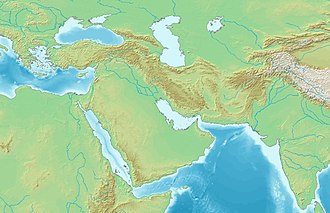
Zentralasien besteht aus fünf ehemaligen Sowjetrepubliken : Kasachstan , Kirgisistan , Turkmenistan , Tadschikistan und Usbekistan mit einer Gesamtbevölkerung von etwa 76 Millionen. [ 1 ] [ 2 ] Afghanistan wird nicht immer zu dieser Region gezählt, aber wenn doch, hat Zentralasien eine Gesamtbevölkerung von etwa 122 Millionen (2016). Auch die Mongolei und Xinjiang (Teil Chinas ) werden aufgrund ihrer zentralasiatischen kulturellen Verbindungen und Traditionen mitunter zu Zentralasien gezählt, obwohl sie geografisch zu Ostasien gehören. [ 1 ] [ 2 ] Die meisten Zentralasiaten gehören Religionen an, die in den letzten 1500 Jahren in die Region eingeführt wurden, wie beispielsweise dem sunnitischen , schiitischen , ismailitischen , tengristischen und syrischen Christentum (vorwiegend ostsyrischen ). [ 3 ] Der Buddhismus wurde jedoch vor über 2.200 Jahren in Zentralasien eingeführt, der Zoroastrismus vor über 2.500 Jahren. [ 4 ]
Ethnische Gruppen
Nachfolgend finden Sie demografische Daten zu den ethnischen Gruppen in Zentralasien . [ 3 ]
Genetische Geschichte

Eine Analyse der mütterlichen DNA-Linien skythisch-sibirischer Vorfahren aus menschlichen Überresten der Eisenzeit im Altai-Gebiet ergab Hinweise auf eine Vermischung westeurasischer und ostasiatischer mütterlicher Linien. [ 18 ] Vor der Eisenzeit waren alle alten mütterlichen Linien im Altai-Gebiet westeurasischen Ursprungs. Funde aus der Eisenzeit zeigen jedoch, dass die westeurasischen Linien um 50 % abnahmen und die ostasiatischen Linien um 50 % zunahmen. [ 19 ] [ 20 ] Die Autoren vermuten, dass der Anstieg der ostasiatischen mtDNA-Linien wahrscheinlich in der skythischen Periode der Eisenzeit stattfand . [ 21 ]
Die Abstammung der heutigen zentralasiatischen Bevölkerungsgruppen stammt maßgeblich von späteren indo-iranischen und türkischen Bevölkerungsgruppen ab. [ 22 ]
Eine im Mai 2018 in Nature veröffentlichte Genstudie untersuchte die Überreste von vier Elitesoldaten der türkischen Armee, die zwischen ca. 300 und 700 n. Chr. bestattet wurden. [ 23 ] 50 % der Y-DNA- Proben gehörten zur westeurasischen Haplogruppe R1 , die anderen 50 % zu den ostasiatischen Haplogruppen Q und O. [ 24 ] Die extrahierten mtDNA -Proben gehörten hauptsächlich zu den ostasiatischen Haplogruppen C4b1 , A14 und A15c , während ein Exemplar die westeurasische Haplogruppe H2a trug . [ 25 ] Die Autoren vermuteten , dass zentralasiatische Nomadenbevölkerungen durch eine ostasiatische Elite turkisiert worden sein könnten, was zu einem geringen, aber nachweisbaren Anstieg des ostasiatischen Anteils geführt haben könnte. Sie stellten jedoch auch fest, dass die Individuen der türkischen Periode eine extrem hohe genetische Diversität aufwiesen, wobei einige fast ausschließlich westeurasischer Abstammung waren. Zur Erklärung dieser Vielfalt der Abstammung schlagen sie vor, dass während der türkischen Periode auch Westeurasier auf der eurasischen Steppe nach Osten einwanderten, was zu einer Vermischung führte. [ 26 ] [ 27 ]
Eine Studie aus dem Jahr 2020 analysierte genetische Daten von sieben frühmittelalterlichen türkischen Skelettresten aus Gräberfeldern des osttürkischen Khaganats in der Mongolei. [ 28 ] [ 29 ] Die Autoren beschrieben die türkischen Proben als sehr divers mit durchschnittlich 40 % westeurasischer und 60 % osteurasischer Abstammung. Die westeurasische Abstammung der Türken vereinte sarmatische und BMAC- Abstammung, während die osteurasische Abstammung mit der altnordostasiatischer Bevölkerung verwandt war . Die Autoren stellten außerdem fest, dass die Abstammung der westlichen Steppenhirten bei den Türken größtenteils von männlichen Vorfahren vererbt wurde, was mit dem deutlichen Anstieg väterlicher Haplogruppen wie R und J während der türkischen Periode in der Mongolei übereinstimmt. [ 30 ] Die Vermischung zwischen ost- und westeurasischen Vorfahren der türkischen Proben wurde auf 500 n. Chr. datiert, also etwa acht Generationen zuvor. [ 31 ] Drei der Männer türkischer Herkunft trugen die väterlichen Haplogruppen J2a und J1a , zwei die Haplogruppe C-F3830 und einer die Haplogruppe R1a-Z93 . Die analysierten mütterlichen Haplogruppen wurden als D4 , D2 , B4 , C4 , H1 und U7 identifiziert . [ 32 ]
Mongolen stammen größtenteils von alten Nordostasiaten (82–94 %) ab, mit einem variablen Anteil westeurasischer Beimischung (6–18 %), die auf eine westasiatische Steppenhirten- Quelle der Bronzezeit zurückgeht. Mongolen aus der Inneren Mongolei weisen dabei einen höheren Anteil an altnordostasiatischer Abstammung auf als Mongolen aus der Mongolei . Kasachen stammen zu etwa 60 % von Osteurasern und zu etwa 40 % von Westeurasern ab. [ 33 ] Andere Studien modellieren Kasachen und Kirgisen als eine Mischung aus „Xinj_HE3“-verwandter (44,8–58,9 %) und „Mongolia_Xiongnu_o1“-verwandter Abstammung (41,1–55,2 %), wobei die erstgenannte Komponente reich an altnordostasiatischer Abstammung ist . Uiguren, Usbeken und Turkmenen lassen sich ebenfalls als Mischung aus Komponenten der Gruppen „Turkmenistan_IA“ (48,8–65,1 %) und „Mongolia_Xiongnu_o1“ (34,9–51,2 %) modellieren. Tadschiken können als Mischung aus iranischen (43,8–52,8 %), anatolischen (13,3–15,8 %), westeuropäischen (9,5–11,8 %), baikalischen (7,7–17,1 %) und anatolischen (9,7–15,6 %) Abstammung modelliert werden. Auch ein gewisser Anteil andamanerischer Abstammung wurde festgestellt. [ 34 ] [ 35 ] [ 36 ]
Eine Studie aus dem Jahr 2022 bestätigte die genetische Kontinuität zwischen den heutigen indo-iranischen Zentralasiaten und den Bevölkerungen der Eisenzeit im südlichen Zentralasien. Die Zentralasiaten der Eisenzeit stammten von den historischen Indo-Iranern ab , die sich am Ende der Bronzezeit in der Region ansiedelten . Gegen Ende der Eisenzeit wurde ostasiatische Abstammung durch historische turko-mongolische Gruppen eingeführt, doch blieb dieser Anteil unter den verbliebenen indo-iranischen Sprechern gering, während er bei den heutigen türkischsprachigen Zentralasiaten im nördlichen Zentralasien bis zu 50 % ausmacht. [ 37 ]
Religion
| Religion [ 3 ] | Ungefähre Bevölkerungszahl | Bevölkerungszentrum |
|---|---|---|
| Sunnitischer Islam | 103.000.000 [ 38 ] [ 39 ] [ 40 ] [ 41 ] [ 42 ] [ 43 ] | South and East of region: Tajikistan, Turkmenistan, Kyrgyzstan, Uzbekistan, Afghanistan, Eastern Xinjiang, and Southern Kazakhstan. (most dense in Afghanistan and Uzbekistan) |
| Buddhism | 9,084,000[44][45][46][47][48] | 700,000 and 1.5 million Buddhists in Russia, 8.44 million in Xinjiang, 140,000 people in Kazakhstan and Afghanistan; (Mongols, Koreans, Daur, Mongour, Tungusic peoples, Tibetans, Tuvans, Yugur) |
| Shia Islam | 4,000,000 | Hazaras, Afghanistan. While a significant number of them are Sunni. |
| Eastern Christianity | 4,000,000 | Mainly in northern Kazakhstan, significant communities are also located in the other four Soviet republics in the region. |
| Atheism and Irreligion | 2,500,000+ | Throughout the region |
| Western Christianity | 510,000 | Kazakhstan |
| Judaism | 27,500 | Uzbekistan (The Persianate Bukhara Jews) |
| Zoroastrianism | 10,000 | Historically Afghanistan, Tajikistan, and Uzbekistan (historical regions of Greater Iran in Persianate Central Asia) |
See also
Bibliography
- Guarino-Vignon, P., Marchi, N., Bendezu-Sarmiento, J. et al. Genetic continuity of Indo-Iranian speakers since the Iron Age in southern Central Asia. Sci Rep12, 733 (2022). https://doi.org/10.1038/s41598-021-04144-4
References
- ^ ab"World Population Prospects 2022". United Nations Department of Economic and Social Affairs, Population Division. Retrieved July 17, 2022.
- ^ ab"World Population Prospects 2022: Demographic indicators by region, subregion and country, annually for 1950–2100"(XSLX) ("Total Population, as of 1 July (thousands)"). United Nations Department of Economic and Social Affairs, Population Division. Retrieved July 17, 2022.
- ^ abc"The World Factbook — Central Intelligence Agency". Cia.gov. Archived from the original on June 1, 2007. Retrieved 11 January 2018.
- ^"The History of Zoroastrianism". Archived from the original on 2009-09-25. Retrieved 2010-02-18.
- ^Foltz, Richard (2019). A History of the Tajiks: Iranians of the East. Bloomsbury Publishing. p. 1. ISBN 978-1-78453-955-9.
- ^"Ethnologue report for Southern Pashto: Iran (1993)". SIL International. Ethnologue: Languages of the World. Retrieved 5 May 2012.
- ^"Total population by nationality (assessment at the beginning of the year, people)". Bureau of Statistics of Kyrgyzstan. 2021.
- ^ ab"Демоскоп Weekly - Приложение. Справочник статистических показателей". Archived from the original on 2010-03-24. Retrieved 2009-01-02.
- ^"Archived copy". Retrieved 2012-07-22.
{{cite web}}: CS1 maint: deprecated archival service (link) - ^ abc"Archived copy"(PDF). Archived from the original(PDF) on 2009-02-06. Retrieved 2012-01-17.
{{cite web}}: CS1 maint: archived copy as title (link) - ^ abcd"Демоскоп Weekly - Приложение. Справочник статистических показателей". Archived from the original on 2010-03-16. Retrieved 2013-05-02.
- ^"Cultural Orientation Balochi"(PDF). Defense Language Institute Foreign Language Center. 2019. p. 111.
An estimated 500,000–600,000 Baloch live in southern Afghanistan, concentrated in southern Nimroz Province, and to a lesser degree in Helmand and Kandahar provinces.
- ^KOKAISLOVÁ, Pavla, KOKAISL Petr. Ethnic Identity of The Baloch People. Central Asia and The Caucasus. Journal of Social and Political Studies. Volume 13, Issue 3, 2012, p. 45-55., ISSN 1404-6091
- ^ Alekseenko, Aleksandr Nikolaevich (2000). Республика в зеркале переписей населения [Republik im Spiegel der Volkszählungen] (PDF). Bevölkerung und Gesellschaft: Newsletter des Zentrums für Demographie und Humanökologie (auf Russisch). Institut für Wirtschaftsprognose der Russischen Akademie der Wissenschaften (47): 58–62. Abgerufen am 18. März 2019.
- ^ „Chitra Rajora fragte: Wie sieht Indiens Diaspora-Politik in zentralasiatischen Ländern aus? – IDSA“ . idsa.in. Institut für Verteidigungsstudien und -analysen. 31.05.2021 . Abgerufen am 10.09.2024 .
- ^ „Среднеазиатские арабы | Народы Казахстана“ (auf Russisch). Archiviert vom Original am 10.02.2015 . Abgerufen am 10.02.2015 .
- ^ Li, Hui; Cho, Kelly; Kidd, J.; Kidd, K. (2009). „Genetische Landschaft Eurasiens und „Beimischung“ bei den Uiguren“ . American Journal of Human Genetics . 85 (6): 934–937 . doi : 10.1016/ j.ajhg.2009.10.024 . PMC 2790568. PMID 20004770. S2CID 37591388 .
- ^ González-Ruiz, Mercedes (2012). „Die Ursprünge der Ost-West-Bevölkerungsmischung in der Altai-Region (Zentralasien)“ . PLOS ONE . 7 (11) e48904. Bibcode : 2012PLoSO...748904G . doi : 10.1371/journal.pone.0048904 . PMC 3494716. PMID 23152818 . „Studien zur alten mitochondrialen DNA dieser Region legen nahe, dass das Altai-Gebirge bis zum Beginn der Eisenzeit als geografische Barriere zwischen west- und ostasiatischen Abstammungslinien fungierte. Nach dem 7. Jahrhundert v. Chr., zeitgleich mit der skythischen Expansion über die eurasischen Steppen, lässt sich ein allmählicher Zustrom ostasiatischer Sequenzen in die westlichen Steppen nachweisen. Die zugrundeliegenden Ereignisse dieser genetischen Vermischung im Altai während der Eisenzeit sind jedoch weiterhin ungeklärt: 1) ob sie auf Migrationsbewegungen (zuerst nach Osten, dann nach Westen) zurückzuführen ist oder 2) ob sie Folge einer lokalen demografischen Expansion in einer Kontaktzone zwischen europäischen und ostasiatischen Völkern war. In der vorliegenden Arbeit analysierten wir die mitochondrialen DNA-Linien in menschlichen Überresten aus bronze- und eisenzeitlichen Gräbern des mongolischen Altai.“
- ^González-Ruiz 2012: "Archaeological findings, almost entirely provided by burial site discoveries, documented that the Scythians had European morphological features [7], [8], [12]. However, several recent works focusing on ancient mitochondrial DNA (mtDNA) of Eastern Scythian burials [9], [10], [11], [16], [17], [18], [19] revealed that this population has a mixed mtDNA composition of West and East Eurasian lineages. This is particularly interesting for the timing of the early contacts between European and Asian people in Altai because all ancient DNA samples analysed so far from Central Asia belonging to a period before the Iron Age bore West Eurasian lineages [18], [20]."
- ^González-Ruiz 2012: "These molecular data raise two likely hypotheses for the origin of the genetic diversity and admixture among the Iron Age inhabitants of the Altai: 1) people holding west Eurasian lineages arrived at Altai Mountains with the eastward migration of Scythians and, once settled, they began to establish relationships with the neighbouring communities from East Asia holding East Eurasian lineages; 2) this was the result of the admixture between the native people inhabiting either sides of the Altai Mountains (people with West Eurasian lineages in Western Altai and East Eurasian lineages in the Eastern Altai), as a result of a demographic expansion during the Scythian period. Hence, the second hypothesis would provide support to the cultural transmission against the demic diffusion during the Scythian period."
- ^González-Ruiz 2012: "Concerning Bronze Age samples from the Mongolian Altai mountains analyzed in the present study, 100% of the mtDNA lineages (3 different lineages from 2 archaeological sites) belong to East Eurasian haplogroups, an opposite profile to that detected in the West side of the Altai [18], [20]. On the other hand, in the Iron Age samples of Mongolian Altai, the same proportion (50%) of East and Western Eurasian lineages were found, evidencing a perfect admixture between East and Western Eurasian lineages as in other Iron Age populations from central Asia and Siberia [10], [18], [19], [20], [40]. Combined with the previous studies performed so far in the Altai region, our results suggest that the Altai represented a boundary to gene flow up to the beginning of the Iron Age and that during the Scythian period of the Altai (5th to 3rd century BC) there were demographic events in the region that led to a population admixture in both sides of the Altai. Half of the shared haplotypes between ancient populations from Central Asia and South Siberia represent lineages present in both pre-Iron Age and Iron Age populations and all of these lineages have a west Eurasian origin. Moreover, considering both shared and non-shared haplotypes, it seems that the number of West Eurasian lineages does not increase in the Iron Age. These results allow us to hypothesise that the substrate of mtDNA lineages is already present in pre-Iron Age populations of the central Asia and that in the Iron Age (Scythian period) a population expansion lead to the admixture of pre-existing lineages. Thus, the admixture profile observed in the region during the Iron Age would not derive from a migratory movement from west to east, as has been hypothesised, but would represent a local population expansion in different directions. This population expansion, however, would be probably be a consequence of the introduction of new technology by the adoption of a new culture, supporting the idea of cultural transmission against the demic diffusion during Scythian period."
- ^Heyer, Evelyne; Balaresque, Patricia; Jobling, Mark A.; Quintana-Murci, Lluis; Chaix, Raphaelle; Segurel, Laure; Aldashev, Almaz; Hegay, Tanya (2009). "Genetic diversity and the emergence of ethnic groups in Central Asia". BMC Genetics. 10 49. doi:10.1186/1471-2156-10-49. PMC 2745423. PMID 19723301.
Our analysis of uniparental markers highlights in Central Asia the differences between Turkic and Indo-Iranian populations in their sex-specific differentiation and shows good congruence with anthropological data.
- ^Damgaard et al. 2018, Supplementary Table 2, Rows 60, 62, 127, 130.
- ^ Damgaard et al. 2018 , Ergänzungstabelle 9, Zeilen 44, 87, 88.
- ^ Damgaard et al. 2018 , Ergänzungstabelle 8, Zeilen 128, 130, 70, 73.
- ^ Damgaard, Peter de Barros; Marchi, Nina (2018). „137 alte menschliche Genome aus den eurasischen Steppen“. Nature . 557 ( 7705 ). Springer Science and Business Media LLC: 369–374 . Bibcode : 2018Natur.557..369D . doi : 10.1038 / s41586-018-0094-2 . hdl : 1887/3202709 . ISSN 0028-0836 . PMID 29743675. S2CID 256769352 .
- Damgaard & Marchi 2018 , S. 372: „Diese Ergebnisse legen nahe, dass türkische Kulturbräuche von einer ostasiatischen Elite auf die nomadischen Bevölkerungsgruppen der zentralen Steppe übertragen wurden, was zu einem geringfügigen, aber messbaren Anstieg des ostasiatischen Anteils führte. Wir stellten jedoch auch fest, dass die Abstammung der Steppennomaden in dieser Zeit äußerst heterogen war, wobei sich mehrere Individuen genetisch an den Extremen der ersten Hauptkomponente (Abbildung 2) befanden, die östliche und westliche Abstammung trennt. Aufgrund dieser bemerkenswerten Heterogenität interpretieren wir, dass die Steppenbevölkerungen im Mittelalter einer allmählichen Vermischung mit östlichen Einflüssen ausgesetzt waren und gleichzeitig mit einwandernden Westeurasiern interagierten. Die starke Variabilität ermöglicht einen direkten Einblick in die laufenden Vermischungsprozesse und die multiethnische Kulturorganisation dieser Zeit.“
- ^ Jeong, Choongwon (12. November 2020). „Eine dynamische 6000-jährige genetische Geschichte der östlichen Steppe Eurasiens“ . Cell . 183 (4): 890–904.e29. doi : 10.1016/j.cell.2020.10.015 . hdl : 21.11116/0000-0007-77BF- D . ISSN 0092-8674 . PMC 7664836. PMID 33157037 .
- ^ Jeong 2020 : „Türk (550–750 n. Chr.). Göktürkische Stämme des Altai-Gebirges errichteten ab 552 n. Chr. eine politische Struktur in ganz Eurasien mit einem Reich, das von 581–742 n. Chr. über die Mongolei herrschte (Golden, 1992). Zwischen 659 und 682 n. Chr. kam es zu einer kurzen Zeit der Uneinigkeit, in der die chinesische Tang-Dynastie Anspruch auf die Mongolei erhob … Wir analysierten Personen aus 5 Türkische Stätten in dieser Studie: Nomgonii Khundii (NOM), Shoroon Bumbagar (türkisches Mausoleum; TUM), Zaan-Khoshuu (ZAA), Uliastai River Lower Terrace (ULI) und Umuumur uul (UGU).“
- ^Jeong 2020: "We observe a clear signal of male-biased WSH admixture among the EIA Sagly/Uyuk and during the Türkic period (i.e., more positive Z scores; Figure 5B), which also corresponds to the decline in the Y chromosome lineage Q1a and the concomitant rise of the western Eurasian lineages such as R and J (Figure S2A)."
- ^Jeong 2020: "The admixture dates estimated for the ancient Türkic and Uyghur individuals in this study correspond to ca. 500 CE: 8 ± 2 generations before the Türkic individuals and 12 ± 2 generations before the Uyghur individuals (represented by ZAA001 and Olon Dov individuals)."
- ^Jeong 2020: "Table S2, S2C_SexHaplogroups, Supplementary Materials GUID: E914F9CE-9ED4-4E0F-9172-5A54A08E9F6B
- ^Zhao, Jing; Wurigemule, null; Sun, Jin; Xia, Ziyang; He, Guanglin; Yang, Xiaomin; Guo, Jianxin; Cheng, Hui-Zhen; Li, Yingxiang; Lin, Song; Yang, Tie-Lin; Hu, Xi; Du, Hua; Cheng, Peng; Hu, Rong (December 2020). "Genetic substructure and admixture of Mongolians and Kazakhs inferred from genome-wide array genotyping". Annals of Human Biology. 47 (7–8): 620–628. doi:10.1080/03014460.2020.1837952. ISSN 1464-5033. PMID 33059477. S2CID 222839155. pp. 5-11: "Chinese Kazakhs shared significant more alleles with West Eurasians than any other Mongolian groups. We here confirm the genetic substructure within three Mongolian groups and Chinese Kazakhs was caused by the different amounts of West Eurasian related admixture in them." "We showed that there are genetic substructures within Mongolians corresponding to Ölöd, Chahar, and Inner Mongolian clusters, which is consistent with their tribe classifications. The substructure is shaped by the relatedness of Mongolians to West Eurasians. Mongolians and Kazakhs are on a genetic cline in terms of different proportions of West Eurasian related admixture from 6% to 40%. The genetic source for the West Eurasian ancestry was most likely Bronze Age Steppe population-related. We note that the small number of sampled individuals from different tribes is a limitation of the study. However, our findings are consistent with archaeological and ancient genomic evidence that the Bronze Age Steppe populations shaped the culture and genetic makeup of northern Eurasia through rapid expansion (Allentoft et al., 2015)."
- ^Shan-Shan Dai, Xierzhatijiang Sulaiman, Jainagul Isakova, Wei-Fang Xu, Najmudinov Tojiddin Abdulloevich, Manilova Elena Afanasevna, Khudoidodov Behruz Ibrohimovich, Xi Chen, Wei-Kang Yang, Ming-Shan Wang, Quan-Kuan Shen, Xing-Yan Yang, Yong-Gang Yao, Almaz A Aldashev, Abdusattor Saidov, Wei Chen, Lu-Feng Cheng, Min-Sheng Peng, Ya-Ping Zhang (25 August 2022). "The Genetic Echo of the Tarim Mummies in Modern Central Asians". academic.oup.com. Retrieved 2022-12-17.
{{cite web}}: CS1 maint: multiple names: authors list (link) "The major ancestry components in the Kyrgyz are from Baikal hunter-gatherer (i.e., Russia_Shamanka_Eneolithic; 59.3–69.8%) and Iranian farmer–related ancestries (16–23.8%). The remaining minor ancestry components are from Anatolian farmers (5.1–5.6%), Western European hunter-gatherers (5.3–6.6%) and ANE-related Tarim_EMBA1 (3.2–5.3%). The ancestry profiles of Tajik populations can be dissected into five components from related ancestries of Iranian farmer (43.8–52.8%), ANE (13.3–15.8%), Western European hunter-gatherer (9.5–11.8%), Baikal hunter-gatherer (7.7–17.1%), and Anatolian farmer (9.7–15.6%)." - ^Guarino-Vignon, Perle; Marchi, Nina; Bendezu-Sarmiento, Julio; Heyer, Evelyne; Bon, Céline (2022-01-14). "Genetic continuity of Indo-Iranian speakers since the Iron Age in southern Central Asia". Scientific Reports. 12 (1): 733. Bibcode:2022NatSR..12..733G. doi:10.1038/s41598-021-04144-4. ISSN 2045-2322. PMC 8760286. PMID 35031610.
- ^Triska, Petr; Chekanov, Nikolay; Stepanov, Vadim; Khusnutdinova, Elza K.; Kumar, Ganesh Prasad Arun; Akhmetova, Vita; Babalyan, Konstantin; Boulygina, Eugenia; Kharkov, Vladimir; Gubina, Marina; Khidiyatova, Irina; Khitrinskaya, Irina; Khrameeva, Ekaterina E.; Khusainova, Rita; Konovalova, Natalia (2017-12-28). "Between Lake Baikal and the Baltic Sea: genomic history of the gateway to Europe". BMC Genetics. 18 (1): 110. doi:10.1186/s12863-017-0578-3. ISSN 1471-2156. PMC 5751809. PMID 29297395.
- ^Guarino-Vignon, Peter; Marchi, Nina; Bendezu-Sarmiento, Julio; et al. (2022). "Genetic continuity of Indo-Iranian speakers since the Iron Age in southern Central Asia". Scientific Reports. 12 (733) 733. Bibcode:2022NatSR..12..733G. doi:10.1038/s41598-021-04144-4. PMC 8760286.
- ^Min Junqing. The Present Situation and Characteristics of Contemporary Islam in China. JISMOR, 8. 2010 Islam by province, page 29. Data from: Yang Zongde, Study on Current Muslim Population in China, Jinan Muslim, 2, 2010.
- ^Religious Composition by Country, 2010–2050 | Pew Research CenterArchived 2017-08-02 at the Wayback Machine. Pewforum.org (2 April 2015). Retrieved on 2017-01-20.
- ^"Mapping the Global Muslim Population: A Report on the Size and Distribution of the World's Muslim Population"(PDF). Pewforum.org. October 2009. Archived from the original(PDF) on 19 June 2018. Retrieved 11 January 2018.
- ^Mapping the Global Muslim Population. A Report on the Size and Distribution of the World's Muslim PopulationArchived 2011-05-19 at the Wayback Machine. Pew Forum on Religion & Public Life (October 2009)
- ^"Religious Composition by Country, 2010-2050". Pewforum.org. 2 April 2015. Retrieved 11 January 2018.
- ^"The World Factbook — Central Intelligence Agency". Cia.gov. Archived from the original on January 4, 2021. Retrieved 11 January 2018.
- ^"Religious Intelligence - Country Profile: Kazakhstan (Republic of Kazakhstan)". 30 September 2007. Archived from the original on 30 September 2007. Retrieved 11 January 2018.
- ^"Religious Intelligence - Country Profile: Kyrgyzstan (Kyrgyz Republic)". 6 April 2008. Archived from the original on 6 April 2008. Retrieved 11 January 2018.
- ^Religious Freedom PageArchived August 29, 2006, at the Wayback Machine
- ^"Turkmenistan". State.gov. Retrieved 11 January 2018.
- ^"The results of the national population census in 2009". Agency of Statistics of the Republic of Kazakhstan. 12 November 2010. Archived from the original on 22 July 2011. Retrieved 21 January 2010.
Sources
- https://www.researchgate.net/profile/Chuan-Chao_Wang
- https://synaptic.bio/publications/8629
- Wang, Chuan-Chao; Robbeets, Martine (April 2020). "The homeland of Proto-Tungusic inferred from contemporary words and ancient genomes". Evolutionary Human Sciences. 2 e8. doi:10.1017/ehs.2020.8. hdl:21.11116/0000-0006-4DEB-C. PMC 10427446. PMID 37588383.
- Wen, Shao-Qing; Sun, Chang; Song, Dan-Lu; Huang, Yun-Zhi (April 2020). "Y-chromosome evidence confirmed the Kerei-Abakh origin of Aksay Kazakhs". Journal of Human Genetics. 65 (9): 797–803. doi:10.1038/s10038-020-0759-1. PMID 32313196. S2CID 215819594.
- Zhao, Jing; Wurigemule, Wurigemule; Sun, Jin; Xia, Ziyang (October 2020). "Genetic substructure and admixture of Mongolians and Kazakhs inferred from genome-wide array genotyping". Annals of Human Biology. 47 (7–8): 620–628. doi:10.1080/03014460.2020.1837952. PMID 33059477. S2CID 222839155.
- Zerjal, Tatiana; Wells, Spencer; Yuldasheva, Nadira Yusupovna; Ruzibakiev, Ruslan (October 2002). "A Genetic Landscape Reshaped by Recent Events: Y-Chromosomal Insights into Central Asia". The American Journal of Human Genetics. 71 (3): 466–82. doi:10.1086/342096. PMC 419996. PMID 12145751.
- Yamamoto, Toshimichi; Senda, Tomoki; Horiba, Daiki; Sakuma, Masayoshi (December 2013). "Y-chromosome lineage in five regional Mongolian populations". Forensic Science International: Genetics Supplement Series. 4 (1): e260-e261. doi:10.1016/j.fsigss.2013.10.133.
- Damgaard, P. B.; et al. (May 9, 2018). "137 ancient human genomes from across the Eurasian steppes". Nature. 557 (7705). Nature Research: 369–373. Bibcode:2018Natur.557..369D. doi:10.1038/s41586-018-0094-2. hdl:1887/3202709. PMID 29743675. S2CID 13670282. Retrieved April 11, 2020.