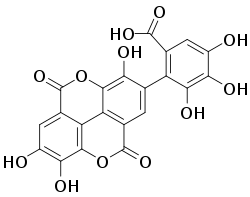
Hydroxychavicol ist eine Phenylpropanoidverbindung, die in den Blättern von Piper betle vorkommt . [ 1 ] Es ist ein stärkerer Inhibitor der Xanthinoxidase (IC 50 = 16,7 μM) als Allopurinol . [ 2 ] [ 3 ]
Forschung
Es könnte sich um eine nützliche neue Substanz zur Behandlung von Hautpilzinfektionen handeln. [ 4 ] Es ist ein vielversprechender Wirkstoff zur Vorbeugung und Behandlung von Zahnerkrankungen, da es bakterizide und fungizide Wirkung gegen Streptococcus intermedius , Streptococcus mutans und Candida albicans zeigt und die Biofilmbildung hemmt. [ 5 ] [ 6 ] [ 7 ] [ 8 ]
Siehe auch
Referenzen
- ^ Atiya A, Sinha BN, Lal UR (März 2020). „Das neue Etherderivat von Phenylpropanoid und seine Bioaktivität wurden aus den Blättern von Piper betle L. untersucht“ . Natural Product Research . 34 (5): 638–645 . doi : 10.1080/14786419.2018.1495634 . PMID 30169967. S2CID 52139286 .
- ^ Murata K, Nakao K, Hirata N, Namba K, Nomi T, Kitamura Y, Moriyama K, Shintani T, Iinuma M, Matsuda H (Juli 2009). „Hydroxychavicol: ein wirksamer Xanthinoxidase-Hemmer, der aus den Blättern von Betel, Piper betle, gewonnen wird“. Zeitschrift für Naturheilmittel . 63 (3): 355– 9. doi : 10.1007/s11418-009-0331-y . PMID 19387769 . S2CID 19647900 .
- ^ Nishiwaki K, Ohigashi K, Deguchi T, Murata K, Nakamura S, Matsuda H, Nakanishi I (Juli 2018). „Struktur-Wirkungs-Beziehungen und Docking-Studien von Hydroxychavicol und seinen Analoga als Xanthinoxidase-Inhibitoren“ . Chemical & Pharmaceutical Bulletin . 66 (7): 741–747 . doi : 10.1248/cpb.c18-00197 . PMID 29695658 .
- ^ Ali I, Satti NK, Dutt P, Prasad R, Khan IA (November 2016). „Hydroxychavicol: Ein Phytochemikal zur Behandlung von Hautpilzinfektionen“ . Scientific Reports . 6 37867. Bibcode : 2016NatSR...637867A . doi : 10.1038/srep37867 . PMC 5126685. PMID 27897199 .
- Phumat P, Khongkhunthian S, Wanachantararak P, Okonogi S (Mai 2020). „Vergleichende Hemmwirkung von 4-Allylpyrocatechol aus Piper betle auf Streptococcus intermedius, Streptococcus mutans und Candida albicans“. Archives of Oral Biology . 113 104690. doi : 10.1016/j.archoralbio.2020.104690 . PMID 32155466. S2CID 212664434 .
- ^ Ali, Intzar; Khan, Farrah G; Suri, Krishan A; Gupta, Bishan D; Satti, Naresh K; Dutt, Prabhu; Afrin, Farhat; Qazi, Ghulam N; Khan, Inshad A (2010). „In-vitro - Antimykotika-Aktivität von aus Piper betle L. isoliertem Hydroxychavicol“ . Annals of Clinical Microbiology and Antimicrobials . 9 (1): 7. doi : 10.1186/1476-0711-9-7 . ISSN 1476-0711 . PMC 2841090. PMID 20128889 .
- ^ Himratul-Aznita, Wan Harun; Nor-Zulaila, Che Omran; Nurul-Fatihah, Khairuddin (2016). „Antimykotische Aktivität der Doppelkombination von Hydroxychavicol mit kommerziell erhältlichen Wirkstoffen gegen orale Candida-Arten“ . SpringerPlus . 5 (1): 1696. doi : 10.1186/s40064-016-3396-6 . ISSN 2193-1801 . PMC 5047859 . PMID 27757368 .
- ^ Mail, Mohd Hafiz; Himratul-Aznita, Wan Harun; Musa, Md Yusoff (2017). „Anti-hyphale Eigenschaften potenzieller bioaktiver Verbindungen für Mundspülungen zur Unterdrückung des Candida-Wachstums“ . Biotechnology & Biotechnological Equipment . 31 (5): 989–999 . doi : 10.1080/13102818.2017.1348255 . ISSN 1310-2818 .