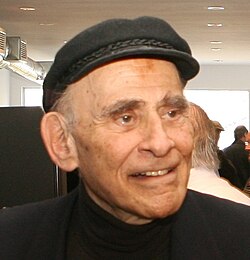
James Robert Laxer (22. Dezember 1941 – 23. Februar 2018), auch bekannt als Jim Laxer , war ein kanadischer politischer Ökonom , Historiker, Intellektueller und politischer Aktivist , der als Professor an der York University lehrte . [ 5 ] [ 6 ] Bekannt wurde er vor allem als Mitbegründer der Waffle-Bewegung , für die er 1971 für den Vorsitz der Neuen Demokratischen Partei kandidierte . Er verfasste mehr als zwei Dutzend Bücher, hauptsächlich zur kanadischen politischen Ökonomie und Geschichte. [ 7 ]
Frühes Leben und Familie
Laxer wurde am 22. Dezember 1941 in Montreal , Quebec , geboren [ 8 ] und war der Sohn von Edna May Quentin, einer Sozialarbeiterin, und Robert Laxer , einem Psychologen, Professor, Autor und politischen Aktivisten . [ 9 ] Sein Vater war Jude , seine Mutter stammte aus einer protestantischen Familie. Ihr Vater, Reverend A. P. Quentin, der 30 Jahre lang als Missionar in China tätig war , hatte den Familiennamen um die Zeit des Ersten Weltkriegs von Quirmbach in Laxer geändert . [ 10 ]
Laxers Eltern waren beide Mitglieder der Kommunistischen Partei Kanadas und ihrer Unterorganisation, der Labour-Progressive Party . Robert Laxer war nationaler Organisator der Partei. Die Familie Laxer verließ die Partei, wie viele andere Mitglieder auch, nach Chruschtschows Geheimrede, in der er Stalins Verbrechen enthüllte , und dem Einmarsch der Sowjetunion in Ungarn 1956. James Laxer beschrieb seine Kindheitserinnerungen in seinen Memoiren „ Red Diaper Baby: A Boyhood in the Age of McCarthyism“ [ 11 ] . Sein Vater prägte seine politische Weltanschauung maßgeblich. [ 12 ]
Sein Großvater väterlicherseits war Rabbiner , sein Großvater mütterlicherseits Pfarrer und christlicher Missionar in China , wo Laxers Mutter geboren wurde. [ 13 ] Sein Bruder Gordon Laxer wurde Politökonom , Autor und Gründer des Parkland Institute . [ 14 ] [ 15 ]
Er erwarb einen Bachelor of Arts an der University of Toronto sowie einen Master of Arts (nach Annahme seiner Masterarbeit „ French-Canadian Newspapers and Imperial Defence, 1899–1914“ im Jahr 1967) und einen Doktortitel (Ph.D.) an der Queen’s University . [ 16 ] [ 17 ] Er war ein aktiver Studentenjournalist, sowohl bei „The Varsity“ an der University of Toronto als auch später beim „ Queen’s Journal“ , und wurde 1965 zum Präsidenten der Canadian University Press gewählt. [ 18 ]
Laxer married three times. He married Diane Taylor in 1965, from whom he was divorced in 1969.[19] He married Krista Maeots in 1969.[6] They had two children: Michael and Katherine (known as "Kate").[19][20] She was a producer at CBC Radio for This Country in the Morning with Peter Gzowski, and then created and was executive producer of CBC Radio's Morningside program with Don Harron.[21] She committed suicide by drowning at Niagara Falls in 1978.[22] Laxer and Maeots were separated at the time of her death in 1978.[20][23][24] Laxer married Sandra Price in 1979.[25] They had two children: Emily and Jonathan.[19][20]
Political career
In 1969, Laxer, along with his father Robert Laxer, Mel Watkins, and others, founded the Waffle,[26] a left-wing group influenced by the New Left, the anti–Vietnam War movement, and Canadian economic nationalism, that tried to influence the direction of the New Democratic Party (NDP).[27] Laxer was a principal author of their Manifesto for an Independent Socialist Canada in 1969 alongside Ed Broadbent and Gerald Caplan.[28] The manifesto was debated at the 1969 federal NDP convention and was rejected by the delegates in favour of a more moderate declaration.[29]
In 1971, Laxer ran for the leadership of the federal NDP and shocked the convention by winning one-third of the vote on the fourth and final ballot against party stalwart David Lewis.[14][30] The Waffle was ultimately forced out of the NDP and briefly became a political party under the name Movement for an Independent Socialist Canada.[14][31] Laxer and other Wafflers unsuccessfully ran for Parliament in 1974.[32] This electoral failure led to the Waffle's demise,[33] and Laxer concentrated on his work at York University, where he was a professor of political science for 47 years,[20] and in broadcasting.
In 1981, he was hired as director of research for the federal NDP, but left in controversy in 1983 when he published a report critiquing the party's economic policy as being "out of date".[34][35]
Academic, writer, and broadcaster
Laxer hosted The Real Story, a nightly half-hour current affairs program on TVOntario in the early 1980s. He also variously wrote a column and op-ed pieces for the Toronto Star from the 1980s until shortly before his death, as well as op-ed pieces for The Globe and Mail.[14][36] He also played "Talleyrand", a mock political insider, on CBC Radio's Morningside in the 1980s.[37]
Laxer co-wrote and presented the five-part National Film Board documentary series Reckoning: The Political Economy of Canada in 1986, which examined Canada's economic and political relationships with the United States[14][38] and Canada's place in the changing global economy.[39] Laxer and his co-writer won a Gemini Award in 1988 for Best Writing in an Information/Documentary Program or Series for episode one of Reckoning titled "In Bed with an Elephant".[40][41] The Canadian Broadcasting Corporation refused to air the series due to its critical view of free trade with the United States, which was being negotiated at the time, and it aired instead on TVOntario and other educational channels in Canada as well as a number of PBS stations in the United States.[38][42]
A democratic socialist,[14] Laxer believed that Canadian economic nationalism was a progressive force against the United States and American imperialism.[43][44] He wrote extensively about the influence of American multinational corporations in the Canadian economy, particularly in the oil and gas industry, and his agitation helped lead to the creation of Petro-Canada.[39] The creation of the Foreign Investment Review Agency, and the Canadian Development Corporation in the 1970s is also attributed in part to the work of Laxer, Watkins, and the Waffle.[45] In the 1980s he strongly opposed the adoption of the Canada–US Free Trade Agreement,[46] though he still believed that free trade agreements were capable of being used to the advantage of the political left through the entrenchment of social charters.[47]
Laxer died suddenly and unexpectedly in Paris of heart-related problems on 23 February 2018 while in Europe researching a book on Canada's role in the Second World War.[20][14][48]
Selected works
- James Laxer (1970). The Energy Poker Game: The Politics of the Continental Resources Deal. New Press. ISBN 9780887700316.
- James Laxer (1974). Canada's Energy Crisis. James Lorimer & Company. ISBN 9780888620873.
- James Laxer and Anne Martin (1976). The Big Tough Expensive Job : Imperial Oil and the Canadian Economy. Press Porcépic. ISBN 9780888781222.
- James Laxer and Robert Laxer (1977). The Liberal Idea of Canada: Pierre Trudeau and the Question of Canada's Survival. James Lorimer & Company. ISBN 0888621248.
- James Laxer (1981). Canada's Economic Strategy. McClelland & Stewart. ISBN 9780771049866.
- James Laxer (1983). Oil and Gas: Ottawa, the Provinces and the Petroleum Industry. James Lorimer & Company. ISBN 9780888625410.
- James Laxer (1984). Rethinking the Economy: The Laxer Report on Canadian Economic Problems and Policies. NC Press. ISBN 092005336X.
- James Laxer (1986). Leap of Faith: Free Trade and the Future of Canada. Hurtig. ISBN 9780888302977.
- James Laxer (1987). Decline of the Super Powers: Winners and Losers in Today's Global Economy. Paragon House. ISBN 9781557781420.
- James Laxer (1991). Inventing Europe: The Rise of a New World Power. Lester. ISBN 9781895555004.
- James Laxer (1993). False God: How the Globalization Myth has Impoverished Canada. Lester Pub. ISBN 978-1-895555-09-7.
- James Laxer (1996). In Search of a New Left: Canadian Politics After the Neoconservative Assault. Viking. ISBN 978-0-670-85901-6.
- James Laxer (1998). The Undeclared War: Class Conflict in the Age of Cyber Capitalism. Viking. ISBN 9780670876600.
- James Laxer (2000). Stalking the Elephant: My Discovery of America. Viking. ISBN 9780670886418.
- James Laxer (2003). The Border: Canada, the U.S. and Dispatches from the 49th Parallel. Doubleday Canada. ISBN 9780385659819.
- James Laxer (2005). Red Diaper Baby: A Boyhood in the Age of McCarthyism. Douglas & McIntyre. ISBN 978-1-55365-150-5.
- James Laxer (2006). Empire. Groundwood Books Canada. ISBN 9781554980154.
- James Laxer (2006). The Acadians: In Search of a Homeland. Doubleday Canada. ISBN 9780385672894.
- James Laxer (2008). Mission der Torheit: Kanada und Afghanistan . Between the Lines Books. ISBN 978-1-897071-37-3Die
- James Laxer (2008). Die Gefahren des Imperiums: Amerika und seine imperialen Vorgänger . Viking Canada. ISBN 9780670063611Die
- James Laxer (2009). Jenseits der Blase: Visionen für eine neue kanadische Wirtschaft . Between the Lines Books. ISBN 978-1-897071-55-7Die
- James Laxer (2012). Tecumseh & Brock: Der Krieg von 1812. House of Anansi Press. ISBN 978-0-88784-261-0Die
- James Laxer (2013). Ein gespaltenes Haus: Amerikas Abstieg in den Bürgerkrieg . House of Anansi Press. ISBN 9781770894242Die
- James Laxer (2013). Reisen durch den Golden State: Ein kalifornisches Tagebuch . House of Anansi Press. ISBN 9781770894235Die
- James Laxer (2017). Ansprüche auf einen Kontinent: John A. Macdonald, Abraham Lincoln, Jefferson Davis und die Entstehung Nordamerikas . House of Anansi Press. ISBN 9781487002312Die
Siehe auch
Referenzen
Zitate
- ↑ Azzi 1999 , S. 127; Azzi 2012 , S. 223–224.
- ^ French, Orland (12. Januar 2002). „Leben der intellektuellen Heiligen“ . The Globe and Mail . Toronto . Abgerufen am 23. Februar 2018 .
- ^ Gonick 1987 , S. 145; Howlett, Netherton & Ramesh 1999 , S. 42.
- ^ Miller 1993 , S. 464.
- ^ Evans 1991 , S. 306; MacDonald & Gastmann 2001 , S. 292ff.
- ^ a b Nerenberg, Karl (26. Februar 2018). „James Laxer und die Bewegung, die er mitbegründet hat“ . Rabble.ca . Abgerufen am 26. Februar 2018 .
- ^ „TPL Eh List: James Laxer“ . Toronto: House of Anansi Press. Archiviert vom Original am 26. Februar 2018. Abgerufen am 27. Februar 2018 .
- ^ Laxer 2004 , S. 7, 52.
- ^ Fulford, Robert (11. September 2004). „Ein seltener Einblick in den kanadischen Stalinismus“ . National Post . Toronto . Abgerufen am 23. Februar 2018 .
- ^ Mills, Rych (17. November 2023). „Blick in die Vergangenheit: Lokaler Missionar/Autor und Künstler vereinen Talente“ . Waterloo Region Record . Abgerufen am 18. Oktober 2024 .
- ^ Doughty 2005 .
- ^ Bullen 1983 , S. 192.
- ^ Laxer 2004 , S. 54.
- ^ a b c d e f g Rizza, Alanna (25. Februar 2018). „James Laxer, ehemaliger NDP-Führungskandidat, mit 76 Jahren gestorben“ . Toronto Star . Abgerufen am 25. Februar 2018 .
- ^ „Gordon Laxer“ . Edmonton: Parkland Institute. Archiviert vom Original am 26. Februar 2018. Abgerufen am 27. Februar 2018 .
- ^ Laxer 1967 .
- ^ „Jim Laxer“ . Toronto: York University. Archiviert vom Original am 24. Februar 2018. Abgerufen am 23. Februar 2018 .
- ^ „Laxer zum CUP-Nationalpräsidenten gewählt“ . Queen's Journal . Band 92, Nr. 23. Kingston, Ontario: Alma Mater Society. 8. Januar 1965. Abgerufen am 27. Februar 2018 .
- ^ a b c Harris, James F. (2014). „James Robert Laxer“ . Die historische Datenbank der Familie Harris . Abgerufen am 27. Februar 2018 .
- Fitterman , Lisa ( 11. März 2018). „ James Laxer, 76, war einer der Gründer der Waffelbewegung in der NDP . “ Globe and MailAbgerufen am 12. März 2018 .
- ^ Gzowski, Peter (13. Oktober 1978). „Danke, Krista, wir werden dich alle sehr vermissen . “ Toronto Star . S. A3 . Abgerufen am 18. Oktober 2024 – via Newspapers.com.
- ^ WS-Redaktion (6. Oktober 1978). „Ehemaliger Einwohner von Kingston vermisst, vermutlich ertrunken“ . The Whig-Standard . Kingston, Ontario : Kingston Whig-Standard Co. Inc., S. 33. Abgerufen am 18. Oktober 2024 – via Newspapers.com.
- ^ „Tod des Produzenten stoppt Radiosendung“. Ottawa Journal . 6. Oktober 1978. S. 5.
- ^ „Die Geschichte von Honeymoon Falls ist eine Geschichte der Zerstörung“. Ottawa Journal . 3. November 1978. S. 69.
- ^ Laxer 2003 ; Laxer 2004 , S. 184.
- ^ Fleming 2010 , S. 182.
- ^Azzi 2012, p. 223; Pitsula 2008, pp. 39–40; Watkins 2015.
- ^McAllister 1984, p. 108.
- ^Pitsula 2008, p. 40.
- ^Erickson & Laycock 2015, p. 16; Isitt 2011, p. 187.
- ^Bullen 1983, p. 212.
- ^Laxer 1996, p. 162.
- ^Watkins, Mel (27 February 2018). "Reflections on Jim Laxer". Rabble.ca. Retrieved 28 February 2018.
- ^"Hansard"(PDF). 15 March 1984. Archived from the original(PDF) on 26 April 2017.
- ^Laxer, Michael (26 February 2018). "Remembering James Laxer, Canadian Iconoclast". Rabble.ca. Retrieved 26 February 2018.
- ^Laxer, James (9 September 2014). "Scottish Referendum: World's First Vote on Economic Inequality". The Globe and Mail. Toronto. Retrieved 27 February 2018.
- ^"James Laxer fonds Inventory #166"(PDF). www.archivesfa.library.yorku.ca. Retrieved 3 August 2024.
- ^ abEvans 1991, p. 306.
- ^ ab"Inventory of the James Laxer Fonds". Clara Thomas Archives. Toronto: York University. 2013 [2002]. Retrieved 1 March 2018.
- ^"Gemini Awards: The Winners". Cinema Canada. January 1989. Retrieved 28 February 2018.
- ^"James Laxer". York University Experts Guide. Toronto: York University. Retrieved 28 February 2018.
- ^Hays, Matthew (12 March 2009). "To NFB or Not to NFB". The Walrus. Toronto. Retrieved 23 February 2018.
- ^Burgess 2002, p. 239.
- ^"Remembering Jim Laxer". NDP Socialist Caucus. 26 February 2018. Retrieved 27 February 2018.
- ^Smart 2009, p. 316.
- ^Warnock 1988, p. 320.
- ^Mandel 1992, p. 224.
- ^ Laxer, Michael (23. Februar 2018). „In Memoriam: James Laxer, 1941–2018“ . The Left Chapter . Abgerufen am 23. Februar 2018 .
Zitierte Werke
- Azzi, Stephen (1999). Walter Gordon und der Aufstieg des kanadischen Nationalismus . Montreal: McGill-Queen's University Press. ISBN 978-0-7735-1840-7Die
- ——— (2012). „Der nationalistische Moment im englischsprachigen Kanada“. In: Campbell, Lara; Clément, Dominique ; Kealey, Gregory S. (Hrsg.). Debatten über Dissens: Kanada und die 1960er Jahre . Toronto: University of Toronto Press. S. 213–228 . ISBN 978-1-4426-1078-1Die
- Bullen, John (1983). „Die Ontario-Waffel und der Kampf um ein unabhängiges sozialistisches Kanada: Konflikte innerhalb der NDP“. Canadian Historical Review . 64 (2): 188–215 . doi : 10.3138/CHR-064-02-04 . ISSN 0008-3755 . S2CID 154732043 .
- Burgess, William (2002). Kanadas Stellung im Weltsystem: Eine Neubewertung der Debatte in der kanadischen politischen Ökonomie (PDF) (Dissertation). Vancouver: University of British Columbia. ISBN 978-0-612-73136-3Archiviert vom Original (PDF) am 1. März 2018. Abgerufen am 1. März 2018 .
- Doughty, Howard A. (2005). „Rezension zu Red Diaper Baby: A Boyhood in the Age of McCarthyism von James Laxer“ . College Quarterly . 8 (1) . Abgerufen am 23. Februar 2018 .
- Erickson, Lynda; Laycock, David (2015). „Parteigeschichte und Wahlerfolge, 1961–2003“. In: Laycock, David; Erickson, Lynda (Hrsg.). Die Wiederbelebung der Sozialdemokratie: Der beinahe Tod und der überraschende Aufstieg der Bundes-NDP . Vancouver: UBC Press. S. 13ff. ISBN 978-0-7748-2852-9Die
- Evans, Gary (1991). Im nationalen Interesse: Eine Chronik des National Film Board of Canada von 1949 bis 1989. Toronto: University of Toronto (veröffentlicht 2001). ISBN 978-0-8020-6833-0Die
- Fleming, RB (2010). Peter Gzowski: Eine Biographie . Toronto: Dundurn Press. ISBN 978-1-77070-539-5Die
- Gonick, Cy (1987). Die große Wirtschaftsdebatte: Gescheiterte Wirtschaftspolitik und eine Zukunft für Kanada . Toronto: James Lorimer & Company. ISBN 978-0-88862-701-8Die
- Howlett, Michael; Netherton, Alex; Ramesh, M. (1999). The Political Economy of Canada: An Introduction (2nd ed.). Don Mills, Ontario: Oxford University Press. ISBN 978-0-19-541348-9.
- Isitt, Benjamin (2011). Militant Minority: British Columbia Workers and the Rise of a New Left, 1948–1972. Toronto: University of Toronto Press. ISBN 978-1-4426-4194-5.
- Laxer, James (1967). French-Canadian Newspapers and Imperial Defence, 1899–1914 (MA thesis). Kingston, Ontario: Queen's University. OCLC 933108264.
- ——— (1996). In Search of a New Left: Canadian Politics after the Neoconservative Assault. Toronto: Viking. ISBN 978-0-670-85901-6.
- ——— (2003). The Border: Canada, the US and Dispatches From the 49th Parallel. Toronto: Anchor Canada (published 2010). ISBN 978-0-385-67290-0.
- ——— (2004). Red Diaper Baby: A Boyhood in the Age of McCarthyism. Vancouver: Douglas & McIntyre. ISBN 978-1-55365-073-7.
- ——— (2012). Tecumseh and Brock: The War of 1812. Toronto: House of Anansi Press. ISBN 978-1-77089-195-1.
- MacDonald, Scott B.; Gastmann, Albert L. (2001). A History of Credit and Power in the Western World. New Brunswick, New Jersey: Transaction Publishers (published 2009). ISBN 978-0-7658-0085-5.
- Mandel, Michael (1992). "Sovereignty and the New Constitutionalism". In Drache, Daniel; Perin, Roberto (eds.). Negotiating with a Sovereign Quebec. Toronto: James Lorimer & Company. pp. 215–229. ISBN 978-1-55028-392-1.
- McAllister, James (1984). Government of Edward Schreyer: Democratic Socialism in Manitoba. Montreal: McGill-Queen's University Press. ISBN 978-0-7735-0436-3.
- Miller, Carman (1993). Painting the Map Red: Canada and the South African War, 1899–1902. Montreal: McGill-Queen's University Press. ISBN 978-0-7735-0913-9.
- Pitsula, James M. (2008). New World Dawning: The Sixties at Regina Campus. Canadian Plains Studies. Vol. 56. Regina, Saskatchewan: Canadian Plains Research Center. ISBN 978-0-88977-210-6. ISSN 0317-6290.
- Smart, Pat (2009). "Queen's University History Department". In Palaeologu, M. Athena (ed.). The Sixties in Canada: A Turbulent and Creative Decade. Montreal: Black Rose Books. pp. 310–318. ISBN 978-1-55164-331-1.
- Warnock, John W. (1988). Free Trade and the New Right Agenda. Vancouver: New Star Books. ISBN 978-0-919573-79-6.
- Watkins, Mel (2015) [2006]. "Waffle". The Canadian Encyclopedia. Toronto: Historica Canada. Retrieved 27 February 2018.