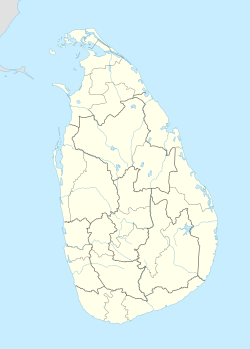
Kataragama (Sinhala: කතරගම, romanized: Kataragama , Tamil: கதிர்காமம், romanized: Katirkāmam) is a pilgrimage town sacred to Buddhist, Hindu and indigenous Vedda people of Sri Lanka. People from South India also go there to worship. The town has the Kataragama temple, a shrine dedicated to Skanda Kumara also known as Kataragama deviyo. Kataragama is located in the Monaragala District of Uva province, Sri Lanka. It is 228 km (142 mi) southeast of Colombo. Although Kataragama was a small village in medieval times, today it is a fast-developing township surrounded by jungle in the southeastern region of Sri Lanka.
The ancient Kiri Vehera Buddhist stupa, which is believed to be built by the regional king Mahasena in the 6th century BC is also a major attraction in Kataragama area.[1] The town has a venerable history dating back to the last centuries BCE. It was the seat of government of many Sinhalese kings during the days of Rohana kingdom.[2] Since the 1950s the town has undergone many improvements with successive governments investing in public transportation, medical facilities, and business development and hotel services. It adjoins the popular Yala National Park.
Etymology
The first reference to this village by this name is in the 6th century AD Pali chronicle Mahavamsa, referring to the place as Kājaragāma.[3] It is mentioned in Mahavamsa that the nobles of Kajaragama were among those took part in the festival of the Bodhi Tree when it was brought over by SangamittaTheri.[2] Some scholars derive Kataragama from Karthikeya Grama, literally meaning Village of Kartikeya, which was shortened in Pali as Kājaragāma and later evolved to Kataragama.[4][5] However, not all scholars accept this explanation.[6]
The literal Sinhalese meaning of Kataragama is the "village in the desert", due to its location in a dry area, stemmed from the words Katara meaning Desert and gama meaning village.[7][8][9] According to a folk etymology, the Tamil name Kathirkāmam is said to be evolved from the combination of two words Kathir (meaning glory of light) and kāmam (Love), which according to the legend is "where the light of Murugan mingled with the love of Valli".[10]
The aboriginal Vedda community used to refer to this deity as O' Vedda or Oya Vedda, meaning "river hunter".[11] The Sri Lankan Moors visiting this place pay homage to a Muslim saint known as al-Khidir, who according to them gave his name to the Islamic shrine at this place, and therefore attributing to the place etymology.[12]
History
Early history
The general vicinity of Kataragama has yielded evidence of human habitation at least 125,000 years ago. It has also yielded evidence of Mesolithic and Neolithic habitations.[13]
Historic period
In der historischen Zeit war die Gegend durch kleine Wasserspeicher und den damit verbundenen Reisanbau geprägt. Das Dorf Kataragama wird erstmals in den historischen Annalen des Mahavamsa aus dem 5. Jahrhundert n. Chr. erwähnt. Darin wird eine Stadt namens Kajjaragama erwähnt, aus der bedeutende Persönlichkeiten kamen, um den heiligen Bodhi-Setzling entgegenzunehmen, der 288 v. Chr. aus dem Maurya-Reich Ashokas gesandt worden war .
Es diente als Hauptstadt mehrerer Könige des Ruhuna-Reiches. Es bot vielen Königen aus dem Norden Zuflucht, als dieser von südindischen Königreichen überfallen wurde. Man nimmt an, dass das Gebiet um das 13. Jahrhundert verlassen wurde. [ 13 ]
Aufgrund archäologischer Funde wird angenommen, dass Kiri Vehera im 1. Jahrhundert v. Chr. entweder renoviert oder erbaut wurde. Zahlreiche weitere Inschriften und Ruinen zeugen von der Vergangenheit. Im 16. Jahrhundert wurde der Kataragamadevio-Schrein in Kataragama mit Skanda-Kumara, einer Schutzgottheit des singhalesischen Buddhismus, gleichgesetzt. [ 14 ] Bereits im 15. Jahrhundert war die Stadt ein beliebter Pilgerort für Hindus aus Indien und Sri Lanka. Die Popularität der Gottheit im Kataragama-Tempel wurde im 16. Jahrhundert in thailändischen Pali- Chroniken wie dem Jinkalmali dokumentiert. Buddhistische und hinduistische Legenden berichten von übernatürlichen Ereignissen an diesem Ort. [ 14 ] Gelehrte wie Paul Younger und Heinz Bechert vermuten, dass die Rituale der einheimischen Priester des Kataragama-Tempels die Vedda-Ideale der Besänftigung widerspiegeln. Sie gehen daher davon aus, dass das Gebiet ursprünglich vedisch verehrt wurde und erst im Mittelalter von Buddhisten und Hindus übernommen wurde. [ 15 ]
Kataragama-Tempel
Tempel des Synkretismus
Kataragama ist ein multireligiöser heiliger Ort. Ungeachtet der Unterschiede in Kaste und Glaubensbekenntnis verehren viele Sri Lanker Gott Kataragama mit großer Ehrfurcht . Sie ehren ihn als mächtige Gottheit und bitten ihn um göttliche Hilfe, um ihre persönlichen Probleme zu überwinden oder geschäftlichen Erfolg zu erlangen, in der festen Hoffnung, dass ihre Bitten erhört werden. Sie glauben an die Existenz Gottes Kataragama und seine außergewöhnliche Macht, jenen beizustehen, die sich in Zeiten der Not und des Unglücks mit Glauben und Hingabe an ihn wenden.
Hindu Katirkamam

TamilHindus of Sri Lanka and South India refer to the place as Katirkamam. Katirkaman is associated with Skanda-Murukan. Saivite Hindus of South India call him Subrahmanya as well. He is known as Kandasamy, Katiradeva, Katiravel, Kartikeya, and Tarakajith. Some of these names are derived from the root katir from Katirkamam. "Katir" means formless light. The Deity is depicted with six faces and twelve hands or one face and four hands. Out of love for Murugan and to mitigate bad karma, bhaktars pierce their cheeks and tongues with vels, pull large chariots carrying murthi of Murugan with large hooks pierced through the skin of their backs. This practice is known as kavadi. Murugan's vahana or vehicle is Mayil, the peacock.
There is a related shrine called Sella Katirkamam dedicated to the beloved elephant-faced God Ganesha nearby, who is known as Murugan's elder brother. The local Manik Ganga or Manika Gangai (River of Gems) is a place of ablution where a sacred bath is taken to purify oneself. Local residents declare that one can be healed of ailments by bathing in it from its high gem content and the medicinal properties of the roots of trees that line the river through the jungle.
Buddhist Kataragama
Many Sinhala Buddhists of Sri Lanka believe that Kataragama deviyo is a guardian deity of Buddhism and he is the presiding deity of Kataragama temple. Kataragama is one of the 16 principal places of Buddhist pilgrimage to be visited in Sri Lanka. According to the chronicle of Sri Lankan history, the Mahawamsa, when the Bo sapling of Bodhi Tree, under which Gotama Buddha attained enlightenment in North India was brought to the city of Anuradhapura 2,300 years ago, the warriors or Kshatriyas from Kataragama were present on the occasion to pay homage and respect. The Bo tree behind the Kataragama temple is one of the eight saplings (Ashta Phala Ruhu Bodhi) of Sri Maha Bodhiya in Anuradapura, Sri Lanka. This tree was planted in the 3rd century BC.[16]
Die buddhistische Kiri Vehera Dagoba, die sich in der Nähe des Kataragama-Tempels befindet, wurde von König Mahasena erbaut. Der Legende nach soll Buddha bei seinem dritten und letzten Besuch in Sri Lanka König Mahasena getroffen haben, der im Jahr 580 v. Chr. über das Gebiet von Kataragama herrschte. Es heißt, König Mahasena habe Buddha begegnet und seinen Ausführungen gelauscht. Aus Dankbarkeit wurde die Dagoba genau an der Stelle errichtet, an der sie heute steht. Daher glauben die einheimischen singhalesischen Buddhisten, dass Kataragama durch Buddha geheiligt wurde.
Vorhinduistische und buddhistische Ursprünge
Die Gottheit von Kataragama ist einheimisch und wird in der sri-lankischen Folklore und Legende seit Langem verehrt. Ursprünglich residiert sie auf dem Gipfel des Berges Wædahiti Kanda (oder Hügel der indigenen Vedda ), unweit der Stadt Kataragama. Seit jeher besteht eine untrennbare Verbindung zwischen dem Gott von Kataragama und seinem Reich. Einst wurde die lokale Gottheit mit dem Gott Saman , einem Schutzgott des Buddhismus und Sri Lankas, gleichgesetzt.
Gemäß der singhalesischen Tradition wurden lokale Vorfahren, Herrscher und Könige, die sich um das Land oder die Gemeinschaft verdient gemacht hatten, zu Gottheiten erhoben. Der Legende nach war Gott Saman ein alter Herrscher des Deva-Volkes in der Region Sabaragamuwa in Sri Lanka. Daher glauben manche, dass König Mahasena, der Kiri Vehera in Kataragama erbauen ließ, später als Gott Kataragama verehrt wurde .
Bis heute kommen die indigenen Vedda aus ihren Waldsiedlungen zum Tempelkomplex, um dort zu beten. Als Verbindung zur Vedda-Vergangenheit findet im Tempel jedes Jahr im Juli oder August ein Fest statt, das die Werbung des Gottes um eine Vedda-Prinzessin und seine Hochzeit feiert.
Ausbildung
Es gibt staatliche Schulen, die Grund-, Mittel- und Oberstufenschüler in singhalesischer Sprache unterrichten.
- President Central College -Kataragama
- Sellakataragama Maha Vidyalaya
- Detagamuwa Junior School
- Gothamigama Junior School
- Kataragama Grundschule
Bevölkerung
Seit seiner Aufgabe im 19. Jahrhundert lebten in dem Dorf nur wenige Dutzend Menschen. Seit den 1950er Jahren hat die Einwohnerzahl zugenommen. Die große Mehrheit der Bewohner sind Singhalesen. Im Juli und August steigt die Einwohnerzahl aufgrund des jährlichen Festes zu Ehren der Gottheit auf mehrere Hunderttausend an.
Kataragama hatte 2012 eine Gesamtbevölkerung von über 18.220. [ 17 ]
| Ethnizität | Bevölkerung | % des Gesamtbetrags |
|---|---|---|
| Singhalesisch | 17.421 | 95,61 |
| Sri-lankische Tamilen | 749 | 4.11 |
| Indische Tamilen | 18 | 0,10 |
| Sri-lankische Mauren | 17 | 0,09 |
| Andere (einschließlich Burgher , Malaien ) | 15 | 0,08 |
| Gesamt | 18.220 | 100 |
Source: Statistical Information of Kataragama Divisional Secretariat
Transport

Most of the many thousands who visit Kataragama travel by vehicles. Even today, despite the lure of modern transport, hundreds of dedicated pilgrims stick to the ancient practice of journeying to Kataragama on foot.[18]
In 1992, it was proposed to extend the railway from Matara to Kataragama and beyond. The Kataragama railway extension is being constructed under a three-phase accelerated development program. The first phase has begun and will consist of the 27 km stretch from Matara to Beliatta costing 60 million rupees; construction has already commenced on the bridge over the Nilwala River by the State Engineering Corporation. The entire project is expected to take six years to complete and will cost around 3 billion rupees. The project is funded by the Chinese government and it is expected to be completed by 2015.[19]
See also
References
- ^Amarasekara, Janani (13 January 2008). "Blessed Kataragama". Sunday Observer. Retrieved 23 January 2018.
- ^ ab"Kacaragama, aka: Kajaragama, Kataragama; 1 Definition(s)". Wisdom Library. Retrieved 2018-01-23.
- ^Gombrich, Richard Francis; Gombrich, Richard; Obeyesekere, Gananath (1988). Buddhism Transformed: Religious Change in Sri Lanka. Motilal Banarsidass. p. 437. ISBN 9788120807020.
- ^Arunachalam, Sir Ponnambalam (1937). Studies and Translations, Philosophical and Religious. Department of Hindu Affairs, Ministry of Regional Development. p. 110.
- ^Wirz, Paul (1966). Kataragama: The Holiest Place in Ceylon. University of California: Lake House Investments. p. 7.
- ^Rasanayagam, Mudaliyar C. (1984). Ancient Jaffna. New Delhi: Asian Educational Services. p. 60.
The village, which was below the hill and on the banks of the Menik Ganga, was, in Sinhalese times, called Kataragama, the Pali form of which was Kajaragama. Its derivation from Kartigeya grama, as some scholars have attempted to derive it, has neither phonetic similarity nor linguistic authority
- ^Clough, B. (December 1997). Sinhalese English Dictionary. Asian Educational Services. p. 101. ISBN 9788120601055.
- ^ Raj, Selva J.; Harman, William P. (Februar 2012). Umgang mit Gottheiten: Das rituelle Gelübde in Südasien . New York: SUNY Press. S. 111. ISBN 9780791482001Die
- ^ Chandani Kirinde und Ravi Shankar (2. Oktober 2016). „Durstig nach Wasser und Gerechtigkeit“ . The Sunday Times .
- ^ Gombrich, Richard Francis; Gombrich, Richard; Obeyesekere, Gananath (1988). Buddhismus im Wandel: Religiöser Wandel in Sri Lanka . Motilal Banarsidass. S. 307. ISBN 9788120807020Die
- ^ Das antike Ceylon . Archäologisches Amt, Sri Lanka. 1971. S. 158.
- ^ Jazeel, Tariq (2013). Sacred Modernity: Nature, Environment and the Postcolonial Geographies of Sri Lankan Nationhood . Oxford University Press. S. 84. ISBN 9781846318863Die
- ^ Jayaratne , DK (5. Mai 2009) . „Rettungsarchäologie von Ruhuna, Veheralgala-Projekt“ . Peradeniya-Universität . Abgerufen am 5. Oktober 2010 .
- ^ a b Pathmanathan, S (September 1999). „Die Schutzgottheiten Sri Lankas: Skanda-Murgan und Kataragama“ . The Journal of the Institute of Asian Studies . Institute of Asian Studies.
- ^ Bechert, Heinz (1970). „Skandakumara und Kataragama: Ein Aspekt der Beziehung zwischen Hinduismus und Buddhismus in Sri Lanka“ . Tagungsband des Dritten Internationalen Tamilischen Konferenzseminars . Paris: Internationale Vereinigung für Tamilische Forschung.
- ^ „Kataragama“ . Reisebericht Sri Lanka . Abgerufen am 11. Juni 2010 .
- ^ „Kataragama Divisional Secretariat“ . Regierung von Sri Lanka . Abgerufen am 6. Oktober 2010 .
- ^ „Zu Fuß im Glauben nach Kataragama“ . The Sunday Leader.
- ^ „Chinesisches Unternehmen erhält 600-Millionen-Dollar-Eisenbahnprojekt in Sri Lanka – Wirtschaft – Chinadaily.com.cn“ . www.chinadaily.com.cn . Xinhua-Nachrichtenagentur . Abgerufen am 9. November 2025 .
Externe Links
- Internationaler Emmy-nominierter Granada-Fernsehfilm (1979):-