Oscar Palmer Robertson (born November 24, 1938), nicknamed "the Big O", is an American former professional basketball player who played for the Cincinnati Royals and Milwaukee Bucks in the National Basketball Association (NBA).[1] As a 12-time All-Star, 11-time member of the All-NBA Team, and winner of the 1964 MVP, Robertson is considered to be one of the greatest point guards of all time. In 1962, he became the first player in NBA history to average a triple-double for a season (the only player in history besides Russell Westbrook and Nikola Jokić).[2] In the 1970–71 NBA season, he was a key player on the team that brought the Bucks their first NBA title. His playing career, especially during high school and college, was plagued by racism.[2]
Robertson is a two-time Naismith Memorial Basketball Hall of Fame inductee, having been inducted in 1980 for his individual career, and in 2010 as a member of the 1960 United States men's Olympic basketball team and president of the National Basketball Players Association. Also in 1980, Robertson was named to the NBA 35th Anniversary Team.[3] He was again voted as one of the 50 Greatest Players in NBA History in 1996.[4] The United States Basketball Writers Association (USBWA) renamed their College Player of the Year Award the Oscar Robertson Trophy in his honor in 1998, and he was one of five people chosen to represent the inaugural National Collegiate Basketball Hall of Fame class in 2006.[5] He was ranked as the 36th best American athlete of the 20th century by ESPN.[6][7] In October 2021, Robertson was honored as one of the league's greatest players of all time by being named to the NBA 75th Anniversary Team.[8]
Robertson was also an integral part of Robertson v. National Basketball Ass'n of 1970.[9] The landmark NBA antitrust suit, which was filed when Robertson was the president of the NBA Players' Association, led to an extensive reform of the league's strict free agency and draft rules and, subsequently, to higher salaries for all players.[2] He was inducted into the FIBA Hall of Fame in 2009.
Early life
Robertson was born into poverty in Charlotte, Tennessee, on November 24, 1938. When he was approximately 18 months old, his parents moved to Indianapolis, Indiana, where he grew up in the segregatedhousing project of Lockefield Gardens.[10] He preferred to play basketball over baseball, which was more popular in the neighborhood because it was "a poor kids' game". He learned how to shoot by using tennis balls and rags wrapped with rubber bands and tossing them into a peach basket in the back of his family's home.[2]
High school career
Robertson attended Crispus Attucks High School, an all-black high school, where he was coached by Ray Crowe, whose emphasis on a fundamentally sound game had a positive effect on his style of play. As a sophomore in 1954, he starred on an Attucks team that lost in the semi-state finals (state quarterfinals) to eventual state champions Milan, a story that would later be the basis of the 1986 movie Hoosiers. When Robertson was a junior, Crispus Attucks dominated its opposition, going 31–1, and winning the 1955 state championship, the first for any all-black school in the nation. It was also the first state championship won by an Indianapolis team in the Hoosier tournament.
In seinem letzten Highschool-Jahr erzielte Robertson durchschnittlich 24,0 Punkte pro Spiel und wurde 1956 zum „Mr. Basketball“ von Indiana gewählt. [ 2 ] Sein Team beendete die Saison mit einer perfekten Bilanz von 31:0 und gewann die zweite IHSAA-Meisterschaft im Herrenbasketball in Folge . Damit war es das erste Team in Indiana, dem eine makellose Saison gelang und das mit 45 Siegen in Folge einen neuen Staatsrekord aufstellte. Nach dem Meisterschaftssieg wurde das Team traditionell durch die Stadt gefahren, anschließend aber – anders als die anderen Teams – in einen Park außerhalb der Innenstadt gebracht, um dort weiter zu feiern. Robertson erklärte: „Die Verantwortlichen dachten, die Schwarzen würden die Stadt verwüsten, und sie glaubten, die Weißen würden das nicht gutheißen.“ [ 11 ]
Nach seinem Abschluss im selben Jahr schrieb sich Robertson an der Universität von Cincinnati ein . [ 4 ]
1983 wurde Robertson in die National High School Hall of Fame aufgenommen . [ 12 ]
Hochschulkarriere

Robertson setzte seine herausragenden Leistungen bei den Cincinnati Bearcats fort und erzielte einen Punkteschnitt von 33,8 Punkten pro Spiel – den dritthöchsten Wert in der Geschichte des College-Basketballs. [ 4 ] In jedem seiner drei Jahre gewann er die nationale Scoring-Meisterschaft , [ 4 ] wurde zum All-American First Team gewählt [ 13 ] und zum College-Spieler des Jahres gekürt . Dabei stellte er 14 NCAA- und 19 Schulrekorde auf. [ 4 ]
Robertsons herausragende Leistungen führten die Bearcats in seinen drei Jahren im Universitätsteam zu einer Gesamtbilanz von 79 Siegen und 9 Niederlagen, darunter zwei Final-Four- Teilnahmen. Dennoch blieb ihm die Meisterschaft verwehrt – ein Umstand, der sich bis zum Ende seiner Profikarriere immer wiederholen sollte. Als Robertson das College verließ, war er der erfolgreichste Punktesammler aller Zeiten in der NCAA, bis ihn sein Hall-of-Fame-Kollege Pete Maravich 1970 übertraf. [ 2 ] Robertson verhalf Cincinnati während seiner Zeit dort zu nationalem Ansehen, doch die größten Erfolge der Universität im Basketball feierte sie unmittelbar nach seinem Weggang, als das Team 1961 und 1962 die nationale Meisterschaft gewann und 1963 den dritten Titel in Folge nur um zwei Punkte verpasste. Er steht weiterhin an der Spitze der Rekordliste der Bearcats und zu den vielen Rekorden, die er noch immer hält, gehören 62 Punkte in einem Spiel (eines seiner sechs Spiele mit 50 Punkten oder mehr), zehn Triple-Doubles in seiner Karriere, 15,2 Rebounds pro Spiel in seiner Karriere und 2.973 Punkte in seiner Karriere. [ 14 ]
Robertson zeigte viele herausragende Einzelleistungen, darunter zehn Triple-Doubles. Seine persönliche Bestleistung waren vermutlich 45 Punkte, 23 Rebounds und 10 Assists gegen Indiana State im Jahr 1959. Trotz seiner Erfolge auf dem Spielfeld wurde Robertsons College-Karriere durch Rassismus überschattet . Damals rekrutierten Universitäten im Süden der USA wie Kentucky, Duke und North Carolina keine schwarzen Athleten, und Auswärtsfahrten in segregierte Städte waren besonders schwierig, da Robertson oft in Studentenwohnheimen statt in Hotels übernachten musste. Jahre später sagte er der Zeitung „The Indianapolis Star“ : „Ich werde ihnen das nie verzeihen.“ [ 2 ] Jahrzehnte nach seiner College-Zeit wurde Robertsons herausragende NCAA-Karriere von der USBWA gewürdigt , indem sie die Trophäe für den NCAA Division I Spieler des Jahres 1998 in Oscar-Robertson-Trophäe umbenannte . Diese Ehrung schloss für Robertson einen Kreis, da er die ersten beiden jemals verliehenen Auszeichnungen gewonnen hatte. [ 15 ]
Olympische Spiele 1960
Nach dem College führten Robertson und Jerry West gemeinsam die US-amerikanische Basketballmannschaft bei den Olympischen Sommerspielen 1960 als Kapitäne an . Das Team, das zu diesem Zeitpunkt als die größte Ansammlung von Basketballtalenten aller Zeiten galt, dominierte die Konkurrenz und gewann die Goldmedaille . Robertson spielte neben Terry Dischinger von Purdue als Forward in der Startaufstellung , kam aber auch als Point Guard zum Einsatz . Er war der Topscorer des Teams [ 16 ] , das seine neun Spiele mit einem durchschnittlichen Vorsprung von 42,4 Punkten gewann. Zehn der zwölf College-Spieler des amerikanischen Kaders spielten später in der NBA, darunter Robertson sowie die späteren Mitglieder der Basketball Hall of Fame, Jerry West, Jerry Lucas und Walt Bellamy . [ 17 ]
Berufliche Laufbahn
Cincinnati Royals (1960–1970)

Vor Beginn der NBA-Saison 1960/61 meldete sich Robertson für den NBA-Draft 1960 an . Er wurde von den Cincinnati Royals als Territorial Pick ausgewählt. Die Royals zahlten Robertson einen Signing-Bonus von 33.000 US-Dollar. [ 2 ] In seinem NBA-Debüt erzielte Robertson 21 Punkte, 12 Rebounds und 10 Assists beim 140:123-Sieg gegen die Lakers . [ 18 ] Am 15. November 1960 erreichte Robertson mit 44 Punkten, 15 Rebounds und 11 Assists seine damalige Karrierebestleistung beim 124:115-Sieg gegen die Philadelphia Warriors. [ 19 ] In seiner Rookie-Saison erzielte Robertson durchschnittlich 30,5 Punkte , 10,1 Rebounds und 9,7 Assists (Ligabestwert) und erreichte fast ein Triple-Double über die gesamte Saison. Er wurde zum NBA Rookie des Jahres gewählt, ins All-NBA First Team berufen – was ihm in seinen ersten neun Saisons in Folge gelang – und nahm zum ersten Mal an einem von zwölf aufeinanderfolgenden All-Star-Game- Spielen teil. [ 1 ] Außerdem wurde er nach seiner Leistung mit 23 Punkten, 14 Assists und 9 Rebounds beim Sieg der Western Conference zum MVP des NBA All-Star Games 1961 gekürt; die Royals beendeten die Saison jedoch mit einer Bilanz von 33 Siegen und 46 Niederlagen und blieben Tabellenletzter der Western Division. Am 10. Februar 1962 erzielte Robertson 32 Punkte, 21 Rebounds und 16 Assists beim 134:118-Sieg gegen die Hawks . [ 20 ]
In der Saison 1961/62 schrieb Robertson NBA-Geschichte: Er war der erste Spieler, der in einer gesamten Saison ein Triple-Double im Schnitt erzielte (30,8 Punkte, 12,5 Rebounds und 11,4 Assists). [ 1 ] Robertson stellte zudem einen damaligen NBA-Rekord für die meisten Triple-Doubles in einer regulären Saison mit 41 auf. Dieser Rekord hielt über ein halbes Jahrhundert, bis Russell Westbrook in der Saison 2016/17 42 Triple-Doubles erzielte und sich Robertson als zweiter Spieler anschloss, der in einer gesamten Saison einen Triple-Double-Schnitt erreichte. Er übertraf den Assist-Rekord von Bob Cousy (715 Assists zwei Saisons zuvor) mit 899 Assists und gehörte neben Johnny Green und Elgin Baylor zu den wenigen Spielern in der NBA-Geschichte mit einer Körpergröße von 1,96 m oder weniger, die in einer Saison über 900 Rebounds holten. [ 21 ] Die Royals qualifizierten sich für die NBA-Playoffs 1962 , schieden jedoch in der ersten Runde gegen die Detroit Pistons aus . [ 22 ] In der Saison 1962/63 etablierte sich Robertson endgültig als einer der größten Spieler seiner Generation. Er erzielte durchschnittlich 28,3 Punkte, 10,4 Rebounds und 9,5 Assists und verpasste nur knapp ein weiteres Triple-Double. [ 1 ] Die Royals erreichten das Finale der Eastern Division, unterlagen dort aber in einer Serie über sieben Spiele den Boston Celtics um Bill Russell . [ 23 ]

In der Saison 1963/64 erreichten die Royals eine Bilanz von 55 Siegen und 25 Niederlagen [ 24 ] und belegten damit den zweiten Platz in der Eastern Division. Unter dem neuen Trainer Jack McMahon blühte Robertson auf. Er führte die NBA in der Freiwurfquote an, erzielte mit 31,4 Punkten pro Spiel einen Karrierebestwert und verbuchte durchschnittlich 9,9 Rebounds und 11,0 Assists pro Spiel. [ 1 ] Er wurde zum NBA MVP gewählt und war neben Bill Russell und Wilt Chamberlain der einzige Spieler , dem diese Auszeichnung zwischen 1960 und 1968 gelang. [ 2 ] Im selben Jahr gewann Robertson auch seine zweite MVP-Auszeichnung im All-Star Game, nachdem er beim Sieg der Eastern Division 26 Punkte, 14 Rebounds und 8 Assists erzielt hatte. In den NBA-Playoffs 1964 besiegten die Royals die Philadelphia 76ers , unterlagen dann aber den Celtics mit 1:4. [ 2 ]
Robertson averaged a triple-double over his first five seasons in the NBA with the Royals, recording averages of 30.3 points, 10.4 rebounds, and 10.6 assists per game in 451 contest. On December 18, 1964, Robertson recorded a career-high 56 points on 17-for-33 shooting from the field, to go along with 9 rebounds and 12 assists in a 111–107 win over the Los Angeles Lakers.[25] From the 1964–65 season on, things began to turn sour for the franchise. Despite Robertson recording averages of at least 24.7 points, 6.0 rebounds and 8.1 assists in the six following seasons,[1] the Royals were eliminated in the first round from 1965 to 1967, then missed the playoffs from 1968 to 1970. In the 1969–70 season, the sixth disappointing season in a row, fan support was waning. To help attract the public, 41-year-old head coach Bob Cousy made a short comeback as a player. For seven games, the former Celtics point guard partnered with Robertson in the Royals' backcourt, but they missed the playoffs.[2]
Milwaukee Bucks (1970–1974)

Prior to the 1970–71 season, the Royals stunned the basketball world by trading Robertson to the Bucks for Flynn Robinson and Charlie Paulk.[26] No reasons were officially given, but many pundits suspected head coach Bob Cousy was jealous of all the attention Robertson was getting.[2] Robertson himself said: "I think he was wrong and I will never forget it."[2]
The relationship between Oscar and the Royals had soured to the point that Cincinnati had also approached the Lakers and Knicks about deals involving their star player; the Knicks players who were discussed in those scenarios are unknown, but Los Angeles stated publicly that the Royals asked about Jerry West and Wilt Chamberlain, with the Lakers saying they would not consider trading either star. Upon arriving in Milwaukee, Robertson switched from hist previous No. 14 jersey to No. 1, which he later explained was because Jon McGlocklin already wore No. 14 and Robertson refused to allow him to give the number up, and Greg Smith wore No. 4, so Robertson took No. 1 as the remaining digit. The trade proved highly beneficial for Robertson. After being stuck with an under-performing team the last six years, he now was paired with the young Lew Alcindor, who would years later become the all-time NBA scoring leader as Kareem Abdul-Jabbar. With Alcindor in the low post and Robertson running the backcourt, the Bucks charged to a league-best 66–16 record, including a then-record 20-game win streak, a dominating 12–2 record in the 1971 NBA playoffs, and crowned their season with the NBA title by sweeping the Baltimore Bullets 4–0 in the 1971 NBA Finals. In his first NBA Finals game, Robertson recorded 22 points, 7 rebounds and 7 assists for the Bucks.[27] For the first time in his career, Robertson had won an NBA championship.[2]
From a historical perspective, Robertson's most important contribution was made not on a basketball court but in a court of law. It was the year of the landmark Robertson v. National Basketball Ass'n, an antitrust suit filed by the NBA's Players Association against the league. As Robertson was the president of the Players Association, the case bore his name. In this suit, the proposed merger between the NBA and American Basketball Association was delayed until 1976, and the college draft, as well as the free agency clauses, were reformed.[2] Robertson himself stated that the main reason was that clubs basically owned their players: players were forbidden to talk to other clubs once their contract was up, because free agency did not exist until 1988.[28] Six years after the suit was filed, the NBA finally reached a settlement, the ABA–NBA merger took place, and the Oscar Robertson suit encouraged signing of more free agents and eventually led to higher salaries for all players.[2]
On the hardwood, the veteran Robertson still proved he was a valuable player. Paired with Abdul-Jabbar, two more division titles with the Bucks followed in the 1971–72 and 1972–73 season. In Robertson's last season, he helped lead Milwaukee to a league-best 59–23 record and helped them to reach the 1974 NBA Finals. There, Robertson had the chance to end his stellar career with a second ring. The Bucks were matched up against a Boston Celtics team powered by an inspired Dave Cowens, and the Bucks lost in seven games.[2] As a testament to Robertson's importance to the Bucks, in the season following his retirement the Bucks fell to last place in their division with a 38–44 record in spite of the continued presence of Abdul-Jabbar.[29]
In 1995, Robertson was elected to the Wisconsin Athletic Hall of Fame.[30]
Post-playing career
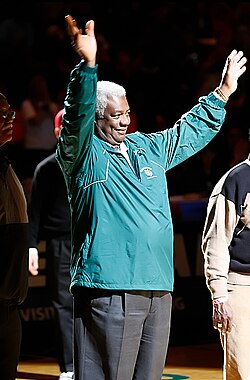
Nach seinem Karriereende als aktiver Spieler engagierte sich Robertson weiterhin für die Verbesserung der Lebensbedingungen in seiner Heimatstadt Indianapolis, insbesondere für die afroamerikanische Bevölkerung . [ 2 ] Außerdem arbeitete er in der NBA-Saison 1974/75 als Co-Kommentator an der Seite von Brent Musburger bei Spielen, die von CBS übertragen wurden. [31] Seine Markenzeichen waren Ausrufe wie „Oh, mein Gott!“ und „Oh, Brent, hast du das gesehen!“, die er als Reaktion auf spektakuläre Spielzüge rief. In der Saison 1988/89 kehrte er als Kommentator zurück und kommentierte Spiele für TBS zusammen mit Hot Rod Hundley. [ 32 ]
Nach seinem Karriereende wurde seine Trikotnummer 14 von den Kansas City Kings (die Royals waren dorthin umgezogen, als Robertson noch bei den Bucks spielte) gesperrt; diese Ehrung wird von den Kings in ihrem heutigen Stadion in Sacramento bis heute fortgeführt. Auch die Bucks sperrten seine Trikotnummer 1, die er in Milwaukee getragen hatte. 1994 wurde vor der Fifth Third Arena im Shoemaker Center , der heutigen Heimspielstätte der Cincinnati Bearcats, eine fast drei Meter hohe Bronzestatue von Robertson errichtet . [ 4 ] Robertson besucht dort viele Spiele und verfolgt die Bearcats von einem Platz am Spielfeldrand aus. 2006 wurde die Statue an den Eingang des Richard E. Lindner Athletics Center der University of Cincinnati versetzt. [ 33 ]
Ab dem Jahr 2000 war Robertson bis zum Verkauf des Unternehmens an die Bank of America im Jahr 2008 als Direktor für die Countrywide Financial Corporation tätig. [ 34 ] Im Juli 2004 wurde Robertson für etwa einen Monat zum Interimstrainer der Herren-Basketballmannschaft der Cincinnati Bearcats ernannt , während Cheftrainer Bob Huggins aufgrund einer Verurteilung wegen Trunkenheit am Steuer suspendiert war. [ 35 ]
Nachdem er viele Jahre nicht im Rampenlicht stand, wurde Robertson am 17. November 2006 für seinen Einfluss auf den College-Basketball geehrt, als er als Gründungsmitglied in die National Collegiate Basketball Hall of Fame aufgenommen wurde . Er war einer von fünf Personen, neben John Wooden , Bill Russell , Dean Smith und James Naismith , die für die erste Klasse ausgewählt wurden. [ 5 ] Im Januar 2011 schloss sich Robertson der Sammelklage O'Bannon gegen die NCAA an , in der die Verwendung von Bildern ehemaliger Studentenathleten durch die Organisation angefochten wurde. [ 36 ]
In 2015, Robertson was among a group of investors that placed a marijuana legalization initiative on the Ohio ballot.[37] The initiative sought exclusive grow rights for the group members while prohibiting all other cultivation except small amounts for personal use.[38] Robertson appeared in a television advertisement advocating for passage of the initiative,[39] but it was ultimately defeated.[40] Second efforts by groups in Ohio succeeded in 2023.
Legacy

Robertson is regarded as one of the greatest players in NBA history, a triple threat who could score inside, outside and also was a stellar playmaker. His rookie scoring average of 30.5 points per game is the third-highest of any rookie in NBA history, and Robertson averaged more than 30 points per game in six of his first seven seasons.[1] Only three other players in the NBA have had more 30+-point-per-game seasons in their career. Robertson was the first player to average more than 10 assists per game, doing so at a time when the criteria for assists were more stringent than today.[2] Robertson is also the first guard in NBA history to ever average more than 10 rebounds per game, doing so three times. It was a feat that would not be repeated until Russell Westbrook managed to achieve it during the 2016–17 season. In addition to his 1964 regular-season MVP award, Robertson won three All-Star Game MVPs in his career (in 1961, 1964, and 1969). He ended his career with 26,710 points (25.7 per game, ninth-highest all time), 9,887 assists (9.5 per game), and 7,804 rebounds (7.5 per game).[1] He led the league in assists six times; at the time of his retirement, he was the NBA's all-time leader in career assists and free throws made, and was the second all-time leading scorer behind Wilt Chamberlain.[2]
Robertson also set yardsticks in versatility. If his first five NBA seasons are strung together, Robertson averaged a triple-double over those, averaging 30.3 points, 10.4 rebounds, and 10.6 assists.[41] For his career, Robertson had 181 triple-doubles, a record that had never been approached for decades until by Westbrook in the 2020-21 season.[42] These numbers are even more astonishing if it is taken into account that the three-point shot, which benefits sharpshooting backcourt players, did not exist when he played. In the 1967–68 season, Robertson became the first of only two players in NBA history to lead the league in both scoring average and assists per game in the same season (also achieved by Nate Archibald). The official scoring and assist titles went to other players that season because the NBA based the titles on point and assist totals (not averages) prior to the 1969–70 season. During his career, Robertson won a total of six NBA assist titles, and was the first to reach the 7,000, 8,000, and 9,000 career assist milestones. For his career, Robertson shot a high .485 field goal average and led the league in free-throw percentage twice—in the 1963–64 and 1967–68 seasons.[1]
Standing 6 ft 5 in (1.96 m), Robertson is recognized by the NBA as the first legitimate "big guard", paving the way for other oversized backcourt players like Los Angeles Lakers legend Magic Johnson.[2] Furthermore, he is also credited with having invented the head fake and the fadeaway jump shot, a shot which Michael Jordan later became famous for.[43] For the Cincinnati Royals, now relocated and named the Sacramento Kings, he scored 22,009 points and 7,731 assists, and is the all-time leader in both statistics for the combined Royals/Kings teams.[2]

Robertson was enshrined in the Naismith Memorial Basketball Hall of Fame on April 28, 1980. On October 30, 1980, Robertson was named to the NBA 35th Anniversary Team.[3] In 1996, Robertson was honored as one of the league's greatest players of all time by being named to the NBA 50th Anniversary Team.[44] He received the "Player of the Century" award by the National Association of Basketball Coaches in 2000 and was ranked third on SLAM's "Top 75 NBA Players" in 2003, behind fellow NBA legends Jordan and Chamberlain. Furthermore, in 2006, ESPN named Robertson the second greatest point guard of all time, praising him as the best post-up guard of all time and placing him only behind Johnson.[41] In 2022, to commemorate the NBA's 75th Anniversary The Athletic ranked their top 75 players of all time, and named Robertson as the 12th greatest player in NBA history. He was the second highest ranked point guard on the list again behind only Johnson.[45] In 2017, it was announced that a life-sized bronze sculpture of Robertson would be featured alongside other Indiana sports stars at The Children's Museum of Indianapolis' Old National Bank Sports Legends Avenue of Champions, located in the museum's sports park.[46] In 2018, he received the NBA Lifetime Achievement Award. In October 2021, Robertson was honored as one of the league's greatest players of all time by being named to the NBA 75th Anniversary Team.[8]
In 1959, the Player of the Year Award was established to recognize the best college basketball player of the year by the U.S. Basketball Writers Association. Five nominees are presented and the individual with the most votes receives the award during the NCAA Final Four. In 1998, it was renamed the Oscar Robertson Trophy in his honor, as the player that won the first two awards, because of his outstanding career and his continuing efforts to promote the game of basketball. In 2004, an 18" bronze statue of Robertson was sculpted by world-renowned sculptor Harry Weber.[15] In 2022, the NBA renamed its Western Conference championship trophy after Robertson.[47] In 2024, NBA Commissioner Adam Silver announced that the league had commissioned a statue of Robertson from sculptor Ryan Feeney to be permanently placed at Crispus Attucks High School.[10]
NBA career statistics
| GP | Games played | GS | Games started | MPG | Minutes per game |
| FG% | Field goal percentage | 3P% | 3-point field goal percentage | FT% | Free throw percentage |
| RPG | Rebounds per game | APG | Assists per game | SPG | Steals per game |
| BPG | Blocks per game | PPG | Points per game | Bold | Career high |
| † | Won an NBA championship | * | Led the league |
Regular season
| Year | Team | GP | GS | MPG | FG% | FT% | RPG | APG | SPG | BPG | PPG |
|---|---|---|---|---|---|---|---|---|---|---|---|
| 1960–61 | Cincinnati | 71 | 42.7 | .473 | .822 | 10.1 | 9.7* | 30.5 | |||
| 1961–62 | Cincinnati | 79 | 44.3 | .478 | .803 | 12.5 | 11.4* | 30.8 | |||
| 1962–63 | Cincinnati | 80* | 44.0 | .518 | .810 | 10.4 | 9.5 | 28.3 | |||
| 1963–64 | Cincinnati | 79 | 45.1 | .483 | .853* | 9.9 | 11.0* | 31.4 | |||
| 1964–65 | Cincinnati | 75 | 45.6* | .480 | .839 | 9.0 | 11.5* | 30.4 | |||
| 1965–66 | Cincinnati | 76 | 46.0 | .475 | .842 | 7.7 | 11.1* | 31.3 | |||
| 1966–67 | Cincinnati | 79 | 43.9 | .493 | .873 | 6.2 | 10.7 | 30.5 | |||
| 1967–68 | Cincinnati | 65 | 42.5 | .500 | .873* | 6.0 | 9.7* | 29.2* | |||
| 1968–69 | Cincinnati | 79 | 43.8 | .486 | .838 | 6.4 | 9.8* | 24.7 | |||
| 1969–70 | Cincinnati | 69 | 41.5 | .511 | .809 | 6.1 | 8.1 | 25.3 | |||
| 1970–71† | Milwaukee | 81 | 39.4 | .496 | .850 | 5.7 | 8.2 | 19.4 | |||
| 1971–72 | Milwaukee | 64 | 37.3 | .472 | .836 | 5.0 | 7.7 | 17.4 | |||
| 1972–73 | Milwaukee | 73 | 37.5 | .454 | .847 | 4.9 | 7.5 | 15.5 | |||
| 1973–74 | Milwaukee | 70 | 35.4 | .438 | .835 | 4.0 | 6.4 | 1.1 | .1 | 12.7 | |
| Career | 1,040 | 42.2 | .485 | .838 | 7.5 | 9.5 | 1.1 | .1 | 25.7 | ||
| All-Star | 12 | 10 | 31.7 | .512 | .714 | 5.8 | 6.8 | 20.5 | |||
Playoffs
| Year | Team | GP | MPG | FG% | FT% | RPG | APG | SPG | BPG | PPG |
|---|---|---|---|---|---|---|---|---|---|---|
| 1962 | Cincinnati | 4 | 46.3 | .519 | .795 | 11.0 | 11.0 | 28.8 | ||
| 1963 | Cincinnati | 12 | 47.5 | .470 | .864 | 13.0 | 9.0 | 31.8 | ||
| 1964 | Cincinnati | 10 | 47.1 | .455 | .858 | 8.9 | 8.4 | 29.3 | ||
| 1965 | Cincinnati | 4 | 48.8 | .427 | .923 | 4.8 | 12.0 | 28.0 | ||
| 1966 | Cincinnati | 5 | 44.8 | .408 | .897 | 7.6 | 7.8 | 31.8 | ||
| 1967 | Cincinnati | 4 | 45.8 | .516 | .892 | 4.0 | 11.3 | 24.8 | ||
| 1971† | Milwaukee | 14 | 37.1 | .486 | .754 | 5.0 | 8.9 | 18.3 | ||
| 1972 | Milwaukee | 11 | 34.5 | .407 | .833 | 5.8 | 7.5 | 13.1 | ||
| 1973 | Milwaukee | 6 | 42.7 | .500 | .912 | 4.7 | 7.5 | 21.2 | ||
| 1974 | Milwaukee | 16 | 43.1 | .450 | .846 | 3.4 | 9.3 | .9 | .3 | 14.0 |
| Career | 86 | 42.7 | .460 | .855 | 6.7 | 8.9 | .9 | .3 | 22.2 | |
Personal life
Robertson ist der Sohn von Mazell und Bailey Robertson. Er hat zwei Brüder, Bailey Jr. und Henry. Er erinnert sich an eine schwierige Kindheit, geprägt von Armut und Rassismus. [ 48 ] Als in den 1990er-Jahren eine Biografie über ihn geschrieben werden sollte, scherzte Robertson, sein Leben sei „langweilig“ gewesen und er sei „schon lange mit derselben Frau verheiratet“. [ 43 ] 1997 spendete Robertson seiner Tochter Tia, die an Nierenversagen infolge von Lupus litt, eine Niere . [ 43 ] Seitdem ist er Ehrensprecher der National Kidney Foundation . 2003 veröffentlichte er seine Autobiografie „ The Big O: My Life, My Times, My Game “. Robertson ist außerdem Eigentümer des Chemieunternehmens Orchem mit Sitz in Cincinnati, Ohio. [ 49 ]
Was Basketball angeht, so hat Robertson erklärt, dass die legendären Harlem Globetrotters -Spieler Marques Haynes und der „Clownprinz“ Goose Tatum seine Idole waren. [ 28 ] Mit über 80 Jahren verfolgt er immer noch Basketball im Fernsehen und besucht die meisten Heimspiele der University of Cincinnati, seiner Alma Mater. Die Holzbearbeitung ist sein liebstes Hobby. [ 28 ] Robertson fügt hinzu, dass er im heutigen Basketball immer noch eine Saison mit einem Triple-Double im Schnitt erzielen könnte und dass er sehr skeptisch ist, ob das jemand anderes schaffen könnte; später gelang dies Russell Westbrook , dessen erste von vier Saisons mit einem Triple-Double die Saison 2016/17 war . Am 9. Juni 2007 erhielt Oscar von der University of Cincinnati die Ehrendoktorwürde der Geisteswissenschaften für sein philanthropisches und unternehmerisches Engagement. [ 50 ] Er ist außerdem Mitglied der Beta-Eta-Sektion der Studentenverbindung Kappa Alpha Psi .
Im August 2018 versteigerte Robertson seinen Meisterschaftsring von 1971, seinen Hall-of-Fame-Ring und eines seiner Trikots der Milwaukee Bucks. Die einzelnen Stücke erzielten Preise zwischen 50.000 und 91.000 US-Dollar. [ 51 ] Am 20. Juli 2021, kurz vor dem zweiten Meisterschaftssieg der Bucks – dem ersten seit Robertsons Amtszeit –, veröffentlichte er einen Artikel im „The Players’ Tribune“, in dem er Giannis Antetokounmpo und den Bucks seine Unterstützung aussprach . [ 52 ]
Siehe auch
- Liste der NBA-Karriere-Punktbesten
- Liste der NBA-Karriere-Assist-Führenden
- Liste der NBA-Karrierebesten bei Freiwurfpunkten
- Liste der NBA-Karriere-Spielminuten-Führenden
- Liste der NBA-Karriere-Triple-Doubles-Rekorde
- Liste der besten NBA-Playoff-Assists aller Zeiten
- Liste der NBA-Karriere-Triple-Doubles-Rekorde in den Playoffs
- Liste der NBA-Spielminutenführer pro Jahr
- List of NBA franchise career scoring leaders
- List of NBA longest winning streaks
- List of NBA single-game assists leaders
- List of NBA rookie single-season scoring leaders
- List of NCAA Division I men's basketball career free throw scoring leaders
- List of NCAA Division I men's basketball players with 2000 points and 1000 rebounds
- List of NCAA Division I men's basketball players with 60 or more points in a game
References
- ^ abcdefghi"Oscar Robertson stats". Basketball-reference.com. Archived from the original on May 12, 2013. Retrieved January 25, 2007.
- ^ abcdefghijklmnopqrstuv"Oscar Robertson Bio". NBA.com. Archived from the original on February 18, 2018. Retrieved January 25, 2007.
- ^ ab"NBA 35th Anniversary All-Time Team | Basketball-Reference.com". Archived from the original on May 15, 2021. Retrieved January 4, 2022.
- ^ abcdef"Oscar Robertson Basketball Hall of Fame summary". Hoophall.com. Archived from the original on January 21, 2007. Retrieved January 25, 2007.
- ^ ab"Wooden, Russell lead founding class into Collegiate Hall of Fame". Abc.com. Archived from the original on April 22, 2009. Retrieved January 25, 2007.
- ^"Top N. American athletes of the century". ESPN. Archived from the original on April 28, 2012. Retrieved May 8, 2015.
- ^"The Naismith Memorial Basketball Hall of Fame – Hall of Famers". Hoophall.com. Archived from the original on February 15, 2011. Retrieved May 8, 2015.
- ^ ab"NBA 75th Anniversary Team announced". NBA.com. October 21, 2021. Retrieved March 16, 2022.
- ^"Oscar defined the triple-double". ESPN. Archived from the original on October 27, 2011. Retrieved May 8, 2015.
- ^ abNeddenriep, Kyle. "Oscar Robertson to get statue at Attucks: 'Important we continue to honor our heroes.'". The Indianapolis Star. Retrieved May 3, 2024.
- ^Dorsey, Patrick (February 27, 2009). "Attucks' win helped race relations". ESPN.com. Archived from the original on January 5, 2016. Retrieved December 13, 2020.
- ^"National High School Hall of Fame"(PDF). nfhs.org. Retrieved November 20, 2025.
- ^"Oscar P. Robertson". Naismith Basketball Hall of Fame. Retrieved April 12, 2025.
- ^"2010-11 Men's basketball Media Supplement"(PDF). Grfx.cstv.com. Archived(PDF) from the original on March 4, 2016. Retrieved May 8, 2015.
- ^ ab"Oscar Robertson Trophy". Usbwa.com. Archived from the original on February 13, 2007. Retrieved January 25, 2007.
- ^"1960 Olympic Games : Tournament for Men". Archived from the original on August 26, 2019. Retrieved August 26, 2019.
- ^"Games of the XVIIth Olympiad -- 1960". Usabasketball.com. Archived from the original on December 31, 2006. Retrieved January 31, 2007.
- ^"Los Angeles Lakers at Cincinnati Royals Box Score, October 19, 1960". Basketball-Reference. Archived from the original on October 31, 2019. Retrieved October 31, 2019.
- ^"Philadelphia Warriors at Cincinnati Royals Box Score, November 15, 1960". Basketball-Reference. Archived from the original on October 31, 2019. Retrieved October 31, 2019.
- ^"St. Louis Hawks at Cincinnati Royals Box Score, February 10, 1962". Basketball-Reference. Archived from the original on October 31, 2019. Retrieved October 31, 2019.
- ^"Players with the height of 6'5 or smaller sorted by descending total rebounds". Basketball-Reference. Archived from the original on November 7, 2021. Retrieved October 31, 2019.
- ^"1962 Cincinnati Royals". Basketball-reference.com. Archived from the original on August 9, 2011. Retrieved January 31, 2007.
- ^"1963 Cincinnati Royals". Basketball-reference.com. Archived from the original on February 24, 2007. Retrieved January 31, 2007.
- ^"1964 Cincinnati Royals". Basketball-reference.com. Archived from the original on January 22, 2007. Retrieved January 31, 2007.
- ^"Los Angeles Lakers at Cincinnati Royals Box Score, December 18, 1964". Basketball-Reference. Archived from the original on October 31, 2019. Retrieved October 31, 2019.
- ^"Royals Trade Robertson to Bucks for Robinson and Paulk, Rookie in Army". The New York Times. April 22, 1970. Archived from the original on June 24, 2021. Retrieved June 20, 2021.
- ^"Baltimore Bullets at Milwaukee Bucks Box Score, April 21, 1971". Basketball-Reference. Archived from the original on August 7, 2020. Retrieved March 10, 2020.
- ^ abc"Oscar Robertson FAQ". Archived from the original on April 30, 2007. Retrieved January 31, 2007.
- ^"1975 Milwaukee Bucks". Basketball-reference.com. Retrieved January 31, 2007.
- ^"Wisconsin Athletic Hall of Fame-Oscar Robertson". Wisconsin Athletic Hall of Fame. Retrieved February 21, 2024.
- ^"Oscar Robertson Company Information". Archived from the original on May 1, 2007. Retrieved January 31, 2007.
- ^ „CBS und TBS bieten eine dürftige Playoff-Berichterstattung – The Washington Post“ . The Washington Post . Archiviert vom Original am 7. November 2021. Abgerufen am 6. Oktober 2020 .
- ^ Harris, Gregory. „Varsity Village landet einen Volltreffer auf dem Universitätscampus“ . LandscapeOnline.com . Archiviert vom Original am 25. April 2012. Abgerufen am 26. November 2011 .
- ^ „Endgültige Bekanntmachung und Stimmrechtsvollmacht“ . Sec.gov. Archiviert vom Original am 24. September 2015. Abgerufen am 8. Mai 2015 .
- „ Hall-of-Famer wird bis zur Rückkehr von Huggins im Amt bleiben . “ ESPN . 21. Juli 2004. Archiviert vom Original am 17. Oktober 2015. Abgerufen am 8. Mai 2015 .
- ^ Wetzel, Dan (26. Januar 2011). „Robertson schließt sich der Klage gegen die NCAA an“ . Yahoo! Sports . Archiviert vom Original am 3. März 2016.
- ^ "„The Big O“ unterstützt die Legalisierung von Cannabis . ESPN . Associated Press. 31. Januar 2015. Archiviert vom Original am 4. Juni 2016. Abgerufen am 26. Mai 2016 .
- ^ Borchardt, Jackie (21. September 2015). „Was Sie über die Vorlage 3 – Ohios Legalisierungsinitiative für Marihuana – wissen müssen“ . Northeast Ohio Media Group . Archiviert vom Original am 13. Mai 2016. Abgerufen am 26. Mai 2016 .
- ^ Saker, Anne (27. Oktober 2015). „Deters und Big O in Werbespots für Ausgabe 3“ . The Cincinnati Enquirer . Archiviert vom Original am 13. Juli 2021. Abgerufen am 26. Mai 2016 .
- ^ Borchardt, Jackie (3. November 2015). „Gesetz zur Legalisierung von Marihuana in Ohio gescheitert“ . cleveland.com . Archiviert vom Original am 24. März 2016. Abgerufen am 26. Mai 2016 .
- ^ a b „Daily Dime: Sonderausgabe – Die 10 besten Point Guards aller Zeiten“ . Archiviert vom Original am 24. Januar 2016. Abgerufen am 25. Januar 2007 .
- ^ Wojnarowski, Adrian (19. November 2006). „Dreifaches Unheil anrichten“ . Archiviert vom Original am 5. August 2011. Abgerufen am 31. Januar 2007 .
- ^ a b c Flatter, Ron. „ESPN Classic – Oscar defined the triple-double“ . Archiviert vom Original am 6. Juni 2011. Abgerufen am 31. Januar 2007 .
- ^ „NBA mit 50: Die 50 besten Spieler“ . NBA.com . Abgerufen am 28. Februar 2022 .
- ^ Murray, Law (3. Februar 2022). „NBA 75: Oscar Robertson war mit seiner Nummer 12 mehr als nur eine Legende für Triple-Doubles; er war ein visionärer Anführer . “ The Athletic . Abgerufen am 18. Januar 2025 .
- ^ „Kindermuseum präsentiert ‚Sportlegenden‘ für neue Freiluftausstellung“ . Indiana Business Journal . 12. September 2017. Archiviert vom Original am 26. Januar 2019. Abgerufen am 13. September 2017 .
- ^ „NBA gestaltet Finals-Trophäe neu und benennt Auszeichnungen nach Magic Johnson und Larry Bird“ . Washington Post . 12. Mai 2022.
Um die Sammlung der Nachsaison-Trophäen zu vervollständigen, aktualisierte die NBA ihre 2001 erstmals eingeführten Conference-Championship-Trophäen und benannte sie nach den Hall-of-Fame-Mitgliedern Bob Cousy (für den Osten) und Oscar Robertson (für den Westen).
- ^ Robertson, Oscar (2003). The Big O: My Life, My Times, My Game . Rodale. ISBN 9781579547646Archiviert vom Original am 31. Mai 2006. Abgerufen am 9. Juli 2020 .
- ^ „Orchem Corporation“ . Orchemcorp.com. Archiviert vom Original am 8. Januar 2012. Abgerufen am 20. Juli 2008 .
- ^ „UC-Legende Oscar Robertson wird bei der Frühjahrs-Abschlussfeier geehrt“ . Uc.edu. 4. Oktober 2007. Archiviert vom Original am 31. Mai 2008. Abgerufen am 8. Mai 2015 .
- ^ „Oscar Robertsons NBA-Meisterschaftsring von 1971 wird für 91.000 US-Dollar verkauft“ . Associated Press. 18. August 2018. Archiviert vom Original am 21. Oktober 2020. Abgerufen am 9. Juli 2020 .
- ^"A Letter to My Bucks Family | by Oscar Robertson". July 20, 2021. Archived from the original on October 26, 2021. Retrieved October 26, 2021.
Further reading
- Aromando, Damian; Robertson, Oscar (2000). Parquet Chronicles.
- Bradsher, Bethany (2011). The Classic: How Everett Case and His Tournament Brought Big-Time Basketball to the South. Houston, Texas: Whitecaps Media. ISBN 978-0-9836825-2-3.
- Bradsher, Bethany (2011). Oscar Robertson Goes to Dixie (E-book ed.). Houston, Texas: Whitecaps Media. ISBN 978-0-9836825-3-0.
- Grace, Kevin; Hand, Greg; Hathaway, Tom; Hoffman, Carey (1998). Bearcats! The Story of Basketball at the University of Cincinnati. Louisville, Kentucky: Harmony House.
- Grace, Kevin (2003). Cincinnati Hoops. Chicago, Illinois: Arcadia.
- Roberts, Randy (1999). But They Can't Beat Us: Oscar Robertson and the Crispus Attucks Tigers. ISBN 1-57167-257-5
- Robertson, Oscar (1998). The Art of Basketball: A Guide to Self-Improvement in the Fundamentals of the Game. ISBN 978-0-9662483-0-2.
- Robertson, Oscar (2003) The Big O: My Life, My Times, My Game. ISBN 1-57954-764-8. Autobiography.
External links
- Career statistics from NBA.com · Basketball Reference
- Basketball Hall of Fame bio
- Indiana Basketball Hall of Fame profile


