Shades of chartreuse are listed below. Chartreuse is a color between yellow and green, so named because of its resemblance to the color of the French liqueurgreen chartreuse.
Definitions of chartreuse
Chartreuse (web color)
| Chartreuse (web color) | |
|---|---|
 Green Chartreuse liqueur | |
 Color coordinates | |
| Hex triplet | #80FF00 |
| sRGBB (r, g, b) | (128, 255, 0) |
| HSV (h, s, v) | (90°, 100%, 100%) |
| CIELChuv (L, C, h) | (90, 123, 119°) |
| Source | X11 |
| ISCC–NBS descriptor | Vivid yellowish green |
| B: Normalized to [0–255] (byte) | |
Chartreuse green was codified to refer to this brighter color when the X11 colors were formulated in 1987; by the early 1990s, they became known as the X11 web colors. The web colorchartreuse is the color precisely halfway between green and yellow, so it is 50% green and 50% yellow. It is one of the tertiary colors of the HSV color wheel, also known as the RGB color wheel. Another name for this color is chartreuse green.[1]
The term chartreuse is defined by the Oxford English Dictionary as: "A shade of color; a pale apple-green". The dictionary gives a quotation in the British publication Western Daily Press (26 Dec. 1884) Vol. 7 No. 5 as being the earliest occurrence found in print of the term 'chartreuse' used as the name of a color. However the source does not define or describe the color referred to.[2]
"Chartreuse Green" is also listed in Plochere Color System (1948).[3]
In Color: Universal Language and Dictionary of Names (1976), "Chartreuse Green" is listed under "116. Brilliant Yellow Green".[4]
In der Zeitschrift „The Domestic Monthly “ (1885) heißt es: „Das zarte, helle Grün mit einem gelblichen Schimmer, genannt ‚Chartreuse‘, konkurriert mit dem wiederentdeckten Apfelgrün .“ Und weiter: „Der neue Farbton Chartreusegrün, von hell bis dunkel, sieht in den großen Federfächern wunderschön aus. … Einige der Kordelseiden weisen kunstvolle Streifen in Farbkombinationen wie … Mousse und Chartreuse auf, dem eleganten Gelbgrün.“ [ 5 ]
In der Ausgabe des Ladies' Home Journal vom Mai 1889 heißt es: „Chantilly-Mäntel haben die Form der altmodischen Rotonde, einen Kragen aus schmaler Spitze und werden über einem Futter aus Chartreusegrün oder Jonquillengelb getragen.“ [ 6 ]
In der Zeitschrift „The Millinery Trade Review “ (1889) heißt es: „Von Madame Catlin aus Paris ein Hut aus Samt in einem mittleren Moosgrün oder in einem kräftigen Chartreusegrün.“ [ 7 ]
In „The Mineral Industry “ (1898) heißt es: „Die charakteristischen Zwillingsfarben einiger doppelbrechender Edelsteine dürften von Interesse sein … Turmalingrün (chartreusegrün und bläulichgrün).“ [ 8 ]
Im Dry Goods Reporter (1905) heißt es unter „Die Wahl eines Osterhutes“: „Chartreusegrün gehört zu den Farben, die sich künstlerisch am schwierigsten kombinieren lassen, und doch harmoniert es mit dem neuen, beliebten Blau.“ [ 9 ]
In Pure Products (1910) heißt es: „Folgende Farben können in Pulverform gekauft werden ... Chartreusegrün.“ [ 10 ]
In einer Ausgabe des Billboard-Magazins von 1956 wird eine Jukebox beworben, die in den Farben „Delftblau, Kirschrot, Anthrazit, Chartreusegrün, Hellsand, Kanariengelb, Atollkoralle und Nachtschwarz“ erhältlich ist. [ 11 ]
1988 soll Margaret Walch, Direktorin der Color Association of the United States, gesagt haben: „Die angesagteste Farbe ist derzeit ein hässliches Chartreusegrün… Sie suggeriert, was wir nicht haben: Natur, Jugend, Energie, Wachstum.“ [ 12 ]
Chartreuse (traditionell)
| Chartreuse (traditionell) | |
|---|---|
| Farbkoordinaten | |
| Hex-Triplett | #DFFF00 |
| sRGB B ( r , g , b ) | (223, 255, 0) |
| HSV ( h , s , v ) | (68°, 100 %, 100 %) |
| CIELCh uv ( L , C , h ) | (95, 108, 97°) |
| Quelle | Maerz und Paul [ 13 ] |
| ISCC–NBS-Deskriptor | Leuchtendes Grüngelb |
| B : Normalisiert auf [0–255] (Byte) | |

Die erste dokumentierte Verwendung des Begriffs Chartreuse für die Farbe, die im amerikanischen Englisch heute als Chartreusegelb bezeichnet wird , erfolgte im Jahr 1892. [ 14 ]
Im Buch „Color Standards and Color Nomenclature “ (1912) wird „Chartreuse Yellow“ aufgeführt und abgebildet. [ 15 ]
Variationen von Chartreuse
Rasengrün
| Rasengrün | |
|---|---|
| Farbkoordinaten | |
| Hex-Triplett | #7CFC00 |
| sRGB B ( r , g , b ) | (124, 252, 0) |
| HSV ( h , s , v ) | (90°, 100 %, 99 %) |
| CIELCh uv ( L , C , h ) | (89, 122, 120°) |
| Quelle | CSS-Farbmodul Stufe 3 |
| ISCC–NBS-Deskriptor | Strahlendes Gelbgrün |
| B : Normalisiert auf [0–255] (Byte) | |
Hellgrün
| Hellgrün | |
|---|---|
| Farbkoordinaten | |
| Hex-Triplett | #66FF00 |
| sRGB B ( r , g , b ) | (102, 255, 0) |
| HSV ( h , s , v ) | (96°, 100 %, 100 %) |
| CIELCh uv ( L , C , h ) | (89, 127, 123°) |
| Quelle | [ Ohne Quellenangabe ] |
| ISCC–NBS-Deskriptor | Strahlendes Gelbgrün |
| B : Normalisiert auf [0–255] (Byte) | |
Gelbgrün
| Gelbgrün | |
|---|---|
| Farbkoordinaten | |
| Hex-Triplett | #9ACD32 |
| sRGB B ( r , g , b ) | (154, 205, 50) |
| HSV ( h , s , v ) | (80°, 76 %, 80 %) |
| CIELCh uv ( L , C , h ) | (77, 86, 107°) |
| Quelle | X11 |
| ISCC–NBS-Deskriptor | Leuchtendes Gelbgrün |
| B : Normalisiert auf [0–255] (Byte) | |
Gelbgrün ist ein matter, mittlerer Farbton von Chartreuse.
Bevor die X11-Farben 1987 entwickelt wurden, bezeichnete man mit dem Farbbegriff Gelbgrün die Farbe, die heute als Webfarbe Chartreuse ( Chartreusegrün ) bekannt ist. Heute wird der Begriff „Gelbgrün“ für diesen mittleren, entsättigten Chartreuse-Ton verwendet.
Grün-gelb
| Grün-gelb | |
|---|---|
 Ein grün-gelber Buntstift von Crayola | |
| Farbkoordinaten | |
| Hex-Triplett | #ADFF2F |
| sRGB B ( r , g , b ) | (173, 255, 47) |
| HSV ( h , s , v ) | (84°, 82 %, 100 %) |
| CIELCh uv ( L , C , h ) | (92, 111, 112°) |
| Quelle | X11 [ 16 ] |
| ISCC–NBS-Deskriptor | Leuchtendes Gelbgrün |
| B : Normalisiert auf [0–255] (Byte) | |
Grüngelb ist eine Mischung aus Grün und Gelb. Es ist eine Webfarbe . Es ist ein heller Farbton von Chartreuse .
„Grün-Gelb“ ist eine offizielle Crayola -Buntstiftfarbe, die 1958 entwickelt wurde.
Grün-Gelb liegt nahe der Mitte des sichtbaren Farbspektrums und ist sehr auffällig. Aus diesem Grund sind viele Einsatzfahrzeuge und Uniformen in Grün-Gelb gehalten.
Kalk

| Kalk | |
|---|---|
 | |
| Farbkoordinaten | |
| Hex-Triplett | #BFFF00 |
| sRGB B ( r , g , b ) | (191, 255, 0) |
| HSV ( h , s , v ) | (75°, 100 %, 100 %) |
| CIELCh uv ( L , C , h ) | (93, 111, 107°) |
| Quelle | Maerz & Paul [ 17 ] |
| ISCC–NBS-Deskriptor | Leuchtendes Gelbgrün |
| B : Normalisiert auf [0–255] (Byte) | |
Limette ist eine Farbe , die manchmal als Bezeichnung für die Farbe der Zitrusfrucht Limette verwendet wird . Ursprünglich bezeichnete sie jedoch die Farbe der geflügelten Früchte des Lindenbaums (Arten der Gattung Tilia ).
Die erste dokumentierte Verwendung von Limonengrün als Farbbezeichnung im Englischen erfolgte im Jahr 1890. [ 18 ] [ 14 ]
Frühlingsknospe
| Frühlingsknospe | |
|---|---|
| Farbkoordinaten | |
| Hex-Triplett | #A7FC00 |
| sRGB B ( r , g , b ) | (167, 252, 0) |
| HSV ( h , s , v ) | (80°, 100 %, 99 %) |
| CIELCh uv ( L , C , h ) | (91, 114, 112°) |
| Quelle | Maerz und Paul [ 19 ] |
| ISCC–NBS-Deskriptor | Leuchtendes Gelbgrün |
| B : Normalisiert auf [0–255] (Byte) | |
Spring Bud war die Farbe, die traditionell als „Frühlingsgrün“ bezeichnet wurde, bevor 1987 die Webfarbe Spring Green entwickelt wurde.
Die erste urkundliche Erwähnung von „spring green“ als Farbbezeichnung im Englischen (damals noch als die Farbe, die heute als „spring bud “ bezeichnet wird ) stammt aus dem Jahr 1766. [ 20 ]
So sauer
| So sauer | |
|---|---|
| Farbkoordinaten | |
| Hex-Triplett | #00ff11 |
| sRGB B ( r , g , b ) | (0, 255, 17) |
| HSV ( h , s , v ) | (124°, 100 %, 100 %) |
| CIELCh uv ( L , C , h ) | (88, 135, 128°) |
| Quelle | ColorKit [ 21 ] |
| ISCC–NBS-Deskriptor | Hochgesättigter Kalk |
| B : Normalisiert auf [0–255] (Byte) | |
So sauer ist ein Limettenton .
Pistazie
| Pistazie | |
|---|---|
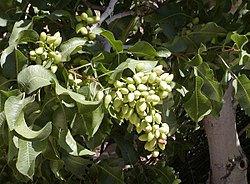 Reife Pistazien (Küchennüsse) | |
| Farbkoordinaten | |
| Hex-Triplett | #60FF00 |
| sRGB B ( r , g , b ) | (96, 255, 0) |
| HSV ( h , s , v ) | (97°, 100 %, 100 %) |
| CIELCh uv ( L , C , h ) | (89, 128, 123°) |
| Quelle | ISCC-NBS [ 22 ] |
| ISCC–NBS-Deskriptor | Kräftiges Gelbgrün |
| B : Normalisiert auf [0–255] (Byte) | |
Pistachio hat eine matte, gelblich-grüne Farbe, die der Pistazie ähnelt .
Avocado
| Avocado | |
|---|---|
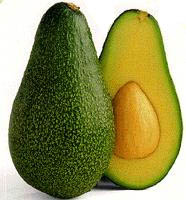 Eine Avocado | |
| Farbkoordinaten | |
| Hex-Triplett | #568203 |
| sRGB B ( r , g , b ) | (86, 130, 3) |
| HSV ( h , s , v ) | (81°, 98 %, 51 %) |
| CIELCh uv ( L , C , h ) | (49, 61, 111°) |
| Quelle | Pourpre.com |
| ISCC–NBS-Deskriptor | Tiefgelbgrün |
| B : Normalisiert auf [0–255] (Byte) | |
Avocado ist ein dunkles Gelbgrün, das die Farbe der Schale einer Avocado darstellt . [ 23 ] Avocado lässt sich durch Mischen gleicher Mengen gelber und grauer Farbe oder ungleicher Mengen gelber und schwarzer Farbe herstellen. Avocado war zusammen mit anderen Erdtönen wie Goldgelb und Orangebraun in den 1970er-Jahren eine gängige Farbe für Konsumgüter wie Autos , Hochflorteppiche und Haushaltsgeräte . [ 23 ]
Spargel
| Spargel | |
|---|---|
 Bündelte Spargelstangen | |
| Farbkoordinaten | |
| Hex-Triplett | #87A96B |
| sRGB B ( r , g , b ) | (135, 169, 107) |
| HSV ( h , s , v ) | (93°, 37 %, 66 %) |
| CIELCh uv ( L , C , h ) | (65, 44, 113°) |
| Quelle | Crayola |
| ISCC–NBS-Deskriptor | Mittleres Gelbgrün |
| B : Normalisiert auf [0–255] (Byte) | |
„Asparagus“ ist ein Chartreuse-Ton, der nach dem Gemüse benannt ist . Crayola kreierte diese Farbe 1993 als eine von 16 Farben, die im Rahmen des Wettbewerbs „Name the Color“ benannt wurden.
Es ist auch die Farbe einer wilden Spargelpflanze, die im Wind weht, aus dem Filmklassiker „Die Sande von Iwo Jima“ von 1949 .
Eine andere Bezeichnung für diese Farbe ist Spargelgrün . Die erste urkundliche Erwähnung von „Spargelgrün“ als Farbbezeichnung im Englischen stammt aus dem Jahr 1805. [ 24 ]
Artischocke
| Artischocke | |
|---|---|
 Eine Artischocke | |
| Farbkoordinaten | |
| Hex-Triplett | #8F9779 |
| sRGB B ( r , g , b ) | (143, 151, 121) |
| HSV (h, s, v) | (76°, 20%, 59%) |
| CIELChuv (L, C, h) | (61, 22, 98°) |
| Source | ISCC-NBS[25][26] |
| ISCC–NBS descriptor | Moderate yellow green |
| B: Normalized to [0–255] (byte) | |
Artichoke is a color that is a representation of the color of a raw fresh uncooked artichoke. Another name for this color is artichoke chartreuse or artichoke green.
The first recorded use of "artichoke green" as a color name in English was in 1905.[26]
See also
References
- ^See the 1930s version of "Chartreuse green" in the index and color samples, a color not as green as the web color chartreuse, but greener than chartreuse yellow – actually it is a representation of the actual color of green chartreuse liqueur. The first recorded use of chartreuse green as a color name in English was in 1926 – Maerz and Paul A Dictionary of Color Page 192; Color sample of Chartreuse Green: Page 47 Plate 12 Color Sample L2
- ^The Oxford English Dictionary (Second ed.). 1989.
- ^Gladys and Gustav Plochere (Dec 15, 1948) Plochere Color System in Book Form, a Guide to Color and Color Harmony, Los Angeles OCLC 5033214
- ^Kenneth Low Kelly, Deane Brewster Judd (1976) Color: Universal Language and Dictionary of Names, p. 58, U.S. Department of Commerce, National Bureau of Standards; Bibliographic record for Color: Universal Language and Dictionary of Names at the Library of Congress
- ^The Domestic Monthly: An Illustrated Magazine of Fashion, Literature, and the Domestic Arts (1885) Vol. 23, pp. 162, 237, 368, Blake and Company, New York
- ^"New Fashions" (May 1889) The Ladies' Home Journal, Vol. 6, No. 6, p. 14, Philadelphia
- ^The Millinery Trade Review (Sep 1889) Vol. 14, No. 9, p. 18
- ^"The Identification of Gems" (1898) The Mineral Industry, Vol. 7, p. 283, McGraw-Hill Book Company, New York and London
- ^"Latest Spring Millinery" (Apr 22, 1905) Dry Goods Reporter Vol. 35, No. 16 p. 33, Chicago
- ^"The Coloration of Liqueurs" (1910) Pure Products, Vol. 6, No. 1, p. 278, Scientific Station for Pure Products, New York
- ^Billboard (Mar 24, 1956) p. 85
- ^"Fashion Confusion" (June 20, 1988) New York Magazine, Vol. 21, No. 25
- ^ The color displayed here matches the color called chartreuse in the 1930 book by Maerz and Paul A Dictionary of Color New York:1930 McGraw-Hill; the color chartreuse is displayed on page 45 Plate 11, Color Sample L1.
- ^ abAloys John Maerz; Morris Rea Paul (1930) A Dictionary of Color, p. 192, New York: McGraw-Hill
- ^Robert Ridgway (1912) Color Standards and Color Nomenclature, p. 67, Published by the author, Washington D.C. OCLC 630954
- ^"SVG Color Keywords, CSS3 Color Module, W3C Candidate Recommendation 14 May 2003". W3C. Retrieved 2007-01-06.
- ^Aloys John Maerz; Morris Rea Paul (1930) A Dictionary of Color, New York: McGraw-Hill; The index refers to Plate 20 Color Sample J1 as Lime Green; this color is shown on Plate 20 as being halfway between yellow-green (the old name for the color that is now called chartreuse green) and yellow on the color wheel.
- ^The Daily News (London) 14 July 1890. "lime, n2". Oxford English Dictionary online version. Oxford University Press. September 2011. Retrieved 2011-11-15.(subscription or participating institution membership required)
- ^The color displayed here matches the color called spring green in the 1930 book by Maerz and Paul A Dictionary of Color New York:1930 McGraw-Hill; the color spring green is displayed on page 59, Plate 18, Color Sample J7.
- ^Maerz and Paul A Dictionary of Color New York:1930 McGraw-Hill p. 205; Color Sample of Spring Green: p. 59 Plate 18 Color Sample J7
- ^https://colorkit.co/color/00ff11/
- ^"ISCC-NBS". Archived from the original on 22 November 2012.
- ^ abSt. Clair, Kassia (2016). The Secret Lives of color. London: John Murray. pp. 230–231. ISBN 9781473630819. OCLC 936144129.
- ^Maerz and Paul A Dictionary of Color New York:1930 McGraw-Hill p. 189
- ^"Retsof online version of ISCC-NBS Dictionary of Colo(u)r Names – Aa through Az". 26 December 2012. Archived from the original on 26 December 2012.
- ^ abMaerz and Paul A Dictionary of Color New York:1930 McGraw-Hill p. 189; Color Sample of Artichoke Green: p. 63 Plate 20 Color Sample B2