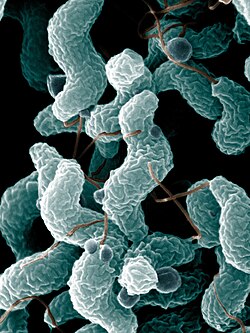
Die Thermotogae sind eine Klasse des Reiches Thermotogati und der Domäne Bacteria . Sie sind die einzige Klasse des Stammes Thermotogota . Die Klasse Thermotogae besteht aus gramnegativen , anaeroben und überwiegend thermophilen und hyperthermophilen Bakterien. [ 2 ] [ 3 ]
Eigenschaften
Der Name dieser Klasse leitet sich von der thermophilen Natur vieler ihrer Arten sowie der charakteristischen Hüllenstruktur, der sogenannten „Toga“, ab, die die Zellen dieser Arten umgibt. [ 4 ] Im Jahr 2010 wurden einige Thermotogae-Arten identifiziert, die in gemäßigten Temperaturen leben. [ 5 ] Obwohl Thermotogae-Arten eine Gram-negative Färbung aufweisen, sind sie von einer einschichtigen Lipidmembran umgeben und zählen daher zu den monodermen Bakterien. [ 3 ] [ 6 ] [ 7 ] Da einige Thermotogae-Arten bei hohen Temperaturen gedeihen können, gelten sie als attraktive Kandidaten für industrielle Anwendungen. [ 8 ] Die Fähigkeit der Thermotogae, verschiedene komplexe Kohlenhydrate zur Wasserstoffproduktion zu nutzen, führte dazu, dass diese Arten als mögliche biotechnologische Energiequelle für alternative Brennstoffe in Betracht gezogen wurden. [ 9 ]
Molekulare Signaturen
Bis vor Kurzem waren keine biochemischen oder molekularen Marker bekannt, die die Arten der Klasse Thermotogae von allen anderen Bakterien unterscheiden konnten. [ 2 ] Eine vergleichende Genomstudie identifizierte jedoch zahlreiche konservierte Signatur-Insertionen/Deletionen (CSIs) in wichtigen Proteinen, die entweder für alle Thermotogae-Arten oder für einige ihrer Untergruppen spezifisch sind. [ 3 ] [ 10 ] Viele dieser CSIs in wichtigen Haushaltsgenen wie Pol I , RecA und TrpRS sowie in ribosomalen Proteinen wie L4, L7/L12, S8, S9 usw. kommen nur in verschiedenen sequenzierten Thermotogae-Arten vor und liefern somit neue molekulare Marker für diese Klasse. In diesen Studien wurden auch CSIs identifiziert, die für jede Ordnung und jede Familie spezifisch sind. [ 11 ] Diese Indels bilden die Grundlage für die aktuelle taxonomische Einteilung der Thermotogae und werden durch phylogenomische Analysen stark gestützt. [ 3 ] [ 10 ] Es wurden weitere CSIs gefunden, die spezifisch für Thermotoga , Pseudothermotoga , Fervidobacterium und Thermosipho sind . Diese CSIs sind spezifisch für alle Arten innerhalb der jeweiligen Gattung und fehlen in allen anderen Bakterien; sie stellen somit spezifische Marker dar. [ 3 ] [ 10 ] Ein Kladus, bestehend aus den tief verzweigten Arten Petrotoga mobilis , Kosmotoga olearia und dem „Thermotogales-Bakterium mesG1“, wurde ebenfalls durch sieben CSIs gestützt. [ 10 ] Darüber hinaus wurden einige CSIs beschrieben, die Hinweise auf horizontalen Gentransfer (LGT) zwischen den Thermotogae und anderen prokaryotischen Gruppen liefern. [ 10 ] Die neu entdeckten molekularen Marker bieten neue Möglichkeiten zur Identifizierung und Abgrenzung von Arten dieser Klasse auf molekularer Ebene und für zukünftige Revisionen ihrer Taxonomie.
Darüber hinaus wurde eine 51 Aminosäuren umfassende Insertion (CSI) identifiziert, die spezifisch für alle Thermotogales sowie für die Aquificales ist , eine weitere Ordnung hyperthermophiler Arten. [ 12 ] Phylogenetische Studien zeigten, dass das Vorkommen derselben CSI in diesen beiden nicht verwandten Bakteriengruppen nicht auf horizontalen Gentransfer zurückzuführen ist , sondern dass sich die CSI wahrscheinlich unabhängig voneinander in diesen beiden Gruppen von Thermophilen aufgrund von Selektionsdruck entwickelt hat . [ 12 ] Die Insertion befindet sich auf der Oberfläche des Proteins in der ATPase-Domäne, nahe der Bindungsstelle für ADP/ATP. Molekulardynamische Simulationen zeigten ein Netzwerk von Wasserstoffbrückenbindungen zwischen Wassermolekülen, Aminosäureresten innerhalb der CSI und einem ADP/ATP-Molekül. Es wird angenommen, dass dieses Netzwerk dazu beiträgt, die ADP/ATP-Bindung an das SecA-Protein bei hohen Temperaturen aufrechtzuerhalten und somit den thermostabilen Phänotyp einiger Thermotogales-Arten zu erklären. [ 12 ]
Phylogenie
| 16S rRNA-basiertes LTP _10_2024 [ 13 ] [ 14 ] [ 15 ] | 120 Markerproteine basierend auf GTDB 10-RS226 [ 16 ] [ 17 ] [ 18 ] | ||||||||||||||||||||||||||||||||||||||||||||||||||||||||||||||||||||||||||||||||||||||||||||||||||||||||||||||||||||||||||||||||||||||||||||||||||||||||||||||||||||||||||||||||||||||||||||||||
|---|---|---|---|---|---|---|---|---|---|---|---|---|---|---|---|---|---|---|---|---|---|---|---|---|---|---|---|---|---|---|---|---|---|---|---|---|---|---|---|---|---|---|---|---|---|---|---|---|---|---|---|---|---|---|---|---|---|---|---|---|---|---|---|---|---|---|---|---|---|---|---|---|---|---|---|---|---|---|---|---|---|---|---|---|---|---|---|---|---|---|---|---|---|---|---|---|---|---|---|---|---|---|---|---|---|---|---|---|---|---|---|---|---|---|---|---|---|---|---|---|---|---|---|---|---|---|---|---|---|---|---|---|---|---|---|---|---|---|---|---|---|---|---|---|---|---|---|---|---|---|---|---|---|---|---|---|---|---|---|---|---|---|---|---|---|---|---|---|---|---|---|---|---|---|---|---|---|---|---|---|---|---|---|---|---|---|---|---|---|---|---|---|---|
|
|
Taxonomie
This class is presently the sole class in the phylum Thermotogae and consists of four orders (Thermotogales, Kosmotogales, Petrotogales, and Mesoaciditogales) and five families (Thermatogaceae, Fervidobacteriaceae, Kosmotogaceae, Petrotogaceae, and Mesoaciditogaceae).[2][3][4][10][19][20][11] It contains a total of 15 genera and 52 species.[21] In the 16S rRNA trees, the Thermotogae have been observed to branch with the Aquificota (a phylum comprising hyperthermophilic organisms) in close proximity to the archaeal-bacterial branch point.[2][4] However, a close relationship of the Thermotogae to the Aquificota, and the deep branching of the latter group of species, is not supported by phylogenetic studies based upon other gene/protein sequences.[3][22][23][24][25] and also by conserved signature indels in several highly conserved universal proteins.[26][27] The Thermotogae have also been scrutinized for their supposedly profuse Lateral gene transfer with Archaeal organisms.[28][29] However, recent studies based upon more robust methodologies suggest that incidence of LGT between Thermotogae and other groups including Archaea is not as high as suggested in earlier studies.[30][31][10][32]
The currently accepted taxonomy is based on the List of Prokaryotic names with Standing in Nomenclature (LPSN)[33] and National Center for Biotechnology Information (NCBI)[34]
- Class ThermotogaeReysenbach 2002
- Genus ?CaldotogaXue et al. 1999
- Order KosmotogalesBhandari & Gupta 2014
- Family Kosmotogaceae Bhandari & Gupta 2014
- Gattung Kosmotoga DiPippo et al. 2009 [ Thermococcoides Feng et al. 2010 ]
- Gattung Mesotoga Nesbo et al. 2013
- Family Kosmotogaceae Bhandari & Gupta 2014
- Ordnung Mesoaciditogales Itoh et al. 2015
- Familie Mesoaciditogaceae Itoh et al. 2015
- Gattung Athalassotoga Itoh et al. 2015
- Gattung Mesoaciditoga Reysenbach et al. 2013
- Familie Mesoaciditogaceae Itoh et al. 2015
- Bestellen Sie Petrotogales Bhandari & Gupta 2014
- Familie Petrotogaceae Bhandari & Gupta 2014
- Tribus "Marinitogeae" Pelletier 2012
- Gattung Marinitoga Wery et al. 2001
- Tribus "Petrotogeae" Pelletier 2012
- Gattung Defluviitoga Ben Hania et al. 2012
- Gattung Geotoga Davey et al. 1993
- Gattung Oceanotoga Jayasinghearachchi und Lal 2011
- Gattung Petrotoga Davey et al. 1993
- Gattung Tepiditoga Mori et al. 2021
- Tribus "Marinitogeae" Pelletier 2012
- Familie Petrotogaceae Bhandari & Gupta 2014
- Bestellung Thermotogales Reysenbach 2002
- Familie Fervidobacteriaceae Bhandari & Gupta 2014
- Gattung Fervidobacterium Patel et al. 1985
- Gattung Thermosipho Huber et al. 1989 nicht Kantor et al. 2013
- Familie "Pseudothermotogaceae" Pallen, Rodriguez-R & Alikhan 2022
- Gattung Pseudothermotoga Bhandari & Gupta 2014
- Familie Thermotogaceae Reysenbach 2002
- Gattung ? Thermopallium Duckworth et al. 1996
- Gattung Thermotoga Stetter und Huber 1986
- Familie Fervidobacteriaceae Bhandari & Gupta 2014
Siehe auch
Referenzen
- ^ Oren A, Garrity GM (2021). „Gültige Veröffentlichung der Namen von zweiundvierzig Stämmen der Prokaryoten“ . Int J Syst Evol Microbiol . 71 (10): 5056. doi : 10.1099/ijsem.0.005056 . PMID 34694987 .
- Huber R., Hannig M. (2006). „Thermotogales“. The Prokaryotes . Band 7: Proteobacteria: Delta and Epsilon Subclasses. Deeply Rooting Bacteria. S. 899–922 . doi : 10.1007/0-387-30747-8_38 . ISBN 978-0-387-25497-5Die
- ^ a b c d e f g Gupta, RS (2014) Der Stamm der Thermotogae. Die Prokaryoten 989-1015. Springer Berlin Heidelberg.
- ^ abcReysenbach, A.-L. (2001) Phylum BII. Thermotogae phy. nov. In: Bergey's Manual of Systematic Bacteriology, pp. 369-387. Eds D. R. Boone, R. W. Castenholz. Springer-Verlag: Berlin.
- ^Nesbo C.L.; Kumaraswamy R.; Dlutek M.; Doolittle W.F. & Foght J. (2010). "Searching for mesophilic Thermotogales bacteria: "mesotogas" in the wild". Appl Environ Microbiol. 76 (14): 4896–4900. Bibcode:2010ApEnM..76.4896N. doi:10.1128/AEM.02846-09. PMC 2901743. PMID 20495053.
- ^Gupta R.S. (1998). "Protein phylogenies and signature sequences: A reappraisal of evolutionary relationships among archaebacteria, eubacteria, and eukaryotes". Microbiol Mol Biol Rev. 62 (4): 1435–1491. doi:10.1128/MMBR.62.4.1435-1491.1998. PMC 98952. PMID 9841678.
- ^Gupta R.S. (2011). "Origin of diderm (Gram-negative) bacteria: antibiotic selection pressure rather than endosymbiosis likely led to the evolution of bacterial cells with two membranes". Antonie van Leeuwenhoek. 100 (2): 171–182. doi:10.1007/s10482-011-9616-8. PMC 3133647. PMID 21717204.
- ^Eriksen N.T.; Riis M.L.; Holm N.K. & Iversen N. (2010). "H(2) synthesis from pentoses and biomass in Thermotoga spp"(PDF). Biotechnol Lett. 33 (2): 293–300. doi:10.1007/s10529-010-0439-x. PMID 20960218. S2CID 35392547.
- ^Conners S.B.; Mongodin E.F.; Johnson M.R.; Montero C.I.; Nelson K.E. & Kelly R.M. (2006). "Microbial biochemistry, physiology, and biotechnology of hyperthermophilic Thermotoga species". FEMS Microbiol Rev. 30 (6): 872–905. doi:10.1111/j.1574-6976.2006.00039.x. PMID 17064285.
- Gupta RS & Bhandari V. (2011). „Phylogenie und molekulare Signaturen für den Stamm der Thermotogae und seine Untergruppen“. Antonie van Leeuwenhoek . 100 ( 1 ) : 1–34 . doi : 10.1007 / s10482-011-9576- z . PMID 21503713. S2CID 24995263 .
- ^ a b Bhandari V, Gupta RS (Januar 2014). „Molekulare Signaturen für den Stamm (die Klasse) Thermotogae und ein Vorschlag für seine Unterteilung in drei Ordnungen (Thermotogales, Kosmotogales ord. nov. und Petrotogales ord. nov.) mit vier Familien (Thermotogaceae, Fervidobacteriaceae fam. nov., Kosmotogaceae fam. nov. und Petrotogaceae fam. nov.) und einer neuen Gattung Pseudothermotoga gen. nov. mit fünf neuen Kombinationen". Antonie van Leeuwenhoek . 105 (1): 143–168 . doi : 10.1007/s10482-013-0062-7 . PMID 24166034 . S2CID 6547323 .
- Khadka , Bijendra ; Persaud, Dhillon; Gupta, Radhey S. (29.12.2019). „ Neuartige Sequenzmerkmale des SecA-Translokaseproteins, einzigartig für thermophile Bakterien: Bioinformatische Analysen zur Untersuchung ihrer potenziellen Rolle“ . Microorganisms . 8 ( 1 ): 59. doi : 10.3390/microorganisms8010059 . ISSN 2076-2607 . PMC 7023208. PMID 31905784 .
- ^ „The LTP“ . Abgerufen am 10. Dezember 2024 .
- ^ „LTP_all-Baum im Newick-Format“ . Abgerufen am 10. Dezember 2024 .
- ^ „LTP_10_2024 Release Notes“ (PDF) . Abgerufen am 10. Dezember 2024 .
- ^ „GTDB-Version 10-RS226“ . Genome Taxonomy Database . Abgerufen am 1. Mai 2025 .
- ^ "bac120_r226.sp_label" . Genome Taxonomy Database . Abgerufen am 1. Mai 2025 .
- ^ „Taxon History“ . Genome Taxonomy Database . Abgerufen am 1. Mai 2025 .
- ^Oren A, Garrity GM (2015). "List of new names and new combinations previously effectively, but not validly, published"(PDF). Int. J. Syst. Evol. Microbiol. 65 (7): 2017–2025. doi:10.1099/ijs.0.000317. PMID 28056215.
- ^Itoh T, Onishi M, Kato S, Iino T, Sakamoto M, Kudo T, Takashina T, Ohkuma M (December 2015). "Athalassotoga saccharophila gen. nov. sp. nov. isolated from an acidic terrestrial hot spring of Japan, and proposal of Mesoaciditogales ord. nov., Mesoaciditogaceae fam. nov. in the phylum Thermotogae". Int. J. Syst. Evol. Microbiol. 66 (2): 1045–1051. doi:10.1099/ijsem.0.000833. PMID 26651491.
- ^Euzeby JP. List of prokaryotic names with standing in nomenclature. http://www.bacterio.cict.fr/t/thermotogales.
- ^Klenk H.P.; Meier T.D.; Durovic P.; et al. (1999). "RNA polymerase of Aquifex pyrophilus: Implications for the evolution of the bacterial rpoBC operon and extremely thermophilic bacteria". J Mol Evol. 48 (5): 528–541. Bibcode:1999JMolE..48..528K. doi:10.1007/pl00006496. PMID 10198119. S2CID 224169.
- ^Gupta R.S. (2000). "The phylogeny of Proteobacteria: relationships to other eubacterial phyla and eukaryotes". FEMS Microbiol Rev. 24 (4): 367–402. doi:10.1111/j.1574-6976.2000.tb00547.x. PMID 10978543.
- ^Ciccarelli F.D.; Doerks T.; von Mering C.; Creevey C.J.; Snel B. & Bork P. (2006). "Toward automatic reconstruction of a highly resolved tree of life". Science. 311 (5765): 1283–1287. Bibcode:2006Sci...311.1283C. CiteSeerX 10.1.1.381.9514. doi:10.1126/science.1123061. PMID 16513982. S2CID 1615592.
- ^Di Giulio M. (2003). "The universal ancestor was a thermophile or a hyperthermophile: Tests and further evidence". J Theor Biol. 221 (3): 425–436. Bibcode:2003JThBi.221..425G. doi:10.1006/jtbi.2003.3197. PMID 12642117.
- ^Bhandari V, Naushad HS, Gupta RS (2012). "Protein based molecular markers provide reliable means to understand prokaryotic phylogeny and support Darwinian mode of evolution". Front Cell Infect Microbiol. 2: 98. doi:10.3389/fcimb.2012.00098. PMC 3417386. PMID 22919687.
- ^Griffiths E. & Gupta R.S. (2004). "Signature sequences in diverse proteins provide evidence for the late divergence of the order Aquificales". International Microbiology. 7 (1): 41–52. PMID 15179606.
- ^Nelson K.E.; Clayton R.; Gill S.; et al. (1999). "Evidence for lateral gene transfer between Archaea and Bacteria from genome sequence of Thermotoga maritima". Nature. 399 (6734): 323–329. Bibcode:1999Natur.399..323N. doi:10.1038/20601. PMID 10360571. S2CID 4420157.
- ^Nesbo C.L.; L'Haridon S.; Stetter K.O. & Doolittle W.F. (2001). "Phylogenetic analyses of two "Archaeal" genes in Thermotoga maritima reveal multiple transfers between Archaea and Bacteria". Mol Biol Evol. 18 (3): 362–375. doi:10.1093/oxfordjournals.molbev.a003812. PMID 11230537.
- ^Ochman H.; Lawrence J.G. & Groisman E.A. (2000). "Lateral gene transfer and the nature of bacterial innovation". Nature. 405 (6784): 299–304. Bibcode:2000Natur.405..299O. doi:10.1038/35012500. PMID 10830951. S2CID 85739173.
- ^Zhaxybayeva O.; Swithers K.S.; Lapierre P.; et al. (2009). "On the chimeric nature, thermophilic origin, and phylogenetic placement of the Thermotogales". Proc Natl Acad Sci U S A. 106 (14): 5865–5870. Bibcode:2009PNAS..106.5865Z. doi:10.1073/pnas.0901260106. PMC 2667022. PMID 19307556.
- ^Kunisawa T (2011). "Inference of the phylogenetic position of the phylum Deferribacteres from gene order comparison". Antonie van Leeuwenhoek. 99 (2): 417–422. doi:10.1007/s10482-010-9492-7. PMID 20706870. S2CID 38697982.
- ^J.P. Euzéby. "Thermotogota". List of Prokaryotic names with Standing in Nomenclature (LPSN). Retrieved 2022-03-20.
- ^Sayers; et al. "Thermotogae". National Center for Biotechnology Information (NCBI) taxonomy database. Retrieved 2022-03-20.