The Transnistrian War (Romanian: Războiul din Transnistria; Russian: Война в Приднестровье, romanized: Voyna v Pridnestrovye) was an armed conflict that broke out on 2 November 1990 in Dubăsari between pro-separatist (Pridnestrovian Moldavian Republic, PMR; Transnistria) forces, including the Transnistrian Republican Guard, militia and neo-Cossack units, which were supported by elements of the Russian 14th Army, and pro-government forces, including Moldovan troops and police.
Fighting intensified on 1 March 1992 and, alternating with ad hoc ceasefires, lasted throughout the spring and early summer of 1992 until a ceasefire was declared on 21 July 1992, which has held. The conflict is sometimes known as the Dniester War (Romanian: Războiul de la Nistru) or the Moldovan–Russian war (Romanian: Războiul moldo-rus) in Moldova and Romania.[6][37] According to Moldovan historian Gheorghe E. Cojocaru, the Moldovan defeat in this war directly led to implementation of Moldovan neutrality.[6]
Background
Historical background
Before the Soviet occupation of Bessarabia and Northern Bukovina and the creation of the Moldavian SSR in 1940, the Bessarabian part of Moldova, i.e. the part situated to the west of the river Dniester (Nistru), was part of Romania (1918–1940). The Molotov–Ribbentrop Pact between the Soviet Union and Nazi Germany, which led to the events of 1940, was later denounced by present-day Moldova, which declared it "null and void" in its Declaration of Independence in 1991. However, after the breakup of the Soviet Union, the territorial changes resulting from it have remained in place.
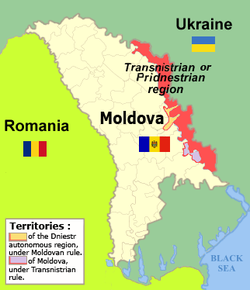
Before the creation of the Moldavian SSR, today's Transnistria was part of the Ukrainian SSR as an autonomous republic called the Moldavian Autonomous Soviet Socialist Republic, with Tiraspol as its capital (1924–1940). It represents slightly more than one tenth of Moldova's territory.
Political background
Under Soviet rule, the Moldavian SSR became subject to a Russification policy, including isolation from the Romanian cultural sphere and the imposition of the Cyrillic alphabet for the Romanian language.[38] During the last years of the 1980s, the political landscape of the Soviet Union was changing due to Mikhail Gorbachev's policies of perestroika and glasnost, which allowed political pluralism at the regional (republican) level. In the Moldavian SSR, as in many other parts of the Soviet Union, national movements became the leading political force.[39] As these movements exhibited increasingly nationalist sentiments and expressed intent to leave the USSR in favor of uniting with Romania, they encountered growing opposition from among the primarily Russian-speaking ethnic minorities living in the republic.[40] This opposition to the new trends and potential future policies was manifested in a more visible way in Transnistria, where, unlike the rest of the MSSR, ethnic Moldovans (39.9%) were outnumbered by the combined figure of Russians and Ukrainians (53.8%) as per the 1989 census in Transnistria, largely due to higher immigration during the Soviet era.
While some believe that the combination of a distinct history (especially 1918–1940) and a fear of discrimination by Moldovans, gave rise to separatist sentiments, others believe that ethnic tensions alone fail to account for the dynamics of the conflict. According to John Mackinlay and Peter Cross, who conducted a study based on casualty reports, significant numbers of both Transnistrians and Moldovans fought together on both sides of the conflict. They suggest that the conflict is more political in nature.[41]
| History of Moldova |
|---|
 |
 Moldova portal |
Am 31. August 1989 erließ der Oberste Sowjet der Moldauischen SSR zwei Gesetze. Das erste erklärte Moldauisch zur Amtssprache und löste Russisch , die faktische Amtssprache der Sowjetunion, ab. Es erwähnte auch eine moldauisch-rumänische Sprachidentität . Das zweite Gesetz legte die Rückkehr zum lateinischen Alphabet fest . „Moldauische Sprache“ war die Bezeichnung für einen nahezu identischen Dialekt der rumänischen Sprache, der in der ehemaligen Sowjetunion von 1940 bis 1989 gesprochen wurde. Am 27. April 1990 nahm der Oberste Sowjet der Moldauischen SSR die traditionelle Trikolore (blau, gelb und rot) mit dem moldauischen Wappen an. Später im selben Jahr wurden die Bezeichnungen „Sowjet“ und „sozialistisch“ gestrichen und der Landesname in „ Republik Moldau “ geändert. 1991 wurde die Nationalhymne in „ Deșteaptă-te, române!“ , die seit 1990 rumänische Nationalhymne, geändert.
Diese Ereignisse, darunter das Ende des Ceaușescu -Regimes im benachbarten Rumänien im Dezember 1989 und die teilweise Öffnung der Grenze zwischen Rumänien und Moldau am 6. Mai 1990, ließen viele in Transnistrien und Moldau an eine unvermeidliche Vereinigung Moldaus mit Rumänien glauben. Diese Möglichkeit schürte die Angst der russischsprachigen Bevölkerung, von den meisten Bereichen des öffentlichen Lebens ausgeschlossen zu werden. Ab September 1989 kam es in der Region zu heftigen Protesten gegen die ethnische Politik der Zentralregierung. Aus diesen Protesten entwickelten sich sezessionistische Bewegungen in Gagausien und Transnistrien, die zunächst Autonomie innerhalb der Moldauischen SSR anstrebten, um Russisch und Gagausisch als Amtssprachen zu behalten. Nachdem der nationalistisch dominierte Oberste Sowjet Moldaus diese Initiativen verboten hatte, erklärten sich die Republik Gagausien und Transnistrien von Moldau losgelöst und beantragten die Wiedereingliederung in die Sowjetunion als unabhängige Föderationsrepubliken. [ 40 ]
Politischer Konflikt
Die Sprachgesetze stellten ein besonders heikles Thema dar, da ein Großteil der nicht-moldauischen Bevölkerung der Moldauischen SSR kein Moldauisch ( Rumänisch ) sprach. Das Problem der Amtssprache in der MSSR hatte sich zu einem gordischen Knoten entwickelt , der übertrieben und womöglich bewusst politisiert wurde. Manche bezeichneten die Sprachgesetze als „diskriminierend“ und kritisierten ihre rasche Umsetzung. Andere hingegen beklagten, dass die Gesetze nicht eingehalten würden.
On 2 September 1990, the Pridnestrovian Moldavian Soviet Socialist Republic was proclaimed, "Pridnestrovie" being the name for Transnistria in Russian. On 22 December 1990 president Gorbachev signed a decree that declared void the decisions of the Second Congress of People Deputies of Transnistria from 2 September. For two months, Moldovan authorities refrained from taking action against this proclamation. Transnistria became one of the "unrecognized republics" that appeared throughout the USSR, alongside Abkhazia, South Ossetia and Nagorno-Karabakh. These self-proclaimed states maintained close ties with each other.
One of the first clashes between the Moldovan government and separatists occurred on 2 November 1990 in Dubăsari.[42] Local women stormed the Court and Prosecutor's Office and stayed there for several hours. A police detachment was then dispatched to clear a roadblock placed by the city residents on the bridge over the river Dniester that effectively cut the city off from the central government. After being prevented from clearing the roadblock, policemen opened fire, with three residents of Dubăsari being killed and 13 wounded, resulting in the first casualties of the conflict.[42][43]
In the aftermath of the failure of the Soviet coup attempt of 1991, on 27 August 1991, the Moldovan parliament adopted the Declaration of Independence of the Republic of Moldova. The declaration referred to the Molotov–Ribbentrop Pact as "null and void" and viewed Moldova's Independence as an act of elimination of "the political and legal consequences of the above", declaring that the establishment of the Moldavian SSR on the territories of Bessarabia, Northern Bukovina, Hertsa region and the Moldavian ASSR was made in absence of "any real legal basis".[44] The PMR interpreted this as meaning that the 1940-merger of the two sides of the Dniester river was dissolved. Moldova, however, did not agree, as large portions of the territory occupied in 1940 by the USSR remain in Ukraine, and almost immediately took steps to assert its sovereignty over the full territory of the former MSSR.
At that time, the Republic of Moldova did not have its own army, and the first attempts to create one took place in early 1992 in response to the escalating conflict. The newly independent Moldovan parliament asked the government of the USSR "to begin negotiations with the Moldovan government in order to put an end to the illegal occupation of the Republic of Moldova and withdraw Soviet troops from Moldovan territory".
When, on 29 August 1991, Transnistria's independence leader Igor Smirnov and three other deputies arrived in Kyiv, the capital of Ukraine, to meet Ukrainian leader Leonid Kravchuk, Smirnov and Andrei Cheban were arrested by Moldova's police and immediately transported to a prison in Moldova. In protest, the women's strike committee headed by Galina Andreeva blocked the Moscow–Chișinău railway line at a waypoint between Bender (Tighina) and Tiraspol, until the men were freed.
In late 1991, policemen in Tiraspol and Rîbnița swore allegiance to the PMR.
Military strength

By 1992, Moldova had troops under the Ministry of the Interior. On 17 March 1992, they started recruiting troops for the newly created Ministry of Defence.[45] By July 1992, total Moldovan troop strength has been estimated at 25,000–35,000, including called-up police officers, conscripts, reservists and volunteers, especially from the Moldavian localities near the conflict zone.
In addition to Soviet weaponry inherited upon independence, Moldova also obtained arms from Romania.[46] Romania also sent military advisors and volunteers[47] to aid Moldova during the conflict.
At the same time, the Russian 14th Guards Army in Moldovan territory numbered about 14,000 professional soldiers. The PMR authorities had 9,000 militiamen trained and armed by officers of the 14th Army. The volunteers came from the Russian Federation: a number of Don, Kuban, Orenburg, Sibir and local Transnistrian Black Sea Cossacks joined in to fight alongside the separatists. Due to the irregular makeup of the forces, troop strength of the PMR is in dispute, but it is believed that during March it numbered around 12,000.[48]
Die in Transnistrien stationierten Streitkräfte der 14. Armee (die nacheinander der UdSSR , der GUS und der Russischen Föderation unterstand) kämpften an der Seite der PMR-Truppen. [ 49 ] [ 50 ] Ein Großteil des Personals der russischen 14. Armee bestand aus einheimischen Wehrpflichtigen und Offizieren, denen eine lokale Residenz zugewiesen worden war. Die PMR-Einheiten konnten sich mit Waffen aus den Beständen der ehemaligen 14. Armee ausrüsten. Die russischen Truppen entschieden sich, den PMR-Einheiten, die sich an den Armeebeständen bedienten, keinen Widerstand zu leisten; im Gegenteil, in vielen Fällen halfen sie den PMR-Truppen bei der Ausrüstung, indem sie ihnen Waffen aushändigten und die Munitionslager öffneten.
Im Dezember 1991 verhafteten die moldauischen Behörden Generalleutnant Jakowlew auf ukrainischem Gebiet. Ihm wurde vorgeworfen, die Volksmobilmachungskräfte (PMR) mit Waffenbeständen der 14. Armee unterstützt zu haben. General Jakowlew war zu dieser Zeit sowohl Kommandeur der 14. Armee als auch Leiter der Abteilung für Nationale Verteidigung und Sicherheit der PMR. Die Regierung der Russischen Föderation intervenierte bei der moldauischen Regierung, um die Freilassung von General Jakowlew im Austausch gegen 26 Polizisten zu erreichen, die zu Beginn der Kämpfe in Dubăsari von den PMR-Kräften festgenommen worden waren.
Am 5. April 1992 rief der russische Vizepräsident Rutskoi in einer Rede vor 5.000 Menschen in Tiraspol das transnistrische Volk dazu auf, seine Unabhängigkeit zu erlangen.
Militärischer Konflikt
Die ersten Todesopfer des aufkeimenden Konflikts ereigneten sich am 2. November 1990, zwei Monate nach der Unabhängigkeitserklärung der PMR am 2. September 1990. Moldauische Truppen drangen in Dubăsari ein , um Transnistrien zu teilen, wurden jedoch von den Einwohnern der Stadt aufgehalten, die die Brücke über den Dnjestr bei Lunga blockiert hatten . In dem Versuch, die Straßenblockade zu durchbrechen, eröffneten die moldauischen Truppen das Feuer. [ 51 ] Im Verlauf der Auseinandersetzung wurden drei Einwohner von Dubăsari, Oleg Geletiuk, Vladimir Gotkas und Valerie Mitsuls, von den moldauischen Streitkräften getötet und sechzehn weitere verletzt. [ 33 ]
A second Moldovan attempt to cross the Lunga bridge took place on 13 December 1991. As a result of the fighting, 27 PMR troops were taken prisoner and four Moldovan troops (Ghenadie Iablocikin, Gheorghe Cașu, Valentin Mereniuk and Mihai Arnăut) were killed,[52] without Moldova being able to cross the bridge. After this second failed attempt, there was a lull in military activity until 2 March 1992, the day Moldova was admitted as a member of the United Nations, i.e. received full international recognition of its 27 August 1991 declaration of independence. After Transnistrian paramilitary advances Moldova declared the state of emergency on 29 March, the armed conflict culminated in May and June in three areas along the Dniester river, and died down on 19–21 June after the Battle of Bender (also Tighina) where the 14th former Soviet Army intervened and drove the Moldovan army putting an end to the conflict.
Cocieri-Dubăsari area

The first area of military action was on the eastern shore of the Dniester river, from north to south, the villages of Molovata Nouă, Cocieri (approx 6,000 inhabitants), Corjova and the city of Dubăsari (approx 30,000 inhabitants), together forming a contiguous mainly inhabited area 10–12 km (about 7 miles) along the shore. The only connection to the western bank from the three villages is either a ferry, or two bridges in Dubăsari.
On 1 March 1992 Igor Shipcenko, the PMR militia chief of Dubăsari, was killed by a teenager and Moldovan police were accused of the killing. Although minor, this incident was a sufficient spark for the already very tense situation to blow up and cause the conflict to escalate.
In response, the Cossacks who came from Rostov-on-Don to support the PMR side stormed the police precinct in Dubăsari during the night. Moldovan president Mircea Snegur, afraid of starting an armed conflict, ordered the 26 policemen to surrender to the attacking Cossacks and PMR forces. They were later exchanged for Lieutenant-General Yakovlev. Moldovan policemen loyal to Chișinău from the Dubăsari raion (district), instead of returning to work in the occupied precinct in Dubăsari, now a milice precinct, gathered in Cocieri.
Am 2. März 1992 drangen Einwohner von Cocieri, nachdem sie von der Lage in Dubăsari erfahren hatten, in das kleine örtliche Waffenlager ein, um sich gegen die PMR zu bewaffnen. Drei Einheimische (Alexandru Luchianov aus Cocieri, Alexandru Gazea aus Molovata und Mihai Nour aus Roghi ) wurden getötet, die Militäreinheit aus Cocieri wurde jedoch von den Moldauern besiegt. Die Offiziere und ihre Familien mussten das Dorf verlassen. [ 53 ] In den folgenden Tagen wurden weitere Polizisten vom Westufer des Dnjestr herbeigeschafft. Sie errichteten eine Verteidigungslinie um die drei Dörfer, während die PMR-Truppen die Kontrolle über Dubăsari behielten. In den folgenden Wochen zogen sowohl die PMR- als auch die moldauischen Streitkräfte große Truppenkontingente in dem Gebiet zusammen und führten einen Stellungskrieg mit zeitweiligen Waffenstillständen.
Gebiet Coșnița
Eine ähnliche Entwicklung ereignete sich am 13. März in den Dörfern Coșnița, Pîrîta, Pohrebea und Doroțcaia. Ein zweiter „Brückenkopf“ entstand am Ostufer, südlich von Dubăsari.
Im April besuchte der russische Vizepräsident Alexander Ruzkoi Transnistrien und sicherte den transnistrischen Separatisten die volle Unterstützung Sowjetrusslands zu. [ 54 ]
Gebiet Bender/Tighina
Im Juni 1992 wurde in der Region Bender (Tighina) ein Waffenstillstand ausgehandelt . Nachdem reguläre moldauische Streitkräfte jedoch in die Stadt Bender einmarschiert waren, um dort die moldauische Autorität wiederherzustellen, brachen offene Kämpfe aus. Berichten zufolge war diese Aktion eine Reaktion auf die Auseinandersetzung am Polizeirevier in Bender am 19. Juni 1992. Am Nachmittag desselben Tages hatte die moldauische Polizei in Bender Major Jermakow von der 14. Armee wegen des Verdachts auf geplante Subversion festgenommen. Nach seiner Festnahme eröffneten Angehörige der paramilitärischen Volksarmee (PMR) das Feuer auf das Polizeirevier. Die moldauische Regierung befahl ihren Truppen am folgenden Morgen den Einmarsch in die Stadt. In der dicht besiedelten Stadt entbrannte ein Häuserkampf zwischen den beiden Seiten, der zivile Opfer forderte. [ 55 ] Laut moldauischem Radio wurden drei sowjetische T-64- Panzer der 14. Armee, einige mit russischen Flaggen, beim Vormarsch auf das Zentrum von Bender zerstört. [ 55 ] Zwei davon durch MT-12-Panzerabwehrkanonen , der dritte wurde von einer MT-12-Granate im Motor getroffen. Ein vierter Panzer wurde durch den Treffer einer Rakete auf die Ketten außer Gefecht gesetzt. [ 56 ] Sprecher der russischen Armee gaben an, die Panzer seien von Separatisten aus Depots erbeutet worden. Russische Quellen berichteten von „Dutzenden Toten“ auf den Straßen. [ 55 ]
Die Nachricht von den Verwüstungen in Bender erreichte das nur 11 km entfernte Tiraspol, als moldauische Truppen sich der strategisch wichtigen Brücke über den Dnjestr näherten. Daraufhin eilten die Transnistrische Republikanische Garde und Kosakenfreiwillige, unterstützt von Panzern der Republikanischen Garde, den moldauischen Streitkräften entgegen. Der russische Vizepräsident Ruzkoi rief in einer Rede im russischen Fernsehen alle in Tiraspol stationierten russischen Streitkräfte zum Sturm auf Bender auf. In den folgenden Tagen wurden Teile der Stadt Bender, darunter das Stadtzentrum, von den Truppen der Volksrepublik Transnistrischen Revolution (PMR) zurückerobert.
Am 22. Juni 1992, nach Meldungen, dass Truppen der 14. Armee bereit seien, den Dnjestr zu überqueren und tief nach Moldau vorzudringen, befahl das moldauische Militär einen Luftangriff zur Zerstörung der Brücke zwischen Bender und Tiraspol. Drei MiG-29 starteten von Chișinău, zwei davon mit je sechs OFAB -250-Bomben bestückt. Die dritte Maschine, eine MiG-29UB, diente der Deckung. Es wurden keine direkten Treffer auf das Ziel erzielt, die Brücke erlitt jedoch durch Nahtreffer Druck- und Splitterschäden. Eine der Bomben verfehlte ihr Ziel und traf ein Wohnhaus, wobei mehrere Menschen getötet wurden. Quellen der 14. Armee behaupteten, am folgenden Tag einen zweiten MiG-29-Angriff auf eine Ölraffinerie in Tiraspol durchgeführt zu haben, bei dem angeblich eine Maschine von einer S-125 Neva/Pechora -Rakete abgeschossen worden sei. Dieser Einsatz wurde jedoch von den moldauischen Behörden dementiert. [ 56 ] [ 57 ]
Waffenstillstands- und Gemeinsame Kontrollkommission

Am 21. Juli wurde ein Waffenstillstandsabkommen unterzeichnet. [ 58 ] Dieses offizielle Dokument, dessen Grundzüge von russischer Seite festgelegt wurden, wurde von den Präsidenten Russlands ( Boris Jelzin ) und Moldaus ( Mircea Snegur ) unterzeichnet. Das Abkommen sah die Entsendung von Friedenstruppen zur Gewährleistung der Einhaltung des Waffenstillstands und der Sicherheitsvorkehrungen vor. Diese Truppen bestanden aus fünf russischen Bataillonen, drei moldauischen Bataillonen und zwei Bataillonen der Volksmobilmachungskräfte (PMR) unter dem Kommando der Gemeinsamen Kontrollkommission (JCC).
Schätzungen zufolge wurden in dem Konflikt insgesamt fast tausend Menschen getötet, die Zahl der Verwundeten beläuft sich auf fast 3.000. Anders als in vielen anderen postsowjetischen Konflikten erreichte die Zahl der Binnenvertriebenen im Transnistrien-Krieg keine hohe Anzahl.
Days after the truce had been agreed upon, a military confrontation between a local self-defence unit and the Moldovan army, took place in Gîsca (Gyska), a village with an ethnic Russian majority near Bender. At least three villagers were killed. During the combat, civil buildings were damaged or destroyed by artillery fire. Later reports of ceasefire violations have been brought under control with no known loss of human lives.
The Russian 14th Army's role in the area was crucial to the outcome of the war. The Moldovan army's position of inferiority prevented it from gaining control of Transnistria. Russia has since disbanded the 14th army and reduced troop strength in Transnistria to a corps of around 1,300 men who form part of the JCC.
With the PMR's overwhelming military superiority, Moldova had little chance of achieving victory and the fighting was unpopular with the skeptical Moldovan population.[5]
Human rights abuses
According to a Human Rights Center "Memorial" report, local Bender eyewitnesses on 19 June 1992 saw Moldovan troops in armored vehicles deliberately firing at houses, courtyards and cars with heavy machine guns.[43] The next day, Moldovan troops allegedly shot at civilians that were hiding in houses, trying to escape the city, or helping wounded PMR guardsmen. Other local eyewitnesses testified that in the same day, unarmed men who gathered in the Bender downtown square in request of the PMR Executive Committee were fired at from machine guns.[43] HRC observers were told by doctors in Bender that as a result of heavy fire from Moldovan positions between 19 and 20 June, they were unable to attend the wounded.[43]
From 21 to 22 June, both sides engaged in intense urban street fighting, which employed the use of tanks, artillery and grenade launchers. Officers from both sides admitted that these actions led to an increase in civilian casualties.[43] During this time period, ambulance cars were fired upon, with both sides accusing each other of the attacks. PMR sources stated that in Bender, one doctor was killed and several wounded, while six ambulance personnel were wounded in Căușeni.[43]
In the Moldovan city of Chișinău, HRC Memorial observers interviewed 12 Transnistrian prisoners of war. The prisoners stated that while being initially detained and interrogated in Căușeni, they were severely beaten with clubs and gun buttstocks by Moldovan police, as well as being threatened with firing squads.[43]
Es gab einige Berichte über gefangengenommene moldauische Polizisten, Soldaten und Freiwillige, die von den PMR-Kräften geschlagen und gefoltert wurden. [ 43 ]
Ausländische Beteiligung
Beteiligung der russischen Armee
Obwohl die russische Armee offiziell Neutralität und Nichteinmischung erklärte, sympathisierten viele ihrer Offiziere mit der jungen Pridnestrowischen Moldauischen Republik (PMR), und einige liefen sogar offen über, um die PMR zu unterstützen. Das Pionierbataillon der Russischen Gefechtsgruppe (ROG) Parcani schloss sich unter dem Kommando von General Butkewitsch der PMR an. Dieses Bataillon zerstörte später die Brücken bei Dubăsari , Gura Bâcului - Bâcioc und Coșnița . Moldauische Streitkräfte setzten Flugzeuge im Dorf Parcani (Parkany) ein und beschossen die dortige ROG-Station, wodurch es nicht nur zu Kämpfen mit der PMR, sondern auch mit russischen Truppen kam.
In 1991, PMR paramilitary forces conducted forays into supply depots of the 14th Guards Army, appropriating an unknown but large amount of equipment. With the commanding officer of the 14th Guards Army, General G. I. Yakovlev, openly supporting the newly created PMR, these forays usually met no resistance from army guards, who never faced punishment. Yakovlev eventually participated in the founding of the PMR, served in the PMR Supreme Soviet and accepted the position as the first chairman of the PMR Department of Defense on 3 December 1991, causing the Commander-in-Chief of the CIS armed forces, Yevgeny Shaposhnikov, to promptly relieve him of his rank and service in the Russian military.[59] Yakovlev's successor, General Yuriy Netkachev, assumed a more neutral stance in the conflict. However, his attempts at mediation between Chișinău and Tiraspol were largely unsuccessful and the situation escalated to an open military engagement by June 1992. On 23 June, in the wake of a coordinated offensive by Moldovan forces, Major General Alexander Lebed arrived at the 14th Army headquarters with standing orders to inspect the army, prevent the theft of armaments from its depots, stop the ongoing conflict with any means available and ensure the unimpeded evacuation of armaments and Army personnel from Moldovan and through Ukrainian territory. After briefly assessing the situation, he assumed command of the army, relieving Netkachev, and ordered his troops to enter the conflict directly. On 3 July at 03:00, a massive artillery strike from 14th Army formations stationed on left bank of the Dniester obliterated the Moldovan force concentrated in Gerbovetskii forest, near Bender, effectively ending the military phase of the conflict.[60][61] Romanian authors Anatolie Muntean and Nicolae Ciubotaru attribute to Lebed a quote demonstrating his support of the Transnistrian cause: "I am proud that we helped and armed Transnistrian guards against Moldovan fascists".[62] He also called himself as "guarantor" of the "Dniester Republic".[63] However, he bore no goodwill towards the Transnistrian leadership and frequently denounced them as "criminals" and "bandits". Another quote attributed to him describes his stance as follows: "I told the hooligans [separatists] in Tiraspol and the fascists in Chișinău – either you stop killing each other, or else I'll shoot the whole lot of you with my tanks".[17]
Involvement of Russian and Ukrainian volunteers
Volunteers from Russia and Ukraine, including Don and Kuban Cossacks, fought on Transnistria's side. There is no general consensus on the number of volunteers or the military role they played in the conflict. Estimates range from as low as 200 to as high as 3,000.[64][65] Russian volunteers included: Dmitry Rogozin,[66]Eduard Limonov and Igor Girkin.[67]
During the Transnistrian War, UNA-UNSO members fought alongside Transnistrian separatists against Moldovan government forces in defense of a large ethnic-Ukrainian minority in Transnistria.[28] The incongruous motive of assisting a mostly pro-Russian region was for the "struggle of Slavs over Moldovan-Romanian aggression."[28] Following the war, 50 UNSO members were awarded the PMR "Defender of Transnistria" medal.
According to Romanian sources, at least one inmate was released from Bender prison to be enrolled in the Transnistrian Guard.[64]
Involvement of Romania
Shortly before the escalation of the conflict in late June 1992, Romania provided military support to Moldova by supplying weaponry, ammunition and armed vehicles,[46][65] and also by sending military advisers and training Moldovan military and police forces.[61] Volunteers from Romania fought on Moldova's side.[17][18][68] However, the Romanian support for Moldova wasn't sufficient enough to win the war, which disappointed the pro-Romanian segments of Moldovan population.[7]
See also
- History of Transnistria
- Kozak memorandum
- Military history of the Russian Federation
- Moldova–Transnistria relations
- Moldovan neutrality
- Odesa Military District
- Russian military presence in Transnistria
- Transnistria conflict
- Uppsala Conflict Data Program
References
- ^Soviet Socialist Republic of Moldova until 23 May 1991. Constituent republic of the Soviet Union until 27 August 1991.
- ^"România, Rusia și geopolitica conflictului transnistrean* | Asociația Europeană de Studii Geopolitice și Strategice "Gheorghe I. Brătianu"".
- ^ a b De La Pedraja, René (2018). Der russische Militärwiederaufschwung: Post-sowjetischer Niedergang und Wiederaufbau, 1992–2018 . McFarland . S. 93–94 . ISBN 9781476634494
Diese Reaktion war zu viel für den Befehlshaber der 14. Armee, General Juri Netkatschew, der daraufhin den Befehl gab, die moldauischen Streitkräfte zu vertreiben. Die 14. Armee hatte die Separatisten von Anfang an unterstützt, doch diese direkte Unterstützung war die erste offene Kampfhandlung. … Die Beteiligung der 14. Armee war für den Sieg der Separatisten unerlässlich. … Die moldauischen Streitkräfte hatten sich in einem Wald bei Bender verschanzt, und Lebed beschloss, ihren Vormarsch mit seiner starken Artillerie zu stoppen. Um 3:00 Uhr am 3. Juli brach ein massives Artilleriefeuer auf die ahnungslosen Moldauer nieder
. - ^ de Waal, Thomas (2018). Unsicheres Terrain: Die Auseinandersetzung mit Europas De-facto-Staaten und abtrünnigen Gebieten (PDF) . Carnegie Endowment for International Peace . S. 39.
Keine der beiden Seiten verfügte über eine adäquate Streitmacht. Die Intervention der russischen 14. Armee und ihres Kommandeurs General Alexander Lebed zugunsten der Transnistrier war entscheidend.
- ^ Kosienkowski, Marcin; Schreiber, William (8. Mai 2012). Moldawien: Arena internationaler Einflüsse . Lexington. ISBN 9780739173923Abgerufen am 4. September 2022 .
- ^ a b William Crowther, „Moldau: zwischen Nation und Imperium gefangen“, in: Neue Staaten, neue Politik , Ian Bremmer und Ray Taras (Hrsg.), (Cambridge: Cambridge University Press, 1997), S. 322.
- ^ a b c Cojocaru, Gheorghe (16. Juli 2022). „Republica Moldova: istoria neutralității“ (auf Rumänisch). Radio Europa Liberă Moldawien . Abgerufen am 29. April 2026 . Asumarea
statutului de neutralitate permanentă printr-o clauză constituțională a fost o consecință a războiului de la Nistru, pierdut în 1992. [ Die Annahme des Status der dauerhaften Neutralität durch eine Verfassungsklausel war eine Folge
des 1992 verlorenen
Dnjestr-Krieges . ]
- ^ a b Całus, Kamil (September 2015). Im Schatten der Geschichte: Rumänisch-Moldauische Beziehungen (PDF) . Warschau: OSW Zentrum für Oststudien. S. 51. ISBN 9788362936656Die
- ^Pavel Kringel: „Alles, was ich wollte, war noch nicht einmal ein Kunde!“[Pavel Creangă: „Während des gesamten Krieges habe ich keinen einzigen schriftlichen Befehl erhalten!“]. KP.Md. 3. März 2010. Abgerufen am 19. März 2022 .
- ^ a b „Meldung nach Erkenntnissen des Präsidenten der Republik Moldau vom 14. November 1991“ „Übersicht der Republik Moldau вооружения, военной Technik, zweijähriges Militär, unabhängiges deutsches Unternehmen, Verbreitung in regionalen Ressorts“„ [Über Maßnahmen zur Umsetzung des Dekrets des Präsidenten der Republik Moldau vom 14. November 1991 „Über die Erklärung von Waffen, militärischer Ausrüstung und anderem militärischen Eigentum der auf dem Gebiet der Republik stationierten Militäreinheiten zum Eigentum der Republik Moldau“] (in Russisch). Archiviert vom Original am 12. November 2017.
- ^ „Категория:Книга Памяти“ [Kategorie:Buch der Erinnerung] (auf Russisch). Archiviert vom Original am 25. März 2016.
- ^Конфликт глубокой заморозки[Konflikt um Tiefkühlung] (auf Russisch). Mk.ru. August 2012. Abgerufen am 19. März 2022 .
- ^ "История Войны" [Geschichte des Krieges] (auf Russisch). Archiviert vom Original am 4. März 2016.
- ^ „Приднестровье без Шевцова“ . Zavtra.ru . Abgerufen am 19. März 2022 .
- ^ MA (12. Juni 2012). „Transnistrien: Monument pentru generalul crime Lebed“ . Ziua Veche . Abgerufen am 19. März 2022 .
- ^ a b Tarasiuk, Taras; Umland, Andreas (29. September 2021). „Unerwartete Freundschaften: Die Zusammenarbeit ukrainischer Ultranationalisten mit russischen und kremlnahen Akteuren“ . Illiberalism Studies Program. Archiviert vom Original am 18. August 2023. Abgerufen am 5. Mai 2023 .
- ^ Munteanu, Anatole (10. Juli 2009).Kampanien in Tigine[Kampagne in Tigine]. artofwar.ru (auf Russisch). Archiviert vom Original am 27. August 2016. Abgerufen am 21. August 2022 .
- ^ a b c d Richard Humphries. „Transnistrien: Relikt einer vergangenen Ära“ , The Japan Times , 8. Oktober 2001. Abgerufen am 6. August 2014.
- ^ abKumar Rupesinghe and Valery A. Tishkov (1996), "Ethnicity and power in the contemporary world" Chapter 5, "Dynamics of the Moldova Trans-Dniester ethnic conflict (late 1980s to early 1990s)"Archived 10 March 2009 at the Wayback Machine, United Nations University Press
- ^"Mircea Snegur: 'Ne-am achitat cu România cu un MiG 29'". 14 October 2011.
- ^"Borderland Europe: Transforming Transnistria?". Archived from the original on 25 March 2007. Retrieved 6 June 2019.
- ^"RUSSIA". www.hrw.org.
- ^Necșuțu, Mădălin (22 January 2021). "BIRN fact-check: what must be done for Russian forces to leave Transnistria?". Balkan Insight.
- ^Hughes, James and Sasse, Gwendolyn: Ethnicity and territory in the former Soviet Union: regions in conflict. Taylor & Francis, 2002, page 107. ISBN 0-7146-8210-1
- ^Voskresenskaya, Ludmila (6 April 2014). 6 апреля казаки в Краснодаре провели поминовение погибших во время военного конфликта в Приднестровье (ФОТО) [On 6 April, Cossacks in Krasnodar held a commemoration for those killed during the military conflict in Transnistria (PHOTO)] (in Russian). Radio Pridnestrovie. Archived from the original on 10 September 2014.
- ^Gladkovskaya, V. Участие казаков России в Приднестровском конфликте [Participation of Russian Cossacks in the Transnistrian conflict]. olvia.idknet.com (in Russian). Archived from the original on 26 July 2014. Retrieved 21 July 2022.
- ^Konoplyov, Roman (2 February 2014). Приднестровье и Молдова. Можно ли уйти из СССР? (in Russian). Roman Konoplev – via Google Books.
- ^Bejan, Ștefan (21 August 2017). "'Noi trebuie să ne închinăm rușilor și să uităm de români'. Interviu cu primul lider al găgăuzilor din Moldova". moldNova (in Romanian). Archived from the original on 23 August 2017.
- ^ abcSabrina Ramet (1999), "The radical right in Central and Eastern Europe since 1989", Pennsylvania University Press. ISBN 0-271-01810-0, pp. 290 ff.
- ^Tkachuk, Maryna (19 August 2011). "uk:'Краще згинути вовком, нiж жити псом'„ [Lieber als Wolf sterben als als Hund leben]. Ukraina Moloda (auf Ukrainisch) . Abgerufen am 25. Dezember 2023. “
- ^ „Monumentul eroilor căzuți în războiul transnistrea“ (auf Rumänisch). Denkmal.md. 29. August 1998. Archiviert vom Original am 22. Juli 2011 . Abgerufen am 5. September 2011 .
- ^ Accente , Nr. 36, 14. März 2002
- ^ Dnestrovskaya Pravda, Nr. 84-85, Seite 2, 24. November 2001
- ^ ein b „В Дубоссарах отметили годовщину первого вооруженного столкновения на Днестре“ (auf Russisch). newdaynews.ru. 4. März 2011 . Abgerufen am 5. September 2011 .
- ^ Возрожденному в приднестровье черноморскому казачьему войску – 15 лет Archiviert am 3. Mai 2007 bei der Wayback Machine Olvia Press . 18. Dezember 2006. Abgerufen am 18. Dezember 2006.
- ^ „Im Vorfeld der 15-jährigen Tschernobyl-Katastrophe“ . Archiviert am 22. Februar 2014 bei Wayback Machine Новый Регион – Приднестровье , 14. Dezember 2006.
- ^ „Moldau“ . UCDP-Konflikt-Enzyklopädie. Archiviert vom Original am 4. April 2016. Abgerufen am 3. Mai 2013 – über die Universität Uppsala.
- ^ Ursu, Valentina (1. März 2020). „Oazu Nantoi: „Conflictul nu este intern.“ „Pacificatorii ruși au mirea de a nu e lokal rezolvarea acestui confliction“" . Radio Europa Liberă Moldova (auf Rumänisch).
- ^ „Transnistrien-Konflikt: Ursprünge und Probleme“ . OSZE . 10. Juni 1994. Abgerufen am 6. März 2022 .
- ^ Hare, Paul (1999). „Wer sind die Moldauer?“ . In: Paul Hare; Mohammed Ishaq; Judy Batt (Hrsg.). Die Neugestaltung des Marktes: Die politische Ökonomie der mikroökonomischen Transformation . Taylor & Francis. S. 363. ISBN 90-5702-328-8Abgerufen am 30. Oktober 2009 .
- ^ a b Hare, Ishaq, Batt , S. 369-370.
- ^ [John Mackinlay und Peter Cross: Regionale Friedenssicherungskräfte, Das Paradoxon der russischen Friedenssicherung. United Nations University Press: New York & Paris, 2003. Seiten 140–141]
- ^ a b Erika Dailey; Jeri Laber; Lois Whitman (1993). Menschenrechte in Moldawien: Der turbulente Dnjestr (Seite 4) . Human Rights Watch. ISBN 9781564320896. Retrieved 5 September 2011.
- ^ abcdefgh"Large-scale and gross violations of human rights and the situation in the zone of armed conflict in and around the city of Bender (June–July, 1992)". Human Rights Center "Memorial". Retrieved 6 August 2014.
- ^"Moldova's 1991 Declaration of Independence". Archived from the original on 17 June 2007.
- ^"Istoria creării Armatei Naționale (Moldova)". Army.gov.md. Archived from the original on 4 September 2011. Retrieved 5 September 2011.
- ^ abArms and Ethnic Conflict, John Sislin, Frederic S. Pearson (Rowman & Littlefield, 2001), p. 99, ISBN 0-8476-8855-0
- ^"Voronin says Romania started Moldova's war against Transnistria". miris.eurac.edu. Tiraspol Times. 29 April 2008. Retrieved 25 March 2022.
- ^Евгений Норин. Под знаменами демократии. С. 51
- ^Vahl, Marius. Borderland Europe: Transforming Transnistria?Archived 25 March 2007 at the Wayback Machine Centre for European Political Studies, October 2001.
- ^Analysis of the Transnistrian Conflict "Human Rights and Russian Military Involvement in the "Near Abroad"" Human Rights Watch December. 1993
- ^Vlad Grecu – "O viziune din focarul conflictlui de la Dubăsari", Prut International 2005, ISBN 9975-69-741-0, page 30-34 (Romanian)]
- ^Vlad Grecu – "O viziune din focarul conflictului de la Dubăsari", page 38-39
- ^V. Grecu – "O viziune din focarul conflictului de la Dubăsari", page 65-68
- ^Хроника конфликта в Приднестровско – Молдавской республике с 1988 по 2006 г.Archived 17 March 2009 at the Wayback Machine(in Russian); Alexander Rutskoi visit in Bender in 1992 (video) on YouTube
- ^ abc"Moldovan Forces Seize A Key Town". The New York Times. 21 June 1992.
- ^ abCooper, Tim; Stratulat, Alexandru (May 1998). "War in Moldova (1992)". Airman Magazine.
- ^Bárcenas Medina, Luis Andrés; López Jiménez, José Ángel (December 2011). "Los Conflictos Congelados de la Antigua Unión Soviética"(PDF). Conflictos Internacionales Contemporáneos (in Spanish). 15. Ministerio de Defensa: 60–1.
- ^Jeff Berliner (21 July 1992). "Leaders sign Moldova peace pact". United Press International.
- ^(in Russian) Anna Volkova, LeaderArchived 24 September 2015 at the Wayback Machine (Tiraspol’: [s.n.], 2001), 56. Chapter 6.
- ^Irina F. Selivanova. "U.S. and Russian Policymaking With Respect to the Use of Force", chapter 4, Trans-Dniestria
- ^ ab(in Russian)"Вождь в чужой стае" by Mikhail Bergman
- ^Anatolie Muntean, Nicolae Ciubotaru – "Războiul de pe Nistru" (The war on Dniestr), Ager-Economistul Publishing House, Bucharest 2004, page 451 (with a photo of Lebed inspecting Transnistrian guards) (in Romanian)
- ^Bodie, William C. (18 March 1993). "Moscow's "near Abroad": Security Policy in Post-Soviet Europe". Institute for National Strategic Studies, National Defense University – via Google Books.
- ^ ab(in Romanian) Anatolie Muntean, Nicolae Ciubotaru – "Războiul de pe Nistru", Ager – Economistul Publishing House, Bucharest 2004, pages 119 and 122.
- ^ abManaging Conflict in the Former Soviet Union: Russian and American Perspectives, Alexei Arbatov, et al. eds. (Cambridge: MIT Press, 1997), p. 178, ISBN 0-262-51093-6
- ^"UNIMEDIA - Portalul de știri nr. 1 din Moldova".
- ^В бой за Донбасс идет господин реконструктор! [In the battle for the Donbass is Mr. Enactor!]. Комсомольская Правда (in Russian). 29 April 2014. Archived from the original on 30 May 2014. Retrieved 16 June 2014.
- ^Приднестровский парламентарий: Причиной приднестровского конфликта стало то, что Молдавия провозгласила себя моноэтническим государством, REGNUM News Agency, 20:04 3 March 2008
Further reading
- Vlad Grecu, O viziune din focarul conflictului de la Dubăsari, Editura Prut International, Chișinău, 2005 (in Romanian)
- Covalschi, Stanislav; Leancă, Viorica (2014). „Aspect Geopolitic al Conflictului Transnistrea“ [Geopolitischer Aspekt des Transnistrienkonflikts] (PDF) . Juristische Nationalität: Theorie und Praxis (3): 242–247 . ISSN 2345-1130 . Abgerufen am 18. April 2021 .