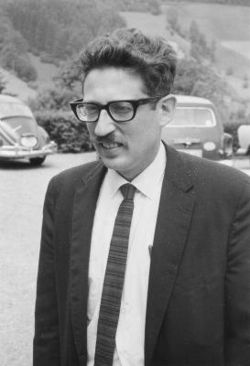
Yousef Alavi (March 19, 1928 – May 21, 2013)[1] was an Iranian-American mathematician, based at Western Michigan University (WMU), who specialized in graph theory. He received his PhD from Michigan State University in 1958,[2] and his career at WMU lasted until 1996. Alavi was a frequent collaborator with Don R. Lick and Jiuqiang Liu (both of Eastern Michigan University) as well as with Paul Erdős, and in 1987, the Michigan Section of the Mathematical Association of America (MAA) awarded him its first annual Distinguished Service Award.
Early life and education (1928–1958)
Alavi was born in the city of Ahvaz in Pahlavi Iran in 1928.[1] He moved to the United States in 1948.[3] There, he earned a bachelor's degree in electrical engineering from Michigan State University in 1953, a master's in math from the same school in 1955, and a PhD in 1958.[3]
Career (1958–1996)
He was a professor of mathematics at WMU from 1958 until his retirement in 1996;[4] he chaired the department from 1989 to 1992.[5]
Alavi was known for complaining that "this is highly irregular!" He was also a frequent host for Erdős on his visits to Western Michigan. On one of these visits, these two things came together: he made his usual complaint at a time when Erdős and Ronald Graham were present. This sparked a discussion on what it might mean for a graph to be highly irregular, kicking off a line of joint research on highly irregular graphs through which Alavi obtained Erdős number one.[6]
In 1987, he received the first Distinguished Service Award of the Michigan Section of the MAA due to his 30 years of service to the section; at that time, the Michigan House and Senate issued a special resolution honoring him.[7]
Research
1987 untersuchten Alavi, Erdős, Paresh J. Malde und Allen J. Schwenk die Knotenunabhängigkeitsfolge eines ungerichteten Graphen , wobei m die maximale Ordnung einer beliebigen unabhängigen Menge ist und die Anzahl der unabhängigen Mengen mit genau i Knoten bezeichnet. [ 8 ] Durch die Vereinigung mehrerer vollständiger Graphen konnten sie zeigen, dass diese Folge jede mögliche Permutation realisieren kann . [ 8 ]


Im selben Jahr führten Alavi, Erdős, A. J. Boals , Gary Chartrand und Ortrud Oellermann auch den Begriff der aufsteigenden Teilgraphenzerlegung ein, bei der ein Graph in eine Folge von Teilgraphen zerlegt wird, sodass jeder dieser Teilgraphen isomorph zu einem Teilgraphen des nächsten Graphen ist. Sie vermuteten, dass jeder endliche Graph eine aufsteigende Teilgraphenzerlegung zulässt, und verifizierten dies für alle Pfade , alle Kreise und alle Graphen mit höchstens 6 Knoten. [ 9 ]
1991 führten Alavi, Erdős, Mehdi Behzad und Don R. Lick den Begriff des Doppelknotengraphen für beliebige Graphen ein. [ 10 ] Weiterführende Forschungen von Alavi, Lick und Jiuqiang Liu in den Jahren 1993 und 1994 führten schließlich zu einer Klassifizierung, welche Hamiltonschen Graphen auch Hamiltonsche Doppelknotengraphen besitzen. [ 10 ] Insbesondere ist der Doppelknotengraph des vollständigen bipartiten Graphen K(m, n) nur dann Hamiltonsch, wenn die Gleichung erfüllt ist. [ 10 ]

Tod und Vermächtnis
Vor seinem Tod widmete sich Alavi seiner Frau und seinem Sohn, die ihn beide überlebten. [ 11 ] Er wurde für seine „große Energie“, seine „Freundlichkeit“ und seinen „guten Humor“ in Erinnerung behalten. [ 11 ]
Alavi starb am 21. Mai 2013; [ 12 ] sein Gesundheitszustand hatte sich bereits mehrere Monate zuvor verschlechtert. [ 11 ] Am 23. Mai fand um 12 Uhr mittags eine private Beisetzung auf dem Riverside Cemetery statt, [ 1 ] und am 29. Juni wurde in der Kanley Chapel ein Gedenkgottesdienst für ihn abgehalten . [ 3 ]
In remembrance of Alavi, the "Yousef Alavi Memorial Symposium" was held from October 24 to 25, 2013, on the sixth floor of the Everett Tower at WMU, as well as the Fetzer Center. It was free and open to the public.[13] Speakers included Fan Chung and Ronald Graham, both of the University of California, San Diego.[13]
References
- ^ abc"Yousef Alavi", Kalamazoo Gazette, May 23, 2013.
- ^Yousef Alavi at the Mathematics Genealogy Project
- ^ abc"Yousef Alavi obituary | News | Western Michigan University", wmich.edu, retrieved 2026-01-14
{{cite web}}CS1-Wartung: Veralteter Archivierungsdienst ( Link ) - ^Emeritus facultyArchived 2009-07-02 at the Wayback Machine, Western Michigan University mathematics department.
- ^History of the departmentArchived 2009-03-01 at the Wayback Machine, Western Michigan University mathematics department.
- ^Schechter, Bruce (2000), My Brain is Open: The Mathematical Journeys of Paul Erdős, Simon and Schuster, p. 197, ISBN 9780684859804
- ^"MAA Michigan Section", sections.maa.org, archived from the original on 2026-03-17, retrieved 2026-03-17
- ^ abAlavi, Yousef; Malde, Paresh J.; Schwenk, Allen J.; Erdos, Paul (1987), "The Vertex Independence Sequence of a Graph Is Not Constrained"(PDF), Congressus Numerantium, 58: 15–23
- ^Alavi, Yousef; Boals, A. J.; Chartrand, Gary; Erdos, Paul; Oellermann, Ortrud R. (1987), "The Ascending Subgraph Decomposition Problem"(PDF), Congressus Numerantium, 58: 7–14
- ^ abcAlavi, Yousef; Lick, Don R.; Liu, Jiuqiang (December 1, 2002), "Survey of Double Vertex Graphs", Graphs and Combinatorics, 18 (4): 709–715, doi:10.1007/s003730200055, ISSN 1435-5914
- ^ a b c „Mathematics People“ (PDF) , Notices of the AMS : 1184, Oktober 2013, archiviert (PDF) vom Original am 14.01.2026
- ^ „Nachruf auf Yousef Alavi (2013) – Kalamazoo, MI – Kalamazoo Gazette“ , Legacy.com , abgerufen am 14.01.2026
- ^ a b „Yousef Alavi wird im Rahmen eines Mathematiksymposiums geehrt | Nachrichten | Western Michigan University“ , wmich.edu , archiviert vom Original am 31.08.2014 , abgerufen am 14.01.2026