
In May to October 1868, a cricket team composed of Aboriginal Australians toured England, becoming the first organised group of Australian sportspeople to travel overseas.[1] It would be another ten years before an Australian cricket team classed as representative left the country.
The concept of an Aboriginal cricket team can be traced to pastoral stations in the Western District of Victoria, where, in the mid-1860s, the European owners introduced Aboriginal station hands to the sport. An Aboriginal XI was created with the assistance of Tom Wills, the captain of the Victorian cricket team and founder of Australian rules football, who acted as the side's captain-coach in the lead-up to and during an 1866–67 tour of Victoria and New South Wales. Several members of the team joined what became the Aboriginal XI that toured England under the captaincy of Englishman Charles Lawrence.
International sporting contact was rare in that era. Previously, only three cricket teams had travelled abroad, all English, to the United States and Canada in 1859, and to Australia in 1861–62 and 1863–64.
Background
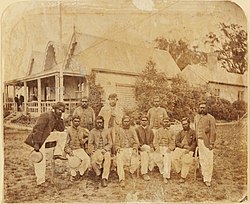


The 1850s and 1860s saw a rapid increase in the popularity of cricket in Australia.[2] In the Western District of Victoria, from the early 1860s onwards, cricket matches took place between Aboriginal Australians and European settlers at local pastoral properties, where many Aboriginal people were employed as station hands. The Aboriginal people were admired for their athletic skills and, in early 1866, a series of matches were staged with the intention of selecting the strongest possible Aboriginal XI. Thomas Gibson Hamilton of Bringalbert Station, near Edenhope, created a team which he coached. They played an exhibition match at Hamilton, which gained the attention of Tom Wills.[3][4]
The resulting team was initially coached by local pastoralist William Hayman. Coaching duties were later turned over to Wills, captain of the Victoria cricket team and founder of Australian rules football, who spoke to the team in the Djab Wurrung language he had learnt as a child growing up in the Western District among the Djab Wurrung people. To commentators at the time, Wills' decision to join and help the team was something of a puzzle given that, only five years earlier, he had survived the Cullin-la-ringo massacre in Queensland, in which his father and 18 other European colonists were murdered by local indigenous people. "It was always a matter of wonder how Tom could be friendly with the blacks, considering that they murdered his father", one sportswriter noted.[5]
On Boxing Day 1866, in front of over 10,000 spectators, Wills captained the team against the Melbourne Cricket Club at the Melbourne Cricket Ground. Bell's Life in Victoria reported: "Seldom has a match created more excitement in Melbourne than the one under notice, and never within our recollection has a match given rise to so much feeling on behalf of the spectators."[6] "The veteran Wills never captained an eleven who so thoroughly possessed the sympathies of the spectators," wrote a Melbourne correspondent for The Sydney Mail. "A dark skin suddenly became a passport to the good graces of Victorians."[7] Although they lost to the MCC, the Aboriginal players were commended for their performance, and showed marked improvement on a subsequent tour of country Victoria.
An entrepreneur, Captain Gurnett, persuaded the team to travel to Sydney to begin a planned tour of the colonies and England. However, after their arrival in Sydney in February 1867, Gurnett embezzled some of the funds raised to finance the enterprise, leaving the team stranded. They were looked after by Charles Lawrence at his Manly Hotel, and he organised a number of games, completing a tour of New South Wales before returning to Victoria in May. Four players succumbed to the effects of illness: "Sugar" and "Watty" died on tour, while "Jellico" and "Paddy" died shortly afterward.
Team members
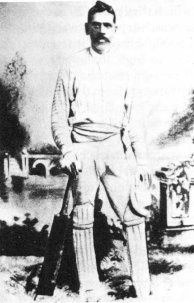
1867 wurde Charles Lawrence als Kapitän und Trainer der australischen „First Eleven“ engagiert, die 1868 durch England tourte. Lawrence spielte 1855 für Surrey, 1862 für die All-Ireland XI und 1863 für die All-England XI. Er wurde als erster professioneller Cricket-Trainer in New South Wales verpflichtet und sah die indigene Mannschaft erstmals unter der Leitung von Tom Wills, der ein Spiel im Albert Ground in Sydney bestritt . Bei dieser Gelegenheit kam es zu einer Vertragsstreitigkeit zwischen dem geplatzten Sponsor Gurnett und Wills, und die Spieler blieben in Sydney zurück. Lawrence wurde beauftragt, sich um die Aborigine-Spieler zu kümmern. Zu dieser Zeit betrieb Lawrence ein Gasthaus und brachte die Spieler in seinem Hotel in Manly unter, bis er Cricketspiele organisieren konnte, um Geld für ihre Rückreise in den Western District von Victoria zu sammeln. 1867 trainierte er die Spieler zwei Monate lang am „Lake Wallace“ in Edenhope in der Wimmera-Region, bevor er die untenstehende Mannschaft für die Englandtournee 1868 auswählte. Der Surrey County Cricket Club stellte außerdem einen seiner Platzwarte ( William Shepherd ) für die Tournee der Aborigines ab, der gelegentlich als Ersatzspieler und Schiedsrichter aushalf. [ 8 ] [ 9 ]
Die Tour wurde von dem Sydneyer Anwalt George Graham finanziert. Zusammen mit seinem Cousin George Smith (der 1859 Bürgermeister von Sydney gewesen war) und William Hayman reisten sie alle zu dieser Tour nach England.
- Charles Lawrence – Spielertrainer
- Johnny Mullagh – traditioneller Name: Unaarrimin
- Bullocky – traditioneller Name: Bullchanach. Bullocky war ein Wicketkeeper und wurde als „sowohl der schwarze Bannerman als auch Blackham seines Teams“ bezeichnet. [ 10 ]
- Sundown – traditioneller Name: Ballarin
- Dick-a-Dick – traditioneller Name: Jungunjinanuke
- Johnny Cuzens – traditioneller Name: Zellanach
- König Cole – traditioneller Name: Bripumyarrimin
- Rote Kappe – traditioneller Name: Brimbunyah
- Twopenny – traditioneller Name: Murrumgunarriman
- Charley Dumas – traditioneller Name: Pripumuarraman
- Jimmy Mosquito – traditioneller Name: Grougarrong, der „aufrecht unter einer Stange hindurchgehen und dann im Stehen darüber springen konnte“. [ 10 ]
- Tiger – traditioneller Name: Boninbarngeet
- Peter – traditioneller Name: Arrahmunijarrimun
- Jim Crow – traditioneller Name: Jallachniurrimin
- William Shepherd – Schiedsrichter, Assistent und gelegentlicher Spielerkapitän
Im Juni starb „King Cole“ an Tuberkulose und wurde auf dem Victoria Park Cemetery im heutigen Londoner Stadtteil Tower Hamlets beigesetzt . Sundown und Jim Crow kehrten im August aus gesundheitlichen Gründen nach Hause zurück. [ 1 ] Keiner der indigenen Spieler erhielt für seine Teilnahme an der Tournee eine Vergütung. [ 11 ]
Tour


Nach einem Schaukampf im Beisein von Prinz Alfred im Albert Ground [ 12 ] verließ die Mannschaft Sydney am 8. Februar 1868 an Bord der Parramatta . [ 13 ] Am 13. Mai erreichten sie Gravesend und erholten sich zunächst in Town Malling von der Reise , bevor sie nach London weiterreisten. [ 14 ] Dort wurden sie mit einer gewissen Faszination empfangen – schließlich befanden sie sich in der Zeit der Evolutionsdebatten nach der Veröffentlichung von Charles Darwins „ Die Entstehung der Arten“ im Jahr 1859. Die Reaktionen waren gemischt. Die Times bezeichnete die Touristen als „eine Farce des Cricketspiels in Lord’s “ und als „die unterworfenen Eingeborenen einer Sträflingskolonie“. Der Daily Telegraph schrieb über Australien: „Von dort kommt nichts Interessantes außer Goldnuggets und schwarzen Cricketspielern.“
Das erste Spiel fand am 25. und 26. Mai im Oval in London statt und lockte 20.000 Zuschauer an. Vermutlich kamen viele der Zuschauer eher aus Neugier als nur, um ein Cricketspiel zu genießen. Die Times berichtete: [ 15 ]
„Ihr Haar und ihre Bärte sind lang und drahtig, ihre Haut variiert in verschiedenen Schwarztönen, und die meisten von ihnen haben weit geöffnete Nasenlöcher. Da sie im Busch unter europäischen Siedlern mit landwirtschaftlichen Tätigkeiten aufgewachsen sind, sind sie bestens zivilisiert und mit der englischen Sprache sehr vertraut.“
Der Daily Telegraph schrieb:
Es ist höchst interessant und kurios, auf dem historisch gesehen sächsischsten Teil unserer Insel bei einem Freundschaftsspiel Angehörige zweier so unterschiedlicher Völker wie den modernen Engländer und den australischen Ureinwohner zu beobachten. Obwohl einige von ihnen einheimische Buschmänner sind und alle pechschwarz sind, scheinen diese Inder in jeder Hinsicht angezogen und geistig gesund zu sein.
Insgesamt bestritt das Aborigine-Team innerhalb von sechs Monaten 47 Spiele in ganz England, von denen es 14 gewann, 14 verlor und 19 unentschieden spielte – ein gutes Ergebnis, das viele damals überraschte. Die Leistungen der Spieler reichten von außergewöhnlichen Athleten bis hin zu zwei oder drei Teammitgliedern, die kaum zum Erfolg beitrugen. Der herausragende Spieler war Johnny Mullagh. Er erzielte 1.698 Runs und nahm 245 Wickets. George Tarrant , ein angesehener englischer Fast Bowler jener Zeit, warf Mullagh während einer Mittagspause einen Ball zu und sagte später: „Ich habe noch nie gegen einen besseren Batsman gespielt.“
Neben dem Cricketspielen führten die Aborigines-Spieler nach einem Spiel häufig Vorführungen im Bumerang- und Speerwerfen auf. Dick-a-Dick hielt außerdem einen schmalen Abwehrschild und forderte die Zuschauer auf, Cricketbälle nach ihm zu werfen, die er mit dem Schild abwehrte. Das Aborigines-Team wurde in einem Cricketball-Wurfwettbewerb nur knapp von dem aufstrebenden englischen Allrounder WG Grace , einem 20-jährigen Starspieler , geschlagen, der 118 Yards warf. [ 16 ]
Am 16. Oktober versammelten sich Mitglieder des Surrey County Cricket Club sowie die Öffentlichkeit in der Canterbury Music Hall in London, wo jedem der tourenden Cricketspieler ein Erinnerungsschläger überreicht wurde. [ 17 ]
Nachwirkungen
Das Team kehrte im Februar 1869 nach Sydney zurück. Im folgenden Monat spielten sie ein Spiel gegen eine Militärmannschaft und trennten sich anschließend. Twopenny zog später nach New South Wales und spielte 1870 für die Kolonie gegen Victoria. Cuzens starb im darauffolgenden Jahr an der Ruhr . Mullagh wurde als Profi vom Melbourne Cricket Club angestellt und vertrat Victoria 1879 gegen die englische Tourneemannschaft, wobei er im zweiten Innings die meisten Punkte erzielte.
1869 entschied der Zentralrat für Aborigines, dass es illegal sei, Aborigines ohne die Zustimmung des zuständigen Regierungsministers aus der Kolonie Victoria zu entfernen. Dies schränkte die Beteiligung von Aborigines am Spielbetrieb faktisch ein.
Als Mullagh im August 1891 im Alter von 50 Jahren starb, galt er neben Lawrence, der 1917 starb, als letztes noch lebendes Mitglied des Teams. [ 18 ] [ 19 ] Man geht jedoch heute davon aus, dass Red Cap zwischen 1891 und 1894 und Tarpot im April 1900 starb. [ 20 ]
William Shepherd verfasste 51 Jahre später einige Beobachtungen über die Spieler, die im Jahr seines Todes, 1919, im Ayres Cricket Companion veröffentlicht wurden. [ 21 ] [ 9 ]
Vermächtnis

On 13 October 1951, former Australia captain Vic Richardson unveiled a memorial to the side in Edenhope, Victoria, where the players had trained prior to the tour.[22][23]
In May 1988, an Aboriginal team captained by John McGuire visited England to mark the Australian Bicentenary, retracing the steps of the 1868 side.[24][25]Vince Copley of the Ngadjuri people assisted in organising the tour,[26] about which a documentary entitled Dreaming of Lords was shown the following year on Channel 4 in the United Kingdom.[27]
In 2002, Charles Lawrence's great-great-grandson, Ian Friend, along with historians and cricketers, including former Test captain Ian Chappell, successfully campaigned to have the Aboriginal XI recognised in the Sport Australia Hall of Fame. Ian Friend and Jack Kennedy (descendant of Johnny Cuzens) both accepted the award on behalf of the team. Also that year, a documentary film about the team, titled A Fine Body of Gentlemen, was broadcast by the ABC.[28]
- 2004 – The 1868 team members were presented with cap numbers by Cricket Australia.
- 2004 – The Johnny Mullagh interpretative centre opened in Harrow in the Wimmera.
- 2018 – Australia Post released a stamp celebrating 150 years since the 1868 tour.
- 2018 – Cricket Australia held a smoking ceremony at Johnny Mullagh's sacred water hole in Harrow, celebrating 150 years since the tour.
Australia sent men's and women's Aboriginal teams to England in June 2018, to mark the 150th anniversary of the tour.[29][30]
In December 2019, Cricket Australia revealed plans for the Johnny Mullagh Medal, to be awarded to the best player in the Boxing Day Test match from 2020. The medal is a recreation of the belt buckle he wore with the addition of a picture of the 1868 team.
Das Theaterstück „Black Cockatoo“ über Cricketspieler , geschrieben von Geoffrey Atherden und mit ausschließlich indigenen Darstellern, wurde beim Sydney Festival 2020 aufgeführt . [ 31 ]
Im Januar 2020 ermutigte Len Pascoe den Singer-Songwriter Matt Scullion , ein Lied über die Tour zu schreiben, nachdem er sich zuvor mit dem Gamilaraay- Ältesten und ehemaligen Cricketspieler Les Knox darüber unterhalten hatte. Scullion schrieb das Lied „1868“ und sang es Anfang 2021 beim zweiten Twenty20 International im Sydney Cricket Ground . Eine weitere Aufführung im Bradman Museum war für April 2021 geplant. [ 32 ] [ 33 ]
Eine Reihe von Artefakten der Aborigines, die von der Reisegruppe nach England gebracht wurden, werden in der Sammlung des Royal Albert Memorial Museum in Exeter aufbewahrt . Ein von Dick-a-Dick benutzter Schläger befindet sich ebenfalls im Besitz des Marylebone Cricket Club . [ 34 ]
Siehe auch
- Australisches Cricket-Team
- Geschichte des Test-Cricket (bis 1883)
- Liste der Spiele des australischen indigenen Cricket-Teams
Referenzen
- ^ a b Ricketts, Olly (9. Juli 2013). „Aboriginal cricket: The first Australian tour of England, 1868“ . BBC News . London . Abgerufen am 9. Juli 2013 .
- ^ McEachern, Jeremy (2017). „Far From Home: The 1868 Aboriginal Cricket Tour of England“ . Agora . 52 (3): 18–24 . ISSN 0044-6726 – via InformIT .
- ^ Hamilton, JC (1914). Pioniertage im westlichen Victoria: Eine Erzählung über das frühe Stationsleben . Melbourne: Exchange Press. S. 79–80 – via Trove .
- ^ „Thomas Gibson HAMILTON, geb. 10. Mai 1844, gest. 2. April 1875; USH00209 auf eHive“ . eHive . 30. Dezember 2017. Abgerufen am 1. Juni 2021.
Thomas trainierte das Edenhope (Victoria) Aboriginal Cricket Team, das 1868 unter der Leitung von William Hayman und Charles Lawrence durch England tourte.
- ^ „Der Vagabund“ (15. März 1883). „Sportliche Notizen“ . The Maitland Mercury and Hunter River General Advertiser . Band 40, Nr. 5440 – via Trove.
- ^"M.C.C. v. Ten Aboriginals with T.W. Wills". Bell's Life in Victoria and Sporting Chronicle. Vol. 11, no. 452. Melbourne. 29 December 1866. p. 2. Retrieved 26 January 2024 – via Trove.
- ^"Thersites" (26 January 1867). "Matters in Melbourne". The Sydney Mail. Vol. 8, no. 343. Retrieved 26 January 2024 – via Trove.
- ^Cricket Walkabout – The Australian Aboriginal Cricketers on Tour 1867-68 by John Mulvaney and Rex Harcourt. Pg 95. ISBN 0-333-43086-7
- ^ abLords Dreaming – The Story of the 1868 aboriginal tour of England and beyond by Ashley Mallett
- ^ abOld Un (2 April 1897). "An Old Time Team of Darkies". Euroa Advertiser. Retrieved 26 January 2024 – via Trove.
- ^Samson, David (2009). "Culture, 'race' and discrimination in the 1868 Aboriginal cricket tour of England". Australian Aboriginal Studies. 2009 (2): 44–60. ISSN 0729-4352.
- ^"Aboriginal Cricket Match". The Sydney Mail. Vol. 9, no. 397. 8 May 1868. pp. 8–9 – via Newspapers.com.
- ^"Cricket". The Standard. No. 13651. London. 6 May 1868. p. 6 – via Newspapers.com.
- ^Christiansen, Rupert (2000). The Victorian Visitors: Culture Shock in Nineteenth-Century Britain. New York: Atlantic Monthly Press. p. 167. ISBN 0871137909.
- ^"Eleven Aboriginal Black Australians v. Eleven Gentlemen of Surrey Club". The Times. No. 26134. London. 26 May 1868. p. 5.
- ^"Aboriginies – The first Australian cricket team". Convictcreations.com. Retrieved 6 April 2014.
- ^"Canterbury Hall". The Standard. No. 13793. London. 19 October 1868. p. 7 – via Newspapers.com.
- ^"Cricket". The Australian Town and Country Journal. Vol. 43, no. 1127. Sydney. 22 August 1891. p. 40 – via Trove.
- ^"Aboriginal Cricketer Dead". The Telegraph. No. 5876. Brisbane. 17 August 1891. p. 2 – via Trove.
- ^Holland, D. J. (1967). Cricket Walkabout. Melbourne University Press. pp. 69–85.
- ^Ayres Cricket Companion 1919, under the title “the tour of Australian Aborigines in the year of 1919”. Pg 195
- ^"Ex-Test Captain Unveils Memorial". The Horsham Times. No. 10521. Horsham, Vic. 16 October 1951. p. 4 – via Trove.
- ^Moyes, A. G. (1959). Australian Cricket: A History. London: Angus and Robertson. pp. 155–157.
- ^"Bats Test". The Glasgow Herald. 14 May 1988. Retrieved 25 June 2011.
- ^"Ashes of Dark Past". Brisbane Times. 21 June 2009. Archived from the original on 24 December 2013. Retrieved 24 June 2011.
- ^Silva, Nadine (13 January 2022). "Ngadjuri Elder and changemaker Vincent Copley passes away aged 85". NITV. Retrieved 23 November 2023.
- ^Billson, Nadine (10 August 1989). "Alternative Australian Cricket". The Times. No. 63469. London. p. 19.
- ^"A Fine Body of Gentlemen". Film Illawarra. Archived from the original on 4 April 2005. Retrieved 22 May 2005.
- ^"Christian, Gardner to lead squads in commemorative tour of England". International Cricket Council. Retrieved 10 April 2018.
- ^"Aboriginal XI squads to commemorate 1868 pioneers with UK tour". Wisden India. Archived from the original on 10 April 2018. Retrieved 10 April 2018.
- ^Boland, Michaela (9 January 2020). "Black Cockatoo tells the story of Australia's all-Indigenous cricket team as Sydney Festival opens". ABC News. Australian Broadcasting Corporation. Retrieved 9 January 2020.
- ^Jackson, Russell (18 February 2021). "How Len Pascoe turned Australia's pioneering Indigenous cricket team into a chart-topping song". ABC News. Australian Broadcasting Corporation. Retrieved 27 March 2021.
- ^1868 Matt Scullion on YouTube
- ^Sculthorpe, Gaye (2016). "Finding Aboriginal lives in United Kingdom museum collections: artefacts from the 1868 Aboriginal cricket tour of England". Australian Aboriginal Studies. 2016 (1): 85–91. ISSN 0729-4352.
Further reading
- Mallett, Ashley (2002). Lords' Dreaming: Cricket on the Run – The 1868 Aboriginal Tour of England. ISBN 0-285-63640-5.
- Mallett, Ashley. The Black Lords of Summer: The Story of the 1868 Aboriginal Tour of England and Beyond, University of Queensland, 2002. ISBN 0-7022-3262-9
- Whimpress, Bernard (1999). Passport To Nowhere: Aborigines In Australian Cricket 1850-1939. Walla Walla Press, Sydney. ISBN 1-876718-06-4.
- Mulvaney, John; Harcourt, Rex (1988). Cricket Walkabout: The Australian Aborigines in England. Macmillan Australia. ISBN 0-333-43086-7.
External links
- Boland, Michaela (9 January 2020). "Black Cockatoo tells the story of Australia's all-Indigenous cricket team as Sydney Festival opens". ABC News. Australian Broadcasting Corporation. – A play about the cricket team called Black Cockatoo, with an all-Indigenous cast.
- ATSIC article
- First Tour Scorebook – State Library of NSW
- Match results on Cricket Archive
- https://australiapostcollectables.com.au/articles/commemorating-the-first-cricket-tour-to-england

