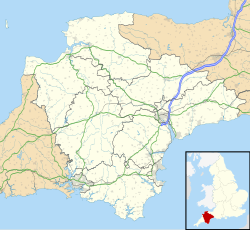
Devonport ( UK : / ˈdɛvənpɔːt / DEV - ən -pot , US: /ˈdɛvənpɔːrt/ DEV-ən-port) [ 1 ] , früher Plymouth Dock oder einfach Dock genannt [ 2 ] , ist ein Stadtteil von Plymouth in der Grafschaft Devon , England , obwohl es einst die bedeutendere Siedlung war. 1889 wurde es zu einer kreisfreien Stadt. Devonport war ursprünglich eine der „ Three Towns “ ( zusammen mit Plymouth und East Stonehouse ); diese fusionierten 1914 zur Stadt Plymouth, die 1928 gegründet wurde. Devonport ist im britischen Parlament als Teil des Wahlkreises Plymouth Sutton and Devonport vertreten . Der gewählte Abgeordnete des Wahlkreises ist Luke Pollard , Mitglied der Labour and Co-operative Party . Die Einwohnerzahl des Wahlkreises betrug laut Volkszählung von 2011 14.788. [ 3 ]
Geschichte
Plymouth Dock

1690 erteilte die Admiralität Robert Waters aus Portsmouth den Auftrag zum Bau eines Steindocks in Point Froward am Ostufer des Hamoaze an der Mündung des Flusses Tamar . Plymouth Dock, wie Devonport ursprünglich hieß, entstand um 1700 als kleine Siedlung für die Arbeiter des neuen Marinestützpunkts, der um Waters' Dock herum errichtet wurde. [ 4 ] Bis 1733 war die Einwohnerzahl auf etwa 3.000 angewachsen, [ 5 ] und 1801 war Plymouth Dock bereits größer als die beiden nahegelegenen Städte Plymouth und Stonehouse zusammen. [ 6 ]
Devonport
Im Jahr 1811 zählte Plymouth Dock etwas über 30.000 Einwohner, die sich daran störten, dass der Name den Eindruck erweckte, es handele sich um einen Vorort von Plymouth. 1823 wurde König Georg IV. mit der Bitte um Umbenennung der Stadt und dem Vorschlag „Devonport“ kontaktiert. Der König stimmte der Namensänderung zu, die am 1. Januar 1824 in Kraft trat. [ 7 ] [ 8 ] Zur Feier des Tages errichtete die Stadt neben dem kurz zuvor fertiggestellten Rathaus die Devonport-Säule ; beide wurden von John Foulston entworfen . [ 2 ] Devonport wurde 1837 gemäß dem Municipal Corporations Act von 1835 erstmals als Stadtgemeinde eingemeindet . Die Volkszählung von 1841 ergab eine Einwohnerzahl von 33.830. [ 9 ]
Im Juli 1849 kam es in der Union Street , die Plymouth mit Devonport verband, zu den ersten Ausbrüchen einer Choleraepidemie . Diese wurden zunächst auf die Verstopfung mehrerer Hausabflüsse während des Baus des neuen Bahnhofs Millbay zurückgeführt . [ 10 ] [ 11 ] Devonport wurde 1888 gemäß dem Local Government Act zu einer kreisfreien Stadt . 1914 wurde die kreisfreie Stadt Devonport aufgelöst, als sie zusammen mit dem benachbarten Stadtbezirk East Stonehouse in die kreisfreie Stadt Plymouth eingemeindet wurde. [ 12 ] Am 1. April 1974 wurde die Gemeinde aufgelöst und mit Plymouth zusammengelegt. [ 13 ] Bei der Volkszählung von 1951 (der letzten vor der Auflösung der Gemeinde) hatte Devonport 72.738 Einwohner. [ 14 ]
Verteidigungsanlagen der Werft

In the mid-eighteenth century a defensive earthwork was constructed around the town and dockyard. Within these dockyard 'lines', six square barracks were built between in 1758–63 to accommodate the garrison of troops required to man the defences.[15] A series of redoubts were also constructed, forward of the lines, in the 1770s, including that at Mount Pleasant (of which there are substantial remains).[16] In the early nineteenth century, the dockyard lines were strengthened with stone ramparts and armed with guns, and the adjacent ditches were deepened. These defences became largely redundant with the building of a series of Palmerston Forts around Plymouth in the second half of the nineteenth century. Much of the open land forming the glacis beyond the lines became Devonport Park in the late 1850s.[17] Three of the six small barracks were replaced in 1854–6 by the sizeable Raglan Infantry Barracks, designed by Captain Francis Fowke (who later designed the Albert Hall); today only its gatehouse remains (and that in a derelict state), the rest having been demolished in the 1970s.[18]
Mount Wise

The high ground south of the town is called Mount Wise. Enclosed within the town ramparts, it was given its own redoubt in the 1770s, with eight guns and two mortars protecting the coastal approach to the dockyard. In earlier times, a gun wharf had been established on the quayside here to the south-east; the gun wharf was removed (and re-established at Morice Yard alongside the Dockyard) in 1724, but the area remained dominated by the armed forces up until the present century. From the late-eighteenth/early-nineteenth century both the military Governor and naval Commander-in-Chief of Plymouth were accommodated in large houses on Mount Wise (in Government House and Admiralty House respectively).[19] In 1805 a Royal Laboratory (an outpost of the Woolwich Arsenal) was established just north-west of the redoubt; small-arms ammunition and explosives were manufactured here, until the compound was converted into barracks accommodation (Mount Wise Barracks) in the 1830s.[20]
21st-century Devonport
During the millennium decade, Devonport received government New Deal for Communities funding of £48.7 million; this enabled an extensive Regeneration programme to be carried out. Since 2009, the investments have begun to transform Devonport – physically, socially, demographically. Where once the area was run-down, depressed, and classified as 'deprived' in many categories, the 21st-century Devonport is beginning to achieve the city's vision of ... "The recreation of Devonport as a distinct place in modern Plymouth; a vibrant self sustaining community; a place of real quality, variety and interest, the pride of residents, attractive to visitors and a model of 21st Century living, working and playing."[21]
The Admiralty's release of several land plots in Devonport has assisted the Regeneration project. One ex-MoD area, where new homes will be available from 2011, is the Admiralty House site at Mount Wise. Although there are pockets of regeneration work remaining to be completed, the waterfront district of Devonport is becoming one of the desired residential areas of the city of Plymouth.[22]
In 2011, the Devonport Heritage Trail was introduced, complete with over 70 waymarkers outlining the route.[23]
Facilities
Devonport has its own shopping street, a railway station, a swimming pool, park and a sports ground, The Brickfields. Since 2003, it has been the home of Plymouth Albion, the city's Rugby union club located near Plymouth City College.
Devonport is also home to the Devonport Playhouse, a theatre located in the former Methodist Central Hall in Fore Street. The space was purchased and converted into a performance venue by the Plymouth Theatre Company back in 1987.[24] It is a popular venue with the local Amateur Dramatic companies, choirs and dancing schools in Plymouth especially, since the closure of the Athenaeum in central Plymouth.[25]
UTC Plymouth is a university technical college (UTC) which opened in September 2013 near Devonport Park. The UTC is situated on the former site of Parkside Community College,[26] which closed in August 2008 due to falling enrolment.[27]
The Torpoint Ferry service across the Hamoaze (River Tamar) operates from Devonport to Cornwall.
Devonport Naval base/Dockyard has, over the years, been known as "Guz" by naval ratings. There are various explanations for the nickname: the Royal Naval Museum says it is short for Guzzle and refers to Devon cream teas.[28]


- R. F. Scott (1968–1912, Antarctica) British naval officer and explorer, born Devonport, led the heroic but ill-fated second expedition in 1910 to reach the South Pole.[29]
- N. T. Carrington (1777–1830), schoolmaster and poet.[30]
- Charles Mathews, theatre manager and comic actor, lived here for several months before his death in 1835.
- Leslie Hore-Belisha, 1st Baron Hore-Belisha (1893–1957) was born in Devonport. In the 1945 general election he stood for the seat as a National Independent candidate, but was defeated by Michael Foot. In 1954 he was elevated to the peerage as Baron Hore-Belisha, of Devonport in the County of Devon.
- Ralph Alger Bagnold (1896–1990) was born here. He was a pioneer of desert exploration, and was the founder and first commander of the British Army's Long Range Desert Group. He also made significant contributions to the scientific understanding of desert structures.
- Guy Burgess (1911–1963), one of the Cambridge Five spy ring that betrayed Western secrets to the Soviets before and during the Cold War, was born here.
Charles Darwin spent two months in Devonport from October 1831 waiting for the weather to improve so that HMS Beagle could begin its journey to South America. The ship finally left on 27 December and Darwin later wrote that those two months were "The most miserable which I ever spent".[31]
Citations
- ^Upton, Clive; Kretzschmar, William A. Jr. (2017). The Routledge Dictionary of Pronunciation for Current English (2nd ed.). Routledge. p. 351. ISBN 978-1-138-12566-7.
- ^ abBridget Cherry & Nikolaus Pevsner (1989). The Buildings of England – Devon. Harmondsworth: Penguin. pp. 674–675. ISBN 0-14-071050-7.
- ^"Ward population 2011". Retrieved 15 February 2015.
- ^Gill (1993), pp. 168–169.
- ^Gill (1993), p. 173.
- ^ Gill (1993), S. 201, gibt folgende Zahlen an: Plymouth – 16.378; Stonehouse – 3.807; Dock – 23.787
- ^ „Rathaus, Plymouth Dock, 26. Dez. 1823“ . Royal Cornwall Gazette . Truro. 3. Januar 1824. S. 3. Abgerufen am 13. August 2023. …
Seine Majestät hat gnädigerweise dem Antrag der genannten Petition entsprochen und angeordnet, dass die Stadt Plymouth Dock ab dem 1. Januar des kommenden Jahres den Namen Devonport tragen soll…
- ^ Gill (1993), S. 203.
- ^ Die Nationale Enzyklopädie des nützlichen Wissens . Band V (Erste Auflage). London: Charles Knight. 1848. S. 372.
- ^ Hamilton, Dr. W. (1850). Über die Vitalstatistik der Stadt Plymouth, in: The London Medical Gazette, Band XI . London: Longman, Brown, Green and Longmans. S. 614.(online bei Google Books )
- ^ Cholera in ihren Beziehungen zu sanitären Maßnahmen, in: The British and Foreign Medico-chirurgical Review . London: Samuel Highley. Januar 1851. S. 23.(online bei Google Books )
- ^ „Gesetz zur Bestätigung der vorläufigen Anordnung des Local Government Board (Nr. 18) von 1914“ (PDF) . legislation.gov.uk . The National Archives . Abgerufen am 30. Dezember 2023 .
- ^ „Plymouth Registration District“ . UKBMD . Abgerufen am 31. Oktober 2025 .
- ^ „Bevölkerungsstatistik Devonport im Laufe der Zeit“ . Eine Vision Großbritanniens im Laufe der Zeit . Abgerufen am 31. Oktober 2025 .
- ^ Douet, James (1998). British Barracks 1600-1914 . Swindon: English Heritage.
- ^ Historic England . „Eintragung in die Liste der denkmalgeschützten Bauwerke (1021287)“ . National Heritage List for England . Abgerufen am 3. März 2015 .
- ^ Historic England . „Details aus der Datenbank denkmalgeschützter Gebäude (1001657)“ . National Heritage List for England . Abgerufen am 3. März 2015 .
- ^ Historic England . „Grade II listing description (1386244)“ . National Heritage List for England . Abgerufen am 3. März 2015 .
- ^ „Plymouth Maritime Headquarters (Mount Wise)“ . Abgerufen am 21. November 2015 .
- ^ „Devonport conservation q“ (PDF) . Stadt Plymouth . Archiviert vom Original (PDF) am 26. August 2016. Abgerufen am 23. August 2016 .
- ^ „Ein Rahmen für den Wandel“ (PDF) . Stadtrat von Plymouth. Archiviert vom Original (PDF) am 15. Oktober 2012. Abgerufen am 21. November 2015 .
- ^ "Devonport Online" .
- ^ „Devonport Heritage Trail“ . Abgerufen am 29. April 2011 .
- ^ „Plymouth Theatre Company :: Devonport : Plymouth :: Plymouths unabhängige Theatergruppe“ . plymouththeatrecompany.com . Abgerufen am 27. Mai 2020 .
- ^ „Der Wind in den Weiden im Devonport Playhouse“ . TicketSource Limited . Abgerufen am 27. Mai 2020 .
- ^ „UTC Plymouth | University Technical College Plymouth | Parkside School Plymouth“ . Archiviert vom Original am 20. April 2013. Abgerufen am 30. März 2013 .
- ^ Eine gemeinsame Erklärung des Stadtrats von Plymouth und des Parkside Community College ( Archiviert am 9. Juni 2011 in der Wayback Machine )
- ^ „Pompey, Chats und Guz: Die Ursprünge der Spitznamen von Marinestädten“ . Royal Naval Museum. Archiviert vom Original am 8. August 2011. Abgerufen am 14. Januar 2011 .
- ^ "Captain Robert Falcon Scott" .
- ^ „Gedichte von N. T. Carrington“ . Copac . Abgerufen am 13. Dezember 2009 .
- ^ „Darwin in Plymouth“ . Stadtrat von Plymouth . Abgerufen am 29. August 2012 .
Allgemeine und zitierte Referenzen
- . Encyclopædia Britannica . Band VII (9. Aufl.). 1878. S. 138–139 .
- Gill, Crispin (1993). Plymouth: Eine neue Geschichte . Devon Books. ISBN 0-86114-882-7Die
Externe Links
 Medien zum Thema Devonport auf Wikimedia Commons