
Eine Infobox ist eine digitale oder physische Tabelle, die dazu dient, eine Auswahl an Informationen zu einem Thema, beispielsweise einem Dokument , zusammenzufassen und darzustellen . Sie ist ein strukturiertes Dokument, das eine Reihe von Attribut-Wert-Paaren enthält [ 1 ] und stellt in Wikipedia eine Zusammenfassung der Informationen zum Thema eines Artikels dar [ 2 ] . Insofern sind sie in mancher Hinsicht mit Datentabellen vergleichbar . Wird eine Infobox innerhalb des größeren Dokuments, das sie zusammenfasst, präsentiert, wird sie häufig als Seitenleiste dargestellt .
Eine Infobox kann in einem anderen Dokument implementiert werden, indem sie in dieses Dokument transkludiert und einige oder alle der mit dieser Infobox verbundenen Attribut-Wert-Paare angegeben werden, was als Parametrisierung bezeichnet wird .
Wikipedia
Eine Infobox kann verwendet werden, um die Informationen eines Wikipedia- Artikels zusammenzufassen . [ 3 ] Sie werden bei ähnlichen Artikeln verwendet, um durch ein einheitliches Format eine konsistente Darstellung zu gewährleisten. [ 4 ] [ 2 ] Ursprünglich wurden Infoboxen (und Vorlagen im Allgemeinen) für das Seitenlayout verwendet . [ 2 ] Eine Infobox kann in einen Artikel eingebunden werden, indem die Werte für einige oder alle ihrer Parameter angegeben werden . [ 5 ] Der verwendete Parametername muss mit dem in der Infobox-Vorlage angegebenen Namen übereinstimmen, es kann jedoch ein beliebiger Wert zugeordnet werden. [ 5 ] Name und Wert werden durch ein Gleichheitszeichen getrennt . [ 5 ] Der Parametername kann als Attribut des Artikelthemas betrachtet werden. [ 6 ]
{{ Infobox Fertiggerichte | Name = | Bild = | Bildgröße = | Bildunterschrift = | Alternativer Name = | Land = | Region = | Ersteller = | Kurs = | Art = | Serviert = | Hauptzutat = | Variationen = | Kalorien = | Sonstiges = }} | {{ Infobox prepared food | name = Crostata | image = Crostata limone e zenzero 3.jpg | image_size = | caption = Crostata mit Zitronen-Ingwer-Füllung | alternate_name = | country = [[ Italy ]] | region = [[ Lombardia ]] | creator = | course = [[ Dessert ]] | type = [[ Tart ]] | served = | main_ingredient = Mürbeteigboden, [[ Marmelade ]] oder [[ Ricotta ]] , Früchte | variations = ''Crostata di frutta'' , ''crostata di ricotta'' , viele weitere süße oder herzhafte Varianten | calories = | other = }} |
| Die Infobox „Zubereitete Speisen“ wird in Wikipedia-Artikeln zum Thema Essen verwendet, wobei für ihre Parameter (Attribute) keine Werte angegeben sind. | Dieselbe Infobox wie im Artikel „crostata“ . Die Werte stehen rechts vom Gleichheitszeichen (=), und die Parameternamen entsprechen denen in der Spezifikation der Infobox-Vorlage. Die Werte sind im Wiki-Markup : Einträge in eckigen Klammern (z. B. [[Tart]]) werden als Link zum entsprechenden Wikipedia-Artikel (z. B. Tart ) dargestellt, und die verlinkte Datei wird anstelle des Markups in den Artikel eingebunden. |

On Wikipedia, an infobox is transcluded into an article by enclosing its name and attribute–value pairs within a double set of braces. The MediaWiki software on which Wikipedia operates then parses the document, for which the infobox and other templates are processed by a template processor. This is a template engine which produces a web document and a style sheet used for presentation of the document. This enables the design of the infobox to be separated from the content it manipulates;[2] that is, the design of the template may be updated without affecting the information within it, and the new design will automatically propagate to all articles that transclude the infobox.[4] Usually, infoboxes are formatted to appear in the top-right corner of a Wikipedia article in the desktop view,[3] or at the top in the mobile view.
Placement of an infobox within the wikitext of an article is important for accessibility.[7] A best practice is to place them following disambiguation templates (those that direct readers to articles about topics with similar names) and maintenance templates (such as that marking an article as unreferenced), but before all other content.[8][9]
Baeza-Yates and King say that some editors find templates such as infoboxes complicated, as the template may hide text about a property or resource that the editor wishes to change; this is exacerbated by chained templates, that is templates transcluded within other templates.[10]
As of August 2009, English Wikipedia used about 3,000 infobox templates that collectively used more than 20,000 attributes.[11] Since then, many have been merged, to reduce redundancy. As of June 2013, there were at least 1,345,446 transclusions of the parent Infobox template,[12] used by some, but not all, infoboxes, on 4,251,127 articles.
The name of an Infobox is typically "Infobox [genre]"; however, widely used infoboxes may be assigned shorter names, such as "taxobox" for taxonomy.[8]
Machine learning
Etwa 44,2 % der Wikipedia-Artikel enthielten 2008 eine Infobox [ 13 ] , 2010 waren es etwa 33 % [ 14 ]. Die automatisierte semantische Wissensextraktion mithilfe von Algorithmen des maschinellen Lernens dient dazu, „maschinenverarbeitbare Informationen mit relativ geringem Aufwand zu extrahieren“ [ 1 ] . Die geringe Abdeckung erschwert dies jedoch, was sich teilweise durch die Ergänzung der Artikeldaten mit Daten aus den Kategorien , denen der Artikel zugeordnet ist, kompensieren lässt [ 13 ]. Die französische Wikipedia initiierte im Mai 2011 das Projekt „Infobox Version 2“ [ 15 ] [ 16 ].
Die durch maschinelles Lernen gewonnenen Erkenntnisse können zur Verbesserung eines Artikels genutzt werden, beispielsweise durch automatisierte Softwarevorschläge für Redakteure zum Hinzufügen von Infobox-Daten. [ 13 ] Das iPopulator-Projekt entwickelte ein System, das den Infobox-Parameter eines Artikels durch automatisiertes Parsen des Artikeltextes mit einem Wert belegt. [ 11 ]
DBpedia nutzt strukturierte Inhalte, die mithilfe von Algorithmen des maschinellen Lernens aus Infoboxen extrahiert werden [ 2 ] , um eine Ressource verknüpfter Daten im semantischen Web zu erstellen; Tim Berners-Lee bezeichnete sie als „eine der bekanntesten“ Komponenten des Linked-Data-Projekts. [ 17 ]
Die maschinelle Extraktion erzeugt ein Tripel bestehend aus Subjekt, Prädikat oder Relation und Objekt. [ 1 ] Jedes Attribut-Wert-Paar der Infobox wird verwendet, um mithilfe einer Ontologie eine RDF- Aussage zu erstellen . [ 18 ] Dies wird dadurch erleichtert, dass die Kluft zwischen Wikipedia und einer Ontologie geringer ist als die zwischen unstrukturiertem oder Freitext und einer Ontologie. [ 19 ]
Die semantische Beziehung zwischen Subjekt und Objekt wird durch das Prädikat hergestellt. [ 1 ] Im Beispiel der Infobox gibt das Tripel („crostata“, Typ, „Tarte“) an, dass eine Crostata eine Tarteart ist . Das Thema des Artikels dient als Subjekt, der Parametername als Prädikat und der Parameterwert als Objekt. [ 18 ] [ 1 ] Jeder Infobox-Typ ist einer Ontologieklasse zugeordnet, und jede Eigenschaft (Parameter) innerhalb einer Infobox ist einer Ontologieeigenschaft zugeordnet. [ 20 ] Diese Zuordnungen werden beim Parsen eines Wikipedia-Artikels zur Datenextraktion verwendet.
Metadaten
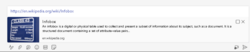
Die Darstellung der grundlegenden Fakten eines Artikels in einer Infobox ermöglicht eine maschinenlesbare Präsentation der Fakten und bietet zusätzliche Funktionen, wie beispielsweise beim Einfügen eines Links zu einem Wikipedia-Artikel in ein kompatibles Programm; anstatt nur des Links selbst werden auch andere Informationen wie das Titelbild des Artikels angezeigt.
Siehe auch
- Wikipedia:Liste der Infoboxen
Referenzen
- ^ a b c d e Baeza-Yates & King 2009 , S. 31.
- ^ a b c d e Liyang 2011 , p. 385.
- ^ a b Broughton 2008 , S. 357.
- ^ a b Broughton 2008 , S. 17.
- ^ a b c Broughton 2008 , S. 18.
- ^ Baeza-Yates & King 2009 , S. 30.
- ^ Broughton 2008 , S. 234.
- ^ a b Broughton 2008 , S. 235.
- Die Richtlinien der englischen Wikipedia zur Barrierefreiheit finden Sie unter „ Wikipedia:Stilrichtlinien/Barrierefreiheit “. Die Richtlinien zum Wikitext- Layout finden Sie unter „ Wikipedia:Stilrichtlinien/Layout “ und „ Wikipedia:Stilrichtlinien/Überschriften “.
- ^ Baeza-Yates & King 2009 , S. 345.
- ^ a b Lange, Böhm & Naumann 2010 , S. 7.
- ^ „Jarry1250s Toolserver Tools – Template-Transklusionszählung“ . Liste der Wikimedia-Projekte . 7. Juni 2013. Abgerufen am 7. Juni 2013 .
- ^ abcBaeza-Yates & King 2009, p. 28.
- ^Lange, Böhm & Naumann 2010, p. 5.
- ^Geertman, Reinhardt & Toppen 2011, p. 493.
- ^The project is hosted on the French Wikipedia page Infobox/V2.
- ^Miller 2008.
- ^ abLiyang 2011, p. 387.
- ^Virvou & Matsuura 2012, p. 315.
- ^Liyang 2011, p. 395.
Works cited
- Baeza-Yates, Ricardo; King, Irwin, eds. (2009). Weaving services and people on the World Wide Web. Springer. ISBN 9783642005695. LCCN 2009926100.
- Broughton, John (2008-07-14). Barber, Nan; Meyers, Peter (eds.). Wikipedia – The Missing Manual. O'Reilly Media. ISBN 9780596553777.
- Geertman, Stan; Reinhardt, Wolfgang; Toppen, Fred, eds. (2011). Advancing geoinformation science for a changing world. Lecture Notes in Geoinformation and Cartography. Vol. 1. Springer. doi:10.1007/978-3-642-19789-5. ISBN 9783642197888. ISSN 1863-2246. LCCN 2011925152.
- Lange, Dustin; Böhm, Christoph; Naumann, Felix (2010). Extracting Structured Information from Wikipedia Articles to Populate Infoboxes. Vol. Technische Berichte des Hasso-Plattner-Instituts für Softwaresystemtechnik an der Universität Potsdam, Hasso-Plattner-Institut für Softwaresystemtechnik Potsdam. Universitätsverlag Potsdam. ISBN 9783869560816. Archived from the original on 2014-06-06. Retrieved 2013-06-02.
- Yu, Liyang (2011). A Developer's Guide to the Semantic Web. Springer. Bibcode:2011adgt.book.....Y. doi:10.1007/978-3-642-15970-1. ISBN 9783642159695.
- Miller, Paul (2008-02-07). "Sir Tim Berners-Lee Talks with Talis about the Semantic Web". Transcription by CastingWords. Talis Group. Archived from the original on 2013-05-10. Retrieved 2013-06-02.
- Virvou, Maria; Matsuura, Saeko, eds. (2012). Knowledge-based Software Engineering: Proceedings of the Tenth Joint Conference on Knowledge-Based Software Engineering. Frontiers and Artificial Intelligence and Applications. Vol. 240. IOS Press. ISBN 9781614990932. LCCN 2012943674.
Further reading
- Kiran, Kumar N.; Santosh, GSK; Varma, Vasudeva (Juni 2011). Multidisziplinäre Informationswiedergewinnung . Lecture Notes in Computer Science. Band 6653. Springer Berlin Heidelberg. doi : 10.1007/978-3-642-21353-3 . ISBN 9783642213533ISSN 0302-9743 . S2CID 9901886 .
- Chutiporn, Anutariya; Domingue, John (Hrsg.). (2008). Das semantische Web: 3. Asiatische Konferenz zum semantischen Web, ASWC 2008, Bangkok, Thailand, 8.–11. Dezember 2008. Konferenzband . Lecture Notes in Computer Science. Band 5367. Springer. ISBN 9783540897033ISSN 0302-9743 .
- Wu, Fei; Hoffmann, Ralph; Weld, Daniel S. (2008). „Informationsextraktion aus Wikipedia“. In: Proceedings der 14. ACM SIGKDD International Conference on Knowledge Discovery and Data Mining . Association for Computing Machinery . S. 731–739 . doi : 10.1145/1401890.1401978 . ISBN 9781605581934. S2CID 7781746 .


