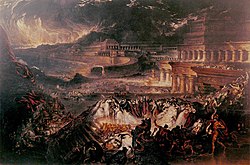
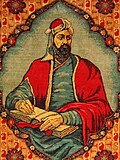
Khosrow and Shirin (Persian: خسرو و شیرین, romanized: Xusraw u Šīrīn) is a romantic epic poem by Nizami Ganjavi (1141–1209). It is the second work of his set of five poems known collectively as Khamsa. It tells a highly elaborated fictional version of the story of the love of Khosrow II for the Christian Shirin, who became the queen consort of the Sasanian Empire.[2][3][4][5] The essential narrative is a romantic tale of Persian origin which was already well known from the great historical epic poem, the Shahnameh, as well as Persian writers and popular tales; other works have the same title.[6] Variants of the story were also told under the title Shirin and Farhad (شیرین و فرهاد).
Plot

Nizami's version begins with an account of Khosrow's birth and his education. This is followed by an account of Khosrow's feast in a farmer's house, for which Khosrow is severely chastised by his father, King Hormizd IV. Khosrow asks forgiveness and repents his offence. Hormizd IV, who is now pleased with his son, forgives him. That very night, Khosrow sees his grandfather Anushirvan in a dream. Anushirvan gives him glad tidings of a wife named Shirin, a steed named Shabdiz, a musician named Barbad, and a great kingdom, that is Iran.
Shapur, Khosrow's close friend and a painter, tells Khosrow of the Armenian queen Mahin Banu and her niece Shirin. Hearing Shapur's descriptions of Shirin's flawless features, the young prince falls in love with the Armenian princess. Shapur travels to Armenia to look for Shirin. Shapur finds Shirin and shows her an image of Khosrow. Shirin falls in love with Khosrow and escapes from Armenia to Khosrow's capital Mada'in. Meanwhile, however, Khosrow coincidentally also flees from his father's anger and sets out for Armenia in search of Shirin.

On the way, he finds Shirin bathing and washing her flowing hair. Shirin also sees Khosrow, but since he was traveling in peasant clothes, they do not recognize one another. Khosrow arrives in Armenia and is welcomed by Shamira – and he finds out that Shirin is in Mada'in. Again, Shapur is sent to bring Shirin. When Shirin reaches Armenia, Khosrow – because of his father's death – has to return to Mada'in. The two lovers keep travelling to opposite places until Khosrow is overthrown by a general named Bahrām Chobin and flees to Armenia.
In Armenia, Khosrow finally meets Shirin and is welcomed by her. Shirin, however, will not agree to marry Khosrow unless he first claims his country back from Bahrām Chobin. Thus, Khosrow leaves Shirin in Armenia and goes to Constantinople. The Caesar agrees to assist him against Bahrām Chobin on condition that he marry his daughter Mariam. Khosrow is also forced to promise not to marry any one else as long as Mariam is alive. Khosrow succeeds in defeating his enemy and reclaims his throne. Mariam, out of jealousy, keeps Khosrow away from Shirin.
Meanwhile, a sculptor named Farhad falls in love with Shirin and becomes Khosrow's rival in love. Khosrow cannot abide Farhad, so he sends him as an exile to Behistun mountain with the impossible task of carving stairs out of the cliff rocks. Farhad begins his task hoping that Khosrow will allow him to marry Shirin. Yet, Khosrow sends a messenger to Farhad and gives him false news of Shirin's death. Hearing this false news, Farhad throws himself from the mountaintop and dies. Khosrow writes a letter to Shirin, expressing his regret for Farhad's death. Soon after this incident, Mariam also dies. According to Ferdowsi's version, it was Shirin who secretly poisoned Mariam. Shirin replies to Khosrow's letter with another satirical letter of condolences.
Bevor Chosrau Schirin einen Heiratsantrag macht, versucht er in Isfahan , mit einer anderen Frau namens Schekar intim zu werden , was die Vereinigung der Liebenden weiter verzögert. Schließlich begibt sich Chosrau zu Schirins Burg, um sie zu sehen. Da Schirin sieht, dass Chosrau betrunken ist, lässt sie ihn nicht in die Burg. Sie wirft ihm insbesondere seine Intimität mit Schekar vor. Betrübt und zurückgewiesen kehrt Chosrau in seinen Palast zurück.
Nach mehreren romantischen und heldenhaften Ereignissen willigt Shirin schließlich in die Heirat mit Khosrow ein. Doch auch Shiroyeh , Khosrows Sohn aus seiner Ehe mit Mariam, liebt Shirin. Daraufhin ermordet Shiroyeh seinen Vater und schickt einen Boten zu Shirin, der ihr mitteilt, dass sie ihn innerhalb einer Woche heiraten müsse. Um der Heirat mit Shiroyeh zu entgehen, begeht Shirin Selbstmord. Khosrow und Shirin werden gemeinsam in einem Grab beigesetzt.
Popularität in der persischen Literatur

Die Legende findet sich in zahlreichen Werken anderer persischer Dichter, darunter Farrokhi , Qatran , Mas'ud-e Sa'd-e Salman , Othman Mokhtari, Naser Khusraw , Anwari und Sanai . Nizam al-Mulk erwähnte, dass die Legende zu seiner Zeit eine populäre Erzählung war. [ 7 ]
Nizamis Version
Obwohl die Geschichte bereits vor Nizami bekannt war , verlieh er ihr erst ihre romantischste Dimension. Anders als das Schahnameh , das sich auf die Geschichte, das Königtum und die Schlachten Chosraus konzentriert, legte Nizami den Schwerpunkt auf den romantischen Aspekt der Erzählung.
Nizami Ganjavi (1141–1209) selbst hielt sie für die schönste Geschichte der Welt:
Die Geschichte von Chosrau und Schirin ist wohlbekannt. Und wahrlich, es gibt keine schönere Geschichte als diese.
Es gilt als eines der besten Werke Nizamis. Seine erste Frau Afaq starb nach dessen Fertigstellung. [ 8 ] Zahlreiche Versionen von Nizamis Werk wurden nacherzählt. Die Geschichte ist von einem stetigen Fortschritt geprägt, der Exposition, Herausforderung, Geheimnis, Krise, Höhepunkt, Auflösung und schließlich Katastrophe umfasst.
Neben Ferdowsi wurde Nizamis Gedicht auch von Asad Gorgani und dessen „ Vis und Rāmin “ [ 9 ] beeinflusst , das dasselbe Metrum aufweist und ähnliche Szenen schildert. Nizamis Interesse an der Astrologie findet sich auch in der detaillierten astrologischen Beschreibung des Nachthimmels in „Vis und Rāmin“ . Nizami übte einen maßgeblichen Einfluss auf die romantische Tradition aus, und Gorgani gilt als Begründer der unverwechselbaren Rhetorik und poetischen Atmosphäre dieser Tradition, die sich durch das Fehlen der in Nizamis Epos sichtbaren Sufi -Einflüsse auszeichnet.
Beeinflussen
Laut der Encyclopædia Iranica : „Der Einfluss der Farhad-Legende beschränkt sich nicht auf die Literatur, sondern durchdringt die gesamte persische Kultur, einschließlich Folklore und bildender Kunst. Farhads Stiel soll zu einem Baum mit heilenden Eigenschaften herangewachsen sein, und es gibt Volkslieder um Farhad, insbesondere unter den Kurden (Mokri).“ [ 7 ]
Im Jahr 2011 verweigerte die iranische Regierung einem Verlag die Genehmigung zum Nachdruck des jahrhundertealten Klassikers, der seit 831 Jahren ein beliebter Bestandteil der persischen Literatur war. Das iranische Ministerium für Kultur und Islamische Führung gab zunächst keine offizielle Begründung für die Ablehnung der achten Auflage des Klassikers. Berichten zufolge konzentrierten sich die Bedenken der islamischen Regierung jedoch auf die als „unsittlich“ empfundene Umarmung der Heldin Shirin mit ihrem Ehemann. [ 10 ]
Orhan Pamuks Roman „ Mein Name ist Rot “ (1998) enthält eine Handlung zwischen den beiden Figuren Shekure und Black, die an die Geschichte von Khosrow und Shirin erinnert, welche ebenfalls im Buch erzählt wird. Der Roman verwendet die türkische Schreibweise von Khosrows Namen, Hüsrev.
Andere Versionen

The tale has been retold by countless Sufi poets and writers in areas which were previously part of the Persian Empire or had Persian influences, such as the northern parts of the neighbouring Indian subcontinent. In Europe, the story was told by Hungarian novelist Mór Jókai. However, the story is usually told under the name of "Shirin Farhad". The story has also become a standard tale in traditional Punjabi Qisse and Bengali Kissa.[11][12] The story has been filmed numerous times, including: 1926,[13] 1929,[14]1931,[15]1934,[16] 1945,[17] 1948,[18]1956 (starring Madhubala and Pradeep Kumar),[19][20] 1970,[21] 1975[22] and 1978.[23]
The tale was used as the inspiration for a 2008 Iranian film, Shirin, made by Abbas Kiarostami. In this formally unusual film, the story is told via the reactions of an audience of Iranian women as they sit watching the film in a cinema. The viewer has to divine the story by only ever seeing these emoting faces and listening to the film's soundtrack.
The story was also referenced in the Jonathan Richman and the Modern Lovers song "Shirin & Fahrad".
The tale was also an inspiration for the 2012 Bollywood romantic comedy film, Shirin Farhad Ki Toh Nikal Padi.[20]
Illustrations
Depictions of Khosrow and Shirin take many different forms, with many depictions coming from adapted versions of Nizami's story that have achieved great popularity.[24] These other illustrations are influenced by European styles of art and the variations in text to picture interpretations are reflections of previous artistic deviations from Nizami's story.
Illustrated Adaptations
The story was especially popular at the Ottoman court during the reign of Bayezid II. There were five illustrated copies produced by the artist Şeyhi titled Hüsrev ve Şirin, one of which was produced in 1498 CE.[25] Nizami's illustrations for Khosrow and Shirin were likely the inspiration for these copies as Şeyhi's plot was closely related to Nizami's.[25]
Another illustrated copy is a poem by Hatifi with illustrations by Sūzī. Although Hatifi's plot does not closely follow Nizami's or Şeyhi's, the illustrations are typical of Nizami's story.[25] Sūzī's depictions showcase a mixture of Persian and Ottoman artistic style. It is one of the few manuscripts that researchers are confident was made during Bayezid II's reign (1481–1512).[25]
An adaptation that also gained widespread popularity is the Khamsa of Amir Khusrau Dihlavi. Dihlavi composed his Khamsa around the 13th to 14th century.[24] The Khamsa follows the plot of Nizami's story, but deviates from the original in some parts.[24]
Hatifi's Poem and Ottoman influence


Hatifi's poem takes inspiration from Nazimi's story, but with some new scenes added in and some other scenes cut out. The illustrated copy of Hatifi's poem dates from the reign of the Ottoman sultan Bayezid II, a celebrated patron of the arts. There are a total of 6 miniatures in the manuscript.[25] The colophon indicates that the author, who went by the pseudonym Sūzī, meaning "burning one",[26] copied the entire text as well as painted the illustrations by themselves.[25]
Early Ottoman artistic influence is visible in the illustrated miniatures. The manuscript starts with a double frontispiece that resembles the first pages in luxury Qur'ans produced at the time, albeit less elaborate (figure 1). Within the bands, there are 8 medallions, each of which contains a verse from the text. Between each gold medallion are clouds, which were typical of the Ottoman artistic style of the period.[25]

Osmanische Hofeinflüsse zeigen sich auch in der Darstellung von Shīrīn, die Chosraus Bildnis in ihrem Zimmer betrachtet (Abbildung 2). Die Balkone und die geschwungenen Bleidächer des Palastgebäudes sind beispielhaft für den osmanischen Architekturstil, ebenso wie die Bogenöffnungen und die Eisengitter an den Gartenmauern. Obwohl diese Darstellungen nicht in allen Miniaturen einheitlich sind, finden sich in dieser Szene auch Beispiele für Perspektive und Schattenwurf. [ 25 ] Die rechte Wand und das Dach des Palastes sind etwas dunkler als die linke, was darauf hindeutet, dass das Licht von links in das Bild fällt. Diese Einbeziehung des Realismus ist typisch osmanisch, während persische Kunststile typischerweise Idealismus und Romantik in den Vordergrund stellen. [ 27 ]
Amir Khusrau Dihlavis Khamsa
Dihlavis Khamsa entstand 1599 n. Chr. im Iran. [ 24 ] Mu'izz al-Din Husayn Langari fertigte die Abschrift an. [ 24 ] Nach dem 16. Jahrhundert wurde sie im Iran und in Indien vielfach kopiert und illustriert. [ 24 ] Eine Szene, die in Persien und Indien unterschiedlich dargestellt wurde, zeigt Shirin, die Farhad bei der Arbeit besucht.
In der persischen Darstellung von Dihlavis Handschrift wünscht sich Farhad Shirins Besuch, wird aber gleichzeitig durch ihre Besuche aufgrund seiner Liebe zu ihr gequält. In der Illustration kauert Farhad links, während Shirin rechts auf ihrem berühmten schwarzen Pferd herbeireitet. Sie trägt einen Kopfschmuck und einen orangefarbenen Mantel über ihrem blauen Kleid. [ 24 ]
In der Mogul- Illustration reitet Shirin von links auf ihrem schwarzen Pferd herein, während Farhad rechts steht. [ 24 ] Obwohl die persischen und Mogul-Illustrationen strukturell unterschiedlich sind, weisen sie in einigen Details Übereinstimmungen auf. So findet sich beispielsweise Shirins Kleidung – Kopfbedeckung, orangefarbenes Gewand und blaues Kleid – auch in der Mogul-Illustration wieder. Allerdings trägt nicht Shirin diese Kleidung, sondern ihre Begleiterin. [ 24 ] Die Ähnlichkeit der Details zwischen den Mogul- und persischen Kopien gibt Aufschluss darüber, welchen Zugang die Mogul-Maler zur persischen Vorlage hatten. Solche spezifischen Details zu Shirins Kleidung konnten unmöglich mündlich zwischen den Künstlern ausgetauscht worden sein. Daher ist es möglich, dass die Mogul-Künstler die persischen Illustrationen in einer Bibliothek einsehen konnten, bevor sie mit ihren eigenen Adaptionen begannen. [ 24 ]
One scene that deviates from Nizami's story is that of Khusrau giving false news to Farhad.[24] Khusrau hears of Farhad's love for Shirin and devises a plan to tell him that Shirin is dead. In both versions, this message causes Farhad to commit suicide. In Nizami's version, Khusrau already knows Farhad's intentions and sends the messenger with the false news.[24] However, in Dihlavi's version, Khusrau is unsure of Farhad's love and visits him while disguised as a shepherd.[24] Only after the visit does Khusrau send the false news of Shirin's death.[24] In the illustration of this scene, there are similarities between the Persian illustration of Dihlavi's version and Nizami's illustrations. Dihlavi's illustration shows Khusrau dressed in a bonnet and with a walking stick.[24] The structure of this scene is very comparable to Nizami's. Khusrau is in such a similar outfit and position as that of the messenger in Nizami's illustration that one could mistake him for a messenger.[24]
Variations In Common Scenes Illustrated
Illustrations of Shirin Bathing

There are a few common scenes from the epic love story that are chosen by artists to illustrate over and over. One particular scene is that of Khosrow stumbling upon Shīrīn bathing. The variations in depictions of the same scene demonstrate influences of other art styles and stylistic choices of each illustrator. The type of body of water Shīrīn bathes varies across different artists. In Nizami's text, Khosrow accidentally sees Shīrīn bathing when he rides by a pool of water in disguise. Shīrīn is alone aside from her famous black horse.
Eine Darstellung dieser Szene hängt im Seattle Art Museum und trägt den Titel „Chusrau entdeckt Schirin beim Baden in einem Teich“. Das Gemälde stammt vom Kalligrafen Murshid al-Schirazi aus der Mitte des 16. Jahrhunderts (Abbildung 3). [ 28 ] Getreu Nizamis Text ist ihr Pferd schwarz und sie ist allein. In dieser Darstellung führt Chusrau die Hand zum Mund, um seine Bewunderung für Schirins Schönheit auszudrücken. [ 28 ] Obwohl das Wasser heute matt gräulich-schwarz angelaufen ist, hatte es ursprünglich eine leuchtend silberne Farbe. Die Szene vermittelt eine intime Atmosphäre, da Schirins Gewand lässig an einem Ast hängt. Die verwendeten Materialien – Wasserfarben, Tusche, Gold und Papier – waren typisch für persische Illustrationen. [ 29 ] In dieser Version platzierte Murshid al-Schirazi Schirin in einem Fluss.
Eine zweite Illustration mit dem Titel „Chusrau erblickt Shirin beim Baden“ von Scheich Zada stammt aus dem Jahr 1524 n. Chr. (Abbildung 4). Sie entstand im heutigen Afghanistan und besteht aus Aquarellfarben, Tusche und Gold auf Papier. [ 30 ] Shirin ist allein mit ihrem Pferd zu sehen, während Chusrau die Hand zum Mund führt. Ihre Kleidung hängt an einem Ast. Der Kunsthistoriker Abolala Soudavar vermutet, dass Chusrau ein Porträt von Hosayn Khan darstellt, dem Auftraggeber der Handschrift, für die diese Illustration angefertigt wurde. [ 31 ] In dieser Illustration badet Shirin in einem Bach, nicht in einem Fluss.
Eine dritte Darstellung mit dem Titel „Shirin vor ihrem Bad “ stammt von dem Künstler Kamal aus dem Jahr 1580 n. Chr. Sie stellt Shīrīn in den Mittelpunkt und lässt Khosrow völlig außer Acht (Abbildung 5). Diese stilistische Entscheidung entsprach der im späten 16. und 17. Jahrhundert üblichen Praxis, Shīrīn allein darzustellen. [ 32 ] Die verwendeten Materialien ähneln denen der Illustration von Murshid al-Shirazi und umfassen Aquarell, Tusche und Gold auf Papier. [ 32 ] In dieser Illustration bereitet sich Shīrīn auf ein Bad in einem Teich vor, nicht in einem Bach oder Fluss.
Ein viertes Gemälde dieser Szene mit dem Titel „Chosrau entdeckt Schirin beim Baden “ stammt von einem unbekannten Künstler des 18. Jahrhunderts. Chosrau ist hier in seiner fürstlichen Tracht dargestellt, nicht verkleidet, und Schirins Pferd ist silberbraun statt schwarz (Abbildung 6). Diese Abweichungen von Nizamis Text sind allesamt Fortführungen früherer Miniaturen. Der Maler dieser Miniatur fügte der Szene jedoch drei weitere Personen hinzu und störte damit die im Text geschilderte Intimität zwischen den beiden Liebenden. [ 33 ] Obwohl die fehlende Perspektive in der Illustration ein Kennzeichen persischer Miniaturmalerei ist, [ 34 ] zeigen die gedeckten Farben, die Verwendung von Hell-Dunkel-Kontrasten und die verwendeten Materialien (Öl auf Leinwand) den Einfluss europäischer Kunst. In dieser Illustration stellte der Maler Schirin beim Baden in einem Teich dar.
Illustrationen von Shirin, die Farhad besucht

Eine weitere häufig dargestellte Szene zeigt Shirin bei ihrem Besuch bei Farhad in den Bergen. Wie bereits erwähnt, wurden Szenen aus den Erzählungen von Nizami und Dihlavi vielfach illustriert. Eine dieser Illustrationen befindet sich in den Sondersammlungen der Princeton University. Sie stammt aus einer Handschrift Dihlavis aus dem Jahr 1524. [ 35 ] In dieser Version ist die Farbpalette – abgesehen von einigen farbigen Flecken – gedeckt und fast monochrom. [ 36 ] Shirin reitet auf einem schwarzen Pferd zu Farhad und trägt einen weißen Kopfschmuck. Der Melker (Farhad ließ eine Milchleitung zu Shirins Palast anlegen) trägt einen Turban. Shirin wird mit üppigem Haar und einem runden Gesicht dargestellt. Sie scheint Farhad direkt anzusehen. [ 36 ]
Eine Darstellung derselben Szene aus der Abteilung für seltene Bücher der Free Library of Philadelphia weist dieselbe Gesamtstruktur wie die Princeton-Illustration auf (Abbildung 7). Diese Illustration stammt aus dem frühen 20. Jahrhundert und ist eine Nachahmung eines safawidischen Gemäldes. [ 37 ] Es gibt jedoch Unterschiede in Farbe und Kleidung. Die Farbgebung dieser Illustration ist üppig und keineswegs monochrom. [ 36 ] Shirin reitet auf einem gescheckten Pferd heran und trägt anstelle eines Kopfschmucks eine goldene Krone. [ 36 ] Der Melker, der ebenfalls auf dieser Illustration zu sehen ist, trägt eine Kappe anstelle eines Turbans. [ 36 ] Shirin ist in dieser Version etwas schlanker dargestellt und scheint über Farhad hinwegzublicken, anstatt ihn direkt anzusehen. [ 36 ]
Eine Illustration einer ähnlichen Szene findet sich in einem Manuskript von Nizamis Erzählung. Es trägt den Titel „Shirin besucht Farhad am Berg Bisutun“ und entstand 1527 im Iran. Verwendet wurden die typisch persischen Materialien Wasserfarben, Gold, Tinte und Papier. [ 38 ] Die Szene zeigt den Moment, bevor Khusrau Farhad die falsche Nachricht von Shirins Tod überbringt. Shirin sitzt auf einem schwarzen Pferd und reicht Farhad einen Krug Milch. [ 38 ]
Siehe auch
 |
| Teil einer Serie über |
| Nizami Ganjavi |
|---|
| Die Khamsa oder Panj Ganj |
|
| Verwandte Themen |
| Denkmäler |
Referenzen
- ^ Graves, Margaret S. (1. Januar 2002). „Words and Pictures“. Persica . 18 (0): 17–54 . doi : 10.2143/PERS.18.0.491 .
Die Khamseh („Quintett“) des Nizami (Or. 13297) aus den Jahren 1386–88 in der British Library wurde bisher kaum erforscht, obwohl es sich um die bisher früheste gesicherte illustrierte Fassung dieses Textes handelt.
- ^ Die Encyclopædia Iranica ( „Ḵosrow o Širin“, archiviert am 17.11.2020 in der Wayback Machine , Encyclopædia Iranica , Paola Orsatti)“ Um die Figur der Širin bildeten sich bald zwei Traditionen : eine zu ihren Gunsten, mit Wurzeln in Armenien und den christlichen Regionen des Kaukasus, wo, wie wir gesehen haben, Neẓāmi seine Quelle fand; und die zweite, dargestellt im Šāh-nāma, wo Širin als Frau von bescheidener Herkunft und schlechtem Ruf gezeigt wird, die gnadenlos Gift einsetzt (bei Ferdowsi vergiftet Širin, von Eifersucht getrieben, Maryam) .
- ^ Die Encyclopædia Iranica ( „Farhad“, archiviert am 08.11.2020 im Internetarchiv Wayback Machine, Encyclopædia Iranica , Heshmat Moayyad)
- ^The Khuzistan Chronicle, written by a Syriac Christian from Khuzistan (Beth Huzaye in Aramaic/Syriac) [Iran], probably in 680, is described as the Syriac counterpart of the Armenian work of Sebeos. We read about the relationship between the bishop Isho Yahb and the Persian king Khosrau II Parvez (590–628): "Isho Yahb was treated respectfully throughout his life, by the king himself and his two Christian wives Shirin the Aramean and Mary the Roman". (Theodor. Nöldeke: Die von Guidi herausgegebene syrische Chronik, Wien 1893, p. 10.) The Chronicle of Séert (Siirt) is an anonymously authored historiographical text written by the Nestorian Church in Persia and the Middle East, possibly as early as the 9th century AD. The text deals with ecclesiastical, social, and political issues of the Christian church giving a history of its leaders and notable members. LVIII. – History of Khosrau Parvez, son of Hormizd "Khosrau, by gratitude for Maurice, ordered to rebuild churches and to honor the Christians. He built himself two churches for Marie (Maryam) and a large church and a castle in the country of Beth Lashpar for his wife Shirin, the Aramean." (Patrologia Orientalis, Tome VII. – Fascicule 2, Histoire Nestorienne (Chronique de Séert), Seconde Partie (1), publiée et traduite par Mgr Addai Scher, Paris 1911, Published Paris : Firmin-Didot 1950 p. 467.)
- ^Johan Christoph Burgel & Christine van Ruyuymbeke, "Nizami: A Key to the Treasure of the Hakim ", Amsterdam University Press, 2011. pg 145: "Shirin is presented as an Armenian princess
- ^Chelkowski, P. "Nezami's Iskandarnameh:"in Colloquio sul poeta persiano Nizami e la leggenda iranica di Alessandro magno, Roma,1977). pp 10: "The Persian legend of Alexander the Great seems to overshadow all of the other fantastic Alexander stories not only in the tale of the successful accomplishment of many a "mission-impossible" but especially concerning the nature of his career. In Iran he rose from the stature of a damned evil conqueror of the country, to that of a national Iranian hero king, and even more, to that of the great prophet of God, preparing all the nations for the true religion. Yet the Persian legend of Alexander is very little known in the Western world."" pp 13: "Nizami was a typical product of the Iranian culture. He created a bridge between Islamic Iran and pre-Islamic Iran and also between Iran and the whole ancient world. His great humanism, strong character, sensibility, drama, colorful description of nature, rich language, and the poetic genius created a new standard of literary achievements and captured the imagination of countless imitators". pg 17: "In the case of previous romances of Khosraw and Bahram, Nizami dealt with national Iranian heroes, though from pre-Islamic times. In the tale of Layla and Majnun, the Arab nationality of the lover is of no importance since the story is based on a simple Arab folktale which was later absorbed and embellished by the Persians". pp 19: "Alexander was glorified by a small minority of the Muslims as a divine agent, a prophet-king and the blessed conqueror of the lands that were to become the stronghold of Islam. To some Muslims, Islam was a realization of Alexander's "koine" --- a commonwealth where people could live in harmony and in peace of heart and mind. In this atmosphere attempts were made to make out of Alexander not only a Muslim but a Persian as well". pg 21: "However, it was not Tabari directly, but Ferdowsi who was Nizami's source of inspiration and material in composing Iskandarnameh. Nizami constantly alludes to the Shahnameh in his writing, especially in the prologue to the Iskandarnameh. It seems that he was always fascinated by the work of Firdawsi and made it a goal of his life to write an heroic epic of the same stature. pg22: "It seems that Nezami's favorite pastime was reading Firdawsi's monumental epic Shahnameh (The book of Kings)". pg 22: "In fact, although Alexander conquered Iran, he was soon conquered by Persian customs and ways of life. In many aspects he was so overwhelmed by Persian civilization that he became more Persian than the Persians. He tried to make a blend of the Greek and Persian civilization."
- ^ abHeshmat Moayyad (1999-12-15). "Farhad". Encyclopedia Iranica. Retrieved 2010-07-26.
- ^ Lornejad, Siavash; Doostzadeh, Ali (2012). Asatrian, Garnik (Hrsg.). „Zur modernen Politisierung des persischen Dichters Nezami Ganjavi“ (PDF) . Yerevan Series for Oriental Studies . 1 : 208.
- ^ Dick Davis (06.01.2005). "Vis o Rāmin" . Encyclopaedia Iranica . Abgerufen am 25.04.2008 .
- ^ Recknagel, Charles (19. August 2011). „Die harte Hand der iranischen Zensoren fällt auf einen persischen Klassiker“ . RadioFreeEurope/RadioLiberty .
- ^ Eine poetische Legende, neu erzählt. Archiviert am 10.02.2020 in der Wayback Machine . Mahmood Awan. Akademie des Punjab in Nordamerika.
- ^ Islam, Sirajul (2012). „Kissa“ . Im Sirajul-Islam ; Miah, Sajahan; Khanam, Mahfuza ; Ahmed, Sabbir (Hrsg.). Banglapedia: die Nationale Enzyklopädie von Bangladesch (Online-Ausgabe). Dhaka, Bangladesch: Banglapedia Trust, Asiatische Gesellschaft von Bangladesch . ISBN 984-32-0576-6OCLC 52727562 . OL 30677644M . Abgerufen am 22. Juni 2026 .
- ^ Shirin Farhad (1926) bei IMDb
- ^ „Shirin Khushrau (1929)“ . Indiancine.ma .
- ^ Ashish Rajadhyaksha; Paul Willemen (2014). Enzyklopädie des indischen Kinos . Taylor & Francis . ISBN 978-1-135-94325-7Die
- ^ شیرین و فرهاد (فیلم ۱۳۱۳) Archiviert am 01.02.2015 auf der Wayback Machine sourehcinema.com ( persische Sprache )
- ^ Shirin Farhad (1945) bei IMDb
- ^ „Aaj ka Farhad“ . Cinemaazi . Archiviert vom Original am 29.06.2022 . Abgerufen am 05.05.2021 .
- ^ „Shirin Farhad (1956)“ . Indiancine.ma .
- ^ a b Filippo Carlà-Uhink; Anja Wieber (2020). Orientalismus und die Rezeption mächtiger Frauen aus der Antike . Bloomsbury Publishing. S. 265. ISBN 978-1-350-05011-2Die
- ^ Ferhat ile Şirin bei IMDb
- ^ Shirin Farhad (1975) bei IMDb
- ^ Bir Aşk Masalı bei IMDb
- Brend , Barbara (2013). „ From Persia and Beyond : a discussion of the illustrations to a Khamsa of Amir Khusrau Dihlavi in the State Library of Victoria “ ( PDF ) . La Trobe Journal . 91 : 97–107 .
- ^ a b c d e f g h Yoltar-Yildirim, Ayşin (22.03.2005). „A 1498–99 Khusraw va Shīrīn: Turning the Pages of an Ottoman Illustrated Manuscript“ . Muqarnas Online . 22 (1): 95–109 . doi : 10.1163/22118993_02201006 . ISSN 0732-2992 .
- ^ „Hatifi | Khusrau und Shirin“ . Das Metropolitan Museum of Art . Abgerufen am 19.04.2024 .
- ^ Mesineh, Maryam (November 2017). „Eine vergleichende Analyse der Faktoren, die die Entwicklung der Miniaturmalerei in der Safawiden- und Osmanenzeit beeinflusst haben“ . International Journal of Cultural and Social Studies (IntJCSS) . 3 .
- ^ a b „Blatt aus einer Khamsa (Quintett) von Nizami (gest. 1209); Vorderseite: Text; Rückseite: Illustration: Khusrau sieht Shirin beim Baden“ . National Museum of Asian Art des Smithsonian . Abgerufen am 19. April 2024 .
- ^ „Transformation verfärbter Pigmente in einem persischen Aquarell aus dem 16. Jahrhundert | Yale University Art Gallery“ . artgallery.yale.edu . Abgerufen am 19. April 2024 .
- ^ „Nizami | „Chusrau erblickt Shirin beim Baden“, Folio 50 aus einer Khamsa (Quintett) von Nizami von Ganja“ . The Metropolitan Museum of Art . Abgerufen am 19. April 2024 .
- ^ Soudavar, Abolala (2016). Eine Neubewertung der frühen safawidischen Kunst und Geschichte, 35 Jahre nach Dickson & Welch 1981. Lulu.com. ISBN 978-1-329-97615-3Die
- ^ a b „Shirin vor ihrem Bad, AKM422, Das Aga Khan Museum“ . Aga Khan Museum . Abgerufen am 19.04.2024 .
- ^ „Khusraw entdeckt Shirin beim Baden (Artikel)“ . Khan Academy . Abgerufen am 19.04.2024 .
- ^Dimand, M. S. (1935). "Persian and Indian Miniature Paintings". The Metropolitan Museum of Art Bulletin. 30 (12): 248–250. doi:10.2307/3255244. ISSN 0026-1521. JSTOR 3255244.
- ^Amīr Khusraw Dihlavī (1524). [Khamsah] (in Persian).
- ^ abcdefSimpson, Marianna Shreve (2008). "Mostly Modern Miniatures: Classical Persian Painting in the Early Twentieth Century". Muqarnas. 25: 359–395. doi:10.1163/22118993-90000140. ISSN 0732-2992. JSTOR 27811128.
- ^"OPenn: Lewis P 265 Illustration of Shirin Visiting Farhad". openn.library.upenn.edu. Retrieved 2024-04-19.
- ^ ab"Remastered | AKM270 Fol. 81r | Aga Khan Museum". remastered.agakhanmuseum.org. Retrieved 2024-04-19.
External links
- Encyclopædia Iranica, "Farhad", Heshmat Moayyad
- Encyclopædia Iranica, "ḴOSROWO ŠIRIN AND ITS IMITATIONS", Paola Orsatti
- Encyclopaedia of Islam, THREE, "Ferhad u Şirin (in Turkic literatures)", Muhsin Macit
- Nizami: "Khosru & Shireen", Medieval SourcebookArchived 2007-08-07 at the Wayback Machine
- The Story of Khosrow and Shirin at iranian.com
- The story of Farhad and Shirin
- Massé, H.; Zajączkowski, A. (2012). "Farhād wa-S̲h̲īrīn". Encyclopaedia of Islam New Edition Online (EI-2 English). Brill. Retrieved 6 July 2025.