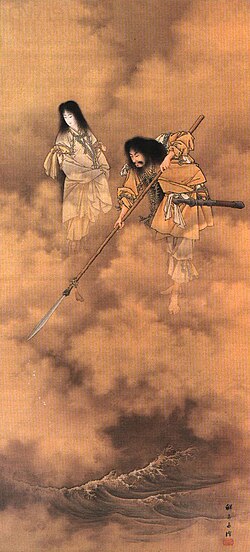
Kushinadahime (櫛名田比売、くしなだひめ), also known as Kushiinadahime (奇稲田姫、くしいなだひめ) or Inadahime (稲田姫、いなだひめ) among other names, is a goddess (kami) in Japanese mythology and the Shinto faith. According to these traditions, she is one of the wives of the god Susanoo, who rescued her from the monster Yamata no Orochi. As Susanoo's wife, she is a central deity of the Gion cult and worshipped at Yasaka Shrine.[1]
Name
The goddess is named 'Kushinadahime' (櫛名田比売) in the Kojiki, while the Nihon Shoki variously names her 'Kushiinadahime' (奇稲田姫), 'Inadahime' (稲田姫), and 'Makamifuru-Kushiinadahime' (真髪触奇稲田媛).
'Inadahime' may be translated either as "lady / princess (hime) of Inada", with "Inada" (稲田) here being understood as the name of a place in Izumo Province (part of what is now the town of Okuizumo (formerly Yokota) in Nita District, Shimane Prefecture),[2] or "lady / princess of the rice fields" (inada literally translated means "rice field" or "rice paddy").[3][4] The element kushi (Old Japanese: kusi) meanwhile is usually interpreted as the adjective meaning "wondrous"; it is homophonous with the word for "comb" (櫛), which features in her story in both the Kojiki and the Shoki.[5][6] The epithet makamifuru (lit. "true-hair-touching"), found in a variant account cited in the Shoki, is understood as a stock epithet or makurakotoba associated with the word "comb".[7]
The Fudoki of Izumo Province meanwhile gives the name of the goddess as 久志伊奈太美等与麻奴良比売命, commonly read as 'Kushiinada-Mitoyomanurahime-no-Mikoto'. One theory interprets the name to mean roughly "princess of the wondrous rice fields (kushi-inada) soaking wet (manura) [and] overflowing with water (mitoyo, here understood as an epithet meaning "water-abundant")".[8]
Mythology
The slaying of the Yamata no Orochi

In the Kojiki and the Nihon Shoki, the god Susanoo, after his banishment from the heavenly realm Takamagahara, came down to earth, to the land of Izumo, where he encountered an elderly couple named Ashinazuchi and Tenazuchi, both children of the mountain god Ōyamatsumi. They told him of a monstrous creature from the nearby land of Koshi known as the Yamata no Orochi ("eight-forked serpent") that had devoured seven of their eight daughters. Upon hearing this, Susanoo agreed to kill the serpent on condition that they give him their sole surviving daughter, Kushinadahime, to be his wife.[9][5][10]
The version recounted in the Nihon Shoki's main narrative is as follows (translation by William George Aston):
Then Sosa no wo no Mikoto descended from Heaven and proceeded to the head-waters of the River Hi, in the province of Idzumo. At this time he heard a sound of weeping at the head-waters of the river, and he therefore went in search of the sound. He found there an old man and an old woman. Between them was set a young girl, whom they were caressing and lamenting over. Sosa no wo no Mikoto asked them, saying:—"Who are ye, and why do ye lament thus?" The answer was:—"I am an Earthly Deity, and my name is Ashi-nadzuchi. My wife's name is Te-nadzuchi. This girl is our daughter, and her name is Kushi-nada-hime. The reason of our weeping is that formerly we had eight children, daughters. But they have been devoured year after year by an eight-forked serpent, and now the time approaches for this girl to be devoured. There is no means of escape for her, and therefore do we grieve." Sosa no wo no Mikoto said:—"If that is so, wilt thou give me thy daughter?" He replied, and said:—"I will comply with thy behest and give her to thee." Therefore Sosa no wo no Mikoto on the spot changed Kushi-nada-hime into a many-toothed close-comb, which he stuck in the august knot of his hair. Then he made Ashi-nadzuchi and Te-nadzuchi to brew eight-fold sake, to make eight cupboards, in each of them to set a tub filled with sake, and so to await its coming. When the time came, the serpent actually appeared. It had an eight-forked head and an eight-forked tail; its eyes were red, like the winter-cherry; and on its back firs and cypresses were growing. As it crawled it extended over a space of eight hills and eight valleys. Now when it came and found the sake, each head drank up one tub, and it became drunken and fell asleep. Then Sosa no wo no Mikoto drew the ten-span sword which he wore, and chopped the serpent into small pieces. When he came to the tail, the edge of his sword was slightly notched, and he therefore split open the tail and examined it. In the inside there was a sword. This is the sword which is called Kusa-nagi no tsurugi.[5]
After defeating the serpent, Susanoo built a palace or shrine for Kushinadahime in a place called Suga - so named because Susanoo felt refreshed (sugasugashi) upon arriving there - and made her father Ashinazuchi its head (obito), giving him the title 'Inada-no-Miyanushi-Suga-no-Yatsumimi-no-Kami' (稲田宮主須賀之八耳神 "Master of the Palace of Inada, the Eight-Eared Deity of Suga"). On that occasion, he composed a song in tanka form later held to be the root of Japanese waka poetry:[11]
Man'yōgana (Kojiki) Japanese Old Japanese Modern Japanese (Rōmaji) Translated by Edwin Cranston[12] 夜久毛多都伊豆毛夜幣賀岐都麻碁微爾夜幣賀岐都久流曾能夜幣賀岐袁[13] 八雲立つ出雲八重垣妻籠みに八重垣作るその八重垣を Yakumo1 tatuIdumo1 yape1gaki1tumago2mi2 niyape1gaki1 tukuruso2no2 yape1gaki1 wo[14] Yakumo tatsuIzumo yaegakitsumagomi niyaegaki tsukurusono yaegaki o In eight-cloud-risingIzumo an eightfold fenceTo enclose my wifeAn eightfold fence I build,And, oh, that eightfold fence!
The child born to Susanoo and Kushinadahime is variously identified as Yashimajinumi in the Kojiki and Ōnamuchi (Ōkuninushi) in the Shoki's main account.[15][16][17]
Variants

While most accounts identify the headwaters of the river Hi in Izumo (肥河 / 簸之川, Hi-no-Kawa, identified with the Hii River in modern Shimane Prefecture) as the place where Susanoo descended, one variant in the Shoki instead has Susanoo arriving at the upper reaches of the river E (可愛之川 E-no-Kawa) in the province of Aki (identified with the Gōnokawa River in modern Hiroshima Prefecture). In this version, Inadahime - whose name is given here as 'Makamifuru-Kushiinadahime' (真髪触奇稲田媛) - is not yet born when Susanoo slew the Yamata no Orochi.[18][19]
In one writing it is said:—"At this time Sosa no wo no Mikoto went down and came to the head-waters of the River Ye, in the province of Aki. There was there a God whose name was Ashi-nadzu-te-nadzu. His wife's name was Inada no Miya-nushi Susa no yatsu-mimi. This Deity was just then pregnant, and the husband and wife sorrowed together. So they informed Sosa no wo no Mikoto, saying:—'Though we have had born to us many children, whenever one is born, an eight-forked serpent comes and devours it, and we have not been able to save one. We are now about to have another, and we fear that it also will be devoured. Therefore do we grieve.' Sosa no wo no Mikoto forthwith instructed them, saying:—'You must take fruit of all kinds, and brew from it eight jars of sake, and I will kill the serpent for you.' The two Gods, in accordance with his instructions, prepared sake. When the time came for the child to be born, the serpent came indeed to the door, and was about to devour the child. But Sosa no wo no Mikoto addressed the serpent, and said:—'Thou art an Awful Deity. Can I dare to neglect to feast thee?' So he took the eight jars of sake, and poured one into each of its mouths. The serpent drank it up and fell asleep. Sosa no wo no Mikoto drew his sword and slew it. [...] Afterwards the child who was born of Inada no Miya-nushi Susa no yatsu-mimi, namely Ina-gami (sic) Furu-kushi-nada-hime, was removed to the upper waters of the river Hi, in the province of ldzumo, and brought up there. After this Sosa no wo no Mikoto made her his consort, and had by her a child, whose descendant in the sixth generation was Oho-na-muchi no Mikoto."[18]
— translation by William George Aston
A legend associated with Yaegaki Shrine in Matsue, Shimane Prefecture claims that Susanoo hid Kushinadahime in an "eightfold fence" (yaegaki) in the forest within the shrine's precincts during his battle with the Yamata no Orochi.[20]
In the Izumo Fudoki

Eine Legende aus dem Izumo Fudoki über die Gemeinde Kumatani (熊谷郷) im Bezirk Iishi (heute Teil der Stadt Unnan in Shimane [ 21 ] ) erzählt, dass Kushinadahime – damals noch als „Kushiinada-Mitoyomanurahime“ – kurz vor der Geburt durch die Gegend zog. Der Name der Gemeinde soll von ihrem Ausruf stammen: „Wie tief und gut verborgen ( kumakumashiki ) ist dieses Tal ( tani )!“ [ 22 ] [ 23 ]
Im Hōki Fudoki
Ein Auszug aus dem angeblich verlorenen Fudoki der Provinz Hōki (heutige westliche Präfektur Tottori ) berichtet, dass Inadahime nach Hōki floh und sich in den Bergen versteckte, als der Yamata no Orochi sie verschlingen wollte. Der Name der Provinz (ursprünglich Hahaki ) soll sich hier von ihrem Hilferuf ableiten: „Mutter, komm!“ ( haha kimase ) [ 24 ] [ 25 ] [ 26 ]
Verehrung
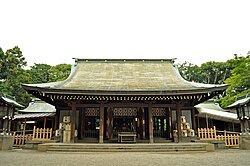
Wie andere Shinto- Kami wird auch Kushinadahime in vielen Schreinen in ganz Japan verehrt, meist zusammen mit ihrem Ehemann Susanoo, aber manchmal auch allein oder mit anderen (verwandten oder nicht verwandten) Gottheiten. Einige Beispiele für Shinto-Schreine, in denen sie verehrt wird, sind die folgenden.
- Dieser Schrein verehrt Kushinadahime als Hauptgottheit, während Susanoo und Ōyamatsumi als Hilfsgottheiten dienen. [ 28 ] In der Nähe des Schreins befindet sich der Ubuyu-no-Ike (産湯の池, wörtlich „Geburtsbadeteich“), ein Teich, der als der Ort gilt, an dem Kushinadahime nach ihrer Geburt ihr erstes Bad ( ubuyu ) nahm, sowie ein Sasa- Bambushain, der der Legende nach aus dem Bambusspatel ( hera ) gewachsen ist, mit dem die Nabelschnur der neugeborenen Kushinadahime durchtrennt wurde – bekannt als Sasa-no-Miya (笹の宮). [ 29 ] [ 30 ]
- Yaegaki-Schrein in Matsue , Präfektur Shimane
- Kushinadahime is one of this shrine's deities alongside Susanoo, Ōnamuchi (Ōkuninushi) and Aohata-Sakusahiko (one of Susanoo's children recorded in the Izumo Fudoki). As mentioned above, shrine legend claims that Susanoo hid Kushinadahime in the wooded area within the shrine's precincts known as Sakusame Forest (佐久佐女の森 Sakusame no mori) during his battle with the Yamata no Orochi.[20]
- Susa Shrine in Izumo, Shimane Prefecture
- This shrine's deities are Susanoo, Kushinadahime, Tenazuchi and Ashinazuchi.[31][32] Located in the former township of Susa (須佐郷), a place closely associated with Susanoo; indeed, a legend recorded in the Izumo Fudoki states that Susanoo himself enshrined his spirit here.[33][34] The shrine's priestly lineage, the Susa (or Inada) clan (須佐氏 / 稲田氏), were considered to be Susanoo's descendants via his son Yashimashino-no-Mikoto (八島篠命, the Kojiki's Yashimajinumi)[35][31] or Ōkuninushi.[36]
- Suga Shrine in Unnan, Shimane Prefecture
- This shrine is claimed to stand on the site of the palace Susanoo built after defeating the Yamata no Orochi and enshrines Susanoo, Kushinadahime, and their son Suga-no-Yuyamanushi-Minasarohiko-Yashima-no-Mikoto (清之湯山主三名狭漏彦八島野命, i.e. Yashimajinumi).[37]
- Kushida Shrine (櫛田宮 Kushida-gū) in Kanzaki, Saga Prefecture
- Dedicated to Susanoo, Kushinadahime, and Yamato Takeru. Legend claims that the shrine was founded by Yamato Takeru's father Emperor Keikō, who visited the area and enshrined these three deities. A camphor tree in the shrine grounds is said to have grown out of a koto that the emperor buried in the ground.[38]
- Kushida Shrine (櫛田神社 Kushida-jinja) in Imizu, Toyama Prefecture
- This shrine, claimed to have been founded by Takenouchi no Sukune, enshrines Susanoo and Kushinadahime as its principal deities.[39]
- Yasaka Shrine in Gion, Higashiyama, Kyoto, Kyoto Prefecture[40]
- Hiromine Shrine in Himeji, Hyōgo Prefecture[41]
- Hikawa Shrine in Ōmiya, Saitama, Saitama Prefecture
- The ichinomiya of former Musashi Province, dedicated to Susanoo, Kushinadahime, and Ōnamuchi.[42] Many of its branch shrines - concentrated in Saitama Prefecture and Tokyo - such as Akasaka Hikawa Shrine (Akasaka, Minato City, Tokyo) or Kawagoe Hikawa Shrine (Kawagoe, Saitama)[43] also venerate these three deities, though some either enshrine Susanoo alone or pair him with other gods (e.g. Azabu Hikawa Shrine in Moto-Azabu, Minato, Tokyo, dedicated to Susanoo and Yamato Takeru[44]).
- This shrine to Kushinadahime is classified in the Jinmyōchō (神名帳, lit. 'Register of Shrine Names') section of the Engishiki as a 'notable shrine' or myōjin-taisha, attesting to its status since antiquity.[45][46] The shrine's original site is located some 300 meters northwest of the current location, situated beside a spring-fed pond known as Yoshii (好井). According to legend, Kushinadahime appeared to a child who was drawing water from the spring and asked that shrines dedicated to her, her husband Susanoo, and her parents Tenazuchi and Ashinazuchi be built there.[46][47][48]
Kushinadahime and Harisaijo

Im Mittelalter und der frühen Neuzeit wurde Susanoo im Volksmund mit dem Seuchengott Gozu Tennō gleichgesetzt , dem Gott, der ursprünglich im Yasaka-Schrein in Kyoto, im Hiromine-Schrein in der Präfektur Hyōgo und im Tsushima-Schrein in Tsushima, Präfektur Aichi , verehrt wurde . [ 49 ] Als Susanoos Gemahlin wurde Kushinadahime wiederum mit Gozu Tennōs Frau Harisaijo (頗梨采女 oder 波利采女, auch bekannt als 'Harisainyo', 'Barisainyo' oder 'Harisai Tennyo ' (頗梨采天女)), der dritten Tochter des Drachenkönigs ( Nāga ) Sāgara , identifiziert . [ 50 ] [ 51 ] Tatsächlich sind im Yasaka-Schrein in Kyoto derzeit Susanoo, seine Frauen (Kushinadahime, Kamu-Ōichihime und Samirahime) und seine acht Kinder (Yashimajinumi, I(so)takeru , Ōya(tsu)hime, Tsumatsuhime, Ōtoshi , Ukanomitama , Ōyabiko und andere verehrt Suseribime ), [ 40 ] seine ursprünglichen Gottheiten waren Gozu Tennō, Harisaijo und ihre acht Söhne, zusammen bekannt als die „Acht Prinzen“ (八王子, Hachiōji ). [ 52 ]
Vermächtnis
Der 1997 entdeckte Asteroid 10613 Kushinadahime ist nach Kushinadahime benannt.
Kushinadahime wurde 1959 in dem Film „ Die Geburt Japans“ von Misa Uehara dargestellt .
Im Nintendo -Videospiel Golden Sun: The Lost Age basieren die Charaktere Kushinada und Susa grob auf Kushinadahime und Susanoo.
Siehe auch
Referenzen
- ^ „Mikogami“ . Enzyklopädie des Shintoismus . 21. April 2005. Archiviert vom Original am 30. September 2007. Abgerufen am 29. September 2019 .
{{cite web}}: CS1 maint: bot: original URL status unknown (link) - ^ Philippi, Donald L. (2015). Kojiki . Princeton University Press. P. 473. ISBN 978-1400878000Die
- ^ Aston, William G. (1905). Shinto (Der Weg der Götter) . Longmans, Green, and Co. S. 137–138 .
- ^ Hiraizumi, Kiyoshi (1997). Die Geschichte Japans: Geschichte von der Gründung der Nation bis zum Höhepunkt des Fujiwara-Wohlstands . Sekai Shuppan Incorporated. S. 25.
- ^ abcAston, William George (1896). . Nihongi: Chronicles of Japan from the Earliest Times to A.D. 697. Kegan Paul, Trench, Trübner & Co. pp. – via Wikisource.
- ^Philippi, Donald L. (2015). Kojiki. Princeton University Press. p. 509. ISBN 978-1400878000.
- ^Matsuoka, Shizuo (1929). Nihon Kogo Daijiten (日本古語大辭典). Tōkō Shoin. p. 1140.
- ^Yoshino, Yū (1969). "Kushiinada-Mitoyomanurahime-no-Mikoto ni tsuite (久志伊奈太美等与麻奴良比売命について)". Nihon Bungaku (日本文学). 18 (2). Japanese Literature Association: 56–61.
- ^Chamberlain (1882). Section XVIII.—The Eight-Forked Serpent.
- ^Philippi, Donald L. (2015). Kojiki. Princeton University Press. pp. 89–90. ISBN 978-1400878000.
- ^Mori, Mizue: "Kushinadahime". Encyclopedia of Shinto, Kokugakuin University, retrieved on 1 January 2014
- ^A Waka Anthology. Volume One: The Gem-Glistening Cup. Translated by Cranston, Edwin A. Stanford University Press. 1998. p. 7. ISBN 9780804731577.
- ^Takeda, Yūkichi (1948). 記紀歌謡集 (Kiki Kayōshu). Iwanami Shoten. p. 7.
- ^Based on Philippi, Donald L. (2015). Kojiki. Princeton University Press. p. 426. The transcription system used to distinguish type A/B vowels in the original text had been changed to indexed notation.
- ^Chamberlain (1882). Section XX.—The August Ancestors of the Deity-Master-of-the-Great-Land.
- ^Philippi, Donald L. (2015). Kojiki. Princeton University Press. p. 92. ISBN 978-1400878000.
- ^Aston, William George (1896). . Nihongi: Chronicles of Japan from the Earliest Times to A.D. 697. Kegan Paul, Trench, Trübner & Co. p. – via Wikisource.
- ^ abAston, William George (1896). . Nihongi: Chronicles of Japan from the Earliest Times to A.D. 697. Kegan Paul, Trench, Trübner & Co. p. – via Wikisource.
- ^Kuroita, Katsumi (1943). Kundoku Nihon Shoki, vol. 1 (訓読日本書紀 上巻). Iwanami Shoten. pp. 69–71.
- ^ ab"八重垣神社について". 【公式】八重垣神社 (Yaegaki Shrine Official Website). Retrieved 2020-03-30.
- ^"飯石郡の村々". Shimane Prefectural Government Official Website. Retrieved 2020-10-19.
- ^Kurita, Hiroshi (1931). 標註古風土記 出雲 (Hyōchū Kofudoki: Izumo). Ō-Oyakama Shoten.
- ^Records of Wind and Earth: A Translation of Fudoki, with Introduction and Commentaries. Translated by Aoki, Michiko Y. Association for Asian Studies, Inc. 1997. p. 40.
- ^Yano, Harumichi (1939). 神典翼 第3巻 (Shinten'yoku, vol. 3). Kokumin Seishin Bunka Kenkyūjo. p. 130.
- ^"山陰道の旧国-1(伯耆国・因幡国)". 米子(西伯耆)・山陰の古代史 (Yonago (Nishi-Hōki) / San'in no Kodaishi) (in Japanese). Retrieved 2020-10-19.
- ^"伯耆 (Hōki)". Nihon Jiten (日本辞典) - Japan Dictionary (in Japanese). Retrieved 2020-10-19.
- ^"稲田神社". 奥出雲町公式観光ガイド (The Official Okuizumo Travel Guide). Retrieved 2020-10-19.
- ^"県内神社一覧". Shimane-ken Jinjachō. Retrieved 2020-10-21.
- ^"稲田神社 (Inada-jinja)". 奥出雲町公式観光ガイド (The Official Okuizumo Travel Guide). Retrieved 2020-10-19.
- ^"笹宮 (Sasa-no-Miya)". 奥出雲町公式観光ガイド (The Official Okuizumo Travel Guide). Retrieved 2020-10-21.
- ^ ab大日本神社志 (Dai-Nippon jinja shi). 大日本敬神会本部 (Dai-Nippon Keishinkai Honbu). 1933. p. 342.
- ^"Dedicated Kami (deities or Japanese gods)". Suga Shrine Official Website. Retrieved 2020-03-30.
- ^Records of Wind and Earth: A Translation of Fudoki, with Introduction and Commentaries. Translated by Aoki, Michiko Y. Association for Asian Studies, Inc. 1997. pp. 140–141.
- ^"History". Suga Shrine Official Website. Retrieved 2020-03-30.
- ^飯石郡誌 (Iishi-gun shi) (in Japanese). 飯石郡役所 (Iishi-gun yakusho). 1918. p. 247.
- ^"須佐(稲田)氏 (Susa (Inada)-shi)". 家紋World - World of KAMON. Retrieved 2020-03-30.
- ^ „第十六番 須我神社“ .出雲國神仏霊場を巡る旅 (Izumo-no-kuni shinbutsu reijo o meguru tabi) . 社寺縁座の会 (Shaji Enza no Kai) . Abgerufen am 30.03.2020 .
- ^ „沿革概要“ . Offizielle Website von Kushida-gū (auf Japanisch) . Abgerufen am 19.10.2020 .
- ^ „神社・境内案内“ . Offizielle Website des Kushida-Schreins (auf Japanisch) . Abgerufen am 19.10.2020 .
- ^ ein b „御祭神“ . Offizielle Website des Yasaka-Schreins (auf Japanisch) . Abgerufen am 19.10.2020 .
- ^ „神々のご利益一覧“ (PDF) . Offizielle Website des Hiromine-Schreins (auf Japanisch) . Abgerufen am 19.10.2020 .
- ^ „氷川神社について“ . Offizielle Website des Hikawa-Schreins (auf Japanisch) . Abgerufen am 19.10.2020 .
- ^ „Über den Akasaka-Hikawa-Schrein“ . Offizielle Website des Akasaka-Hikawa-Schreins . Archiviert vom Original am 14.05.2020 . Abgerufen am 19.10.2020 .
- ^ „麻布氷川神社について“ . Offizielle Website des Azabu-Hikawa-Schreins (auf Japanisch) . Abgerufen am 21.10.2020 .
- ^ „稲田神社(常陸国新治郡)“ . Shinto Jinja-Datenbank . Kokugakuin-Universität . Abgerufen am 22.10.2020 .
- ^ a b „稲田神社“ . Ibaraki-ken Jinjachō (auf Japanisch) . Abgerufen am 19.10.2020 .
- ^ „奥の院 稲田姫伝説の好井“ . Handwerksrat KASAMA JAPAN . Abgerufen am 22.10.2020 .
- ^ Meiji Jinja Shiryō Hensanjo, Hrsg. (1912).府県郷社 明治神社誌料上 (Fu-ken-gōsha Meiji Jinja Shiryō, Bd. 1) . Meiji Jinja Shiryō Hensanjo.
- ^ Yonei, Tsuruyoshi. „Gozu Tennō“ . Enzyklopädie des Shinto . Kokugakuin-Universität . Abgerufen am 19.10.2020 .
- ^ Rambelli, Fabio (2007). Buddhistische Materialität: Eine Kulturgeschichte der Objekte im japanischen Buddhismus . Stanford University Press. S. 230–231 .
- Brumann , Christoph (2012). Tradition, Demokratie und das Stadtbild von Kyoto: Ein Anspruch auf die Vergangenheit . Routledge. S. 166. ISBN 9780415690706Die
- ^ Shimada, Hiromi (2020). Ekibyō-taisan. Nihon no gofu besuto 10 (疫病退散 日本の護符ベスト10) . Cyzo. P. 25.
Externe Links
 Medien zum Thema Kushinadahime auf Wikimedia Commons