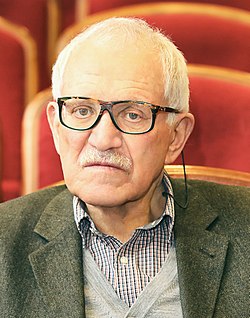
Iwan Sergejewitsch Schmeljow ( russisch : Иван Сергеевич Шмелёв , auch Schmelew und Chmelow geschrieben ; 3. Oktober [ 21. September nach OS ] 1873 – 24. Juni 1950) war ein russischer Schriftsteller, der vor allem für seine idyllischen Schilderungen einer vorrevolutionären Vergangenheit im Moskauer Kaufmannsviertel bekannt ist . Er war Mitglied der Moskauer Literaturgruppe Sreda . Nach der Oktoberrevolution floh Schmeljow nach Frankreich und wurde Emigrant und Schriftsteller. [ 1 ]
Biographie
Frühen Lebensjahren
Schmelew wurde in Samoskoworetschje als Sohn einer Kaufmannsfamilie geboren. Nach seinem Abitur 1894 studierte er Rechtswissenschaften an der Moskauer Universität . Seine erste veröffentlichte Geschichte erschien 1895. Im selben Jahr besuchte er das Walaam-Kloster , eine Reise, die ihn tief spirituell prägte und 1897 zu seinem ersten Buch „ Auf den Klippen von Walaam“ ( russisch : На скалах Валаама Na skalakh Valaama ) führte. Nach seinem Universitätsabschluss 1898 leistete er Militärdienst und arbeitete einige Jahre als Beamter in der Provinz, während er weiterhin schrieb. Seine frühen Erzählungen wurden vom Verlag „Znaniye“ von Maxim Gorki veröffentlicht . Nach der Russischen Revolution von 1905 stieg seine Popularität, und seine 1911 erschienene Erzählung „ Der Mann aus dem Restaurant“ ( Человек из ресторана Chelovek iz restorana ) feierte einen enormen Erfolg und machte ihn zu einem der bekanntesten Schriftsteller seiner Zeit. Sie „schildert mit Momenten von Dostojewskischer Kraft die Dekadenz der Reichen aus der Sicht eines einfachen Kellners und frommen Vaters, zu dem Sohn und Tochter nach verhängnisvollen Abenteuern in der Welt zurückkehren.“ [ 2 ] Schmeljows Erzählung diente als Grundlage für Jakow Protasanows gleichnamigen Film , der 1927 mit Michail Tschechow in der Hauptrolle erschien.
Karriere
In 1912 Shmelyov organized the Moscow Writers' Publishing House («Книгоиздательство писателей в Москве»), which published Ivan Bunin, Boris Zaitsev, and other leading writers of the day, as well as his own work. His works from this period on "were remarkable for the richness of their popular (in the sense of narodnyj) language.... Particularly noteworthy was his brilliant use of the skaz technique."[3]
Shmelev welcomed the February Revolution and the fall of the autocracy; he set off on a series of journeys across Russia to see the effects of the change, and was extremely moved when political exiles returning from Siberia told him how much his writings had meant to them.[4] However, he rejected the October Revolution and moved to the White-held Crimea, and when his beloved son Sergei, an officer in the Volunteer Army who had accepted the Bolsheviks' offer of amnesty and refused to follow P. Wrangel into exile in 1920, was seized by Béla Kun's Revolutionary Committee in the Crimea and shot without trial,[5] he accepted Bunin's suggestion that he join him in exile in France.
Perhaps the most powerful of Shemelev's writings in emigration is Solntse mertvykh (1923, tr. as The Sun of the Dead in 1927): "In the mosaic of the impressions of the narrator, an elderly intelligent stuck in the Crimea after the evacuation of Wrangel's troops from the peninsula, there pass the fates of the inhabitants of the Crimea—intelligents, workers, peasants—Tatars and Russians—men and women, all equally clutched in the vice of hunger and fear of the Terror... Everything gradually dies against the background of the loveliness of nature, on the shore of the azure sea, under the rays of a golden sun—the sun of the dead, because it illuminates an earth on which everything has been eaten, drunk, trampled—on which poultry, animals, and men are all dying".[6] Another important work of his later period is The Year of Grace [Leto Gospodne] (1933–48), an autobiographical novel full of lovingly drawn characters and beautifully observed details in which "his style reaches a high level of lyrical and epic contemplation".[7] The tetralogy from which Shmelev has had time to complete only first two volumes of the novel "The heavenly ways" (1937, 1948) has been conceived. Operation of the third part of the novel should occur in deserts Optinoj where after many shocks and irreplaceable losses its hero finds the sincere world and the higher sense of life begins to see clearly.
Later life
The younger generation of Russian writers, who came of age in exile, sometimes did not appreciate Shmelev's traditionalism and approval of the patriarchal society. Nina Berberova wrote of a reading in Paris in 1942: "Shmelev read as they read in the provinces before the time of Chekhov: with shouts and muttering, like an actor. He read some old-fashioned stuff, churchy, silly, about religious processions and hearty Russian dishes. The audience was ecstatic and clapped."[8] But his rich prose and his deep roots in Russian culture won him many readers when he was finally published in his homeland. Fifty years after his death, in 2000, the remains of Shmelyov and his wife were transferred from the Sainte-Geneviève-des-Bois Russian Cemetery to the necropolis of Donskoy Monastery in Moscow.
English translations
- The Sun of the Dead, Dent, 1927.
- The Story of a Love, Dutton, 1931.
- Schatten der Tage , Christliche Vesper und Das kleine Ei aus „Eine russische kulturelle Wiederbelebung“ , University of Tennessee Press, 1981. ISBN 0-87049-296-9
- Die Steinzeit , Barbary Coast, 1985.
Siehe auch
- My Love ist eine Verfilmung von A Love Story aus dem Jahr 1927.
Referenzen
- ^ „Иван Сергеевич Шмелев. Превознесенный talantom“ .
- ^ A. K. Thorlby (Hrsg.), The Penguin Companion to Literature: European , Penguin Books, 1969, S. 718
- ^ Elizabeth K. Beaujour, Rezension von Moscoviana: The Life and Art of Ivan Shmelyov von Olga Sorokin, The Slavic and East European Journal , Bd. 34, Nr. 2 (Sommer 1990), S. 266
- ^ Oleg Mikhailov, Einführung in Rukopisi ne goryat... [‚Manuskripte brennen nicht...‘) (Moskau: „Molodaya Gvardiya“, 1990), S. 10
- ^ Vikenty Veresaev , Augenzeugenbericht zitiert in Oleg Mikhailov, Einleitung zu Rukopisi ne goryat... , S. 11
- ^ Olga Sorokina, zitiert in Oleg Mikhailov, Einführung in Rukopisi ne goryat... , S. 12
- ^ Victor Terras (Hrsg.), Handbuch der russischen Literatur (Yale UP, 1985), S. 408
- ^ Nina Berberova, The Italics Are Mine (New York: Vintage Books, 1991), S. 416
Externe Links
- Werke (auf Russisch)
- Biografie (auf Russisch)
- Rückkehr nach Russland. Schmelev (auf Russisch)