Oxalessigsäure (auch Oxalsäure oder OAA genannt ) ist eine kristalline organische Verbindung mit der chemischen Formel HO₂CC (O)CH₂CO₂H . Oxalessigsäure , in Form ihrer konjugierten Base Oxalacetat , ist ein Stoffwechselzwischenprodukt in vielen Prozessen , die in Tieren ablaufen. Sie ist an der Gluconeogenese , dem Harnstoffzyklus , dem Glyoxylatzyklus , der Aminosäuresynthese , der Fettsäuresynthese und dem Citratzyklus beteiligt . [ 1 ]
Eigenschaften
Oxalessigsäure durchläuft sukzessive Deprotonierungen und bildet dabei das Dianion :
- HO 2 CC(O)CH 2 CO 2 H ⇌ − O 2 CC(O)CH 2 CO 2 H + H + , pKa = 2,22
- − O 2 CC(O)CH 2 CO 2 H ⇌ − O 2 CC(O)CH 2 CO 2 − + H + , pKa = 3,89
Bei hohem pH-Wert ist das enolisierbare Proton ionisiert:
- − O 2 CC(O)CH 2 CO 2 − ⇌ − O 2 CC(O − )CHCO 2 − + H + , pKa = 13,03
Die Enolformen der Oxalessigsäure sind besonders stabil. Die Keto-Enol-Tautomerisierung wird durch das Enzym Oxalacetat-Tautomerase katalysiert . trans -Enol-Oxalacetat entsteht auch, wenn Tartrat das Substrat für Fumarase ist . [ 2 ]

Biosynthese
Oxalacetat entsteht in der Natur auf verschiedenen Wegen. Ein Hauptweg ist die Oxidation von L -Malat , katalysiert durch Malatdehydrogenase im Citratzyklus. Malat wird auch durch Succinatdehydrogenase in einer langsamen Reaktion oxidiert, wobei Enol-Oxalacetat als erstes Produkt entsteht. [ 3 ] Es entsteht außerdem durch die Kondensation von Pyruvat mit Kohlensäure, angetrieben durch die Hydrolyse von ATP .
- CH₃C (O ) CO₂⁻ + HCO₃⁻ + ATP → −O₂CCH₂C ( O ) CO₂⁻ + ADP + Pi
Dieser Prozess findet im Mesophyll von Pflanzen statt und verläuft über Phosphoenolpyruvat , katalysiert durch Phosphoenolpyruvatcarboxylase . Oxalacetat kann auch durch Trans- oder Desaminierung von Asparaginsäure entstehen .
Biochemische Funktionen
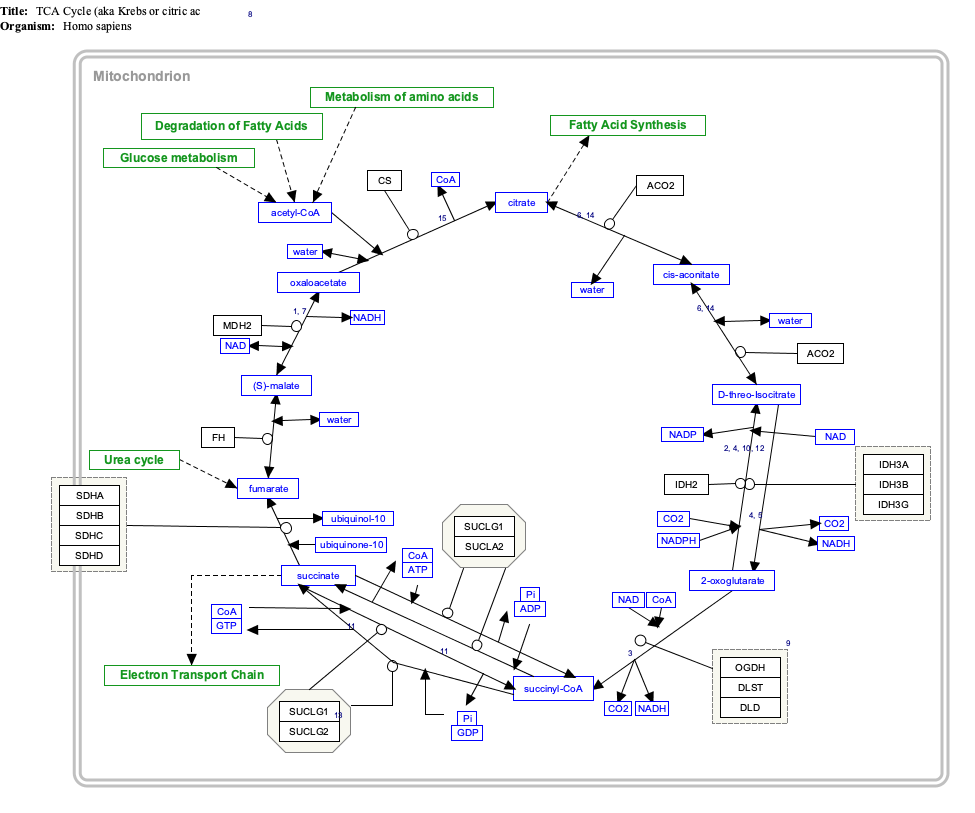
Oxalacetat ist ein Zwischenprodukt des Citratzyklus , wo es mit Acetyl-CoA zu Citrat reagiert. Diese Reaktion wird durch die Citratsynthase katalysiert . Oxalacetat ist außerdem an der Gluconeogenese , dem Harnstoffzyklus , dem Glyoxylatzyklus , der Aminosäuresynthese und der Fettsäuresynthese beteiligt . Darüber hinaus hemmt Oxalacetat den Komplex II .
Gluconeogenese
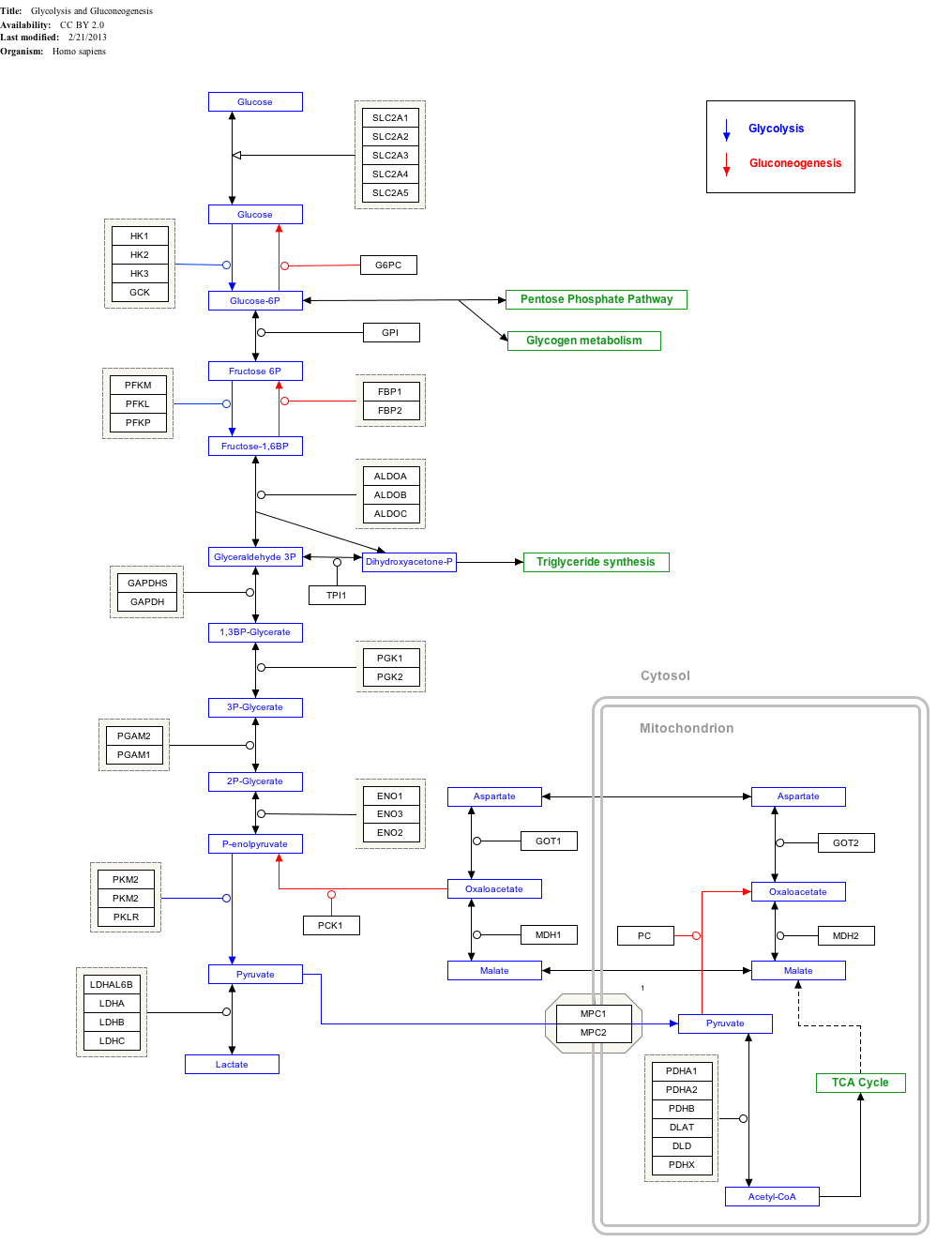
Die Gluconeogenese [ 1 ] ist ein Stoffwechselweg, der aus elf enzymkatalysierten Reaktionen besteht und zur Bildung von Glucose aus Nicht-Kohlenhydrat-Substraten führt. Dieser Prozess beginnt in der mitochondrialen Matrix , wo Pyruvatmoleküle vorliegen. Ein Pyruvatmolekül wird durch das Enzym Pyruvatcarboxylase carboxyliert , welches durch je ein Molekül ATP und Wasser aktiviert wird. Bei dieser Reaktion entsteht Oxalacetat. NADH reduziert Oxalacetat zu Malat . Diese Umwandlung ist notwendig, um das Molekül aus den Mitochondrien zu transportieren . Im Zytosol angekommen , wird Malat mithilfe von NAD+ erneut zu Oxalacetat oxidiert. Das Oxalacetat verbleibt dann im Zytosol, wo die weiteren Reaktionen stattfinden. Oxalacetat wird später durch Phosphoenolpyruvat-Carboxykinase decarboxyliert und phosphoryliert und wird unter Verwendung von Guanosintriphosphat (GTP) als Phosphatquelle zu 2-Phosphoenolpyruvat umgewandelt . Nach weiterer Aufarbeitung entsteht Glucose.
Harnstoffzyklus
Der Harnstoffzyklus ist ein Stoffwechselweg, der zur Bildung von Harnstoff führt . Dabei werden ein Ammoniummolekül aus abgebauten Aminosäuren, eine weitere Ammoniumgruppe aus Aspartat und ein Bicarbonatmolekül benötigt. [ 1 ] Dieser Weg findet häufig in Hepatozyten statt . Die Reaktionen des Harnstoffzyklus produzieren NADH , das auf zwei verschiedene Arten gebildet werden kann. Eine davon nutzt Oxalacetat . Im Zytosol befinden sich Fumaratmoleküle . Fumarat kann durch das Enzym Fumarase in Malat umgewandelt werden . Malat wird durch Malatdehydrogenase zu Oxalacetat umgesetzt, wobei ein Molekül NADH entsteht. Anschließend wird Oxalacetat zu Aspartat recycelt , da Transaminasen diese Keto-Säuren gegenüber anderen bevorzugen . Dieses Recycling hält den Stickstofffluss in die Zelle aufrecht.

Glyoxylatzyklus
Der Glyoxylatzyklus ist eine Variante des Citratzyklus. [ 4 ] Es handelt sich um einen anabolen Stoffwechselweg, der in Pflanzen und Bakterien vorkommt und die Enzyme Isocitratlyase und Malatsynthase nutzt . Einige Zwischenschritte des Zyklus unterscheiden sich geringfügig vom Citratzyklus; dennoch erfüllt Oxalacetat in beiden Prozessen dieselbe Funktion. [ 1 ] Das bedeutet, dass Oxalacetat in diesem Zyklus sowohl als primärer Reaktant als auch als Endprodukt fungiert. Tatsächlich ist Oxalacetat ein Nettoprodukt des Glyoxylatzyklus , da in dessen Schleife zwei Moleküle Acetyl-CoA eingebaut werden.
Fettsäuresynthese
In vorangegangenen Stadien wird Acetyl-CoA aus den Mitochondrien ins Zytoplasma transportiert, wo sich die Fettsäuresynthase befindet. Das Acetyl-CoA wird als Citrat transportiert, das zuvor in der mitochondrialen Matrix aus Acetyl-CoA und Oxalacetat gebildet wurde. Diese Reaktion initiiert normalerweise den Citratzyklus. Wird jedoch keine Energie benötigt, wird das Citrat ins Zytoplasma transportiert und dort zu zytoplasmatischem Acetyl-CoA und Oxalacetat abgebaut.
Ein weiterer Teil des Zyklus benötigt NADPH für die Fettsäuresynthese. [ 5 ] Ein Teil dieser Reduktionskraft entsteht, wenn cytosolische Oxalacetat in die Mitochondrien zurückgeführt wird, solange die innere Mitochondrienmembran für Oxalacetat undurchlässig ist. Zunächst wird Oxalacetat mithilfe von NADH zu Malat reduziert. Anschließend wird Malat zu Pyruvat decarboxyliert. Dieses Pyruvat kann nun leicht in die Mitochondrien gelangen, wo es durch Pyruvatcarboxylase wieder zu Oxalacetat carboxyliert wird. Auf diese Weise entsteht durch den Transfer von Acetyl-CoA aus den Mitochondrien ins Zytoplasma ein Molekül NADH. Die Gesamtreaktion, die spontan abläuft, lässt sich wie folgt zusammenfassen:
- HCO₃⁻ + ATP + Acetyl-CoA → ADP + Pᵢ + Malonyl- CoA
Aminosäuresynthese
Sechs essentielle und drei nicht-essentielle Aminosäuren werden aus Oxalacetat und Pyruvat synthetisiert . [ 6 ] Aspartat und Alanin entstehen durch Transaminierung von Glutamat aus Oxalacetat bzw. Pyruvat . Asparagin wird durch Amidierung von Aspartat synthetisiert, wobei Glutamin die NH₄-Gruppe liefert. Diese Aminosäuren sind nicht-essentiell und ihre einfachen Biosynthesewege kommen in allen Organismen vor. Methionin, Threonin, Lysin, Isoleucin, Valin und Leucin sind essentielle Aminosäuren für den Menschen und die meisten Wirbeltiere, was bedeutet, dass Oxalacetat nicht in diese Aminosäuren umgewandelt werden kann. Bakterien können sie jedoch über komplexe und miteinander verbundene Biosynthesewege synthetisieren.

Oxalatbiosynthese
Oxalacetat produziert durch Hydrolyse Oxalat. [ 7 ]
- Oxalacetat + H₂O ⇌ Oxalat + Acetat
Dieser Prozess wird durch das Enzym Oxalacetase katalysiert . Dieses Enzym kommt in Pflanzen vor, ist aber im Tierreich nicht bekannt. [ 8 ]
Interaktive Wegekarte
| Klicken Sie unten auf Gene, Proteine und Metaboliten, um zu den jeweiligen Artikeln zu gelangen. [ § 1 ] Glykolyse und Gluconeogenese bearbeiten
| Klicken Sie unten auf Gene, Proteine und Metaboliten, um zu den jeweiligen Artikeln zu gelangen. [ § 1 ] TCACycle_WP78 bearbeiten
|
Siehe auch
Referenzen
- ^ a b c d Nelson, David L.; Cox, Michael M. (2005). Principles of Biochemistry (4. Aufl.). New York: W. H. Freeman. ISBN 0-7167-4339-6Die
- ^ van Vugt-Lussenburg, BMA; van der Weel, L; Hagen, WR; Hagedoorn, PL (26. Februar 2021), „Biochemical Similarities and Differences between the Catalytic [4Fe-4S] Cluster Containing Fumarases FumA and FumB from Escherichia coli “, PLOS ONE , 8 (2) e55549 (veröffentlicht am 6. Februar 2013), doi : 10.1371/journal.pone.0055549 , PMC 3565967 , PMID 23405168
- ^ MV Panchenko; AD Vinogradov (1991). „Direkter Nachweis von Enol-Oxalacetat als unmittelbares Produkt der Malatoxidation durch die Succinatdehydrogenase von Säugetieren“ . FEBS Letters . 286 ( 1–2 ): 76–78 . Bibcode : 1991FEBSL.286...76P . doi : 10.1016/0014-5793(91)80944-X . PMID 1864383 .
- ^ „Willkommen im Chemiezentrum“ . www.pearsonhighered.com . Abgerufen am 5. April 2018 .
- ^ „Fettsäuresynthese“ . www.rpi.edu .
- ^ „Synthetisierte Aminosäuren aus Oxalacetat und Pyruvat“ . faculty.ksu.edu.sa . Archiviert vom Original (PPTX) am 21. Oktober 2013. Abgerufen am 21. Oktober 2013 .
- ^ Gadd, Geoffrey M. „Pilzproduktion von Zitronensäure und Oxalsäure: Bedeutung für die Metallspezies, Physiologie und biogeochemische Prozesse“ Advances in Microbial Physiology (1999), 41, 47-92.
- ^ Xu, Hua-Wei. „Oxalatakkumulation und -regulation sind unabhängig von der Glykolatoxidase in Reisblättern.“ Journal of Experimental Botany, Band 57, Nr. 9, S. 1899–1908, 2006.


