Rupert Leo Scott Bruce-Mitford (14 June 1914 – 10 March 1994) was a British archaeologist and scholar. He spent the majority of his career at the British Museum, primarily as the keeper of the Department of British and Medieval Antiquities, and was particularly known for his work on the Sutton Hoo ship-burial. Described as the guiding spirit of such research, he oversaw the production of the monumental three-volume work The Sutton Hoo Ship-Burial, termed by the president of the Society of Antiquaries as "one of the great books of the century".[1]
Though Bruce-Mitford was born in London, his preceding two generations had lived largely abroad: his maternal grandparents as early settlers of British Columbia, his paternal grandparents as missionaries in India, and his parents as schoolteachers in Japan. When Bruce-Mitford was five, his father died. His mother was left to raise four sons, of whom Bruce-Mitford was the youngest, on a tiny salary; the stresses were substantial, and he was fostered for a time after his mother had a breakdown. He attended preparatory school with the support of a relative, enrolled at the charity schoolChrist's Hospital five years later, and, in 1933, earned a Baring Scholarship in History to attend Hertford College, Oxford. Recommending him for a museum curatorship in 1936, the University Appointments Board noted that he "has an exceptional gift for research, a sphere in which he could do work of outstanding merit".[2]
After spending a year as an assistant keeper at the Ashmolean Museum, during which he produced the first standardised chronology of medieval pottery, in December 1937, Bruce-Mitford joined the British Museum's Department of British and Medieval Antiquities. The ship-burial was excavated in 1939, weeks before the outbreak of the Second World War; Bruce-Mitford spent 1940 to 1946 in the Royal Corps of Signals, and returned with responsibility over Sutton Hoo. Bruce-Mitford spent much of the next four decades focused on the subject, publishing dozens of works, studying contemporary graves in Scandinavia (excavating a boat-grave in Sweden and learning Swedish and Danish along the way), and leading a second round of excavations at Sutton Hoo from 1965 to 1970.
In his other duties, Bruce-Mitford excavated at the Mawgan Porth Dark Age Village, published significant works on the Lindisfarne Gospels, the Codex Amiatinus, and (posthumously) Celtichanging bowls, translated P. V. Glob's book The Bog People into English, and oversaw acquisitions including Courtenay Adrian Ilbert's collection of thousands of clocks and watches, considered the greatest such collection in the world. He also founded the Society for Medieval Archaeology, and served as secretary, and later vice-president, of the Society of Antiquaries. After his retirement from the British Museum in 1977, he served as Slade Professor of Fine Art at the University of Cambridge, a visiting fellow at All Souls College, Oxford, and a faculty visitor in the Department of English at the Australian National University.
Early life and background
Rupert Leo Scott Bruce-Mitford was born on 14 June 1914 at 1 Deerhurst Road, Streatham, London.[3] Following Terence, Vidal and Alaric (Alec), he was the fourth of four sons born to Charles Eustace and Beatrice Jean Bruce-Mitford; a daughter did not survive.[4] Family tradition has it that Rupert's brothers were responsible for his given names, selecting them from their reading: Rupert from Anthony Hope's Rupert of Hentzau, Leo from Rider Haggard's She, and Scott from either Robert Falcon Scott's diary, or his "Message to England".[5][note 1]
Bruce-Mitfords Urgroßeltern väterlicherseits, George und Elizabeth Beer, reisten 1836 ins Godavari- Delta in Indien, um dort als Baptistenmissionare zu arbeiten. [ 7 ] [ 8 ] Obwohl sie bei ihrer Abreise arm und nicht ordiniert waren, zählten sie laut Anthony Norris Groves ’ Biograf zu den „beharrlichsten christlichen Missionaren aller Zeiten“. [ 9 ] [ 10 ] [ 11 ] Ihre beiden Söhne, John William und Charles Henry, setzten die Berufung fort, während ihre beiden Töchter Lehrer aus der Gegend heirateten. [ 12 ] [ 10 ] [ 13 ] 1866 heiratete John Beer Margaret Anne Midford, die Tochter einer englischen Familie aus Machilipatnam . [ 14 ] Sie hatten fünf Kinder, darunter Herbert Leonard (geb. 1871) und Eustace (geb. 1875), den Vater von Rupert Bruce-Mitford. [ 14 ] Die Familie kehrte 1884 nach Devon zurück , als John Beer erkrankte. [ 14 ] Er starb kurz nach seiner Ankunft; seine Frau kehrte nach Indien zurück, starb dort aber vier Jahre später. [ 14 ] Eustace Beer, so schrieb Rupert Bruce-Mitford später, wurde dadurch „selbst als kleiner Junge zweimal zum Waisen“. [ 14 ] 1891 befand er sich in England, nachdem er entweder zurückgekehrt oder nach dem Tod seines Vaters nie weggegangen war. [ 14 ] Nach seinem Studium in Exeter unterrichtete er Englisch und Klassische Philologie an der Blackburn Grammar School , segelte aber 1901 von Genua aus nach China, um an der Weihaiwei- Schule zu unterrichten, einer von seinem Bruder Herbert gegründeten Einrichtung für europäische Jungen. [ 15 ] [ 16 ] Knapp neun Monate später reiste er nach Japan, um dort seine eigene Schule mit einem Lehrplan und einer Philosophie zu gründen, die seinen eigenen Vorstellungen entsprachen. [ 17 ] [ 18 ]
Shortly before his 1902 departure to China, Eustace Beer adopted the surname Bruce-Mitford—perhaps indicative of his desire to separate himself from his family's missionary past.[18] "Mitford" was a take on "Midford", his mother's maiden name, and, perhaps not unintentionally, that of the unrelated Bertram Freeman-Mitford, 1st Baron Redesdale, whose name carried respect in the British expatriate community in Japan.[19] "Bruce" may have been taken from Major Clarence Dalrymple Bruce, an acquaintance who commanded the Weihaiwei Regiment.[20] In Japan Eustace founded the Yokohama Modern School, which targeted the sons of English, and English-speaking, businessmen and missionaries.[20] In 1903, and likely on the basis of his book and articles on Weihaiwei, he was elected a fellow of the Royal Geographical Society; he subsequently became interested in geography and vulcanology, writing additional works on Japan.[21][22][note 2]
Eustace Bruce-Mitford had met Beatrice Allison on his ship to Yokohama, and soon after founding his school recruited her as an assistant teacher; they married on 27 July 1904, at Christ Church, Yokohama.[31][32][note 3] She was the eldest daughter of early settlers of British Columbia, Susan Louisa (née Moir)[35] and John Fall Allison, an explorer, gold prospector, and cattle rancher.[32] In 1908, however, by which time the family had three sons, William Awdry, the Bishop of South Tokyo, announced from the pulpit of Christ Church that "certain marriages of British subjects celebrated in Japan" might not be legally valid, and if so "the couples ... will find that they have been and are living together ... in concubinage and that their children are 'illegitimate'".[36][37][38] Though a legal technicality, and one which was remedied by an Act of Parliament in 1912,[39] the announcement disgraced the Bruce-Mitfords, and Eustace lost his leadership of the Yokohama Modern School.[36][note 4] He was taken on as an assistant editor by Francis Brinkley, owner and editor of The Japan Mail, though by 1911 had returned to England as a freelance journalist.[40] Rupert Bruce-Mitford was born three years after his family returned from Japan.[41] Three years later, his father left for India to work as an assistant editor at The Madras Mail.[41] Eustace died following a short fever in 1919, when he was forty-four and Rupert five.[41]
Following the death of his father, Bruce-Mitford later wrote, "the family was stranded in London and fell on very hard times".[42][41] His mother then earned roughly £170 a year (equivalent to £8,900 in 2025), of which she lent £120 (equivalent to £6,300 in 2025) to Terence and Vidal, to be repaid after their studies, and spent approximately £42 18s yearly (equivalent to £2,250 in 2025) for part of a house, with rent paid weekly.[43] Bruce-Mitford was frequently sick as a child, coming down with scarlet fever and diphtheria when aged two, and influenza when around six.[43] The stresses on the family were substantial, and at one point Beatrice had a breakdown, causing Rupert to be fostered for a time.[44]
Education

Fatherless and poor, Rupert Bruce-Mitford was educated with the financial support of his mother's cousin.[45] The support hinged, Bruce-Mitford later wrote, "on one condition – that my father's novel, depicting life in Yokohama at the turn of the century, should be burnt; she thought it immoral and scurrilous".[42][43] Around 1920, Bruce-Mitford was thereby sent to Brightlands preparatory school in Dulwich, London, which his brothers Terence and Alec also attended before receiving scholarships to Dulwich College.[43] Bruce-Mitford was baptised around the same time, perhaps to improve his later chances of admittance to the charity schoolChrist's Hospital.[43] Five years later the Brightlands headmaster nominated Bruce-Mitford to take an examination for Christ's Hospital.[43] Following success in the examination—covering the three compulsory subjects of English, arithmetic and practical mensuration, and history and geography, as well as all three optional subjects of Latin, French, and mathematics—and his mother's application, he was admitted on 17 September 1925.[43]
Bruce-Mitford was successful, and happy, at Christ's Hospital.[44] He was also introduced to archaeology; in 1930 he participated in a dig with S. E. Winbolt at the Jacobean ironworks in Dedisham, Sussex.[44] Winbolt wrote in the school magazine that "unhappily the 'dig' produced no useful results", but added that "possibly, however, the C.H. diggers learnt something", and named Bruce-Mitford "among willing helpers, mentioned honoris causa".[44] Meanwhile, Bruce-Mitford was active in school events, including playing rugby and cricket, acting in (and directing the orchestra for) John Galsworthy's The Little Man, debating at the Horsham Workers' Educational Association, and writing his first article, on a ten-day signals camp held over the 1931 summer holiday.[44]

By the time Bruce-Mitford was 16 or 17, he had switched his studies from classics to history—the result, in no small part, of his shaky grasp of Greek and Latin, despite devoted tutoring by his brother Terence.[46][44] Around the same time, he came across Samuel Gardner's English Gothic Foliage Sculpture in the school's library,[47] and upon reading it discovered his love of the concrete and visual.[46][48][note 5] In 1933, he was awarded a £100 (equivalent to £6,200 in 2025) Baring Scholarship in History to attend Hertford College, Oxford.[49][44] This came as surprise, he wrote, "for I never had a head for dates and treaties".[46][44] But as he recalled four decades later, at Oxford "I fell in love with the atmosphere and smell of the oldest part of the Library where, under the flat-arched 15th century ceiling, cases displaying illuminated manuscripts were set out".[46] One, the twelfth-century Ashmole Bestiary, open to a folio of a red eagle on a background of gold, so captured his attention that "after some weeks I could stand my ignorance and quell my curiosity no longer", and, "[s]crewing up my courage", asked for permission to see it; he remained absorbed in the work through lunch and until evicted at the end of the day.[46][48]
During school vacations, Bruce-Mitford often took the tram to the British Museum, where he spent time in the Reading Room.[46][50] He also walked around the building, listening to guest lecturers speak on the objects, and particularly enjoying hearing about the Chinese paintings and the Royal Gold Cup.[46][51] In 1936, he obtained his bachelor's degree with a Second Class in Modern History,[52] and in Michaelmas term began a postgraduate Bachelor of Letters on "The Development of English Narrative Art in the Fourteenth Century".[51] The research included an investigation of the pigments (particularly Egyptian blue) used in early illuminated manuscripts.[51][53] Bruce-Mitford's supervisor was Robin Flower, deputy keeper of manuscripts at the British Museum.[51] The same year, the University Appointments Board recommended Bruce-Mitford for the curatorship of the York Castle Museum, writing that he "would do well in a trading or administrative post, but has an exceptional gift for research, a sphere in which he could do work of outstanding merit".[2][note 6] He never finished the Bachelor of Letters, although he was promoted to the rank of Master of Arts in 1961 and awarded a Doctor of Letters in 1987, both from Hertford College.[51][note 7]
Career
Ashmolean Museum
1937 nahm Bruce-Mitford eine einjährige Stelle als Assistenzkurator am Ashmolean Museum an . [ 56 ] Zu seinen ersten Aufgaben gehörte die Neuordnung und Präsentation der Sammlung mittelalterlicher Pilgerabzeichen des Museums . [ 46 ] [ 56 ] Bald darauf kam er jedoch mit der sogenannten Rettungsarchäologie in Berührung , als eine Gruppe von Häusern aus dem 17. Jahrhundert zugunsten eines großen Anbaus der Bodleian Library abgerissen wurde . [ 46 ] [ 57 ] Vor dem Abriss lud der Leiter der Bibliothek die Oxfordshire Architectural and Historical Society ein, die Häuser auf ihren architektonischen und antiquarischen Wert hin zu untersuchen und den bevorstehenden Abriss sowie die Ausgrabungen der Fundamente zu beobachten. [ 58 ] [ 57 ] Die Gesellschaft wiederum setzte einen Unterausschuss ein, bestehend aus Edward Tudor Long, Edward Thurlow Leeds und William Abel Pantin, um die Untersuchung der Häuser zu leiten und während des Abrisses nach Funden Ausschau zu halten. [ 58 ] [ 57 ]
Demolition lasted from December 1936 to March 1937,[59] after which began, according to the geologist William Joscelyn Arkell, "the removal of the greatest quantity of subsoil ... ever taken out of one hole within the City of Oxford".[60][56] Bruce-Mitford was tasked with watching the site during the excavation.[46][56] Much of his work involved waiting for the well in front of each house to be dug out, revealing two or three feet (around half a metre to a metre) of mud at the bottom, filled with broken medieval pottery and other artefacts.[46][56] He waited "impotently", he later recalled, for the jaws of the mechanical diggers (which would not wait for the archaeologists) to pick up the mud and transfer it to a lorry; he then jumped aboard, and picked out the artefacts as the lorry made its way "to some gravel hungry site at Cumnor".[46][56] When back at the Ashmolean, he would wash the sherds and stick them together.[46][56] Bruce-Mitford's energy and eye resulted in a collection of pottery that was exceptionally useful.[61] Because the wells quickly silted up during their use and had to be replaced by new ones every 50 or so years, Bruce-Mitford found it possible to accurately date pottery within particularly short time-frames.[62] In 1939, he published an article on the finds, to be read in conjunction with an article by Pantin,[63] in which he described five distinct groups of pottery in their probable chronological order; his brother Alaric provided the illustrations.[64][65] This was "the first serious study of medieval pottery", wrote the archaeologist Maureen Mellor in 1997, and "has never had to be challenged, although refined and extended".[66][67][68] Bruce-Mitford's work also influenced him, decades later, to create a national reference collection of medieval pottery at the British Museum.[69][70][71][72]
British Museum
On 3 December 1937, Bruce-Mitford was named assistant keeper (second class) of the Department of British and Medieval Antiquities at the British Museum.[73][70] He was possibly helped in this position by his professor from two years previously, Robin Flower, also the deputy keeper of manuscripts.[74] The following year Bruce-Mitford was reacquainted with archaeological work, spending three weeks with Gerhard Bersu at the Iron Age site of Little Woodbury in Wiltshire.[75][76][77] "I learned a lot", he later wrote, "and loved being out on the chalk, in the fresh air."[76] There, Bruce-Mitford met Charles Phillips, the secretary of the Prehistoric Society (for which Bersu was digging).[75][76]
In 1939 Bruce-Mitford was tasked with leading an excavation, this time at the medieval village of Seacourt in Oxfordshire.[75] Though Seacourt was a difficult site, Bruce-Mitford thought it would be possible to determine a complete ground plan of domestic buildings and of the church.[75][78] It was also a village that was known to have been deserted and archaeologically sealed by 1439, within a century of the Black Death.[79] This provided a terminus ante quem for any artefacts found there, offering the chance to obtain important chronological evidence as to pottery and small objects such as brooches, ornaments, bucks, fittings, shears, horseshoes, and nails, the dating of which was particularly imprecise.[80] Excavations wrapped up 15 July 1939,[81] seven weeks before Britain's entry into the Second World War.[82][note 8]
Second World War
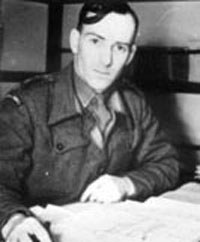
From 1940 to 1946, Bruce-Mitford served in the Royal Corps of Signals.[70] Joining as a lance corporal and initially assigned to a territorial unit in Essex, he transmitted morse code during the day, after which he watched for fires from the dome of St Paul's Cathedral.[82] He was in Catterick Camp in North Yorkshire by autumn,[82] when The Yorkshire Archæological Journal reported that he and his friends cleared out a Roman hypocaust at Middleham.[84] The site had previously been excavated around 1881 and 1906.[85][86][87] Bruce-Mitford's notes were published in The Journal of Roman Studies, with photographs taken by Eric Lomax.[85][88]
Bruce-Mitford was commissioned as a second lieutenant on 1 February 1941,[89][90] and promoted to war substantive lieutenant on 1 August 1942, acting captain on 20 November 1942,[91] and temporary captain on 26 February 1943.[92][82] By 1943 he was working on the publications staff of the Royal School of Signals at Catterick,[93] where he wrote a booklet on wireless communication, attempted to reorganise the Northern Command's signals system, and travelled around Yorkshire by motorcycle, laying cable.[82] From 1943 to 1945, he led parties from the School of Signals to archaeological and other sites across Northern England, including Richmond Castle, Jervaulx Abbey, Easby Parish Church, Stanwick St John, Middleham Castle, and the Georgian Theatre Royal, recording notes and commentaries when there.[94][82]
Return to the British Museum
Sutton Hoo
Bruce-Mitford verbrachte den Krieg in Erwartung seiner Rückkehr zur Abteilung für britische und mittelalterliche Altertümer. [ 95 ] Bereits 1940 schrieb T. D. Kendrick – damals Leiter der Abteilung, später Direktor des Museums – an Bruce-Mitford in seinem Armeelager und teilte ihm mit, dass er für die Sammlung angelsächsischer Altertümer, die germanischen Sammlungen Europas und die spätkeltischen Sammlungen der Britischen Inseln verantwortlich sein würde. [ 96 ] Der Brief schloss mit einer Warnung: „Sie werden auch für Sutton Hoo zuständig sein . Bereiten Sie sich auf diese Aufgabe vor.“ [ 96 ] Bruce-Mitfords Verantwortung für das angelsächsische Schiffsgrab von Sutton Hoo , schrieb der Oxford-Gelehrte Martin Biddle , sollte „der entscheidende Moment in Ruperts Leben, seine größte Herausforderung, die Quelle fast unüberwindlicher Schwierigkeiten und seine größte Leistung“ werden. [ 95 ] Anfang 1946 wurde Bruce-Mitford als Ehrenhauptmann aus der Armee entlassen und kehrte umgehend ins Museum zurück; [ 97 ] [ 95 ] den ersten Vortrag, den er nach seiner Entlassung besuchte, hielt Phillips über Sutton Hoo. [ 98 ]
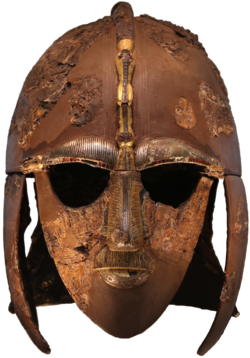
Bruce-Mitford returned to a museum that had suffered during the war.[95] Understaffed and with inadequate facilities, the museum had much of its collection still in storage.[95] The Sutton Hoo finds, excavated in 1939 and promptly taken to the safety of the tunnel connecting the Aldwych and Holborn tube stations,[99] had been returned to the museum only a year or two before.[100][101]Herbert Maryon, a technical attaché recruited for the task,[102] set to work restoring what Bruce-Mitford later termed "the real headaches – notably the crushed shield, helmet and drinking horns".[100] "When I began work", he continued, "I sat with Maryon while he took me through the material and with infectious enthusiasm, demonstrated what he was doing".[100] "There followed great days for Sutton Hoo when new, often dramatic, discoveries were being made in the workshops all the time. Built from fragments, astonishing artefacts – helmet, shield, drinking horns, and so on – were recreated."[96]
Early in 1946, Kendrick and Bruce-Mitford placed restored artefacts from Sutton Hoo on display in the museum's King Edward VII Gallery.[103][104][100] In January 1947, Bruce-Mitford was elected a fellow of the Society of Antiquaries of London,[105][note 9] and the museum published The Sutton Hoo Ship-Burial: A Provisional Guide, which Bruce-Mitford had written and produced during evenings at his kitchen table.[113][114] The work quickly proved to be one of the museum's most successful publications, going through ten impressions even before the second edition was issued.[115] Also in 1947, in what he later termed "one of the most rewarding experiences of my life", he visited Sweden for six weeks at the invitation of the archaeologist Sune Lindqvist.[100] Bruce-Mitford studied the similar finds from Vendel and Valsgärde and helped Lindqvist excavate the boat-grave from Valsgärde 11, learning Swedish along the way.[116][115][note 10]
Although Bruce-Mitford continued to write prolifically on Sutton Hoo—he quickly became, in the words of Francis Peabody Magoun, the "spiritus rector of present-day Sutton Hoo research"[118]—a definitive publication remained elusive.[113] Writing a memorandum to Kendrick in May 1949, Bruce-Mitford outlined a plan for "[t]hree large volumes" and possibly a fourth, buttressed by "a formidable array of technical reports obtained at my request from outside scientists", and accompanied by the "hope that the publication will set a new standard in archaeological publication".[113] But he admitted that he could not see "any real prospect of getting the catalogue out the way things are at present".[119] The museum had other needs, and Bruce-Mitford other responsibilities; the country plunged into the Korean War, and resources were diverted elsewhere.[113][120] In a 1957 addendum to his 1949 memorandum, Bruce-Mitford wrote "[t]here was no reply to this report".[119]
Other matters
Throughout the 1950s, Bruce-Mitford's attention was directed away from Sutton Hoo.[121] In these "fallow years for Sutton Hoo", as Biddle termed them, germinated many of the other contributions of Bruce-Mitford's career.[122][113] He began two projects that would result in posthumous publications: excavations at the Mawgan Porth Dark Age Village in Cornwall from 1949 to 1952 (continued in 1954 and 1974),[123][124][125] and the compilation of information on Celtic hanging bowls.[126][127] He undertook another effort in 1955, unsuccessfully searching Lincoln Cathedral with Sir Wilfred Le Gros Clark and Harold Plenderleith for the burial place of Saint Hugh of Lincoln.[128][129][121]
Also starting in the 1950s, Bruce-Mitford began to shoulder increasing roles and responsibilities, including deputy keepership of the Department of British and Medieval Antiquities in February 1954,[130][131] full keepership upon the retirement of A. B. Tonnochy that August,[132] appointment to the Ancient Monuments Board for England that same year (serving until at least 1975),[133][134][135][136][137] membership in the Museums Association by 1955,[138][139][140][141] and founder and president of the Society for Medieval Archaeology in 1957.[142][143] In the latter half of the decade Bruce-Mitford became a semi-regular participant in the show Animal, Vegetable, Mineral?, appearing in 1955, 1956, 1958, and 1959.[144][145][146][147][note 11] In 1960, he opened an exhibition, "Archaeology from the Air", at the Victoria Galleries in Kingston upon Hull.[150]
This time also saw Bruce-Mitford's primary work on early medieval manuscripts.[101] In 1956 and 1960, he published a two-volume work—facsimile and commentary—on the Lindisfarne Gospels.[151][152][note 12] The work was his first major publication; the museum gave him four months' leave to focus on the work, including time at the Royal Library in Copenhagen and the Laurentian Library in Florence.[115] The result, according to the journal Antiquity, was "magistral".[156] While at the Laurentian, Bruce-Mitford also studied the c. 700 AD bible known as the Codex Amiatinus,[156] eventually resulting in a Jarrow Lecture on the subject in 1967.[157][158][note 13] Around the same time, he translated P. V. Glob's 1965 book The Bog People from Danish to English, with the result published in 1969.[160][note 14]

Though Bruce-Mitford helped secure acquisitions throughout his 21 years as keeper, two of his most significant efforts came in 1958.[165] That year, the museum purchased the Lycurgus Cup from Victor Rothschild, 3rd Baron Rothschild, for £20,000 (equivalent to £542,000 in 2024).[166][167] The museum also purchased Courtenay Adrian Ilbert's collection of clocks and watches. This, wrote Biddle, was "the greatest collection of horology in the world", and Bruce-Mitford's "greatest coup".[165] After Ilbert died in 1956,[168] his collection—some 210 clocks and 2,300 watches and watch movements—was set for auction at Christie's.[169] Although the treasury declined a request for funds, Bruce-Mitford approached the Worshipful Company of Clockmakers, which was able to secure a donor to purchase the clocks for the museum.[165] The company then again approached the treasury, the head of which this time agreed to petition parliament for funds to purchase the remainder of the collection.[165] The collection was purchased for the museum, and the company made Bruce-Mitford a liveryman.[165]
Shortly thereafter, in 1960, Bruce-Mitford embarked on an ultimately unsuccessful two-year attempt to acquire what would become known as the Cloisters Cross.[165] The ivory cross, which a panel of experts at the museum declared "one of the finest and most impressive objects of the 12th century they [had] ever seen", appeared at the museum on 5 December 1960, prior to which it was virtually unknown;[165] Bruce-Mitford was alerted by an urgent note that a man had arrived with an ivory cross, and that it was his last day in London.[170][note 15] Bruce-Mitford studied the cross over the ensuing two years—including four days spent in a bank vault in Zurich—assembled a file an inch and a half thick, and successfully persuaded the treasury to allocate £195,000 (equivalent to £5,290,000 in 2024) for its purchase.[172][173] But as unsavoury rumours swirled around the owner, Ante Topić Mimara, and doubts persisted that the unprovenanced cross might be Nazi loot, Mimara steadfastly refused to disclose how he had obtained possession.[172] With the museum unwilling to pay without this information and Mimara unwilling to disclose it, the museum's option expired at midnight on 31 January 1963.[174] The Metropolitan Museum of Art had been waiting in the wings; its curator Thomas Hoving, untroubled by the issues with the cross and owner, stayed up over dinner with Mimara and purchased it immediately.[174][175][note 16]
Return to Sutton Hoo
Frank Francis succeeded Kendrick as director in 1959,[178] and the following year made two floors of a Montague Street house available for Bruce-Mitford to devote to the Sutton Hoo operation.[179] A research assistant was added in 1962 and, eventually, thirteen people were involved.[180] By then, criticism over the delays in publication had begun to mount; a 1964 article by Christopher Hawkes lamented the fact that "[a] quarter of a century has passed ... and Sutton Hoo is still not published", and concluded that the museum "really must go to it".[181] Much of the criticism landed on the shoulders of Bruce-Mitford, leading the archaeologist Robert T. Farrell[182] to observe that "it has become something of a trend to slate Bruce-Mitford for delay".[183] After the volumes were ultimately published, Hawkes and his wife Sonia went as far as to translate, privately publish, and distribute amongst colleagues a biting German review by Joachim Werner.[184][185][186] Sir David M. Wilson, who became director of the museum in 1977, disparaged Bruce-Mitford in his 2002 book The British Museum: A History, and wrote that work on the Sutton Hoo volumes "presents a precautionary, if unique, tale of procrastination and obfuscation".[187][note 17] To others, including Biddle and Rosemary Cramp, while Bruce-Mitford's perfectionism and penchant for detail did not speed matters, the criticism failed to account for the many other demands on his time, and the museum's delay in making resources available for the publication.[189][109] Nor, wrote Biddle, did it appreciate the scope of the undertaking, which involved modernising multiple fields of research—such as the proper chronology of Merovingian coins, used to date the burial; the study of textiles; and the study of soil, used to determine whether the burial was a grave or a cenotaph—and the re-excavation of the ship-burial.[190][191][192]
From 1965 to 1970, Bruce-Mitford led another round of excavations at Sutton Hoo in order to acquire more information about the mound, the ship, and the burial.[193] Especially given that the original two-week excavation had been an exercise in rescue archaeology, it was hoped that an excavation without the looming spectre of war might discover items or features that had been missed.[194] In 1968, Bruce-Mitford updated the Provisional Guide with a new edition, now entitled The Sutton Hoo Ship-Burial: A Handbook;[195][196] second and third editions of the Handbook followed in 1972 and 1979.[197] In 1973, he delivered the second G. N. Garmonsway Memorial Lecture at the University of York, speaking on Sutton Hoo,[198] and in 1974, he published Aspects of Anglo-Saxon Archaeology.[199] The book contained twelve updated and rewritten chapters that had appeared elsewhere, along with four new chapters; originally conceived as a reference work which the forthcoming Sutton Hoo publication would cite throughout, it also provided a more high-level overview of certain portions of the burial.[200][note 18]
The first volume of The Sutton Hoo Ship-Burial finally appeared in 1975.[206][192] It focused on the larger issues of the burial—such as the site, the excavations, the ship, the date of the burial, and the questions of whom it honoured, and whether or not it was a cenotaph.[207] The book was widely welcomed; A. J. Taylor, then president of the Society of Antiquaries, hailed the publication as "one of the great books of the century".[1][192] The book was "splendid", wrote Birgit Arrhenius,[208] and to Biddle, "the firm foundation on which all subsequent work on the site and on the contents of the mound will safely rest".[209] Cramp wrote of "the consistently high standard of argument and presentation" in the work,[210] and even beyond the specific site of Sutton Hoo, the art critic Terence Mullaly suggested the book "sets standards for archaeologists everywhere".[211] The authors and the museum, James Graham-Campbell wrote in Antiquity, "merit every congratulation on the appearance of this first volume".[212]
Also in 1975, Bruce-Mitford relinquished his role as keeper of the Department of British and Medieval Antiquities to spend two years as research keeper.[213] This period was the only time during his career which he was able to devote exclusively to Sutton Hoo.[192] Amidst some internal conflict, some of the museum's trustees, led by Eric Fletcher, Baron Fletcher, sought to terminate the keepership six months early; the effort was thwarted by the advocacy of Sir Grahame Clark and A. J. Taylor, who had seen the first volume of The Sutton Hoo Ship-Burial shortly after printing, and were able to report being "impressed ... by the copiousness and quality of the volume".[214] During this period, in 1976, Bruce-Mitford was also elected a fellow of the British Academy.[215]
The second volume of The Sutton Hoo Ship-Burial, covering arms, armour, and regalia, followed in 1978.[216] The work was again widely praised, with Graham-Campbell calling it a "tour de force",[217] Farrell a "very great accomplishment",[218] and Vera Evison a "mighty effort" with "no sign of limitation on the length of the text or the number and scale of the illustrations".[219] This resulted in what J. N. L. Myres termed an "open-ended approach" that emphasised exploring judgement calls in reconstructions and interpretations rather than presenting conclusions as unimpeachable.[220] The third volume, published in two parts and covering many items including the silver objects, hanging bowls, drinking vessels, textiles, and lyre, came in 1983.[221][222][note 19] Writing of the series as a whole, Farrell termed it "a series which in scope and format is one of the most monumental to have been undertaken in the field of medieval archaeology",[223]Catherine Hills "[a] monument of publication [which] enshrines the original monument",[224] and Myres "a truly heroic achievement in archaeological publishing".[225]Martin Carver, who led research and excavation at Sutton Hoo after Bruce-Mitford, called the publication "the most compendious ever produced for a British archaeological site".[226]
A fourth volume had been planned to offer thoughts on the relationship between Sutton Hoo and Beowulf, the connection between Sutton Hoo and Sweden, studies of comparable materials, and any needed revisions, although its fate was uncertain even after volume one was in press.[227][228][229] The plan was ultimately shelved in the face of financial considerations and a desire to focus on facts rather than interpretation.[230] Writing in the preface to the final volume, Bruce-Mitford stated that "the Trustees felt that with the completion of the third volume their essential responsibility to archaeology had been discharged, the factual record being completed with Volume 3".[231][note 20]
After the British Museum
Bruce-Mitford retired from the British Museum after his research keepership ended in 1977.[215] From 1978 to 1979, he served as Slade Professor of Fine Art at the University of Cambridge, and in the same year served as a visiting fellow at All Souls College, Oxford.[215] In 1981, he took his last position at the Australian National University, where he was a faculty visitor in the Department of English.[215] Two years later, he was elected an honorary fellow of Hertford College, his alma mater.[215]
In his years after leaving the British Museum, Bruce-Mitford worked to bring old works to publication.[215] He finished his work on the excavations at Mawgan Porth; the book was published posthumously in 1997.[125][215] He also resumed work on A Corpus of Late Celtic Hanging-Bowls, on which he had begun work in the 1940s, and which was finished by Shiela Raven and published in 2005.[127][215] The result, a 500-page tome with 800 illustrations, was reviewed as "a fitting memorial to Dr Bruce-Mitford whose contribution to early medieval archaeology—and to metalwork studies in particular—was immense".[233]
Personal life
Bruce-Mitford was married three times and had three children. In November 1941 he married Kathleen Dent, with whom he fathered Myrtle (b. 1943), Michael (b. 1946), and Miranda (b. 1951).[82] A professional cellist, Myrtle Bruce-Mitford herself contributed to the Sutton Hoo finds, being employed by the British Museum to work on the remnants of the lyre and co-authoring a paper with her father.[234][235] She was also the longtime partner of Nigel Williams,[236] who from 1970 to 1971 reconstructed the Sutton Hoo helmet.[237]
Bruce-Mitford's relationship with Dent was long troubled, and he left home in the later 1950s (with the marriage officially dissolved in 1972[109]) and formed a series of relationships.[111] In March 1975 he and his former research assistant Marilyn Roberta Luscombe announced their engagement,[238] marrying on 11 July.[111][239][note 21] The two had met eight years prior, when Bruce-Mitford was interviewing her for the position; knowing Bruce-Mitford's work but believing him to be dead, Luscomb said she spoke at length about one of his papers before realising she was interviewing with its author.[239][241] The marriage was dissolved in 1984,[111] at which point Bruce-Mitford found it necessary to sell his library, which went to Okinawa Christian Junior College in Japan.[215][note 22] In 1986 he married for a third time, to Margaret Edna Adams, a child psychiatrist and published poet, whom he had met at Oxford fifty years before.[215]
In 1987, Bruce-Mitford visited British Columbia, the homeland of his mother's family.[32] He met cousins living on a reservation there and, Biddle wrote, was "deeply moved" by The Lake, an opera about early life in the Okanagan Valley.[32] Biddle noted that Bruce-Mitford "was fascinated by his family's background" in both British Columbia and Japan;[32] Bruce-Mitford wrote two essays to feature in the 1989 auction catalogue for his library, one of which was titled "My Japanese Background".[244]
After years of inherited heart disease, on 10 March 1994 Bruce-Mitford died of a heart attack at the John Radcliffe Hospital; he had driven himself there two days before.[215][245] He was buried eight days later by St Mary's Church in Bampton, Oxfordshire.[215]The Guardian recalled him as amongst "that tiny band of scholars whose names are linked with great archaeological discoveries".[246] A service was held at St George's, Bloomsbury on 14 June, with the address given by Biddle.[247] Additional obituaries were published in The Daily Telegraph,[248]The New York Times,[245]The Independent,[109]Old English Newsletter,[226] and Medieval Archaeology.[249] Biddle's memorial address was later published in The Hertford College Magazine,[250] and in 2015 expanded into a bibliographic memoir published by the British Academy.[251] Bruce-Mitford's widow, Margaret Edna Adams, died in 2002.[215]
Bruce-Mitford was a fan of boxing, rugby, and cricket.[252][248] He was a member of Marylebone Cricket Club, and frequented the Athenaeum and the Garrick.[253][248] An avid reader of the books of Dick Francis, he was fond of recalling a two-day transcontinental train journey in Australia during which he shared a compartment with the author.[109]
Publications
Many of the works below are listed in the 1989 catalogue of Bruce-Mitford's library produced in preparation for its sale.[254] The first 156 items in the catalogue are works by or about Bruce-Mitford;[254] Bruce-Mitford's personal copy is held by Columbia University's Avery Architectural and Fine Arts Library, and contains 14 additional works added by hand.[255]
Books
- Bruce-Mitford, Rupert (1947a). The Sutton Hoo Ship-Burial: A Provisional Guide. London: Trustees of the British Museum. OCLC 869758063.
- ——— (2 November 1951). The Society of Antiquaries of London: Notes on its History and Possessions. London: Society of Antiquaries of London. OCLC 1030053915.
- Kendrick, Thomas Downing; Brown, Thomas Julian; Bruce-Mitford, Rupert; Roosen-Runge, Heinz; Ross, Alan Strode Campbell; Stanley, Eric Gerald & Werner, Alfred Emil Anthony, eds. (1956). Codex Lindisfarnensis. Vol. I. Olten: Urs Graf. OCLC 1440544.
- Kendrick, Thomas Downing; Brown, Thomas Julian; Bruce-Mitford, Rupert; Roosen-Runge, Heinz; Ross, Alan Strode Campbell; Stanley, Eric Gerald & Werner, Alfred Emil Anthony, eds. (1960). Codex Lindisfarnensis. Vol. II. Olten: Urs Graf. OCLC 1440544.
- Bruce-Mitford, Rupert (1968). The Sutton Hoo Ship-Burial: A Handbook. London: Trustees of the British Museum. SBN 7141-1320-4.
- ——— (1972). The Sutton Hoo Ship-Burial: A Handbook (2nd ed.). London: Trustees of the British Museum. SBN 7141-1330-1.
- ——— (1979). The Sutton Hoo Ship-Burial: A Handbook (3rd ed.). London: British Museum Publications Ltd. ISBN 0-7141-1343-3.
- Glob, P. V. (1969). The Bog People: Iron Age Man Preserved. Translated by Bruce-Mitford, Rupert. London: Faber and Faber. OCLC 1015925879.
- Published in United States as Glob, P. V. (1969). The Bog People: Iron Age Man Preserved. Translated by Bruce-Mitford, Rupert. Ithaca: Cornell University Press. OCLC 13404.
- Bruce-Mitford, Rupert (1974a). Aspects of Anglo-Saxon Archaeology: Sutton Hoo and Other Discoveries. London: Victor Gollancz Limited. ISBN 0-575-01704-X.
- Published in the United States as ——— (1974a). Aspects of Anglo-Saxon Archaeology: Sutton Hoo and Other Discoveries. New York: Harper's Magazine Press. LCCN 73-13220. SBN 06-120480-3.
- ———, ed. (1975). Recent Archaeological Excavations in Europe. London: Routledge & Kegan Paul. ISBN 0-7100-7963-X.
- ——— (1975). The Sutton Hoo Ship-Burial, Volume 1: Excavations, Background, the Ship, Dating and Inventory. London: British Museum Publications Limited. ISBN 0-7141-1334-4.
- ——— (1978a). The Sutton Hoo Ship-Burial, Volume 2: Arms, Armour and Regalia. London: British Museum Publications. ISBN 0-7141-1335-2.
- ——— (1983a). The Sutton Hoo Ship-Burial, Volume 3: Late Roman and Byzantine Silver, Hanging-Bowls, Drinking Vessels, Cauldrons and Other Containers, Textiles, the Lyre, Pottery Bottle and Other Items. Vol. I. London: British Museum Publications. ISBN 0-7141-0529-5.
- ——— (1983b). The Sutton Hoo Ship-Burial, Volume 3: Late Roman and Byzantine Silver, Hanging-Bowls, Drinking Vessels, Cauldrons and Other Containers, Textiles, the Lyre, Pottery Bottle and Other Items. Vol. II. London: British Museum Publications Limited. ISBN 0-7141-0530-9.
- ——— (1979). The Sutton Hoo Ship-Burial: Reflections After Thirty Years. University of York Medieval Monograph Series. Vol. 2. York: William Sessions. ISBN 0-900657-46-4.
- ——— (1997). Taylor, Robin J. (ed.). Mawgan Porth: A Settlement of the Late Saxon Period on the North Cornish Coast: Excavations 1949–52, 1954 and 1974. London: English Heritage. doi:10.5284/1028203. ISBN 978-1-848-02186-0.
- ——— & Raven, Sheila (2005). A Corpus of Late Celtic Hanging-Bowls with an Account of the Bowls Found in Scandinavia. Oxford: Oxford University Press. ISBN 978-0-19-813410-7.
Articles
- Bruce-Mitford, Rupert (July 1938). "A Hoard of Neolithic Axes from Peaslake, Surrey". The Antiquaries Journal. XIII (3). London: Society of Antiquaries of London: 279–284. doi:10.1017/S0003581500094737. S2CID 164198113.

- Correction issued in "The Peaslake Hoard". The Antiquaries Journal. XIX (1). London: Society of Antiquaries of London: 94. January 1939. doi:10.1017/S0003581500094907. S2CID 163195581.
- Correction issued in "The Peaslake Hoard". The Antiquaries Journal. XIX (1). London: Society of Antiquaries of London: 94. January 1939. doi:10.1017/S0003581500094907. S2CID 163195581.
- ——— (June 1939). "Two Medieval Pottery Vessels". The British Museum Quarterly. XIII (2). London: The Trustees of the British Museum: 35–38. doi:10.2307/4422140. JSTOR 4422140.
- ——— (1939). "The Archaeology of the Site of the Bodleian Extension in Broad Street, Oxford"(PDF). Oxoniensia. IV. Oxford: Oxfordshire Architectural and Historical Society: 89–146. ISSN 0308-5562.
- ——— (July 1939). "Anglo-Saxon Brooch and Pot from Brixworth, Northants". The Antiquaries Journal. XIX (3). London: Society of Antiquaries of London: 325–326. doi:10.1017/S0003581500095081. S2CID 164096144.
- Skinner, Frederick George & Bruce-Mitford, Rupert (January 1940). "A Celtic Balance-beam of the Christian Period". The Antiquaries Journal. XX (1). London: Society of Antiquaries of London: 87–102. doi:10.1017/S0003581500045595. S2CID 162218406.
- Bruce-Mitford, Rupert (January 1940a). "Medieval Tripod Pitchers". The Antiquaries Journal. XX (1). London: Society of Antiquaries of London: 103–112. doi:10.1017/S0003581500045613. S2CID 162835240.
- ——— (1940b). "The Excavations at Seacourt, Berks, 1939: An Interim Report"(PDF). Oxoniensia. V. Oxford: Oxfordshire Architectural and Historical Society: 31–41. ISSN 0308-5562.
- ——— & Jope, E. M. (1940). "Eleventh and Twelfth Century Pottery from the Oxford Region"(PDF). Oxoniensia. V. Oxford: Oxfordshire Architectural and Historical Society: 42–49. ISSN 0308-5562.
- ——— (September 1946). "Sutton Hoo Ship-Burial". East Anglian Magazine. 6 (1): 2–9, 43. ISSN 0012-8392.
- Myres, J. N. L.; Hawkes, C. F. C.; Bruce-Mitford, Rupert & Radford, C. A. Ralegh (1946). "The Archaeology of Lincolnshire and Lincoln: Anglian and Anglo-Danish Lincolnshire"(PDF). The Archaeological Journal. CIII. London: The Royal Archaeological Institute of Great Britain and Ireland: 85–101. doi:10.1080/00665983.1946.10853806.
- Bruce-Mitford, Rupert (January 1947b). "Swedish Museums and the Public". The Museums Journal. 46 (10). London: The Museums Association: 188–194. ISSN 0027-416X.
- ——— (June 1947). "Anglo-American Museums Officers Visit to Finland (September–October, 1946)". The Museums Journal. 47 (3). London: The Museums Association: 41–51. ISSN 0027-416X.
- ——— (1948). "Saxon Rendlesham: Some Preliminary Considerations"(PDF). Proceedings of the Suffolk Institute of Archaeology. XXIV (3). Ipswich: 228–251. Archived(PDF) from the original on 19 February 2016. Retrieved 12 February 2026.
- Edited and republished in Bruce-Mitford 1974a, ch. 2
- ——— (1948). "Sutton Hoo och Sverige". Ord och Bild. 57. Stockholm: Sven Rinman: 97–104.

- ——— (May 1948). "Sutton Hoo and Sweden". The Archaeological News Letter. 1 (2). Linden Publicity: 5–7. ISSN 0003-8040.
- Lindqvist, Sune (September 1948). "Sutton Hoo and Beowulf". Antiquity. XXII (87). Translated by Bruce-Mitford, Rupert. Gloucester: John Bellows Ltd.: 131–140. doi:10.1017/S0003598X00019669. S2CID 164075295.
- Bruce-Mitford, Rupert (October 1948). "Medieval Archaeology". The Archaeological News Letter. 1 (6). Linden Publicity: 1–4. ISSN 0003-8040.
- ——— (November–December 1948). "The Sutton Hoo Ship-Burial". The Norseman. VI (6): 394–400. OCLC 1760471.
- ——— (1949). "The Sutton Hoo Ship-Burial: Recent Theories and Some Comments on General Interpretation"(PDF). Proceedings of the Suffolk Institute of Archaeology. XXV (1). Ipswich: 1–78.
- Summarised, with Bruce-Mitford's input, in Crawford, O. G. S. (March 1952). "Sutton Hoo? A Summary". Antiquity. XXVI (101): 4–8. doi:10.1017/S0003598X00021232. S2CID 246041741.
- Edited and republished in Bruce-Mitford 1974a, ch. 1
- Summarised, with Bruce-Mitford's input, in Crawford, O. G. S. (March 1952). "Sutton Hoo? A Summary". Antiquity. XXVI (101): 4–8. doi:10.1017/S0003598X00021232. S2CID 246041741.
- Bruce-Mitford, Rupert (1950). "The Sutton Hoo Ship-Burial". Proceedings of the Royal Institution of Great Britain. XXXIV (III). London: The Royal Institution of Great Britain: 440–449. ISSN 0035-8959.
- ——— & Hill, George Francis (January–April 1950). "A Note by Sir George Hill on the Sutton Hoo Treasure Trove Inquest". The Antiquaries Journal. XXX (1–2). London: Society of Antiquaries of London: 67–68. doi:10.1017/S0003581500088193. S2CID 163275205.
- ——— (March 1950). "The Problem of the Sutton Hoo Cenotaph". The Archaeological News Letter. 2 (10). Linden Publicity: 166–169. ISSN 0003-8040.
- ——— (4 March 1950). "The Sutton Hoo Ship-Burial". Nature. CLXV (4192). Nature Publishing Group: 339–341. Bibcode:1950Natur.165..339B. doi:10.1038/165339a0.
- ——— (April 1950). "The Sutton Hoo Ship-Burial: A New Chapter in Anglo-Swedish Relations". The Anglo-Swedish Review. London: The Swedish Chamber of Commerce for the United Kingdom: 69–72. OCLC 51228631.
- ——— (October–November 1950). "3rd International Congress of Prehistoric and Protohistoric Sciences, Zurich, August 14th to 19th, 1950". The Archaeological News Letter. 3 (5). Linden Publicity: 78–79. ISSN 0003-8040.
- ——— (1951). "Anglo-Saxon Suffolk"(PDF). The Archaeological Journal. CVIII. Royal Archaeological Institute: 132–133.
- ——— (1951). "A Late-Medieval Chalk-Mine at Thetford"(PDF). Norfolk Archaeology. XXX (III). Norwich: Norfolk and Norwich Archæological Society: 220–222.
- ——— (January–April 1951). "A Saxon Jewelled Circular Brooch from Long Bennington, Lincs". The Antiquaries Journal. XXXI (1–2). London: Society of Antiquaries of London: 67–68. doi:10.1017/S0003581500058005. S2CID 163358427.
- ——— (March 1951). "The Sutton Hoo Ship-Burial". The American-Scandinavian Review. XXXIX (1). Princeton, New Jersey: The American-Scandinavian Foundation: 27–32. ISSN 0003-0910.
- ——— (April 1951). "The Sutton Hoo Ship-Burial". Scientific American. 184 (4): 24–30. Bibcode:1951SciAm.184d..24B. doi:10.1038/scientificamerican0451-24. JSTOR 24945139. S2CID 45498190.
- ——— (1952). "An Anglo-Saxon Gold Pendant from High Wycombe, Bucks". The British Museum Quarterly. XV. London: The Trustees of the British Museum: 72. doi:10.2307/4422266. JSTOR 4422266.
- ——— (1952). "The Castle Eden Vase". The British Museum Quarterly. XV. London: The Trustees of the British Museum: 73. doi:10.2307/4422267. JSTOR 4422267.
- ——— (1952). "A Late Saxon Disk-Brooch and Sword Pommel". The British Museum Quarterly. XV. London: The Trustees of the British Museum: 74–75. doi:10.2307/4422268. JSTOR 4422268.
- ——— (1952). "Other Dark-Age Acquisitions". The British Museum Quarterly. XV. London: The Trustees of the British Museum: 75–76. doi:10.2307/4422395. JSTOR 4422269.
- ——— (1952). "A Medieval Polychrome Pottery Aquamanile from Stonar, Kent". The British Museum Quarterly. XV. London: The Trustees of the British Museum: 80–81. doi:10.2307/4422275. JSTOR 4422275.
- ——— & King, William (1952). "Medieval Pottery, Tiles, and Glass". The British Museum Quarterly. XV. London: The Trustees of the British Museum: 81–82. doi:10.2307/4422276. JSTOR 4422276.
- ——— (June 1952). "A Late-Saxon Silver Disk-Brooch from the Isle of Ely". The British Museum Quarterly. XVII (1). London: The Trustees of the British Museum: 15–16. doi:10.2307/4422367. JSTOR 4422367.
- ——— & Allan, John (June 1952). "Sutton Hoo—A Rejoinder: With a Note on the Coins". Antiquity. XXVI (102): 76–82. doi:10.1017/S0003598X00023619. S2CID 163980192.
- ——— (December 1952). "The Fuller Brooch". The British Museum Quarterly. XVII (4). London: The Trustees of the British Museum: 75–76. doi:10.2307/4422395. JSTOR 4422395.
- ——— (1952). "The Snape Boat-Grave"(PDF). Proceedings of the Suffolk Institute of Archaeology. XXVI (1). Ipswich: 1–26.
- Edited and republished in Bruce-Mitford 1974a, ch. 3
- ——— (1952–1953). "A Bronze Strap-End of c. A. D. 900 from Souldern, Oxon"(PDF). Oxoniensia. XVII–XVIII. Oxford: Oxfordshire Architectural and Historical Society: 236. ISSN 0308-5562.
- ——— (January 1954). "A Late- or Sub-Roman Buckle-Plate from College Wood, near Winchester". The Antiquaries Journal. XXXIV (1–2). London: Society of Antiquaries of London: 75–76. doi:10.1017/S0003581500073224. S2CID 163239398.
- Tonnochy, A. B.; Brailsford, J. W.; Bruce-Mitford, Rupert & King, William (June 1954). "British and Medieval Antiquities, 1753–1953". The British Museum Quarterly. XIX (1). London: The Trustees of the British Museum: 18–27. doi:10.2307/4422462. JSTOR 4422462.
- Bruce-Mitford, Rupert (1955). "Gold and Silver Cloisonné Buckle from Wynaldum, Friesland". Verslag van het Fries Genootschap van Geschied-, Oudheid- en Taalkunde. 126. Leeuwarden: Friesch Genootschap van Geschied-, Oudheid- en Taalkunde: 16–17. OCLC 73136678.
- Edited and republished in Bruce-Mitford 1974a, pp. 270–273
- ——— (1955). "Recent Studies of Late Saxon Metalwork". Transactions of the Lancashire and Cheshire Antiquarian Society. LXV. Manchester: Lancashire and Cheshire Antiquarian Society: 134–135. ISSN 0950-4699.
- ——— (Oktober 1955). „Edward Thurlow Leeds“. Nachruf. The Museums Journal . 55 (7). London: The Museums Association : 189–190 . ISSN 0027-416X .
- ——— (1956). „Der Benty-Grange-Helm“. Jahresbericht für das am 31. März 1956 endende Geschäftsjahr . Sheffield: Sheffield City Museum. S. 13–15 . OCLC 694999446 .
- ——— (Januar 1956). „Nationale Museen und lokales Material“. The Museums Journal . 55 (10). London: The Museums Association : 251–258 . ISSN 0027-416X .
- ——— (Juli 1957). „Ein mittelalterlicher polychromer Krug aus der City of London“. The British Museum Quarterly . XXI (2). London: The Trustees of the British Museum : 54–55 . doi : 10.2307/4422573 . JSTOR 4422573 .
- Andrew O'Dell, Andrew ; Bruce-Mitford, Rupert; Stevenson, Robert BK; Plenderleith, Harold James & Brown, Thomas Julian (Dezember 1959). „Der Silberschatz von St. Ninian’s Isle“. Antiquity . XXXIII (132): 257–268 . doi : 10.1017/S0003598X00027654 . S2CID 163046639 .
- Bruce-Mitford, Rupert (November 1960). „Der Schatz von St. Ninian’s“. Scientific American . 203 (5): 154–166 . Bibcode : 1960SciAm.203e.154B . doi : 10.1038/scientificamerican1160-154 . JSTOR 24940701 .
- ——— (Juni 1961). „Die Book-of-Kells-Ausstellung“. Museums Journal . 61 (1). London: The Museums Association : 7–20 . ISSN 0027-416X .
- ——— (1963). „Das frühe Evangelienbuch auf den Britischen Inseln, mit besonderer Berücksichtigung der Evangelien des Hl. Chad“. Jahresbericht . 30. Llandaff , Wales: Freunde der Kathedrale von Llandaff : 16–19 . OCLC 896111779 .
- ——— (1964). „Ausgrabungen in Sutton Hoo im Jahr 1938“ (PDF) . Proceedings of the Suffolk Institute of Archaeology . XXX (1). Ipswich: 1–43 .
- ——— (1964a). „Eine nationale Referenzsammlung mittelalterlicher Keramik“ (PDF) . Mittelalterarchäologie . 8. London: The Society for Medieval Archaeology: 229–230 . doi : 10.5284/1000320 .
- ——— (September 1964). „Eine hiberno-sächsische Bronzemontierung aus Markyate, Hertfordshire“. Antiquity . XXXVIII (151). Cambridge: Antiquity Publications Ltd.: 219–220 . doi : 10.1017/S0003598X00105095 .
- ——— (Dezember 1964c). „National Reference Collection of Medieval Pottery“. Antiquity . XXXVIII (152). Cambridge: Antiquity Publications Ltd.: 303–304 . doi : 10.1017/S0003598X00108270 . S2CID 246047709 .
- ——— (Februar 1965). „Sutton Hoo und Schweden“. The Anglo-Swedish Review (1). London: The Swedish Chamber of Commerce for the United Kingdom : 20–22 . OCLC 51228631 .
- ——— (Sommer 1965). „Die Lindisfarne-Evangelien im Mittelalter und später“. The British Museum Quarterly . XXIX ( 3–4 ). London: The Trustees of the British Museum : 98–100 . doi : 10.2307/4422900 . JSTOR 4422900 .
- ——— (September 1966). „Archäologie: Eine nationale Museumsperspektive“. Das Verhältnis von National- und Provinzmuseen. Museums Journal . 66 (2). London: The Museums Association : 99–106 . ISSN 0027-416X .
- ——— (1967). „Eine neue Galionsfigur eines hölzernen Schiffs, gefunden in der Schelde, bei Moerzeke-Mariekerke“. Verschiedenes. Acta Archaeologica . XXXVIII : 199–209 . ISSN 0065-101X .
- Herausgegeben und erneut veröffentlicht in Bruce-Mitford 1974a , Kap. 6
- ——— (4. November 1967). „Sutton Hoo Revisited“ . Archäologische Sektion Nr. 2277. The Illustrated London News . Band 251, Nr. 6692. London. S. 26–27 . ISSN 0019-2422 .
- ——— (März 1968). „Sutton Hoo“. Gypsum Journal (47). London: The Gypsum Plasterboard Development Association: 11–14 . OCLC 21731710 .
- ——— (March 1968). "Sutton Hoo Excavations, 1965–7". Antiquity. XLII (165). Cambridge: Antiquity Publications Ltd.: 36–39. doi:10.1017/S0003598X00033810. S2CID 163655331.
- Edited and republished in Bruce-Mitford 1974a, ch. 5
- ——— (December 1968). "Fresh Observations on the Torslunda Plates". Frühmittelalterliche Studien. 2. Münster: 233–236. doi:10.1515/9783110242027.233. S2CID 185602132.
- Edited and republished in Bruce-Mitford 1974a, ch. 10
- ——— (1969). "The Art of the Codex Amiatinus: Jarrow Lecture 1967". Journal of the British Archaeological Association. XXXII: 1–25. doi:10.1080/00681288.1969.11894883.
- Also published as a hardcover offprint. SeeOCLC 926900345, 7214133300
- ——— (1969). "The Ruined Church of Stone-by-Faversham: Appendix III, The Amber Pendant". The Antiquaries Journal. XLIX (2). London: Society of Antiquaries of London: 292–293. doi:10.1017/S0003581500053798. S2CID 161808688.
- ——— & Bruce-Mitford, Myrtle (March 1970). "The Sutton Hoo Lyre, Beowulf, and the Origins of the Frame Harp". Antiquity. XLIV (173). Cambridge: Antiquity Publications Ltd.: 7–13. doi:10.1017/S0003598X00040916.
- Edited and republished in Bruce-Mitford 1974a, ch. 7
- ——— (June 1970). "Ships' Figure-heads in the Migration Period and Early Middle Ages". Antiquity. XLIV (174). Cambridge: Antiquity Publications Ltd.: 146–148. doi:10.1017/S0003598X00104764. S2CID 163282907.
- Edited and republished in Bruce-Mitford 1974a, ch. 6
- ——— (Spring 1971). "Envoi". The British Museum Quarterly. XXXV (1–4). London: The Trustees of the British Museum: 8–16. doi:10.2307/4423066. JSTOR 4423066.
- ——— (Herbst 1972). „Der Sutton-Hoo-Helm: Eine neue Rekonstruktion“. The British Museum Quarterly . XXXVI ( 3–4 ). London: The Trustees of the British Museum : 120–130 . doi : 10.2307/4423116 . JSTOR 4423116 .
- Herausgegeben und erneut veröffentlicht in Bruce-Mitford 1974a , Kap. 8
- ——— (Februar 1973). „Sutton Hoo Trinkhörner“. The British Museum Society Bulletin (12): 20. ISSN 0525-5260 .
- ——— (1974b). „Exhibits at Ballots: 5. A Replica of the Sutton Hoo Helmet Made in the Tower Armouries, 1973“. The Antiquaries Journal . LIV (2). London: Society of Antiquaries of London : 285–286 . doi : 10.1017/S0003581500042529 . S2CID 246055329 .
- ——— (1974c). „Exhibits at Ballots: 6. Anglo-Saxon Gold Sword Mount from Maidstone, Kent“. The Antiquaries Journal . LIV (2). London: Society of Antiquaries of London : 286. doi : 10.1017/S0003581500042529 . S2CID 246055329 .
- ——— (Februar 1974d). „Der Sutton-Hoo-Helm“. The British Museum Society Bulletin (15): 6–7 . ISSN 0525-5260 .
- Herausgegeben und neu veröffentlicht in Bruce-Mitford 1974b
- ——— (März 1975). „Neue Galerien für mittelalterliche und spätere Altertümer“. The British Museum Society Bulletin (18): 6–7 . ISSN 0525-5260 .
- ——— (1977). „Nachruf: Basil Brown“ (PDF) . Proceedings of the Suffolk Institute of Archaeology . XXXIV (1). Ipswich: 71.
- ——— (Januar 1978b). „Der Archäologe“ . Antique Collector . 49 (1). London: National Magazine Company LTD.: 68–69 .
- ——— (1980). „Nachruf: Leslie Dow, FSA“ (PDF) . Proceedings of the Suffolk Institute of Archaeology . XXXIV (4). Ipswich: 287–288 .
- — (Dezember 1982). „Die Rekonstruktion des Sutton-Hoo-Helms und die Gestaltung des königlichen Zaumzeugs und Schwertgürtels: Eine Antwort an Hofrat Dr. Ortwin Gamber mit einigen zusätzlichen Anmerkungen zu den Waffen und Rüstungen von Sutton Hoo“. The Journal of the Arms & Armour Society . X (6). London: 217–274 . ISSN 0004-2439 .
- Antwort auf: Gamber, Ortwin (Dezember 1982). „Einige Anmerkungen zur militärischen Ausrüstung von Sutton Hoo“. The Journal of the Arms & Armour Society . X (6). London: 208–216 . ISSN 0004-2439 .
- Bruce-Mitford, Rupert (1989a). „Frühe Gedanken zu Sutton Hoo“ . Saxon (10). Woodbridge, Suffolk: The Sutton Hoo Society.
- ——— (1989b). Angelsächsische und mittelalterliche Archäologie, Geschichte und Kunst mit besonderem Bezug auf Sutton Hoo: Die hochbedeutende Arbeitsbibliothek und das Archiv mit mehr als 6.000 Titeln, gegründet von Dr. Rupert L. S. Bruce-Mitford FBA, D.Litt., FSA . Wickmere: Merrion Book Co. OCLC 858531182 .
- Enthält die einleitenden Essays „ Mein japanischer Hintergrund“ und „Vierzig Jahre mit Sutton Hoo“ von Bruce-Mitford.
Kapitel
- Bruce-Mitford, Rupert (1952). „Das Schiffsbegräbnis von Sutton Hoo“ . In: Hodgkin, Robert Howard (Hrsg.). Geschichte der Angelsachsen . Band II (3. Aufl.). London: Oxford University Press. S. 696–734 , 750–756 .
- Fußnote 21 wurde bearbeitet und erneut veröffentlicht in Bruce-Mitford 1974a , Kap. 9.
- ——— (1953). „Einige aktuelle Ergebnisse der Anwendung der Labortechnik auf Altertümer der angelsächsischen Zeit in Großbritannien“ . In Vogt, Emil (Hrsg.). Actes de la III e session: Zürich, 1950 . Zürich: Congrès International des Sciences Préhistoriques et Protohistoriques. S. 321–323 . OCLC 797756211 .
- ——— (1954). „Vorwort“. In: Lasko, Peter (Hrsg.). Katalog einer Ausstellung von Elfenbeinschnitzereien, die von den öffentlichen Museen der Stadt Liverpool zur Verfügung gestellt wurden, hauptsächlich aus der Sammlung Mayer-Fejervary . London: Trustees of the British Museum. S. 3. OCLC 30175308 .
- ———, Hrsg. (1956). Neuere archäologische Ausgrabungen in Großbritannien: Ausgewählte Ausgrabungen 1939–1955 mit einem Kapitel über neuere Luftaufklärung . New York: Macmillan.
- Enthält ——— (1956). „Eine frühmittelalterliche Siedlung in Mawgan Porth, Cornwall“ . In: Bruce-Mitford, Rupert (Hrsg.). Neuere archäologische Ausgrabungen in Großbritannien: Ausgewählte Ausgrabungen 1939–1955 mit einem Kapitel über neuere Luftaufklärung . New York: Macmillan. S. 167–196 .
- Enthält ——— (1956). „Schatzfunde: Eine Anmerkung zu Recht und Praxis“ . In: Bruce-Mitford, Rupert (Hrsg.). Neuere archäologische Ausgrabungen in Großbritannien: Ausgewählte Ausgrabungen 1939–1955 mit einem Kapitel über neuere Luftaufklärung . New York: Macmillan. S. 297–301 .
- — & Harden, Donald Benjamin (1956). „Edward Thurlow Leeds: 1877–1955“. In: Harden, Donald Benjamin (Hrsg.). Dark-Age Britain: Studies Presented to ET Leeds with a Bibliography of His Works . London: Methuen & Co. Ltd. S. ix– xvi. OCLC 30193045 .
- ——— (1956). „Spätsächsische Scheibenfibeln“. In: Harden, Donald Benjamin (Hrsg.). Das frühmittelalterliche Britannien: Studien, die E. T. Leeds mit einer Bibliographie seiner Werke gewidmet sind . London: Methuen & Co. Ltd. S. 171–201 . OCLC 30193045 .
- Teilweise wiederveröffentlicht in Bruce-Mitford 1964b , Anhang B
- Herausgegeben und erneut veröffentlicht in Bruce-Mitford 1974a , Kap. 15
- ——— (1956). „Das Brustkreuz“. In: Battiscombe, Christopher Francis (Hrsg.). Die Reliquien des Heiligen Cuthbert . Oxford: Oxford University Press. S. 308–325 , 542–544 . OCLC 4071903 .
- ——— (1964). „Vorwort und Anhang B: Ikonographie der Fuller-Brosche“. In: Wilson, David M. (Hrsg.). Angelsächsische Ziermetallarbeiten 700–1100 . Katalog der Altertümer der Spätsächsischen Periode. Band I. London: The Trustees of the British Museum. S. v, 91–98 . OCLC 886634250 .
- ——— (1967). „Die Rezeption der mediterranen Kunst durch die Angelsachsen nach ihrer Bekehrung von Irland nach Rom“. La Conversione al Cristianesimo nell'Europa dell'Alto Medioevo: 14.–19. April 1966 . Studio-Einstellung im Centro Italiano di Studi sull'alto Medioevo. Bd. XIV. Spoleto: Centro Italiano di Studi sull'Alto Medioevo. S. 797–825 . OCLC 1115912 .
- ——— (1967). „Die Lindisfarne-Evangelien“. Große Bücher Irlands: Thomas Davis Lectures . Dublin: Clonmore & Reynolds Ltd. S. 26–37 . OCLC 20194 .
- ——— (1970). „Vorwort“ . In: Grohskopf, Bernice (Hrsg.). Der Schatz von Sutton Hoo . New York: Atheneum. S. vii– x. LCCN 74-86555 .
- — (1971). „Mittelalterliche und spätere Altertümer“. In: Francis, Frank (Hrsg.). Schätze des Britischen Museums . London: Thames & Hudson . S. 179–209 . ISBN 0-500-18125-XDie
- ——— (1971). „Sutton Hoo und der Hintergrund des Gedichts“ . In: Girvan, Ritchie (Hrsg.). Beowulf und das siebte Jahrhundert: Sprache und Inhalt (2. Aufl.). London: Methuen & Co. Ltd., S. 85–98 .
- Herausgegeben und erneut veröffentlicht in Bruce-Mitford 1974a , Kap. 12
- ——— (1972). „Die Datierung der Sutton-Hoo-Münzen: Einige Anmerkungen“. In: Hall, E. T. & Metcalf, David Michael (Hrsg.). Methoden der chemischen und metallurgischen Untersuchung antiker Münzen: Ein Symposium der Royal Numismatic Society im Burlington House, London, vom 9. bis 11. Dezember 1970. Sonderveröffentlichung der Royal Numismatic Society. Band 8. London: Royal Numismatic Society. S. 108–109 . OCLC 962994865 .
- — (1976). „Die Gräber im Vestibül des Kapitelsaals in Lincoln und der Leichnam des hl. Hugo von Avalon“. In: Emmison, Frederick & Stephens, Roy (Hrsg.). Tribut an einen Antiquar: Essays, die Marc Fitch von einigen seiner Freunde gewidmet wurden . London: Leopard’s Head Press. S. 127–140 . ISBN 0-904920-00-3Die
- ——— (1976). "Excavation at the Sutton Hoo Site, England, 1969". In Oehser, Paul Henry (ed.). Abstracts and Reviews of Research and Exploration Authorized Under Grants from the National Geographic Society During the Year 1968. National Geographic Society Research Reports. Vol. 9. Washington, D.C.: National Geographic Society. pp. 49–52. LCCN 68-26794. SBN 87044-136-1.
- ——— (1978). "A Comparison Between the Sutton Hoo Burial Deposit and Childeric's Treasure". Actes du Colloque International d'Archéologie, Rouen 3-4-5 Juillet 1975: La Période Mérovingienne. Vol. III. Rouen: Musée départemental des antiquités de Seine-Maritime. pp. 365–372. OCLC 633625288.
- ——— (1978). "La Matériel archéologique de la sépulture royale de Sutton Hoo (Grand-Bretagne, Suffolk): dernier bilan des recherches" [The archaeological material of the royal burial of Sutton Hoo (Great Britain, Suffolk): latest research report]. In Fleury, Michel & Périn, Patrick (eds.). Problèmes de chronologie relative et absolue concernant les cimetières mérovingiens d'entre Loire et Rhin: Actes du IIe colloque archéologique de la IVe Section de l'Ecole pratique des Hautes Etudes (Paris, 1973) [Problems of relative and absolute chronology concerning the Merovingian cemeteries between Loire and Rhine: Proceedings of the 2nd archaeological colloquium of the 4th Section of the École pratique des hautes études (Paris, 1973)]. Bibliothèque de l'Ecole des hautes études: IVe Section — Sciences historiques et philologiques (in French). Vol. 326. Paris: Librairie Honoré Champion. pp. 13–17. OCLC 932310155.
- ——— & Wilson, David M. (1979). "Die Angelsachsen" [The Anglo-Saxons]. In Roth, Helmut (ed.). Kunst der Völkerwanderungszeit [Art of the Migration Period]. Propyläen Kunstgeschichte: Supplementbänd (in German). Vol. IV. Berlin: Propyläen Verlag. pp. 206–222. OCLC 1078702695.
- ——— (1986). "The Sutton Hoo Ship-Burial: Some Foreign Connections". Angli e Sassoni al di qua e al di là del mare: 26 aprile-lo maggio 1984, tomo primo. Settimane di studio del Centro italiano di studi sull'alto Medioevo. Vol. XXXII. Spoleto: Centro italiano di studi sull'alto Medioevo. pp. 171–210.
- ——— (1987). „Irland und die Hanging Bowls – Eine Übersicht“. In: Ryan, Michael (Hrsg.). Irland und die Inselkunst, 500–1200 n. Chr.: Tagungsband einer Konferenz am University College Cork, 31. Oktober – 3. November 1985. Dublin: Royal Irish Academy. S. 30–39 . ISBN 0-901714-54-2Die
- ——— (1989). „Der Durham-Echternach-Kalligraph“. In: Bonner, Gerald ; Rollason, David & Stancliffe, Clare (Hrsg.). St. Cuthbert, sein Kult und seine Gemeinde bis 1200 n . Chr. Woodbridge, Suffolk: The Boydell Press . S. 175–188 . ISBN 0-85115-510-3. LCCN 88-16805 .
- ——— (1991). „Thomas Downing Kendrick: 1895–1979“ (PDF) . Vorträge und Memoiren . Proceedings of the British Academy. Band 76. Oxford: Oxford University Press. S. 445–471 . ISBN 0-19-726107-8ISSN 0068-1202 .
Rezensionen
- Bruce-Mitford, Rupert (1945). „Rezension der Londoner Museumskataloge, Nr. 7: Mittelalterkatalog“ (PDF) . The Archaeological Journal . CII . London: The Royal Archaeological Institute of Great Britain and Ireland : 173–174 . doi : 10.5284/1018054 .
- ——— (November 1948). „Rezension von Medieval English Pottery von Bernard Rackham “. The Archaeological News Letter . 1 (7). Linden Publicity: 7. ISSN 0003-8040 .
- ——— (Juni 1949). „Rezension von Essai sur les Origines de la Miniature Dite Irlandaise, von François Masai“. Neue Bücher rezensiert. Der Kenner . CXXIII (512): 126. ISSN 0010-6275 .
- ——— (August 1949). „Rezension von Late Saxon and Viking Art, von T. D. Kendrick“. The Archaeological News Letter . 2 (4). Linden Publicity: 61–62 . ISSN 0003-8040 .
- ——— (Januar–April 1950). „Rezension von Nubian Treasure von Walter B. Emery“. The Antiquaries Journal . XXX ( 1–2 ). London: Society of Antiquaries of London : 76–80 . doi : 10.1017/S0003581500088259 . S2CID 163791671 .
- ——— (September 1950). "Review of Merowingerzeit, by Gustav Behrens". Antiquity. XXIV (95). Gloucester: John Bellows Ltd.: 163–164. doi:10.1017/S0003598X00023243. S2CID 162972699.
- Republished with edits in ——— (June 1951). "Review of Merowingerzeit, by Gustav Behrens". Antiquity. XXV (98). Gloucester: John Bellows Ltd.: 107–108. doi:10.1017/S0003598X00021001.
- Republished with edits in ——— (June 1951). "Review of Merowingerzeit, by Gustav Behrens". Antiquity. XXV (98). Gloucester: John Bellows Ltd.: 107–108. doi:10.1017/S0003598X00021001.
- ——— (December 1950). "Review of Culture in Early Anglo-Saxon England, by D. Elizabeth Martin-Clarke". Antiquity. XXIV (96). Gloucester: John Bellows Ltd.: 211–212. doi:10.1017/S0003598X00023462. S2CID 163141521.
- ——— (August 1951). "Review of The Coffin of Saint Cuthbert, by Donald McIntyre". The Burlington Magazine. XCIII (581): 274. JSTOR 870757.
- ——— (29 May 1952). "Review of Pre-Conquest England and Byzantium, by David Talbot Rice". Summer Books. The Listener. Vol. XLVII, no. 1213. London: The British Broadcasting Corporation. p. 879.
- ——— (14 May 1954). "Boats of the North". History. The Times Literary Supplement. No. 2728. London. p. 314. Archived from the original on 9 May 2023. Retrieved 9 May 2023.
- ——— (July–October 1954). "Review of Der Tassilokelch, by Gunther Haseloff". The Antiquaries Journal. XXXIV (3–4). London: Society of Antiquaries of London: 245–246. doi:10.1017/S0003581500060042. S2CID 162310675.
- ——— (July–October 1954). "Review of Die langobardischen Fibeln aus Italien, by Siegfried Fuchs and Joachim Werner". The Antiquaries Journal. XXXIV (3–4). London: Society of Antiquaries of London: 246–247. doi:10.1017/S0003581500060054. S2CID 163720738.
- ——— (July–October 1954). "Review of Das Alamannische Gräberfeld von Bülach, by Joachim Werner". The Antiquaries Journal. XXXIV (3–4). London: Society of Antiquaries of London: 247. doi:10.1017/S0003581500060066. S2CID 162670894.
- ——— (December 1954). "Review of The English Windmill, by Rex Wailes". The Archaeological News Letter. 5 (7). Linden Publicity: 128. ISSN 0003-8040.
- ——— (January–April 1956). "Review of Oreficerie Langobarde a Parma, by Giorgio Monaco". The Antiquaries Journal. XXXVI (1–2). London: Society of Antiquaries of London: 99–100. doi:10.1017/S0003581500060595. S2CID 162256332.
- ——— (January–April 1957). "Review of Fynske Jernaldergrave II: Ældre romersk jernalder, by Erling Albrechtsen". The Antiquaries Journal. XXXVII (1–2). London: Society of Antiquaries of London: 79–80. doi:10.1017/S0003581500077441. S2CID 162911783.
- ——— (1958). "Review of Early Christian Ireland, by Máire and Liam de Paor"(PDF). Medieval Archaeology. 2. London: The Society for Medieval Archaeology: 214–217. doi:10.5284/1000320.
- ——— (September 1959). "Review of The Beginnings of Christian Art, by David Talbot Rice". Antiquity. XXXIII (131): 226–227. doi:10.1017/S0003598X00027551. S2CID 163981765.
- ——— (1962). "Review of The Sword in Anglo-Saxon England: Its Archaeology and Literature, by Hilda Ellis Davidson"(PDF). The Archaeological Journal. CXIX. London: The Royal Archaeological Institute: 367. doi:10.5284/1018054.
- ——— (1962). „Überblick über die Ausgrabungen in Helgö, I: Bericht für 1954–1956, herausgegeben von Wilhelm Holmqvist in Zusammenarbeit mit Birgit Arrhenius und Per Lundström“. The Antiquaries Journal . XLII (1). London: Society of Antiquaries of London : 99–100 . doi : 10.1017/S000358150002415X .
- ——— (Juni 1962). „Rezension von Archäologische Denkmäler der Gepiden im Mitteldonaubecken (454–568 u. Z.), von Dezsö Csallány“. Museumsjournal . 62 (1). London: The Museums Association : 354–355 . ISSN 0027-416X .
- ——— (1962–1963). „Rezension von Ladby-Skibet, von Knud Thorvildsen“ (PDF) . Mittelalterliche Archäologie . 6–7 . Gesellschaft für mittelalterliche Archäologie : 353–356 . doi : 10.5284/1000320 .
- — (22. Februar 1963). „Der dritte große Kodex: Die Bedeutung des Book of Durrow in der keltischen Welt“ . The Times Literary Supplement . Nr. 3182. London. S. 143. Archiviert vom Original am 9. Oktober 2023. Abgerufen am 30. Juli 2021 .
- ——— (1965). „Rezension zu ‚The Fifth Century Invasions South of the Thames‘ von Vera Evison“. The Archaeological Journal . CXXII . London: The Royal Archaeological Institute : 247–249 . doi : 10.1080/00665983.1965.11077377 .
- ——— (1967). „Rezension von Three Viking Graves in the Isle of Man, von Gerhard Bersu und David M. Wilson“ ( PDF) . Medieval Archaeology . 11. Society for Medieval Archaeology : 332–334 . doi : 10.5284/1000320 .
- — (28. Mai 1971). „Topographische Vergangenheit“ . Geschichte. The Times Literary Supplement . Nr. 3613. London. S. 612. Archiviert vom Original am 9. Oktober 2023. Abgerufen am 9. Mai 2023 .
- ——— (August 1971). „Rezension von Early Celtic Art, von Paul Jacobstahl“. The Burlington Magazine . CXIII (821): 478. JSTOR 876721 .
- ——— (1975). „Review of Britain before the Norman Conquest“. The Antiquaries Journal . LV (1). London: Society of Antiquaries of London : 155. doi : 10.1017/S0003581500035733 . S2CID 162394640 .
- ——— (1985). „Rezension von Vendel Period Studies: Transactions of the Boat-grave Symposium, Stockholm, 1981, herausgegeben von Jan Peder Lamm und Hans-Åke Nordström“ (PDF) . Medieval Archaeology . 29. Society for Medieval Archaeology : 231–233 . doi : 10.1080 /00766097.1985.11735471 .
- — (4. Januar 1985). „Das Zeitalter des Kreuzes“ . Kunstgeschichte. The Times Literary Supplement . Nr. 4266. London. S. 21. Archiviert vom Original am 4. April 2023. Abgerufen am 30. Juli 2021 .
- ——— (1986). „Rezension von Corpus of Anglo-Saxon Sculpture in England, Vol. I: County Durham and Northumberland, von Rosemary Cramp“. The Antiquaries Journal . LXVI (1). London: Society of Antiquaries of London : 179–181 . doi : 10.1017/S0003581500085000 .
- ——— (1988). „Rezension von The Sutton Hoo Ship Burial von Angela Care Evans“. The Antiquaries Journal . LXVIII (2). London: Society of Antiquaries of London : 356–357 . doi : 10.1017/S0003581500069882 . S2CID 163211667 .
- ——— (1988). „Rezension zu From Durrow to Kells: The Insular Gospel-Books 650–800 von George Henderson“. The Antiquaries Journal . LXVIII (2). London: Society of Antiquaries of London : 359–360 . doi : 10.1017/S0003581500069912 . S2CID 161482786 .
- ——— (11. November 1988). „Das Zeichen des Kreuzes“ . Archäologie. The Times Literary Supplement . Nr. 4467. London. S. 1256.
- ——— (1993). „Rezension zu ‚The Origins of Beowulf and the Pre-Viking Kingdom of East Anglia‘ von Sam Newton“. The Antiquaries Journal . LXXIII . London: Society of Antiquaries of London : 210–211 . doi : 10.1017/S0003581500071985 . S2CID 164034442 .
Andere
- Sheppard, Thomas (February 1940). "Saxon Remains at Barton, Part II". The Naturalist (997). London: A. Brown & Sons, Ltd.: 37–47.
- Contains (at pp. 40–42) letter by Bruce-Mitford on weights and scales excavated at Barton-upon-Humber. Part I of the article published at Sheppard, Thomas (October 1939). "Saxon Relics from Barton, Lincs". The Naturalist (993). London: A. Brown & Sons, Ltd.: 257–262.
- Contains (at pp. 40–42) letter by Bruce-Mitford on weights and scales excavated at Barton-upon-Humber. Part I of the article published at Sheppard, Thomas (October 1939). "Saxon Relics from Barton, Lincs". The Naturalist (993). London: A. Brown & Sons, Ltd.: 257–262.
- "The Sutton Hoo Musical Instrument". Reports of Meetings. The Archaeological News Letter. 1 (1). London: Linden Publicity: 11–13. April 1948. ISSN 0003-8040.
- Summary of lecture given by Bruce-Mitford to the Society of Antiquaries of London on 26 February 1948.
- Bruce-Mitford, Rupert (May 1949). "The Alfred Jewel". Letters to the Editor. The Museums Journal. 49 (2). London: The Museums Association: 47–48. ISSN 0027-416X.
- ——— (1950). "Gold and Silver Work: Early Christian". Chambers's Encyclopædia. Vol. VI. London: George Newnes Limited. pp. 418–419. OCLC 265899.
- ——— (1950). "Jewellery: Dark Ages". Chambers's Encyclopædia. Vol. VIII. London: George Newnes Limited. pp. 87–89.
- ——— (October 1951). "Archaeology in Cornwall". Letters. The Archaeological News Letter. 4 (3). London: Linden Publicity: 43. ISSN 0003-8040.
- ——— (1955). "Sutton Hoo Ship Burial". The Encyclopedia Americana. Vol. 26. New York: Americana Corporation. p. 104. LCCN 55-5910.
- Republished in subsequent editions, such as ——— (1956). "Sutton Hoo Ship Burial". The Encyclopedia Americana. Vol. XXVI. New York: Americana Corporation. pp. 104–104b. LCCN 56-5839, and ——— (1970). "Sutton Hoo Ship Burial". The Encyclopedia Americana. Vol. 26. New York: Americana Corporation. pp. 103–104b. LCCN 72-97500. SBN 7172-0101-5.
- ——— (September 1955). "Points from Correspondence". The South African Archaeological Bulletin. X (39). Claremont, Cape Town: The South African Archaeological Society: 104. doi:10.2307/3887567. JSTOR 3887567.
- ——— (1956). "Preface to Second Edition". In Watson, William (ed.). Flint Implements: An Account of Stone Age Techniques and Cultures. London: The Trustees of the British Museum. p. v. OCLC 4847841.
- ——— (1968). "Preface to Third Edition". In Watson, William (ed.). Flint Implements: An Account of Stone Age Techniques and Cultures. London: The Trustees of the British Museum. p. 6. ISBN 0-7141-1306-9.
- ——— (June 1956). "The Woman in Grey". Under the Dome. 15 (6). London: British Museum: 2–4. OCLC 561848219.
- Short ghost story.
- ——— (1958). "Anglo-Sassoni e Irlandesi Centri e Tradizioni". Enciclopedia Universale dell'Arte (in Italian). Vol. I. Venice: Istituto per la Collaborazione Culturale. col. 408–425, pl. 248–265. OCLC 6109600.
- Translated and republished as ——— (1959). "Anglo-Saxon and Irish Art". Encyclopedia of World Art. Vol. I. New York: McGraw-Hill Book Company, Inc. col. 446–463, pl. 274–291.
- ——— (1961). "Revival of Roman Influences in the 7th and 8th Centuries in Anglo-Saxon Archaeology". In Bersu, Gerhard & Dehn, Wolfgang (eds.). Bericht über den V. Internationalen Kongress für Vor- und Frühgeschichte Hamburg vom 24. bis 30. August, 1958. Berlin: Verlag Gebr. Mann. p. 158. OCLC 1046238019.
- ——— (19 July 1963). "Mr. A. B. Tonnochy". Obituary. The Times. No. 55757. London. p. 14. Archived from the original on 4 April 2023. Retrieved 10 August 2021.
- ——— (23 July 1965). "Mr. Herbert Maryon". Obituary. The Times. No. 56381. London. p. 14. Archived from the original on 5 November 2023. Retrieved 9 May 2023.
- — & Jenkins, Gilbert Kenneth (29. November 1966). „Schatzfund“ . Leserbriefe. The Times . Nr. 56801. London. S. 11. Archiviert vom Original am 9. Mai 2023. Abgerufen am 9. Mai 2023 .
- ——— (1967). „Angelsächsische Schiffsbestattungen“. Das zwanzigste Aldeburgh Festival für Musik und Kunst . S. 33. OCLC 28358875 .
- ——— (1967). „Keltische Kunst“ . Neue Katholische Enzyklopädie . Band III. New York: McGraw-Hill Book Company . S. 382–383 . LCCN 66-22292 .
- ——— (1967). „Durrow, Buch von“ . Neue Katholische Enzyklopädie . Band IV. New York: McGraw-Hill Book Company . S. 1123–1124 . LCCN 66-22292 .
- ——— (2003). „Durrow, Buch von“ . New Catholic Encyclopedia: Com-Dyn . New Catholic Encyclopedia . Band 4 (2. Aufl.). Detroit: Thomson Gale . S. 953–954 . ISBN 0-7876-4008-5Die
- ——— (1967). „Irische Kunst“ . Neue Katholische Enzyklopädie . Band VII. New York: McGraw-Hill Book Company . S. 633–666 . LCCN 66-22292 .
- ——— (1967). „Irische Kreuze“ . Neue Katholische Enzyklopädie . Band VII. New York: McGraw-Hill Book Company . S. 644–645 . LCCN 66-22292 .
- ——— (2003). „Irische Kreuze“ . Neue Katholische Enzyklopädie: Hol-Jub . Neue Katholische Enzyklopädie . Band 7 (2. Aufl.). Detroit: Thomson Gale . S. 583–584 . ISBN 0-7876-4011-5Die
- ——— (1967). „Kells, Buch von“ . Neue Katholische Enzyklopädie . Band VIII. New York: McGraw-Hill Book Company . S. 145–146 . LCCN 66-22292 .
- — (2003). „Kells, Buch von“ . New Catholic Encyclopedia: Jud-Lyo . New Catholic Encyclopedia . Band 8 (2. Aufl.). Detroit: Thomson Gale . S. 138–139 . ISBN 0-7876-4012-3Die
- ——— (1967). „Lindisfarne-Evangelien“ . Neue Katholische Enzyklopädie . Band VIII. New York: McGraw-Hill Book Company . S. 771. LCCN 66-22292 .
- — (2003). „Lindisfarne-Evangelien“ . New Catholic Encyclopedia: Jud-Lyo . New Catholic Encyclopedia . Band 8 (2. Aufl.). Detroit: Thomson Gale . S. 593–594 . ISBN 0-7876-4012-3Die
- ——— (1969). "Vorwort". In Zürn, Hartwig & Schiek, Siegwalt (Hrsg.). Die Sammlung Edelmann im Britischen Museum zu London . Urkunden zur Vor- und Frühgeschichte aus Südwürttemberg-Hohenzollern (auf Deutsch). Bd. 3. Stuttgart: Verlag Müller & Gräff. P. 5. OCLC 17063707 .
- — (2. Februar 1971). „Sutton Hoo Stag“ . Leserbriefe. The Times . Nr. 58088. London. S. 15. Archiviert vom Original am 9. Mai 2023. Abgerufen am 9. Mai 2023 .
- — (27. Juli 1971). „Schatzfund“ . Leserbriefe. The Times . Nr. 58235. London. S. 20. Archiviert vom Original am 27. September 2022. Abgerufen am 30. Juli 2021 .
- — (23. März 1977). „Herr Basil Brown: Entdeckung des Schiffs Sutton Hoo“ . Nachruf. The Times . Nr. 59959. London. S. 18. Archiviert vom Original am 9. Mai 2023. Abgerufen am 9. Mai 2023 .
- ——— (Mai 1976). „Die Paglesham-Brosche“. Leserbriefe. Current Archaeology . Band V, Nr. 56. S. 287. ISSN 0011-3212 .
- Leserbrief zum Artikel in der vorherigen Ausgabe: Clarke, David Tyrwhitt-Drake (Januar 1976). „Für Großbritannien gerettet!“. Current Archaeology . Band V, Nr. 54. S. 214–215 . ISSN 0011-3212 .
- Bruce-Mitford, Rupert (12. Dezember 1979). „Herr Leslie Dow“ . Nachruf. The Times . Nr. 60498. London. S. 16. Archiviert vom Original am 4. April 2023. Abgerufen am 3. August 2021 .
- Nicht Bruce-Mitford in The Times zugeschrieben , aber aufgeführt in Bruce-Mitford 1989b , S. 28 (#55).
- — (11. März 1980). „Ein langer Weg zurück nach Tipperary“ . Leserbriefe. The Times . Nr. 60572. London. S. 13. Archiviert vom Original am 4. April 2023. Abgerufen am 30. Juli 2021 .
- — (28. August 1989). „Schiff oder Grab in Sutton Hoo?“ Leserbriefe. The Times . Nr. 63484. London. S. 11. Archiviert vom Original am 30. Juli 2021.
- Oddy, Andrew & Bruce-Mitford, Rupert (1. Mai 1992). „Nigel Reuben Rook Williams, 1944–1992: Zwei Würdigungen“. Unveröffentlicht .
Anmerkungen
- Laut Bruce -Mitfords Nachruf „schätzte er sich stets glücklich, nicht nach Rudolf Rassendyll, dem englischen Gentleman-Helden aus [ Rupert von Hentzau ], benannt worden zu sein“. [ 6 ]
- Zu den Büchern von Eustace Bruce-Mitford gehören „ The Territory of Wei-hai-wei: A Descriptive Guide and Handbook with Maps and Illustrations a Historical Note and Appendix“ (1902) [ 23 ] , „A New Geography of Japan for the Upper Forms of Schools and Colleges“ (1905) [ 24 ] und „Japan's Inheritance: The Country, Its People, and Their Destiny“ (1914) [ 25 ] . Seine Artikel umfassen „Wei-Hai-Wei: Some Physical Characteristics of Our New Dependency in the Far East“ (1903) [ 26 ] , „Mountain and Cliff at Weihaiwei“ (1903) [ 27 ] , „Notes on the Physiography of Certain Volcanoes in Northern Japan“ (1908) [ 28 ] und „The Active Volcanoes of Japan“ (1909). [ 29 ] Außerdem verfasste er einen dreispaltigen Artikel mit dem Titel „Die Vulkane Japans“, der1910 als Teil einer ausführlichen Japan-Beilage in der Times erschien. [ 30 ]
- Beatrice Allison war die Schwester von Rose Isabella Allison, die im Mai 1898 den englischen Bergbauingenieur Samuel Dickinson Sandes heiratete. [ 33 ] Sandes war der Bruder der Soldatin Flora Sandes aus dem Ersten Weltkrieg, über die Bruce-Mitford möglicherweise schon als Kind gelesen hatte. [ 34 ]
- Bruce -Mitford schrieb 1989: „Um 1909 scheint mein Vater sich mit seinem Gouverneursausschuss überworfen zu haben. Ich habe nie erfahren, worum es dabei ging.“ [ 17 ]
- ^ Bruce-Mitford erinnerte sich 1978 fälschlicherweise an das Buch als „English Gothic Stiff-leafed Foliage“ von W. R. Lethaby . [ 46 ] [ 48 ]
- Die Stelle wurde jedoch mit Allen Grove besetzt, da der Gründer, John Kirk , einen Kurator mit Erfahrung in modernen Museumspraktiken wünschte. [ 2 ]
- ^ In Übereinstimmung mit der Praxis in Oxford und einigen anderen britischen Universitäten verleiht Hertfordnach einer gewissen Anzahl von Jahren auf Antrag von Alumni den Master of Arts . [ 54 ] Für den Erwerb dieses Abschlusses ist kein weiteres Studium erforderlich. [ 54 ] Auch der Doctor of Letters wird ohne weiteres Universitätsstudium verliehen. [ 55 ] Die Vergabe erfolgt auf Grundlage einer Bewertung der Beiträge des Bewerbers nach dem Studienabschluss zu seinem Fachgebiet, beispielsweise wichtiger Publikationen. [ 55 ]
- ^ Die Ausgrabungen an der Stätte wurden zwei Jahrzehnte später von Martin Biddle fortgesetzt . [ 83 ]
- Bruce -Mitford war von 1950 bis 1954 Sekretär der Organisation [ 106 ] [ 107 ] und von 1972 bis 1976 Vizepräsident [ 108 ] [ 109 ]. Im September 1973 enthüllte Bruce-Mitfordwährend des 24. Internationalen Sachsensymposiums in London [ 110 ] die Nachbildung des angelsächsischen Sutton-Hoo-Helms aus der Sammlung der Royal Armouries [ 111 ] . Vor einer Abendansprache wurde das Licht gedimmt; Nigel Williams schritt mit einer Nachbildung des Sutton-Hoo-Wetzsteins den Mittelgang entlang ; hinter ihm folgte Bruce-Mitford, in eine Kutschendecke gehüllt und mit andächtig verschränkten Händen, den Helm auf dem Kopf und die ersten Zeilen von Beowulf rezitierend [ 112 ] [ 111 ] .
- ^ Bruce-Mitford besuchte Kopenhagen ebenfalls im Jahr 1951. [ 117 ]
- ^ Im Jahr 1972 trat Bruce-Mitford auch im Fernsehen bei Thames TV mit Antonia Fraser und Gerald Hugh Tait [ 148 ] in der Sendung "Schätze des Britischen Museums – Die Überlebenden" auf. [ 149 ]
- ^On 6 December 1957, Bruce-Mitford had read a paper, "Some Comments on the Miniatures and Ornaments of the Lindisfarne Gospels", as his first presidential address to the Society for Medieval Archaeology.[153][154] The book itself is frequently catalogued under Kendrick's name, as he is listed first amongst seven authors.[155] Bruce-Mitford was listed third, but contributed most heavily to the work.[155]
- ^As far back as 1952, Bruce-Mitford was noted as a "fluent and witty speaker".[159]
- ^Grahame Clark used a review "to congratulate the translator on making an excellent job".[161] Sir Barry Cunliffe termed the book "splendid", and "attractively translated".[162] He added that "[i]n some places the translator delights in explaining the subtleties of the Danish language", which, per Cunliffe, "adds much to the enjoyment of the work".[162] To John Amyas Alexander, the book was "[w]ritten and translated in a pleasant if rather dramatic style".[163] To Ralph Rowlett, writing in American Anthropologist, the translation was "fluent" but "a sort of linguistic curiosity", with "a slight tendency to over-translate, even in place names".[164]
- ^The note read: "[There is a man] at present over in Manuscripts ... Mr Lasko is very anxious for you to see an object which he has with him — it appears to be a 2' Winchester style morse ivory altar cross, carved back and front. He asks if you could go over there — this is the last day the man will be in London. URGENT."[171]
- ^Hoving published a book about the acquisition in 1981.[176] In a later telling, he wrote that to acquire the cross for the Cloisters, "I had to conceal some nasty stuff I'd learned about the owner."[177] This included that Mimara had "made off with hundreds of art treasures from what was called the Collecting Point established in Munich after the fall of the Third Reich", a deposit which "contained hundreds of thousands of works of art stolen primarily from Jewish collectors by the Nazis".[177]
- Wilson schrieb außerdem , dass „Rupert Bruce-Mitford ein sturer und hinterlistiger Mann war, ein international anerkannter Gelehrter mit beschränktem Horizont, der praktisch jeden, mit dem er zusammenarbeitete, verärgerte.“ [ 187 ] Ebenso verunglimpfte er Bruce-Mitfords Arbeit beim Erwerb der Ilbert-Sammlung von Uhren – beispielsweise, indem er schrieb, Bruce-Mitford habe „den Kuratoren immer wieder Memoranden zukommen lassen, bis diese sie schließlich endgültig satt hatten.“ [ 188 ]
- Die Rezensionen enthielten mehr Kritik als Lob. Ein Rezensent in der Zeitschrift „Archaeology“ bezeichnete die Beiträge zwar als „an sich wertvoll“, kritisierte aber die zahlreichen Verweise auf die demnächst erscheinende Sutton-Hoo-Publikation: „Wenn ein Hauptwerk auf einen Beitrag verweist, der nur durch Bezugnahme auf das noch unveröffentlichte Hauptwerk vollständig verständlich ist, führt das zu Verwirrung und Irritation. Hoffentlich folgen andere Wissenschaftler diesem Beispiel nicht.“ [ 201 ] Peter Hunter Blair fanddas Buch zwar „viel Interessantes“, aber auch zahlreiche Rechtschreibfehler im angelsächsischen und lateinischen Text. [ 202 ] Tania Dickinson nannte die Publikation ein „unzureichendes Buch“. Trotz Bruce-Mitfords Behauptung, die Beiträge „grundlegend überarbeitet und aktualisiert“ zu haben, seien sie ihrer Meinung nach lediglich einer „kosmetischen sprachlichen und textlichen Anpassung innerhalb des ursprünglichen Rahmens“ unterzogen worden. [ 203 ] Christopher Hawkes eröffnete seine Rezension mit den Worten: „Dieses Buch bietet viel Genuss. Dennoch hat es auch seine Schattenseiten.“ [ 204 ] Anschließend folgte eine Seite voller Kritik, die mit den Worten schloss: „Solche unanständigen Aromen empfinde ich als unangenehm.“ [ 205 ]
- Die Verzögerung zwischen diesen Bänden war größtenteils auf Produktionsschwierigkeiten zurückzuführen. [ 191 ]
- ^ Wilson schrieb 1989, dass man der Ansicht war, ein vierter Band wäre angesichts der umfangreichen Literatur zu diesem Thema zu einseitig und kompliziert gewesen ... Rupert Bruce-Mitford hat sich nicht nur in der endgültigen Publikation, sondern auch in seinem Buch „ Aspects of Anglo-Saxon Archaeology “ geäußert. [ 232 ]
- ^ Luscombe hatte den Großteil der redaktionellen Arbeit an Bruce-Mitfords 1974 erschienenem Buch „ Aspects of Anglo-Saxon Archaeology“ übernommen und war Mitautor des elften Kapitels „The Benty Grange Helmet“ mit ihm. [ 240 ]
- ^Six more of Bruce-Mitford's books were auctioned in 1997.[242][243]
References
- ^ abTaylor 1976, p. 4.
- ^ abcBrears, Peter (March 1981). "Letters to the Editor". Museums Journal. 80 (4). London: Museums Association: 220. ISSN 0027-416X.
- ^Biddle 2015, p. 59.
- ^Biddle 2015, pp. 59–61, 69.
- ^Biddle 2015, pp. 59 & n.4.
- ^Biddle 2015, p. 59 n.2.
- ^Bromley 1937.
- ^Stunt et al. 1972.
- ^Dann 2004, pp. 352, 442.
- ^ abTatford 1983.
- ^Biddle 2015, p. 60 & n.6.
- ^Biddle 2015, p. 60.
- ^Tatford 1986, p. 534.
- ^ abcdefBiddle 2015, p. 61.
- ^Biddle 2015, pp. 61–63.
- ^Nield 2015, p. 268.
- ^ abBruce-Mitford 1989b, p. 9.
- ^ abBiddle 2015, p. 63.
- ^Biddle 2015, pp. 63–64.
- ^ abBiddle 2015, p. 64.
- ^Biddle 2015, pp. 64 & n.32.
- ^Biddle, Martin (23 September 2004). "Mitford, Rupert Leo Scott Bruce-". Oxford Dictionary of National Biography (online ed.). Oxford University Press. doi:10.1093/ref:odnb/54774.(Subscription, Wikipedia Library access or UK public library membership required.)
- ^Bruce-Mitford 1902.
- ^Bruce-Mitford 1905.
- ^Bruce-Mitford 1914.
- ^Bruce-Mitford 1903a.
- ^Bruce-Mitford 1903b.
- ^Bruce-Mitford 1908.
- ^Bruce-Mitford 1909.
- ^Bruce-Mitford 1910.
- ^"Marriage". The Japan Weekly Mail. Vol. XLII, no. 5. Yokohama. 30 July 1904. p. 109. Archived from the original on 2 April 2023. Retrieved 2 April 2023.
- ^ abcdeBiddle 2015, p. 65.
- ^Allison 1976, pp. xl, 189, 197.
- ^Biddle 2015, pp. 65–66.
- ^Allison 1976.
- ^ abBiddle 2015, p. 66.
- ^Williams 1958, pp. 132–134.
- ^"Anglican Marriages in Japan: Important Question as to Their Validity". The Japan Daily Herald. Vol. LXXXIII, no. 13, 555. 10 February 1908. pp. 7–8. OCLC 19565586.
- ^Marriages in Japan (Validity) Act, 1912(PDF) (Ch. 15). Parliament of the United Kingdom. 13 December 1912.
- ^Biddle 2015, pp. 66–67.
- ^ abcdBiddle 2015, p. 67.
- ^ abBruce-Mitford 1989b, p. 10.
- ^ abcdefgBiddle 2015, p. 68.
- ^ abcdefghBiddle 2015, p. 69.
- ^Biddle 2015, pp. 67–68.
- ^ abcdefghijklmnBruce-Mitford 1978b, p. 68.
- ^Gardner 1927.
- ^ abcBiddle 2015, p. 70.
- ^"Oxford University Awards: Midland Names in the List". The Birmingham Post. No. 23, 315. Birmingham. 23 March 1933. p. 16. Archived from the original on 20 September 2023. Retrieved 3 April 2023 – via Newspapers.com.
- ^Biddle 2015, pp. 70–71.
- ^ abcdeBiddle 2015, p. 71.
- ^"Oxford Class List: Honour School of Modern History". The Daily Telegraph. No. 25, 328. London. 31 July 1936. p. 18. Archived from the original on 20 September 2023. Retrieved 3 April 2023 – via Newspapers.com.
- ^Jope 1989, p. xii.
- ^ ab"Graduation". Hertford College. 30 September 2025. Archived from the original on 22 December 2025. Retrieved 22 December 2025.
- ^ ab"Higher Doctorates". University of Oxford. 28 March 2025. Archived from the original on 22 December 2025. Retrieved 22 December 2025.
- ^ abcdefgBiddle 2015, p. 72.
- ^ abcBiddle 2015, pp. 71–72.
- ^ ab"Old Houses on the Site of the Bodleian Extension"(PDF). Oxoniensia. I. Oxford: Oxfordshire Architectural and Historical Society: 202. 1936. ISSN 0308-5562. Archived(PDF) from the original on 3 August 2021. Retrieved 3 August 2021.
- ^Pantin 1937, p. 171.
- ^Arkell 1938, p. 1.
- ^Mellor 1997, back cover.
- ^Hinton 1977, p. 224.
- ^Pantin 1937.
- ^Bruce-Mitford 1939, pp. 89, 89 n.2, 115.
- ^Biddle 2015, p. 73 n.67.
- ^Mellor 1997, p. 68.
- ^Hinton 1977, pp. 224–225.
- ^Biddle 2015, pp. 72–73.
- ^Bruce-Mitford 1978b, pp. 68–69.
- ^ abcBiddle 2015, p. 73.
- ^Bruce-Mitford 1964a.
- ^Bruce-Mitford 1964c.
- ^"No. 34472". The London Gazette. 11 January 1938. p. 198.
- ^Biddle 2015, pp. 71, 73.
- ^ abcdBiddle 2015, p. 74.
- ^ abcBruce-Mitford 1978b, p. 69.
- ^Bersu, Gerhard (January–July 1940). "Excavations at Little Woodbury, Wiltshire". Proceedings of the Prehistoric Society. VI (1). London: The Prehistoric Society: 30–111. doi:10.1017/S0079497X00020429. S2CID 164206226.
- ^Bruce-Mitford 1940b, p. 40.
- ^Bruce-Mitford 1940b, pp. 31, 33, 37, 40–41.
- ^Bruce-Mitford 1940b, pp. 31, 33, 40–41.
- ^Bruce-Mitford 1940b, p. 33.
- ^ abcdefgBiddle 2015, p. 75.
- ^Biddle, Martin (1961–1962). "The Deserted Medieval Village of Seacourt, Berkshire"(PDF). Oxoniensia. XXVI–XXVII. Oxford: Oxfordshire Architectural and Historical Society: 70–201. ISSN 0308-5562. Archived(PDF) from the original on 13 August 2021. Retrieved 13 August 2021.
- ^Clark 1941, p. 226.
- ^ abRoman Britain in 1940, pl. xiii.
- ^Topham, John (1882). "Supposed Roman Remains Found Near Middleham". The Yorkshire Archæological and Topographic Journal. VII. Yorkshire Archæological and Topographical Association: 459–464.
- ^"The Roman Antiquities Committee for Yorkshire". Journal of the British Archaeological Association. New Series. XII. London: British Archaeological Association: 288–289. December 1906.

- ^Lomax 1995, pp. 25, 42.
- ^"Royal Corps of Signals—Regular Army Emergency Commissions—2nd Lieutenants". The Quarterly Army List. London: Her Majesty's Stationery Office: 692z. April 1941. Archived from the original on 22 August 2021. Retrieved 22 August 2021.
- ^"No. 35082". The London Gazette (Supplement). 18 February 1941. p. 1068.
- ^"Royal Corps of Signals—Regular Army Emergency Commissions—2nd Lieutenants". The Quarterly Army List. London: Her Majesty's Stationery Office: 693b. April 1943.
- ^"Royal Corps of Signals—Regular Army Emergency Commissions—2nd Lieutenants". The Quarterly Army List (2). London: Her Majesty's Stationery Office: 693b. April 1944. Archived from the original on 22 August 2021. Retrieved 22 August 2021.
- ^"Establishments—Educational and Training—School of Signals". The Quarterly Army List. London: Her Majesty's Stationery Office: 2821. January 1944. Archived from the original on 22 August 2021. Retrieved 22 August 2021.
- ^Bruce-Mitford 1989b, #5584.
- ^ abcdeBiddle 2015, p. 76.
- ^ abcBruce-Mitford 1989b, p. 13.
- ^"Royal Corps of Signals—Regular Army Emergency Commissions—2nd Lieutenants". The Quarterly Army List (2). London: Her Majesty's Stationery Office: 692z. April 1946. Archived from the original on 24 August 2021. Retrieved 24 August 2021.
- ^Bruce-Mitford 1979, p. 5.
- ^Bruce-Mitford 1975, pp. xxxvii, 137.
- ^ abcdeBruce-Mitford 1989a.
- ^ abBiddle 2015, p. 80.
- ^Bruce-Mitford 1975, p. 228.
- ^Biddle 2015, pp. 79–81.
- ^Martin-Clarke 1947, p. 63 n.19.
- ^"Proceedings of the Society of Antiquaries". The Antiquaries Journal. XXVII (1–2). London: Society of Antiquaries of London: 112. January–April 1947. doi:10.1017/S0003581500017765. S2CID 246045292.
- ^Proceedings of the Society of Antiquaries 1950, p. 233.
- ^Mann 1954, p. 149.
- ^Proceedings of the Society of Antiquaries 1972, p. 460.
- ^ abcdeCramp 1994.
- ^"Symposia Since 1949". Internationales Sachsensymposion. Archived from the original on 3 January 2022. Retrieved 20 September 2023.
- ^ abcdeBiddle 2015, p. 84.
- ^Myres 1974, p. 7.
- ^ abcdeBiddle 2015, p. 79.
- ^Bruce-Mitford 1947a.
- ^ abcBiddle 2015, p. 81.
- ^Archaeological News Letter 1948, p. 4.
- ^Brøndsted, Johannes (7 May 1951). "Mr. Bruce-Mitford og Sutton Hoo" [Mr. Bruce-Mitford and Sutton Hoo]. Politiken (in Danish). Copenhagen. p. 9. ISSN 0907-1814.
- ^Magoun 1954, p. 117.
- ^ abBiddle 2015, pp. 79 & n.85.
- ^Bruce-Mitford 1991, pp. 462–463.
- ^ abBiddle 2015, pp. 79–80.
- ^Biddle 1997–1998, pp. 119–120.
- ^"Mawgan Porth Site Will Throw Light on Rural Life in Dark Ages: Digging Up Village of A.D. 1000". The Western Morning News. No. 28, 287. Plymouth. 27 September 1950. p. 2. Archived from the original on 20 September 2023. Retrieved 4 April 2023 – via Newspapers.com.
- ^Bruce-Mitford 1956, pp. 167–196.
- ^ abBruce-Mitford 1997.
- ^Biddle 2015, pp. 79–80, 85.
- ^ abBruce-Mitford & Raven 2005.
- ^Williams, Iolo (5 March 1955). "Search for Saint's Burial Place: Doubts Remain". Manchester Guardian. No. 33, 806. Manchester. p. 10. Archived from the original on 4 April 2023. Retrieved 12 February 2026 – via Newspapers.com.
- ^Bruce-Mitford 1976.
- ^Bruce-Mitford, Rupert (April 1954). "Appointments". Personal Items. The Museums Journal. 54 (1). London: The Museums Association: 17. ISSN 0027-416X.
- ^"British Museum Changes". Manchester Guardian. No. 33, 499. Manchester. 9 March 1954. p. 5. Archived from the original on 20 March 2023. Retrieved 16 August 2021 – via Newspapers.com.
- ^"British Museum Staff Appointments". Manchester Guardian. No. 33, 634. Manchester. 14 August 1954. p. 10. Archived from the original on 30 January 2025. Retrieved 12 February 2026 – via Newspapers.com.
- ^"Tele-Topics". Liverpool Echo. No. 24, 685. Liverpool. 18 April 1959. p. 3. Archived from the original on 20 September 2023. Retrieved 11 April 2023 – via Newspapers.com.
- ^"Deer Antlers May be Clue to Age of Stonehenge". The Daily Telegraph. No. 32, 381. London. 27 May 1959. p. 16. Archived from the original on 20 September 2023. Retrieved 11 April 2023 – via Newspapers.com.
- ^Lawless, John (30 June 1974). "Digging Methods Cause Roman Row". The Observer. No. 9, 544. London. p. 4. Archived from the original on 20 September 2023. Retrieved 11 April 2023 – via Newspapers.com.
- ^"Wall Dig Told 'Take More Care'". The Daily Telegraph. No. 37, 173. London. 26 November 1974. p. 6. Archived from the original on 20 September 2023. Retrieved 11 April 2023 – via Newspapers.com.
- ^"Ancient Monuments Board: Volume 889: Debated on Wednesday 26 March 1975". Hansard. Parliament of the United Kingdom. Archived from the original on 6 December 2022. Retrieved 19 September 2023.
- ^"Work of Museums Association: Birmingham Conference Arrangements". The Birmingham Post. No. 30, 214. Birmingham. 23 June 1955. p. 6. Archived from the original on 20 September 2023. Retrieved 29 April 2023 – via Newspapers.com.
- ^"Museums Have Lost Source of Supply". The Birmingham Mail. No. 27, 854. Birmingham. 6 July 1955. p. 7. Archived from the original on 20 September 2023. Retrieved 29 April 2023 – via Newspapers.com.
- ^"Tour to Places of Historic Interest: Museums Association Members Visit Bodmin and Padstow Area". Cornish Guardian. Vol. LXI, no. 3, 155. Bodmin. 28 June 1961. p. 7. Archived from the original on 20 September 2023. Retrieved 29 April 2023 – via Newspapers.com.
- ^Wallis, F. S. (23 July 1966). "Museums Association 1966"(PDF). Nature. 211 (5047). London: Macmillan (Journals), Ltd.: 353. Bibcode:1966Natur.211..353W. doi:10.1038/211353a0. S2CID 4189741. Archived(PDF) from the original on 25 May 2023. Retrieved 25 May 2023.
- ^Brogan, Olwen Brogan (3 February 1959). "Getting to Know the Middle Ages: Work of New Society". Manchester Guardian. No. 35, 020. Manchester. p. 5. Archived from the original on 20 September 2023. Retrieved 9 April 2023 – via Newspapers.com.
- ^Gerrard, Christopher (2007). "50 Years of Medieval Archaeology". Society for Medieval Archaeology. Archived from the original on 7 May 2023. Retrieved 9 April 2023.
- ^"Grosvenor Museum Challenged the Experts". The Cheshire Observer. Vol. CI. Chester. 29 January 1955. p. 16. Archived from the original on 20 September 2023. Retrieved 2 April 2023 – via Newspapers.com.
- ^"Television: B.B.C. (Channels 1–5)". To-day's Broadcasting Programmes. The Daily Telegraph. No. 31, 599. London. 15 November 1956. p. 4. Archived from the original on 20 September 2023. Retrieved 2 April 2023 – via Newspapers.com.
- ^B., F. (10 December 1958). "Dot and Carry One". TV and Radio. The Birmingham Post. No. 31, 290. Birmingham. p. 3. Archived from the original on 20 September 2023. Retrieved 2 April 2023 – via Newspapers.com.
- ^"Tele-Topics". Lincolnshire Echo. No. 10, 498. Lincolnshire. 26 February 1959. p. 6. Archived from the original on 20 September 2023. Retrieved 2 April 2023 – via Newspapers.com.
- ^Watts, David C. & Gudenrath, William (2005). "Gerald Hugh Tait, F.S.A. (1927–2005)". Journal of Glass Studies. 47. The Corning Museum of Glass: 200–206. ISBN 0-87290-047-9. JSTOR 24191104. LCCN 59-12390.
- ^"Today's Television". The Daily Telegraph. No. 36, 292. London. 19 January 1972. p. 25. Archived from the original on 20 September 2023. Retrieved 9 April 2023 – via Newspapers.com.
- ^"Secrets of Past from the Air". The Daily Mail. No. 23, 303. Kingston upon Hull. 20 September 1960. p. 7. Archived from the original on 20 September 2023 – via Newspapers.com.
- ^Kendrick et al. 1956.
- ^Kendrick et al. 1960.
- ^"The Society for Medieval Archaeology". Antiquity. XXXII (126). Cambridge: Antiquity Publications Ltd.: 126 June 1958. doi:10.1017/S0003598X00118204.
- ^Cherry 1995, p. 179.
- ^ abBiddle 2015, p. 81 n.97.
- ^ abHenry 1963, p. 100.
- ^Bruce-Mitford 1969.
- ^Biddle 2015, pp. 81–82.
- ^"Treasure Talk". Despatch Man's Diary. Evening Despatch. No. 19, 126. Birmingham. 17 November 1952. p. 4. Archived from the original on 20 September 2023. Retrieved 20 September 2023 – via Newspapers.com.
- ^Glob 1969.
- ^Clark, Grahame (February 1970). "Review of The Bog People, by P. V. Glob". Proceedings of the Prehistoric Society. XXXV. London: The Prehistoric Society: 366. doi:10.1017/S0079497X00013591. S2CID 163440263.
- ^ abCunliffe 1969, p. 424.
- ^Alexander 1969, p. 320.
- ^Rowlett 1970, p. 1569.
- ^ abcdefgBiddle 2015, p. 77.
- ^"1935 The Lycurgus Cup". Annual Report. 55. London: National Art-Collections Fund: 31–32. 1959. OCLC 1771816.
- ^"Lycurgus Cup Purchased by British Museum". The Museums Journal. 59 (2). London: The Museums Association: 50–51. May 1959. ISSN 0027-416X.
- ^"Mr. Courtenay Ilbert". Obituary. The Times. No. 53, 487. London. 23 March 1956. p. 13. Archived from the original on 20 March 2023. Retrieved 19 March 2023.
- ^Christie's 1958, p. 3.
- ^Biddle 1997–1998, p. 118 (bracket omitted).
- ^Biddle 1997–1998, p. 118
- ^ abBiddle 2015, pp. 77–78.
- ^Biddle 1997–1998, pp. 118–119.
- ^ abBiddle 2015, p. 78.
- ^Hoving 1981, pp. 296–298.
- ^Hoving 1981.
- ^ abHoving, Thomas (27 September 2001). "Super Art Gems of New York City: The Cloisters Cross, Part I". Artnet. Archived from the original on 24 January 2023. Retrieved 20 March 2023.
- ^"Director of British Museum". Obituary. The Times. No. 54, 324. London. 3 December 1958. p. 12. Archived from the original on 21 March 2023. Retrieved 21 March 2023.
- ^Biddle 2015, p. 82.
- ^Biddle 2015, pp. 82–83.
- ^Hawkes 1964, pp. 252, 256.
- ^Brady, Niall & Schryver, James (December 2003). "Robert T. Farrell: 1939–2003". Antiquity. 77 (298): 878–879. doi:10.1017/S0003598X00061937.
- ^Farrell 1985, p. 128.
- ^Werner 1982.
- ^Werner 1985.
- ^Biddle 2015, p. 84 n.104.
- ^ abWilson 2002, p. 298.
- ^Wilson 2002, p. 292.
- ^Biddle 2015, pp. 83 & n.102.
- ^Farrell 1977, p. 934.
- ^ abFarrell 1985, p. 129.
- ^ abcdBiddle 2015, p. 83.
- ^Bruce-Mitford 1975, p. 230.
- ^Bruce-Mitford 1975, pp. 230–232.
- ^Bruce-Mitford 1968.
- ^Kirby 1971.
- ^Biddle 2015, p. 81 n.93.
- ^Bruce-Mitford 1979, p. 1.
- ^Bruce-Mitford 1974a.
- ^Bruce-Mitford 1974a, p. xxi.
- ^Ross 1975, pp. 279–280.
- ^Blair 1976, pp. 172–173.
- ^Dickinson 1975, p. 227.
- ^Hawkes 1976, p. 104.
- ^Hawkes 1976, pp. 104–105.
- ^Bruce-Mitford 1975.
- ^Farrell 1977, pp. 932–933.
- ^Arrhenius 1978, p. 195.
- ^Biddle et al. 1977, p. 251.
- ^Cramp 1978, p. 427.
- ^Mullaly, Terence (14 February 1976). "Archaeology Comes of Age". Art. The Daily Telegraph. No. 37, 547. London. p. 9. Archived from the original on 20 September 2023. Retrieved 2 April 2023 – via Newspapers.com.
- ^Graham-Campbell 1977, p. 80.
- ^Biddle 2015, pp. 73, 81, 83.
- ^Biddle 2015, p. 83 n.102.
- ^ abcdefghijklmBiddle 2015, p. 85.
- ^Bruce-Mitford 1978a.
- ^Graham-Campbell 1979, p. 159.
- ^Farrell 1981, p. 599.
- ^Evison 1980, p. 124.
- ^Myres 1980, p. 607.
- ^Bruce-Mitford 1983a.
- ^Bruce-Mitford 1983b.
- ^Farrell 1985, p. 126.
- ^Hills 1985, p. 80.
- ^Myres 1985, p. 121.
- ^ abCarver, Martin (Spring 1994). "In Memoriam: Rupert Bruce-Mitford (1915–1994)". Old English Newsletter. 27 (3). Binghamton, New York: Center for Medieval and Early Renaissance Studies at the State University of New York at Binghamton: 15. ISSN 0030-1973. Archived from the original on 2 September 2017. Retrieved 1 September 2017.
- ^Bruce-Mitford 1975, p. xxxiii.
- ^Farrell 1977, p. 933.
- ^Myres 1977, pp. 847 & n.1.
- ^Bruce-Mitford 1983a, pp. xxxvii, xlii.
- ^Bruce-Mitford 1983a, p. xlii.
- ^Wilson 1992, pp. 1, 7.
- ^Ryan 2006, p. 487.
- ^"The Sutton Hoo Harp is a Lyre". The Daily Mail. No. 26, 065. Kingston upon Hull. 16 August 1969. p. 5. Archived from the original on 20 September 2023. Retrieved 9 April 2023 – via Newspapers.com.
- ^Bruce-Mitford & Bruce-Mitford 1970.
- ^Oddy & Bruce-Mitford 1992.
- ^Williams 1992.
- ^"Dr R. L. S. Bruce-Mitford and Miss M. R. Luscombe". Forthcoming Marriages. The Daily Telegraph. No. 37, 361. London. 8 July 1975. p. 21. Archived from the original on 20 September 2023. Retrieved 2 April 2023 – via Newspapers.com.
- ^ ab"Love Story". Londoner's Diary. Evening Standard. No. 46, 923. London. 10 July 1975. p. 12. Archived from the original on 1 October 2022. Retrieved 12 February 2026 – via Newspapers.com.
- ^Bruce-Mitford 1974a, pp. xxi, 223.
- ^"Researcher Fell in Love with Her Boss". Harrow Observer. Vol. 120. Harrow. 18 July 1975. p. 6. Archived from the original on 20 September 2023. Retrieved 2 April 2023 – via Newspapers.com.
- ^"Dominic Winter Book Auctions". The Daily Telegraph. No. 44, 038. London. 20 January 1997. p. 14. Archived from the original on 20 September 2023. Retrieved 2 April 2023 – via Newspapers.com.
- ^"Library of R.L.S. Bruce-Mitford". Academia: Academic Books from the Libraries of A.A. Kassman, Rupert Bruce-Mitford and Other Vendors. Swindon: Dominic Winter Book Auctions. 30 January 1997. pp. 21–22.
- ^Bruce-Mitford 1989b, pp. 9–10, 13–19.
- ^ abPace, Eric (18 March 1994). "Rupert Bruce-Mitford Dies at 79; Expert on Saxon Ruin in England". Obituaries. The New York Times. New York.
- ^Mullaly, Terence (5 April 1994). "Keeper of the Death Ship". Personal. The Guardian. Manchester. p. II-19. Archived from the original on 24 October 2023. Retrieved 12 February 2026 – via Newspapers.com.
- ^"Mr Rupert Bruce-Mitford". In Memoriam. The Daily Telegraph. No. 43, 227. London. 15 June 1994. p. 23. Archived from the original on 20 September 2023. Retrieved 2 April 2023 – via Newspapers.com.
- ^ abc"Rupert Bruce-Mitford". Obituaries. The Daily Telegraph. No. 43, 148. London. 15 March 1994. p. 21. Archived from the original on 24 December 2025. Retrieved 24 December 2025 – via Newspapers.com.
- ^Cherry 1995.
- ^Biddle 1997–1998.
- ^Biddle 2015.
- ^Biddle 1997–1998, pp. 120–121.
- ^Biddle 1997–1998, p. 121.
- ^ abBruce-Mitford 1989b, pp. 25–37.
- ^"Anglo-Saxon and Mediaeval Archaeology, History and Art With Special Reference to Sutton Hoo". Columbia University Libraries. Columbia University. Retrieved 12 February 2023.
Bibliography
- Alexander, John (December 1969). "Review of The Bog People, by P. V. Glob". Antiquity. XLIII (172): 320–321. doi:10.1017/S0003598X00040758. S2CID 163281870.
- Allison, Susan (1976). Ormsby, Margaret (ed.). A Pioneer Gentlewoman in British Columbia: The Recollections of Susan Allison. Vancouver: University of British Columbia Press. ISBN 0-7748-0039-9.
- Arkell, William Joscelyn (1938). "The Geology of the Site of the Bodleian Extension in Broad Street"(PDF). Oxoniensia. III. Oxford: Oxfordshire Architectural and Historical Society: 1–5. ISSN 0308-5562. Archived(PDF) from the original on 19 May 2016.
- Arrhenius, Birgit (1978). "Review of The Sutton Hoo Ship-Burial, volume 1, by Rupert Bruce-Mitford". Medieval Archaeology. 22. Society for Medieval Archaeology: 189–195. doi:10.1080/00766097.1978.11735412.
- Biddle, Martin; Binns, Alan; Cameron, J. M.; Metcalf, David Michael; Page, Raymond Ian; Sparrow, Charles & Warren, F. L. (1977). "Sutton Hoo Published: A Review". Anglo-Saxon England. 6. Cambridge: Cambridge University Press: 249–265. doi:10.1017/s0263675100001058. S2CID 161813648.
- Biddle, Martin (1997–1998). "Dr Rupert Bruce-Mitford F.B.A., F.S.A."(PDF). The Hertford College Magazine (83): 115–121. Archived(PDF) from the original on 15 January 2022.
- Biddle, Martin (3 December 2015). "Rupert Leo Scott Bruce-Mitford: 1914–1994"(PDF). Biographical Memoirs of Fellows of the British Academy. XIV. British Academy: 58–86. Archived(PDF) from the original on 28 September 2020.
- Blair, Peter Hunter (January 1976). "Review of Aspects of Anglo-Saxon Archaeology, by Rupert Bruce-Mitford". The English Historical Review. XCI (358). London: Longman Group Limited: 172–173. JSTOR 565221.
- "Boat Graves in Sweden". The Archaeological News Letter. 1 (5). Linden Publicity: 4, 7. August–September 1948. ISSN 0003-8040.
- Bromley, Eustace Blake (1937). They Were Men Sent From God(PDF). Bangalore: The Scripture Literature Press. Archived(PDF) from the original on 30 July 2021.
- Bruce-Mitford, Charles Eustace (1902). The Territory of Wei-hai-wei: A Descriptive Guide and Handbook with Maps and Illustrations a Historical Note and Appendix. Shanghai: Kelly & Walsh, Limited.
- Bruce-Mitford, Charles Eustace (June 1903a). "Wei-Hai-Wei: Some Physical Characteristics of Our New Dependency in the Far East". The Geographical Teacher. II (2): 66–70. JSTOR 40554245.
- Bruce-Mitford, Charles Eustace (July 1903b). "Mountain and Cliff at Weihaiwei". The East of Asia Magazine. II (2): 169–173.
- Bruce-Mitford, Charles Eustace (1905). A New Geography of Japan for the Upper Forms of Schools and Colleges. Yokohama: Japan Gazette Press.
- Bruce-Mitford, Charles Eustace (February 1908). "Notes on the Physiography of Certain Volcanoes in Northern Japan". The Geographical Journal. XXXI (2). London: The Royal Geographical Society: 187–198. Bibcode:1908GeogJ..31..187M. doi:10.2307/1776879. JSTOR 1776879.
- Bruce-Mitford, Charles Eustace (1909). "The Active Volcanoes of Japan". Transactions of the Asiatic Society of Japan. XXXVII (I). Yokohama: Asiatic Society of Japan: 89–112.
- Bruce-Mitford, Charles Eustace (19 July 1910). "The Volcanoes of Japan". The Times. No. 39, 328. London. p. 70. Archived from the original on 24 December 2025. Retrieved 24 December 2025 – via Newspapers.com.
- Bruce-Mitford, Charles Eustace (1914). Japan's Inheritance: The Country, Its People, and Their Destiny. New York: Dodd, Mead & Co.
- The Celebrated Collection of English and Continental Clocks Formed by the Late Courtenay A. Ilbert, Esq., F.B.H.I . London: Christie, Manson & Woods, Inc. 1958. OCLC 4020841.
- Cherry, John (1995). "Rupert Bruce-Mitford 1914–1994"(PDF). Medieval Archaeology. 39. Society for Medieval Archaeology: 178–179. doi:10.5284/1000320. Archived(PDF) from the original on 2 September 2017.
- Clark, Mary Kitson (1941). "Roman Yorkshire, 1940". The Yorkshire Archæological Journal. XXXV (138). Yorkshire Archæological Society: 222–227.
- Cramp, Rosemary (1978). "Review of The Sutton Hoo Ship-Burial, volume 1, by Rupert Bruce-Mitford". The Antiquaries Journal. LVIII (2). London: The Oxford University Press: 426–428. doi:10.1017/S0003581500056158.
- Cramp, Rosemary (23 March 1994). "Rupert Bruce-Mitford". Obituaries. The Independent. No. 2, 314. London. p. 14. Archived from the original on 24 October 2023 – via Newspapers.com.
- Also published online
- Cunliffe, B. W. (26 July 1969). "Bog Burials". Nature. 223 (5204). Macmillan (Journals) Ltd.: 423–424. Bibcode:1969Natur.223..423C. doi:10.1038/223423b0.
- Dann, Robert Bernard (2004). Father of Faith Missions: The Life and Times of Anthony Norris Groves. Waynesboro, Georgia: Authentic Media. OCLC 58027950.
- Dickinson, Tania M. (September 1975). "Review of Aspects of Anglo-Saxon Archaeology, by Rupert Bruce-Mitford". Antiquity. XLIX (195): 227–228. doi:10.1017/S0003598X00070101. S2CID 163138211.
- Evison, Vera (1980). "Review of The Sutton Hoo Ship-Burial, volume 2, by Rupert Bruce-Mitford". The Antiquaries Journal. LX (1). London: The Oxford University Press: 124–127. doi:10.1017/S0003581500036179.
- Farrell, Robert T. (October 1977). "Review of The Sutton Hoo Ship-Burial, volume 1, by Rupert Bruce-Mitford". Speculum. LII (4). Cambridge, Massachusetts: The Mediaeval Academy of America: 932–935. doi:10.2307/2855397. JSTOR 2855397.
- Farrell, Robert T. (July 1981). "Review of The Sutton Hoo Ship-Burial, volume 2, by Rupert Bruce-Mitford, and of The Sutton Hoo Ship-Burial: Reflections after Thirty Years, by Rupert Bruce-Mitford". Speculum. 56 (3). Cambridge, Massachusetts: The Mediaeval Academy of America: 590–593. doi:10.2307/2847749. JSTOR 2847749.
- Farrell, Robert T. (January 1985). "Review of The Sutton Hoo Ship-Burial, volume 3, by Rupert Bruce-Mitford". Speculum. 60 (1). Cambridge, Massachusetts: The Mediaeval Academy of America: 126–130. doi:10.2307/2852142. JSTOR 2852142.
- Gardner, Samuel (1927). English Gothic Foliage Sculpture. Cambridge: Cambridge University Press.
- Graham-Campbell, James (March 1977). "Review of The Sutton Hoo Ship-Burial, volume 1, by Rupert Bruce-Mitford". Antiquity. LI (201): 79–80. doi:10.1017/S0003598X00100754. S2CID 163133488.
- Graham-Campbell, James (Juli 1979). „Rezension von The Sutton Hoo Ship-Burial , Band 2, von Rupert Bruce-Mitford“. Antiquity . LIII (208): 159–160 . doi : 10.1017/S0003598X00042435 . S2CID 163087755 .
- Hawkes, Christopher (Dezember 1964). „Sutton Hoo: Fünfundzwanzig Jahre später“. Antiquity . XXXVIII (152): 252–257 . doi : 10.1017/S0003598X00031136 . S2CID 164039505 .
- Hawkes, Christopher (1976). „Rezension von Aspects of Anglo-Saxon Archaeology von Rupert Bruce-Mitford“. The Antiquaries Journal . LVI (1). London: The Oxford University Press : 104–105 . doi : 10.1017/S0003581500019892 . S2CID 163031781 .
- Henry, Françoise (Juni 1963). „Die Lindisfarne-Evangelien“. Antiquity . XXXVII (146): 100–110 . doi : 10.1017/S0003598X00037200 . S2CID 163055695 .
- Hills, CM (März 1985). „Rezension von The Sutton Hoo Ship-Burial , Band 3, von Rupert Bruce-Mitford“. Antiquity . LIX (225): 60–61 . doi : 10.1017/S0003598X00056611 . S2CID 163185472 .
- Hinton, David A. (1977). "„Grob gefertigte irdene Gefäße“ des 12. bis 15. Jahrhunderts n. Chr. In: Peacock, David Philip Spencer (Hrsg.). Pottery and Early Commerce: Characterization and Trade Roman and Later Ceramics . London: Academic Press . S. 221–238 . ISBN 0-12-547850-X. LCCN 77-77360 .
- Hoving, Thomas (1981). König der Bekenner . New York: Simon & Schuster . ISBN 0-671-43388-1. LCCN 81-9050 .
- Jope, EM (1989). „Vorwort“. In: Henderson, Julian (Hrsg.). Wissenschaftliche Analyse in der Archäologie und ihre Interpretation . Monographie (Oxford University Committee for Archaeology). Band 19. Oxford: Oxford University Committee for Archaeology Institute of Archaeology. S. xi– xv. ISBN 0-947816-19-4. LCCN 89-26932 .
- Kirby, David Peter (January 1971). "Review of The Sutton Hoo Ship-Burial: A Handbook, by Rupert Bruce-Mitford". The English Historical Review. LXXXVI (338). London: Longman Group Limited: 153–154. doi:10.1093/ehr/LXXXVI.CCCXXXVIII.153.
- Lomax, Eric (1995). The Railway Man. London: Jonathan Cape. ISBN 0-224-04187-8.
- Magoun, Francis P. Jr. (January 1954). "The Sutton Hoo Ship-Burial: A Chronological Bibliography". Speculum. XXIX (1). Cambridge, Massachusetts: The Mediaeval Academy of America: 116–124. doi:10.2307/2853871. JSTOR 2853871. S2CID 162599371.
- Mann, James (July–October 1954). "Anniversary Address". The Antiquaries Journal. XXXIV (3–4). London: Society of Antiquaries of London: 149–154. doi:10.1017/S0003581500059825. S2CID 246042776.
- Martin-Clarke, D. Elizabeth (1947). Culture in Early Anglo-Saxon England(PDF). Baltimore: Johns Hopkins Press. Archived(PDF) from the original on 3 January 2019.
- Mellor, Maureen (1997). Pots and People that Have Shaped the Heritage of Medieval and Later England. Oxford: Ashmolean Museum. ISBN 1-85444-080-2.
- Myres, J. N. L. (1974). "Anniversary Address". The Antiquaries Journal. LIV (1). London: Society of Antiquaries of London: 1–7. doi:10.1017/S0003581500030055. S2CID 246045948.
- Myres, J. N. L. (October 1977). "Review of The Sutton Hoo Ship-Burial, volume 1, by Rupert Bruce-Mitford". The English Historical Review. XCII (365). Longman Group Limited: 847–851. doi:10.1093/ehr/XCII.CCCLXV.847. JSTOR 567658.
- Myres, JNL (Juli 1980). „Rezension zu The Sutton Hoo Ship-Burial , Band 2, von Rupert Bruce-Mitford“. The English Historical Review . XCV (376). Longman Group Limited : 607–611 . doi : 10.1093/ehr/XCV.CCCLXXVI.607 . JSTOR 568060 .
- Myres, JNL (Januar 1985). „Rezension von The Sutton Hoo Ship-Burial , Band 3, von Rupert Bruce-Mitford“. The English Historical Review . C (394). Longman Group Limited : 120–121 . doi : 10.1093/ehr/C.CCCXCIV.120 . JSTOR 569930 .
- Nield, Robert (2015). Chinas fremde Orte: Die ausländische Präsenz in China während der Vertragshafenzeit, 1840–1943 . Hongkong: Hong Kong University Press . ISBN 978-988-8139-28-6Die
- Pantin, William Abel (1937). „Die kürzlich abgerissenen Häuser in der Broad Street, Oxford“ (PDF) . Oxoniensia . II . Oxford: Oxfordshire Architectural and Historical Society : 171–200 . ISSN 0308-5562 . Archiviert (PDF) vom Original am 13. Juni 2012.
- „Verhandlungen der Gesellschaft der Antiquare“. The Antiquaries Journal . XXX ( 3–4 ). London: Society of Antiquaries of London : 233–240 . Juli–Oktober 1950. doi : 10.1017/S0003581500088077 . S2CID 246042921 .
- "Proceedings". The Antiquaries Journal . LII (2). London: Society of Antiquaries of London : 438–460 . 1972. doi : 10.1017/S000358150002148X .
- „Das römische Britannien im Jahr 1940“. The Journal of Roman Studies . XXXVI . London: The Society for the Promotion of Roman Studies : 128–148 . 1941. JSTOR 297109 .
- Ross, Edward Hunter (Oktober 1975). „Rezension von Aspects of Anglo-Saxon Archaeology von Rupert Bruce-Mitford“. Archaeology . 28 (4). New York: Archaeological Institute of America : 279–280 . JSTOR 41710181 .
- Rowlett, Ralph M. (Dezember 1970). „Rezension von The Bog People von P. V. Glob“ . American Anthropologist . 72 (6). Washington, DC: American Anthropological Association : 1568–1569 . doi : 10.1525/aa.1970.72.6.02a01080 . JSTOR 672952 .
- Ryan, Michael (Juni 2006). „Rezension von A Corpus of Late Celtic Hanging Bowls von Rupert Bruce-Mitford & Sheila Raven“. Antiquity . 80 (308): 487–488 . doi : 10.1017/S0003598X00093923 . S2CID 163688085 .
- Stunt, William Thornburgh; Pulleng, Alexander; Pickering, Arnold; Simmons, George Philip; Boak, Donald Kenneth & Warren, Stanley Francis (1972). Die Welt auf den Kopf gestellt: Ein Jahrhundert missionarischen Engagements (2. Aufl.). Bath: Echoes of Service .
- Tatford, Frederick Albert (1983). „Das Godavari-Delta“. Die Herausforderung Indiens . Damit die Welt es weiß. Band 3. Bath: Echoes of Service . S. 91–128 . ISBN 0-946-214-02-6Die
- Tatford, Frederick Albert (1986). Die Inseln des Meeres . Damit die Welt sie kennt. Band 10. Bath: Echos des Dienstes . ISBN 0-946214-11-5Die
- Taylor, AJ (1976). „Antrittsrede“. The Antiquaries Journal . LVI (I). London: The Oxford University Press : 1–10 . doi : 10.1017/S0003581500019582 . S2CID 246044560 .
- Werner, Joachim (1982). „Das Schiffsgrab von Sutton Hoo: Forschungsgeschichte und Informationsstand zwischen 1939 und 1980“ [The Sutton Hoo Ship-Burial: Research and Publication Between 1939 and 1980]. Germania (auf Deutsch). 60 (1): 193–209 . doi : 10.11588/ger.1982.94642 .
- Werner, Joachim (1985). Die Schiffsbestattung von Sutton Hoo: Forschung und Veröffentlichung zwischen 1939 und 1980. Übersetzt von Christopher Hawkes & Sonia Hawkes . Oxford: Privatdruck. OCLC 848873715 .
- Williams, Harold S. (1958). Geschichten der ausländischen Siedlungen in Japan . Tokio: Charles E. Tuttle Company . LCCN 58-11101 .
- Williams, Nigel (1992). „Der Sutton-Hoo-Helm“ . In: Oddy, William Andrew (Hrsg.). Die Kunst des Restaurators . London: British Museum Press. S. 73–88 . ISBN 0-7141-2056-1Die
- Wilson, David M. (1992). „Sutton Hoo – Pros and Cons“. In: Farrell, Robert & Neuman de Vegvar, Carol (Hrsg.). Sutton Hoo: Fifty Years After . American Early Medieval Studies. Band 2. Oxford, Ohio: Miami University . S. 5–12 . ISBN 1-879836-01-7Die
- ISBN wurde fälschlicherweise als ISBN gedruckt 1-879836-02-7
{{isbn}}: ignored ISBN errors (link)
- ISBN wurde fälschlicherweise als ISBN gedruckt 1-879836-02-7
- Wilson, David M. (2002). Das Britische Museum: Eine Geschichte . London: British Museum Press. ISBN 0-7141-2764-7Die


