
Ein Rezept ist eine Anleitung, die die Zutaten und Zubereitungsschritte für ein bestimmtes Gericht oder eine Mahlzeit auflistet . Ein Unterrezept ist ein Rezept für eine Zutat , die in der Anleitung des Hauptrezepts benötigt wird. Kochbücher sind Sammlungen von Rezepten, die kulturelle Identitäten und gesellschaftliche Veränderungen widerspiegeln und gleichzeitig als Lehrmittel dienen. [ 1 ] Historisch gesehen umfasste der Begriff „Rezept“ auch Heilmittel, da die Herstellung von Lebensmitteln und Medikamenten in den meisten Haushalten miteinander verbunden war.
Geschichte
Frühe Beispiele

Die ältesten bekannten schriftlichen Rezepte stammen aus dem Jahr 1730 v. Chr. und wurden auf Keilschrifttafeln aufgezeichnet, die in Mesopotamien gefunden wurden. [ 2 ]
Weitere frühe schriftliche Rezepte datieren um 1600 v. Chr. und stammen von einer akkadischen Tontafel aus dem südlichen Babylonien . [ 3 ] Es gibt auch Werke in altägyptischen Hieroglyphen, die die Zubereitung von Speisen darstellen. [ 4 ]
Viele altgriechische Rezepte sind bekannt. Das Kochbuch des Mithaecus war eines der ersten, aber der größte Teil davon ist verloren gegangen; Athenaios zitiert in seinen Deipnosophistae ein kurzes Rezept . Athenaios erwähnt viele weitere Kochbücher, die alle verloren gegangen sind. [ 5 ]
Römische Rezepte sind ab dem 2. Jahrhundert v. Chr. mit Catos des Älteren Werk „ De Agri Cultura“ bekannt . Viele Autoren dieser Zeit beschrieben die Küche des östlichen Mittelmeerraums auf Griechisch und Latein. [ 5 ] Einige punische Rezepte sind in griechischer und lateinischer Übersetzung überliefert. [ 5 ]
Die umfangreiche Rezeptsammlung „De re coquinaria“ , üblicherweise als „Apicius“ bezeichnet , entstand im 4. oder 5. Jahrhundert und ist das einzige vollständig erhaltene Kochbuch der Antike. [ 5 ] Es listet die Gänge einer Mahlzeit als „Gustatio“ (Vorspeise), „Primae Mensae“ (Hauptgang) und „Secundae Mensae“ (Dessert) auf. [ 6 ] Jedes Rezept beginnt mit dem lateinischen Befehl „Nimm…“, „Rezept…“. [ 7 ]
Arabic recipes are documented starting in the 10th century; see al-Warraq and al-Baghdadi.
The earliest recipe in Persian dates from the 14th century. Several recipes have survived from the time of Safavids, including Karnameh (1521) by Mohammad Ali Bavarchi, which includes the cooking instruction of more than 130 different dishes and pastries, and Madat-ol-Hayat (1597) by Nurollah Ashpaz.[8] Recipe books from the Qajar era are numerous, the most notable being Khorak-ha-ye Irani by prince Nader Mirza.[9]
King Richard II of England commissioned a recipe book called Forme of Cury in 1390,[10] and around the same time, another book was published entitled Curye on Inglish, "cury" meaning cooking.[11] Both books give an impression of how food for the noble classes was prepared and served in England at that time. The luxurious taste of the aristocracy in the Early Modern Period brought with it the start of what can be called the modern recipe book. By the 15th century, numerous manuscripts were appearing detailing the recipes of the day. Many of these manuscripts give very good information and record the re-discovery of many herbs and spices including coriander, parsley, basil and rosemary, many of which had been brought back from the Crusades.[12]
 A page from the Nimatnama-i-Nasiruddin-Shahi, book of delicacies and recipes. It documents the fine art of making kheer.
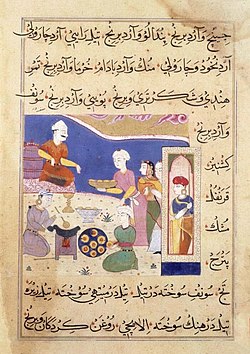 Medieval Indian Manuscript (c. 16th century) showing samosas being served
Medieval and early modern medical recipes
In older English works, a recipe was called a "receipt". Both words "receipt" and "recipe" were originally used to mean instructions on how to administer medicine.[13] Medical recipes were an important part of literature in medieval Europe, as they were the primary means for sharing medical knowledge. Key medieval examples include Bald's Leechbook and the Tabula Medicine which both functioned as encyclopedias of medical information.[14] These recipe books were often organized alphabetically by ailment or followed an a capite ad calcem ("from head to foot") structure, that listed cured for each part of the body.[15] A defining linguistic feature of these medical recipes was the use of efficacy phrases like probatum est ("it is proved").[16] This language was meant to signal to the reader that a remedy had been personally tested and verified, establishing a sense of medical authority.
There were different types of "paper tools" that were used to aid in the process writing down medical texted.[17]Vade Mecums were small, portable handbooks that were used to jot down quick instructions when first encountered during travel or a social visit. Intermediary books were volumes that organized recipes and held them in a liminal stage while they waited to be tested. Lastly, neat or gift books were volumes that were carefully put together to record treasured knowledge that had been personal verified and was intended to pass down to children as a family heirloom.[18]
Many examples of handwritten medical recipe books come from common people's personal collections. Lady Johanna St. John recorded her final wishes in her will before her death in 1704, which included two handwritten recipe books among her other treasured items. The first was a volume of recipes for cookery while the second was her "Great Receit Book" which was filled with hundreds of remedies for various illnesses organized in alphabetical order. Recipe books were treated as treasured heirlooms and vital "paperwork of kinship."[19] They were essential records of a family's history and social status.
Connection between culinary and medical recipes
Im Mittelalter und der frühen Neuzeit waren medizinische und kulinarische Rezepte durch ihre materielle Beschaffenheit, ihren gemeinsamen häuslichen Ursprung und die zugrunde liegende wissenschaftliche Theorie eng miteinander verbunden. [ 20 ] In dieser Zeit fand die Gesundheitsversorgung größtenteils im häuslichen Umfeld statt, weshalb die meisten Medikamente und Heilmittel in denselben Küchen und Brennereien hergestellt wurden, die auch für die Zubereitung von Speisen genutzt wurden. [ 21 ] Dies führte dazu, dass Geräte wie Töpfe, Pfannen, Mörser und Stößel sowie Siebbeutel sowohl zum Kochen als auch zur Herstellung von Heilmitteln verwendet wurden. Selbst spezialisiertere Geräte wie Destillierapparate (Limbecks) und Kaltbrennapparate , die in den Küchen der Gutsbesitzer üblich waren, dienten sowohl medizinischen als auch kulinarischen Zwecken. [ 22 ]
Die Integration basierte auf der galenischen Humoralpathologie , die Nahrung und Medikamente nicht konzeptionell trennte. [ 20 ] Gemäß diesem Medizinsystem wurde die Gesundheit durch das Gleichgewicht der Körpersäfte mittels Ernährung erhalten , wodurch die Zubereitung von Speisen zu einem zentralen Bestandteil der Körperpflege wurde. So konnte beispielsweise eine gebratene Hammelkeule ein köstliches Gericht sein und gleichzeitig als hervorragendes Mittel gegen Verdauungsbeschwerden empfohlen werden. [ 20 ] Diese konzeptionelle Überschneidung zeigt sich am deutlichsten in der physischen Struktur von Familienbüchern , die medizinische und kulinarische Anweisungen oft in einem einzigen Band vereinten. Dies erklärt auch die Praxis, dieselben Küchengeräte sowohl für die tägliche Nahrungszubereitung als auch für die Herstellung wichtiger Heilmittel zu verwenden.
Moderne Rezepte und Kochtipps

Mit der Erfindung des Buchdrucks im 16. und 17. Jahrhundert entstanden zahlreiche Bücher über Haushaltsführung und Speisenzubereitung. In Holland [ 23 ] und England [ 24 ] entbrannte ein Wettstreit zwischen den Adelsfamilien, wer das aufwendigste Bankett ausrichten konnte. Um 1660 hatte sich die Kochkunst zu einer wahren Kunstform entwickelt, und gute Köche waren gefragt. Viele von ihnen veröffentlichten eigene Bücher, in denen sie ihre Rezepte detailliert darlegten und mit ihren Rivalen wetteiferten. [ 25 ] Viele dieser Bücher wurden übersetzt und sind online verfügbar. [ 26 ]
By the 19th century, the Victorian preoccupation for domestic respectability brought about the emergence of cookery writing in its modern form. Although eclipsed in fame and regard by Isabella Beeton, the first modern cookery writer and compiler of recipes for the home was Eliza Acton. Her pioneering cookbook, Modern Cookery for Private Families published in 1845, was aimed at the domestic reader rather than the professional cook or chef. This was immensely influential, establishing the format for modern writing about cookery. It introduced the now-universal practice of listing the ingredients and suggested cooking times with each recipe. It included the first recipe for Brussels sprouts.[27] Contemporary chef Delia Smith called Acton "the best writer of recipes in the English language."[28]Modern Cookery long survived Acton, remaining in print until 1914 and available more recently in facsimile.


Acton's work was an important influence on Isabella Beeton,[29] who published Mrs Beeton's Book of Household Management in 24 monthly parts between 1857 and 1861. This was a guide to running a Victorian household, with advice on fashion, child care, animal husbandry, poisons, the management of servants, science, religion, and industrialism.[30][31] Of the 1,112 pages, over 900 contained recipes. Most were illustrated with coloured engravings. It is said that many of the recipes were plagiarised from earlier writers such as Acton, but the Beetons never claimed that the book's contents were original. It was intended as a reliable guide for the aspirant middle classes.
The American cook Fannie Farmer (1857–1915) published in 1896 her famous work The Boston Cooking School Cookbook which contained some 1,849 recipes.[32]
Components


Formatting a recipe can be done in many different ways but two formats are typical. One typical format displays information in two columns, one for instructions and one for ingredients. The other typical format displays information in a solid block paragraph alternating between the ingredients and instructions.[33]
Modern culinary recipes normally consist of several components
- The name of the recipe (Origins/History of the dish).
- Yield: The number of servings that the dish provides.
- List all ingredients in the order of its use. Describe it in step by step instructions.
- List ingredients by quantity (Can abbreviate measurements: oz instead of ounces; tbsp instead of tablespoon) [33]
- How much time does it take to prepare the dish, plus cooking time for the dish.
- Necessary equipment used for the dish.
- Cooking procedures. Temperature and bake time if necessary.
- Serving procedures (Served while warm/cold).
- Review of the dish (Would you recommend this dish to a friend?).
- Photograph of the dish (Optional).
- Nutritional Value: Helps for dietary restrictions. Includes number of calories or grams per serving.
Recipe writers sometimes also list variations of a traditional dish, to give different tastes of the same recipes.
Recipe writers may include a narrative before or after the recipe to add to the significance of the recipe. These consist of cultural values or personal stories relating to the dish.[34]
Sub-recipes
A sub-recipe or subrecipe is a recipe for an ingredient that will be called for in the instructions for the main recipe.[35]
Sub-recipes are often for spice blends, sauces, confits, pickles, preserves, jams, chutneys, or condiments.[35] Sometimes the sub-recipe calls for the ingredient to be held for several hours, overnight, or longer, which home cooks sometimes find frustrating as it means the main recipe cannot be made in a single session or day.[35][36][37] Sub-recipes discovered late and calling for an ingredient the cook does not have on hand means a special shopping trip or trying to find a substitute.[38][36]
Sub-recipes, and the cookbooks that contain them, are often described as not being targeted at casual cooks.[35][38][39] Reviewers have mentioned finding alternate uses for leftover sub-recipes.[35][38]
Zu den Kochbüchern mit Unterrezepten gehören Christina Tosis Momofuku Milk Bar (2011) [ 40 ] [ 41 ] und Terry Bryants Vegetable Kingdom (2020). [ 42 ]
Rezepte aus dem Internet und dem Fernsehen
Mitte des 20. Jahrhunderts gab es Tausende von Kochbüchern und Rezepten. Die nächste Revolution kam mit dem Aufkommen der Fernsehköche. Der erste Fernsehkoch der Welt war Philip Harben mit seiner Sendung „Cookery“ auf BBC, die im Juni 1946 Premiere feierte. [ 43 ] Wenige Monate später lief in den USA die erste Kochsendung dieser Art mit James Beard . [ 43 ] Fernsehkochsendungen erreichten ein neues Publikum. Anfangs wurden Rezepte per Post von der BBC verschickt; später, mit der Einführung des CEEFAX- Textes auf dem Bildschirm, waren sie im Fernsehen verfügbar.
Die erste Usenet-Newsgruppe im Internet , die sich dem Kochen widmete, war net.cooks , die 1982 gegründet wurde und später in rec.food.cooking umbenannt wurde . [ 44 ] Sie diente als Forum zum Austausch von Rezepten in Textdateien und Kochtechniken.
In den USA kam es 2008 aufgrund der Rezession Ende der 2000er Jahre zu einem erneuten Anstieg des Interesses am Kochen zu Hause . [ 45 ] Eine ähnliche Entwicklung erlebte das Kochen zu Hause in den USA Anfang der 2020er Jahre während der Coronavirus-Pandemie . [ 46 ]
Die Vielzahl an Multimedia-Elementen in modernen Kochrezepten macht diese auch für Hobbyköche zugänglicher. [ 47 ] Die Verfügbarkeit von Kochbüchern im Internet hilft Hobbyköchen zudem, ihre Fähigkeiten zu verbessern und die kulturelle Bedeutung von Kochbüchern besser zu verstehen. [ 48 ]
Fernsehsender wie der Food Network und Zeitschriften sind nach wie vor wichtige Quellen für Rezeptinformationen. Internationale Köche und Küchenchefs wie Jamie Oliver , Gordon Ramsay , Nigella Lawson und Rachael Ray haben Sendungen zur Hauptsendezeit und bieten dazu auf ihren Internetseiten detaillierte Informationen zu all ihren Rezepten an. Hinzu kamen Reality-TV-Shows wie Top Chef oder Iron Chef sowie zahlreiche Internetseiten mit kostenlosen Rezepten, doch Kochbücher sind weiterhin so beliebt wie eh und je. [ 49 ]
Copyright
Under U.S. copyright law, recipes are in the public domain. However, a collection of recipes, as in a cookbook, is able to be copyrighted. Additionally, information accompanying the recipe, such as photographs of the food or a headnote describing its cultural context, can be copyrighted.[50][51][52]
See also
- Cookbook
- Course (food)
- Culinary art
- hRecipe - a microformat for marking-up recipes in web pages
- List of desserts
- List of foods
- Rhyming recipe
References
- ^"Food Preparation: Cooking and Cooks". Food in Colonial and Federal America: 89–124. 2005. doi:10.5040/9798400652615.ch-003. ISBN 979-8-4006-5261-5.
- ^Winchester, Ashley. "The world's oldest-known recipes decoded". www.bbc.com. Archived from the original on 2020-06-04. Retrieved 2020-06-17.
- ^Jean Bottéro, Textes culinaires Mésopotamiens, 1995. ISBN 0-931464-92-7; commentary at "Society of Biblical Literature". Archived from the original on 2021-09-30.
- ^Ancient Egyptian cuisine
- ^ abcdAndrew Dalby, Food in the Ancient World from A to Z, 2003. ISBN 0-415-23259-7 p. 97-98.
- ^"Roman food in Britain". Archived from the original on 2010-07-20. Retrieved 2007-05-10.
- ^Colquhoun, Kate (2008) [2007]. Taste: The Story of Britain through its Cooking. Bloomsbury. p. 25. ISBN 978-0-747-59306-5.
- ^"Jaam-e Jam"(PDF). Archived(PDF) from the original on 2020-06-16. Retrieved 2017-09-10.
- ^"کتاب خوراکهای ایرانی". مجله تصویری فرهنگ غذا (in Persian). December 3, 2016. Retrieved November 20, 2017.
- ^2007 Recipe Calendar. COMDA, Canada.
- ^Hicatt, Constance B; Sharon Butler (1985). English Culinary Manuscripts of the 14C.
- ^Austin, Thomas (1888). Ashmole and other Manuscripts.
- ^"When a Recipe Was a 'Receipt'". Merriam Webster. Retrieved 2024-10-05.
- ^ Leong, Elaine (28. November 2018). Rezepte und Alltagswissen: Medizin, Wissenschaft und Haushalt im frühneuzeitlichen England . University of Chicago Press. S. 13. ISBN 978-0226583662Die
- ^ Leong, Elaine (28. November 2018). Rezepte und Alltagswissen: Medizin, Wissenschaft und Haushalt im frühneuzeitlichen England . University of Chicago Press. S. 191. ISBN 978-0226583662Die
- ^ Leong, Elaine (28. November 2018). Rezepte und Alltagswissen: Medizin, Wissenschaft und Haushalt im frühneuzeitlichen England . University of Chicago Press. S. 84. ISBN 978-0226583662Die
- ^ Leong, Elaine (28. November 2018). Rezepte und Alltagswissen: Medizin, Wissenschaft und Haushalt im frühneuzeitlichen England . University of Chicago Press. S. 135. ISBN 978-0226583662Die
- ^ Leong, Elaine (28. November 2018). Rezepte und Alltagswissen: Medizin, Wissenschaft und Haushalt im frühneuzeitlichen England . University of Chicago Press. S. 80–96 . ISBN 978-0226583662Die
- ^ Leong, Elaine (28. November 2018). Rezepte und Alltagswissen: Medizin, Wissenschaft und Haushalt im frühneuzeitlichen England . University of Chicago Press. S. 11–12 . ISBN 978-0226583662Die
- ^ a b c Wall, Wendy (2016). Rezepte fürs Denken: Wissen und Geschmack in der frühneuzeitlichen englischen Küche . University of Pennsylvania Press. S. 1–19 .
- ^ Wall, Wendy (2016). Rezepte für das Denken: Wissen und Geschmack in der frühneuzeitlichen englischen Küche . University of Pennsylvania Press. S. 209–250 .
- ^ Leong, Elaine (2008). „Die Herstellung von Arzneimitteln im frühneuzeitlichen Haushalt“. Bulletin of the History of Medicine . 82 (1): 145–168 – via JSTOR.
- ^ Sieben, Ria Jansen (1588). Ein bemerkenswertes Buch von Cokeryen .
- ^ Die gute Hausfrauenmagd für Kochkunst . 1588.
- ^ May, Robert (1685). Der versierte Koch .
- ^ Judy Gerjuoy. „Mittelalterliche Kochbücher“ . Archiviert vom Original am 09.06.2007 . Abgerufen am 15.06.2007 .
- ^ Pearce, Food For Thought: Extraordinary Little Chronicles of the World , (2004), S. 144
- ^ Das Interview wurde am 06.06.2014 in der Wayback Machine archiviert .
- ^"Acton, Eliza (1799–1859)". Women in World History: A Biographical Encyclopedia. Gale Research Inc. January 2002. Archived from the original on 2013-05-18. Retrieved 8 January 2013.(subscription required)
- ^General Observations on the Common Hog
- ^"in season in April 1861". Archived from the original on 2013-11-19. Retrieved 2014-06-02.
- ^Cunningham, Marion (1979). The Fannie Farmer Cookbook (revised). Bantam Books, New York. ISBN 978-0-553-56881-3.
- ^ abTomlinson, Graham (September 1986). "Thought for Food: A Study of Written Instructions". Symbolic Interaction. 9 (2): 201–216. doi:10.1525/si.1986.9.2.201. ISSN 0195-6086.
- ^Floyd, Janet; Forster, Laurel (2017-03-02). The Recipe Reader (0 ed.). Routledge. doi:10.4324/9781315237480. ISBN 978-1-351-88319-1.
- ^ abcdeCohen, Chris (2019-03-18). "What to Cook This Weekend: Coming to Terms With the Sub-Recipe". Saveur. Archived from the original on 2022-11-10. Retrieved 2022-11-10.
- ^ ab"8 Highly Giftable Cookbooks by New York Chefs". Eater. 2020-11-25. Archived from the original on 2022-11-10. Retrieved 2022-11-10.
- ^Gould, Emily (2016-08-30). "Why Restaurant Cookbooks Can't Have It All". Eater. Archived from the original on 2022-11-10. Retrieved 2022-11-10.
- ^ abc"A Cookbook Full of Recipes Within Recipes Can Be the Greatest of Them All". Food52. 2016-06-21. Archived from the original on 2022-11-10. Retrieved 2022-11-10.
- ^ Benwick, Bonnie S. (11.12.2017). „Rezension | Die besten Kochbücher 2017: Die Inspiration, die Sie brauchen, um ein leckeres Abendessen auf den Tisch zu bringen“ . The Washington Post . ISSN 0190-8286 . Archiviert vom Original am 07.12.2022 . Abgerufen am 10.11.2022 .
- ^ Chang, T. Susan (19. April 2015). "„Milk Bar Life“, eine Rezension: „Süße und herzhafte Genüsse – eine Mischung aus Genuss und Tücke“ . The Washington Post . Archiviert vom Original am 27. Juli 2021. Abgerufen am 10. November 2022 .
- ^ Haupt, Melanie (2. November 2012). „Kochbuchrezension: Momofuku Milk Bar: Christina Tosis Kochbuch ist alles andere als einfach“ . Austin Chronicle . Archiviert vom Original am 10. November 2022. Abgerufen am 10. November 2022 .
- ^ Rao, Tejal (31. März 2020). „Diese Brokkoli-Dill-Pasta hat einen Hippie-Touch. Ihre Kinder werden sie lieben . “ New York Times . Archiviert vom Original am 10. November 2022. Abgerufen am 10. November 2022 .
- ^ a b „Zeitleiste der Persönlichkeiten von Fernsehkochshows“ . Archiviert vom Original am 24.05.2021 . Abgerufen am 24.05.2021 .
- ^ Sack, Victor (20. Oktober 2016), rec.food.cooking FAQ und Konvertierungsdatei , Abschnitt 6.1, archiviert vom Original am 30. August 2018 , abgerufen am 17. Februar 2018
- ^ Holmes, Elizabeth (05.05.2009). „Web Recipes Are Cooking With Gas“ . Wall Street Journal . Archiviert vom Original am 27.09.2017 . Abgerufen am 08.08.2017 .
- ^ „Ein Jahr später: Wie die Pandemie das Kochen zu Hause verändert hat“ . Allrecipes . Archiviert vom Original am 10.11.2022 . Abgerufen am 10.11.2022 .
- Buykx , Lucy; Petrie, Helen (Dezember 2011). „What Cooks Needs from Multimedia and Textually Enhanced Recipes“ . 2011 IEEE International Symposium on Multimedia . IEEE. S. 387–392 . doi : 10.1109/ism.2011.70 . ISBN 978-1-4577-2015-4Die
- ^Coyle, L. Patrick (1985). Cooks' books: an affectionate guide to the literature of food and cooking. New York, N.Y: Facts on File. ISBN 978-0-87196-683-4.
- ^Andriani, Lynn. "Cookbooks surge to top category at libraries". Archived from the original on 2015-04-02. Retrieved 2013-10-14.
- ^"Copyright Protection in Recipes". Copyrightlaws.com.
- ^"Navigating copyright and your recipes: What's protected".
- ^"Copyright Protection Not Available for Names, Titles, or Short Phrases"(PDF). copyright.gov. Archived from the original(PDF) on 5 April 2016.
Listings of ingredients, as in recipes, labels, or formulas. When a recipe or formula is accompanied by an explanation or directions, the text directions may be copyrightable, but the recipe or formula itself remains uncopyrightable.

