Herbert Henry Asquith, 1st Earl of Oxford and Asquith (/ˈæskwɪθ/ASS-kwith; 12 September 1852 – 15 February 1928), was a British statesman who was Prime Minister of the United Kingdom from 1908 to 1916. He was the last prime minister from the Liberal Party to command a majority government, and the most recent Liberal to have served as Leader of the Opposition.
He played a major role in the design and passage of major liberal legislation and a reduction of the power of the House of Lords. In August 1914 Asquith took the United Kingdom of Great Britain and Ireland and the British Empire into the First World War. During 1915 his government was vigorously attacked for a shortage of munitions and the failure of the Gallipoli Campaign. He formed a coalition government with other parties, but failed to satisfy critics, was forced to resign in December 1916 and never regained power.
After attending Balliol College, Oxford, he became a successful barrister. In 1886 he was the Liberal candidate for East Fife, a seat he held for over thirty years. In 1892 he was appointed Home Secretary in William Ewart Gladstone's fourth ministry, remaining in the post until the Liberals lost the 1895 election. In the decade of opposition that followed, Asquith became a major figure in the party, and when the Liberals regained power under Sir Henry Campbell-Bannerman in 1905, Asquith was named Chancellor of the Exchequer. In 1908 Asquith succeeded him as prime minister.
Die Liberalen waren entschlossen, ihre Reformagenda voranzutreiben. Ein Hindernis war das Oberhaus , das den Volkshaushalt von 1909 ablehnte. Gleichzeitig wurde der Südafrika-Act von 1909 verabschiedet. Asquith rief Neuwahlen für Januar 1910 aus , die die Liberalen zwar gewannen, aber nur noch eine Minderheitsregierung bildeten . Nach weiteren Parlamentswahlen im Dezember 1910 erreichte er die Verabschiedung des Parlamentsgesetzes von 1911 , das es ermöglichte, ein vom Unterhaus dreimal in aufeinanderfolgenden Sitzungen verabschiedetes Gesetz unabhängig vom Oberhaus in Kraft zu setzen. Im Umgang mit der irischen Selbstverwaltung hatte Asquith weniger Erfolg . Wiederholte Krisen führten zu Waffenschmuggel und Gewalt, die beinahe in einen Bürgerkrieg mündete.
Als Großbritannien Deutschland infolge des deutschen Einmarsches in Belgien den Krieg erklärte , wurden die brisanten innenpolitischen Konflikte um Irland und das Frauenwahlrecht in den Hintergrund gedrängt . Asquith agierte eher als Ausschussvorsitzender denn als dynamischer Anführer. Er beaufsichtigte die nationale Mobilmachung, die Entsendung der britischen Expeditionsstreitkräfte an die Westfront , den Aufbau einer Massenarmee und die Entwicklung einer Industriestrategie zur Unterstützung der britischen Kriegsziele. Der Krieg geriet ins Stocken, und der Ruf nach einer besseren Führung wurde laut. Anfang 1915 war er gezwungen, eine Koalition mit der Konservativen Partei und der Labour-Partei zu bilden . Seine Unentschlossenheit in Bezug auf Strategie, Wehrpflicht und Finanzierung schwächte ihn. [ 1 ]
David Lloyd George löste ihn im Dezember 1916 als Premierminister ab. Sie wurden zu erbitterten Feinden und kämpften um die Kontrolle der rapide schwindenden Liberalen Partei. Asquiths Rolle beim Aufbau des modernen britischen Wohlfahrtsstaates (1906–1911) ist zwar bekannt, doch seine Schwächen als Kriegsführer und Parteivorsitzender nach 1914 wurden von Historikern hervorgehoben. Zwischen 1827 und 1979 (dem Beginn der elfjährigen Amtszeit von Margaret Thatcher ) hatte er die längste ununterbrochene Amtszeit als Premierminister inne und diente mehr als acht Jahre in Folge.
Frühes Leben: 1852–1874
Familiärer Hintergrund

Herbert Henry Asquith was born on 12 September 1852 in Morley, in the West Riding of Yorkshire, the younger son of Joseph Dixon Asquith (1825–1860) and his wife Emily, née Willans (1828–1888). The couple also had three daughters, of whom only one survived infancy.[2][3][a] The Asquiths were an old Yorkshire family, with a long nonconformist tradition.[b] It was a matter of family pride, shared by Asquith, that an ancestor, Joseph Asquith, was imprisoned for his part in the pro-RoundheadFarnley Wood Plot of 1664.[4]
Asquith's parents came from families associated with the Yorkshire wool trade. Dixon Asquith inherited the Gillroyd Mill Company, founded by his father. Emily's father, William Willans, ran a successful wool-trading business in Huddersfield. Both families were middle-class, Congregationalist and politically radical. Dixon was a mild man, cultivated and in his son's words "not cut out" for a business career.[2] He was described as "a man of high character who held Bible classes for young men".[5] Emily suffered persistent poor health, but was of strong character, and a formative influence on her sons.[6]
Childhood and schooling
In his younger days, he was called Herbert ("Bertie" as a child) within the family, but his second wife called him Henry. His biographer Stephen Koss entitled the first chapter of his biography "From Herbert to Henry", referring to upward social mobility and his abandonment of his Yorkshire Nonconformist roots with his second marriage. However, in public, he was invariably referred to only as H. H. Asquith. "There have been few major national figures whose Christian names were less well known to the public" according to his biographer Roy Jenkins.[2]
Herbert Asquith und sein Bruder wurden bis 1860 von ihren Eltern zu Hause unterrichtet, als Dixon Asquith plötzlich verstarb. William Willans übernahm die Familie, brachte sie in ein Haus in der Nähe seines eigenen und sorgte für die Schulbildung der Jungen. [ 7 ] Nach einem Jahr am Huddersfield College wurden sie als Internatsschüler an die Fulneck School , eine Schule der Herrnhuter Brüdergemeine in der Nähe von Leeds , geschickt . 1863 starb William Willans, und die Familie kam in die Obhut von Emilys Bruder John Willans. Die Jungen zogen zu ihm nach London; als er 1864 aus geschäftlichen Gründen nach Yorkshire zurückkehrte, blieben sie in London und wurden bei verschiedenen Familien untergebracht.
Die Biografin Naomi Levine schreibt, dass Asquith den Rest seiner Kindheit im Grunde wie ein Waisenkind behandelt wurde. [ 8 ] Der Weggang seines Onkels kappte Asquiths Bindungen zu seiner Heimat Yorkshire, und er bezeichnete sich fortan selbst als „im Grunde genommen Londoner“. [ 9 ] Ein anderer Biograf, Colin Matthew , schreibt, dass Asquiths nordenglischer, nonkonformistischer Hintergrund ihn weiterhin prägte: „Er gab ihm einen festen Bezugspunkt gegen das Establishment, wichtig für einen Mann, dessen Leben ansonsten von einem langen Eintauchen in die Großstadt geprägt war.“ [ 10 ]
The boys were sent to the City of London School as day boys. Under the school's headmaster, E. A. Abbott, a distinguished classical scholar, Asquith became an outstanding pupil. He later said that he was under deeper obligations to his old headmaster than to any man living;[11] Abbott disclaimed credit for the boy's progress: "I never had a pupil who owed less to me and more to his own natural ability."[11][12] Asquith excelled in classics and English, was little interested in sport, read voraciously in the Guildhall Library and became fascinated with oratory. He visited the public gallery of the House of Commons, studied the techniques of famous preachers and honed his own skills in the school debating society.[13] Abbott remarked on the cogency and clarity of his pupil's speeches, qualities for which Asquith became celebrated throughout the rest of his life.[14][15] Asquith later recalled seeing, as a schoolboy, the corpses of five murderers left hanging outside Newgate.[16]
Oxford

In November 1869 Asquith won a classicalscholarship at Balliol College, Oxford, going up the following October. The college's prestige, already high, continued to rise under the recently elected Master, Benjamin Jowett. He sought to raise the standards of the college to the extent that its undergraduates shared what Asquith later called a "tranquil consciousness of effortless superiority".[17] Although Asquith admired Jowett, he was more influenced by T. H. Green, White's Professor of Moral Philosophy. The abstract side of philosophy did not greatly attract Asquith, whose outlook was always practical, but Green's progressive liberal political views appealed to him.[10]
Asquiths Universitätslaufbahn war bemerkenswert – „auffällig, ohne reißerisch zu sein“, wie Jenkins es ausdrückte. Dank seines mühelosen Verständnisses der Studieninhalte hatte er viel Zeit, seiner Vorliebe für Debatten nachzugehen. Bereits im ersten Monat an der Universität hielt er einen Vortrag in der Oxford Union . Seine offiziellen Biografen, J. A. Spender und Cyril Asquith , bemerkten, dass er in seinen ersten Monaten in Oxford „die orthodoxe liberale Position vertrat und sich unter anderem für die Trennung von Kirche und Staat sowie für die Nichteinmischung in den Deutsch-Französischen Krieg aussprach “. [ 18 ] Gelegentlich debattierte er mit seinem Kommilitonen Alfred Milner vom Balliol College , der zwar damals Liberaler war, aber bereits ein Verfechter des britischen Imperialismus. [ 19 ] 1872 wurde er zum Schatzmeister der Union gewählt, scheiterte jedoch bei seinem ersten Versuch, das Präsidentenamt zu erlangen. [ 20 ] Während der Parlamentswahlen im Januar und Februar 1874 sprach er im nahegelegenen Woodstock gegen Lord Randolph Churchill , der damals noch kein bedeutender Politiker war . [ 21 ] Im Sommersemester 1874, seinem letzten Semester als Student, wurde er schließlich Präsident der Studentenvereinigung . [ 22 ] [ 23 ]
Asquith wurde 1872 Zweiter beim Hertford-Preis, 1873 erneut Zweiter beim Ireland-Preis und 1874 abermals, wobei er bei letzterem so knapp scheiterte, dass ihm die Prüfer einen Sonderpreis in Form von Büchern verliehen. Er gewann jedoch das Craven-Stipendium und schloss sein Studium mit einem, wie seine Biographen es beschreiben, „einfachen“ Doppelabschluss mit Auszeichnung in den Fächern Moderne und Moderne ab . [ 24 ] Nach seinem Abschluss wurde er zum Ehrenmitglied des Balliol College gewählt. [ 25 ]
Frühere berufliche Laufbahn: 1874–1886
Nach Oxford
Womöglich aufgrund seiner bescheidenen Herkunft fühlte sich Asquith stets zu den Annehmlichkeiten und dem Luxus hingezogen, die man sich mit Geld kaufen kann. Er lebte verschwenderisch und genoss das Leben in vollen Zügen – gutes Essen, angenehme Gesellschaft, anregende Gespräche und attraktive Frauen.
After his graduation in 1874, Asquith spent several months coaching Viscount Lymington, the 18-year-old son and heir of the Earl of Portsmouth. He found the experience of aristocratic country-house life agreeable.[27][28] He liked less the austere side of the nonconformist Liberal tradition, with its strong temperance movement. He was proud of ridding himself of "the Puritanism in which I was bred".[29] His fondness for fine wines and spirits, which began at this period, eventually earned him the sobriquet "Squiffy".[30]
Returning to Oxford, Asquith spent the first year of his seven-year fellowship in residence there. But he had no wish to pursue a career as a don; the traditional route for politically ambitious but unmoneyed young men was through the law.[28] While still at Oxford Asquith had already entered Lincoln's Inn to train as a barrister, and in 1875 he served a pupillage under Charles Bowen.[31] He was called to the bar in June 1876.[32]
Marriage and children
There followed what Jenkins calls "seven extremely lean years".[31] Asquith set up a legal practice with two other junior barristers. With no personal contacts with solicitors, he received few briefs.[c] Those that came his way he argued capably, but he was too fastidious to learn the wilier tricks of the legal trade: "he was constitutionally incapable of making a discreet fog ... nor could he prevail on himself to dispense the conventional patter".[33] He did not allow his lack of money to stop him from marrying. His bride, Helen Kelsall Melland (1854–1891), was the daughter of Frederick Melland, a physician in Manchester. She and Asquith had met through friends of his mother's.[33] The two had been in love for several years, but it was not until 1877 that Asquith sought her father's consent to their marriage. Despite Asquith's limited income—practically nothing from the bar and a small stipend from his fellowship—Melland consented after making inquiries about the young man's potential. Helen had a private income of several hundred pounds a year, and the couple lived in modest comfort in Hampstead. They had five children:
- Raymond Asquith (6. November 1878 – 15. September 1916), der am 25. Juli 1907 Katharine Horner (Tochter von Sir John Horner ) heiratete. Sie hatten drei Kinder.
- Herbert Asquith (11. März 1881 – 5. August 1947), der am 28. Juli 1910 Lady Cynthia Charteris (Tochter von Hugo Richard Charteris, 11. Earl of Wemyss und 7. Earl of March ) heiratete. Sie hatten drei Kinder.
- Arthur Asquith (24. April 1883 – 25. August 1939), der am 30. April 1918 Betty Constance Manners (Tochter von John Manners-Sutton, 3. Baron Manners ) heiratete. Sie hatten vier Töchter.
- Violet Asquith (15. April 1887 – 19. Februar 1969), die am 30. November 1915 Sir Maurice Bonham Carter heiratete . Sie hatten vier Kinder.
- Cyril Asquith, Baron Asquith of Bishopstone (5. Februar 1890 – 24. August 1954), [ 10 ] der am 12. Februar 1918 Anne Pollock (Tochter von Sir Adrian Donald Wilde Pollock) heiratete. Sie hatten vier Kinder.
Der Spectator und die Politik

Between 1876 and 1884 Asquith supplemented his income by writing regularly for The Spectator, which at that time had a broadly Liberal outlook. Matthew comments that the articles Asquith wrote for the magazine give a good overview of his political views as a young man. He was staunchly radical, but as unconvinced by extreme left-wing views as by Toryism. Among the topics that caused debate among Liberals were British imperialism, the union of Great Britain and Ireland, and female suffrage. Asquith was a strong, though not jingoistic, proponent of the Empire, and, after initial caution, came to support home rule for Ireland. He opposed votes for women for most of his political career. According to the official biography by J. A. Spender and Cyril Asquith, H.H. Asquith "had a profound respect for the mind and intelligence of women ... but he considered politics to be peculiarly the male sphere, and it offended his sense of decorum and chivalry to think of them as engaged in the rough and tumble of this masculine business and exposed to its publicity. He always vehemently denied that the question had any relation to democratic theory or that the exclusion of women from the franchises was any reflection on their sex."[34] There was also an element of party interest: Asquith believed that votes for women would disproportionately benefit the Conservatives. In a 2001 study of the extension of the franchise between 1832 and 1931, Bob Whitfield concluded that Asquith's surmise about the electoral impact was correct.[35] In addition to his work for The Spectator, he was retained as a leader writer by The Economist, taught at evening classes, and marked examination papers.[36]
Asquiths Karriere als Anwalt begann 1883, als R. S. Wright ihn einlud, in seine Kanzlei am Inner Temple einzutreten . Wright war Junior Counsel des Schatzamtes, ein Posten, der oft als „ Teufel des Generalstaatsanwalts “ bezeichnet wurde [ 37 ] und dessen Aufgabe unter anderem die Rechtsberatung von Ministern und Regierungsbehörden umfasste. [ 37 ] Eine von Asquiths ersten Aufgaben in Wrights Diensten war die Erstellung eines Memorandums für Premierminister W. E. Gladstone über den Status des Parlamentseides nach dem Bradlaugh-Fall . Sowohl Gladstone als auch Generalstaatsanwalt Sir Henry James waren beeindruckt. Dies steigerte Asquiths Bekanntheitsgrad, brachte ihm aber keine wesentlich besseren Einnahmen. Deutlich lukrativer waren seine neuen Kontakte zu Anwälten, die regelmäßig Wright beauftragten und nun auch begannen , Asquith zu engagieren. [ 38 ]
Mitglied des Parlaments: 1886–1908
Kronanwalt
Im Juni 1886, als die Liberale Partei in der Frage der irischen Selbstverwaltung gespalten war , rief Gladstone Neuwahlen aus . [ 39 ] In East Fife wurde kurzfristig ein Sitz frei , da der dortige liberale Abgeordnete John Boyd Kinnear von seinem örtlichen Liberalen Verband wegen seiner Ablehnung der irischen Selbstverwaltung abgewählt worden war. Richard Haldane , ein enger Freund Asquiths und ebenfalls ein junger, aufstrebender Anwalt, war seit Dezember 1885 liberaler Abgeordneter für den benachbarten Wahlkreis Haddingtonshire . Er schlug Asquith als Kinnears Nachfolger vor, und nur zehn Tage vor der Wahl wurde Asquith von den örtlichen Liberalen offiziell nominiert. [ 40 ] Die Konservativen traten nicht an, sondern unterstützten Kinnear, der als liberaler Unionist gegen Asquith kandidierte . Asquith wurde mit 2.863 Stimmen gewählt, Kinnear erhielt 2.489 Stimmen. [ 41 ]
The Liberals lost the 1886 election, and Asquith joined the House of Commons as an opposition backbencher. He waited until March 1887 to make his maiden speech, which opposed the Conservative administration's proposal to give special priority to an Irish Crimes Bill.[42][43] From the start of his parliamentary career Asquith impressed other MPs with his air of authority as well as his lucidity of expression.[44] For the remainder of this Parliament, which lasted until 1892, Asquith spoke occasionally but effectively, mostly on Irish matters.[45][46]
Asquith's legal practice was flourishing, and took up much of his time. In the late 1880s Anthony Hope, who later gave up the bar to become a novelist, was his pupil. Asquith disliked arguing in front of a jury because of the repetitiveness and "platitudes" required, but excelled at arguing fine points of civil law before a judge or in front of courts of appeal.[47] These cases, in which his clients were generally large businesses, were unspectacular but financially rewarding.[48]

From time to time Asquith appeared in high-profile criminal cases. In 1887 and 1888, he defended the radical Liberal MP Cunninghame Graham, who was charged with assaulting police officers when they attempted to break up a demonstration in Trafalgar Square.[49] Graham was later convicted of the lesser charge of unlawful assembly.[50] In what Jenkins calls "a less liberal cause", Asquith appeared for the prosecution in the trial of Henry Vizetelly for publishing "obscene libels"—the first English versions of Émile Zola's novels Nana, Pot-Bouille and La Terre, which Asquith described in court as "the three most immoral books ever published".[51]
Asquiths juristische Karriere erfuhr 1889 einen unerwarteten Aufschwung, als er zum Junior Counsel von Sir Charles Russell in der Parnell-Untersuchungskommission ernannt wurde . Die Kommission war nach schädlichen Äußerungen in der „Times“ eingesetzt worden , die auf gefälschten Briefen basierten und behaupteten, der irische Abgeordnete Charles Stuart Parnell habe die Morde im Phoenix Park in Dublin gebilligt . Als der Manager der „Times“ , J. C. Macdonald, als Zeuge aussagen sollte, überraschte der müde Russell Asquith, indem er ihn bat, das Kreuzverhör zu führen. [ 52 ] Unter Asquiths Befragung wurde deutlich, dass Macdonald, indem er die Fälschungen ohne Überprüfung für echt hielt, sich – um es mit Jenkins’ Worten zu sagen – „mit einer Leichtgläubigkeit verhalten hatte, die kindlich gewesen wäre, wenn sie nicht kriminell fahrlässig gewesen wäre“. [ 53 ] Der Manchester Guardian berichtete, dass Macdonald sich unter Asquiths Kreuzverhör „durch ein Dutzend halbfertiger Sätze windete, um eine Erklärung abzugeben, und keinen einzigen beendete“. [ 54 ] Die Anschuldigungen gegen Parnell erwiesen sich als falsch, die Times musste sich umfassend entschuldigen, und Asquiths Ruf war wiederhergestellt. [ 55 ] [ 56 ] Innerhalb eines Jahres wurde er zum Kronanwalt ( Queen’s Counsel) ernannt . [ 57 ]
Asquith wirkte Anfang der 1890er Jahre in zwei wichtigen Fällen mit. Im aufsehenerregenden Verleumdungsprozess um Tranby Croft (1891) spielte er eine effektive, aber unauffällige Rolle und trug dazu bei, dass die Klägerin widerlegt wurde. Im Fall Carlill gegen Carbolic Smoke Ball Co. (1892), einem wegweisenden Urteil im englischen Vertragsrecht, das festlegte, dass ein Unternehmen verpflichtet ist, seine beworbenen Versprechen einzuhalten, stand er auf der unterlegenen Seite. [ 58 ] [ 59 ]
Witwer und Kabinettsminister
Im September 1891 starb Helen Asquith an Typhus , nachdem sie einige Tage während eines Familienurlaubs in Schottland erkrankt war. [ 60 ] Asquith kaufte ein Haus in Surrey und stellte Kindermädchen und weiteres Hauspersonal ein. Er verkaufte das Anwesen in Hampstead und bezog eine Wohnung in der Mount Street in Mayfair , wo er während der Arbeitswoche lebte. [ 61 ]

The general election of July 1892 returned Gladstone and the Liberals to office, with intermittent support from the Irish Nationalist MPs. Asquith, who was then only 39 and had never served as a junior minister, accepted the post of Home Secretary, a senior Cabinet position. The Conservatives and Liberal Unionists jointly outnumbered the Liberals in the Commons, which, together with a permanent Unionist majority in the House of Lords, restricted the government's capacity to put reforming measures in place. Asquith failed to secure a majority for a bill to disestablish the Church in Wales, and another to protect workers injured at work, but he built up a reputation as a capable and fair minister.[10]
In 1893 Asquith responded to a request from Magistrates in the Wakefield area for reinforcements to police a mining strike. Asquith sent 400 Metropolitan policeman. After two civilians were killed in Featherstone when soldiers opened fire on a crowd, Asquith was subject to protests at public meetings for a period. He responded to a taunt, "Why did you murder the miners at Featherstone in '92?" by saying, "It was not '92, it was '93."[62]
When Gladstone retired in March 1894, Queen Victoria chose the Foreign Secretary, Lord Rosebery, as the new prime minister. Asquith thought Rosebery preferable to the other possible candidate, the Chancellor of the Exchequer, Sir William Harcourt, whom he deemed too anti-imperialist—one of the so-called "Little Englanders"—and too abrasive.[63] Asquith remained at the Home Office until the government fell in 1895.[10]
Asquith had known Margot Tennant slightly since before his wife's death, and grew increasingly attached to her in his years as a widower. On 10 May 1894 they were married at St George's, Hanover Square. Asquith became a son in law of Sir Charles Tennant, 1st Baronet. Margot was in many respects the opposite of Asquith's first wife, being outgoing, impulsive, extravagant and opinionated.[64] Despite the misgivings of many of Asquith's friends and colleagues the marriage proved to be a success. Margot got on, if sometimes stormily, with her step-children. She and Asquith had five children of their own, only two of whom survived infancy:[64]Anthony Asquith (9 November 1902 – 21 February 1968) and Elizabeth Asquith (26 February 1897 – 7 April 1945), who married the Romanian prince Antoine Bibesco on 30 April 1919.
Out of office

The general election of July 1895 was disastrous for the Liberals, and the Conservatives under Lord Salisbury won a majority of 152. With no government post, Asquith divided his time between politics and the bar.[d] Jenkins comments that in this period Asquith earned a substantial, though not stellar, income and was never worse off and often much higher-paid than when in office.[65] Matthew writes that his income as a QC in the following years was around £5,000 to £10,000 per annum (around £500,000–£1,000,000 at 2015 prices).[10][66] According to Haldane, on returning to government in 1905 Asquith had to give up a £10,000 brief to act for the Khedive of Egypt.[67] Margot later claimed (in the 1920s, when they were short of money) that he could have made £50,000 per annum had he remained at the bar.[68]
Die Liberale Partei, deren Führung – Harcourt im Unterhaus und Rosebery im Oberhaus – einander zutiefst verabscheute, erlitt erneut Fraktionsspaltungen. Rosebery trat im Oktober 1896 zurück, Harcourt folgte ihm im Dezember 1898. [ 69 ] [ 70 ] Asquith geriet unter starken Druck, die Nominierung zum Vorsitzenden der Liberalen Partei anzunehmen. Da das Amt des Oppositionsführers jedoch, obwohl hauptberuflich, unbezahlt war, konnte er es sich nicht leisten, auf sein Einkommen als Anwalt zu verzichten. Er und andere überzeugten schließlich den ehemaligen Kriegsminister Sir Henry Campbell-Bannerman, das Amt zu übernehmen. [ 71 ]
Während des Burenkriegs von 1899–1902 spaltete sich die liberale Partei in proimperialistische und „Little England“-Lager, wobei Campbell-Bannerman die Einheit der Partei zu wahren suchte. Asquith war weniger geneigt als sein Parteichef und viele andere in der Partei, die konservative Regierung für ihr Vorgehen zu kritisieren, obwohl er den Krieg als unnötige Ablenkung betrachtete. [ 10 ] Joseph Chamberlain , ein ehemaliger liberaler Minister und nun Verbündeter der Konservativen, setzte sich für Zölle ein , um die britische Industrie vor billigerer ausländischer Konkurrenz zu schützen. Asquiths Eintreten für die traditionelle liberale Freihandelspolitik trug dazu bei, dass Chamberlains Vorschläge zu Beginn des 20. Jahrhunderts zur zentralen Frage der britischen Politik wurden. Matthew zufolge „legten Asquiths analytische Fähigkeiten schnell die Schwächen und Widersprüche in Chamberlains Argumentation offen.“ [ 10 ] Die Frage spaltete die Konservativen, während die Liberalen unter dem Banner der „Befürworter kostenloser Lebensmittel“ gegen diejenigen in der Regierung vereint waren, die eine Steuer auf importierte lebensnotwendige Güter befürworteten. [ 72 ]
Schatzkanzler, 1905–1908

Salisbury's Conservative successor as prime minister, Arthur Balfour, resigned in December 1905, but did not seek a dissolution of Parliament and a general election. A biographer of Campbell-Bannerman, A. J. A. Morris, later suggested that Balfour was motivated in this unusual step by the vain hope that minority government would open up the many divisions within the Liberal party.[73]King Edward VII invited Campbell-Bannerman to form a minority government. Asquith and his close political allies Haldane and Sir Edward Grey tried to pressure him into taking a peerage to become a figurehead prime minister in the House of Lords, giving the pro-empire wing of the party greater dominance in the House of Commons. Campbell-Bannerman called their bluff and refused to move.[73][74] Asquith was appointed Chancellor of the Exchequer. He held the post for over two years, and introduced three budgets.[75][76]
A month after taking office, Campbell-Bannerman called a general election, in which the Liberals gained a landslide majority of 124.[77] However, Asquith's first budget, in 1906, was constrained by the annual income and expenditure plans he had inherited from his predecessor Austen Chamberlain. The only income for which Chamberlain had over-budgeted was the duty from sales of alcohol.[e][78] With a balanced budget, and a realistic assessment of future public expenditure, Asquith was able, in his second and third budgets, to lay the foundations for limited redistribution of wealth and welfare provisions for the poor. Blocked at first by Treasury officials from setting a variable rate of income tax with higher rates on those with high incomes, he set up a committee under Sir Charles Dilke which recommended not only variable income tax rates but also a supertax on incomes of more than £5,000 a year. Asquith also introduced a distinction between earned and unearned income, taxing the latter at a higher rate. He used the increased revenues to fund old-age pensions, the first time a British government had provided them. Reductions in selective taxes, such as that on sugar, were aimed at benefiting the poor.[79]
Asquith entwarf den Haushalt für 1908, war aber zum Zeitpunkt seiner Vorlage im Unterhaus nicht mehr Schatzkanzler. Campbell-Bannermans Gesundheitszustand hatte sich seit fast einem Jahr verschlechtert. Nach mehreren Herzinfarkten trat Campbell-Bannerman am 3. April 1908 zurück, weniger als drei Wochen vor seinem Tod. [ 80 ] Asquith galt allgemein als sein natürlicher Nachfolger. [ 81 ] König Edward, der sich in Biarritz im Urlaub befand , ließ Asquith zu sich rufen. Dieser reiste mit dem Zug nach Frankreich und küsste am 8. April im Hôtel du Palais in Biarritz als Premierminister die Hände . [ 82 ]
Premierminister in Friedenszeiten: 1908–1914
Termine und Kabinett

Nach Asquiths Rückkehr aus Biarritz wurde seine Führung der Liberalen Partei auf einer Parteiversammlung bestätigt (ein Novum für einen Premierminister). [ 10 ] Er leitete eine Kabinettsumbildung ein. Lloyd George wurde zu Asquiths Nachfolger als Schatzkanzler ernannt. Winston Churchill folgte Lloyd George als Präsident des Handelsministeriums nach und trat trotz seines jungen Alters (33 Jahre) und der Tatsache, dass er erst vier Jahre zuvor zu den Liberalen übergelaufen war, ins Kabinett ein . [ 83 ]
Asquith degradierte oder entließ mehrere Minister aus Campbell-Bannermans Kabinett. Lord Tweedmouth , der Erste Lord der Admiralität , wurde auf den nominellen Posten des Lordpräsidenten des Rates zurückgestuft . Lord Elgin wurde aus dem Kolonialministerium entlassen, und auch der Earl of Portsmouth (den Asquith einst unterrichtet hatte) wurde als Unterstaatssekretär im Kriegsministerium abgesetzt. Die abrupten Entlassungen führten zu Verbitterung; Elgin schrieb an Tweedmouth: „Ich wage zu glauben, dass selbst ein Premierminister die unter Gentlemen üblichen Gepflogenheiten beachten sollte … Ich finde, selbst ein Hausmädchen wird besser gewarnt.“ [ f ] [ 84 ]
Historian Cameron Hazlehurst wrote that "the new men, with the old, made a powerful team".[85] The cabinet choices balanced the competing factions in the party; the appointments of Lloyd George and Churchill satisfied the radicals, while the Whiggish element favoured Reginald McKenna's appointment as First Lord.[10]
Prime minister at leisure
Possessed of "a faculty for working quickly",[86] Asquith had considerable time for leisure. Reading[87] the classics, poetry and a vast range of English literature consumed much of his time. So did correspondence; intensely disliking the telephone, Asquith was a prolific letter writer.[88] Travelling, often to country houses owned by members of Margot's family, was almost constant, Asquith being a devoted "weekender".[89] He spent part of each summer in Scotland, with golf, constituency matters, and time at Balmoral as duty minister.[10] He and Margot divided their time between Downing Street and The Wharf,[90] a country house at Sutton Courtenay in Berkshire which they bought in 1912;[91] their London mansion, 20 Cavendish Square,[92] was let during his premiership. He was addicted to Contract bridge.[93]
Asquith blühte vor allem in Gesellschaft und anregenden Gesprächen auf. Als geselliger Mann genoss er die Gesellschaft kluger und attraktiver Frauen umso mehr. [ 94 ] Zeit seines Lebens hatte Asquith einen engen Freundeskreis, den Margot als seinen „Harem“ bezeichnete. [ 95 ] 1912 wurde eine dieser Frauen, Venetia Stanley , ihm besonders nahe. Sie hatten sich 1909/10 kennengelernt, und ab 1912 war sie Asquiths ständige Briefpartnerin und Begleiterin. Zwischen diesem Zeitpunkt und 1915 schrieb er ihr rund 560 Briefe, bis zu vier pro Tag. [ 96 ] Obwohl unklar bleibt, ob sie ein Liebespaar waren, [ 97 ] wurde sie zu einer zentralen Figur in seinem Leben. [ 98 ] Asquiths uneingeschränkter Genuss von „Komfort und Luxus“ [ 94 ] in Friedenszeiten und seine Weigerung, sein Verhalten während des Konflikts anzupassen, [ 99 ] trugen letztlich zu dem Eindruck eines realitätsfernen Mannes bei. Helen Maud Holts spöttische Frage, die sie auf dem Höhepunkt des Konflikts stellte: „Sagen Sie mal, Mr. Asquith, interessieren Sie sich für den Krieg?“, [ 100 ] spiegelte eine weit verbreitete Ansicht wider.
Asquith trank gern, und sein Alkoholkonsum war Gegenstand zahlreicher Gerüchte. Seine lockere Einstellung zum Trinken enttäuschte die Abstinenzbefürworter in der liberalen Koalition [ 101 ] , und einige Autoren vermuten, dass sie seine Entscheidungen beeinflusste, beispielsweise seine Ablehnung von Lloyd Georges kriegsbedingten Angriffen auf den Spirituosenhandel. [ 102 ] Der konservative Parteichef Bonar Law witzelte: „Asquith kann im betrunkenen Zustand eine bessere Rede halten als jeder von uns nüchtern.“ [ 103 ] Sein Ruf litt, insbesondere da die Kriegskrisen die volle Aufmerksamkeit des Premierministers erforderten. [ 104 ] David Owen schreibt, dass Asquith nach einem Beinahe-Zusammenbruch im April 1911 von seinem Arzt angewiesen wurde, seinen Alkoholkonsum einzuschränken, doch es ist unklar, ob er dies tatsächlich tat. Owen, von Beruf Arzt, stellt fest: „Nach heutigen Diagnosekriterien wurde Asquith während seiner Amtszeit als Premierminister zum Alkoholiker.“ Zeugen bemerkten häufig seine Gewichtszunahme und sein rotes, aufgedunsenes Gesicht. [ 105 ]
Innenpolitik
Reform des Oberhauses
Asquith hoffte, zwischen den Mitgliedern seines Kabinetts zu vermitteln, während diese die liberalen Gesetze durch das Parlament brachten. Ereignisse, darunter Konflikte mit dem Oberhaus, zwangen ihn jedoch von Beginn seiner Amtszeit an in den Vordergrund. Trotz der massiven Mehrheit der Liberalen im Unterhaus genossen die Konservativen im nicht gewählten Oberhaus überwältigende Unterstützung . [ 106 ] Dieses Ungleichgewicht im Oberhaus war auf die Spaltung der Liberalen über die erste Home-Rule-Vorlage von 1886 zurückzuführen, in deren Folge viele liberale Peers zu den Liberalen Unionisten wurden , die sich zu diesem Zeitpunkt fast vollständig mit den Konservativen vereinigten. Wie bereits in den liberalen Regierungen von 1892 bis 1895 wurden auch während Campbell-Bannermans Amtszeit zahlreiche Gesetzesvorlagen vom konservativ dominierten Oberhaus abgelehnt. Obwohl das Oberhaus den Trade Disputes Act 1906 ( 6 Edw. 7. c. 47), den Workmen's Compensation Act 1906 ( 6 Edw. 7. c. 58) und den Coal Mines Regulation Act 1908 ( 8 Edw. 7. c. 57) verabschiedete, lehnte es den Education Bill von 1906 ab, eine in den Augen liberaler Nonkonformisten wichtige Maßnahme. [ 107 ] Campbell-Bannerman hatte sich für eine Reform des Oberhauses ausgesprochen, indem er vorsah, dass ein Gesetz, das dreimal im Abstand von mindestens sechs Monaten vom Unterhaus verabschiedet wurde, ohne Zustimmung des Oberhauses in Kraft treten konnte. Gleichzeitig wollte er die Macht des Unterhauses beschneiden, indem er die maximale Legislaturperiode des Parlaments von sieben auf fünf Jahre verkürzte. [ 108 ] Asquith hatte als Schatzkanzler einem Kabinettsausschuss angehört, der einen Plan zur Überwindung von Gesetzesblockaden durch eine gemeinsame Sitzung des Unterhauses mit 100 Mitgliedern des Oberhauses ausgearbeitet hatte. [ 109 ] Das Unterhaus verabschiedete 1908 mehrere Gesetze, die im Oberhaus abgelehnt oder stark abgeändert wurden, darunter ein Lizenzierungsgesetz, ein Gesetz über schottische Kleinbauern und ein Gesetz über schottische Bodenwerte. [ 106 ]
Keiner dieser Gesetzesentwürfe war wichtig genug, um das Parlament aufzulösen und bei Neuwahlen ein neues Mandat einzuholen. [ 10 ] Asquith und Lloyd George glaubten, die Peers würden nachgeben, wenn ihnen liberale Ziele in einem Finanzgesetz präsentiert würden – das Oberhaus hatte seit dem 17. Jahrhundert kein Finanzgesetz blockiert und, nachdem es Gladstones (als Schatzkanzler) Versuch, die Papiersteuer aufzuheben, zunächst vereitelt hatte, 1861 nachgegeben, als dieser erneut in einem Finanzgesetz eingebracht wurde. Dementsprechend erwartete die liberale Führung, dass das Oberhaus nach heftigem Widerstand der konservativen Peers den im Haushaltsgesetz enthaltenen politischen Änderungen zustimmen würde. [ 110 ]
1909: Volkshaushalt
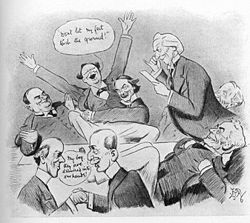
In a major speech in December 1908, Asquith announced that the upcoming budget would reflect the Liberals' policy agenda, and the People's Budget that was submitted to Parliament by Lloyd George the following year greatly expanded social welfare programmes. To pay for them, it significantly increased both direct and indirect taxes.[10] These included a 20 per cent tax on the unearned increase in value in land, payable at death of the owner or sale of the land. There would also be a tax of 1⁄2d in the pound[g] on undeveloped land. A graduated income tax was imposed, and there were increases in imposts on tobacco, beer and spirits.[111] A tax on petrol was introduced despite Treasury concerns that it could not work in practice. Although Asquith held fourteen cabinet meetings to assure unity amongst his ministers,[10] there was opposition from some Liberals; Rosebery described the budget as "inquisitorial, tyrannical, and Socialistic".[112]
The budget divided the country and provoked bitter debate through the summer of 1909.[113] The Northcliffe Press (The Times and the Daily Mail) urged rejection of the budget to give tariff reform (indirect taxes on imported goods which, it was felt, would encourage British industry and trade within the Empire) a chance; there were many public meetings, some of them organised by dukes, in protest at the budget.[114] Many Liberal politicians attacked the peers, including Lloyd George in his Newcastle upon Tyne speech, in which he said "a fully-equipped duke costs as much to keep up as two Dreadnoughts; and dukes are just as great a terror and they last longer".[115] King Edward privately urged the Conservative leaders Balfour and Lord Lansdowne to pass the Budget (this was not unusual, as Queen Victoria had helped to broker agreement between the two Houses over the Irish Church Act 1869 and the Third Reform Act in 1884).[116]
From July it became increasingly clear that the Conservative peers would reject the budget, partly in the hope of forcing an election.[117] If they rejected it, Asquith determined, he would have to ask the King to dissolve Parliament, four years into a seven-year term,[10] as it would mean the legislature had refused supply.[h] The budget passed the Commons on 4 November 1909, but was voted down in the Lords on the 30th, the Lords passing a resolution by Lord Lansdowne stating that they were entitled to oppose the finance bill as it lacked an electoral mandate.[118] Asquith had Parliament prorogued three days later for an election beginning on 15 January 1910, with the Commons first passing a resolution deeming the Lords' vote to be an attack on the constitution.[119]
1910: election and constitutional deadlock

The January 1910 general election was dominated by talk of removing the Lords' veto.[10][120] A possible solution was to threaten to have King Edward pack the House of Lords with freshly minted Liberal peers, who would override the Lords's veto; Asquith's talk of safeguards was taken by many to mean that he had secured the King's agreement to this. They were mistaken; the King had informed Asquith that he would not consider a mass creation of peers until after a second general election.[10]
Lloyd George and Churchill were the leading forces in the Liberals' appeal to the voters; Asquith, clearly tired, took to the hustings for a total of two weeks during the campaign, and when the polls began, journeyed to Cannes with such speed that he neglected an engagement with the King, to the monarch's annoyance.[121] The result was a hung Parliament. The Liberals lost heavily from their great majority of 1906, but still finished with two more seats than the Conservatives. With Irish Nationalist and Labour support, the government would have ample support on most issues, and Asquith stated that his majority compared favourably with those enjoyed by Lord Palmerston and Lord John Russell.[122]

Immediate further pressure to remove the Lords' veto now came from the Irish MPs, who wanted to remove the Lords' ability to block the introduction of Irish Home Rule. They threatened to vote against the Budget unless they had their way.[123][i] With another general election likely before long, Asquith had to make clear the Liberal policy on constitutional change to the country without alienating the Irish and Labour. This initially proved difficult, and the King's speech opening Parliament was vague on what was to be done to neutralise the Lords' veto. Asquith dispirited his supporters by stating in Parliament that he had neither asked for nor received a commitment from the King to create peers.[10] The cabinet considered resigning and leaving it up to Balfour to try to form a Conservative government.[124]
Der Haushalt passierte erneut das Unterhaus und wurde diesmal im April vom Oberhaus ohne Abstimmung gebilligt. [ 125 ] Das Kabinett beschloss schließlich, einen auf Campbell-Bannermans Vorschlag basierenden Plan zu unterstützen: Ein vom Unterhaus in drei aufeinanderfolgenden Legislaturperioden verabschiedetes Gesetz sollte ungeachtet der Einwände des Oberhauses in Kraft treten. Sofern der König nicht garantierte, genügend liberale Peers zur Verabschiedung des Gesetzes zu ernennen, würden die Minister zurücktreten und Balfour die Regierungsbildung ermöglichen. Die Frage sollte dann bei den folgenden Parlamentswahlen debattiert werden. [ 126 ] Am 14. April 1910 verabschiedete das Unterhaus Resolutionen, die die Grundlage für den späteren Parliament Act 1911 bildeten : die Abschaffung des Vetorechts des Oberhauses gegen Haushaltsgesetze, die Beschränkung der Blockade anderer Gesetze auf eine zweijährige Verzögerungsmöglichkeit und die Verkürzung der Legislaturperiode von sieben auf fünf Jahre. [ 127 ] In dieser Debatte deutete Asquith – auch um sich die Unterstützung der irischen Abgeordneten zu sichern – an, er werde den König bitten, die Blockade „in diesem Parlament“ aufzulösen (d. h. er werde die Massenernennung von Peers fordern, entgegen der früheren Forderung des Königs nach einer zweiten Wahl). [ 128 ] Im April wurde der König von Balfour und dem Erzbischof von Canterbury (an den er sich für relativ neutralen Verfassungsrat gewandt hatte) darüber informiert, dass die Liberalen kein ausreichendes Wählermandat besäßen, um die Ernennung von Peers zu fordern. [ 129 ] König Edward fand den gesamten Vorschlag „einfach widerlich“ und die Regierung sei „in den Händen von Redmond & Co.“ Lord Crewe, der liberale Fraktionsvorsitzende im Oberhaus, erklärte öffentlich, der Wunsch der Regierung, Peers zu ernennen, sei als formeller „ministerieller Rat“ zu behandeln (dem der Monarch gemäß der Konvention Folge leisten müsse), obwohl Lord Esher argumentierte, der Monarch sei im äußersten Notfall berechtigt , die Regierung zu entlassen, anstatt ihren „Rat“ anzunehmen. [ 130 ]
Either way, these plans were somewhat scuppered by the death of Edward VII on 6 May 1910. Asquith and his ministers were initially reluctant to press the new king, George V, in mourning for his father, for commitments on constitutional change, and the monarch's views were not yet known. With a strong feeling in the country that the parties should compromise, Asquith and other Liberals met with Conservative leaders in a number of conferences through much of the remainder of 1910. These talks failed in November over Conservative insistence that there be no limits on the Lords's ability to veto Irish Home Rule.[10] When the Parliament Bill was submitted to the Lords, they made amendments that were not acceptable to the government.[131]
1910–1911: second election and Parliament Act

On 11 November Asquith asked King George to dissolve Parliament for another general election in December, and on 14 November met again with the King and demanded assurances George would create an adequate number of Liberal peers to carry the Parliament Bill. The King was slow to agree, and Asquith and his Cabinet informed him they would resign if he did not make the commitment. Balfour had told Edward that he would form a Conservative government if the Liberals left office, but the new King did not know this. The King reluctantly gave in to Asquith's demand, writing in his diary that, "I disliked having to do this very much, but agreed that this was the only alternative to the Cabinet resigning, which at this moment would be disastrous".[132]
Asquith dominated the short election campaign, focusing on the Lords' veto in calm speeches, compared by his biographer Stephen Koss to the "wild irresponsibility" of other major campaigners.[133] In a speech at Hull, he stated that the Liberals' purpose was to remove the obstruction, not establish an ideal upper house, "I have always got to deal—the country has got to deal—with things here and now. We need an instrument [of constitutional change] that can be set to work at once, which will get rid of deadlocks, and give us the fair and even chance in legislation to which we are entitled, and which is all that we demand."[134]
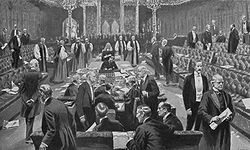
Die Wahl brachte kaum Veränderungen in der Stärke der Parteien (die Liberalen und Konservativen waren gleich groß; 1914 sollte die Konservative Partei aufgrund von Nachwahlsiegen sogar größer werden). Dennoch blieb Asquith Premierminister und verfügte im Unterhaus über eine große Mehrheit in der Frage des Oberhauses. Der Parlamentsentwurf passierte das Unterhaus im April 1911 erneut und wurde im Oberhaus stark abgeändert. Asquith teilte König Georg mit, dass der Monarch aufgefordert werde, die Peers zu ernennen, und der König stimmte zu, bat jedoch darum, sein Versprechen öffentlich zu machen und dem Oberhaus die Möglichkeit zu geben, seinen Widerstand zu überdenken. Daraufhin entbrannte innerhalb der Konservativen eine heftige interne Debatte darüber, ob man nachgeben oder weiterhin mit Nein stimmen sollte, obwohl man von Hunderten neu ernannter Peers zahlenmäßig unterlegen war. Nach längerer Debatte stimmte das Oberhaus am 10. August 1911 mit knapper Mehrheit dagegen, auf den Änderungsanträgen der Regierung zu bestehen. Viele konservative Peers enthielten sich der Stimme, einige wenige stimmten für die Regierung; das Gesetz wurde verabschiedet. [ 135 ]
Laut Jenkins agierte Asquith während der Krise zwar mitunter zögerlich, doch „insgesamt war Asquiths behutsames Vorgehen ein meisterhaftes Beispiel für politisches Geschick und geduldige Entschlossenheit. Verglichen mit den Konservativen war seine Führungsrolle herausragend.“ [ 136 ] Churchill schrieb nach der zweiten Wahl von 1910 an Asquith: „Ihre Führung war das prägendste Merkmal des gesamten Kampfes.“ [ 133 ] Matthew stellte in seinem Artikel über Asquith fest: „Diese Episode markierte den Höhepunkt von Asquiths Karriere als Premierminister. In der Tradition der britischen Liberalen flickte er die Verfassung, anstatt sie grundlegend zu reformieren.“ [ 10 ]
Soziale, religiöse und arbeitsrechtliche Angelegenheiten
Trotz der Ablenkung durch die Probleme im Oberhaus trieben Asquith und seine Regierung eine Reihe von Reformgesetzen voran. Laut Matthew war „kein Premierminister in Friedenszeiten ein so effektiver Wegbereiter. Arbeitsvermittlungsstellen, die Einführung der Arbeitslosen- und Krankenversicherung … spiegelten die Reformen wider, die die Regierung trotz der Probleme im Oberhaus erreichen konnte. Asquith selbst war kein ‚neuer Liberaler‘, aber er erkannte die Notwendigkeit eines Wandels der Annahmen über das Verhältnis des Einzelnen zum Staat und war sich des politischen Risikos einer Labour-Partei an der linken Flanke der Liberalen vollkommen bewusst.“ [ 10 ] Um die Unterstützung der Labour-Partei zu erhalten, verabschiedete die Regierung Asquith von dieser Partei geforderte Gesetze, darunter den Trade Union Act von 1913 (der das Osborne-Urteil aufhob ) und die 1911 eingeführte Besoldung der Abgeordneten, wodurch es für Arbeiter einfacher wurde, im Unterhaus zu dienen. [ 137 ]
1911 gab es Befürchtungen vor einem möglichen Bergarbeiterstreik unmittelbar nach dem Eisenbahnerstreik im August. Im Februar 1912 stimmten die Führungskräfte des Bergarbeiterverbandes für einen Streik. Asquith traf sich zusammen mit Lloyd George, Buxton und Grey mit den Führungskräften im Außenministerium . Dort akzeptierte er zwar das Prinzip eines Mindestlohns, lehnte aber die Forderung nach fünf und zwei Dollar ab. [ 138 ] Wie angedroht, begann der Streik. Nachdem Kompromissversuche des Kabinetts gescheitert waren, griff die Regierung zu Notstandsgesetzen . Im März wurde der Gesetzentwurf zum Mindestlohn für Bergleute vom Unterhaus verabschiedet, und das Oberhaus, das seiner Politik der Nichtbeeinflussung von Gewerkschaften folgte, billigte das Gesetz. Asquith präsentierte den Gesetzentwurf emotional zur dritten Lesung mit den Worten: „Wir haben alle unsere Mittel der Überredung, Argumentation und Verhandlung ausgeschöpft.“ Das Gesetz wurde verabschiedet, und das neue Kohlebergwerksgesetz (Mindestlohn) von 1912 richtete Bezirksausschüsse ein, die unter Beteiligung der Gewerkschaften die Mindestlöhne festlegten. Im April scheiterte eine Gewerkschaftsabstimmung daran, die erforderliche Zweidrittelmehrheit für die Fortsetzung des Betriebs zu erreichen, und die Bergleute nahmen ihre Arbeit wieder auf. [ 139 ]
Asquith had as chancellor placed money aside for the provision of non-contributory old-age pensions; the bill authorising them passed in 1908, during his premiership, despite some objection in the Lords.[140] Jenkins noted that the scheme (which provided five shillings a week to single pensioners aged seventy and over, and slightly less than twice that to married couples) "to modern ears sounds cautious and meagre. But it was violently criticised at the time for showing a reckless generosity."[141] In 1913, a committee was established to develop a land reform scheme. The committee produced a comprehensive report on rural land issues and its proposals were largely accepted by government ministers and formed the foundation of Lloyd George's “Land Campaign”.[142] In August 1913, following the prorogation of Parliament, the final proposals were presented to Asquith at a ministerial gathering at Haldane's house. Asquith ultimately approved them, including the introduction of a minimum wage for agricultural labourers, despite previously being reluctant on the issue.[143]
The Children Act 1908 consolidated multiple previous laws to improve child welfare. It established juvenile courts, remand homes, and prohibited placing children under 16 in adult prisons. The act also aimed to enhance parental responsibility and state involvement in child welfare.[144] Asquith's government also passed the National Insurance Act 1911[145] which established health and unemployment insurance for certain groups of workers.[146][147] Asquith described the insurance scheme to the King as "the largest and most beneficial increase in social reform yet achieved in any country." The National Insurance Act was "...the kingpin of the social policy of a Liberal government."[148]
Asquiths neue Regierung geriet in eine Kontroverse um den Eucharistischen Kongress von 1908 in London. Nach dem Katholikenemanzipationsgesetz von 1829 erlebte die katholische Kirche in Großbritannien einen Aufschwung, und eine große Prozession mit dem Allerheiligsten Sakrament war geplant, um auch Laien die Teilnahme zu ermöglichen. Obwohl ein solches Ereignis durch das Gesetz von 1829 verboten war, setzten die Organisatoren auf den britischen Ruf der religiösen Toleranz [ 149 ] , und Francis Kardinal Bourne , der Erzbischof von Westminster , hatte die Genehmigung der Metropolitan Police eingeholt . Als die Pläne bekannt wurden, erhob König Edward Einspruch, ebenso wie viele andere Protestanten. Asquith erhielt widersprüchliche Ratschläge von seinem Innenminister Herbert Gladstone und setzte die Organisatoren schließlich erfolgreich unter Druck, die religiösen Elemente der Prozession abzusagen, was ihn jedoch den Rücktritt seines einzigen katholischen Kabinettsmitglieds, Lord Ripon , kostete . [ 150 ]
Die Trennung der walisischen Kirche vom Staat war ein zentrales Anliegen der Liberalen, doch trotz der Unterstützung der meisten walisischen Abgeordneten gab es im Oberhaus Widerstand. Asquith galt seit seiner Zeit unter Gladstone als Experte für die Trennung der walisischen Kirche vom Staat, war aber an der Verabschiedung des Gesetzes kaum beteiligt. Es wurde 1912 und 1913 zweimal vom Oberhaus abgelehnt, aber nachdem es durch den Parliament Act von 1911 erzwungen worden war, erhielt es im September 1914 als Welsh Church Act 1914 die königliche Zustimmung . Die Bestimmungen wurden jedoch durch den Suspensory Act 1914 bis zum Kriegsende ausgesetzt. [ 10 ] [ 151 ]
Wahlrecht für Frauen

Asquith hatte sich bereits 1882 gegen das Frauenwahlrecht ausgesprochen und blieb während seiner gesamten Amtszeit als Premierminister als dessen Gegner bekannt. [ 152 ] Er betrachtete die Frage des Frauenwahlrechts distanziert und war der Ansicht, sie solle danach beurteilt werden, ob eine Ausweitung des Wahlrechts das Regierungssystem verbessern würde, und nicht als Frage der Rechte. Er verstand nicht – Jenkins führte dies auf mangelnde Vorstellungskraft zurück –, warum die Debatte auf beiden Seiten so hitzig geführt wurde. 1913 sagte er im Unterhaus, als er sich über die „übertriebene Rhetorik“ beider Seiten beklagte: „Manchmal bin ich versucht zu denken, wenn ich den Argumenten der Befürworterinnen des Frauenwahlrechts zuhöre, dass nichts dafür zu sagen sei, und manchmal bin ich versucht zu denken, wenn ich den Argumenten der Gegnerinnen des Frauenwahlrechts zuhöre, dass nichts dagegen zu sagen sei.“ [ 153 ]
In 1906 the suffragettes Annie Kenney, Adelaide Knight and Jane Sbarborough were arrested when they tried to obtain an audience with Asquith.[154][155] Offered either six weeks in prison or giving up campaigning for one year, the women all chose prison.[154] Asquith was a target for militant suffragettes as they abandoned hope of achieving the vote through peaceful means. He was several times the subject of their tactics: approached (to his annoyance) arriving at 10 Downing Street (by Olive Fargus and Catherine Corbett, whom he called 'silly women'),[156] confronted at evening parties, accosted on the golf course, and ambushed while driving to Stirling to dedicate a memorial to Campbell-Bannerman. On the last occasion, his top hat proved adequate protection against the dog whips wielded by the women. These incidents left him unmoved, as he did not believe them a true manifestation of public opinion.[157]
With a growing majority of the Cabinet, including Lloyd George and Churchill, in favour of women's suffrage, Asquith was pressed to allow consideration of a private member's bill to give women the vote. The majority of Liberal MPs were also in favour.[158] Jenkins deemed him one of the two main prewar obstacles to women gaining the vote, the other being the suffragists's own militancy. In 1912, Asquith reluctantly agreed to permit a free vote on an amendment to a pending reform bill, allowing women the vote on the same terms as men. This would have satisfied Liberal suffrage supporters, and many suffragists, but the Speaker in January 1913 ruled that the amendment changed the nature of the bill, which would have to be withdrawn. Asquith was loud in his complaints against the Speaker, but was privately relieved.[159]
Asquith belatedly came around to support women's suffrage in 1917,[160] by which time he was out of office. Women over the age of thirty were eventually given the vote by Lloyd George's government under the Representation of the People Act 1918. Asquith's reforms to the House of Lords eased the way for the passage of the bill.[161]
Irish Home Rule

Als Minderheitspartei nach den Wahlen von 1910 waren die Liberalen auf die irischen Stimmen angewiesen, die von John Redmond kontrolliert wurden . Um die irische Unterstützung für den Haushalt und das Parlamentsgesetz zu gewinnen, versprach Asquith Redmond, dass die irische Selbstverwaltung höchste Priorität haben würde. [ 162 ] Dies erwies sich als deutlich komplexer und zeitaufwändiger als erwartet. [ 163 ] Die Unterstützung der irischen Selbstverwaltung war seit 1886 ein Grundsatz der Liberalen Partei, doch Asquith hatte sich weniger enthusiastisch gezeigt und 1903 (in der Opposition) erklärt, die Partei dürfe niemals die Regierung übernehmen, wenn diese für ihr Überleben auf die Unterstützung der Irischen Nationalisten angewiesen wäre . [ 164 ] Nach 1910 waren die Stimmen der Irischen Nationalisten jedoch unerlässlich, um an der Macht zu bleiben. Der Verbleib Irlands in der Union war das erklärte Ziel aller Parteien, und die Nationalisten, als Teil der Mehrheit, die Asquith im Amt hielt, waren berechtigt, die Umsetzung ihrer Pläne für die Selbstverwaltung zu fordern und die Unterstützung der Liberalen und der Labour-Partei zu erwarten. [ 10 ] Die Konservativen, die auf die unerschütterliche Unterstützung der protestantischen Oranier aus Ulster zählen konnten, lehnten die Home Rule entschieden ab. Der Wunsch, dem Oberhaus ein Vetorecht bei solchen Gesetzesvorlagen zu sichern, hatte in den Verfassungsgesprächen vor der zweiten Wahl von 1910 eine unüberbrückbare Kluft zwischen den Parteien geschaffen. [ 165 ]
Das Kabinettskomitee (ohne Asquith), das 1911 den dritten Home-Rule-Gesetzentwurf plante , lehnte jeglichen Sonderstatus für das protestantische Ulster innerhalb des mehrheitlich katholischen Irlands ab. Asquith schrieb später (1913) an Churchill und erklärte, der Premierminister habe stets geglaubt und erklärt, die Bedingung für die Selbstverwaltung müsse ein Sonderstatus für Ulster sein. Trotzdem enthielt der im April 1912 eingebrachte Gesetzentwurf keine derartige Bestimmung und sollte für ganz Irland gelten. [ 10 ] Weder eine Teilung noch ein Sonderstatus für Ulster konnten wohl eine der beiden Seiten zufriedenstellen. [ 163 ] Die im Gesetzentwurf vorgesehene Selbstverwaltung war sehr begrenzt, doch die irischen Nationalisten, die mit einer schrittweisen Einführung der Selbstverwaltung durch das Parlament rechneten, befürworteten sie. Die Konservativen und die irischen Unionisten lehnten sie ab. Die Unionisten begannen, sich darauf vorzubereiten, ihren Willen notfalls mit Gewalt durchzusetzen, was die Nationalisten zu einem ähnlichen Verhalten veranlasste. Obwohl sie eine deutliche Minderheit bildeten, waren die irischen Unionisten im Allgemeinen besser finanziert und organisierter. [ 166 ]
Since the Parliament Act 1911 the Unionists could no longer block Home Rule in the House of Lords, but only delay royal assent by two years. Asquith decided to postpone any concessions to the Unionists until the bill's third passage through the Commons, when he believed the Unionists would be desperate for a compromise.[167] Jenkins concluded that had Asquith tried for an earlier agreement, he would have had no luck, as many of his opponents wanted a fight and the opportunity to smash his government.[168] Sir Edward Carson, MP for Dublin University and leader of the Irish Unionists in Parliament, threatened a revolt if Home Rule was enacted.[169] The new Conservative leader, Bonar Law, campaigned in Parliament and in northern Ireland, warning Ulstermen against "Rome Rule", that is, domination by the island's Catholic majority.[170] Many who opposed Home Rule felt that the Liberals had violated the Constitution—by pushing through major constitutional change without a clear electoral mandate, with the House of Lords, formerly the "watchdog of the constitution", not reformed as had been promised in the preamble of the Parliament Act 1911—and thus justified actions that in other circumstances might be treason.[171]
Die durch die Irlandfrage ausgelösten Leidenschaften standen im Kontrast zu Asquiths kühler Distanz. Er schrieb über die drohende Teilung der Grafschaft Tyrone mit ihrer gemischten Bevölkerung und bezeichnete sie als „eine Sackgasse mit unsagbaren Folgen in einer Angelegenheit, die englischen Augen unvorstellbar klein und irischen Augen unermesslich groß erscheint“. [ 172 ] 1912 sagte Asquith: „Irland ist eine Nation, nicht zwei Nationen, sondern eine. Es gibt wenige Beispiele in der Geschichte, … in denen eine Nationalität zugleich so ausgeprägt, so beständig und so anpassungsfähig war wie die irische.“ [ 173 ] Während das Unterhaus Ende 1912 und Anfang 1913 über die Home-Rule-Gesetzgebung debattierte, mobilisierten sich die Unionisten in Nordirland. Es wurde über die Ausrufung einer provisorischen Regierung durch Carson und den Aufbau der Ulster Volunteer Forces (UVF) um die Oranier-Logen gesprochen . Im Kabinett betrachtete jedoch nur Churchill diese Entwicklung mit Sorge. [ 174 ] Diese Truppen, die zwar auf ihrer Loyalität zur britischen Krone bestanden, aber zunehmend mit eingeschmuggelten deutschen Waffen ausgerüstet waren, bereiteten sich auf den Kampf gegen die britische Armee vor. Die unionistischen Führer waren jedoch zuversichtlich, dass die Armee die Durchsetzung der Selbstverwaltung Ulsters nicht unterstützen würde. [ 172 ] Während der Gesetzentwurf zur Selbstverwaltung Ulsters auf seine dritte Lesung im Unterhaus wartete, ereignete sich im April 1914 der Curragh-Vorfall . Angesichts des unmittelbar bevorstehenden Truppeneinsatzes in Ulster und der drohenden Äußerungen Churchills und des Kriegsministers John Seely erklärten etwa sechzig Offiziere unter Führung von Brigadegeneral Hubert Gough , dass sie lieber aus dem Dienst entlassen würden, als zu gehorchen. [ 10 ] Da sich die Unruhen unter den Offizieren in England ausbreiteten, versuchte das Kabinett, die Offiziere mit einer von Asquith verfassten Erklärung zu beschwichtigen. Darin wurde die Pflicht der Offiziere, rechtmäßige Befehle zu befolgen, bekräftigt, aber gleichzeitig behauptet, der Vorfall sei ein Missverständnis gewesen. Seely fügte daraufhin eine unautorisierte Zusicherung hinzu, die von Sir John French (dem Chef der Armee) gegengezeichnet wurde, dass die Regierung nicht die Absicht habe, Gewalt gegen Ulster anzuwenden. Asquith wies diese Ergänzung zurück und forderte Seely und French zum Rücktritt auf. Er übernahm selbst das Kriegsministerium [ 175 ] und behielt die zusätzliche Verantwortung bis zum Beginn der Kampfhandlungen gegen Deutschland. [ 176 ]
Innerhalb eines Monats nach Asquiths Amtsantritt im Kriegsministerium landete die UVF eine große Ladung Waffen und Munition in Larne . Das Kabinett hielt es jedoch nicht für ratsam, deren Anführer zu verhaften. Am 12. Mai kündigte Asquith an, er werde die dritte Lesung der Home Rule im Unterhaus sichern (was am 25. Mai gelang), jedoch mit einem Änderungsgesetz, das Sonderbestimmungen für Ulster enthielt. Das Oberhaus nahm jedoch für Asquith inakzeptable Änderungen an dem Änderungsgesetz vor. Da es keine Möglichkeit gab, das Parlamentsgesetz von 1911 auf das Änderungsgesetz anzuwenden, willigte Asquith ein, sich am 21. Juli mit anderen Parteiführern auf einer Allparteienkonferenz im Buckingham Palace unter dem Vorsitz des Königs zu treffen. Als keine Lösung gefunden werden konnte, planten Asquith und sein Kabinett weitere Zugeständnisse an die Unionisten. Diese kamen jedoch nicht zustande, da die Krise auf dem Kontinent zum Krieg eskalierte. [ 10 ] Im September 1914, nach Ausbruch des Konflikts, kündigte Asquith an, dass der Home-Rule-Gesetzentwurf zwar verabschiedet (als Government of Ireland Act 1914 ), aber erst nach dem Krieg in Kraft treten würde (siehe Suspensory Act 1914 ); in der Zwischenzeit solle ein Gesetzentwurf zur Gewährung eines Sonderstatus für Ulster geprüft werden. Diese Lösung befriedigte keine der beiden Seiten. [ 177 ]
Außen- und Verteidigungspolitik

Als Premierminister führte Asquith eine tief gespaltene Liberale Partei, insbesondere in Fragen der Außenpolitik und der Verteidigungsausgaben. [ 10 ] Unter Balfour hatten Großbritannien und Frankreich die Entente Cordiale vereinbart . [ 178 ] 1906, als die Liberalen die Regierung übernahmen, herrschte zwischen Frankreich und Deutschland eine Krise um Marokko, und die Franzosen baten Großbritannien um Hilfe im Falle eines Konflikts. Außenminister Grey lehnte jegliche formelle Vereinbarung ab, äußerte aber seine persönliche Meinung, dass Großbritannien Frankreich im Kriegsfall beistehen würde. Frankreich forderte daraufhin militärische Gespräche zur Koordinierung in einem solchen Fall. Grey stimmte zu, und diese Gespräche wurden in den folgenden Jahren ohne Wissen des Kabinetts fortgesetzt – Asquith erfuhr höchstwahrscheinlich erst 1911 davon. Als er davon erfuhr, befürchtete Asquith, die Franzosen hielten die britische Hilfe im Kriegsfall für selbstverständlich, doch Grey überzeugte ihn, die Gespräche müssten weitergeführt werden. [ 179 ]
Das Wettrüsten zur See zwischen Großbritannien und Deutschland stand im Mittelpunkt der öffentlichen Debatte . Die Marokkokrise war auf der Konferenz von Algeciras beigelegt worden , und das Kabinett Campbell-Bannerman hatte reduzierte Marineausgaben genehmigt. Die angespannten Beziehungen zu Deutschland und dessen Bestrebungen, eigene Dreadnoughts zu bauen , veranlassten Reginald McKenna , nachdem Asquith ihn 1908 zum Ersten Lord der Admiralität ernannt hatte , den Bau von acht weiteren britischen Dreadnoughts in den folgenden drei Jahren vorzuschlagen. Dies führte zu Konflikten im Kabinett zwischen Befürwortern dieses Programms, wie McKenna, und den „Ökonomen“, die unter Führung von Lloyd George und Churchill für eine Reduzierung der Marineausgaben plädierten. [ 180 ] In der Öffentlichkeit herrschte die weitverbreitete Meinung, so viele Schiffe wie möglich zu bauen, um die britische Seeherrschaft zu sichern. Asquith vermittelte zwischen seinen Kollegen und erreichte einen Kompromiss: Vier Schiffe sollten gleichzeitig auf Kiel gelegt werden, und vier weitere, falls sich dies als notwendig erweisen sollte. [ 181 ] Die Rüstungsfrage wurde während der innenpolitischen Krisen um den Haushalt von 1909 und das Parlamentsgesetz zurückgestellt, obwohl der Bau von Kriegsschiffen in beschleunigtem Tempo fortgesetzt wurde. [ 182 ]
Die Agadir-Krise von 1911 entbrannte erneut zwischen Frankreich und Deutschland um marokkanische Interessen. Asquiths Regierung signalisierte jedoch in Lloyd Georges Rede im Mansion House am 21. Juli ihre freundschaftliche Haltung gegenüber Frankreich. [ 183 ] Gegen Ende des Jahres brachte der Lordpräsident des Rates, Viscount Morley , die Frage der Kommunikation mit den Franzosen vor das Kabinett. Auf Asquiths Betreiben hin beschloss das Kabinett, dass keine Gespräche geführt werden dürften, die Großbritannien zum Krieg verpflichten würden, und dass koordinierte Militäraktionen der Zustimmung des Kabinetts bedürften. Dennoch forderten die Franzosen 1912 eine verstärkte Marinekoordinierung, und gegen Ende des Jahres wurden die verschiedenen Vereinbarungen in einem Briefwechsel zwischen Grey und dem französischen Botschafter Paul Cambon schriftlich festgehalten . [ 184 ] Die Beziehungen zu Frankreich beunruhigten einige liberale Hinterbänkler, und Asquith sah sich verpflichtet, ihnen zu versichern, dass nichts im Geheimen vereinbart worden sei, was Großbritannien zum Krieg verpflichten würde. Dies beruhigte die außenpolitischen Kritiker Asquiths, bis Anfang 1914 ein weiterer Streit über die Marineausgaben ausbrach. [ 185 ]
Julikrise und Ausbruch des Ersten Weltkriegs

The assassination of Archduke Franz Ferdinand of Austria in Sarajevo on 28 June 1914 initiated a month of unsuccessful diplomatic attempts to avoid war.[186] These attempts ended with Grey's proposal for a four-power conference of Britain, Germany, France and Italy, following the Austrian ultimatum to Serbia on the evening of 23 July. Grey's initiative was rejected by Germany as "not practicable".[187] During this period, George Cassar considers that "the country was overwhelmingly opposed to intervention."[188] Much of Asquith's cabinet was similarly inclined, Lloyd George told a journalist on 27 July that "there could be no question of our taking part in any war in the first instance. He knew of no Minister who would be in favour of it."[187] and wrote in his War Memoirs that before the German ultimatum to Belgium on 3 August "The Cabinet was hopelessly divided—fully one third, if not one half, being opposed to our entry into the War. After the German ultimatum to Belgium the Cabinet was almost unanimous."[189] Asquith himself, while growing more aware of the impending catastrophe, was still uncertain of the necessity for Britain's involvement. On 24 July he wrote to Venetia, "We are within measurable, or imaginable, distance of a real Armageddon. Happily there seems to be no reason why we should be anything more than spectators."[190]
During the continuing escalation Asquith "used all his experience and authority to keep his options open"[191] and adamantly refused to commit his government by saying, "The worst thing we could do would be to announce to the world at the present moment that in no circumstances would we intervene."[192] But he recognised Grey's clear commitment to Anglo-French unity and, following Russian mobilisation on 30 July,[193] and Kaiser Wilhelm II's ultimatum to Tsar Nicholas II on 1 August, he recognised the inevitability of war.[194] From this point, he committed himself to participation, despite continuing Cabinet opposition. As he said, "There is a strong party reinforced by Ll George[, ] Morley and Harcourt who are against any kind of intervention. Grey will never consent and I shall not separate myself from him."[195] Also, on 2 August, he received confirmation of Conservative support from Bonar Law.[196] In one of two extraordinary Cabinets held on that Sunday, Grey informed members of the 1912 Anglo-French naval talks and Asquith secured agreement to mobilise the fleet.[197]
On Monday 3 August the Belgian Government rejected the German demand for free passage through its country and in the afternoon, "with gravity and unexpected eloquence",[196] Grey spoke in the Commons and called for British action "against the unmeasured aggrandisement of any power".[198]Basil Liddell Hart considered that this speech saw the "hardening (of) British opinion to the point of intervention".[199] The following day Asquith saw the King and an ultimatum to Germany demanding withdrawal from Belgian soil was issued with a deadline of midnight Berlin time, 11.00 pm (GMT). Margot Asquith described the moment of expiry, somewhat inaccurately, in these terms: "(I joined) Henry in the Cabinet room. Lord Crewe and Grey were already there and we sat smoking cigarettes in silence ... The clock on the mantelpiece hammered out the hour and when the last beat of midnight struck it was as silent as dawn. We were at War."[200]
First year of the war: August 1914 – May 1915
Asquith's wartime government
The declaration of war on 4 August 1914 saw Asquith as the head of an almost united Liberal Party. Having persuaded Sir John Simon and Lord Beauchamp to remain,[201] Asquith suffered only two resignations from his cabinet, those of John Morley and John Burns.[202] With other parties promising to co-operate, Asquith's government declared war on behalf of a united nation, Asquith bringing "the country into war without civil disturbance or political schism".[203]
The first months of the War saw a revival in Asquith's popularity. Bitterness from earlier struggles temporarily receded and the nation looked to Asquith, "steady, massive, self-reliant and unswerving",[204] to lead them to victory. But Asquith's peacetime strengths ill-equipped him for what was to become perhaps the first total war and, before its end, he would be out of office for ever and his party would never again form a majority government.[205]
Beyond the replacement of Morley and Burns,[206] Asquith made one other significant change to his cabinet. He relinquished the War Office and appointed the non-partisan but Conservative-inclined Lord Kitchener of Khartoum.[207] Kitchener was a figure of national renown and his participation strengthened the reputation of the government.[208] Whether it increased its effectiveness is less certain.[100] Overall, it was a government of considerable talent with Lloyd George remaining as chancellor,[209] Grey as foreign secretary[210] and Churchill at the Admiralty.[207]
The invasion of Belgium by German forces, the touch paper for British intervention, saw the Kaiser's armies attempt a lightning strike through Belgium against France, while holding Russian forces on the Eastern Front.[211] To support the French, Asquith's cabinet authorised the despatch of the British Expeditionary Force.[212] The ensuing Battle of the Frontiers in the late summer and early autumn of 1914 saw the final halt of the German advance at the First Battle of the Marne, which established the pattern of attritional trench warfare on the Western Front that continued until 1918.[213] This stalemate brought deepening resentment against the government, and against Asquith personally, as the population at large and the press lords in particular, blamed him for a lack of energy in the prosecution of the war.[214] It also created divisions within the Cabinet between the "Westerners", including Asquith, who supported the generals in believing that the key to victory lay in ever greater investment of men and munitions in France and Belgium,[215] and the "Easterners", led by Churchill and Lloyd George, who believed that the Western Front was in a state of irreversible stasis and sought victory through action in the East.[216] Lastly, it highlighted divisions between those politicians, and newspaper owners, who thought that military strategy and actions should be determined by the generals, and those who thought politicians should make those decisions.[217] Asquith said in his memoirs: "Once the governing objectives have been decided by Ministers at home—the execution should always be left to the untrammeled discretion of the commanders on the spot."[218] Lloyd George's counter view was expressed in a letter of early 1916 in which he asked "whether I have a right to express an independent view on the War or must (be) a pure advocate of opinions expressed by my military advisers?"[219] These divergent opinions lay behind the two great crises that would, within 14 months, see the collapse of the last ever fully Liberal administration and the advent of the first coalition on 25 May 1915, the Dardanelles Campaign and the Shell Crisis.[220]
Dardanelles Campaign

The Dardanelles Campaign was an attempt by Churchill and those favouring an Eastern strategy to end the stalemate on the Western Front. It envisaged an Anglo-French landing on Turkey's Gallipoli Peninsula and a rapid advance to Constantinople which would see the exit of Turkey from the conflict. The plan was rejected by Admiral John Fisher, the First Sea Lord, and Kitchener.[221] Unable to provide decisive leadership, Asquith sought to arbitrate between these two and Churchill, leading to procrastination and delay. The naval attempt was badly defeated. Allied troops established bridgeheads on the Gallipoli Peninsula, but a delay in providing sufficient reinforcements allowed the Turks to regroup, leading to a stalemate Jenkins described "as immobile as that which prevailed on the Western Front".[222] The Allies suffered from infighting at the top, poor equipment, incompetent leadership, and lack of planning, while facing the best units of the Ottoman army. The Allies sent in 492,000 men; they suffered 132,000 casualties in the humiliating defeat—with very high rates for Australia and New Zealand that permanently transformed those dominions. In Britain, it was political ruin for Churchill and badly hurt Asquith.[223]
Shell Crisis of May 1915
The opening of 1915 saw growing division between Lloyd George and Kitchener over the supply of munitions for the army. Lloyd George considered that a munitions department, under his control, was essential to co-ordinate "the nation's entire engineering capacity".[224] Kitchener favoured the continuance of the current arrangement whereby munitions were sourced through contracts between the War Office and the country's armaments manufacturers. As so often, Asquith sought compromise through committee, establishing a group to "consider the much vexed question of putting the contracts for munitions on a proper footing".[225] This did little to dampen press criticism[226] and, on 20 April, Asquith sought to challenge his detractors in a major speech at Newcastle by saying, "I saw a statement the other day that the operations of our army were being crippled by our failure to provide the necessary ammunition. There is not a word of truth in that statement."[227]
Die Reaktion der Presse war vernichtend: Am 14. Mai 1915 veröffentlichte die Times einen Brief ihres Korrespondenten Charles à Court Repington, in dem er die britische Niederlage in der Schlacht von Aubers Ridge auf einen Mangel an Sprenggranaten zurückführte. Damit begann eine ausgewachsene Krise, die Granatenkrise . Die Frau des Premierministers identifizierte den Hauptgegner ihres Mannes, den Pressemagnaten und Eigentümer der Times , Lord Northcliffe , richtig : „Ich bin mir ziemlich sicher, dass Northcliffe hinter all dem steckt.“ [ 228 ] Sie übersah jedoch die heimliche Beteiligung von Sir John French , der Repington die Details des Granatenmangels zugespielt hatte. [ 229 ] Northcliffe behauptete, „die gesamte Frage der Munitionsversorgung ist eine, in der das Kabinett nicht scharf genug kritisiert werden kann.“ [ 230 ] Angriffe auf die Regierung und auf Asquiths persönliche Lethargie kamen sowohl von links als auch von rechts. C. P. Scott , der Herausgeber des Manchester Guardian , schrieb: „Die Regierung hat in der Munitionsfrage auf furchtbare und schändliche Weise versagt.“ [ 231 ]
Andere Veranstaltungen
Das Scheitern im Osten wie im Westen löste eine Kette von Ereignissen aus, die Asquiths liberale Regierung überfordern sollte. [ 232 ] Strategische Rückschläge trafen ihn mit einem vernichtenden persönlichen Schlag, als Venetia Stanley am 12. Mai 1915 ihre Verlobung mit Edwin Montagu bekannt gab . Asquiths Antwort war prompt und kurz: „Wie du weißt, bricht mir das das Herz. Ich konnte es nicht ertragen, dich zu besuchen. Ich kann nur zu Gott beten, dass er dich segnet – und mir hilft.“ [ 233 ] Venetias Bedeutung für ihn zeigt sich in einer Bemerkung in einem Brief aus Mitte 1914: „Bleib mir nahe, Geliebte, in dieser so kritischen Zeit meines Lebens. Ich weiß, du wirst mich nicht im Stich lassen.“ [ 234 ] Ihre Verlobung, „eine sehr trügerische Rückkehr nach all der Freude, die du mir bereitet hast“, traf ihn tief. [ 235 ] So bedeutend der Verlust persönlich auch war, seine politischen Auswirkungen auf Asquith können überschätzt werden. [ 236 ] Der Historiker Stephen Koss merkt an, dass Asquith „stets in der Lage war, sein öffentliches und privates Leben in getrennte Bereiche zu unterteilen (und) bald neue Vertraute fand, denen er mit nicht weniger Häufigkeit, Leidenschaft und Indiskretion schrieb.“ [ 237 ]
Unmittelbar nach diesem persönlichen Verlust trat Admiral Fisher am 15. Mai zurück, nachdem es zu anhaltenden Meinungsverschiedenheiten mit Churchill und Frustration über die enttäuschenden Entwicklungen in Gallipoli gekommen war. [ 238 ] Der 74-jährige Fisher verhielt sich zunehmend unberechenbar und ließ in häufigen Briefen an Lloyd George seinem Ärger über den Ersten Lord der Admiralität freien Lauf : „Fisher schreibt mir alle ein bis zwei Tage, um mich über den Stand der Dinge zu informieren. Er hat große Probleme mit seinem Chef, der immer etwas Großes und Spektakuläres tun will.“ [ 239 ] Widrigkeiten, die Feindseligkeit der Presse, die Opposition der Konservativen und persönliche Schicksalsschläge setzten Asquith zu, und seine Position wurde durch seine liberalen Kollegen weiter geschwächt. Cassar ist der Ansicht, dass Lloyd George einen deutlichen Mangel an Loyalität an den Tag legte [ 240 ] , und Koss berichtet von zeitgenössischen Gerüchten, Churchill habe „wie immer seine Intrigen gesponnen“ und erwähnt die Behauptung, Churchill habe in Absprache mit Sir John French „zweifellos den Repington-Brief inspiriert“ [ 241 ] . Da es der Regierung an innerem Zusammenhalt mangelte und sie von außen angegriffen wurde, kam Asquith zu dem Schluss, dass seine Regierung nicht weiterbestehen konnte, und schrieb an den König: „Ich bin endgültig zu dem Schluss gekommen, dass die [Regierung] auf einer breiten und parteiunabhängigen Basis neu gebildet werden muss.“ [ 242 ]
Erste Koalition: Mai 1915 – Dezember 1916

Mit der Bildung der Ersten Koalition bewies Asquith jene politische Klugheit, die ihn scheinbar verlassen hatte. [ 243 ] Doch dies hatte seinen Preis. Er musste zwei alte politische Weggefährten opfern: Churchill, dem die Schuld am Dardanellen-Fiasko zugeschrieben wurde, und Haldane, der in der Presse fälschlicherweise prodeutscher Sympathien bezichtigt wurde. [ 242 ] Die Konservativen unter dem Bonar-Gesetz machten diese Entlassungen zur Bedingung für den Eintritt in die Regierung, und mit der Entlassung Haldanes, der „keinen Widerstand leistete“, [ 244 ] beging Asquith „den ungewöhnlichsten Fehler seiner gesamten Karriere“. [ 245 ] In einem Brief an Grey schrieb Asquith über Haldane: „Er ist mein ältester persönlicher und politischer Freund auf der Welt, und mit ihm haben wir, Sie und ich, fast 30 Jahre lang zusammengearbeitet.“ [ 246 ] Doch er konnte diese Gefühle Haldane nicht direkt mitteilen, was diesen sehr verletzte. Asquith gestaltete die Verteilung der Ämter erfolgreicher. Er ernannte Law zum vergleichsweise unbedeutenden Kolonialsekretär [ 247 ] , entzog Kitchener die Verantwortung für die Munitionsversorgung und übertrug sie als neues Ministerium Lloyd George. Balfour wurde anstelle Churchills, der auf den unbedeutenden Kabinettsposten des Kanzlers des Herzogtums Lancaster degradiert wurde, zum Admiralitätsminister ernannt . Insgesamt hielten die Liberalen zwölf Kabinettssitze, darunter die meisten wichtigen, während die Konservativen acht innehatten. [ 248 ] Trotz dieses Ergebnisses waren viele Liberale bestürzt. Der entlassene Charles Hobhouse schrieb: „Der Zerfall der Liberalen Partei ist vollständig. Lloyd George und seine Tory-Freunde werden Asquith bald loswerden.“ [ 249 ] Aus parteipolitischer und persönlicher Sicht wurde die Bildung der Ersten Koalition als „bemerkenswerter Sieg für Asquith, wenn auch nicht für die Sache der Alliierten“ angesehen. [ 243 ] Doch Asquiths abweisender Umgang mit Law trug auch zu seinem eigenen und dem späteren Untergang seiner Partei bei. [ 250 ]
Kriegsreorganisation
Nach dem Wiederaufbau seiner Regierung versuchte Asquith, seinen Kriegsapparat neu zu strukturieren. Das wichtigste Element hierbei war die Einrichtung des Munitionsministeriums [ 251 ] , gefolgt von der Umwandlung des Kriegsrates in ein Dardanellen-Komitee mit Maurice Hankey als Sekretär und dem Auftrag, alle Fragen der Kriegsstrategie zu behandeln. [ 252 ]
The Munitions of War Act 1915 brought private companies supplying the armed forces under the tight control of the Minister of Munitions, Lloyd George. The policy, according to J. A. R. Marriott, was that:
no private interest was to be permitted to obstruct the service, or imperil the safety, of the State. Trade Union regulations must be suspended; employers' profits must be limited, skilled men must fight, if not in the trenches, in the factories; man-power must be economised by the dilution of labour and the employment of women; Private factories must pass under the control of the State, and new national factories be set up. Results justified the new policy: the output was prodigious; the goods were at last delivered.[253]
Nevertheless, criticism of Asquith's leadership style continued. The Earl of Crawford, who had joined the Government as Minister of Agriculture, described his first Cabinet meeting in these terms: "It was a huge gathering, so big that it is hopeless for more than one or two to express opinions on each detail [...] Asquith somnolent—hands shaky and cheeks pendulous. He exercised little control over debate, seemed rather bored, but good humoured throughout." Lloyd George was less tolerant, George Riddell recording in his diary, "(He) says the P.M. should lead not follow and (Asquith) never moves until he is forced, and then it is usually too late."[254] And crises, as well as criticism, continued to assail the Prime Minister, "envenomed by intra-party as well as inter-party rancour".[255]
Conscription

The insatiable demand for manpower for the Western Front had been foreseen early on. A volunteer system had been introduced at the outbreak of war, and Asquith was reluctant to change it for political reasons, as many Liberals, and almost all of their Irish Nationalist and Labour allies, were strongly opposed to conscription.[256] Volunteer numbers dropped,[257] not meeting the demands for more troops for Gallipoli, and much more strongly, for the Western Front.[258] This made the voluntary system increasingly untenable; Asquith's daughter Violet wrote in March 1915, "Gradually every man with the average number of limbs and faculties is being sucked out to the war."[259] In July 1915 the National Registration Act was passed, requiring compulsory registration for all men between the ages of 18 and 65.[260] This was seen by many as the prelude to conscription but the appointment of Lord Derby as Director-General of Recruiting instead saw an attempt to rejuvenate the voluntary system, the Derby Scheme.[261] Asquith's slow steps towards conscription continued to infuriate his opponents. Sir Henry Wilson, for example, wrote this to Leo Amery: "What is going to be the result of these debates? Will 'wait and see' win, or can that part of the Cabinet that is in earnest and is honest force that damned old Squiff into action?"[262] The Prime Minister's balancing act, within Parliament and within his own party, was not assisted by a strident campaign against conscription conducted by his wife. Describing herself as "passionately against it",[263] Margot Asquith engaged in one of her frequent influencing drives, by letters and through conversations, which had little impact other than doing "great harm" to Asquith's reputation and position.[264]
Ende 1915 war klar, dass die Wehrpflicht unerlässlich war, und Asquith brachte am 5. Januar 1916 den Military Service Act im Unterhaus ein. [ 265 ] Das Gesetz führte die Wehrpflicht für unverheiratete Männer ein und wurde später im selben Jahr auf verheiratete Männer ausgeweitet. Asquiths größter Widerstand kam aus den eigenen Reihen, insbesondere von Sir John Simon, der daraufhin zurücktrat. Asquith beschrieb Simons Haltung in einem Brief an Sylvia Henley folgendermaßen: „Ich fühlte mich wie ein Mann, dem sein Sohn öffentlich ins Gesicht geschlagen hatte.“ [ 266 ] Einige Jahre später räumte Simon seinen Fehler ein: „Mir ist längst klar geworden, dass mein Widerstand ein Irrtum war.“ [ 267 ] Asquiths Leistung, das Gesetz ohne Zerfall der Regierung durchzubringen, war beachtlich, um die Einschätzung seiner Frau zu zitieren: „Henrys Geduld und Geschick, die Labour-Partei in diesem erstaunlichen Wandel in England zu halten, haben alle verblüfft.“ [ 268 ] Doch der lange Kampf „schadete seinem eigenen Ruf und der Einheit seiner Partei.“ [ 269 ]
Irland
On Easter Monday in 1916 a group of Irish Volunteers and members of the Irish Citizen Army seized a number of key buildings and locations in Dublin and elsewhere. There was heavy fighting over the next week before the Volunteers were forced to surrender.[270] Distracted by conscription, Asquith and the Government were slow to appreciate the developing danger,[271] which was exacerbated when, after hasty courts martial, a number of the Irish leaders were executed. On 11 May Asquith crossed to Dublin and, after a week of investigation, decided that the island's governance system was irredeemably broken,[272] He turned to Lloyd George for a solution. Lloyd George brokered a settlement which would have seen Home Rule introduced at the end of the War, with the exclusion of Ulster.[273] However, neither he, nor Asquith, appreciated the extent of Conservative opposition, the plan was strongly attacked in the House of Lords, and was abandoned thereafter.[274] The episode damaged not only Lloyd George's reputation, but also that of Asquith. Walter Long spoke of the latter as "terribly lacking in decision".[275] It also further widened the divide between Asquith and Lloyd George, and encouraged the latter in his plans for government reconstruction. Lloyd George remarked that "Mr. A gets very few cheers nowadays."[276]
Progress of the war

Continued Allied failure and heavy losses at the Battle of Loos between September and October 1915 ended any remaining confidence in the British commander, Sir John French and in the judgement of Lord Kitchener.[277] Asquith resorted to a favoured stratagem and, persuading Kitchener to undertake a tour of the Gallipoli battlefield in the hope that he could be persuaded to remain in the Mediterranean as Commander-in-Chief,[278] took temporary charge of the War Office himself.[279] He then replaced French with Sir Douglas Haig. In his diary for 10 December 1915, the latter recorded, "About 7 pm I received a letter from the Prime Minister marked 'Secret' and enclosed in three envelopes. It ran 'Sir J. French has placed in my hands his resignation ... Subject to the King's approval, I have the pleasure of proposing to you that you should be his successor.'"[280] Asquith also appointed Sir William Robertson as Chief of the Imperial General Staff with increased powers, reporting directly to the Cabinet and with the sole right to give them military advice, relegating the Secretary of State for War to the tasks of recruiting and supplying the army.[281] Lastly, he instituted a smaller Dardanelles Committee, re-christened the War Committee,[282] with himself, Balfour, Law, Lloyd George and Reginald McKenna as members[283] although, as this soon increased, the Committee continued the failings of its predecessor, being "too large and lack(ing) executive authority".[284] None of this saved the Dardanelles Campaign and the decision to evacuate was taken in December,[285] resulting in the resignation from the Duchy of Lancaster of Churchill,[286] who wrote, "I could not accept a position of general responsibility for war policy without any effective share in its guidance and control."[283] Further reverses took place in the Balkans: the Central Powers overran Serbia, forcing the Allied troops which had attempted to intervene back towards Salonika.[287]
Anfang 1916 begann die deutsche Offensive bei Verdun , die als „größte Abnutzungsschlacht der Geschichte“ gilt. [ 288 ] Ende Mai fand mit der Skagerrakschlacht die einzige bedeutende anglo-deutsche Seeschlacht des Krieges statt . Obwohl sie strategisch erfolgreich war, [ 289 ] führten die höheren Schiffsverluste auf alliierter Seite zu anfänglicher Bestürzung. [ 290 ] Lord Newton , Generalzahlmeister und Parlamentssprecher des Kriegsministeriums in Kitcheners Abwesenheit, notierte in seinem Tagebuch: „Die Nachricht von der Seeschlacht vor Skagerrak war erschütternd. Als ich die Liste der verlorenen Schiffe hörte, dachte ich, es sei die schlimmste Katastrophe, die wir je erlitten haben.“ [ 291 ] Diese Verzweiflung wurde für die Nation, wenn auch nicht für seine Kollegen, noch verstärkt, als Lord Kitchener am 5. Juni beim Untergang der HMS Hampshire ums Leben kam . [ 292 ]
Asquith erwog zunächst, das vakante Kriegsministerium selbst zu übernehmen, bot es dann aber Law an, der zugunsten von Lloyd George ablehnte. [ 293 ] Dies war ein wichtiges Zeichen für die wachsende Einigkeit der beiden Männer und erfüllte Margot Asquith mit Besorgnis: „Ich betrachte dies als den größten politischen Fehler in Heinrichs Leben … Wir sind raus: Es ist nur noch eine Frage der Zeit, bis wir Downing Street verlassen müssen.“ [ 294 ] [ 295 ]

Asquith followed this by agreeing to hold Commissions of Inquiry into the conduct of the Dardanelles and of the Mesopotamian campaign, where Allied forces had been forced to surrender at Kut.[296]Sir Maurice Hankey, Secretary to the War Committee, considered that, "the Coalition never recovered. For (its) last five months, the function of the Supreme Command was carried out under the shadow of these inquests."[297] But these mistakes were overshadowed by the limited progress and immense casualties of the Battle of the Somme, which began on 1 July 1916, and then by another devastating personal loss, the death of Asquith's son Raymond, on 15 September at the Battle of Flers–Courcelette.[298] Asquith's relationship with his eldest son had not been easy. Raymond wrote to his wife in early 1916, "If Margot talks any more bosh to you about the inhumanity of her stepchildren you can stop her mouth by telling her that during my 10 months exile here the P.M. has never written me a line of any description."[299] But Raymond's death was shattering. Violet wrote as follows: "...to see Father suffering so wrings one",[300] and Asquith passed much of the following months "withdrawn and difficult to approach".[301] The War brought no respite; Churchill remarked, "The failure to break the German line in the Somme, the recovery of the Germanic powers in the East [i.e. the defeat of the Brusilov Offensive], the ruin of Roumania and the beginnings of renewed submarine warfare strengthened and stimulated all those forces which insisted upon still greater vigour in the conduct of affairs."[302]
Fall: November–December 1916
The events that led to the collapse of the First Coalition were exhaustively chronicled by almost all of the major participants[303] (although Asquith himself was a notable exception), and have been studied by historians in the 100 years since.[304] Although many of the accounts and studies differ in detail, and present a somewhat confusing picture overall, the outline is clear. As R. J. Q. Adams wrote, "The Prime Minister depended upon [a] majority [in] Parliament. The faith of that majority in Asquith's leadership had been shaken and the appearance of a logical alternative destroyed him."[305][306][307]
Nigeria debate and Lord Lansdowne's memorandum

The touch paper for the final crisis was the unlikely subject of the sale of captured German assets in Nigeria.[308] As Colonial Secretary, the Conservative leader Bonar Law led the debate and was subject to a furious attack by Sir Edward Carson. The issue itself was trivial,[309] but the fact that Law had been attacked by a leading member of his own party, and was not supported by Lloyd George (who absented himself from the House only to dine with Carson later in the evening), was not.[310]
Margot Asquith immediately sensed the coming danger: "From that night it was quite clear that Northcliffe, Rothermere, Bonar, Carson, Ll.G (and a man called Max Aitken) were going to run the Government. I knew it was the end."[311] Grey was similarly prescient and wrote, "Lloyd George means to break up the Government."[312] Law saw the debate as a threat to his own political position,[313] as well as another instance of lack of grip by the government.[314]
The situation was further inflamed by the publication of a memorandum on future prospects in the war by Lord Lansdowne.[315] Circulated on 13 November, it considered, and did not dismiss, the possibility of a negotiated settlement with the Central Powers. Asquith's critics immediately assumed that the memorandum represented his own views and that Lansdowne was being used as a stalking horse,[316]Lord Crewe going so far as to suggest that the Lansdowne Memorandum was the "veritable causa causans[j] of the final break-up".[317]
Triumvirate gathers
On 20 November 1916 Lloyd George, Carson and Law met at the Hyde Park Hotel.[318] The meeting was organised by Max Aitken, who was to play central roles both in the forthcoming crisis and in its subsequent historiography.[319] Max Aitken was a Canadian adventurer, millionaire, and close friend of Law.[320] His book on the fall of the First Coalition, Politicians and the War 1914–1916, although always partial and sometimes inaccurate, gives a detailed insider's view of the events leading up to Asquith's political demise.[321] The trio agreed on the necessity of overhauling the government and further agreed on the mechanism for doing so; the establishment of a small War Council, chaired by Lloyd George, with no more than five members and with full executive authority for the conduct of the war.[322]
Asquith was to be retained as prime minister, and given honorific oversight of the War Council, but day-to-day operations would be directed by Lloyd George.[318] This scheme, although often reworked, remained the basis of all proposals to reform the government until Asquith's fall on 6 December. Until almost the end, both Law[323] and Lloyd George[324] wished to retain Asquith as premier, but Aitken,[321] Carson[325] and Lord Northcliffe emphatically did not.[326]
Power without responsibility

Lord Northcliffe's role was critical, as was the use Lloyd George made of him, and of the press in general. Northcliffe's involvement also highlights the limitations of both Aitken's and Lloyd George's accounts of Asquith's fall. Both minimised Northcliffe's part in the events. In his War Memoirs, Lloyd George stated emphatically "Lord Northcliffe was never, at any stage, brought into our consultations."[327] Aitken supported this by saying, "Lord Northcliffe was not in active co-operation with Lloyd George."[328]
But these claims are contradicted by others. In their biography of Northcliffe, Reginald Pound and Geoffrey Harmsworth record Northcliffe's brother Rothermere writing contemporaneously, "Alfred has been actively at work with Ll.G. with a view to bringing about a change."[329] Riddell wrote in his diary for 27 May 1916: "LG never mentions directly that he sees Northcliffe but I am sure they are in daily contact."[330] Margot Asquith was also certain of Northcliffe's role, and of Lloyd George's involvement, although she obscured both of their names when writing in her diary: "I only hope the man responsible for giving information to Lord N- will be heavily punished: God may forgive him; I never can."[331]
The claims are also contradicted by events. Northcliffe met with Lloyd George on each of the three days just prior to Lloyd George's resignation, on 1, 2, and 3 December,[332] including two meetings on 1 December, both before and after Lloyd George put his revised proposals for the War Council to Asquith.[333] It seems improbable that ongoing events were not discussed and that the two men confined their conversations to negotiating article circulation rights for Lloyd George once he had resigned, as Pound and Harmsworth weakly suggest.[334]
Die Versuche anderer, Northcliffe und die Presse für sich zu nutzen, verdienen ebenfalls Beachtung. In diesem Zusammenhang waren einige hochrangige Offiziere äußerst aktiv. Robertson schrieb beispielsweise im Oktober 1916 an Northcliffe: „Die Deutschen bereiten mir keine Schwierigkeiten im Vergleich zu dem, was ich in London erlebe. Daher wird jede Hilfe, die Sie mir leisten können, von imperialem Wert sein.“ [ 335 ] Schließlich müssen die Aktionen von Northcliffes Zeitungen berücksichtigt werden – insbesondere der Leitartikel der Times vom 4. Dezember, der Asquith dazu veranlasste, Lloyd Georges letzte Vorschläge des Kriegsrates abzulehnen. [ 336 ] Thompson, Northcliffes jüngster Biograf, kommt zu dem Schluss: „Den Beweisen zufolge scheint Northcliffe und seinen Zeitungen mehr Anerkennung für den Sturz der Regierung Asquith im Dezember 1916 zuzuschreiben zu sein, als ihnen allgemein zuteil wurde.“ [ 337 ]
Hin und her
Law traf sich am 25. November erneut mit Carson und Lloyd George und entwarf mit Aitkens Hilfe ein Memorandum zur Unterzeichnung durch Asquith. [ 338 ] Dieses sah die Einrichtung eines „zivilen Generalstabs“ unter dem Vorsitz von Lloyd George und dem Vorsitz von Asquith vor, der unregelmäßig an den Sitzungen teilnehmen, aber das Recht haben sollte, das Kabinett bei Bedarf zu konsultieren. [ 338 ] Law legte dieses Memorandum Asquith vor, der sich verpflichtete, am Montag der folgenden Woche zu antworten. [ 339 ]
Seine Antwort war eine kategorische Ablehnung; der Vorschlag sei unmöglich, „ohne das Vertrauen meiner Kollegen schwerwiegend zu beeinträchtigen und meine eigene Autorität zu untergraben.“ [ 339 ] Law überbrachte Carson und Lloyd George Asquiths Antwort in seinem Büro im Kolonialministerium. Alle waren sich über das weitere Vorgehen im Unklaren. [ 340 ] Law beschloss, sich mit seinen ranghohen konservativen Kollegen zu treffen, was er zuvor noch nicht getan hatte. [ 341 ] Er traf sich am Donnerstag, dem 30. November, mit Austen Chamberlain , Lord Curzon und Lord Robert Cecil . Alle waren sich in ihrer Ablehnung von Lloyd Georges Plänen für einen Kriegsrat einig. Chamberlain schrieb: „Wir waren einstimmig der Ansicht, dass die Pläne schwerwiegenden Einwänden ausgesetzt waren, und unterbreiteten entsprechende Alternativvorschläge.“ [ 342 ]
Lloyd George hatte sich ebenfalls mit dem Inhalt des Plans auseinandergesetzt und traf sich am Freitag, dem 1. Dezember, mit Asquith, um ihm einen Alternativvorschlag zu unterbreiten. Dieser sah einen dreiköpfigen Kriegsrat vor, bestehend aus den beiden Militärministern und einem dritten Mitglied ohne Geschäftsbereich. Eines der drei Mitglieder, vermutlich Lloyd George, obwohl dies nicht explizit erwähnt wurde, sollte den Vorsitz übernehmen. Asquith würde als Premierminister die „oberste Kontrolle“ behalten. [ 343 ]
Asquiths Antwort am selben Tag stellte keine kategorische Ablehnung dar, doch er forderte, den Vorsitz des Rates zu behalten. [ 344 ] Dies war für Lloyd George inakzeptabel, und er schrieb am nächsten Tag (Samstag, 2. Dezember) an Law: „Ich füge eine Kopie des Briefes des Premierministers bei. Das Leben des Landes hängt jetzt von Ihrem entschlossenen Handeln ab.“ [ 345 ]
Die letzten vier Tage: Sonntag, 3. Dezember bis Mittwoch, 6. Dezember
In einer viertägigen Krise bemerkte Asquith nicht, wie schnell seine Unterstützung schwand. Lloyd George genoss nun wachsende Unterstützung unter den Unionisten, die Rückendeckung der Labour-Partei und (dank Christopher Addisons Bemühungen ) eine Mehrheit der liberalen Abgeordneten. Asquith stürzte, und Lloyd George reagierte auf die lauten Forderungen nach einer deutlich entschlosseneren Regierung. Er richtete energisch ein neues, kleines Kriegskabinett, ein Kabinettssekretariat unter Hankey und ein Sekretariat privater Berater in der „ Gartenstadt “ ein, um die Kontrolle in Richtung Premierministerschaft zu erweitern. [ 346 ]
Sonntag, 3. Dezember
Am Sonntag, dem 3. Dezember, traf sich die Führung der Konservativen Partei in Laws Haus, Pembroke Lodge. [ 347 ] Das Treffen fand vor dem Hintergrund einer zunehmenden Beteiligung der Presse statt, die teilweise von Max Aitken angeheizt wurde. [ 348 ] Die am selben Morgen erschienene Zeitung „Reynold’s News“ , die Henry Dalziel , einem engen Vertrauten Lloyd Georges, gehörte und von ihm herausgegeben wurde , hatte einen Artikel veröffentlicht, in dem Lloyd Georges Forderungen an Asquith dargelegt und erklärt wurden, er beabsichtige zurückzutreten und sich an die Öffentlichkeit zu wenden, sollten diese nicht erfüllt werden. [ 349 ] In Laws Haus entwarfen die anwesenden Konservativen eine Resolution, die Law Asquith vorlegen sollte. [ 350 ]
Dieses Dokument, das später Anlass zu zahlreichen Debatten gab, erklärte, dass „die Regierung in ihrer jetzigen Form nicht weiterbestehen kann; der Premierminister sollte den Rücktritt der Regierung anbieten“, und falls Asquith dazu nicht bereit sei, würden die konservativen Regierungsmitglieder „ihre Rücktritte anbieten“. [ 351 ] Die Bedeutung dieser Resolution ist unklar, und selbst diejenigen, die zu ihr beigetragen haben, interpretierten sie unterschiedlich. [ 352 ]
Chamberlain felt that it left open the options of either Asquith or Lloyd George as premier, dependent on who could gain greater support. Curzon, in a letter of that day to Lansdowne, stated that no one at the Pembroke Lodge meeting felt that the war could be won under Asquith's continued leadership, and that the issue for the Liberal politicians to resolve was whether Asquith remained in a Lloyd George administration in a subordinate role, or left the government altogether.[353] Max Aitken's claim that the resolution's purpose was to ensure that "Lloyd George should go"[354] is not supported by most of the contemporary accounts,[355] or by the assessments of most subsequent historians.
As one example, Gilmour, Curzon's biographer, writes that the Unionist ministers "did not, as Beaverbrook alleged, decide to resign themselves in order to strengthen the Prime Minister's hand against Lloyd George..(their intentions) were completely different."[356] Similarly, Adams, Law's latest biographer, describes Aitken's interpretation of the resolution as "convincingly overturned".[357]John Ramsden is equally clear: "the Unionist ministers acted to strengthen Lloyd George's hand, from a conviction that only greater power for Lloyd George could put enough drive into the war effort."[358]
Law then took the resolution to Asquith, who had, unusually, broken his weekend at Walmer Castle to return to Downing Street.[359] At their meeting Law sought to convey the content of his colleagues' earlier discussion but failed to produce the resolution itself.[360] That it was never actually shown to Asquith is incontrovertible, and Asquith confirmed this in his writings.[361] Law's motives in not handing it over are more controversial. Law himself maintained he simply forgot.[362] Jenkins charges him with bad faith, or neglect of duty.[363] Adams suggests that Law's motives were more complex (the resolution also contained a clause condemning the involvement of the press, prompted by the Reynold's News story of that morning)[364] and that, in continuing to seek an accommodation between Asquith and Lloyd George, Law felt it prudent not to share the actual text.[365]
The outcome of the interview between Law and Asquith was clear, even if Law had not been.[366] Asquith immediately decided that an accommodation with Lloyd George, and a substantial reconstruction to placate the Unionist ministers, were required.[367] He summoned Lloyd George and together they agreed a compromise that was, in fact, little different from Lloyd George's 1 December proposals.[368] The only substantial amendment was that Asquith would have daily oversight of the War Council's work and a right of veto.[368]John Grigg saw this compromise as "very favourable to Asquith".[369] Cassar is less certain: "The new formula left him in a much weaker position[, his] authority merely on paper for he was unlikely to exercise his veto lest it bring on the collective resignation of the War Council."[370] Nevertheless, Asquith, Lloyd George, and Law who had rejoined them at 5.00 pm, all felt a basis for a compromise had been reached, and they agreed that Asquith would issue a bulletin that evening announcing the reconstruction of the Government.[370] Crewe, who joined Asquith at Montagu's house at 10.00 p.m., recorded: "accommodation with Mr. Lloyd George would ultimately be achieved, without sacrifice of (Asquith's) position as chief of the War Committee; a large measure of reconstruction would satisfy the Unionist Ministers."[371]
Despite Lloyd George's denials of collaboration, the diary for 3 December by Northcliffe's factotum Tom Clarke, records that: "The Chief returned to town and at 7.00 o'clock he was at the War Office with Lloyd George."[372] Meanwhile, Duff Cooper was invited to dinner at Montagu's Queen Anne's Gate house, he afterwards played bridge with Asquith, Venetia Montagu and Churchill's sister-in-law "Goonie", recording in his diary : "..the P.M. more drunk than I have ever seen him, (..) so drunk that one felt uncomfortable ... an extraordinary scene."[373]
Monday 4 December
The bulletin was published on the morning of Monday 4 December. It was accompanied by an avalanche of press criticism, all of it intensely hostile to Asquith.[374] The worst was a leader in Northcliffe's Times.[375] This had full details of the compromise reached the day before, including the names of those suggested as members of the War Council. More damagingly still, it ridiculed Asquith, claiming he had conspired in his own humiliation and would henceforth be "Prime Minister in name only."[374] Lloyd George's involvement is uncertain; he denied any,[376] but Asquith was certain he was the source.[377] The author was certainly the editor, Geoffrey Dawson, with some assistance from Carson. But it seems likely that Carson's source was Lloyd George.[332]
The leak prompted an immediate reaction from Asquith: "Unless the impression is at once corrected that I am being relegated to the position of an irresponsible spectator of the War, I cannot possibly go on."[376] Lloyd George's reply was prompt and conciliatory: "I cannot restrain nor I fear influence Northcliffe. I fully accept in letter and in spirit your summary of the suggested arrangement—subject of course to personnel."[378] But Asquith's mind was already turning to rejection of the Sunday compromise and outright confrontation with Lloyd George.[379]
It is unclear exactly whom Asquith spoke with on 4 December. Beaverbrook and Crewe state he met Chamberlain, Curzon and Cecil.[380][381] Cassar follows these opinions, to a degree.[382] But Chamberlain himself was adamant that he and his colleagues met Asquith only once during the crisis and that was on the following day, Tuesday 5 December. Chamberlain wrote at the time, "On Tuesday afternoon the Prime Minister sent for Curzon, Bob Cecil and myself. This is the first and only time the three of us met Asquith during those fateful days."[383] His recollection is supported by details of their meetings with Law and other colleagues,[383] in the afternoon, and then in the evening of the 4th,[384] and by most modern historians, e.g. Gilmour[385] and Adams.[386] Crawford records how little he and his senior Unionist colleagues were involved in the key discussions, and by implication, how much better informed were the press lords, writing in his diary: "We were all in such doubt as to what had actually occurred, and we sent out for an evening paper to see if there was any news!"[387] Asquith certainly did meet his senior Liberal colleagues on the evening of 4 December; they were unanimously opposed to compromise with Lloyd George and supported Asquith's growing determination to fight.[379] His way forward had been cleared by his tendering the resignation of his government to the King earlier in the day.[382] Asquith also saw Law, who confirmed that he would resign if Asquith failed to implement the War Council agreement as discussed only the day before.[388] In the evening, and having declined two requests for meetings, Asquith threw down the gauntlet to Lloyd George by rejecting the War Council proposal.[389]
Tuesday 5 December

Lloyd George nahm die Herausforderung per Post an und schrieb: „Da im Krieg jede Verzögerung fatal ist, stelle ich Ihnen mein Amt ohne weitere Verhandlungen zur Verfügung.“ [ 389 ] Asquith hatte diese Antwort erwartet, war aber überrascht von einem Brief Arthur Balfours, der bis dahin krankheitsbedingt von der Krise ausgeschlossen gewesen war. [ 390 ] Vordergründig bestätigte dieser Brief lediglich Balfours Überzeugung, dass Lloyd Georges Plan für einen kleineren Kriegsrat eine Chance verdiente und dass er nicht in der Admiralität bleiben wollte, sollte Lloyd George ihn abberufen wollen. Jenkins argumentiert, Asquith hätte dies als einen Loyalitätswechsel erkennen müssen. [ 390 ] Asquith besprach die Krise mit Lord Crewe, und beide waren sich einig, dass ein baldiges Treffen mit den unionistischen Ministern unerlässlich sei. Ohne deren Unterstützung „wäre es für Asquith unmöglich, weiterzumachen.“ [ 391 ]
Asquiths Treffen mit Chamberlain, Curzon und Cecil um 15:00 Uhr verdeutlichte nur die Schwäche seiner Position. [ 366 ] Sie lehnten es einstimmig ab, in einer Regierung ohne Law und Lloyd George zu dienen, [ 392 ] da eine solche Regierung keine Aussicht auf Stabilität bot. Ihre Antwort auf Asquiths Nachfrage, ob sie unter Lloyd George dienen würden, beunruhigte ihn noch mehr. Die „Drei Cs“ erklärten, sie würden unter Lloyd George dienen, wenn er die stabile Regierung bilden könne, die sie für die effektive Kriegsführung als unerlässlich erachteten. [ 393 ]
Das Ende war nahe, und ein weiterer Brief Balfours, in dem er sich weigerte, seine frühere Entscheidung zu überdenken, besiegelte es. Der Innenminister Herbert Samuel hielt in einer zeitgenössischen Notiz fest: „Wir waren alle der festen Überzeugung – und [Asquith] stimmte dem zu –, dass es keine Alternative [zum Rücktritt] gab. Wir konnten ohne LlG und die Unionisten nicht weitermachen und sollten nicht den Anschein erwecken, dies zu wollen.“ [ 394 ]
At 7.00 pm, having been prime minister for eight years and 241 days, Asquith went to Buckingham Palace and tendered his resignation.[395] Describing the event to a friend sometime later, Asquith wrote, "When I fully realised what a position had been created, I saw that I could not go on without dishonour or impotence, or both."[396] That evening, he dined at Downing Street with family and friends, his daughter-in-law Cynthia describing the scene: "I sat next to the P.M.—he was too darling—rubicund, serene, puffing a guinea cigar and talking of going to Honolulu."[397] Cynthia believed that he would be back "in the saddle" within a fortnight with his position strengthened.[398]
Later that evening Law, who had been to the Palace to receive the King's commission, arrived to enquire whether Asquith would serve under him. Lord Crewe described Asquith's reply as "altogether discouraging, if not definitely in the negative."[395][k]
Wednesday 6 December
I am personally very sorry for poor old Squiff. He has had a hard time and even when 'exhilarated' seems to have had more capacity and brain power than any of the others. However, I expect more action and less talk is needed now
Wednesday saw an afternoon conference at Buckingham Palace, hosted by the King and chaired by Balfour.[401] There is some doubt as to the originator of the idea,[401] although Adams considers that it was Law.[402] This is supported by a handwritten note of Aitken's, reproduced in A. J. P. Taylor's life of that politician, which reads: "6th Wed. Meeting at BL house with G. (Lloyd George) and C. (Carson)—Decide on Palace Conference."[403] Conversely, Crewe suggests that the suggestion came jointly from Lord Derby and Edwin Montagu.[404]
However the meeting came about, it did not bring the compromise the King sought. Within two hours of its break-up, Asquith, after consulting his Liberal colleagues,[405] except for Lloyd George, declined to serve under Law,[402] who accordingly declined the King's commission.[406] At 7.00 pm. Lloyd George was invited to form a Government. In just over twenty four hours he had done so, forming a small War Cabinet instead of the mooted War Council, and at 7.30 pm on Thursday 7 December he kissed hands as prime minister.[407]
Lloyd George's achievement in creating a government was considerable, given that almost all of the senior Liberals sided with Asquith.[408] Balfour's acceptance of the Foreign Office made it possible.[409] Others placed a greater responsibility on Asquith as the author of his own downfall, for example Churchill: "A fierce, resolute Asquith, fighting with all his powers would have conquered easily. But the whole trouble arose from the fact that there was no fierce resolute Asquith to win this war or any other."[410]
Wartime Opposition Leader: 1916–1918
The Asquiths finally vacated 10 Downing Street on 9 December. Asquith, not normally given to displays of emotion, confided to his wife that he felt he had been stabbed.[398] He likened himself (10 December) to the Biblical character Job, although he also commented that Aristide Briand's government was also under strain in France.[411] Lord Newton wrote in his diary of meeting Asquith at dinner a few days after the fall, "It became painfully evident that he was suffering from an incipient nervous breakdown and before leaving the poor man completely collapsed."[412] Asquith was particularly appalled at Balfour's behaviour,[413] especially as he had argued against Lloyd George to retain Balfour at the Admiralty.[414] Writing years later, Margot's spleen was still evident: "between you and me, this is what hurt my husband more than anything else. That Lloyd George (a Welshman!) should betray him, he dimly did understand, but that Arthur should join his enemy and help to ruin him, he never understood."[414]
Asquith's fall was met with rejoicing in much of the British and Allied press and sterling rallied against the German mark on the New York markets. Press attacks on Asquith continued and indeed increased after the publication of the Dardanelles Report.[415]
Like Sir Robert Peel after 1846, Asquith after 1916 still controlled the party machinery and resented those who had ousted him, but showed no real interest in reuniting his party. Asquith did not put any pressure on Liberals to eschew joining the coalition government; in fact, though, few Liberals did join it. Most Liberal parliamentarians remained intensely loyal to him, and felt that he alone should not be left to face the criticism. On 8 December a gathering of Liberal MPs gave Asquith a vote of confidence as Leader of the Liberal Party, followed unanimously a few days later by the executive of the National Liberal Federation. There was much hostility to Lloyd George at these gatherings.[416]
Within Parliament, Asquith pursued a course of quiet support, retaining a "heavy, continuing responsibility for the decision of August 4, 1914."[417]A. G. Gardiner in The Daily News (9 December) stated explicitly that Lloyd George's government should not have to live under the constant barrage of criticism that Asquith's coalition had endured.[418] In a "gracious" reply to Lloyd George's first speech in the House of Commons as prime minister on 19 December 1916, Asquith made clear that he did not see his role "in any sense to be the leader of what is called an opposition".[419] From around the spring of 1917 Asquith's reluctance to criticise the government at all began to exasperate some of his press supporters.[418]
Outside of the Commons, Margot and he returned to 20 Cavendish Square and he divided his life between there, The Wharf and visiting. Money, in the absence of his premier's salary, became more of a concern.[420] In March 1917 he was informally offered the Lord Chancellorship, with the highest salary in government, but he declined.[160] Personal sadness continued in December 1917 when Asquith's third son Arthur, known in the family as "Oc", was badly wounded fighting in France; his leg was amputated in January 1918. Asquith's daughter-in-law recorded in her diary, "The Old Boy (Asquith) sent me fifteen pounds and also, in a letter, told me the sad news of poor, dear Oc having been badly wounded again."[421]
Maurice Debate
On 7 May 1918 a letter from a serving officer, Major-General Sir Frederick Maurice, appeared in four London newspapers, accusing Lloyd George and Law of having misled the House of Commons in debates the previous month as to the manpower strength of the army in France.[160] Asquith, who received a letter from Maurice on 6 May,[422] and had also been in contact with the sacked Robertson,[423] with whom Maurice discussed the letter, called for a Select Committee of the House to investigate the charges.[424]
In response to a private notice question, Law had offered a judicial inquiry, with Asquith free to choose the judges, but Asquith declined this offer on the evening of 7 May, thinking it contrary to the dignity of Parliament.[425] Prior to the debate, Asquith received a surprising communication (8 May) from H. A. Gwynne, the editor of The Morning Post, and previously a fervent opponent. "The effect of the Maurice letter, and your motion, must be the dissolution of the present government (and) your accession to power."[426] At this point "Asquith hated Lloyd George with a passion" but he did not want the premiership for himself.[427]
Asquith's opening speech on the Select Committee motion was lengthy and lacked punch. William Bridgeman recorded, "He did not make much of a case, and did not even condemn Maurice's breach of the King's Regulations, for which he got a very heavy blow from L.G.".[428] Lloyd George's one-and-a-quarter-hour-long reply was "a stunning solo display by the greatest rhetorician of his age"[429] in which he threatened the House with the inevitable political consequence of a vote for Asquith's motion. "... if this motion is carried, he [Asquith] will again be responsible for the conduct of the War. Make no mistake!"[430]
John Ramsden summed up the opinion in the House of Commons: "Lloyd George's lies were (preferred to) Asquith's half-measures."[431] The motion was defeated by 293 votes to 106, more an "utter rejection of Asquith, than (a) wholehearted endorsement of Lloyd George",[432] and the latter's position in Parliament was not seriously threatened for the remainder of the War.
End of the war
Asquith was left politically discredited by the Maurice Debate and by the clear turn of the war in the Allies' favour from the summer of 1918. He devoted far more effort to his Romanes Lecture "Some Aspects of the Victorian Age" at Oxford in June 1918 than to any political speech. However, Lady Ottoline Morrell thought it "a dull address".[433] A letter of July 1918 describes a typical couple of days. "Nothing much is happening here. I dined with the usual crowd at Mrs. Astor's last night. The Duke of Connaught lunches here on Friday: don't you wish you were coming!"[434]
The beginning of the end of the war began where it had begun, with the last German offensive on the Western Front, the Second Battle of the Marne.[435] "The tide of German success was stemmed and the ebb began under pressure of the great Allied counter-stroke."[435] In response to the Allied offensives, "the governments of the Central Powers were everywhere in collapse".[436]
Decline and eclipse: 1918–1926
Coupon election
Even before the Armistice, Lloyd George had been considering the political landscape and, on 2 November 1918, wrote to Law proposing an immediate election with a formal endorsement—for which Asquith coined the name "Coupon", with overtones of wartime food rationing—for Coalition candidates.[437] News of his plans soon reached Asquith, causing considerable concern. On 6 November he wrote to Hilda Henderson, "I suppose that tomorrow we shall be told the final decision about this accursed election."[438] A Liberal delegation met Lloyd George in the week of 6 November to propose Liberal reunification but was swiftly rebuffed.[439][438]
Asquith joined in the celebrations of the Armistice, speaking in the Commons, attending the service of thanksgiving at St Margaret's, Westminster and afterwards lunching with King George.[440] Asquith had a friendly meeting with Lloyd George a few days after the Armistice (the exact date is unclear), which Lloyd George began by saying "I understand you don't wish to join the government."[441] Asquith was instead keen to go to the Peace Conference, where he considered his expertise at finance and international law would have been an asset.[442] As he refused to accept public subordination, Lloyd George, despite lobbying from the King and Churchill, refused to invite him.[443][441]
Asquith led the Liberal Party into the election, but with a singular lack of enthusiasm, writing on 25 November: "I doubt whether there is much interest. The whole thing is a wicked fraud."[443] The Liberal leaders expected to lose the 1918 election badly, as they had lost the "Khaki Election" in 1900, but did not foresee the sheer scale of the defeat.[444] Asquith hoped for 100 Liberal MPs to be returned.[445] He began by attacking the Conservatives, but was eventually driven to attack the "blank cheque" which the government was demanding.[444]
Asquith was one of five people given a free pass by the Coalition but the East Fife Unionist Association defied national instructions and put up a candidate, Alexander Sprot, against him.[444] Sprot was refused a Coalition "coupon".[446] Asquith assumed his own seat would be safe and spent only two and half days there, speaking only to closed meetings; in one speech there on 11 December he conceded that he did not want to "displace" the current government. He scoffed at press rumours that he was being barracked by a gang of discharged soldiers.[444] Postwar reconstruction, the desire for harsh peace terms, and Asquith's desire to attend the peace talks, were campaign issues, with posters asking: "Asquith nearly lost you the War. Are you going to let him spoil the Peace?"[447] James Scott, his chairman at East Fife, wrote of "a swarm of women going from door to door indulging in a slander for which they had not a shadow of proof. This was used for such a purpose as to influence the female vote very much against you."[l][448]
At the poll on 14 December, Lloyd George's coalition won a landslide, with Asquith and every other former Liberal Cabinet minister losing his seat.[449] Margot later recorded having telephoned Liberal headquarters for the results: "Give me the East Fife figures: Asquith 6994—Sprott [sic] 8996." She said she had exclaimed "Asquith beat? ... Thank God!"[450]Augustine Birrell also wrote to him "You are surely better off out of it for the time, than watching Ll.G. lead apes to Hell".[451] But for Asquith personally, "the blow was crippling, a personal humiliation which destroyed his hope of exercising any influence on the peace settlement."[446]
1919: out of Parliament

Asquith blieb Vorsitzender der Liberalen Partei, obwohl McKenna ihn fast unmittelbar nach der Wahl vergeblich drängte, seinen Rücktritt der Nationalen Liberalen Föderation anzubieten und beim Aufbau eines Bündnisses mit der Labour-Partei mitzuwirken. [ 447 ] Anfangs war Asquith äußerst unbeliebt, und es gibt keine Belege dafür, dass er in den ersten sechs Monaten des Jahres 1919 zu einer Rede vor einer liberalen Vereinigung im ganzen Land eingeladen wurde. [ 452 ] Er wurde weiterhin in der Presse und im Parlament wegen der angeblichen Anwesenheit von Deutschen in der Downing Street während des Krieges verleumdet. [ 453 ]
Obwohl die genauen Zahlen unterschiedlich angegeben werden, wurden etwa 29 nicht zur Koalition gehörende Liberale gewählt, von denen nur drei über Erfahrung als Staatssekretäre verfügten und nicht alle Gegner der Koalition waren. Asquiths Führung stieß auf weit verbreitete Unzufriedenheit, und Sir T. A. Bramsdon , der angab, in Portsmouth nur gewählt worden zu sein, weil er versprochen hatte, Asquith nicht zu unterstützen, protestierte offen von außerhalb des Unterhauses gegen seinen verbliebenen Parteichef. Zunächst dehnte Lloyd George die Regierungsfraktion auf alle liberalen Abgeordneten aus. Am 3. Februar schlossen sich 23 nicht zur Koalition gehörende Liberale zu einer Gruppe namens „Freie Liberale“ zusammen (die bald nach einer gleichnamigen schottischen Sekte als „Kleine Freie“ bekannt wurde ). Sie akzeptierten Asquiths Ernennung von Sir Donald Maclean zum Vorsitzenden in seiner Abwesenheit, bestanden aber darauf, dass G. R. Thorne , den Asquith zum Fraktionsvorsitzenden ernannt hatte, dieses Amt gemeinsam mit J. M. Hogge bekleiden sollte , von dem Asquith und Maclean wenig hielten. Nach einem kurzen Versuch, mit den liberalen Abgeordneten der Koalition einen gemeinsamen Ausschuss zur Prüfung einer Wiedervereinigung zu bilden, traten die „Wee Frees“ am 4. April von der Regierungsfraktion zurück, obwohl einige liberale Abgeordnete weiterhin unentschlossen waren, ob sie der Regierung angehören sollten. [ 454 ] Die Liberalen gewannen Nachwahlen im März und April 1919, doch danach schnitt Labour bei Nachwahlen besser ab als die Liberalen. [ 455 ]
Im April 1919 hielt Asquith vor liberalen Kandidaten eine eher schwache Rede – seine erste öffentliche Rede seit der Wahl. In Newcastle (15. Mai) hielt er eine etwas energischere Rede, angefeuert von seinem Publikum, das ihn aufforderte, „zuzuschlagen!“ [ 456 ] Auch von den „Bedingungen und dem Geist“ des Versailler Vertrags im Mai war Asquith enttäuscht, lehnte ihn aber in der Öffentlichkeit nicht besonders entschieden ab. [ 453 ] Am 31. Juli 1919 schrieb Asquith nach einem Mittagessen zu Ehren des ehemaligen Oberbefehlshabers der Alliierten , Ferdinand Foch : „Er redete viel Unsinn darüber, dass Deutschland untergehen und nie wieder aufstehen würde.“ [ 448 ]
Im August 1919 wurde Asquith gebeten, den Vorsitz einer Königlichen Kommission zur Untersuchung der Universitäten Oxford und Cambridge zu übernehmen. Der Bericht, der schließlich vorlag, entsprach jedoch Asquiths eigenen akademischen Ansichten und war eher konservativ. [ 452 ] Die Kommission nahm ihre Arbeit im Januar 1920 auf; viele Dozenten hätten Haldane als Vorsitzenden bevorzugt. [ 456 ] Asquiths öffentliche Rehabilitation setzte sich mit dem Erhalt des 1914 Star , der British War Medal und der Victory Medal Ende 1919 fort . Diese Auszeichnungen hatte das Kriegsministerium unter Churchill ursprünglich nur Lloyd George verleihen wollen, bis der König darauf bestand, dass auch Asquith sie erhielt. [ 452 ]
Maclean und andere drängten Asquith, bei der Nachwahl im Wahlkreis Spen Valley im Dezember 1919 zu kandidieren, doch es ist unklar, ob er dies jemals ernsthaft in Erwägung zog. Das erwies sich als Glücksfall, denn es war deutlich geworden, dass Labour den Wahlkreis hart umkämpfen würde, und sie besiegten Sir John Simon, nachdem Lloyd George darauf bestanden hatte, die Stimmen der Liberalen durch die Aufstellung eines Kandidaten der Koalitionsliberalen zu spalten. [ 453 ]
Paisley
Ein Parlamentssitz war unerlässlich, damit Asquith in Zukunft wieder eine bedeutende Rolle spielen konnte. Im Herbst 1919 übte J. M. Hogge offene Kritik an Asquiths Führungsstil, und im Januar 1920 kursierten Gerüchte, er habe Asquith ein Ultimatum gestellt: Sollte er bei einer Nachwahl nicht ins Parlament zurückkehren, würden die unabhängigen liberalen Abgeordneten ihn als ihren Vorsitzenden absetzen (hätte er die Nachwahl verloren, wäre seine Position ohnehin unhaltbar gewesen, wie er genau wusste). [ 457 ]
Im Januar 1920 bot sich in Paisley , Schottland, wie schon in seinem vorherigen Wahlkreis, nach dem Tod des liberalen Abgeordneten eine Gelegenheit. [ 458 ] Die Liberalen hatten den Wahlkreis 1918 nur mit 106 Stimmen Vorsprung gewonnen. Asquiths Nominierung war keineswegs sicher: Der örtliche Verband war in Befürworter und Gegner der Koalition gespalten, und er wurde zunächst mit 20:17 Stimmen vom Vorstand und anschließend mit 92:75 Stimmen der übrigen Mitglieder gewählt. Am 21. Januar 1920 wurde er offiziell nominiert und vereinte bald den örtlichen liberalen Verband hinter sich. [ 455 ] [ 459 ] Asquith war der Idee, nach Schottland zurückzukehren, zunächst skeptisch gegenüber und betrachtete sein Wagnis mit Besorgnis, obwohl sein Selbstvertrauen im Laufe des Wahlkampfs wuchs. [ 460 ] In Begleitung seiner Tochter Margot, seiner Tochter Violet und eines kleinen Mitarbeiterstabs richtete Asquith den Großteil seines Wahlkampfes nicht gegen die Labour Party, die bereits an zweiter Stelle stand, sondern gegen die Koalition. Er forderte eine weniger harte Linie in der Frage der deutschen Reparationen und des Irischen Unabhängigkeitskrieges . [ 461 ] Manche hielten es für angebracht, [den Wahlkampf] mit Gladstones Midlothian-Feldzug zu vergleichen , [ 462 ] obwohl Asquith selbst zurückhaltender war. [ 463 ]
Das Ergebnis war überwältigend: Asquith besiegte seinen Labour-Gegner mit einer Mehrheit von über 2000 Stimmen, während der Kandidat der Koalition nur einen enttäuschenden dritten Platz belegte. [ 464 ] Violet war außer sich vor Freude: „Alle politischen Sterne standen auf der Seite meines Vaters, als wir Paisley verließen. Dort wurde er zu dem, was er in seinem Leben noch nie gewesen war: der ‚populäre‘ Kandidat, der Liebling der Massen.“ [ 465 ] Die Umfragewerte lagen 8000 Stimmen über denen von 1918. [ 464 ] Asquiths überraschender Sieg wurde durch die Unterstützung des Pressemagnaten Lord Rothermere begünstigt . [ 466 ]
Er wurde in Glasgow von jubelnden Menschenmengen verabschiedet und am nächsten Morgen in Euston sowie auf dem Weg zu seinem ersten Einzug ins Parlament von weiteren Menschenmengen begrüßt. Im Plenarsaal selbst wurde er jedoch nur kühl empfangen und erhielt von den Koalitionspolitikern keine persönlichen Glückwünsche, mit Ausnahme von Lord Cave , der ihn später, im Jahr 1925, bei der Wahl zum Kanzler der Universität Oxford besiegen sollte. [ 467 ]
Oppositionsführer: 1920–1921
Paisley was a false dawn, for the Liberals and for Asquith personally. Jenkins wrote that "The post-war Liberal day never achieved more than a grey and short-lived light. By 1924, it was dusk again. By 1926, for Asquith, it was political night."[468] Maurice Cowling characterised Asquith at this time as "a dignified wreck, neither effective in the House of Commons nor attractive as a public reputation, (who) drank too much and (who) had lost touch with the movement of events and the spirit of the time."[469]
Money, or its lack, also became an increasing concern. Margot's extravagance was legendary[470] and Asquith was no longer earning either the legal fees or the prime ministerial salary they had enjoyed in earlier years. Additionally, there were on-going difficulties with Margot's inheritance.[470] In 1920, as an economy measure, 20 Cavendish Square was sold[471] to Viscountess Cowdray[472] and Asquith and Margot moved to 44, Bedford Square.[471]
Criticism of Asquith's weak leadership continued. Lloyd George's mistress Frances Stevenson wrote (18 March) that he was "finished ... no fight left in him"; the press baron Lord Rothermere, who had supported him at Paisley, wrote on 1 April of his "obvious incapacity for the position he is expected to fill".[473] In fact Asquith spoke in the House of Commons far more frequently than he had ever previously done when not a minister. He also spoke frequently around the country, in June 1921 topping the Liberal Chief Whip's list of the most active speakers.[474] The issue was the quality of his contributions. Asquith still maintained friendly relations with Lloyd George, although Margot made no secret of her enmity for him.[475]
Until the Paisley by-election Asquith had accepted that the next government must be some kind of Liberal-Labour coalition, but Labour had distanced themselves because of his policies on the mines, the Russo-Polish War, education, the prewar secret treaties and the suppression of the Easter Rebellion.[476] The success of Anti-Waste League candidates at by-elections made leading Liberals feel that there was a strong anti-Coalition vote which might be tapped by a wider-based and more credible opposition.[477] By late June 1921 Asquith's leadership was still under strong attack from within the Wee Free group, although Frances Stevenson's claim in her diary that most of them now wanted Lloyd George as their leader is not corroborated by the report in The Times.[478] Lord Robert Cecil, a moderate and pro-League of Nations Conservative, had been having talks with Edward Grey about a possible coalition, and Asquith and leading Liberals Crewe, Runciman and Maclean had a meeting with them on 5 July 1921, and two subsequent ones. Cecil wanted a genuine coalition rather than a de facto Liberal government, with Grey rather than Asquith as prime minister, but the Liberals did not, and little came of the plans.[479][476]
Asquith did fiercely oppose "the hellish policy of reprisals" in Ireland, impressing the young Oswald Mosley.[478] J.M. Hogge even urged Sir Donald Maclean (31 August) to "knock Asquith into the middle of next week" and seize back the chairmanship of the Liberal MPs.[475] Late in 1921 the National Liberal Federation adopted an industrial programme without Asquith's agreement.[480] On 24 October 1921 Asquith commented "if one tries to strike a bold true note half one's friends shiver and cower, and implore one not to get in front of the band".[475]
Leader of the Opposition: 1922
In January 1922 C.P. Scott of the Manchester Guardian told Asquith that he supported a centre-left grouping, but only if moderate Labour was included—in reality Labour leaders were unable to deliver the support of their local members for such a realignment.[481] Asquith achieved more success with a major speech at Westminster Central Hall in January 1922, in reply to a speech by Lloyd George a few days earlier. Asquith had with some difficulty been persuaded to make the maximum possible reference to his renewed alliance with Grey, but Haldane had refused to join the platform. Five days later Churchill replied with a pro-Coalition speech in which he accused Asquith and other Liberals of having "stood carefully aside" during the war, causing deep offence.[482][m]
By the summer of 1922 Asquith's interest in politics was at a very low ebb.[484] He was observed to be very heavily drunk and was helped up the stairs by Lloyd George at a party of Sir Philip Sassoon's on 16 July 1922. His reputation was further damaged by his portrayal in Aldous Huxley's novel Crome Yellow and by the publication of the first volume of Margot's memoirs, which sold well in the UK and the United States, but were thought an undignified way for a former prime minister to make money.[485] On 13 September 1922 Sir Donald Maclean told Harold Laski that Asquith was devoted to bridge and small talk and did not do enough real work.[480] Asquith was increasingly attracted by the thought of making money from writing, with Churchill doing very well from his The World Crisis and Lloyd George rumoured to be being paid handsomely for his memoirs (which in the event did not appear until the mid-1930s).[486] Asquith's books The Genesis of the War finally appeared in September 1923 and Studies and Sketches in 1924.[487] His second son Herbert recorded, "A large part of my father's later years was occupied with authorship and it was during this period that he wrote most of his longer books."[488]
Asquith played no part in Lloyd George's fall from power in October 1922, which happened because the rank-and-file majority of his Conservative coalition partners, led by Stanley Baldwin and Lloyd George's former colleague Law, deserted him.[489] Law formed a purely Conservative government, and the following month, at the 1922 general election, Asquith ceased to be Leader of the Opposition as more Labour MPs were elected than the two Liberal factions combined. 138 Labour members outnumbered the combined Liberal number of 117, with 60 Asquith supporters and 57 "National Liberals" (adherents to Lloyd George).[490] Asquith had thought Paisley would be safe but was only narrowly returned with a 316 majority (50.5 per cent of the votes cast in a two-candidate battle with Labour), despite a rise in the Liberal vote. He put this down to the 5,000 unemployed at Paisley after the slump of 1920–1921. He wrote that he "gloated" over the senior Coalition Liberals—Churchill, Hamar Greenwood, Freddie Guest and Edwin Montagu—who lost their seats.[491][492]
Liberal reunion
Im März 1923 erhielt eine Petition zur Wiedervereinigung der liberalen Hinterbänkler 73 Unterschriften. Unterstützt wurde sie von der Lloyd-George-nahen Zeitung „Daily Chronicle“ und dem „Asquithian Liberal Magazine“ . Doch hochrangige Asquith-Anhänger wie Sir John Simon, Viscount Gladstone und Charles Masterman sowie noch am 30. Juni Journalisten wie H. W. Massingham und Gardiner von „The Nation “ sprachen sich gegen die Wiedervereinigung aus . [ 493 ] Viscount Gladstone meinte, es sei allgemein anerkannt, dass Asquith als aktiver Parteiführer nicht mehr effektiv sei, Lloyd George dürfe ihm aber nicht nachfolgen. [ 493 ] Im Juli zeigte sich Asquith Lloyd George gegenüber oberflächlich freundlich und konsultierte ihn, berief ihn aber nicht ins Schattenkabinett. [ n ] [ 493 ] Asquith wollte, dass Lloyd George den ersten Schritt machte. Obwohl dieser bei hochrangigen Asquith-Unterstützern den Kontakt suchte, betonte er, er sei weder Bittsteller noch Reumütiger. [ 474 ] M. S. R. Kinnear schreibt, Asquith habe angesichts der schwindenden Stärke von Lloyd Georges Fraktion geglaubt, er könne durch Abwarten nur gewinnen, während ein zu schnelles Vorgehen die Labour-Führer verärgern würde, die Lloyd George hassten und deren Unterstützung er für eine künftige Koalition zwischen Liberalen und Labour benötigen könnte. Kinnear argumentiert zudem, Asquiths Schadenfreude über die Niederlage der Koalitionsliberalen im Jahr 1922 belege, dass „der wichtigste Faktor, der Asquith von einer schnellen Wiedervereinigung abhielt, seine persönliche Abneigung gegen Lloyd George und sein Rachedurst waren.“ [ 494 ]
Die politische Lage veränderte sich grundlegend, als sich der inzwischen amtierende Premierminister Baldwin am 22. Oktober 1923 in Plymouth für den Protektionismus aussprach. [ 474 ] Lloyd George, der sich selbst für den Freihandel aussprach, war zumindest formell gezwungen, sich Asquiths Führung zu beugen. [ 495 ] Das Parlament wurde aufgelöst. Asquith und Lloyd George erzielten am 13. November eine Einigung, der ein Freihandelsmanifest und später ein allgemeineres folgten. Lloyd George reiste am 24. November in Begleitung seiner Tochter Megan nach Paisley, um sich für Asquith auszusprechen. [ 496 ]
Asquith führte 1923 einen energischen nationalen Wahlkampf für den Freihandel, der an die Kampagne von 1903 erinnerte. [ 497 ] Er sprach in Nottingham und Manchester, rechnete aber insgeheim nicht mit mehr als 200 gewählten Liberalen – obwohl er hoffte, Labour zu überholen und erneut Oppositionsführer zu werden – und hoffte auf einen knappen Sieg Baldwins. [ 496 ]
Die Wahl in Paisley wurde von einem unabhängigen extremen Sozialisten und einem Konservativen geteilt. [ 474 ] [ 496 ] Asquith gewann mit 33,4 Prozent der Stimmen. [ 492 ] Landesweit führte die Wahl im Dezember 1923 zu einem Patt im Parlament (258 Konservative, 191 Labour, 158 Liberale); die Liberalen hatten zwar Sitze hinzugewonnen, lagen aber weiterhin auf dem dritten Platz. [ 474 ] Ein Viertel der Sitze wurde von einer Mehrheit von weniger als 1.000 Stimmen gehalten. Insgesamt schnitten die Asquith-Liberalen besser ab als die Lloyd-George-Liberalen, was Gladstone und Maclean als Grund sahen, eine enge Zusammenarbeit zwischen den Fraktionen zu verhindern. [ 496 ]
Die Labour-Partei an die Macht bringen
Es stand außer Frage, dass die Liberalen eine Fortsetzung der konservativen Regierung unterstützen würden, nicht zuletzt, weil befürchtet wurde, ein Bündnis der beiden „bürgerlichen“ Parteien würde die Labour-Partei verärgern. Asquith bemerkte: „Wenn in diesem Land jemals eine Labour-Regierung erprobt werden soll, was früher oder später der Fall sein wird, könnte dies kaum unter sichereren Bedingungen geschehen.“ Asquiths Entscheidung, eine Labour-Minderheitsregierung zu unterstützen, wurde von Lloyd George befürwortet und am 18. Dezember auf einer Parteiversammlung bestätigt. [ 498 ]
Baldwin vertrat eine ähnliche Ansicht, da er Sir Robert Hornes Plan für ein konservativ-liberales Bündnis ablehnte. Roy Douglas bezeichnete die Entscheidung, Ramsay MacDonald ins Amt zu bringen, als „die verhängnisvollste Einzelmaßnahme, die ein Liberaler je gegenüber seiner Partei begangen hat“. Andere Historiker wie Trevor Wilson und Koss widersprechen dieser Ansicht und argumentieren, Asquith habe kaum eine andere Wahl gehabt. [ 499 ]
Asquith zweifelte nie an der Richtigkeit seines Vorgehens, obwohl ihn eine Flut von Briefen drängte, das Land vor dem Sozialismus zu retten. [ 500 ] Am 28. Dezember schrieb er: „Ich wurde in den letzten Wochen inständig gebeten, beschworen, beschwichtigt, beinahe umschmeichelt, gefoltert, bedroht, eingeschüchtert und beinahe erpresst, als Retter der Gesellschaft aufzutreten.“ [ 501 ] [ 498 ]
The Liberals thus supported Britain's first ever (minority) Labour Government under Ramsay MacDonald. The Liberal Party voted for the Labour amendment to the Address, causing Baldwin to resign (Asquith believed that Baldwin could have ignored the vote and carried on attempting to govern without a majority). He thought the new Labour Government "a beggarly array" although he remarked that the Foreign Office staff were glad to see the back of "the Archduke Curzon".[500] Asquith believed that MacDonald would soon be discredited both in the eyes of the country and of his own more extreme supporters, and the Liberal revival would continue.[502]
Labour government and the Campbell Case
Asquith's decision only hastened his party's destruction, the Conservative Austen Chamberlain writing to his colleague Sir Samuel Hoare, "We have got (unexpectedly and by our own blunders and Asquith's greater folly) a second chance. Have we got the wit to take it?"[503]
Relations with Labour soon became very tense, with Liberal MPs increasingly angered at having to support a Labour Government which treated them with such open hostility. Many Liberals were also angered at MacDonald's pursuit of a trade agreement with the Soviet Union, although Asquith rather less so.[504] The intervention of a Labour candidate at a by-election in Oxford in June handed the seat to the Conservatives.[505]
As Asquith brought MacDonald in so, later in the same year, he had significant responsibility for forcing him out over the Campbell Case and the Russian Treaty.[506] The Conservatives proposed a vote of censure against the Government for withdrawing their prosecution for sedition against the Daily Worker, and Asquith moved an amendment calling for a select committee (the same tactic he had employed over the Marconi scandal and the Maurice Debate).[504] Asquith's contribution to the debate showed an increasingly rare return to Parliamentary form. "Almost every one of his delightful sentences filled the Chamber with laughter."[507] Asquith's motion was passed by 364–198.[504] As in the Maurice Debate, his sense of political tactics was, in Jenkins' view, overcome by his sense of Parliamentary propriety. He could not bring himself to withdraw the amendment, but could not support the government either.[508]
1924 election
Instead of resigning MacDonald requested, and was granted, a General Election.[504] The 1924 election was intended by MacDonald to cripple the Liberals, and it did.[505] Lloyd George refused to hand over money from his fund until he had more say over the Liberal whips office, Liberal Party Headquarters at Arlington Street and an election there was a chance of winning.[508][505]
Meetings at Paisley were tumultuous and Asquith was barracked by hecklers singing "The Red Flag".[509] Asquith was widely expected to lose his seat and did so by 2,228.[510] He received 46.5 per cent of the vote in his final parliamentary election, a straight fight against Labour.[492] Violet wrote, "Father was absolutely controlled. He just said to me, 'I'm out by 2,000'."[511]
It was a political, as well as a personal, disaster. Baldwin won a landslide victory, with over "400 Conservatives returned and only 40 Liberals",[512] far behind Labour which entrenched its position as the "chief party of Opposition."[513] Labour's vote actually increased somewhat (partly as a result of their fielding more candidates than before). The Liberal vote collapsed, much of it coalescing to the Conservatives as a result of the scare around the forged Zinoviev Letter.[504]
The Liberal grandees, who hated Lloyd George, did not press Asquith to retire. Sir Robert Hudson and Maclean called on him (31 October) and insisted he firmly keep the chair at the next meeting and nominate the new Chief Whip himself.[510]
Elevation
The 1924 election was Asquith's last Parliamentary campaign, and there was no realistic chance of a return to the Commons. He told Charles Masterman "I'd sooner go to hell than to Wales," the only part of the country where Liberal support remained strong. The King offered him a peerage (4 November 1924).[514][515] Asquith felt he was not rich enough to accept, and would have preferred to die a commoner like William Pitt the Younger or Gladstone. He accepted in January 1925 after a holiday in Egypt with his son Arthur. He deliberately chose the title "Earl of Oxford", saying it had a splendid history as the title chosen by Robert Harley, a Tory statesman of Queen Anne's reign.[516] He was thought by some to have delusions of grandeur, Lady Salisbury writing to him that the title was "like a suburban villa calling itself Versailles."[517] Asquith found the controversy amusing but the College of Heralds insisted that he add "and Asquith" to the final title, after protests from Harley's family. In practice he was known as "Lord Oxford".[518] He never enjoyed the Lords, and thought the quality of debates there poor.[519]
In 1924 the Liberal Party had only been able to put up 343 candidates due to lack of money. At one point the Liberal Shadow Cabinet suggested obtaining the opinion of a Chancery Lawyer as to whether the Liberal Party was entitled under trust law to Lloyd George's money, which he had obtained from the sale of honours.[520] On 29 January 1925, at a two-day London convention, Asquith launched a Million Fund Appeal in an unsuccessful attempt to raise Liberal Party funds independent of Lloyd George.[521][522]
Oxford University chancellor election
I have had a noble offer from Lady Breadalbane who proposes to give me her late husband's Garter robes as a present. I shall jump at this, as it will save me a lot of money.
One more disappointment remained. In 1925 he stood for the Chancellorship of Oxford University, vacant on the death of Lord Curzon. He was eminently suited and was described by Lord Birkenhead, one of his many Conservative supporters, as "the greatest living Oxonian."[524]
Asquith suspected he might lose because of country clergy's hostility to Welsh Disestablishment, blaming "Zadok the Priest and Abiathar the Priest—with their half-literate followers in the rural parsonages". The election was also seen as a settling of party scores and a mockery of his title. He lost to the Conservative candidate, Lord Cave, by 987 votes to 441 on 20 March. He claimed to be "more disappointed than surprised", but his friend Desmond MacCarthy wrote that it affected him "more than any disappointment, save one, in his life after he ceased to be Prime Minister."[525][526]
On 17 March 1925 Asquith was appointed to the Judicial Committee of the Privy Council,[527] and in May 1925 he accepted the Order of the Garter from Baldwin, who was known to be a personal admirer of his.[515][528]
Resignation
Die Schwierigkeiten mit Lloyd George, der seit 1924 Vorsitzender der liberalen Abgeordneten war, hielten an [ 529 ] und betrafen die Parteiführung und die Parteifinanzen. [ 530 ] Im Herbst 1925 protestierten Hobhouse, Runciman und der Industrielle Sir Alfred Mond bei Asquith gegen Lloyd Georges geplante Kampagne zur Reform des Landbesitzes. Asquith war „nicht begeistert“, doch Lloyd George ignorierte ihn und veranlasste, dass Asquith Berichte und Berechnungen zugesandt wurden („Lord Oxford mag Zahlen“, schrieb er). Bei einem Treffen am 25. November 1925 drängten Grey, Maclean, Simon, Gladstone und Runciman Asquith zu einer Auseinandersetzung mit Lloyd George über die Finanzen. Asquith wollte sich die Sache überlegen und verließ die Sitzung des Exekutivkomitees der Föderation im Dezember 1925, bevor das Thema zur Sprache kam. Zum Entsetzen seiner Anhänger erzielte Asquith am 2. Dezember eine grundsätzliche Einigung mit Lloyd George über die Landreform. Gemeinsam legten sie am 26. Februar 1926 der National Liberal Federation Pläne vor. Doch, so schrieb Maclean, „Asquiths Sprache gegenüber Lloyd George war im privaten Kreis schändlich.“ [ 531 ] [ 522 ]
Im Januar 1926 entzog Mond der Liberalen Partei seine finanzielle Unterstützung. [ 531 ] [ 522 ] Der Verlust wohlhabender Spender und das Scheitern des Spendenaufrufs „Million Fund Appeal“ schwächten Asquiths Position weiter. Es gibt Hinweise darauf, dass seine häufigen Spendenaufrufe Spender wie Sir Robert Perks verärgerten , der der Partei über Jahre hinweg großzügige Zuwendungen zukommen ließ, und dass er außerhalb seines engsten Kreises von Anhängern Schwierigkeiten hatte, gute Beziehungen zu potenziellen Spendern zu pflegen. [ 532 ]
This was followed by a near final breach with Lloyd George over the General Strike. The Liberal Shadow Cabinet unequivocally backed Baldwin's handling of the strike on 3 May. Asquith viewed the strike as "criminal folly"[533] and condemned it in the House of Lords, whilst in the Commons Sir John Simon declared it to be illegal. But whereas Asquith and Grey both contributed to the British Gazette, Churchill's pro-government newssheet, Lloyd George, who had not previously expressed a contrary opinion at Shadow Cabinet, wrote an article for the American press more sympathetic to the strikers, and did not attend the Shadow Cabinet on 10 May, sending his apologies on "policy grounds". Asquith at first assumed him to be trying to ingratiate himself with the churches and Labour, but then (20 May) sent him a public letter rebuking him for not attending the meeting to discuss his opinions with colleagues in private.[534][535]
In private, both sides were incandescent; one of Asquith's colleagues describing him as "far more indignant at L.G. than I have ever seen",[536] whilst Lloyd George expressed his private feelings in a letter to Frances Stevenson on 24 May "(Asquith) is a silly old man drunk with hidden conceit. When he listens to those poor creatures he has a weakness for gathering around him he generally makes a fool of himself. They are really 'beat'. Dirty dogs—and bitches."[537]
Lloyd George's letter of 10 May had not been published, making it appear that Asquith had fired the first shot, and Lloyd George sent a moderate public reply, on 25 May. Asquith then wrote another public letter (1 June) stating that he regarded Lloyd George's behaviour as tantamount to resignation, the same as if a Cabinet Minister had refused to abide by the principle of collective responsibility. Twelve leading Liberals (including Grey, Lord Buckmaster, Simon, Maclean and Runciman) wrote in Asquith's support to The Times (1 June). However, Lloyd George had more support amongst the wider party than amongst the grandees. The executive of the National Liberal Federation, despite backing Asquith by 16:8, had already urged a reconciliation in late May, and the London Liberal Candidates' Association (3 June) and the Liberal MPs (8 June) did the same. Asquith had planned to launch a fightback at the National Liberal Federation in Weston-Super-Mare, due on 17 June, but on the eve of the conference he suffered a stroke (12 June) which put him out of action for three months.[534][535]
Margot soll später behauptet haben, ihr Mann habe den Vertragsbruch bereut und nur gehandelt, nachdem mehrere wohlhabende Spender mit dem Austritt gedroht hatten. [ 538 ] Asquith trat schließlich am 15. Oktober 1926 vom Vorsitz der Liberalen Partei zurück. [ 539 ]
Letzte Jahre: 1926–1928

Asquith verbrachte seinen Ruhestand mit Lesen, Schreiben, etwas Golf [ 540 ] , Reisen und Treffen mit Freunden. [ 539 ] Seit 1918 hatte er ein Interesse an moderner Malerei und Bildhauerei entwickelt. [ 539 ]
Sein Gesundheitszustand blieb fast bis zuletzt relativ gut, obwohl ihn finanzielle Sorgen zunehmend plagten. [ 541 ] Ein vielleicht überraschender Spender für einen 1927 zu Asquiths Unterstützung eingerichteten Stiftungsfonds war Lord Beaverbrook (ehemals Max Aitken), der 1.000 Pfund beisteuerte. [ 542 ] Violet war zutiefst beschämt über die Versuche ihrer Stiefmutter, Aitken, Lord Reading und andere Freunde und Bekannte ihres Mannes um Hilfe zu bitten. „Es ist ungeheuerlich, dass andere Leute Margots Brückenrechnungen bezahlen müssen. Wie sie seinen Namen in den Dreck gezogen hat!“ [ 543 ]
Asquith erlitt im Januar 1927 einen zweiten Schlaganfall [ 544 ] , der sein linkes Bein vorübergehend lähmte und ihn im Frühjahr und Frühsommer 1927 an den Rollstuhl fesselte. [ 545 ] Sein letzter Besuch galt der verwitweten Venetia Montagu in Norfolk. [ 546 ] Nach seiner Rückkehr nach The Wharf im Herbst 1927 konnte er ohne Hilfe nicht mehr aus seinem Auto aussteigen und „konnte nie wieder in sein Zimmer im Obergeschoss gehen“. [ 547 ] Ende 1927 erlitt er einen dritten Schlaganfall. [ 548 ] Seine letzten Monate waren schwer, und er wurde zunehmend verwirrt. Seine Tochter Violet schrieb: „Mitanzusehen, wie Vaters großartiger Verstand zerbrach und sank – wie ein großes Schiff – ist ein Schmerz, der meine Vorstellungskraft übersteigt.“ [ 543 ]
Tod
Asquith starb am Morgen des 15. Februar 1928 im Alter von 75 Jahren in The Wharf. [ 541 ] „Er wurde seinem Wunsch entsprechend in aller Schlichtheit beigesetzt“ [ 549 ] auf dem Friedhof von All Saints in Sutton Courtenay. Sein Grabstein trägt seinen Namen, seinen Titel sowie sein Geburts- und Sterbedatum. Eine Gedenktafel erinnert an seinen langjährigen Wohnsitz am Cavendish Square 20 [ 550 ] , und später wurde in Westminster Abbey eine Gedenktafel angebracht . [ 551 ] Viscount Grey, Haldane Asquiths ältester politischer Freund, schrieb: „Ich habe seinen Tod sehr empfunden: Zwar war sein Werk vollbracht, aber wir standen uns so viele Jahre sehr nahe. Ich erlebte den Beginn seiner parlamentarischen Laufbahn; und nun sein Ende mitzuerleben, bedeutet für mich das Ende eines langen Kapitels.“ [ 552 ]
Asquiths Testament wurde am 9. Juni 1928 für gültig erklärt; sein Nachlass belief sich auf 9345 Pfund, 9 Schilling und 2 Pence (entspricht etwa 507.581 Pfund im Jahr 2025). [ 553 ] [ 554 ]
Nachkommen

Asquith hatte fünf Kinder mit seiner ersten Frau Helen und zwei überlebende Kinder (drei weitere starben bei der Geburt oder im Säuglingsalter) mit seiner zweiten Frau Margot. [ 555 ]
Sein ältester Sohn Raymond , der eine akademische Karriere einschlug, die die seines Vaters übertraf, [ 556 ] fiel 1916 an der Somme. [ 556 ] Sein zweiter Sohn Herbert (1881–1947) wurde Schriftsteller und Dichter und heiratete Cynthia Charteris . [ 557 ] Sein späteres Leben war von Alkoholismus überschattet. [ 558 ] Sein dritter Sohn Arthur (1883–1939) wurde Soldat und Geschäftsmann. [ 556 ] Seine einzige Tochter aus erster Ehe, Violet, die spätere Violet Bonham Carter (1887–1969), wurde eine angesehene Schriftstellerin und als Baroness Asquith of Yarnbury zur Life Peeress ernannt. [ 559 ] Sie heiratete 1915 Asquiths persönlichen Privatsekretär Maurice Bonham Carter. Dessen vierter Sohn, Cyril (1890–1954), wurde an dem Tag geboren, an dem Asquith zum Kronanwalt (QC) ernannt wurde [ 560 ] und später zum Lordrichter ernannt wurde . [ 556 ]
His two children by Margot were Elizabeth, later Princess Antoine Bibesco (1897–1945), a writer, who also struggled with alcohol,[561] and Anthony Asquith (1902–1968),[562] known as "Puffin", a filmmaker, whose life was also severely affected by alcoholism.[561]
Among his living descendants are his great-granddaughter, the actress Helena Bonham Carter (born 1966),[563] and two great-grandsons, Dominic Asquith, a former British High Commissioner to India,[564] and Raymond Asquith, 3rd Earl of Oxford and Asquith, who inherited Asquith's earldom.[565] Another leading British actress, Anna Chancellor (born 1965), is Asquith's great-great-granddaughter on her mother's side.[566]
Assessment

According to Matthew, "Asquith's decision for war with Germany was the most important taken by a British prime minister in the twentieth century, and was more important than any prime ministerial decision of the nineteenth century. It not only dictated the involvement of the United Kingdom in war but affected much of the pattern of imperial, foreign, and economic history for the rest of the century."[10] Matthew deemed the decision Asquith's, in that without prime ministerial support, it was not likely Britain would have entered the war.[10] Given the deep divisions in the Liberal Party, Pearce and Goodlad said "it was a measure of [Asquith's] skill that he took Britain into the war with only two relatively minor Cabinet ministers ... choosing to resign".[567]
Asquiths Ruf wird stets stark von seinem Sturz auf dem Höhepunkt des Ersten Weltkriegs geprägt sein. 1970 fasste Basil Liddell Hart die Meinungen zu den Gründen für seinen Fall zusammen: „Lloyd George kam als Sprecher einer weit verbreiteten Forderung nach einer energischeren und effizienteren Kriegsführung an die Macht.“ [ 568 ] Asquiths kollegialer Ansatz; [ 569 ] seine Tendenz zum Abwarten; [ 570 ] seine Rolle als Kabinettsvorsitzender [ 571 ] und nicht als Regierungschef – „zufrieden damit, den Vorsitz zu führen, ohne zu lenken“; [ 572 ] seine „Verachtung für die Presse, da er Journalisten als unwissend, boshaft und unpatriotisch betrachtete“; [ 573 ] und seine Alkoholsucht – „Ich hatte gestern zweimal Gelegenheit, mit dem Premierminister zu sprechen, und beide Male wurde ich beinahe von den alkoholischen Dämpfen, die er ausstieß, erstickt.“ [ 574 ] All dies trug zu der weitverbreiteten Ansicht bei, dass Asquith den „Erfordernissen des totalen Krieges“ nicht gewachsen war. [ 575 ] Grigg schlussfolgert: „In gewisser Hinsicht war er nicht qualifiziert, den Krieg zu führen. Als bedeutender Regierungschef in Friedenszeiten befand er sich Ende 1916 in einem allgemeinen Niedergang, und seine offenkundigen Mängel als Kriegsführer traten zutage.“ [ 576 ]
Cassar, reflecting on Asquith's work to bring a united country to war, and his efforts in the year thereafter, goes towards a reassessment: "His achievements are sufficiently impressive to earn him a place as one of the outstanding figures of the Great War".[577] His contemporary opponent Lord Birkenhead paid tribute to his bringing Britain united into the War, "A statesman who rendered great service to his country at a time when no other living Englishman could have done what he did."[578] The Coalition Whip, William Bridgeman, provided an alternative Conservative view, comparing Lloyd George to Asquith at the time of the latter's fall: "[H]owever unpopular or mistrusted [Lloyd George] was in the House, he carried much more weight in the Country than Asquith, who was almost everywhere looked on as a lazy and dilatory man."[579]Gary Sheffield and John Bourne provide a recent historical reassessment: "Asquith's governments arguably took all the key decisions of the War: the decision to intervene, to send the BEF; to raise a mass volunteer army; to start and end the Gallipoli Campaign; the creation of a Coalition government; the mobilisation of industry; the introduction of conscription."[580] The weight of opinion continues to agree with Asquith's own candid assessment, in a letter written in the midst of war in July 1916: "I am [as usual] encompassed by a cloud of worries, anxieties, problems and the rest. 'The time is out of joint' and sometimes I am tempted to say with Hamlet 'O cursed spite, that ever I was born to set it right.' Perhaps I wasn't."[581]
Asquith's fall also saw the end of the "Liberal Party as one of the great parties of state."[582] According to Koss, Asquith's memory, "has lingered over the successive crises that continued to afflict his party. Each glimmer of a Liberal revival has enhanced his historical stature, if only as the victim or agent of the Liberal decline."[583] After 1922 the Liberals did not hold office again, except as junior partners in coalition governments in 1931–1932, in 1940–1945,[o] and (as today's Liberal Democrats) in 2010–2015. Leonard considers that responsibility for this must also be carried, in part, by Asquith, "this gifted, fastidious, proud yet ultimately indecisive man must bear his share of the blame."[582]

Koss kommt zu dem Schluss, dass in Asquiths „langer, ereignisreicher und komplexer Karriere, die sich nicht ohne Weiteres zusammenfassen lässt, seine Fehler nicht weniger deutlich waren als seine Erfolge.“ [ 584 ] Michael und Eleanor Brock betonen, dass „seine Erfolge in der Gesetzgebung während des Friedens nicht von seinen Versäumnissen in der Kriegszeit überschattet werden sollten.“ [ 585 ] Über diese Erfolge schrieb sein Kollege Lord Buckmaster : „Die stumpfen Sinne und die schweren Lider der Öffentlichkeit hindern sie daran, all das zu sehen, was Sie erreicht haben, aber die Geschichte wird es festhalten, und die Leistung ist gewaltig.“ [ 586 ] Zu seinen größten innenpolitischen Errungenschaften zählt die Reform des House of Lords. Doch Asquiths Amtszeit als Premierminister war auch von vielen Schwierigkeiten geprägt, was McKenna in seinen Memoiren zu der Aussage veranlasste: „Freunde begannen sich zu fragen, ob die höchste Staatskunst darin besteht, eine Krise zu überwinden, indem man eine andere schafft.“ [ 587 ] Hazlehurst schrieb 1970, dass eine kritische Betrachtung von Asquiths Amtszeit als Premierminister in Friedenszeiten noch viel zu gewinnen berge: „Sicherlich muss die Bilanz eines Premierministers, unter dem die Nation an den Rand eines Bürgerkriegs [wegen Irlands] gerät, einer strengsten Prüfung unterzogen werden.“ [ 587 ]
Asquiths größte persönliche Leistung war wohl seine parlamentarische Dominanz. Schon in seinen ersten Tagen im Unterhaus sprach er „mit der Autorität eines Anführers und nicht wie ein Hinterbänkler.“ [ 588 ] Als Campbell-Bannermans „Schlaghammer“ war seine „Debattierkunst unübertroffen.“ [ 589 ] Lord Curzon lobte sein Geschick in der parlamentarischen Dialektik: „Immer wenn ich ihn bei einer erstklassigen Gelegenheit gehört habe, erscheint mir das Bild einer großen Militärparade vor Augen. Die Worte, die Argumente, die Punkte folgen einander mit dem gleichmäßigen Marsch der Regimenter über das Feld; jede Einheit steht an ihrem Platz, das Ganze marschiert in rhythmischer Ordnung; die Sonne glitzert auf den Bajonetten, und immer wieder ertönt das Rollen der Trommeln.“ [ 590 ]
Jenkins considered Asquith as foremost amongst the great social reforming premiers of the twentieth century. His Government's social and political reforms were unprecedented and far-sighted, "paving the way for the welfare state legislation of the Attlee government in 1945–1951 as well as Blair's constitutional reforms after 1997."[582] According to Roy Hattersley, a changed Britain entered the war in 1914, "the political, social and cultural revolution had already happened. Modern Britain was born in the opening years of the twentieth century."[591] Asquith also worked strenuously to secure a settlement of the Irish question and, although unsuccessful, his work contributed to the 1922 settlement.[592] Lastly, as a "great head of a Cabinet",[593] Asquith directed and developed the talents of an extraordinary array of parliamentarians, for an extraordinarily long period.[569] Hazlehurst contends that this "ability to keep so gifted and divergently-inclined a group in harness (was) one of his major achievements."[85]
Overall, the Brocks argue that "on the basis of his achievements 1908 to 1914 he must rank among the greatest British statesmen of any era."[585] His oldest political and personal friend, Haldane, wrote to Asquith on the latter's final resignation: "My Dear A., a time has come in both of our lives when the bulk of work has been done. That work does not pass away. It is not by overt signs that its enduring character is to be judged. It is by the changes made in the spirit of things into which the work has entered."[594]
Arms
 |
|
See also
Notes
- ^Some sources mention only two daughters. See Bates, p. 9. The brother and sister who survived into adulthood were William Willans and Emily Evelyn. See Margot Asquith 1962, p. 263.
- ^The surname, a variant of Askwith, a village in North Yorkshire, derives from Old Norse ask-viðr – "ash-wood". See Ekwall, p. 16.
- ^The English legal profession is split into two branches. At that time, any member of the public needing legal representation in the High Court or Court of Appeal had to engage a solicitor – who would in turn "instruct" or "brief" a barrister – who had the sole right to appear before the higher courts, but was not permitted to take work direct from the public without a solicitor as intermediary. A barrister without good contacts with solicitors would therefore go short of work. The distinctions between the two branches of the profession have been relaxed to some extent since Asquith's time, but to a considerable degree barristers remain dependent on solicitors for work. See Terrill, p. 58.
- ^He was the first former cabinet minister to resume practice at the bar after leaving government office. All cabinet ministers were, and are, appointed as lifetime members of the Privy Council, and there had been an uncodified feeling before 1895 that it was inappropriate for a Privy Councillor to appear as an advocate in court, submitting to the rulings of judges who, for the most part, ranked below him in the official order of precedence. See Jenkins, pp. 90–91.
- ^Jenkins, with a reference to Asquith's own reputation in that sphere, comments that Asquith did his personal best to reverse the downward trend in alcohol sales.
- ^Notice before one's employment is terminated
- ^That is, half a penny in a pound at a time (until 1971) when the pound sterling was made up of 240 pence, thus the tax was 1⁄480 of the land's value, annually.
- ^Asquith had to apologise to the King's adviser Lord Knollys for a Churchill speech calling for a Dissolution and rebuked Churchill at a Cabinet Meeting (21 July 1909) telling him to keep out of "matters of high policy", as the monarch's permission was needed to dissolve Parliament prematurely. See Magnus 1964, p. 527
- ^ Irish nationalists, unlike Liberals, favoured tariff reform, and opposed the planned increase in whisky duty, but an attempt by Lloyd George to win their support by cancelling it was abandoned as the Cabinet felt that this was recasting the Budget too much, and because it would also have annoyed nonconformist voters. See Magnus 1964, pp. 548, 553
- ^ Definition: The real, effective cause of damage
- ^That evening, Aitken and Churchill were dining with F. E. Smith at the latter's Grosvenor Gardens home. The dinner ended acrimoniously, as Aitken records: "'Smith,' said Winston with great emphasis, 'This man knows I am not to be in the Government.' He picked up his coat and hat and dashed into the street ... a curious end to the day." Churchill was detested by the Conservatives for his defection to the Liberals in 1904, for his role as an active, partisan Liberal thereafter, and for his role in the disastrous Dardanelles campaign; despite his energy and ability Lloyd George was not able to bring him back into the government until the summer of 1917.[399]
- ^The exact nature of the slander is not specified. The Asquiths had been the subject of rumour about their supposed pro-German sympathies, and Noel Pemberton Billing had put it about that they had been amongst public figures seduced by German agents with sexual favours, lesbian ones in Margot's case.
- ^Churchill's wife remonstrated with him that Asquith had seen his sons killed and maimed. Churchill replied that Asquith had left him to be a scapegoat over the Dardanelles, had refused to appoint him Commander-in-Chief in East Africa or to give him the brigade command on the Western Front which he had promised him at the end of 1915, or to appoint him to the vacancy for Minister of Munitions in the summer of 1916.[482] Asquith re-established friendly relations with Churchill after they were sat together at the wedding of the Duke of York and Elizabeth Bowes-Lyon, writing of him as Chancellor of the Exchequer in 1925 that he was "a Chimborazo or Everest among the sandhills of the Baldwin Cabinet".[483]
- ^Koss observes that this was not without recent precedent, as Campbell-Bannerman had sometimes excluded Asquith and the other Liberal Imperialists at the time of the Boer War.
- ^The Liberal Nationals, a breakaway faction led by Asquith's former protégé Sir John Simon were in coalition throughout the 1931–1945 period and eventually merged with the Conservatives.
References
- ^Cameron Hazlehurst, "Herbert Henry Asquith" in John P McIntosh, ed. British Prime Ministers in the 20th Century (1977) 105–106
- ^ abcJenkins, p. 13.
- ^Davies, Edward J. "The Ancestry of Herbert Henry Asquith", Genealogists' Magazine, 30 (2010–12), pp. 471–479
- ^Alderson, p. 1.
- ^Margot Asquith 1962, pp. 194–195.
- ^Margot Asquith 1962, p. 195.
- ^Jenkins, p. 15.
- ^Levine, p. 75.
- ^Bates, p. 10.
- ^ abcdefghijklmnopqrstuvwxyzaaabacMatthew, H. C. G. "Asquith, Herbert Henry, first earl of Oxford and Asquith (1852–1928)"Archived 23 September 2021 at the Wayback Machine, Oxford Dictionary of National Biography, Oxford University Press, 2004. Retrieved 6 June 2015 (subscription, Wikipedia Library access or UK public library membership required)
- ^ abDinner to Mr. Asquith", The Times, 25 November 1892, p. 6
- ^Alderson, p. 10.
- ^Bates, pp. 10–11.
- ^Alderson, p. 3.
- ^Jenkins, p. 17.
- ^Spender & Asquith, p. 30.
- ^"Political Notes", The Times, 23 July 1908, p. 12
- ^Spender, J. A. and Cyril Asquith. "Lord Oxford", The Times, 12 September 1932, p. 11
- ^Spender & Asquith, pp. 31–32.
- ^Spender & Asquith, p. 33.
- ^Spender & Asquith, p. 34.
- ^Spender & Asquith, pp. 33–34.
- ^Jenkins, p. 24.
- ^Spender & Asquith, p. 32.
- ^Jenkins, p. 23.
- ^Levine, p. 76.
- ^Bates, p. 12.
- ^ abJenkins, p. 25.
- ^Rintala, p. 111.
- ^Rintala, p. 118.
- ^ abJenkins, p. 27.
- ^Alderson, p. 36.
- ^ abSpender, J. A. and Cyril Asquith. "Lord Oxford", The Times, 13 September 1932, p. 13
- ^Spender & Asquith, p. 360.
- ^Whitfield, p. 228.
- ^Jenkins, pp. 31–32.
- ^ ab"Death of Mr. Justice Wright", The Times, 15 May 1904, p. 2
- ^Jenkins, p. 37.
- ^Douglas, p. 71.
- ^Jenkins, pp. 38–40.
- ^"The General Election", The Times, 9 July 1886, p. 10; and "The Election", The Manchester Guardian, 9 July 1886, p. 8.
- ^Spender & Asquith, p. 52.
- ^Alderson, pp. 37–38.
- ^Jenkins, pp. 42–43.
- ^Alderson, p. 44.
- ^Jenkins, p. 44.
- ^Spender & Asquith, p. 48.
- ^Jenkins, p. 47.
- ^"The Riots in London", The Manchester Guardian, 15 November 1887, p. 8.
- ^"Central Criminal Court", The Times, 19 January 1888, p. 10.
- ^"Police", The Times, 11 August 1888, p. 13; and "Central Criminal Court", The Times, 1 November 1888, p. 13.
- ^Alderson, p. 33.
- ^Jenkins, p. 49.
- ^"Parnell Commission", The Manchester Guardian, 20 February 1889, p. 5.
- ^Popplewell, pp. 24–25.
- ^Alderson, pp. 33–34.
- ^Popplewell, p. 25.
- ^Popplewell, pp. 28–30.
- ^"The Baccarat Case", The Times, 2 June 1891, p. 11; and "Queen's Bench Division", The Times, 20 June 1892, p. 3.
- ^Jenkins, p. 52.
- ^Jenkins, p. 56.
- ^Jenkins, Roy (2012). Churchill: A Biography. UK: Pan Macmillan. p. 199. ISBN 9780330476072.
- ^Jenkins, pp. 72–73.
- ^ abBrock, Eleanor, "Asquith, Margaret Emma Alice (Margot), countess of Oxford and Asquith (1864–1945)"Archived 23 September 2021 at the Wayback Machine, Oxford Dictionary of National Biography, Oxford University Press, 2014. Retrieved 14 June 2015 (subscription, Wikipedia Library access or UK public library membership required)
- ^Jenkins, p. 92.
- ^"Compute the Relative Value of a U.K. Pound". Archived from the original on 31 March 2016. Retrieved 27 March 2016.
- ^Bates, p. 33.
- ^Koss, pp. 282–283.
- ^Hattersley, p. 60.
- ^Jenkins, pp. 200, 105.
- ^Hattersley, p. 65.
- ^Jenkins, p. 140.
- ^ abMorris, A. J. A."Bannerman, Sir Henry Campbell- (1836–1908)"Archived 4 October 2015 at the Wayback Machine, Oxford Dictionary of National Biography, Oxford University Press, 2008. Retrieved 22 June 2015 (subscription, Wikipedia Library access or UK public library membership required)
- ^Jenkins, p. 155.
- ^Spender & Asquith, pp. 172–173.
- ^Jenkins, p. 158.
- ^Jenkins, p. 164.
- ^Jenkins, p. 161.
- ^Jenkins, pp. 162–164.
- ^Hattersley, pp. 132–136.
- ^Douglas, p. 123.
- ^Jenkins, pp. 179–180.
- ^Jenkins, p. 181.
- ^Hazlehurst, pp. 504–505.
- ^ abHazlehurst, p. 506.
- ^Asquith 1985, p. 470.
- ^Koss, p. 93.
- ^Asquith 1985, p. 13.
- ^Jenkins, pp. 259–261.
- ^Tyack, Bradley & Pevsner, p. 553.
- ^Jenkins, p. 259.
- ^Margot Asquith 2014, p. xli.
- ^Koss, p. 94.
- ^ abAsquith 1985, p. 471.
- ^Margot Asquith 2014, p. xlviii.
- ^Asquith 1985, preface.
- ^Asquith 1985, p. 3.
- ^Koss, p. 140.
- ^Margot Asquith 2014, p. xcv.
- ^ abAdelman, p. 11.
- ^Marvin Rintala, "Taking the Pledge: H.H. Asquith and Drink." Biography 16.2 (1993): 103–135. onlineArchived 5 October 2018 at the Wayback Machine
- ^ Robert Duncan (2013). Pubs and Patriots: The Drink Crisis in Britain During World War One . Oxford University Press. S. 86–88 . ISBN 9781846318955Archiviert vom Original am 23. September 2021. Abgerufen am 5. Oktober 2018 .
- ^ Hugh Purcell (2006). Lloyd George . Haus. S. 42–43 . ISBN 9781904950585Archiviert vom Original am 23. September 2021. Abgerufen am 5. Oktober 2018 .
- ^ Ben Wright, Order Order!: The Rise and Fall of Political Drinking (2016) Kap. 4.
- ^ David Owen (2014). Die verborgene Perspektive: Die Militärgespräche 1906–1914 . Haus. S. 115–116 . ISBN 9781908323675Archiviert vom Original am 23. September 2021. Abgerufen am 11. November 2018 .
- ^ a b Spender & Asquith , S. 239.
- ^ Magnus 1964 , S. 532.
- ^ Weston , S. 508.
- ^ Weston , S. 508–512.
- ^ Koss , S. 112.
- ^ Spender & Asquith , S. 254–255.
- ^ Jenkins , S. 199.
- ^ Jenkins , S. 198–199.
- ^ Magnus 1964 , S. 232, 527.
- ^ Lloyd George, David (1929). „Haushalt: Rede in Newcastle“. In: Guedalla, Philip (Hrsg.). Slings and Arrows – Sayings Chosen from the Speeches of the Rt Hon David Lloyd George, OM, MP . London: Cassell and Company, Ltd., S. 111.
- ^ Heffer , S. 281–282.
- ^ Magnus 1964 , S. 534.
- ^ Heffer , S. 283–284.
- ^ Koss , S. 116–117.
- ^ Blewett, Neal (1972). Die Peers, die Parteien und das Volk: Die britischen Parlamentswahlen von 1910. Toronto und Buffalo: University of Toronto Press. ISBN 0-8020-1838-6Die
- ^ Koss , S. 117.
- ^ Koss , S. 118.
- ^ Magnus 1964 , S. 548.
- ^ Heffer , S. 290–293.
- ^ Koss , S. 121.
- ^ Jenkins , S. 208–210.
- ^ Heffer , S. 286–288.
- ^ Heffer , S. 293.
- ^ Magnus 1964 , S. 555–556.
- ^ Heffer , S. 294–296.
- ^ Spender & Asquith , S. 298–299.
- ^ Matthew, HCG (2004). „George V (1865–1936)“ . Oxford Dictionary of National Biography (Online-Ausgabe). Oxford University Press. doi : 10.1093/ref:odnb/33369 . Abgerufen am 28. Juli 2015 .(Abonnement, Zugang zur Wikipedia-Bibliothek oder Mitgliedschaft in einer öffentlichen Bibliothek in Großbritannien erforderlich.)
- ^ a b Koss , S. 125.
- ^ Spender & Asquith , S. 299–300.
- ^ Jenkins , S. 222–230.
- ^ Jenkins , S. 231.
- ^ Koss , S. 230.
- ^ Koss , S. 132–33.
- ^ Koss , S. 133.
- ^ Jenkins , S. 166–167, 188.
- ^ Jenkins , S. 167.
- ^ Spender & Asquith , S. 357.
- ^ Spender & Asquith , S. 358.
- ^ Laybourn, Keith (1. Januar 1995). Die Entwicklung der britischen Sozialpolitik und des Wohlfahrtsstaates, ca. 1800–1993 . Edinburgh University Press. S. 169–170 . ISBN 978-1853310768Die
- ^ Cartwright 2016 , S. 53.
- ^ Huddleston 1989 , S. 209–210.
- ↑ Friedlaender & Oser 1953 , S. 340.
- ^ Fraser, Derek (29. November 2002). Die Entwicklung des britischen Wohlfahrtsstaates (3. Aufl.). Palgrave Macmillan. S. 151, 161. ISBN 978-0333946596Die
- ^ Devlin, Carol A. (September 1994). „ Die eucharistische Prozession von 1908: Das Dilemma der liberalen Regierung“. Church History . 6 (3): 408–409 . doi : 10.2307/3167537 . JSTOR 3167537. S2CID 161572080.
Die Organisatoren erwarteten jedoch aufgrund des englischen Rufs für religiöse Toleranz und Gastfreundschaft nur wenige Probleme
. - ^ Jenkins , S. 190–193.
- ^ Spender & Asquith , S. 356.
- ^ Koss , S. 131.
- ^ Jenkins , S. 247.
- ^ a b „Adelaide Knight, Anführerin der ersten Suffragetten in East London“ . East End Women's Museum . 12. Oktober 2016. Archiviert vom Original am 2. April 2020. Abgerufen am 1. März 2018 .
- ^ Rosemary Taylor (2014). East London Suffragettes . History Press. S. 32–. ISBN 978-0-7509-6216-2Die
- ^ Atkinson, Diane (2018). Aufstehen, Frauen!: Die bemerkenswerten Leben der Suffragetten . London: Bloomsbury. ISBN 9781408844045OCLC 1016848621 .
- ^ Jenkins , S. 247–248.
- ^ Kennedy, Maev (29. September 2006). „Regierung befürchtete Suffragetten-Komplott zur Ermordung von Asquith“ . The Guardian . London. Archiviert vom Original am 6. Februar 2018. Abgerufen am 15. April 2011 .
- ^ Jenkins , S. 248–250.
- ^ a b c Jenkins , S. 467.
- ^ Garner, Les (1984). Stepping Stones to Women's Liberty: Feminist Ideas in the Women's Suffrage Movement, 1900–1918 . Rutherford , New Jersey : Fairleigh Dickinson University Press. S. 96. ISBN 978-0-8386-3223-9Die
- ^ George Dangerfield, The Strange Death of Liberal England (1935) S. 74–76.
- ^ ein b Pearce & Goodlad , S. 30.
- ^ Hattersley , S. 184–185.
- ^ Jenkins , S. 215.
- ^ Hattersley , S. 215–218.
- ^ Pearce & Goodlad , S. 30–31.
- ^ Jenkins , S. 281.
- ^ Jenkins , S. 274.
- ^ Koss , S. 134–135.
- ^ Hattersley , S. 190.
- ^ ein b Pearce & Goodlad , S. 31.
- ^ O'Brien, Jack (1989). Britische Brutalität in Irland . Dublin: The Mercier Press. S. 128. ISBN 0-85342-879-4Die
- ^ Hattersley , S. 192–193.
- ^ Jenkins , S. 311–313.
- ^ Pearce & Goodlad , S. 27.
- ^ McEwen , S. 111–112.
- ^ Koss , S. 143.
- ^ Jenkins , S. 242–244.
- ^ Hattersley , S. 474–475.
- ^ Koss , S. 108–109.
- ^ Hazlehurst , S. 518–519.
- ^ Mulligan , S. 71.
- ^ Jenkins , S. 242–245.
- ^ Hazlehurst , S. 519.
- ^ Cassar , S. 11.
- ^ a b Gilbert 1995 , S. 23.
- ^ Cassar , S. 19.
- ^ Lloyd George Band I , S. 66.
- ^ Asquith 1985 , S. 123.
- ^ Cassar , S. 20.
- ^ Asquith 1985 , S. 133.
- ^ Gilbert 1995 , S. 27.
- ^ Cassar , S. 15.
- ^ Asquith 1985 , S. 146.
- ^ a b Koss , S. 159.
- ^ Hastings , S. 88.
- ^ Hastings , S. 93.
- ^ Liddell Hart , S. 50.
- ^ Margot Asquith 1962 , S. 294–295.
- ^ Asquith 1928b , S. 10.
- ^ Hobhouse , S. 180.
- ^ Cassar , S. 234.
- ^ Cassar , S. 31.
- ^ Cassar , S. 232.
- ^ Asquith 1923 , S. 220–221.
- ^ a b Cassar , S. 38.
- ^ Asquith 1923 , S. 219.
- ^ Cassar , S. 37.
- ^ Cassar , S. 36.
- ^ Liddell Hart , S. 69.
- ^ Gilbert 1995 , S. 37.
- ^ Liddell Hart , S. 131.
- ^ Cassar , S. 93.
- ^ Cassar , S. 171.
- ^ Cassar , S. 144.
- ^ Taylor , S. 109.
- ^ Asquith 1928a , S. 154.
- ^ Grigg 1985 , S. 390.
- ^ Clifford , S. 273–274.
- ^ Tom Curran, „Wer war für das Marine-Fiasko in den Dardanellen verantwortlich?“ Australian Journal of Politics & History 57.1 (2011): 17–33.
- ^ Jenkins , S. 354.
- ^ Jenny Macleod (2015). Gallipoli: Große Schlachten . Oxford UP. S. 65–68 . ISBN 9780191035227Archiviert vom Original am 23. September 2021. Abgerufen am 6. Oktober 2018 .
- ^ Cassar , S. 84.
- ^ Asquith 1985 , S. 497.
- ^ Cassar , S. 87.
- ^ Cassar , S. 88.
- ^ Margot Asquith 2014 , S. 128.
- ^ Riddell , S. 111.
- ^ Thompson , S. 237.
- ^ Scott , S. 124.
- ^ Jenkins , S. 355.
- ^ Asquith 1985 , S. 593.
- ^ Asquith 1985 , S. 101.
- ^ Clifford , S. 271.
- ^ Koss , S. 186.
- ^ Koss , S. 186–187.
- ^ Riddell , S. 112.
- ^ Toye , S. 136.
- ^ Cassar , S. 100.
- ^ Koss , S. 193.
- ^ a b Jenkins , S. 360.
- ^ a b Grigg 1985 , S. 254.
- ^ Haldane , S. 286.
- ^ Jenkins , S. 362.
- ^ Trevelyan , S. 278.
- ^ Adams , S. 188.
- ^ Adams , S. 193.
- ^ Hobhouse , S. 247.
- ^ Leonard , S. 68.
- ^ Jenkins , S. 368.
- ^ Jenkins , S. 370.
- ^ JAR Marriott , Modern England: 1885–1945 (4. Aufl., 1948), S. 376.
- ^ Riddell , S. 147.
- ^ Grigg 1985 , S. 308.
- ^ Jenkins , S. 371.
- ^ Cassar , S. 151.
- ^ Jenkins , S. 373.
- ^ Bonham Carter , S. 33.
- ^ Cassar , S. 150.
- ^ Toye , S. 155.
- ^ Amery , S. 124.
- ^ Margot Asquith 2014 , S. 180.
- ^ Margot Asquith 2014 , S. 175.
- ^ Cassar , S. 162.
- ^ Cassar , S. 163.
- ^ Simon , S. 107.
- ^ Margot Asquith 2014 , S. 257.
- ^ Cassar , S. 169.
- ^ Jenkins , S. 395.
- ^ Grigg 1985 , S. 348.
- ^ Jenkins , S. 398.
- ^ Grigg 1985 , S. 351.
- ^ Grigg 1985 , S. 352.
- ^ Riddell , S. 166.
- ^ Riddell , S. 167.
- ^ Jenkins , S. 380.
- ^ Gilbert 1971 , S. 562.
- ^ Jenkins , S. 381.
- ^ Sheffield & Bourne , S. 172.
- ^ Cassar , S. 136.
- ^ Toye , S. 156.
- ^ a b Gilbert 1972 , S. 1249.
- ^ Cassar , S. 134.
- ^ Grigg 1985 , S. 325.
- ^ Gilbert 1971 , S. 564.
- ^ Grigg 1985 , S. 322–324.
- ^ Gilbert 1995 , S. 231.
- ^ Cassar , S. 185.
- ^ Grigg 1985 , S. 342.
- ^ Newton , S. 222.
- ^ Jenkins , S. 405.
- ^ Jenkins , S. 406–407.
- ^ Margot Asquith 2014 , S. 268.
- ^Grigg 1985, p. 360.
- ^Jenkins, p. 410.
- ^Jenkins, p. 411.
- ^Clifford, p. 367.
- ^Raymond Asquith, pp. 286–287.
- ^Bonham Carter, p. 95.
- ^Jenkins, p. 415.
- ^Churchill, p. 1139.
- ^Koss, p. 217.
- ^Cassar, p. 211.
- ^Adams, p. 243.
- ^Fry, Michael (September 1988). "Political Change in Britain, August 1914 to December 1916: Lloyd George Replaces Asquith: The Issues Underlying the Drama". The Historical Journal. 31 (3). Cambridge University Press: 609–627. doi:10.1017/S0018246X00023517. JSTOR 2639759. S2CID 153441235.
- ^John M. McEwen, "The Struggle for Mastery in Britain: Lloyd George versus Asquith, December 1916." Journal of British Studies 18#1 (1978): 131–156.
- ^Adams, p. 222.
- ^Koss, p. 214.
- ^Koss, p. 215.
- ^Margot Asquith 2014, p. 306.
- ^Grey, p. 248.
- ^Bridgeman, pp. 111–112.
- ^Adams, p. 223.
- ^Jenkins, p. 418.
- ^Jenkins, p. 419.
- ^Pope-Hennessy, p. 181.
- ^ abCassar, p. 212.
- ^Riddell, p. 181.
- ^Adams, p. 224.
- ^ abTaylor, p. 121.
- ^Scott, p. 243.
- ^Adams, p. 226.
- ^Grigg 1985, p. 444.
- ^Taylor, p. 110.
- ^Grigg 1985, p. 441.
- ^Lloyd George Volume II, p. 982.
- ^Beaverbrook, p. 403.
- ^Pound & Harmsworth, p. 513.
- ^Riddell, p. 157.
- ^Margot Asquith 1962, p. 308.
- ^ abJenkins, p. 445.
- ^Lee, p. 160.
- ^Pound & Harmsworth, p. 514.
- ^Pound & Harmsworth, p. 508.
- ^Jenkins, p. 450.
- ^Thompson, p. 264.
- ^ abAdams, p. 227.
- ^ abCassar, p. 213.
- ^Jenkins, p. 426.
- ^Jenkins, p. 427.
- ^Chamberlain, p. 117.
- ^Grigg 1985, p. 450.
- ^Jenkins, p. 430.
- ^Beaverbrook, p. 406.
- ^Morgan, Kenneth O. (19 October 2017). "7 December 1916: Asquith, Lloyd George and the Crisis of Liberalism". Parliamentary History. 36 (3): 361–371. doi:10.1111/1750-0206.12318.
- ^Beaverbrook, p. 410.
- ^Taylor, p. 113.
- ^Beaverbrook, p. 411.
- ^Jenkins, p. 435.
- ^Beaverbrook, p. 413.
- ^Grigg 1985, p. 453.
- ^Grigg 1985, pp. 453–454.
- ^Beaverbrook, p. 414.
- ^Dutton, pp. 132–133.
- ^Gilmour, p. 455.
- ^Adams, p. 231.
- ^Ramsden, p. 132.
- ^Koss, p. 218.
- ^Jenkins, p. 439.
- ^Asquith 1928b, p. 131.
- ^Adams, p. 232.
- ^Jenkins, p. 440.
- ^Beaverbrook, p. 420.
- ^Adams, p. 233.
- ^ abDutton, p. 133.
- ^Asquith 1928b, p. 132.
- ^ abJenkins, p. 441.
- ^Grigg 1985, p. 457.
- ^ abCassar, p. 219.
- ^Pope-Hennessy, p. 185.
- ^Herbert Asquith, p. 272.
- ^Cooper, p. 40.
- ^ abCassar, p. 221.
- ^Koss, p. 219.
- ^ abGrigg 1985, p. 460.
- ^Cassar, p. 222.
- ^Jenkins, pp. 447–448.
- ^ abCassar, p. 224.
- ^Beaverbrook, p. 441.
- ^Asquith 1928b, p. 133.
- ^ abCassar, p. 223.
- ^ abChamberlain, p. 123.
- ^Lindsay, pp. 372–373.
- ^ Gilmour , S. 457.
- ^ Adams , S. 234.
- ^ Lindsay , S. 373.
- ^ Grigg 1985 , S. 461.
- ^ a b Grigg 1985 , S. 462.
- ^ a b Jenkins , S. 453.
- ^ Cassar , S. 226.
- ^ Jenkins , S. 454.
- ^ Chamberlain , S. 124.
- ^ Samuel , S. 122.
- ^ a b Asquith 1928b , S. 134.
- ^ Asquith 1933 , S. 241.
- ^ Cynthia Asquith , S. 241.
- ^ a b De Courcy 2014 , S. 330–340.
- ^ Chisholm & Davie , S. 149.
- ^ Sheffield & Bourne , S. 259.
- ^ a b Jenkins , S. 455.
- ^ a b Adams , S. 238.
- ^ Taylor , S. 107.
- ^ Pope-Hennessy , S. 187.
- ^ Koss , S. 222.
- ^ Cassar , S. 231.
- ^ Grigg 1985 , S. 481.
- ^ Young , S. 370.
- ^ Egremont , S. 280.
- ^ Taylor , S. 119.
- ^ Jenkins , S. 461–462.
- ^ Newton , S. 230.
- ^ Young , S. 371.
- ^ a b Egremont , S. 281.
- ^ Koss , S. 224–227.
- ^ Koss , S. 225–228.
- ^ Jenkins , S. 465.
- ^ a b Koss , S. 227–228.
- ^ Grigg 2002 , S. 20.
- ^ Jenkins , S. 466.
- ^ Cynthia Asquith , S. 384.
- ^ Clifford , S. 451.
- ^ Woodward , S. 209–210.
- ^ Clifford , S. 453.
- ^ Grigg 2002 , S. 493.
- ^ Grigg 2002 , S. 494.
- ^ George H. Cassar (2009). Lloyd George at War, 1916–1918 . Anthem. S. 268. ISBN 9781843317937Archiviert vom Original am 23. September 2021. Abgerufen am 5. Dezember 2018 .
- ^ Bridgeman , S. 132.
- ^ Adams , S. 272.
- ^ Grigg 2002 , S. 498.
- ^ Ramsden , S. 115.
- ^ Grigg 2002 , S. 499.
- ^ Koss , S. 228–230.
- ^ Asquith 1933 , S. 67–68.
- ^ a b Liddell Hart , S. 531.
- ^ Adams , S. 273.
- ^ Jenkins , S. 475.
- ^ a b Asquith 1933 , S. 81.
- ^ Jenkins , S. 475–476.
- ^ Jenkins , S. 476.
- ^ a b Koss , S. 236.
- ^ Ramsden , S. 139.
- ^ a b Jenkins , S. 477.
- ^ a b c d Koss , S. 236–239.
- ^ Jenkins , S. 478.
- ^ a b Jenkins , S. 479.
- ^ a b Koss , S. 240.
- ^ a b Jenkins , S. 481.
- ^ Bonham Carter , S. 99.
- ^ Margot Asquith 1962 , S. 334.
- ^ Jenkins , S. 480.
- ^ a b c Jenkins , S. 483.
- ^ a b c Koss , S. 243.
- ^ Koss , S. 241–242.
- ^ a b Koss , S. 242–244.
- ^ a b Koss , S. 244.
- ^ Koss , S. 245.
- ^ Asquith 1933 , S. 125.
- ^ Jenkins , S. 485.
- ^ Koss , S. 246–247.
- ^ Jenkins , S. 486.
- ^ Asquith 1933 , S. 130.
- ^ Koss , S. 248–249.
- ^ a b Jenkins , S. 487.
- ^ Bonham Carter , S. 113.
- ^ Koss , S. 247–248.
- ^ Jenkins , S. 487–488.
- ^ Jenkins , S. 489.
- ^ Cowling , S. 100.
- ^ a b Clifford , S. 460.
- ^ a b Herbert Asquith , S. 371.
- ^ „Cavendish Square 4: Nr. 20 (Royal College of Nursing) | UCL Survey of London“ . Blogs.ucl.ac.uk. 29. April 2016. Archiviert vom Original am 23. September 2016. Abgerufen am 4. August 2016 .
- ^ Koss , S. 249.
- ^ a b c d e Jenkins , S. 498.
- ^ a b c Koss , S. 250.
- ^ abKoss, p. 251.
- ^Jenkins, pp. 490–491.
- ^ abKoss, p. 252.
- ^Jenkins, pp. 491–492.
- ^ abKoss, p. 255.
- ^Jenkins, pp. 492–493.
- ^ abKoss, pp. 253–255.
- ^Jenkins, p. 497.
- ^Jenkins, p. 493.
- ^Koss, pp. 255–256.
- ^Jenkins, p. 494.
- ^Jenkins, p. 495.
- ^Herbert Asquith, p. 367.
- ^Adams, pp. 327–328.
- ^Jenkins, p. 496.
- ^Jenkins, pp. 495–496.
- ^ abcCraig, F.W.S. (1977). British Parliamentary Election Results 1918–1949 (revised ed.). London: The Macmillan Press Ltd. p. 605. OCLC 26407514.
- ^ abcKoss, pp. 259–261.
- ^M.S.R. Kinnear (1973). The Fall of Lloyd George: The Political Crisis of 1922. Palgrave Macmillan. p. 213. ISBN 9781349005208. Archived from the original on 23 September 2021. Retrieved 5 December 2018.
- ^Taylor, p. 219.
- ^ abcdKoss, pp. 261–263.
- ^Jenkins, p. 499.
- ^ abJenkins, p. 500.
- ^Koss, pp. 264–265.
- ^ abJenkins, p. 501.
- ^Middlemas & Barnes, p. 253.
- ^Koss, p. 265.
- ^Ramsden, p. 183.
- ^ abcdeJenkins, p. 502.
- ^ abcKoss, p. 266.
- ^Marquand, p. 373.
- ^Marquand, p. 376.
- ^ abJenkins, p. 503.
- ^Jenkins, p. 504.
- ^ abKoss, pp. 267–268.
- ^Bonham Carter, p. 164.
- ^Cowling, p. 414.
- ^Cowling, p. 1.
- ^Jenkins, p. 505.
- ^ abKoss, p. 274.
- ^Jenkins, p. 506.
- ^Bonham Carter, p. 167.
- ^Jenkins, p. 508.
- ^Jenkins, p. 509.
- ^Jenkins, p. 512.
- ^Koss, p. 271.
- ^ abcJenkins, pp. 513–514.
- ^Asquith 1934, p. 135.
- ^Campbell, p. 709.
- ^Koss, pp. 274–275.
- ^Jenkins, p. 511.
- ^"No. 33031". The London Gazette. 20 March 1925. p. 1952.
- ^Jenkins, p. 510.
- ^Scott, p. 467.
- ^Herbert Asquith, p. 362.
- ^ abKoss, pp. 272–274.
- ^Koss, p. 275.
- ^Koss, p. 276.
- ^ abJenkins, pp. 514–516.
- ^ abKoss, pp. 276–280.
- ^Koss, p. 277.
- ^Koss, p. 278.
- ^Koss, p. 281.
- ^ abcJenkins, p. 517.
- ^Herbert Asquith, p. 365.
- ^ abBonham Carter, p. 172.
- ^Taylor, p. 236.
- ^ abBonham Carter, p. 173.
- ^Koss, p. 282.
- ^Jenkins, p. 518.
- ^Herbert Asquith, p. 377.
- ^Asquith 1934, Epilogue.
- ^Koss, p. 283.
- ^Herbert Asquith, p. 378.
- ^"Asquith, Herbert Henry, 1st Earl of Oxford and Asquith (1852–1928)". English Heritage. Archived from the original on 4 March 2016. Retrieved 29 July 2016.
- ^"Herbert Asquith, Earl of Oxford and Asquith". Westminster Abbey. Archived from the original on 23 September 2016. Retrieved 4 August 2016.
- ^Trevelyan, p. 333.
- ^"OXFORD AND ASQUITH". probatesearchservice.gov. UK Government. 1928. Archived from the original on 23 September 2021. Retrieved 7 August 2019.
- ^UK Consumer Price Index inflation figures from 1209–2024 based on data from "Inflation calculator". Bank of England. London. 18 February 2026. Retrieved 1 April 2026.
- ^Spender & Asquith.
- ^ abcdJenkins, p. 30.
- ^Clifford, p. 173.
- ^Clifford, p. 474.
- ^Clifford, p. 475.
- ^Spender & Asquith, p. 49.
- ^ abClifford, p. 476.
- ^Margot Asquith 1962, Appendix 1.
- ^Iggulden, Amy (24 March 2006). "Bonham Carter buys back family heritage for £2.9m". Telegraph. Archived from the original on 7 July 2016. Retrieved 18 September 2016.
- ^"Dominic Asquith is new British high commissioner to India". Hindustan Times. 9 March 2016. Archived from the original on 23 September 2016. Retrieved 18 September 2016.
- ^"The Earl of Oxford and Asquith". Telegraph. 17 January 2011. Archived from the original on 10 October 2016. Retrieved 18 September 2016.
- ^Gilbert, Gerard (20 December 2014). "Anna Chancellor has a lineage worthy of Tatler but has had to scrap to establish herself as one of our finest actors". The Independent. Archived from the original on 11 December 2017. Retrieved 18 September 2016.
- ^Pearce & Goodlad, p. 32.
- ^Liddell Hart, p. 384.
- ^ abGrey, p. 241.
- ^Birkenhead, p. 30.
- ^Lindsay, p. 363.
- ^Dutton, p. 131.
- ^Riddell, p. 149.
- ^Bridgeman, p. 95.
- ^Middlemas & Barnes, p. 57.
- ^Grigg 1985, pp. 470–471.
- ^Cassar, p. 236.
- ^Birkenhead, p. 32.
- ^Bridgeman, p. 112.
- ^Sheffield & Bourne, p. 496.
- ^Asquith 1933, p. 8.
- ^ a b c Leonard , S. 71.
- ^ Koss , S. 233.
- ^ Koss , S. 284.
- ^ a b Margot Asquith 2014 , S. cxlvii.
- ^ Asquith 1928b , S. 242.
- ^ a b Hazlehurst , S. 531.
- ^ Spender & Asquith , S. 29.
- ^ Wilson , S. 508.
- ^ Rose , S. 132.
- ^ Hattersley , S. 481.
- ^ Jenkins , S. 402.
- ^ Jenkins , S. 463.
- ^ Asquith 1928b , S. 244.
- ^ Morris, Susan (2019). Debrett's Peerage and Baronetage 2019. eBook Partnership. ISBN 9781999767051Die
Quellen
- Adams, RJQ (1997). „Andrew Bonar Law und der Fall der Asquith-Koalition: Die Kabinettskrise im Dezember 1916“ . Canadian Journal of History . 32 (2): 185–200 . doi : 10.3138/cjh.32.2.185 .
- Adams, RJQ (1999). Bonar Law . London: John Murray. ISBN 978-0-7195-5422-3Die
- Adelman, Paul (1995). Der Niedergang der Liberalen Partei, 1910–1931 . London: Longman. ISBN 978-0-582-27733-5Die
- Alderson, JP (1905). Mr. Asquith . London: Methuen. OCLC 1107438 .
- Bates, Stephen (2006). Asquith . London: Haus. ISBN 978-1-904950-57-8Die
- Lord Beaverbrook (1960). Politiker und der Krieg, 1914–1916 . London: Collins. OCLC 400531 .
- Lord Birkenhead (1924). Zeitgenössische Persönlichkeiten . London: Cassell & Co. OCLC 1308320 .
- Bonham Carter, Violet (1999). Pottle, Mark (Hrsg.). Champion Redoubtable: The Diaries and Letters of Violet Bonham Carter 1914–1945 . London: Weidenfeld & Nicolson. ISBN 978-0-7538-0546-6Die
- Bridgeman, William (1988). Williamson, Philip (Hrsg.). Die Modernisierung der konservativen Politik: Tagebücher und Briefe von William Bridgeman, 1904–1935 . London: The Historians' Press. ISBN 978-0-9508900-4-3Die
- Campbell, John (1983). F. E. Smith, First Earl of Birkenhead . London: Jonathan Cape. ISBN 978-0-224-01596-7Die
- Cartwright, Anthony C. (2016). The British Pharmacopoeia, 1864 to 2014: Medicines, International Standards and the State. Routledge. ISBN 978-1472420329.
- Cassar, George (1994). Asquith as War Leader. London: Hutchinson. ISBN 978-1-85285-117-0.
- Chamberlain, Austen (1935). Down The Years. London: Cassell & Co. OCLC 1674665.
- Chisholm, Anne; Michael, Davie (1992). Beaverbrook: A Life. London: Hutchinson. ISBN 978-0-394-56879-9.
- Churchill, Winston (1938). The World Crisis 1911–1918 Volume 2. London: Odhams Press. OCLC 4739262.
- Clifford, Colin (2002). The Asquiths. London: John Murray. ISBN 978-0-7195-5457-5.
- Cooper, Duff (2005). Norwich, John Julius (ed.). The Duff Cooper Diaries. London: Weidenfeld & Nicolson. ISBN 978-0-297-84843-1.
- Cowling, Maurice (1971). The Impact of Labour 1920–1924. London: Cambridge University Press. ISBN 978-0-521-07969-3. OCLC 126150.
- de Courcy, Anne (2014). Margot at War: Love and Betrayal in Downing Street, 1912–1916. London: Weidenfeld & Nicolson. ISBN 978-0-297-86983-2. OCLC 909289608.
- Douglas, Roy (2005). The Liberals: The History of the Liberal and Liberal Democrat Parties. London and New York: Hambledon and London. ISBN 978-1-85285-353-2.
- Dutton, David (1985). Austen Chamberlain: Gentleman in Politics. Bolton: Ross Anderson Publications. ISBN 978-0-86360-030-2.
editions:wYXZBk7a4uQC.
- Egremont, Max (1998). Balfour – A Life of Arthur James Balfour. London: Phoenix. ISBN 978-0-7538-0146-8.
- Ekwall, Eilert (1960). Concise Oxford Dictionary of English Place-names. Oxford: Oxford University Press.ISBN 978-0-19-869103-7.
- Fry, Michael (September 1988). "Political Change in Britain, August 1914 to December 1916: Lloyd George Replaces Asquith: The Issues Underlying the Drama". The Historical Journal. 31 (3). Cambridge University Press: 609–627. doi:10.1017/S0018246X00023517. JSTOR 2639759. S2CID 153441235.
- Gilbert, Martin (1971). Winston S. Churchill Volume III 1914–1916. London: Heinemann. ISBN 9780395131534. OCLC 1158303.
- Friedlaender, Heinrich E.; Oser, Jacob (1953). Economic History of Modern Europe. New York: Prentice Hall Inc.
- Gilbert, Martin (1972). Winston S. Churchill Companion Volume III Part 2 May 1915 – December 1916. London: Heinemann. OCLC 870699758.
- Gilbert, Martin (1995). First World War. London: Harper Collins. ISBN 978-0-00-637666-8.
- Gilmour, David (1994). Curzon: Imperial Statesman. London: Macmillan. ISBN 978-0-374-53024-2.
- Grey, Sir Edward (1925). Twenty-Five Years: 1892–1916 Volume II. London: Hodder & Stoughton. OCLC 5794156.
- Grigg, John (1985). Lloyd George: From Peace to War 1912–1916. London: Methuen. ISBN 978-0-413-46660-0.
- Grigg, John (2002). Lloyd George: War Leader 1916–1918. London: Allen Lane. ISBN 978-0-7139-9343-1.
- Haig, Douglas (2006). Sheffield, Gary; Bourne, John (eds.). Douglas Haig: War Diaries and Letters 1914–1918. London: Phoenix. ISBN 978-0-7538-2075-9.
- Haldane, Richard Burdon (1929). An Autobiography. London: Hodder and Stoughton. OCLC 400640.
Richard Burdon Haldane An Autobiography.
- Hastings, Max (2013). Catastrophe: Europe Goes To War 1914. London: William Collins. ISBN 978-0-00-751974-3.
- Hattersley, Roy (2005). The Edwardians. New York: St. Martin's Press. ISBN 978-0-312-34012-4.
- Hazlehurst, Cameron (1970). "Asquith as Prime Minister, 1908–1916". English Historical Review. pp. 502–531. JSTOR 563193.
- Hobhouse, Charles (1977). David, Edward (ed.). Inside Asquith's Cabinet: From the Diaries of Charles Hobhouse. London: John Murray. ISBN 978-0-7195-3387-7.
- Heffer, Simon (1998). Power and Place: the Political Consequences of King Edward VII. Weidenfeld & Nicolson. ISBN 978-0-297-84220-0.
- Huddleston, John (1989). The Search for a Just Society. George Ronald. ISBN 978-0853982883.
- Jenkins, Roy (1964). Asquith (first ed.). London: Collins. OCLC 243906913.; online
- Koss, Stephen (1985). Asquith. London: Hamish Hamilton. ISBN 978-0-231-06155-1.
- Lee, Arthur (1974). Clark, Alan (ed.). A Good Innings: The Private Papers of Viscount Lee of Fareham. London: John Murray. ISBN 978-0-7195-2850-7. OCLC 1090793.
- Leonard, Dick (2005). A Century of Premiers: Salisbury to Blair. Basingstoke: Palgrave Macmillan. ISBN 978-1-4039-3990-6.
- Levine, Naomi (1991). Politics, Religion and Love: the story of H. H. Asquith, Venetia Stanley and Edwin Montagu. New York: New York University Press. ISBN 978-0-8147-5057-5.
- Liddell Hart, Basil (1970). History of the First World War. London: Macmillan. ISBN 978-0-304-93653-3.
- Lindsay, David (1984). Vincent, John (ed.). The Crawford Papers: The journals of David Lindsay, twenty-seventh Earl of Crawford and tenth Earl of Balcarres 1871–1940 during the years 1892 to 1940. Manchester: Manchester University Press. ISBN 978-0-7190-0948-8.
- Lloyd George, David (1933). War Memoirs: Volume I. London: Ivor Nicholson and Watson. OCLC 422190936.
- Lloyd George, David (1933). War Memoirs: Volume II. London: Ivor Nicholson and Watson. OCLC 422190936.
- McEwen, John M. (November 1972). "The Liberal Party and the Irish Question during the First World War". Journal of British Studies. 12 (1): 109–131. doi:10.1086/385636. JSTOR 175330. S2CID 145766753.
- McEwen, J. M. (Fall 1978). "The Struggle For Mastery in Britain: Lloyd George Versus Asquith, December 1916". Journal of British Studies. 18 (1): 131–156. doi:10.1086/385732. S2CID 144378217.
- McEwen, J. M. “The Press and the Fall of Asquith.” Historical Journal 21#4 (1978), pp. 863–83. online
- McGill, Barry. “Asquith’s Predicament, 1914-1918.” Journal of Modern History 39#3 (1967), pp. 283–303. online
- Magnus, Philip (1964). King Edward The Seventh. London: John Murray.ISBN 978-0-14-002658-0.
- Marquand, David (1997). Ramsay MacDonald. London: Richard Cohen Books. ISBN 978-1-86066-113-6.
- Marriott, J. A. R. Modern England, 1885–1945 (1948) pp 275–390 on Asquith as prime minister. online
- Middlemas, Keith; Barnes, John (1969). Baldwin. London: Weidenfeld & Nicolson. ISBN 9780297178590. OCLC 60633.
baldwin middlemas barnes.
- Mulligan, William (2010). The Origins of the First World War. Cambridge, England: Cambridge University Press. ISBN 978-0-521-88633-8.
- Lord Newton (1941). Retrospection. London: John Murray. OCLC 1741622.
- Pearce, Robert; Goodlad, Graham (2013). British Prime Ministers from Balfour to Brown. London: Routledge. ISBN 978-0-415-66983-2.
- Pope-Hennessy, James (1955). Lord Crewe 1858–1945: The Likeness of a Liberal. London: Constable & Co. OCLC 917741.
- Popplewell, Oliver (2014). The Prime Minister and His Mistress. Raleigh, US: Lulu Press. ISBN 978-1-4834-1429-4.
- Pound, Reginald; Harmsworth, Geoffrey (1959). Northcliffe. London: Cassell. OCLC 655815144.
northcliffe pound and harmsworth.
- Ramsden, John (1978). A History of the Conservative Party – The Age of Balfour and Baldwin: 1902–1940. London: Longman. ISBN 978-0-582-50714-2.
- Lord Riddell (1984). McEwen, John M. (ed.). The Riddell Diaries: 1908–1923. London: The Athlone Press. ISBN 978-0-485-11300-6.
- Rintala, Marvin (Spring 1993). "Taking the Pledge: H. H. Asquith and Drink". Biography. 16 (2): 103–135. doi:10.1353/bio.2010.0351. JSTOR 23539576. S2CID 154967226.
- Rose, Kenneth (1985). Curzon: A Most Superior Person. London: Macmillan. ISBN 978-0-333-39060-3.
- Spender, J. A.; Asquith, Cyril (1932). Life of Herbert Henry Asquith, Lord Oxford and Asquith. London: Hutchinson. OCLC 767392. vol 2 from 1912 online
- Taylor, A. J. P. (1972). Beaverbrook. London: Hamish Hamilton. ISBN 9789070006525. OCLC 607732694.
- Terrill, Richard (2013). World Criminal Justice Systems: A Comparative Survey. Waltham, US: Anderson. ISBN 978-1-4557-2589-2.
- Thompson, J. Lee (2000). Northcliffe – Press Baron in Politics, 1865–1922. London: John Murray. ISBN 978-0-7195-5725-5.
- Toye, Richard (2007). Lloyd George and Churchill – Rivals for Greatness. London: Macmillan. ISBN 978-1-4050-4896-5.
- Trevelyan, G. M. (1940). Grey of Fallodon. London: Longmans, Green and Co. OCLC 669134853.
- Tyack, Geoffrey; Bradley, Simon; Pevsner, Nikolaus (2010). Berkshire. The Buildings of England. Yale University Press. ISBN 978-0-300-12662-4.
- Weston, Corinne Comstock (1968). "The Liberal Leadership and the Lords' Veto, 1907–1910". The Historical Journal. 11 (3): 508–537. doi:10.1017/S0018246X00001679. JSTOR 2638166. S2CID 159632264.
- Whitfield, Bob (2001). The Extension of the Franchise, 1832–1931. Oxford: Heinemann. ISBN 978-0-435-32717-0.
- Wilson, John (1973). CB: A Life of Sir Henry Campbell-Bannerman. London: Constable and Company. ISBN 978-0-09-458950-6.
CB A life of Sir Henry Campbell-Bannerman.
- Woodward, David R. (1998). Field Marshal Sir William Robertson: Chief of the Imperial General Staff in the Great War. Westport: Praeger. ISBN 978-0-275-95422-2.
- Young, Kenneth (1963). Arthur James Balfour. London: G. Bell & Sons. OCLC 1627683.
Primary sources
- Asquith, H. H. (1918). Occasional Addresses 1893–1916. London: Macmillan and Co. OCLC 4086237.
- Asquith, H. H. (1926). Fifty Years of Parliament Volume 1. London: Cassell & Co. OCLC 15982.
- Asquith, H. H. (1926). Fifty Years of Parliament, Volume 2. London: Cassell & Co. OCLC 15982.
- Amery, Leo (1980). Barnes, John; Nicholson, David (eds.). The Leo Amery Diaries Volume 1 1896–1929. London: Hutchinson. ISBN 978-0-09-131910-6.
- Asquith, Cynthia (1987). Asquith, Michael; Asquith, Simon (eds.). The Diaries of Lady Cynthia Asquith 1915–18. London: Century Hutchinson. ISBN 978-0-7126-1787-1. OCLC 17727845.
- Asquith, H. H. (1923). The Genesis of the War. London: Cassell & Co. OCLC 750479258.
- Asquith, H. H. (1928). Memories and Reflections Volume 1. London: Cassell & Co. OCLC 499252263.
- Asquith, H. H. (1928). Memories and Reflections Volume 2. London: Cassell & Co. OCLC 499252263.
- Asquith, H. H. (1933). Letters of the Earl of Oxford and Asquith to a Friend, First Series. London: Geoffrey Bles. OCLC 624755.
- Asquith, H. H. (1934). Letters of the Earl of Oxford and Asquith to a Friend, Second Series. London: Geoffrey Bles. OCLC 624755.
- Asquith, H. H. (1985). Brock, Michael; Brock, Eleanor (eds.). H.H. Asquith: Letters to Venetia Stanley. Oxford: Oxford University Press. ISBN 978-0-19-212200-1. OCLC 8345827.
- Asquith, Margot (1962). The Autobiography of Margot Asquith. London: Eyre & Spottiswoode. OCLC 3023145.
- Asquith, Margot (2014). Brock, Michael; Brock, Eleanor (eds.). Margot Asquith's Great War Diary – 1914–1916. Oxford: Oxford University Press. ISBN 978-0-19-822977-3.
- Asquith, Herbert (1938). Moments of Memory: Recollections and Impressions. London: Hutchinson & Co. OCLC 1447379.
- Asquith, Raymond (1980). Jolliffe, John (ed.). Raymond Asquith: Life and Letters. London: Century. ISBN 978-0-7126-1491-7.
- Viscount Samuel (1945). Memoirs by the Rt. Hon. Viscount Samuel P.C., G.C.B., G.B.E. London: The Cresset Press. OCLC 575921.
- Scott, C. P. (1970). Wilson, Trevor (ed.). The Political Diaries of C. P. Scott 1911–1928. London: Collins. ISBN 978-0-8014-0569-3.
- Simon, John (1952). Retrospect: The Memoirs of the Rt. Hon. Viscount Simon. London: Hutchinson. OCLC 652361601.
Further reading
- Asquith, H H, Dr Johnson and Fanny Burney, paper read to the Johnson Club and privately published by Sir Charles Russell, 1923.
- Adams, Ralph JQ. "Asquith's choice: the May Coalition and the coming of conscription, 1915–1916." Journal of British Studies 25.3 (1986): 243–263.
- Ball, Stuart, "Asquith's Decline and the General Election of 1918", Scottish Historical Review, vol. 61, no. 171 (1982): 44–61.
- Buckle, George Earle (1922). . Encyclopædia Britannica (12th ed.).
- Chisholm, Hugh (1911). . Encyclopædia Britannica. Vol. 2 (11th ed.). pp. 769–770.
- Dangerfield, George (1935). The Strange Death of Liberal England.
- Eccleshall, Robert; Walker, Graham (1998). Eccleshall, Robert; Walker, Graham (eds.). Biographical Dictionary of British Prime Ministers. pp. 244–251.
- Ensor, Robert (1936). England 1870–1914. Clarendon Press. OCLC 400389.online
- Hay, James Roy. Origins of the Liberal Welfare Reforms, 1906–14 (1975) 78pp online
- Jenkins, Roy, Asquith (Collins, 1964)
- Jenkins, Roy (1998). The Chancellors. London: Macmillan. ISBN 978-0-333-73057-7.
- Jeffery, Keith (2006). Field Marshal Sir Henry Wilson: A Political Soldier. Oxford University Press. ISBN 978-0-19-820358-2.
- Koss, Stephen E. "The Destruction of Britain's Last Liberal Government" Journal of Modern History 40#2 (1968), pp. 257–277 online
- Koss, Stephen, Asquith (Allen Lane, 1976)
- Koss, Stephen, "Asquith versus Lloyd George: the last phase and beyond", in Alan Sked & Chris Cook (eds), Crisis and Controversy: Essays in Honour of A.J.P. Taylor (Macmillan, 1976): 66–89
- Little, John Gordon. "H.H. Asquith and Britain's Manpower Problem, 1914–1915." History 82.267 (1997): 397–409.
- Martin, Ged. "Asquith, the Maurice Debate and the Historians." Australian Journal of Politics & History 31.3 (1985): 435–444.
- Pugh, Martin D. (December 1974). "Asquith, Bonar Law and the First Coalition". The Historical Journal. 17 (4). Cambridge University Press: 813–836. doi:10.1017/S0018246X00007925. JSTOR 2638558. S2CID 159640792.
- Quinault, Roland. "Asquith's Liberalism". History 77.249 (1992): 33–49.
- Quinault, Roland. "Asquith: A Prime Minister at War". History Today (2014) 64#5 pp 40–46.
- Wilson, Trevor. The Downfall of the Liberal Party, 1914–1935 (1966) excerpt
External links
- Hansard 1803–2005: contributions in Parliament by the Earl of Oxford
- Bodleian Library catalogue record (finding aid) of H.H. Asquith's private papers
- Bodleian Library catalogue record (finding aid) of Margot Asquith's private papers
- Bodleian Library catalogue record (finding aid) of Lady Violet Bonham Carter's private papers
- Catalogue record of items related to Asquith and Women's Suffrage held at The Women's Library at the Library of the London School of Economics
- Tregidga, Garry: Asquith, Herbert Henry, in: 1914–1918-online. International Encyclopedia of the First World War.
- Asquith biography from BBC History
- Asquith entry in Encyclopædia Britannica
- Blue plaque to Asquith on his house in Sutton Courtenay, Oxfordshire Blue Plaques Scheme
- Portraits of Herbert Henry Asquith, 1st Earl of Oxford and Asquith at the National Portrait Gallery, London
- "Archival material relating to H. H. Asquith". UK National Archives.
- Works by or about H. H. Asquith at the Internet Archive
- Works by H. H. Asquith at LibriVox (public domain audiobooks)

- Newspaper clippings about H. H. Asquith in the 20th Century Press Archives of the ZBW


