

Die Baubataillone der US-Marine , besser bekannt als Navy Seabees , bilden die US-Marinebaustreitkräfte ( NCF ). Der Spitzname „Seabee“ ist eine Kombination der Anfangsbuchstaben „CB“ von „Construction Battalion“ (Baubataillon). [ 1 ] Je nach Kontext kann sich „Seabee“ auf alle Mannschaften im Berufsfeld 13 (OF-13) der US-Marine, auf alle Angehörigen der Marinebaustreitkräfte (NCF) oder auf ein Baubataillon beziehen. Seabees dienen sowohl innerhalb als auch außerhalb der NCF. Die Angehörigen der NCF betrachteten diese Einheiten als „Seabees“. [ 2 ]
Während des Zweiten Weltkriegs gehörten sie zu den Gründungsmitgliedern der Kampfsprengeinheiten der Marine und der Unterwasser-Sprengteams (UDTs). [ 3 ] Darüber hinaus dienten die Seabees als Teil des United States Marine Corps (USMC) in spezialisierten, autarken Einheiten auf vorgeschobenen Stützpunkten, den sogenannten Lions (Hauptstützpunkte), Cubs (Nebenstützpunkte) und Acorns (Flugplätze). [ 4 ] [ 1 ] Sie stellten außerdem die Einsatzkräfte für die streng geheime CWS Flame Tank Group . Heute haben die Seabees zahlreiche Spezialaufgaben, angefangen bei Camp David und der Marineunterstützungseinheit im US-Außenministerium . Die Seabees dienen sowohl unter den Kommandeuren der Atlantik- und Pazifikflotte als auch in vielen Bereichen der öffentlichen Bauverwaltung und der Tauchereinheiten der US-Marine.


Die Marinebaubataillone wurden nach dem Angriff auf Pearl Harbor als Ersatz für zivile Bauunternehmen in Kampfgebieten konzipiert . Damals arbeiteten rund 70.000 zivile Auftragnehmer im Auftrag der US-Marine im Ausland. Nach internationalem Recht war es zivilen Arbeitern verboten, sich einem Angriff zu widersetzen. Andernfalls wären sie als Guerillakämpfer eingestuft und hätten standrechtlich hingerichtet werden können . [ 5 ] Die Aufstellung der Seabees nach der Schlacht um Wake Island inspirierte die Hintergrundgeschichte des Films „The Fighting Seabees“ über den Zweiten Weltkrieg . Sie spielen auch eine wichtige Rolle in dem Kriegsmusikdrama (und dem darauf basierenden Film) „South Pacific“ .
Admiral Moreells Konzeptmodell CB sah eine vom USMC ausgebildete militärische Entsprechung ziviler Unternehmen vor: einsatzfähig überall und unter allen Bedingungen. [ 6 ] Sie blicken auf eine lange Tradition kreativer Feldeinsätze zurück, [ 7 ] die von der Normandie und Okinawa bis zum Irak und Afghanistan reicht . Admiral Ernest King schrieb den Seabees zu ihrem zweiten Jahrestag: „Euer Einfallsreichtum und eure Standhaftigkeit sind legendär in der Marine.“ [ 8 ] Sie waren von Anfang an einzigartig und entsprechen bis heute unverändert Admiral Moreells Modell. In der Oktoberausgabe 1944 von Flying werden die Seabees als „ein Phänomen des Zweiten Weltkriegs“ beschrieben. [ 9 ]
Geschichte des Schiffbaus
CB-Konzeptbildung
In the 1930s Bureau of Yards and Docks (BuDocks) began providing for "Navy Construction Battalions" (CB) in contingency war plans.[10] In 1934, Capt. Carl Carlson's version of the CB was approved by the chief of naval operations.[11] In 1935, RADM. Norman Smith, head of BuDocks, selected Captain Walter Allen, War Plans Officer, to represent BuDocks on the War Plans Board. Capt. Allen presented the bureau's CB concept with the Board including it in the Rainbow war plans.[11] The Seabees named their first training center for Capt. Allen.[12] A criticism of the proposal was CBs would have a dual command; military control administrated by fleet line officers while construction operations would be administrated by Civil Engineer Corps officers.[11] Additional criticisms were no provisions for the military organization or military training necessary to provide unit structure, discipline, and esprit de corps. In December 1937, RADM. Ben Moreell became BuDocks Chief and the lead proponent of the CB proposal.[11]
In 1941, the Navy and BuDocks decided to improve project oversight of civilian contractors by creating "Headquarters Construction Companies".[11] These companies would have 2 officers and 99 enlisted, but would do no actual construction.[11] On 31 October 1941, RADM. Chester Nimitz, Chief of the Bureau of Navigation, authorized the formation of the 1st Headquarters Construction Company.[11] Recruiting began in November while boot training began 7 December 1941 at Naval Station Newport.[11] By 16 December, four additional companies had been authorized, but Pearl Harbor changed everything.[11]
The Seabee skillset became multi-faceted with all advanced military training being USMC instruction. That training led to CBs being tasked as USMC Pioneers (Shore party)[13] in multiple landings. They added pontoon development, fabrication, and combat utilization.[14] The military training added frontline combat with both the Marine Corps and the Army during WWII and the Marines and Army Special forces during Vietnam. It also led to combat as machine gunners on USN LCVP and PT boats during WWII. On the construction side of their toolbox the NCF CBs were formed with skilled tradesmen making the NCF competent in all types of vertical and horizontal civil construction as well as the associated engineering.[15] The newly formed Naval Construction Force (NCF) toolbox quickly focused on airfield and harbor construction. The toolbox was expanded to include underwater construction, demolition, as well as the related combat applications used by the Seabees that comprised the NCDU's and UDTs. The toolbox was further expanded by the creation of public works units to maintain the facilities they constructed. In addition mosquito/malaria control was added to their Public works skillset. The NCF added traditional fleet salvage, repair, and maintenance as needed. Combat engineering was added to the toolbox when CBs were transferred to the Marine Corps as elements of USMC engineering regiments. War demands added stevedoring to the toolbox both in USMC assault operations and at forward operating facilities. Weapons development and manufacture were added by the US Army Chemical Warfare Service. Polar petroleum exploration and construction were specialties that were also added. Postwar the National Science Foundation would take advantage of those skillsets. Ingenuity and resourcefulness were tools they became famous for.[16][17] Postwar assignments with the CIA and State Department added further to the toolbox in electronic fields related to national security.
Their official motto is "We build, we fight." The NCF also adopted the motto "Can Do" as the force believed it could do anything it was tasked with. The Seabees boasted of this by posting signs reading: "The difficult we Can Do now, The impossible takes a little longer".[18][19]
World War II


On 28 December 1941, Adm. Moreell requested authority to commission three Naval Construction Battalions. His request was approved on 5 January 1942 by Admiral Chester W. Nimitz.[11] The 1st HQ Construction Company was used to commission the 1st Naval Construction Detachment, which was assigned to Operation Bobcat.[21] They were sent to Bora Bora and are known in Seabee history as "Bobcats".[21]
Concurrently, the other requested companies had been approved. BuDocks took Companies 2 & 3 to form the 1st Naval Construction Battalion at Charleston, South Carolina. HQ Companies 4 & 5 were used for the 2nd CB.[11] All four companies deployed independently. CBs 3, 4, & 5 were deployed the same way.[22] CB 6 was the first battalion to deploy as a Battalion.[22]
Before all this could happen, BuDocks had to address the dual command issue. Naval regs stated unit command was strictly limited to line officers. BuDocks deemed it essential that CBs be commanded by CEC officers trained in construction. The Bureau of Naval Personnel (BuPers) was strongly opposed. Adm. Moreell took the issue directly to the secretary of the Navy, Frank Knox. On 19 March 1942, Knox gave the CEC complete command of all NCF personnel. Almost 11,400 would become CEC during WWII with 7,960 doing CB service. Two weeks earlier, on 5 March all CB personnel were officially named "Seabees".
The first volunteers were tradesmen that received advanced rank for their trade skills. This resulted in the Seabees being the highest-paid group in uniform.[23] To recruit these men, age and physical standards were waived up to age 50. Until November 1942 the average Seabee was 37, even so, all received the same physical training.[24] In December, FDR ordered the Selective Service System to provide CB recruits. Enlistees could request CB service with a written statement certifying that they were trade qualified.[1]: 136 This lasted until October 1943 when voluntary enlistment in the Seabees ceased until December 1944.[1]: 136 By war's end, 258,872 officers and enlisted had served in the Seabees. They never reached the Navy's authorized quota of 321,056.[25]
In 1942, initial CB boot was at Camp Allen in Norfolk, Virginia, which moved to Camp Bradford, which moved to Camp Peary and finally moved to Camp Endicott in Quonset Point, Rhode Island. CBs 1–5 were sent directly overseas for urgent projects. CBs that followed were sent to Advance Base Depots (ABDs) for deployment.[26] Camp Rousseau at Port Hueneme became operational first and was the ABD to the Pacific. The Davisville ABD became operational in June with NTC Camp Endicott commissioned that August.[27] Other CB Camps were Camp Parks, Livermore, Ca.,[28] and Camp Lee-Stephenson, Quoddy Village, Eastport, Maine,[29] and Camp Holliday, Gulfport, Mississippi.
CBs sent to the Pacific were attached to one of the four Amphibious Corps: I, III, and V were USMC. The VII Amphibious Force was under General Douglas MacArthur, Supreme Commander. MacArthur said the only problem he had with the Seabees was that he didn't have enough of them.
Advance Bases
The Office of Naval Operations created a code identifying Advance Base (AB)[30] construction as a numbered metaphor for the size/type of base. That code was also used to identify the "unit" that would be the administration for that base.[31] These were Lion, Cub, Oak and Acorn with a Lion being a main Fleet Base (numbered 1–6).[32] Cubs were Secondary Fleet Bases 1/4 the size of a Lion (numbered 1–12).[33] Oak and Acorn were the names given air installations, new or captured (airfield or airstrip).[34] Cubs quickly gained status. The speed with which the Seabees could make one operational led the Marines to consider them a tactical component. Camp Bedilion shared a common fence-line with Camp Rousseau at Port Hueneme and was home to the Acorn Assembly and Training Detachment (AATD)[35] As the war progressed, BuDocks realized that logistics required that Advance Base Construction Depots (ABCDs) be built and CBs built seven.[36] When the code was first created, BuDocks foresaw two CBs constructing a Lion. By 1944 an entire Regiment was being used. The invasion of Okinawa took four Construction Brigades of 55,000 men. The Seabees built the infrastructure needed to take the war to Japan. By war's end CBs had, served on six continents, constructed over 300 bases on as many islands.[37] They built everything: airfields, airstrips, piers, wharves, breakwaters, PT & seaplane bases, bridges, roads, com-centers, fuel farms, hospitals, barracks and anything else.[38]
In the Atlantic the Seabees biggest job was the preparations for the Normandy landing. After which CBMUs 627, 628, and 629 were tasked to facilitate the crossing of the Rhine. For CBMU 629 it was front-line work.[39] The Pacific is where 80% of the NCF deployed.
African American Service: the Seabee stevedores


Im Februar 1942 empfahl Admiral Harold Rainsford Stark, Chef der Marineoperationen (CNO) , Afroamerikaner für den Dienst in Baugewerken. Im April kündigte die Marine an, Afroamerikaner in die Seabees aufzunehmen. Dennoch gab es nur zwei „ farbige “ Bataillone, das 34. und das 80. [ 41 ] Beide hatten weiße Offiziere aus den Südstaaten und schwarze Mannschaften. In beiden Bataillonen kam es zu Problemen mit dieser Konstellation, die zum Austausch der Offiziere führten. Die Männer des 34. Bataillons traten in einen Hungerstreik, der landesweit für Schlagzeilen sorgte. Der Kommandeur des 80. Bataillons ließ 19 Mannschaften wegen Aufruhrs unehrenhaft entlassen. Die NAACP und Thurgood Marshall erreichten, dass 14 dieser Entlassungen aufgehoben wurden.
Anfang 1943 ernannte die Marine ihre ersten afroamerikanischen Offiziere. [ 42 ] Der erste, der dem Offizierskorps der Seabees beitrat, war der MIT- Absolvent Edward S. Hope . [ 42 ] Im Mai 1943 schloss er die Ausbildung zum Civilian Engineer Corps (CEC) in Camp Endicott ab und wurde als Leiter des öffentlichen Bauwesens in der Manana-Kaserne im Hawaii-Territorium eingesetzt. [ 42 ] Im selben Jahr erarbeitete die Marine einen Vorschlag, die Anzahl der farbigen Combat Boots (CBs) auf fünf zu erhöhen und vorzuschreiben, dass alle nicht-mannschaftsmäßigen Soldaten in den nächsten 24 CBs farbig sein sollten. Der Vorschlag wurde zwar angenommen, aber nicht umgesetzt.
The lack of stevedores in combat zones was a huge issue for the Navy. Authorization for the formation of cargo handling CBs or "Special CBs" happened mid-September 1942.[43] By wars end 41 Special CBs had been commissioned of which 15 were "colored". Neither the Navy or NCF used that label, the units were simply segregated in the men assigned to them. The Special CBs were the first fully integrated units in the U.S. Navy.[41] V-J Day brought the decommissioning of all of them. The Special CBs were forerunners of today's Navy Cargo Handling Battalions of the Navy Expeditionary Logistics Support Group (United States). The arrival of 15 African American Special CBs in Pearl Harbor made segregation an issue for the 14th Naval District.[44] For a protracted period the men lived in tents, but the disparity of treatment was obvious even to the Navy.[44] The 14th Naval District Command felt they deserved proper shelter with at least separate but equal barracks.[44] Manana Barracks and Waiawa Gulch became the United States' largest "colored" installation with over 4,000 Seabee stevedores barracked there.[44] It was the site of racial strife to the point that the camp was fenced in and placed under armed guard.[44] The Seabees were trucked to and from the docks in cattle trucks.[44] Two naval supply depots were located at Waiawa Gulch. At wars end 12,500 African Americans would serve in the Construction Battalions.[45]
The 17th Special CB was one of the segregated Specials and was at Peleliu in September 1944. The unit is not listed in the USMC order of battle at Peleliu despite being attached to the 1st Marine Pioneers. On D-day, the 7th Marines had a situation where they did not have the men to man the lines and get the wounded to safety. Coming to their aid were the 2 companies of the 16th Marine Field Depot (segregated) and the 17th Special CB. The Japanese mounted a banzaicounter-attack at 0200 hours that night. By the time it was over, nearly the entire 17th had volunteered to carry ammunition to the front lines on the stretchers they brought the wounded back on. They filled the line where the wounded had been, manned 37mm guns that had lost crews and volunteered for anything the Marines needed. The 17th remained with the 7th Marines until the right flank had been secured D+3.[46][47][48][49][50] There is nothing comparable in USMC history. According to the Military History Encyclopedia on the Web, "were it not for the Black Marine shore party---the (banzai) on the 7th Marines would not have been repulsed".[51] The 17th had five men killed in action and 28 Purple Hearts awarded by Vice Admiral J.H. Hoover and Brig. General H.D. Campbell USMC.
- On Peleliu, shore party detachments from the 33rd and 73rd CBs received Presidential Unit Citations as did the primary shore party (1st Marine Pioneers).[52] The Commander of the 17th Special CB received the same commendatory letter as the Company Commanders of the 7th Marine Ammunition Co. and the 11th Marine Depot Co. Before the battle was even over, Maj. Gen. Rupertus, USMC wrote to each:
"The negro race can well be proud of the work performed [by the 11th Marine Depot Co./ 7th Marine Ammunition Co./ 17th Special CB]. The wholehearted co-operation and untiring efforts which demonstrated in every respect that they appreciated the privilege of wearing a Marine uniform and serving with the marines in combat. Please convey to your command these sentiments and inform them that in the eyes of the entire division they have earned a 'well done'."[53][54] The Department of the Navy made an official press release 28 November 1944 of the 17th CB's copy of this letter.[55]
- African American Seabees[56][57]
Seabee North Slope Oil Exploration 1944

Construction Battalion Detachment (CBD) 1058 was formed from "screening Camp Peary and the NCF for geologists, petroleum engineers, oil drillers, tool pushers, roustabouts and roughnecks" and later designated 1058.[58][59] Additional personnel were chosen for their arctic experience with CBs 12 and 66.[58] They mustered at Camp Lee Stephenson for Operation Pet 4. Congress put $1,000,000 aside to wildcat for oil in U.S. Navy Petroleum Reserve No. 4 (NPR-4) in 1944. NPR-4 had been created and placed in the oil reserve in 1923.[58] Today NPR-4 is the National Petroleum Reserve in Alaska. The detachment's mission was:
- Do a detailed geologic study at Umiat and Cape Simpson
- Drill test and core holes
- Drill a deep well
- Do complete aerial and overland pipeline surveys for NPR 4.[58]
- Build a base camp with a runway at Point Barrow
- Build field camp runways at Umiat and Bettles
On 19 July the USS Spica headed north with the SS Jonathan Harrington for Point Barrow and Cape Simpson. The det's base camp was constructed at Point Barrow. Four D-8s with twenty sleds of supplies were prepped for the 330-mile trek to Umiat once the tundra had frozen.[60] The first tractor train delivered supplies, the second, heavy well equipment.[60] The D8s would make eight trips total. When summer arrived a wildcat was drilled to 1,816' before the cold shut down operations. The hole was designated Seabee#1[61] It was near four known seeps at Umiat in the very south-east of NPR 4.[58][60] The rock strata there was from the Upper Cretaceous and a stratum of it was named the "Seabee Formation".[62] On the coast the Seabees drilled test holes at Cape Simpson and Point Barrow.[63] Once the runways were completed additional supplies were flown in. In March 1946 civilians took over the project. Some Seabees of CBD 1058 were hired immediately upon discharge to continue doing the work they had been doing"[62] The Navy applied the cold weather experience from CBD 1058 for Operation Highjump and Operation Deep Freeze. Seabee #1 remains a USGS monitor well today.[64]
Land surveys
Twice the Seabees have been tasked with large-scale land surveys. The first was done by CBD 1058 for a proposed NPR 4 pipeline route to Fairbanks. The Trans-Alaskan pipeline follows a portion of their survey from roughly the Arctic Circle to Fairbanks. The second would be done by a Seabee team from MCB 10. They went to Vietnam in 1956 to survey and map the existing road network.[65] That survey was extensively used during the Vietnam War.
Malaria and Epidemic Control Group
Navy Medicine created the Malaria and Epidemic Control Group to deal with insect-borne diseases. Between August 1942, and February 1943, American troops in the Pacific averaged ten malaria cases for every combat injury. Seabees oiled, drained and sprayed mosquito breeding areas and inspected and fumigated ships and aircraft transiting malaria-infested areas.[66] It was an important task that absolutely needed to be done in order for the United States to field an effective combat force. On Guadalcanal the 63rd CB had malaria control as its primary task.[67] At Gulfport a school was established to train Battalions for the Malaria and Epidemic Control Group.
World War II Seabees outside the NCF


During World War II Seabees were tasked outside the NCF in the USMC, NCDUs, and UDTs.
Marine Corps
USMC historian Gordon L. Rottman wrote "that one of the biggest contributions the Navy made to the Marine Corps during WWII was the creation of the Seabees".[71] In exchange, the Corps would be influential upon the CB organization and its history. After the experience of Guadalcanal the Department of War decided that the Marines and Seabees would make all subsequent landings together.[72] That arrangement led to numerous Seabee claims that they had landed first, even leaving signs on the beach asking the Marines "What took you so long?"[72] The Seabees in the UDTs made an effort of this[72] of which their mates in the CBs approved.
When the first three CBs were formed the Seabees did not have a base of their own. Upon leaving boot the recruits were sent to National Youth Administration camps in Illinois, New Jersey, New York, and Virginia to receive military training from the Marine Corps.[1]: 138 The Marine Corps listed CBs on their Table of organization: "D-Series Division" for 1942,[73] "E-Series Division" for 1943,[74][75] and "Amphibious Corps" for 1944–45.[76]
When CBs were created the Marine Corps wanted one for each of the three Marine Divisions, but were told no because of war priorities. Even so, early Seabee units were connected with Marine Corps ops. The 1st Naval Construction Detachment (Bobcats)[21] together with and A Co CB 3 was transferred to the Marines and redesignated 3rd Battalion 22nd Marines.[77] The Bobcats had deployed without receiving advanced military training. The 22nd Marines took care of that.[78] The 4th Construction Detachment was attached to the 5th Marine Defense Battalion for two years.[22]
By autumn, the 18th, 19th and 25th CBs[79] had been transferred to the Corps as combat engineers.[80] Each was attached to a composite engineer regiment,[81] redesignated as 3rd Battalion:[80]17th Marine Regiment, 18th Marine Regiment, 19th Marine Regiment, and 20th Marine Regiment. The 18th and 19th CBs each claim to have been the first CBs authorized to wear standard USMC issue.[69] Both received their military training and USMC duffle bag at MTC New River, NC. There is no record of how many CBs received USMC issue. It is known that the 31st, 43rd,[82] 76th,[83] 121st and 133rd CBs received partial or complete issues.[84] On 15 January 1944 the 142nd CB was commissioned at New River, Camp Lejeune. On 2 February that Battalion arrived at Camp Pendelton for further training, mounting out 19 April.
After Guadalcanal amphibious operations became joint USMC/Seabee pairings. The 6th CB joined the 1st Marine Division after combat had started on Guadalcanal. The 18th CB was sent to join them from Fleet Marine Force depot Norfolk.[85] Many more would follow. The 6th Special CB was tasked to the 4th Marines Depot in the Russells.[22] November saw the 14th CB tasked to the 2nd Raider Bn on Guadalcanal. In June, the 24th CB had been tasked to the 9th Marine Defense Bn on Rendova.[86] The 33rd and 73rd CBs had dets tasked to the 1st Pioneers as shore party on Peleliu[87] as was the 17th Special CB colored. At Enogi Inlet on Munda, a 47th det was shore party to the 1st and 4th Marine Raiders.[77] The 3rd Marine Div. made the Commander of the 71st CB shore party commander on Bougainville. His 71st had support from the 25th, 53rd, and 75th CBs.[88] At Cape Torokina the 75th had 100 men volunteer to make the assault of the 3rd Marines.[89] Also at Bougainville, the 53rd provided shore parties to the 2nd Raiders on green beach and the 3rd Raiders on Puruata Island.[90] The 121st was formed at the CB Training Center of MTC Camp Lejuene as 3rd Bn 20th Marines.[91] They would be shore party to the 23rd Marines on Roi-Namur, Saipan, and Tinian.
When the Marine Engineer Regiments were inactivated in 1944, CBs were then tasked to Marine Divisions. For Iwo Jima, the 31st and 133rd were attached to the 4th and 5th Marine Divisions. The 133rd was shore party to the 23rd Marines.[92] while the 31st CB was in the 5th Shore Party Regiment. The 31st demolitionsmen attached directly to the Division.[93][94] The 8th Marine Field Depot was the shore party command eschelon for Iwo Jima. They requested 26 heavy equipment operators and received volunteers from CB 8.[95] Okinawa saw the 58th, 71st, 130th, and 145th CBs detached from the Navy and tasked to the Marine Corps 6th, 2nd, and 1st Marine Divisions respectively.[96]
From Iwo Jima the 5th Marine Div. returned to Camp Tarawa to have the 116th CB attached.[94] When Japan fell the 116th CB was part of the occupation force. V-J Day left thousands of Japanese troops in China and the III Marine Amphibious Corps was sent there to get them home. The 33rd NCR was assigned to III Marine Amphib. Corps for this mission.[97]
CBs were also tasked individually to the three USMC Amphibious Corps. The 19th CB started out with the I MAC[85] prior to joining the 17th Marines. The 53rd CB was attached to I MAC as Naval Construction Battalion I M.A.C. When I MAC was redesignated III Amphibious Corps the battalion became an element of the 1st Provisional Marine Brigade.[98] For Guam, III Amphibious Corps had the 2nd Special CB, 25th, and 53rd CBs. The CO 25 CB was shore party commander for the 3rd Marines on beaches Red 1 and Red 2. The 3rd Marines would award 25's shore party 17 bronze stars.[99]V Amphibious Corps (VAC) had the 23rd Special and 62nd CBs on Iwo Jima. On Tinian the 6th Construction Brigade was attached to V Amphibious Corps.[100]
- Two sections of CBMU 515 saw combat with the 22nd Marines on Guam.[101]
- When the decision was made to construct Marine Corps Base, Camp Pendleton in 1942, BuDocks issued the main contracts to civilian contractors. However, the base project was so large that some smaller contracts were awarded to the Seabees, one of which was a Quonsent Camp for USMC instruction of Naval Construction Battalions in area 25(Vado del Rio).[102] Seabees were also involved in the construction of Camp Del Mar in area 21 and erected a temporary construction camp close by while they were assigned.[102]
When the war ended the Seabees had a unique interservice standing with the U.S. Marine Corps.[103] Seabee historian William Bradford Huie wrote "that the two have a camaraderie unknown else-wheres in the U.S. military".[104] Even though they are "Navy" the Seabees adopted USMC fatigues with a Seabee insignia in place of the EGA. At least 10 CB units incorporated USMC insignia into theirs. Admiral Moreell wrote, tongue in cheek, that the Marines were the best fighting men in the Pacific, but one had to serve 90 days with the Seabees to qualify to as a "Junior Bee".[105]
Naval Combat Demolition Units

In early May 1943, a two-phase "Naval Demolition Project" was ordered by the Chief of Naval Operations "to meet a present and urgent requirement" for the invasion of Sicily. Phase-1 began at Amphibious Training Base (ATB) Solomons, Maryland, with the creation of Operational Naval Demolition Unit # 1. Six Officers led by Lt. Fred Wise CEC and eighteen enlisted reported from Camp Peary dynamiting and demolition school.[107] Seabees called them "Demolitioneers".[108]Naval Combat Demolition Units (NCDUs) consisted of one junior CEC officer,[109] five enlisted, and were numbered 1–216.[110] After that first group had been trained, Lt. Commander Draper Kauffman was selected to command the program. It had been set up in Camp Peary's "Area E"(explosives) at the dynamiting and demolition school. Between May and mid-July, the first six NCDU classes graduated at Camp Peary. While the program was at Camp Peary the men were given head-of-the-line privileges at the mess hall. The program was moved to Fort Pierce where the first class began mid-July.[108] Despite the move, Camp Peary remained Kauffman's primary recruit center. "He would go back to the dynamite school, assemble the (Seabees) in the auditorium and say, 'I need volunteers for hazardous, prolonged and distant duty.'"[24] Fort Pierce had two CB units assigned, CBD 1011 and CBMU 570. They were tasked with the construction and maintenance of obstacles needed for demolition training.
The invasion of Normandy had 34 NCDUs. When the first ten arrived in England they had no CO. Lt. Smith (CEC) assumed the role, splitting them up to train with the 146th, 277th and 299th Combat Engineers.[111] As more NCDUs arrived they did the same, with 5 combat engineers attached to each NCDU.[112] Group III (Lt. Smith) did research and development and is credited with developing the Hagensen Pack.[111] NCDUs had a 53% casualty rate at Normandy.[24] Four from Utah beach later took part in Operation Dragoon.
With Europe invaded, Admiral Turner requisitioned all available NCDUs from Fort Pierce for integration into the UDTs for the Pacific. That netted him 20 NCDUs that had received Presidential Unit Citations and another 11 that had gotten Navy Unit Commendations.[113] Prior to Normandy 30 NCDUs[114] had embarked to the Pacific and another three had gone to the Mediterranean. NCDUs 1–10 were staged at Turner City on Florida Island in the beginning of 1944.[115] NCDU 1 was briefly in the Aleutians in 1943.[116] The first NCDUs in combat were 4 and 5 with the 4th Marines on Green Island, Papua New Guinea and Emirau Island.[116] Later, NCDUs 1–10 were combined to form the short-lived UDT Able. NCDUs 2, 3, 19, 20, 21 and 24[117] were assigned to MacArthur's 7th Amphibious Force and were the only NCDUs remaining at the war's end.
see Notes
Underwater Demolition Teams (UDT)s


Vor den Operationen Galvanic und Tarawa hatte das V. Amphibienkorps Korallenriffe als Problem für zukünftige amphibische Operationen identifiziert . Konteradmiral Kelly Turner , Kommandeur des V. Amphibienkorps, ordnete eine Überprüfung an, um das Problem in den Griff zu bekommen. Die Überprüfung ergab, dass nur die Angehörigen der Marinebaubataillone über einschlägige Erfahrung mit dem Material verfügten. Leutnant Thomas C. Crist vom Baubataillon 10 (CB 10) befand sich von Canton Island [ 119 ] [ 120 ] in Pearl Harbor, wo er für die Räumung von Korallenriffen zuständig gewesen war . Sein Aufenthalt in Pearl Harbor war von entscheidender Bedeutung für die Geschichte der UDT (United Defense Task Force ). Dort erfuhr er von Admiral Turners Interesse an der Korallensprengung und traf sich mit ihm. Der Admiral beauftragte Leutnant Crist mit der Entwicklung einer Methode zur Korallensprengung unter Kampfbedingungen und der Zusammenstellung eines entsprechenden Teams. [ 114 ] Leutnant Crist begann mit der Rekrutierung von Männern des CB 10, die restlichen Kräfte kamen vom 7. Bauregiment. [ 121 ] Am 1. Dezember 1943 verfügte er auf der amphibischen Operationsbasis Waipio auf Oahu über knapp 30 Offiziere und 150 Mannschaften . [ 114 ]
In November the Navy had a hard lesson with coral and tides at Tarawa. It prompted Adm. Turner to request the creation of nine Underwater Demolition Teams to address those issues.[122] Six teams for VAC in the Central Pacific while the other three would go to III Amphibious Corps in the South Pacific. UDTs 1 & 2 were formed from the 180 men Lt. Crist had staged. Seabees make up the majority of the men in teams 1–9, 13 and 15.[123] How many Seabees were in UDTs 10 and 12 is not listed, for UDT 11 they composed 20% of the team.[123][124] UDT officers were mainly CEC.[125] UDT 10 had 5 officers and 24 enlisted originally trained as OSS Maritime Unit: Operational Swimmer Group II,[126] but the OSS was not allowed to operate in the Pacific Theater. Adm. Nimitz needed swimmers and approved their transfer from the OSS to his control. The MU men brought with the swimfins they had trained with and the Seabees made them a part of UDT attire as quickly as the Supply dept. could get them.[126] In the Seabee dominated teams the next largest group of UDT volunteers came from the joint Army-Navy Scouts and Raiders school that was also in Fort Pierce. Additional volunteers came from the Navy's Bomb disposal School, Marine Corps and U.S. Fleet.[114][123]
The first team commanders were Cmdr. E.D. Brewster (CEC) UDT 1 and Lt. Crist (CEC) UDT 2. Both Teams were "provisional" totaling the 180 men Lt Crist had put together from the 7th NCR.[127][121] Those men were put through five weeks of training by a Marine Corps Amphibious Reconnaissance Battalion. They wore fatigues, life-vests and were expected to stay in their rubber boats like the NCDUs. At Kwajalein Adm.Turner ordered daylight recon. It was apparent to the Seabees that staying in the boats would not get the Admiral the intel he wanted. Cmdr. Brewester's men all wore swim trucks under their fatigues. Ensign Lewis F. Luehrs, and Charp. Bill Acheson spent 45 minutes in the water in broad daylight and were the first team members recovered.[114] Still wet and in their trunks they reported directly to Adm. Turner. He concluded what they had done was the only way to get accurate intelligence on submerged obstacles and conveyed that opinion to Adm. Nimitz.[128] At Engebi Cmdr. Brewster was wounded.[114] The success of UDT-1 not following USMC Recon protocol rewrote the UDT mission model and training regimen.[129] Ens. Luehrs and Charp. Acheson were each awarded a Silver Star for their initiative while unintentionally creating the UDT "naked warrior" image.[130] Diving masks were uncommon in 1944 and some men had tried using goggles at Kwajalein.[131] Diving masks were a rare item in Hawaii so Lt. Crist and CB Chief Howard Roeder had requested supply get them.[131] A fortuitous observation by one of the men spotted a magazine advertisement for diving masks. A priority dispatch was made to the States that appropriated the store's entire stock.[131] The UDTs adopted goggles independent of the OSS. When UDTs 1 and 2 returned to Hawaii Chief Acheson and three other UDT Officers were transferred to the 301st dredging CB.[121] The 301st had 12 dredges saving Teams from blasting channels, but needed divers to get the job done. Ensign Leuhrs made Lt. and was a member of UDT 3 until he was made XO of team 18. Commander Brewster's purple heart got him out of the UDTs and elevated to Commander 7th NCR instead of back to CB 10.
Adm. Turner also requested the formation of a Demolition Training Center at Kihei. It was approved. The actions of UDT 1 provided the training model, making UDT training distinctly different from Fort Pierce's NCDU program. Lt. Crist was briefly the first training officer and emphasized swimming and recon until he was made CO of UDT 3. When UDT 3 returned from Leyte in the fall of 1944 it became the school instructors with Lt. Crist again OIC of training.[123] The classes now included: night ops, weapons, bivouacking, small unit tactics, along with coral and lava blasting. In April 1945, team 3 was sent to Fort Priece to instruct there. Lt. Crist was promoted to Lt. Cmdr. and sent back to Kihei. Team 3 would train teams 12–22.[123] UDT 14 is called the first "all fleet team" even though it had Seabees from Team Able and the CO and XO were both CEC. UDT 15 was the last team formed of NCDUs. Teams 12–15 were sent to Iwo Jima. Three cleared the shoreline for five days, D+2-D+7. After July 1944 new UDTs were only USN. In 1945, CBMU 570 was tasked to the UDT coldwater training center at ATB Oceanside, CA.[132]
On Guam team 8 requested permission to build a base.[133] It was approved by AdComPhibsPac, but disapproved by Island Command.[133] Team 8 turned to the CBs on the island and got everything needed.[133] Coral paving got placed the night before Admiral Nimitz inspected, giving teams 8 & 10 a glowing review.[133]
By V-J day 34 teams had been formed. Teams 1–21 saw actual deployment with the Seabees providing over half of the men in those teams. The Navy did not publicize the existence of the UDTs until post-war and when they did they gave credit to Lt. Cmdr. Kauffman and the Seabees.[134] During World War II the Navy did not have a rating for the UDTs nor did they have an insignia. Those men with the CB rating on their uniforms considered themselves Seabees that were doing underwater demolition. They did not call themselves "UDTs" or "Frogmen", but rather "Demolitioneers"[135] reflecting where Lt. Cmdr. Kauffman had recruited them from, the CB dynamiting and demolition school.
UDTs mussten das übliche Rekrutierungsalter haben; ältere Seabees konnten sich nicht freiwillig melden. Mitte 1945 wurde zur Vorbereitung auf die kälteren Gewässer um Japan ein Kaltwasser-Trainingszentrum eingerichtet. Damit einher ging eine verschärfte körperliche Untersuchung . Team 9 verlor aufgrund dieser Umstellung 70 % seiner Mitglieder.
Nach dem Krieg wurde MCB 7 mit Projekten im UDT-Ausbildungszentrum auf St. Thomas, Jungferninseln, beauftragt.
siehe Anmerkungen
Kalter Krieg
Mit dem Ende des Zweiten Weltkriegs begann der Kalte Krieg . Die Seabees leisteten in dieser Zeit Dienste für ein breites Spektrum nationaler Interessen: Atomtests, zwei Kriege, Botschaftssicherheit, Weltraumwettlauf, CIA, militärische Kommunikation, internationale Beziehungen, Grundlagenforschung und Camp David.
Nachkriegsphase: Sibirien-China
Am VJ-Day befand sich CB 114 auf den Aleuten. Im September 1945 entsandte das Bataillon ein Detachement in die UdSSR , um dort eine Flottenwetterzentrale zu errichten. [ 136 ] [ 137 ] Diese lag 16 km außerhalb von Petropawlowsk-Kamtschatski auf der Halbinsel Kamtschatka . [ 138 ] Laut der ursprünglichen Vereinbarung hatten die Seabees drei Wochen Zeit, die Basis fertigzustellen. Bei ihrer Ankunft teilten ihnen die Russen mit, dass sie nur zehn Tage Zeit hätten und waren erstaunt, dass die Basis in so kurzer Zeit fertiggestellt wurde. [ 138 ] Es war eine von zwei Anlagen, denen Stalin zustimmte.
Der VJ-Tag führte zur Operation Beleaguer und zur Rückführung der japanischen Armee aus China . Teile des 33. CB-Regiments waren daran beteiligt: die CBs 83, 96, 122 und das 32. Spezialregiment. [ 139 ] Diese Einheiten landeten im November 1945 in Qingdao und Tanggu und wurden der 6. Marineinfanteriedivision zugeteilt. Die CB 42 und die A-Kompanie des 33. Spezialregiments landeten mit der Naval Advance Base Unit 13 in Shanghai . [ 140 ] Nach Kriegsende reichten die ausscheidenden Soldaten nur noch für ein CB-Regiment und die beiden CB-Spezialregimenter. Die Männer wurden im 96. CB-Regiment zusammengeführt [ 139 ] , während die anderen CB-Regimenter aufgelöst wurden. Im Dezember begann das 96. CB-Regiment mit dem Bau von Flugplätzen in Qingdao und Qinhuangdao zur Unterstützung der Operationen des III. Marine-Amphibienkorps. [ 139 ] Im Mai 1946 erhielt das III. Marine Amphibious Corps den Befehl, die 96. CB am 1. August aufzulösen. Die 96. wurde dem 4. Marines-Regiment der 1. Marine Division unterstellt und dort aufgelöst.
Atomtests

Anfang 1946 wurde das 53. Nuklearwaffenbataillon (53rd NCB) im Rahmen der Operation Crossroads für die Atomtests auf dem Bikini-Atoll eingesetzt . [ 141 ] Es trug die Bezeichnung Task Unit TU 1.8.6. [ 142 ] Zu den Aufgaben des 53. Bataillons gehörten Beobachtungs-, Instrumenten- und Kommunikationstürme, Funkfeuer , seismische Messstationen, Fotoreferenzkreuze, allgemeine Basis- und Freizeiteinrichtungen sowie die Ausbaggerung der Lagune . Zusätzlich wurden auf der Insel Japtan Freizeiteinrichtungen für die Schiffsbesatzungen der Operation errichtet. Das Bataillon unterstützte auch die Umsiedlung der einheimischen Bevölkerung. Es demontierte das Gemeindezentrum und die Kirche, um sie auf dem Rongerik-Atoll wieder aufzubauen . Im August wurde das Bataillon aufgelöst und die Soldaten zur neu aufgestellten Gefechtsgruppe CBD 1156 auf Bikini verlegt. [ 143 ] Die Bezeichnung TU 1.8.6 wurde auf die CBD übertragen. Die CBD 1156 blieb nach dem zweiten Test noch neun Tage vor Ort. [ 144 ] [ 145 ]
UDT 3 wurde für die Operation als TU 1.1.3 bezeichnet. Am 27. April 1946 schifften sich sieben Offiziere und 51 Mannschaften im CBC Port Hueneme nach Bikini ein. [ 146 ] Ihr Auftrag war die Bergung von Wasserproben vom Epizentrum der Baker-Explosion. 1948 beantragten die vertriebenen Einwohner von Bikini die Einrichtung eines Kanals zur Insel Kili , wohin sie umgesiedelt worden waren. Dieser Antrag wurde an die Seabee-Abteilung auf Kwajelin weitergeleitet, die UDT 3 um Unterstützung bat.
Das 121. CB wurde im Dezember außer Dienst gestellt und in CBD 1504 umbenannt. [ 147 ] Im Januar 1947 wurden die CBs 104 und 105 reaktiviert. Das 30. NCR war auf Guam stationiert und bestand aus den CBDs 1501–1503 und dem NCB 103. 1949 wurde das 103. zu einem mobilen Baubataillon (MCB) umstrukturiert, während die CBs 104 und 105 zu amphibischen Baubataillonen (ACBs) wurden. Von 1949 bis 1968 wurden die CBs als MCBs bezeichnet. 1949 wurde das MCB 1 auf der Naval Amphibious Base Little Creek, Virginia, reaktiviert. Im Juni 1950 umfasste die NCF einige Tausend Mann.
Koreakrieg


The outbreak of the Korean War led to a call-up of 10,000 from the Seabee Reserve. Seabees landed at Inchon during the assault, installing causeways dealing with enormous tides and enemy fire. Their actions there and elsewheres underscored the necessity of having CBs. During that war the authorized size of a CB was 550 men. When the truce was declared there was no CB demobilization as there had been at the end of World War II.
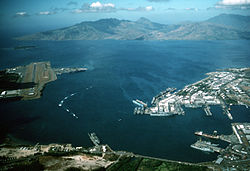
During the Korean War, the U.S. realized the need of an air station in the region. Cubi Point in the Philippines was selected. Civilian contractors were approached for bids. After seeing the Zambales Mountains and the maze of jungle, they claimed it could not be done. The Navy then turned to the Seabees. The first to arrive was CBD 1802 to do the surveying. MCB 3 arrived on 2 October 1951 to get the project going and was joined by MCB 5 in November. Over the next five years, MCBs 2, 7, 9, 11 and CBD 1803 all contributed to the effort. They leveled a mountain to make way for a nearly 2-mile-long (3.2 km) runway. NAS Cubi Point turned out to be one of the largest earth-moving projects in the world, equivalent to the construction of the Panama Canal. Seabees there moved 20 million cubic yards (15 million cubic metres) of dry fill plus another 15 million that was hydraulic fill. The $100 million facility ($1.2 billion in 2025 dollars) was commissioned on 25 July 1956, and comprised an air station and an adjacent pier that was capable of docking the Navy's largest carriers.
Die Seabee-Teams, deren Vorläufer im Zweiten Weltkrieg die PT Advance Base Detachments des 113. CB waren, bildeten die Grundlage für ihre Ausbildung. Jeder Mann war in mindestens drei Berufen ausgebildet, einige qualifizierten sich als Sanitäter und Taucher. [ 150 ] Auch während des Vietnamkriegs galt die Anforderung, in drei Berufen qualifiziert zu sein, weiterhin. [ 151 ] Die ersten Seabees, die als „Seabee-Teams“ bezeichnet wurden, waren die CBDs 1802 und 1803. [ 152 ] Ihnen folgten die Detachments Able und Baker. Das US-Außenministerium erfuhr von den Teams und schloss daraus, dass sie im Kalten Krieg eine wichtige Rolle spielen könnten. Sie sollten als US-„Botschafter des guten Willens“ in Entwicklungsländern fungieren, um der Ausbreitung des Kommunismus entgegenzuwirken – eine Art militärisches Pendant zum Friedenskorps . Diese 13-köpfigen Teams sollten Schulen bauen, Brunnen bohren oder Kliniken errichten und so ein positives Bild der USA vermitteln. Sie wurden von der United States Agency for International Development (USAID) eingesetzt und waren Mitte der 1950er-Jahre in Südostasien im Einsatz. Anfang der 1960er-Jahre wurden die US-amerikanischen Spezialeinheiten in ländliche Gebiete Südvietnams entsandt, um dort eine Selbstverteidigungstruppe gegen die kommunistische Bedrohung aufzubauen. Der Einsatz der Seabee-Teams in diesen Gebieten erschien der CIA sinnvoll [ 153 ] . Zunächst wurden zwölf Seabee-Teams mit Geheimhaltungsfreigabe im Rahmen des von der CIA finanzierten Programms „Civilian Irregular Defense Group “ (CIDG) [ 154 ] [ 155 ] zwischen 1963 und 1965 zusammen mit den Spezialeinheiten der US-Armee eingesetzt. 1965 verfügte die US-Armee über genügend Pioniere im Einsatzgebiet, um die Beteiligung der Seabees an den Spezialeinheiten zu beenden. Die Teams hießen zunächst „Seabee Technical Assistance Teams“ (STAT) und waren auf zwei gleichzeitig im Einsatzgebiet beschränkt. Ab STAT 1104 wurden die Teams in Seabee-Teams umbenannt, und bis 1969 waren es 17. [ 155 ] Als militärische Einheit erhielten die Seabee-Teams zahlreiche Auszeichnungen für Tapferkeit. [ 156 ] Auch in andere Länder wurden Teams entsandt. Die königlich-thailändische Regierung forderte 1963 STATs an, und seitdem entsenden die Seabees ununterbrochen Teams.
Construction Civic Action Details oder CCAD [ 157 ] CCADs oder „See-Kads“ sind größere Einheiten für zivile Aktionen mit 20–25 Seabees [ 158 ] , die denselben Zweck wie Seabee-Teams erfüllen. Die Bezeichnung CCAD ist vor 2013 nicht in den Akten verzeichnet.
Camp David
Camp David is officially known as Naval Support Facility Thurmont, as it is technically a military installation. The base is staffed by the CEC, Seabees,[159] and Marines. "In the early 1950s, Seabee BUs, UTs and CEs took over routine maintenance of the base and additional rates were added for administrative functions. Today Seabees still man the base public works and see that the grounds are in an impeccable condition."[160] "Selectees undergo a single scope background investigation to determine if they qualify for a Top Secret Sensitive Yankee White (YW) clearance. All personnel in Presidential support activities are required a "Yankee White" security clearance. The tour lasts 36 months."[159] When the base has a larger construction project a Construction Battalion from the fleet can be tasked. NMCBs 5 and 133 have drawn these assignments.
Antarctica: Science


Operation Highjump
In December 1946, 166 Seabees sailed from Port Hueneme on the USS Yancey and USS Merrick assigned to Operation Highjump. They were part of Admiral Richard E. Byrd's Antarctic expedition. The U.S. Navy was in charge with "Classified" orders "to do all it could to establish a basis for a (U.S.) land claim in Antarctica".[161] The Navy sent the Seabees to do the job starting with the construction of Little America (exploration base) IV as well as a runway for aerial mapping flights.[162] This Operation was vastly larger than IGYOperation Deep Freeze that followed.[161]
Operation Deep Freeze

In 1955, Seabees were assigned to Operation Deep Freeze making Antarctica an annual deployment site. Their task was the construction and maintenance of scientific bases for the National Science Foundation. The first "wintering over" crew included 200 Seabees. They cleared an 6,000-foot (1,800 m) ice runway at Mcmurdo for the advance party of Deep Freeze II to fly to South Pole Station. MCB 1 was assigned for Deep Freeze II.
Antarctica added to the Seabee's list of accomplishments:
- Tractor train traverses covering hundreds of miles.
- Bases built: McMurdo Station, South Pole Station, Byrd Station, Palmer Station, Siple Station, Ellsworth Station, Brockton Station, Eights Station, Plateau Station, Hallett Station, and Little America IV and Little America V
- MCB 1s construction of a nuclear power plant[164] which got them a Navy Unit Commendation.
- NMCB 71s construction of a Buckminster FullerGeodesic dome at So. Pole Station.[165] It became a symbolic icon of the United States Antarctic Research Program (USARP).
Vietnam War


Die Seabees waren in den 1950er Jahren zweimal in Vietnam. Zuerst im Juni 1954 im Rahmen der Operation Passage to Freedom und dann zwei Jahre später zur Vermessung und Kartierung der Straßen. Die Seabee-Teams 501 und 502 trafen im Januar 1963 als erste Seabees des Vietnamkriegs ein . Sie errichteten in Dam Pau und Tri Ton Stützpunkte für Spezialeinheiten. [ 166 ] 1964 wurden kleine Seabee-Gruppen mit 14 Mann den Beratern der US Army in der Special Operations Group zugeteilt. Das ACB 1 war in diesem Jahr das erste Baubataillon im Einsatzgebiet. 1965 landeten die Marines mit Seabees in Chu Lai. Ganze Marinebauregimenter folgten. [ 151 ] Die Seabees unterstützten die Marines in den Kampfstützpunkten Khe Sanh und Chu Lai . Die USA hatten viele zivile Auftragnehmer im Land, die Bauarbeiten der Seabees umfassten jedoch zahlreiche Flugzeugstützpunkte, Straßen und Brücken. Für jede Meile Straße, die sie ausbauten, errichteten sie 100 Fuß Brückendeck. [ 151 ] Sie führten außerdem im ganzen Land zivile Hilfsprojekte durch. Im Juni 1965 nahm der Baumechaniker 3. Klasse Marvin G. Shields vom Seabee-Team 1104 an der Schlacht von Dong Xoai teil . Ihm wurde posthum die Ehrenmedaille verliehen ; er ist der einzige Seabee, dem diese Auszeichnung zuteilwurde. Die Seabee-Teams waren Teil eines Propagandaprogramms zur Förderung der Unterstützung für Südvietnam durch positives gesellschaftliches Engagement, typischerweise durch den Bau von Schulen und Kliniken oder das Bohren von Brunnen. 1966 reparierten Seabees das Flugfeld in Khe Sahn und bedeckten innerhalb von vier Tagen eine Fläche von 3.900 x 60 Fuß mit Aluminiummatten. General Westmoreland bezeichnete dies als eine der herausragendsten militärischen Ingenieurleistungen des Krieges. [ 167 ] Das MCB 4 hatte eine Abteilung in Con Thien , deren Aktionen nahezu eine Wiederholung der Schlacht von Dong Xoai darstellten .
In 1968, the Marine Corps requested that the Navy make a change. The Marines were using "MCB" for "Marine Corps Base" while the Navy was using "MCB" for "Mobile Construction Battalion", it was causing confusion in logistics. The Navy agreed and added "Naval" to MCB creating the NMCBs that now exist. During that year the 30th NCR had five battalions in the Da Nang area and two at Chu Lai. The 32nd NCR had three battalions tasked near Phu Bai and one at Dong Ha. In May 1968 two reserve battalions RNMCB 12 and 22 were activated, bring the total number of battalions in Vietnam to 21. Both ACBs were in theater as well as CBMUs 301 and 302. In 1968, NMCB 10 drew an atypical Seabee "task" supporting the 101st Airborne. It happened again in 1969 when CBs 10, 40 and 121 sent EOs to Fire base Fury. During 1969 the number of Seabees in theater reached 29,000, from there their draw-down began.[168] The last battalion withdrew late 1971 with the last Seabee teams out a year later. When it was over they had sent 137 Seabee teams, built 15 CB camps, and deployed 22 battalions.[169]CBMU 302 became the largest CB ever at over 1400 men and was homeported at Cam Rahn Bay. On 23 April 1975 it was announced that U.S. involvement in Vietnam was over. That day CB 4 started construction of a temporary camp for Operation New Life on Guam. In seven days 2,000 squad tents were erected and numbered 3,500 when done.[170]
During Vietnam the Seabees had a few uniform variations. One was the stenciling of unit numbers across the back of the field jacket M-65.[171] Another was the collar and cover devices for enlisted E4-E6. The Navy authorized that the "crow" be replaced by the rating insignia of each trade. Nametags were another, they started out white with a multicolored seabee. In 1968, the USMC OD green pattern was copied. The NAVCATs became the only Seabees to ever be authorized to wear a shoulder patch.[172]
NAVCATs Naval Construction Action Teams
CBMU 302 had 23 NAVCATS(Naval Construction Action Teams) total with 15 the most active at one time.[173] Teams were numbered 1-23. They were Vice Admiral Elmo Zumwalt's expansion of the Seabee Team concept. He submitted it in November 1968 to General Creighton Abrams commander of Military Assistance Command, Vietnam.[174]
Agent Orange: Viele Seabees waren während ihres Einsatzes in Vietnam dem Entlaubungsmittel Agent Orange ausgesetzt . Das NCBC Gulfport war das größte Lager für Agent Orange in den Vereinigten Staaten . Von dort wurde es nach Vietnam verschifft. [ 175 ] 1968 erhielt das NCBC 68.000 Fässer zur Weiterleitung. [ 176 ] Die Langzeitlagerung der Fässer begann 1969 und dauerte bis 1977. Das Gelände umfasste 30 Acres und wurde 2013 noch saniert. [ 175 ] [ 177 ]
Weltraumrennen: NASA/Tektite I

Im Jahr 1960 errichtete eine Abteilung des MCB 10 auf der Insel Canton eine Telemetrie- und Bodeninstrumentierungsstation für das Projekt Mercury . [ 178 ] [ 179 ]
Am 28. Januar 1969 begann ein 50-köpfiges Kontingent [ 180 ] des Amphibischen Baubataillons 2 zusammen mit 17 Seabee-Tauchern mit der Installation des Tektite-Habitats in der Great Lameshur Bay bei Lameshur, Amerikanische Jungferninseln . [ 181 ] Das Tektite-Programm wurde von der NASA finanziert und war das erste von der US-Regierung geförderte Wissenschaftler-im-Meer-Programm. [ 182 ] Die Seabees errichteten außerdem ein Basislager mit zwölf Hütten in Viers, das heute als Umweltressourcenstation der Jungferninseln dient. [ 183 ] Das Projekt war ein Nebenprodukt des Weltraumwettlaufs . Es führte dazu, dass die US-Marine den Bedarf an einer permanenten Unterwasserbaukapazität erkannte, was zur Aufstellung der Seabee-Unterwasserbauteams führte. [ 184 ]
Aktuell arbeitet die NASA am Mond-Mars -Programm. Im Jahr 2015 war ACB 1 am Transport des Boilerplate Test Article (BTA) der Orion-Kapsel beteiligt. [ 185 ] Im August 2019 wurde ACB 1 mit einer Testbergungsübung der Orion-Kapsel beauftragt . [ 186 ] ACB 2 führte dieselbe Aufgabe ein Jahr später, im August 2020, durch. [ 187 ]
CIA- und Marine-Geheimdienst-/Kommunikationsunterstützung
- Nachdem die Seabees Camp Peary verlassen hatten, zog die CIA in das Gelände ein und bezeichnet es nun als „die Farm“.
- During World War II NAS Tanapag, Saipan was a "major propaganda site of the Office of War Information" (OWI).[188] In 1947, CBD 1510 began maintaining NAS Tanapag for the NTTU (Naval Technical Training Unit).[189][190] In 1948, CBD 1510's men were transferred to CBD 1504 when it was replacing CB 121 as island Public Works. That year the CIA created the NTTU as a "cover" and made access highly restricted to the base. The CIA station had Capitol Hill constructed to administer its operations at a cost of $28 million. The station covered the northern half of Saipan including, Kagman Field, Marpi Point Field, and the four radio towers.[190] "Brig. Gen. Edward G. Lansdale, Pentagon expert on guerrilla warfare, shared with Gen. Maxwell D. Taylor, President Kennedy's military adviser, on "Resources for Unconventional Warfare in SE. Asia."....that the "CIA maintains a field training station on the island of Saipan ... the installation is under Navy cover and is known as the Naval Technical Training Unit. The primary mission of the Saipan Training Station is to provide physical facilities and competent instructor personnel to fulfill a variety of training requirements including intelligence tradecraft, communications, counter-intelligence and psychological warfare techniques. Training is performed in support of CIA activities conducted throughout the Far East area."[191] The Seabees cease listing the Public Works assignments at NAS Tanapag in 1953 while the CIA remained until 1962. However, MCB 9 deployed to Saipan in 1954 with one of their projects being the up-grading of the Public Works shops.[192] MCB 10 Det Bravo deployed to Saipan from July 1957 until February 1958 with projects unlisted.[193]

- A year before the Bay of pigs and Cuban Missile Crisis the CIA took a "top secret" urgent/immediate project to the Seabees.[194] The agency wanted two 220' radio towers with a supporting airstrip, dock, and quonsets erected on Swan Island, built asap, with no construction plans for the Seabees.[194] The station would be independent-self sufficient. Det Tango of MCB 6 was given the project.[194] LSTs 1046 and 1056 delivered men and materials from CBC Quonset Point.[194] The Seabees had the CIA's "Radio Swan" on the air in short order.[194]
Naval Intelligence: NAVFACs
The Navy built 22 Naval Facilities (NAVFACs) for its Sound Surveillance System (SOSUS) to track Soviet submarines. They were in service 1954–79 with Seabees staffing all the Public works. In the 1980s the number of tracking stations was halved with the advent of the Integrated Underwater Surveillance System (IUSS). The NAVFACs were decommissioned by further advances in technology, the end of the Cold War and disclosures by John Walker to the Soviets.
The Seabees have also been tasked building Naval Communication facilities. One at Nea Makri Greece was built by MCB 6 in 1962 and upgraded by NMCB 133. Naval Comm Station Sidi Yahya was first built in World War II another is NavCommSta Guam. It started out on the island as the Joint Communications Agency (JCA) in 1945.
Naval Support Unit: Department of State/Embassy security

In 1964, at the height of the Cold War, Seabees were assigned to the State Department because listening devices were found in the Embassy of the United States in Moscow.[196] Those initial Seabees were "Naval Mobile Construction Battalion FOUR, Detachment November".[197] The U.S. had just constructed a new embassy in Warsaw. After what had been found in Moscow Seabees were dispatched and found many "bugs" there also. This led to the creation of the Naval Support Unit in 1966 as well as the decision to make it permanent two years later.[198][199] That year William Darrah, a Seabee of the support unit, is credited with saving the U.S. Embassy in Prague, Czechoslovakia from a potentially disastrous fire.[200] In 1986, "as a result of reciprocal expulsions ordered by Washington and Moscow" Seabees were sent to "Moscow and Leningrad to help keep the embassy and the consulate functioning".[201]
The Support Unit has a limited number of special billets for select NCOs, E-5 and above. These Seabees are assigned to the Department of State and attached to Diplomatic Security.[202][196] Those chosen can be assigned to the Regional Security Officer of a specific embassy or be part of a team traveling from one embassy to the next. Duties include the installation of alarm systems, CCTV cameras, electromagnetic locks, safes, vehicle barriers, and securing compounds. They can also assist with the security engineering in sweeping embassies (electronic counter-intelligence). They are tasked with new construction or renovations in security sensitive areas and supervise private contractors in non-sensitive areas.[203] Due to Diplomatic protocol the Support Unit is required to wear civilian clothes most of the time they are on duty and receive a supplemental clothing allowance for this. The information regarding this assignment is very scant, but State Department records in 1985 indicate department security had 800 employees, plus 1,200 Marines and 115 Seabees.[204] That Seabee number is roughly the same today.[205]
Cold War winds down
As the Cold War wound down, new challenges and changes came for the Seabees starting with the increased incidence of terrorism. This was in addition to ongoing Seabee support missions for USN/USMC bases worldwide. Cold War Facilities still required support, like the Polaris and Poseidon submarines at Holy Loch, Rota. In 1971, the Seabees began the huge project on Diego Garcia[206] in the Indian Ocean. It was completed in 1987 at a cost of $200 million. With the extended construction timeline, it is difficult to inflation-adjust that cost into today's dollars. The complex accommodates the Navy's largest ships and cargo planes. The base served as a staging facility for Operations Desert Shield and Desert Storm. Additionally, Seabees were also tasked upgrading and expanding Naval Air Station Sigonella, Sicily for the United States Sixth Fleet.
In 1983, a truck bomb demolished the Marine's barracks in Beirut, Lebanon.[206] From the Beirut International AirportDruze militia artillery harassed the Marines. NMCB-1 was in Rota and sent its AirDet to construct bunkers for the Marines.[206] EO2 Kirt May became the first Seabee post-Vietnam to receive a Purple Heart while on this mission.
CN Carmella Jones became the first female Seabee when she cross-rated to Equipment Operator during the summer of 1972.[207]
International terrorism
The Cold war did not end until 1991 and 9/11 was further off yet, but SW2 Robert Stethem was executed by the Lebanese Shia militia Hezbollah when they hijacked TWA Flight 847 in 1985. Stethem was a diver in UCT 1. The Navy named USS Stethem (DDG-63) in his honor. On 24 August 2010, during a shipboard ceremony, Stethem was posthumously honored to the rank of Master Chief Constructionman (CUCM) by the Master Chief Petty Officer of the Navy and given the Prisoner of War Medal.
Persian Gulf War

Over 5,000 Seabees served in the Gulf War. In August 1990 the 1st Marine Expeditionary Force (I MEF) was assigned NMCBs 4, 5, 7, and 40.[208] The first Seabees in theater were a Det from ABC 1, followed by a Det from ACB 2[208] and then CBUs 411 and 415.[208] Mid September Air-Dets from the four battalions deployed to construct air fields for Marine Air Groups (MAG) 11, 13, 16, and 25 of the 3rd Marine Air Wing.[208] NMCB 7 was the first Battalion to arrive. Camp Nomad was a NMBC-74 project at Ras Al Mishab for MAG 26. Camps were constructed for both the 1st and 2nd Marine Divisions as well as Hq complexes for MEF I and II.[208] In Saudi Arabia, Seabees built numerous camps, galleys, runways, aprons, helo zones, plus two 500-bed Fleet Hospitals near Al-Jubayl. The 3rd NCR was activated to provide a command echelon. NMCBs 24 and 74 also deployed in support of the Marines.[208]
Iraq, Afghanistan, and the war on terrorism


Seabees deployed in both initial invasions of the Afghanistan War and Iraq War. All active and reserve NMCBs and NCRs were deployed to building to work on civil infrastructure.[209] One of the most visible tasks assigned to the NCF was the removal of statues of Saddam Hussein in Baghdad.
In Afghanistan, the Seabees' main task was the construction of multiple forward operating bases. NMCB 133 deployed to FOB Camp Rhino and help build Kandahar Airfield where a detention facility was constructed as well.[209]
Since 2002, Seabees have provided civic action support in the Philippines,[209] most notably near Abu Sayyaf's jungle training area in the southern Philippines. Seabees work with Army, Marines, and Air Force under the Joint Special Operations Task Force - Philippines.[209]
Seabees have supported the war on terrorism ever since the invasion with numerous deployments over the years.
Disaster relief and recovery

- Hurricane Camille hit NCBC Gulfport, Mississippi, NMCB-121 was in homeport and was tasked with base cleanup, rescue, and community outreach.
- Cyclone Ofa in 1990 NMCB 133 sent a det to American Samoa to aid the recovery.
- 1994 Northridge earthquake, Seabees supported the disaster recovery.
- Hurricane Andrew in 1992, Seabees provided disaster recovery to Homestead, Florida.[208]
- Operation Restore Hope In 1992–1993 two battalions were sent for the humanitarian efforts in Somalia.[210]
- Operation Sea Signal 1994 Seabees provided assistance to the Haitian Relief effort at Guantanamo Bay Naval Base.[208]
- Operation Joint Endeavor In Dec. 1995, Seabees were in Croatia supporting the peacekeeping in Sarajevo, Bosnia and Herzegovina. NMCB 40 was tasked to the U.S. Army 1st Infantry Div. for dismantling FOBs during the IFOR/SFOR phase.[208]
- Hurricane Georges Seabees deployed to the Caribbean with damage assessment teams, generators and water trucks providing disaster relief.
- Hurricane Mitch 1998 Seabees deployed to Honduras with Joint Task Force Bravo. They did road and bridge repair, debris cleanup, and erected camps. For NMCB 7, it was on their second humanitarian mission of the deployment.
- Hurricane Ivan NMCBs 1 & 74 deployed in September 2004 to the repair Naval Air Station Pensacola. They cleared debris, repaired roads, erected tents, and provided general support.
- Typhoon Nanmadol (2004) NMCB 7 provided disaster relief.
- 2004 Indian Ocean earthquake and tsunami NMCBs 7, 40, and UCT 2 provided disaster relief.
- Joint Task Force Katrina 2005. Seabees from NMCBs 1, 7, 18, 40 and 133 plus ACB 2 and CBMUs 202 and 303 and UCT 1 were tasked the reconstruction of CBC Gulfport and the recovery of the Gulf Coast[211]
- 2010 Haiti earthquake NMCB 7 provided construction support and disaster relief with UCT 1, ACB-2 and Army Engineers.
- April 2011 Miyagi earthquake Seabees from NMCB-133 and UCT 2 deployed to Japan as part of the relief effort.
- Hurricane Sandy NMCB 11 Air Det deployed to support disaster recovery in New Jersey and New York.[212] NMCB 5 assisted disaster relief throughout the Sandy Hook area.[213]
Naval Construction Force (NCF)
At present, there are six active-duty Naval Mobile Construction Battalions (NMCBs) in the United States Navy, split between the Pacific Fleet and the Atlantic Fleet.

30th Naval Construction Regiment is located on Guam. Naval Construction Battalion Center Port Hueneme, CA is homeport to the Regiment's battalions.
- Naval Mobile Construction Battalion 3
- Naval Mobile Construction Battalion 4
- Naval Mobile Construction Battalion 5
22nd Naval Construction Regiment is stationed at Naval Construction Battalion Center (Gulfport, Mississippi) the homeport to the Atlantic fleet CBs.
- Naval Mobile Construction Battalion 1
- Naval Mobile Construction Battalion 11
- Naval Mobile Construction Battalion 133
NCF Reserve From the 1960s through 1991, reserve battalions were designated as "Reserve Naval Mobile Construction Battalions" (RNMCBs). After 1991 "Reserve" was dropped with the integration of reserve units within the NCF making all battalions NMCBs
- Naval Mobile Construction Battalion 14, HQ Gulfport, MS. detachments in five states and Puerto Rico.
- Naval Mobile Construction Battalion 18, HQ Port Hueneme, CA., detachments in six states and Guam.
- Naval Mobile Construction Battalion 22, HQ Port Hueneme, CA. detachments in five states.
- Naval Mobile Construction Battalion 25, HQ Port Hueneme, CA. detachments in six states.
- Naval Mobile Construction Battalion 27, HQ Gulfport, MS. detachments in seven states.
Detachment: A construction crew that is "detached" from the battalion's "main body" deployment site. The size is determined by the project scale and timeline.
Battalion: The battalion is the basic NCF unit with a HQ Company plus four Construction Companies: A, B, C, & D. CBs are organized to function as independent self sufficient units.
Regiment: Naval Construction Regiments (NCRs) provide a higher echelon command to three or four CBs operating on close proximity.
Naval Construction Groups 1 and 2: In 2013, Seabee Readiness Groups (SRGs) were decommissioned, and re-organized as NCG-1 and NCG-2. They are regimental-level command groups tasked with administrative and operational control of CBs, as well as conducting pre deployment training for all assigned units. NCG-2 is based at CBC Gulfport while NCG-1 is at CBC Port Hueneme.
Seabee Engineer Reconnaissance Team (SERTs)

SERTs ( Special Emergency Response Teams) sind die Spezialeinsatzkräfte der NCF (National Combat Force), die von der First Naval Construction Division (1st NCD) im Rahmen der Operation Iraqi Freedom entwickelt wurden. Ihre Aufgabe ist die Durchführung von technischen Lagebeurteilungen im Feld zur Unterstützung der Aufklärungsbataillone des United States Marine Corps . Ein Team besteht aus zwei CEC-Offizieren (Combat Engineering Center) und acht Seabees-Unteroffizieren, die bei Bedarf durch weiteres Personal verstärkt werden. [ 214 ] Ein Team gliedert sich in drei Elemente: Verbindung, Sicherung und Aufklärung. Das Verbindungselement (LNO) besteht aus einem Offizier und zwei Kommunikationsspezialisten, die für die Übermittlung der Lagebeurteilungen und der gewonnenen Informationen zuständig sind. Das Aufklärungselement umfasst den zweiten Offizier, den Einsatzleiter (OIC), einen BU- oder SW- CPO (Certified Probation Officer) mit Erfahrung im Brückenbau. Das Team verfügt über einen Sanitäter oder ein medizinisch ausgebildetes Mitglied; die übrigen Mitglieder werden aufgrund ihrer Qualifikation ausgewählt. Alle müssen das Seabee-Kriegsabzeichen tragen. Im Jahr 2013 wurden die 1st Naval Construction Division und die SERTs aufgelöst. Die heutigen UCT-Leistungen demonstrieren das SERT-Konzept für NECC. [ 215 ]
Seabees außerhalb der NCF
Amphibische Baubataillone (PHIBCBs)

Den ACBs (oder PHIBCBs) gingen die Pontonmontage-CBs aus dem Zweiten Weltkrieg voraus. Am 31. Oktober 1950 wurden die MCBs 104 und 105 in ACB 1 und ACB 2 umbenannt und den Naval Beach Groups zugeteilt. Die ACBs unterstehen den jeweiligen Oberflächen -TYCOMs . Außerdem ist in einer ACB die Hälfte der Mannschaften im Baugewerbe tätig, die andere Hälfte gehört der Flotte an.
Instandsetzungseinheiten des Baubataillons

Während des Zweiten Weltkriegs verfügten diese Einheiten über ein Viertel des Personals einer CB (Community Base). Ihre Aufgabe bestand darin, die Instandhaltung von Stützpunkten zu übernehmen, sobald die CBs ihre Bauarbeiten abgeschlossen hatten. Heute leisten CBMUs (Community Base Maintenance Units) Unterstützung bei öffentlichen Bauarbeiten an Marinestützpunkten, vorgeschobenen Operationsbasen und Flottenkrankenhäusern/Expeditionskrankenhäusern während Kriegs- oder Kriseneinsätzen für Marineexpeditionsstreitkräfte (MEF), Marineexpeditionsgruppen (MEG) oder NSW (Naval Service Command). Sie leisten außerdem Unterstützung bei der Katastrophenhilfe für regionale Marinekommandeure in den kontinentalen USA .
- CBMU 202[216] Joint Expeditionary Base Little Creek-Fort Story, VA (formerly Naval Amphibious Base)
- det Jacksonville
- CBMU 303[217] Navy Expeditionary Combat Force, Naval Base San Diego, Ca.
- det Port Hueneme
- det Pearl Harbor
NAVFAC Engineering & Expeditionary Warfare Center Ocean Facilities Department.[218] Gives support to the Fleet through the support of Underwater Construction Teams.[218] UCTs deploy worldwide to conduct underwater construction, inspection, repair, and underwater demolition.
Underwater Construction Teams (UCT)

UCTs deploy worldwide tasked with underwater construction, inspections, repairs, and demolition operations. They can support a Fleet Marine Forceamphibious operation or provide combat service support ashore. UCT1 is home ported at Little Creek, Virginia, while UCT2 is at Port Hueneme, California.[219]
After basic UCT training a diver is qualified as a 2nd Class Diver. Training is 26 weeks at the Dive school at Panama City, Florida. It includes a tactical training phase for advanced combat and demolitions skills.[220] The training qualifies divers as Underwater Construction Technicians skilled in: seafloor excavation, hydrographic surveys, search and recovery, engineering reconnaissance, and precision demolitions. Senior NCOs are schooled for their supervisory positions whether construction or demolition.[221]
UCT divers can apply for selection to support the Naval Special Warfare Development Group.[222]
Public Works: U.S. Naval Bases
These units have CEC officers leading them and enlisted Seabees for the various crews. About one-third of new Seabees are assigned to Public Works Departments (PWD) at naval installations both within the United States and overseas. While stationed at a Public Works Department, a Seabee can get specialized training and experience in multiple facets of their rating. Many bases have civilians that augment Public Works, but the department is a military operation.
Combat Service Support Detachments (CSSD) / Naval Special Warfare (NSW)
The Seabee detachments have several hundred supporting Naval Special Warfare (NSW) units based out of Coronado, CA, and Virginia Beach, VA. Field support can include camp construction, camp and vehicle maintenance, power generation, transportation logistics, and water purification.[223][224] The assignment requires additional training in first aid, small arms, driving, specialized equipment, and[223][224] qualifying as Expeditionary Warfare Specialists.[225] With that qualification a Seabee can be classified as 5306 – Naval Special Warfare (Combat Service Support) or 5307 – Naval Special Warfare (Combat Support).[226] They also can apply for selection to support the Naval Special Warfare Development Group.[222]
Training and rates


Trainees begin "A" School (trade school) upon completion of boot: 4 weeks classroom, 8 weeks hands-on. From "A" School, trainees most often report to a NMCB or ACB. There, recruits go through four-weeks of Expeditionary Combat Skills (ECS), which is also required for those who report to a Navy Expeditionary Combat Command. ECS provides basic training in map reading, combat first aid, recon and other combat-related skills. Half of each course is spent on basic marksmanship to qualify with the M4 carbine and the M9 service pistol. Those posted to Alfa Company of an NMCB may be assigned to a crew-served weapon, like the MK 19 40 mm grenade launcher, the M2 Browning .50-caliber machine gun or the M240 machine gun. Many reserve units still field the M60 machine gun. Seabees were last in the U.S. military to wear the U.S. Woodland camouflage uniform and the Desert Camouflage Uniform. They now have the Navy Working Uniform Type III and use ALICE field gear. Some units with the Marines will use USMC-issue Improved load-bearing equipment (ILBE).
Current rates:[227][228] The current ratings were adopted by the Navy in 1948.
- BU : Builder
- CE : Construction electrician
- CM : Construction mechanic
- EA : Engineering aide
- EO : Equipment operator
- SW : Steelworker
- UT : Utilitiesman
The Seabee "constructionman" ranks of E-1 through E-3 are designated by sky-blue stripes on uniforms. The color was adopted in 1899 as a uniform trim color designating the Civil Engineer Corps, but was later given up. Its continued use is a bit of Naval Heritage in the NCF.
At paygrade E-8, the Builder, Steelworker, and Engineering Aid rates combine into a single rate: Senior Chief Constructionman (CUCS). Before NAVADMIN 054/21, at the E-9 paygrade they were referred to as a Master Chief Constructionman (CUCM).
Before NAVADMIN 054/21, the remaining Seabee rates combined only at the E-9 paygrade:
- Master Chief Equipmentman (EQCM) for Equipment Operator and Construction Mechanic.
- Master Chief Utilitiesman (UCCM) for Construction Electrician and Utilitiesman.
Per NAVADMIN 054/21: Constructionman Master Chief (CUCM), Equipmentman Master Chief (EQCM) and Utilities Constructionman Master Chief (UCCM) renamed Seabee Master Chief (CBCM). Those Master Chiefs already in CUCM, EQCM or UCCM ratings were to be automatically converted to CBCM on 15 March 2021, but current source ratings badges were to be retained.


Diver is a qualification that the various rates can obtain with three grades: Basic Underwater Construction Technician/ NEC B17A (2nd Class Diver), Advanced Underwater Construction Technician/ NEC B18A (1st Class Diver), and Master Underwater Construction Technician/ NEC B16A (Master diver). Seabee divers are attached to five principal commands outside the NCF:
- UCT ONE, Little Creek, VA.[229]
- UCT TWO, Port Hueneme, CA.
- Naval Facilities Engineering Service Center (NFESC) that has detachments in Port Hueneme, CA, and in the Washington Navy Yard, DC. These are CEC officer billets only. Those at Port Hueneme are with the highly technical NFESC "Dive Locker Team".[230]
- Navy System Commands, e.g., NAVSEA or NAVAIR. These are CEC officer billets only.[229]
- Navy Experimental Diving Unit – Navy Diving & Salvage Training Center (NEDU/NDSTC)[229]
The "Seabee" and Unit insignias
On 1 March 1942 the RADM Moreell recommended that an insignia be created to promote esprit de corps in the new CBs to ID their equipment as the Air corps did to ID squadrons. It was not intended for uniforms.[1]: 136 Frank J. Iafrate, a civilian file clerk at Quonset Point Advance Naval Base, Davisville, Rhode Island, who created the original "Disney Style" Seabee. In early 1942 his design was sent to RADM Moreell who made a single request: that the Seabee being set inside a letter Q, for Quonset Point, be changed to a hawser rope and it would be officially adopted.[231]
The Seabees had a second Logo. It was of a shirtless constructionman holding a sledge hammer with a rifle strapped across his back standing upon the words "Construimus Batuimus USN". The figure was on a shield with a blue field across the top and vertical red and white stripes. A small CEC logo is left of the figure and a small anchor is to the right. This logo was incorporated into many CB Unit insignias.[232]
During World War II, artists working for Disney Insignia Department designed logos for about ten Seabee units including the: 60th NCB,[233] 78th NCB[233] 112th NCB,[234] and the 133rd NCB.[235] There are two Disney published Seabee logos that are not identified with any unit.[236]
Qualification badges and Unit awards

The military qualification badge for the Seabees is known as the Seabee combat warfare specialist insignia (SCW). It was created in 1993 for both officers and enlisted personnel attached to qualifying units: NMCBs, ACBs, UCTs, or NCRs. Its designer, Commander Ross S. Selvidge, CEC, USNR, was the first to wear the insignia.

The Fleet Marine Force Insignia or Fleet Marine Force pin (FMF pin), is for USN officers or enlisted trained and qualified to support the USMC. It comes in three classes : enlisted, officer, and chaplain. For requirements, see: Fleet Marine Force Warfare Specialist (EFMFWS) Program per OPNAV Instruction 1414.4B.
The Peltier Award is given annually to the "Best of Type" active duty Construction Battalion. It was instituted by Rear Admiral Eugene J. Peltier CEC in 1960. He was Commander of BuDocks 1959–1962.[237]
Seabee barge carriers

Es wurden sechs „Seabee“ -Schiffe gebaut: [ 238 ] die SS Cape Mendocino (T-AKR-5064), die SS Cape May (T-AKR-5063) , die SS Cape Mohican (T-AKR-5065) und drei weitere, die von der Lykes Brothers Steamship Company betrieben wurden (die SS Doctor Lykes, die SS Tillie Lykes und die SS Almeria Lykes). Die NCF ist der Hauptnutzer der Seabee-Schiffe. Die Schiffe pendeln zwischen den Schiffen hin und her und ermöglichen so das Entladen von Containerladungen nach Bedarf. Die Schiffe verfügen über ein Aufzugsystem, mit dem die Schiffe am Heck aus dem Wasser gehoben werden. Die Schiffe, ob beladen oder unbeladen, werden auf eines der drei Decks gehoben und dann auf einer Schiene zum Bug transportiert, wo sie gelagert werden. Das Schiff kann 38 Schiffe aufnehmen, jeweils 12 auf den unteren und 14 auf den oberen Decks. Die 38 Schiffe bieten Platz für insgesamt 160 Seecontainer. Sie haben einen Tiefgang von 2,5 Fuß und messen 97 x 35 Fuß. [ 239 ] Neben den Lastkähnen verfügt das Schiff über einen in die Seitenwände und den Doppelrumpf integrierten Treibstoffspeicher von fast 36.000 m³ ( 9.510.194 Gallonen), wodurch es auch als Treibstofftransporter eingesetzt werden kann. Die Schiffe wurden vom Military Sealift Command beschafft .
Museen

Das US Navy Seabee Museum [ 240 ] befindet sich außerhalb des Haupttors des Marinestützpunkts Ventura County in Port Hueneme, Kalifornien . Im Juli 2011 wurde das neue Gebäude mit Galerien, einer großen Halle, einem Theater, Lagerräumen und Forschungsbereichen eröffnet.
Das Seabee Heritage Center in Gulfport, Mississippi , ist die Außenstelle des Seabee Museums in Port Hueneme an der Atlantikküste. [ 241 ] Es wurde 1995 eröffnet. [ 242 ] Die Ausstellungsstücke in der Außenstelle in Gulfport werden vom Seabee Museum in Port Hueneme zur Verfügung gestellt. [ 243 ]
Das Seabee Museum und der Gedenkpark [ 244 ] in Davisville, Rhode Island, wurden Ende der 1990er Jahre eröffnet. Dort befindet sich eine Statue eines kämpfenden Seabee.
Seabees des bemerkenswerten Seabee-Dienstes
- Admiral Ben Moreell (gründete die Seabees)
- CM3 Marvin Glenn Shields ( Ehrenmedaille )
- SW2 Robert Stethem (Seabee-Taucher)
- Cdr Blake Wayne Van Leer
Siehe auch
- Militärtechnik der Vereinigten Staaten
- Mobiles Marinebaubataillon 1
- Mobiles Marinebaubataillon 3
- Mobiles Marinebaubataillon 4
- Mobiles Marinebaubataillon 5
- Mobiles Marinebaubataillon 11
- Mobiles Marinebaubataillon 133
- Unterwasserbauteams
- Übungsgelände der Reservekräfte des Parks
- Seabees-Denkmal
- Experimentelle Tauchereinheit der US-Marine
- Unsinkbarer Flugzeugträger
- Marinestützpunkte der Seabees in Nordafrika
- USS Marvin Shields
- USS Stethem
Andere US-amerikanische Militärbau-/Ingenieureinheiten:
Anmerkungen
Zweiter Weltkrieg
 Presidential Unit Citation USN/USMC
- 6. CB, 1. Marineinfanteriedivision, Guadalcanal. [ 113 ]
- 18. CB, 2. Marinedivision, Tarawa [ 113 ]
- 33. CB, Landungsmannschaft, 1. Marineinfanteriedivision, Peleliu [ 113 ]
- 73. CB, Landungsmannschaft, 1. Marineinfanteriedivision, Peleliu [ 113 ]
- 121. CB, 12-köpfige Doodlebug-Landungsmannschaft, 4. Marineinfanteriedivision, Tinian [ 113 ]
 Auszeichnung für herausragende Einheiten der US-Armee
- Die im Zweiten Weltkrieg verliehenen CB-Auszeichnungen der US-Marine für Tapferkeit wurden monatlich in der Versammlung „ All Hands“ zusammen mit den Auszeichnungen der übrigen Marineangehörigen aufgeführt. [ 245 ]
Marine Corps, Seabees außerhalb der NCF
- Als die 18., 19. und 25. CBs zum Marine Corps überführt wurden, wurden sie jeweils um eine Kompanie plus ein Fünftel der Stabskompanie reduziert, um der Organisation eines Bataillons des USMC zu entsprechen. Die B-Kompanie der 25. CB [ 246 ] und die C-Kompanie der 18. CB [ 247 ] wurden zur Aufstellung der 53. CB verwendet. Die verbleibende Kompanie bildete die 121. CB.
- Da Seabees bei ihrer Einstellung einen höheren Dienstgrad erhielten, bezeichneten die Mannschaften des Marine Corps die Baubataillone als „Sergeant-Bataillone“. Sergeants des USMC verrichten keinen Wachdienst, daher wurden die Seabees mit höherem Dienstgrad nicht zugeteilt. Die Unteroffiziere des 18. Bataillons trugen Winkel des USMC und nicht die „Krähen“ der US Navy auf ihren Uniformen. [ 248 ]
- USN-Abzeichen auf USMC-Ausrüstung. [ 249 ]
- Seabees were shore party for the Marines on Bougainville,[88] Peleliu,[87] Guam,[250] Purata Island,[89] Roi-Namur, Saipan,[251] Iwo Jima,[92] and Okinawa.[252] The Marines deployed them as combat engineers at Cape Gloucester,[253] Tarawa,[254] and Tinian.[255]
- The first Marines assigned to a CB were attached to CBD 1010 on Guam.[256] The 2nd Separate Marine Engineer Battalion was next, assigned to the 27th NCR with two former USMC CBs; the 25th and the 53rd.[257] In mid-August 1944 the 1st Separate Marine Engineer Battalion was assigned to the 30th NCR.[258] Prior, 100 Marines were assigned to the 71st CB on Bougainville.
NCDUs, Seabees outside the NCF
- NCDUs at Normandy: 11, 22–30, 41–46, 127–8, 130-42[111]
- The Joint Army Navy Experimental Testing (JANET) site for beach obstacle removal, Project DM-361, was located at the ex-Seabee base, Camp Bradford after the NCDU program moved.[259]
- 14 NCDUs were combined to create UDT 9, almost completely Seabees[123]
- NCDUs 200 – 216 were combined to create UDT 15.[114]
- Presidential Unit Citation USN/USMC : Naval Combat Demolition Force O on Omaha beach at Normandy.[260]
 Navy Unit Commendation: Naval Combat Demolition Force U on Utah beach at Normandy.
UDTs, Seabees outside the NCF
- The Naval Special Warfare Command building at the U.S.N. Seal base at Fort Pierce is named for Ltjg. Frank Kaine CEC commander of NCDU 2.
- General Donovan the head of the OSS approached General MacArthur and Admiral Nimitz about using OSS men in the Pacific[126] with Europe invaded. Gen. MacArthur had no interest.[126] Adm. Nimitz looked at Donovan's list and also said no, except he could use the swimmers from the Maritime Unit.[126] He was only interested in them for being swimmers not being OSS.
- Seabees außerhalb der NCF schrieben Marinegeschichte . [ 261 ] Admiral Turner empfahl über 60 Silver Stars und über 300 Bronze Stars mit V für die Seabees und andere Angehörige der UDTs 1–7. [ 261 ] Dies war beispiellos in der Geschichte der USN/USMC. [ 261 ] Für die UDTs 5 und 7 auf Tinian sowie die UDTs 3 und 4 auf Guam erhielten alle Offiziere einen Silver Star und alle Mannschaften einen Bronze Star mit V. [ 118 ] Admiral Conolly war der Ansicht, dass Leutnant Crist und Leutnant Carberry von den UDTs 3 und 4 auf Guam das Navy Cross hätten erhalten sollen. [ 118 ]
- Viele der Männer aus den UDTs 1 und 2 wurden zur Bildung der UDTs 3 und 4 eingesetzt. [ 114 ]
- UDT 3 bestand bei der Aufstellung aus 11 CEC-, 4 USN- und 1 USMC-Offizier [ 123 ].
- Die Offiziere der UDT 7 durchliefen eine „Einführungsschulung“ im „Bereich E“ von Camp Peary. [ 123 ]
Seabee-Ölexploration am North Slope 1944
- Der Seabee Creek wurde durch CBD 1058 benannt und mündet bei Umiat, Alaska, in den Colville River.
- Geologen der US-Marine entdeckten mit dem Raumschiff CBD 1058 die große Aupuk-Gasquelle. [ 262 ]
Kalter Krieg: Korea – Seabee-Teams
- Im Oktober 1965 wurden zwei Seabee-Teams des MCB 11 dem „Projekt Demo“ zugeteilt. Das US-Außenministerium beauftragte sie mit der Entwanzung von Botschaften hinter dem Eisernen Vorhang und der Behebung der durch die Entfernung der Abhörgeräte entstandenen Schäden. [ 263 ] [ 264 ]
Kalter Krieg: Antarktis
- Seabee Heights ist eine geologische Formation des Transantarktischen Gebirges . Von dort aus hat man einen Ausblick auf die Seabee-Überquerungsroute des Beardmore-Gletschers ins Landesinnere.
- Seabee Hook befindet sich in der Nähe des Standorts der Hallett-Station am Rossmeer .
Kalter Krieg: Vietnam
- Commander Naval Construction Battalion US Pacific Fleet, Tân Sơn Nhất, Republik Vietnam, Abschlussbericht 1963–1972.
- Die militärische Ausbildung der CBs dauerte in diesem Zeitraum sechs Wochen. Zwei Wochen verbrachten sie im jeweiligen Heimathafen und vier Wochen bei den Marines in Camp Lejeune oder Camp Pendleton .
- Presidential Unit Citation USN/USMC : Dets from MCBs 5, 10, 53 and CBMU 301 in support of the 26th Marines at the Battle of Khe Sanh Jan–Feb 1968. [ 166 ]
- Projekte aus der Zeit des Kalten Krieges: 1961 Schwimmdock für Polaris-U-Boote in Holy Loch , Schottland. [ 265 ] 1963 US-Marine-Funkwarte Nea Makri , Griechenland. [ 265 ]
Kalter Krieg: CIA
- Nach der Übertragung von CBD 1510 an CBD 1504 wurde es für eine ähnliche Funktion wie Acorns vorgesehen: Luftfahrt und OTA. [ 266 ] Die Verwendung von „OTA“ durch die Marine kennzeichnet die Zuweisung an die CIA, wobei Other Transaction Authority (OTA) die üblicherweise verwendete Bezeichnung für die (10 USC 2371b) Befugnis des Verteidigungsministeriums (DoD) zur Durchführung bestimmter Prototypen-, Forschungs- und Produktionsprojekte ist. [ 267 ]
- Im Jahr 2007 genehmigte das Naval Expeditionary Combat Command (NECC) die Finanzierung von vierzig Stellen im Bereich Marinenachrichtendienst innerhalb der NCF. [ 268 ] Ziel war es, eigenes Nachrichtendienstpersonal innerhalb der NCF aufzubauen. Traditionell wurde der Ausbildungsoffizier zum Nachrichtendienstoffizier, wenn ein CB (Combat Combat Command) im Einsatz war.
- Ein geschwärztes CIA-Memorandum vom 14. Juni 1968 behandelt den Einsatz von Marinebaupersonal/Seabees bei einem Projekt. [ 269 ]
Irak Afghanistan
- Presidential Unit Citation USN/USMC : 30th NCR, NMCBs 4, 5, 74, 133, Air-Det 22nd NCR, Air-Det UCT 2, NCF Support Unit 2 zur Unterstützung der First Marine Expeditionary Force (I MEF Engineer Group) im November 2003. Nach einer Überprüfung wurden später folgende Einheiten hinzugefügt: NMCBs 7, 15 sowie Air-Det NMCB 21, Air-Det NMCB 25 und CBMU 303 Det. [ 270 ] (gemäß: CMC MARADMIN 507/03) [ 271 ]
- Im Jahr 2015 transportierte ACB 1 den Orion (Raumschiff) Boilerplate (Raumflug) Testartikel für die NASA nach San Diego, Kalifornien.
Seabee-Abzeichen
- Logos von Marinebaubataillonen aus dem Zweiten Weltkrieg [ 272 ]
- Die CBs sponserten viele B-29 auf Tinian und versahen die Flugzeuge mit dem Abzeichen der Seabee-Einheit als Bugbemalung. [ 273 ] [ 274 ] [ 275 ]
Marineunterstützungseinheit
- 1977 wurde die US-Botschaft in Moskau durch ein schweres Feuer zerstört, was 1979 den Bau einer neuen Botschaft erforderlich machte. Auf der Baustelle der neuen Botschaft wurden 20 bis 30 Seabees zur Überwachung von über 800 russischen Bauarbeitern eingesetzt. [ 276 ] Dies veranlasste die Russen, vor der Anlieferung von Baumaterialien Wanzen in diese einzubauen. Der Erfolg des KGB bei der Verwanzung der neuen Botschaft bestärkte das US-Außenministerium nur in seinem Bedarf an den Seabees.
SEABEE Binnenschiffe
- Besondere Anforderungen an die Rumpfkonstruktion der SEABEE-Schiffsschiffe. [ 277 ]
Referenzen
- ^ a b c d e f „Kapitel VI: Die Seabees“ . Aufbau der Marinestützpunkte im Zweiten Weltkrieg: Geschichte der BuDocks und des CEC 1940–1946 . Band I. Washington, DC: USGPO. 1947. Abgerufen am 18. Oktober 2017 – via HyperWar.
- ^ 37. Seabees-Kreuzfahrtbericht, Webseite des Seabee Museum Archives, Port Hueneme, Kalifornien, Januar 2020, S. 12-16
- ^ 37. Seabees-Kreuzfahrtbericht, Webseite des Seabee Museum Archives, Port Hueneme, Kalifornien, Januar 2020, S. 12-16
- ^ US Marine Corps WWII Order of Battle, Gordon L. Rottman, Greenwood Press, Westport, CT, 2002, S. 32
- ^ „Seabee History: Formation of the Seabees and World War II“ . NHHC . 2017. Abgerufen am 15. März 2017 .
- ^ „Admiral Ben Moreell, CEC, USN“ . Seabee Museum und Gedenkpark . Archiviert vom Original am 15. Januar 2018. Abgerufen am 18. Oktober 2017 .
- ^ „Coca-Cola und die Kunst der Seabee-„Akquisition““" . 15. Mai 2019. Archiviert vom Original am 13. Februar 2023 . Abgerufen am 11. Mai 2022 .
- ^ „Name und Abzeichen der SeaBees offiziell genehmigt“ . Naval History Blog . US Naval Institute . 29. Februar 2012. Abgerufen am 18. Oktober 2017 .
- ^ „Die Seabees“ . Flying (Zeitschrift) . Band 35, Nr. 4. Oktober 1944. S. 261. Abgerufen am 18. Oktober 2017 .
- ^ Rogers, J. „US Navy Seabees During World War II“ (PDF) . Archiviert vom Original (PDF) am 14. Juni 2022. Abgerufen am 15. April 2020 .
- ^ a b c d e f g h i j k „Seabee History - Introduction“ . NHHC . Abgerufen am 11. Mai 2022 .
- ^ Docks, United States Bureau of Yards und (1947). Bau der Marinestützpunkte im Zweiten Weltkrieg: Geschichte der BuDocks und des CEC, 1940-1946 . US GPO.
- ^ Definition von „shore party“, Merriam-Webster, 2023
- ^ Die Überbrückung der Kluft zwischen Schiff und Land, Frank A. Blazich Jr., Naval History Magazine Band 35, Nummer 4, August 2021 [1]
- ^Challeen, Steven G. (1992). "Construction management training the Navy Seabees". Calhoun: The NPS Institutional Archive. Dudley Knox Library at the Naval Postgraduate School. Retrieved 16 February 2025.
- ^Thinking Outside the Box: Ingenuity is Key to Seabees' Success, Steve Forbes, CEC/Seabee Historical Foundation, PO Box 657, Gulfport, MS [2]Archived 10 February 2023 at the Wayback Machine
- ^Pontoons – Magic Boxes Nothing Short of a Miracle, CEC/Seabee Historical Foundation, March 2016 [3]Archived 10 February 2023 at the Wayback Machine
- ^Seabees -- their simple motto tells the story: "We build, we fight"., U.S. Navy official website, accessed 11 May 2020.
- ^A Memorial to those that "CAN DO!"Archived 3 January 2023 at the Wayback Machine, By: Julius Lacano, Historian, US Navy Seabee Museum.
- ^"Flags, Pennants & Customs, NTP 13 (B), Naval Computer And Telecommunications Command, Washington, DC, section 17.11, p. 17-5"(PDF). Retrieved 11 May 2022.
- ^ abc"Chapter IV: Bobcat". Dept. of the Navy Office of Naval Operations: The Logistics of Advance Bases: The Base Maintenance Division Op30 (Op415). Washington, DC: U. S. GPO. 1947. Retrieved 18 October 2017 – via HyperWar.
- ^ abcd"Seabee Unit Histories"(PDF). The NMCB 62 "Minutemen". Archived from the original(PDF) on 25 November 2020. Retrieved 18 October 2017.
- ^Rogers, J. David. "U.S. Navy Seabees During World War II"(PDF). Missouri University of Science and Technology. p. 8. Archived from the original(PDF) on 14 June 2022. Retrieved 18 October 2017.
- ^ abc"Training the Fighting Seabees of WWII at Camp Peary, Daily Press, E-newspaper 3 Dec 2017, Mark St. John Erickson, Newport News, VA". Archived from the original on 5 August 2018. Retrieved 11 May 2022.
- ^Olsen, Olsen (24 November 2011). The King Bee: A Biography of Admiral Ben Moreell. Naval Institute Press. ISBN 9781612511085. Retrieved 11 May 2022 – via Google Books.
- ^"129th Seabees collection - State Archives - Kansas Historical Society". www.kshs.org. Retrieved 20 April 2020.
- ^Schroder, Walter K.; Emma, Gloria A. (1999). Davisville and the Seabees. Arcadia Publishing. ISBN 9780738501062.
- ^Navy Civil Engineer. NAVFAC Engineering Command. 1962.
- ^Battalion, 30th, United States Navy Construction (1945). The 30th Log, 1942-1944. U.S. Navy Seabee Museum.
{{cite book}}: CS1 Wartung: numerische Namen: Autorenliste ( Link ) - ^"Chapter VI: AB Units – Lions, Cubs, Acorns". Dept. of the Navy Office of Naval Operations: The Logistics of ABs: The Base Maintenance Div. Op30 (Op415). Washington, DC: U. S. GPO. 1947. Retrieved 18 October 2017 – via HyperWar.
- ^"Chapter XXVI: Bases in the Southwest Pacific". Building the Navy's Bases in WWII: History of the BuDocks and the CEC 1940–1946. Vol. I. Washington, DC: U.S. GPO. 1947. p. 120. Retrieved 18 October 2017.
- ^Rottman, Gordon L. (2002). World War II Pacific Island Guide: A Geo-military Study. Westport, CT: Greenwood Publishing Group. p. 78. ISBN 9780313313950. Retrieved 18 October 2017.
- ^Building the Navy's Bases in WWII: History of the BuDocks and the CEC 1940–1946. Vol. II. Washington, DC: U.S. GPO. 1947. p. 264. Retrieved 18 October 2017.
- ^"Chapter V: Procurement and Logistics for ABs". Building the Navy's Bases in WWII: History of the BuDocks and the CEC 1940–1946. Vol. I. Washington, DC: U.S. GPO. 1947. Retrieved 18 October 2017 – via HyperWar.
- ^"Historic California Posts: Naval Construction Battalion Center, Port Hueneme". www.militarymuseum.org. Retrieved 11 May 2022.
- ^Building the Navy's Bases in WWII: History of the BuDocks and the CEC 1940–1946. Vol. I. Washington, DC: U.S. GPO. 1947. p. 130. Retrieved 18 October 2017.
- ^"Seabees, U.S. Navy Official website, 12 August 2009". Retrieved 11 May 2022.
{{cite web}}CS1-Wartung: Veralteter Archivierungsdienst ( Link ) - ^"Chapter XXV: Campaign in the Solomons". Building the Navy's Bases in WWII: History of the BuDocks and the CEC 1940–1946. Vol. II. Washington, DC: U.S. GPO. 1947. Retrieved 18 October 2017 – via HyperWar.
- ^"Building the Navy's Bases, vol. 2 (part III)". NHHC. Retrieved 11 May 2022.
- ^"Antill, Peter (2003), Peleliu, battle for (Operation Stalemate II) – The Pacific War's Forgotten Battle, September–November 1944, "Hitting the Beach 3rd paragraph"". Retrieved 11 May 2022.
- ^ abMagazine, Seabee. "Building for a Nation and Equality: African American Seabees in World War II". Archived from the original on 10 May 2021. Retrieved 7 August 2019.
- ^ abc"LCDR Edward S. Hope". NHHC. Archived from the original on 7 May 2017. Retrieved 11 May 2022.
- ^live.mil/326-2/ This week in Seabee History, Sept 17–23, Seabee Online Magazine, NAVFAC Engineering Command, Wash. Navy Yard, DC.
- ^ abcdefHistorical Content Significance, Naval Aviation Supply Depot Hut 33 at Waiawa Gulch, Peral City, U.S. Dept of Interior, Nat. Park Service, p. 10
- ^"Building for a Nation and for Equality: African American Seabees in WWII, U.S. Navy Seabee Museum, Naval History and Heritage Command, Dr. Frank A. Blazich Jr., March 4, 2014". Archived from the original on 1 May 2021. Retrieved 11 May 2022.
- ^"17th Special NCB cruisebook"(PDF). NHHC. pp. 29, 30. Retrieved 18 October 2017.
- ^"Seabees of 17th Special Naval Construction Battalion wait to assist wounded of 7th Marines". World War II Database. Archived from the original on 15 August 2017. Retrieved 18 October 2017.
- ^ „Afroamerikanische Marinesoldaten des 16. Feldlagers ruhen sich auf Peleliu aus“ . Datenbank zum Zweiten Weltkrieg . Archiviert vom Original am 15. März 2018. Abgerufen am 18. Oktober 2017 .
- ^ „Marine Corps Chevron, 2. Dezember 1944 – Historische Zeitschriften“ . historicperiodicals.princeton.edu . Abgerufen am 11. Mai 2022 .
- ^ Peleliu, 33. Seabee Cruise-Book, S. 23, Seabee Museum, Port Hueneme, CA. 2024 [4]
- ^ „Peleliu, Schlacht um (Operation Stalemate II) – Die vergessene Schlacht des Pazifikkriegs, September–November 1944“ . www.historyofwar.org . Abgerufen am 11. Mai 2022 .
- ^ „Teil 2 – Auszeichnungen für einzelne Einheiten“ . NHHC . Abgerufen am 11. Mai 2022 .
- ^ „Das Recht zu kämpfen: Afroamerikanische Marinesoldaten im Zweiten Weltkrieg (Peleliu und Iwo Jima)“ . www.nps.gov . Abgerufen am 11. Mai 2022 .
- ^ Sutherland, Jonathan (11. Mai 2004). African Americans at War: An Encyclopedia . ABC-CLIO. ISBN 9781576077467Abgerufen am 11. Mai 2022 – via Google Books.
- ^ „17. Sonder-NCB-Kreuzfahrthandbuch“ (PDF) . NHHC . S. 29. Abgerufen am 18. Oktober 2017 .
- ^ „The Sextant, Building for a Nation and for Equality: African American Seabees in World War II – 4. März 2014, Dr. Frank A. Blazich Jr., US Navy Seabee Museum, NHHC“ . Archiviert vom Original am 6. Mai 2018. Abgerufen am 11. Mai 2022 .
- ^ „Barrieren überwinden: Das 34. Marinebaubataillon“ . 7. Februar 2018. Archiviert vom Original am 20. April 2019. Abgerufen am 11. Mai 2022 .
- ^ a b c d e Erkundung des Marine-Erdölreservats Nr. 4 und angrenzender Gebiete in Nordalaska, 1944–53 Teil 1, Geschichte der Erkundung Von John C. Reed, CDR, USNR, Geological Survey Professional Paper 301 Erstellt und veröffentlicht auf Anfrage und in Zusammenarbeit mit dem US-Marineministerium, Amt für Marine-Erdöl- und Ölschieferreserven, US GPO, Washington: 1958, S. 4, 23
- ^ „ComIcePac, CBD 1058, 1945, Seabee Museum, Port Hueneme, CA“ (PDF) .
- ^ abc"HyperWar: Building the Navy's Bases in World War II [Chapter 23]". www.ibiblio.org. Retrieved 11 May 2022.
- ^"Dept. of the Interior U.S. Geological Survey Selected Data from Fourteen Wildcat Wells in the NPR in Alaska, USGS Open File Report 00-200, Wildcat Well Seabee 1, Dept. of the Interior, U.S. Geological Survey, Central Region Energy Resources Team, Denver, CO". Archived from the original on 11 February 2017. Retrieved 11 May 2022.
- ^ abDiv. of Geological & Geophysical Surveys Preliminary Interpretive Report 2008-1, Preliminary Results Of Recent Geologic Field Investigations in the Brooks Range Foothills and North Slope, Alaska by Marwan A. Wartes and Paul L. Decker, March 2008, Released by State of Alaska, Dept. of Natural Resources, Div. of Geological & Geophysical Surveys, Fairbanks, AK.
- ^Exploration of the Petroleum Reserve No. 4 and Adjacent Areas, Northern Alaska 1944–53, Part 1, History of the Exploration, John C. Reed, Cdr, CEC, Geological Survey Professional Paper 301, U.S. Gov. Printing Office, Washington, DC, 1958, pp. 21–46
- ^Alaska Legacy Wells Summary Report:NPR Alaska, Rob Brumbaugh, Stan Porhola, BLM/AK/ST-05/004+2360+941, November 2004, U.S. Dept. of Interior Bureau of Land Management
- ^Tregaskis, Richard (11 May 1975). "Southeast Asia: Building the Bases: The History of Construction in Southeast Asia". U.S. Navy Seabee Museum. Retrieved 11 May 2022 – via Google Books.
- ^"News Releases, R & D Chronicles - The Mosquito Fighters, Part VIII: Malaria Control in the Pacific War, BUMED, Naval Medical Research and Development Enterprise Laboratories, André B. Sobocinski Released: 11/18/2016". Archived from the original on 18 January 2021. Retrieved 11 May 2022.
- ^Malaria Control, Chapt. 8, Office of Medical History, U.S.Army Medical Department, P.A. Harper MD, W.C. Downs MD, P.W. Downs MD, N.D. Levine MD.
- ^"Photo of a vet wearing CB insignia on USMC issue, U.S. Militaria Forum webpage". Retrieved 11 May 2022.
- ^ ab"Photo of: Marine with early Seabee insignia WWII, U.S. Militaria Forum". Archived from the original on 3 April 2019. Retrieved 11 May 2022.
- ^ „Kap. 5: Erkennungszeichen/Auszeichnungen/Insignien: Nr. 5319: Verschiedene Abzeichen“ . USN Uniform Regulations . NAVPERS. Archiviert vom Original am 7. Juni 2011. Abgerufen am 18. Oktober 2017 .
- ^ Rottman, Gordon L. (2002). USMC WWII Order of Battle: Ground & Air units in the Pacific War, 1939–1945 . Westport, CT: Greenwood Press. S. 31.
- ^ a b c „Die Seabees der US-Marine: Mit Bulldozern den Weg zum Sieg ebnen“ . 4. Januar 2020. Abgerufen am 11. Mai 2022 .
- ^ Rottman (2002), Abb. 4.2.
- ^ Rottman (2002), Abb. 4.3.
- ^ Rottman, Gordon L. (20. Februar 2013). US Marine Corps Pacific Theater of Operations 1943–44 . Bloomsbury Publishing. ISBN 9781472801579Abgerufen am 11. Mai 2022 – via Google Books.
- ^ Rottman (2002) Abb. 4.2.1
- ^ „HyperWar: Building the Navy's Bases in World War II [Kapitel 24]“ . www.ibiblio.org . Abgerufen am 11. Mai 2022 .
- ^ Ratomski, John J. „Das 25. NCB“ . Geschichten aus dem Zweiten Weltkrieg in ihren eigenen Worten . Abgerufen am 18. Oktober 2017 .
- ^ Rottman (2002), S. 218–220 .
- ^ Rottman, Gordon L. (2004). Battle Orders: USMC Pacific Theater of Operations 1943–44 . Osprey Publishing. S. 13. ISBN 9781472802217Die
- ^ „43rd Seabees Wearing USMC Uniforms – Maui, Hawaii“ . seabee-rvn.com . Abgerufen am 18. Oktober 2017 .
- ^ „Navy Seabees in Marine Corps Service Uniform“ . Uniformen des Zweiten Weltkriegs . Abgerufen am 18. Oktober 2017 .
- ^ Ratomski, John J. „121st NCB“ . Geschichten aus dem Zweiten Weltkrieg in ihren eigenen Worten . Abgerufen am 18. Oktober 2017 .
- ^ a b "Seabee Battalion List" . seabees93.net . Abgerufen am 18. Oktober 2007 .
- ^ Melson, Charles D. (2013). „Der Munda-Angriff und die 9. Infanteriedivision“ . Up The Slot: Marines in den zentralen Salomonen . Gedenkreihe „Marines im Zweiten Weltkrieg“. CreateSpace Independent Publishing Platform . Abgerufen am 18. Oktober 2017 .
- ^ a b Ratomski, John J. „Peleliu Shore Party“ . Tribute to Michael A. Lazaro and all other Peleliu Veterans . Archiviert vom Original am 5. April 2019. Abgerufen am 18. Oktober 2017 .
- ^ a b 71st US NCB . Seabee Museum. S. 14.
- ^ a b "Seabees!" . WWII Forums . Abgerufen am 18. Oktober 2017 .
- ^ „Foren“ . www.6thcorpscombatengineers.com . Abgerufen am 11. Mai 2022 .
- ^ „Fotos der Seabees aus dem Zweiten Weltkrieg“ . Zeuge des Krieges . Abgerufen am 18. Oktober 2017 .
- ^ a b „Operationsbericht der 4. Marineinfanteriedivision, Iwo Jima, 19. Februar bis 16. März 1945“ . Digitale Bibliothek der Ike Skelton Combined Arms Research Library . Abgerufen am 18. Oktober 2017 .PDFs 6 und 7, Anhang 1 Annex Dog (Logbuch der Landungsmannschaft D-Day–D+18)
- ^ Annex Uncle, 5th Marine Div. Operations Report, April 1945, NARA, College Park, Md.
- ^ a b Chapin, John C. (11. Mai 1945). „Die 5. Marineinfanteriedivision im Zweiten Weltkrieg“ . [Washington?] : Historische Abteilung, Hauptquartier des US Marine Corps . Abgerufen am 11. Mai 2022 – via Internet Archive.
- ^ 8. NCB-Kreuzfahrtbuch, 1946, Seabee Museum Archive, Port Hueneme, CA. S. 83/142
- ^ 58. CB-Geschichtsdatei, Webseite des Seabee-Museumsarchivs, Prot Hueneme, CA., 15. Januar 2015
- ^ Bau der Marinestützpunkte im Zweiten Weltkrieg: Geschichte der BuDocks und des CEC 1940–1946 . Band II. Washington, DC: US GPO. 1947. S. 470. Abgerufen am 18. Oktober 2017 .
- ^ 53. Marinebaubataillon: Das Marine Seabee 1st MAC US Navy Seabee Museum. S. 14 & 106.
- ^ 25. NCB-Kreuzfahrtbuch, S. 97
- ^ „USN Seabee Museum Archives“ . Picssr . Archiviert vom Original am 25. März 2017. Abgerufen am 18. Oktober 2017 .
- ^ „HyperWar: Building the Navy's Bases in World War II [Kapitel 28]“ . www.ibiblio.org . Abgerufen am 11. Mai 2022 .
- ^ a b „1st Marine Corps Base Camp Pendleton, Marine Corps Installations-West, Installation Histories, USMC Official website p.2, 4“ (PDF) . Archiviert vom Original (PDF) am 29. September 2021. Abgerufen am 11. Mai 2022 .
- ^ Kester, Charles (Januar 1963). "Ich schaffe das!" . Leatherneck . S. 30 . Abgerufen am 18. Oktober 2017 .
- ^ Third Marine Div. Assoc. (1992). Third Marine Division's Two Score and Ten History . Turner Pub. Comp. S. 162. ISBN 9781563110894Abgerufen am 18. Oktober 2017 .
- ^ „Navy Civil Engineer“ . Naval Facilities Engineering Command. 11. Mai 1963. Abgerufen am 11. Mai 2022 – via Google Books.
- ^ Blazich, Frank A. (6. Juni 2014). „Eröffnung von Omaha Beach: Fähnrich Karnowski und NCDU-45“ . Seabees Online . Washington Navy Yard, DC: Navy Facilities Engineering Command. Archiviert vom Original am 3. September 2017. Abgerufen am 18. Oktober 2017 .
- ^ Blazich, Frank A. (12. Mai 2017). „Diese Woche in der Geschichte der Seabees (Woche vom 14. Mai)“ . Seabees Online . Navy Facilities Engineering Command. Archiviert vom Original am 5. August 2017. Abgerufen am 18. Oktober 2017 .
- ^ a b „Naval Combat Demolitions Units“ . SpecWarNet.net . Abgerufen am 18. Oktober 2017 .
- ^ „1988.0022.23 – Schwarzweißfoto von Marineoffizieren | UDT-SEAL Museum Association“ . navysealmuseum.pastperfectonline.com . Abgerufen am 11. Mai 2022 .
- ^ „Diese Woche in der Geschichte der Seabees: 3.–9. Juni, Offizielles Online-Magazin der US Navy Seabees, Naval Facilities Engineering Command“ . Archiviert vom Original am 16. Oktober 2018. Abgerufen am 11. Mai 2022 .
- ^ a b c Bericht über Marine-Kampfsprengeinheiten in der Operation "NEPTUNE" als Teil der Task Force 122, Lt.(jg) HL Blackwell Jr., USNR, 5. Juli 1944.
- ^ "evpl-lst325bk-147-0028" . digital.evpl.org . Abgerufen am 11. Mai 2022 .
- ^ a b c d e f g h Webseite des Naval History and Heritage Command, Teil 2 – Auszeichnungen für Einheiten, 31. August 2015
- ^ a b c d e f g h The Water Is Never Cold , James Douglas O'Dell, 2000, S. 132, Brassey's, Dulles, VA.
- ^ USN Special Warfare Units des Zweiten Weltkriegs, Eugene Lipak, Osprey Publishing, New York, 2014, p. 25
- ^ a b „Navy SEAL History Part One, A Glance at the Origins of Naval Special Warfare, Aug. 2018, MC2 Taylor Stinson, Defense Media Activity, All Hands Magazine, Defense Media Activity, US DOD“ . Archiviert vom Original am 27. März 2019. Abgerufen am 11. Mai 2022 .
- ^ „SEAL-Geschichte: Ursprünge der Spezialkriegsführung der Marine im Zweiten Weltkrieg“ . National Navy UDT-SEAL Museum . Abgerufen am 11. Mai 2022 .
- ^ a b c Naked Warriors , Cdt. Francis Douglas Fane USNR (Ret.), St. Martin's Press, New York, 1996, S. 122, 131
- ^ "UDT1 und 2" . www.viewoftherockies.com . Abgerufen am 11. Mai 2022 .
- ^ UDTs 1 & 2, Die Marshallinseln, Kwajalein, Roi-Namur, Eniwetok, US Naval Special Warfare Archives]
- ^ a b c „Naval Construction Battalions“ . NHHC . Abgerufen am 11. Mai 2022 .
- ^ Die Unterwasser-Sprengkommandos des Pazifiks, Pearl Harbor Visitors Bureau, archiviert am 6. September 2019 in der Wayback Machine .
- ^ a b c d e f g h „Die Teams im Zweiten Weltkrieg“ . Blick auf die Rocky Mountains . Archiviert vom Original am 19. Oktober 2017. Abgerufen am 18. Oktober 2017 .
- ^ „Interviewtranskript: Wright S. Travis: Veterans History Project (Library of Congress)“ . memory.loc.gov . Abgerufen am 11. Mai 2022 .
- ^ Blazich, Frank A. (12. September 2016). „Diese Woche in der Geschichte der Seabees (Woche vom 11. September)“ . Seabees Online . NavFac Engineering Command. Archiviert vom Original am 13. Oktober 2017. Abgerufen am 18. Oktober 2017 .
- ^ a b c d e „OSS in Action The Pacific and the Far East (US National Park Service)“ . www.nps.gov . Abgerufen am 11. Mai 2022 .
- ^ „WWII UDT One & WWII UDT Two“ . Blick auf die Rocky Mountains . Archiviert vom Original am 19. Oktober 2017. Abgerufen am 18. Oktober 2017 .
- ^ Hoyt, Edwin P. (2011). SEALs at War . Random House Publishing. S. 25. ISBN 9780307570062Abgerufen am 18. Oktober 2017 .
- ^ Kelly, Orr (24. Juni 2014). Tapfere Männer, dunkle Gewässer: Die ungeschriebene Geschichte der Navy SEALs . Open Road Media. S. 30. ISBN 9781497645639Abgerufen am 18. Oktober 2017 .
- ( Das Wasser ist niemals kalt), James Douglas O'Dell, Brassey's, Dulles, VA, 2001, S. 136
- ^ a b c Naked Warriors, Cdmr. Francis Douglas Fane USNR (Ret.), St. Martin's Press, New York, 1996, S. 828
- ^ „CBMU 570 Records, Seabee Museum Archives, Port Hueneme, CA“ (PDF) . Abgerufen am 11. Mai 2022 .
- ^ a b c d "UDT8" . www.viewoftherockies.com . Archiviert vom Original am 13. Februar 2023 . Abgerufen am 11. Mai 2022 .
- ^ „Unterwassersprengung, „Alle Mann“, Informationsbulletin des Büros für Marinepersonal, Oktober 1945, NAVPERS-0 Nummer 343, S. 12–15“ (PDF) . Archiviert vom Original (PDF) am 17. Juni 2015. Abgerufen am 11. Mai 2022 .
- ^ „2018.0033.2 – Schwarzweißfoto von NCDU216, Morrow’s Demolitioneers in Kampfuniformen. Diese Männer wurden Teil der UDT-15 im Zweiten Weltkrieg | UDT-SEAL Museum Association“ . navysealmuseum.pastperfectonline.com . Abgerufen am 11. Mai 2022 .
- ^ Bataillon, 114., Baubataillon der US-Marine (11. Mai 1945). „Das 114. US-Marinebaubataillon“ . US Navy Seabee Museum . Abgerufen am 11. Mai 2022 – via Google Books.
{{cite web}}: CS1 Wartung: numerische Namen: Autorenliste ( Link ) - ^ „Diese Woche in der Geschichte der Seabees, 30. September – 6. Oktober, Seabee Museum Archives, Port Hueneme, Kalifornien“ . Archiviert vom Original am 19. November 2018. Abgerufen am 11. Mai 2022 .
- ^ a b March, G. Patrick (1988). „Yanks in Siberia: US Navy Weather Stations in Soviet East Asia, 1945“ . Pacific Historical Review . 57 (3): 327–342 . doi : 10.2307/3640708 . JSTOR 3640708. Abgerufen am 11. Mai 2022 .
- ^ a b c „HyperWar: Building the Navy's Bases in World War II [Chapter 31]“ . www.ibiblio.org . Abgerufen am 11. Mai 2022 .
- ^ Akte des 33. Speziellen Marinebaubataillons, 1946, Seabee Museum Archives, Port Hueneme, CA.
- ^ Bau der Marinestützpunkte im Zweiten Weltkrieg: Geschichte der BuDocks und des CEC 1940–1946 . Band II. Washington, DC: US GPO. 1947. S. 416. Abgerufen am 18. Oktober 2017 .
- ^ „Zusammensetzung der Joint Task Force One“ . NHHC . Abgerufen am 11. Mai 2022 .
- ^ „Operations Crossroads, DNA 6032F, erstellt von der Defense Nuclear Agency, S. 190–91“ (PDF) . Archiviert vom Original (PDF) am 25. März 2021. Abgerufen am 11. Mai 2022 .
- ^ Rottman, Gordon L. (2002). US Marine Corps World War II Order of Battle: Ground and Air units in the Pacific War, 1939–1945 . Westport, CN: Greenwood Press. S. 224 . ISBN 9780313319068Die
- ^ Blazich, Frank A. (30. Juli 2017). „Diese Woche in der Geschichte der Seabees (Woche vom 30. Juli bis 5. August)“ . Seabees Online . Navy Facilities Engineering Command. Archiviert vom Original am 7. August 2017. Abgerufen am 18. Oktober 2017 .
- ^ „Operations Crossroads, DNA 6032F, erstellt von der Defense Nuclear Agency, S. 189“ (PDF) . Archiviert vom Original (PDF) am 25. März 2021. Abgerufen am 11. Mai 2022 .
- ^ Akte des Marinebaubataillons, Abteilung 1504, Seabee Museum Archives, Port Hueneme, CA.
- ^ Operation Crippled Chick, ACB 1 baut Notlandebahn hinter feindlichen Linien, von Steve Karoly, The Seabeecook
- ^ SERT, Seabee Engineer Reconnaissance Team, Andrew G. Wright, Engineering News-Record, Seabee Magazine Special Commemorative Double Issue 2003, Naval Facilities Engineering Command (NAVFAC), Attn: SEABEE Online (Code PA), Washington Navy Yard, DC, S. 69.
- ^ Die vergessenen Fünfundfünfzig, NCB93: 113. Seabees-Abteilung, zugeteilt den PT-Staffeln, Seabees93.net
- ^ a b c Seabees in Action in Vietnam, Naval Facilities Engineering Command, US GPO 1968 O-323-015.
- ^ Baubataillonsabteilungen 1802, 1803, NHHC, Seabee-Museum, Port Hueneme, Kalifornien
- ^ „Seabee-Geschichte: Südostasien“, Online-Lesesaal des Naval History and Heritage Command, veröffentlicht am 16. April 2015
- ^ Seabee-Teams in Vietnam 1963–69, Thomas A. Johnson, Createspace Independent Publishing Platform, 2010, ISBN 9781461192107
- ^ a b Kommandeur des Marinebaubataillons der US-Pazifikflotte, Tân Sơn Nhất, Republik Vietnam, Abschlussbericht 1963–1972.
- ^ Commander Naval Construction Battalion US Pacific Fleet, Tân Sơn Nhất, Republik Vietnam, Abschlussbericht 1963–1972. P. 4-7 /4-12
- ^ „Civic Action Team: Building Friendships“ . Archiviert vom Original am 7. August 2019. Abgerufen am 7. August 2019 .
- ^ „Aufbau und dauerhafte Präsenz“, archiviert am 19. Januar 2018 in der Wayback Machine , The Military Engineer, LTJG Frances Hunter & Lt. James A. Harder (NMCB 11), Nov.–Dez. 2017, Society of American Military Engineers, Alexandria, VA
- ^ a b David, About Camp (11. August 2013). "Arbeiten in Camp David" .
- ^ „CNIC, Naval Support Facility Thurmont website, PO Box 1000, Thurmont, MD 21788-5001“ . Archiviert vom Original am 21. Januar 2025. Abgerufen am 16. April 2025 .
- ^ a b „Operation Highjump“ , Air & Space Magazine , Juli 2007, Smithsonian Institution, Washington, DC
- ^ Magazin, Seabee. „Diese Woche in der Geschichte der Seabees (Woche vom 17. Januar)“ . Archiviert vom Original am 7. August 2019. Abgerufen am 7. August 2019 .
- ^ a b Sabbatini, Mark. „Schwerlast-Champion wird 50“ . The Antarctic Sun. Abgerufen am 18. Oktober 2017 .
- ^Reid, Tyler (21 March 2014). "Nuclear Power at McMurdo Station". Stanford University. Retrieved 18 October 2017.
- ^Blazich, Frank A. (27 August 2014). "Rendezvous with Penguins: Seabee Construction of the South Pole Dome". Seabees Online. NAVFAC Engineering Command. Archived from the original on 19 May 2017. Retrieved 18 October 2017.
- ^ ab"This Week in Seabee History (Week of February 14)". Archived from the original on 7 August 2019. Retrieved 7 August 2019.
- ^Mel Schenck, Vietnam (16 January 2018). "The Largest Military Construction Project in History, Vietnam '67". The New York Times.
- ^Tucker, Spencer C., ed. (2011). "Seabees". The Encyclopedia of the Vietnam War: A Political, Social, and Military History (2nd ed.). Santa Barbara, CA: ABC-CLIO. p. 1023. ISBN 978-1-85109-961-0. Retrieved 18 October 2017.
- ^U.S. Navy Seabees – The Vietnam Years, Terry Lukanic, ', 2017
- ^"Temporary Facilities, 4.5.1.1 Role in the Cold War, Regional Cold War History for DOD Installations in Guam and Northern Mariana Islands, Jayne Aaron, July 2011, DOD Legacy Program, p. 4–26 (94/198)". Archived from the original on 1 August 2019. Retrieved 1 August 2019.
- ^"MCB 1 Cruisebook 1966, p. 57–58, Seabee Museum, Port Hueneme, CA"(PDF).
- ^USN Seabees to drop anchor in Walla Walla 6-9 Oct., Walla Walla Union-Bulletin, 2016-09-28
- ^NAVCAT 12 patch, Lee-Jackson Militaria, San Jose, CA
- ^Southeast Asia, Building the Bases, Richard Tregaskis, U.S. GPO, 1975, p. 403
- ^ abAgent Orange clean at Navy Seabee base is the focus at public meeting, reported by Natalie Campen, WLOX TV, Gulfport, MS, 9 July 2013 at 3:04 PM CDT
- ^The History, Use, Disposition and Environmental Fate of Agent Orange, Chapt 7: Monitoring Studies of Former Agent Orange Storage Sites in Mississippi and Johnston Island, Alvin L. Young, Springer Publishing, 2008
- ^Public Health Assessment, Naval Construction Battalion Center Gulfport, Mississippi, Facility ID No. MS2170022626, April 2005, prepared by: Federal Facilities Assessment Branch, Division of Health Assessment and Consultation, Agency for Toxic Substances and Disease Registry
- ^United States Navy and Marine Corps Bases: Domestic, Paolo E. Coletta, Greenwood Press, Westport, CT, 1986. p. 495
- ^"MCB10 cruisebook 1963, Seabee Museum Archives, Port Hueneme, CA".
- ^"All Hands, June 1969, Number 629, Navy Dept. Washington, DC. p. 39"(PDF). Archived from the original(PDF) on 18 June 2015.
- ^Seabeemagazine online Seabeemagazine onlineArchived 4 July 2017 at the Wayback Machine
- ^"Project Tektite: The Aquanauts That Lived in the Sea". 11 August 2016.
- ^St. John Historical Society, St. John, US Virgin Islands, Crystal Blue View of Tektite II
- ^"U.S. Navy Seabee Museum online magazine, "Project Tektite and the Birth of the Underwater Construction Teams" by Dr. Frank A. Blazich Jr., Historian, U.S. Navy Seabee Museum". Archived from the original on 31 July 2017. Retrieved 20 January 2018.
- ^"ACB 1 Helps NASA Lift Off, MC3 Eric Chan, Public Affairs Office ACB 1, Seabee Magazine Online, 2016, Seabee Museum Archives, Port Hueneme, CA". Archived from the original on 26 September 2020. Retrieved 15 August 2020.
- ^"ACB-1 Teams-Up with NASA, MC2 Brianna Jones ACB 1 Public Affairs Office, Seabee Online, Seabee Museum Archives, Port Hueneme, CA". Archived from the original on 15 August 2020. Retrieved 15 August 2020.
- ^"PHIBCB TWO SUPPORTS NASA, MC3 Taylor Mohr, Public Affairs Office ACB 2, Seabee Online, Seabee Museum Archives, Port Hueneme, CA". Archived from the original on 4 December 2020. Retrieved 15 August 2020.
- ^The Incredible Psyop of USMC Lt. Robert Bruce Sheeks on Saipan, Perspectives, Journal of the Psychological Operations Association, Fall 2018, Cold War Covert Activities on Saipan, SGM Herbert A. Friedman (Ret.), William H. Stewart, Posted 21 Dec 2004
- ^Naval Technical Training Unit (NTTU), Northern Mariana Islands, Tanapag website.
- ^ a b Verdeckte Operationen während des Kalten Krieges auf Saipan und anderswo in der Region | Veröffentlicht am 21. Dezember 2004, Saipan Tribune
- ^ NTTU Saipan, 25. Dezember 2017, „Die Pentagon-Papiere“, Gravel Edition, Band 2; (2) Prados, John, „Die geheimen Kriege des Präsidenten“, William Morrow Company, New York, 1986; John Wilson Sr., NTTU-1959–1962
- ^ "Kreuzfahrtbuch, MCB 9, Abordnung Able, Saipan 1954" (PDF) .
- ^ Marine-Mobilbaubataillon 10, NHHC, Seabee Museum Archives, Port Hueneme CA.
- ^ a b c d e „Radio Swan: Seabees Part of Cold War History“, Seabee Magazine online, Kenneth Van Belkum, Cmdr. CEC (a.D.), OIC of Det. Tango, Seabee Museum, Port Hueneme, CA“ . Archiviert vom Original am 2. Juni 2019. Abgerufen am 2. Juni 2019 .
- ^ „Die entscheidende Mission der Gewährleistung diplomatischer Sicherheit: Aus der Sicht eines Seabee der US Navy“ . DipNote .
- ^ a b „Diese Woche in der Geschichte der Seabees (Woche vom 16. April)“ . Archiviert vom Original am 11. Februar 2020. Abgerufen am 7. August 2019 .
- ^ Geschichte des Büros für Diplomatische Sicherheit des US-Außenministeriums, Kapitel 5 – Spione, Leaks, Abhörgeräte und Diplomaten, verfasst vom Historischen Büro des Außenministeriums, S. 179–180, US-Außenministerium
- ^ „Kapitel 1, Grundlegende militärische Anforderungen der US Navy für Seabees“ (PDF) . Archiviert vom Original (PDF) am 30. August 2020. Abgerufen am 19. November 2017 .
- ^ Haushaltsmittel des Außenministeriums, des Justizministeriums, des Handelsministeriums, der Justizbehörde und verwandter Behörden für 1966, Anhörungen...Außenministerium, S. 6
- ^ „26. August, Diese Woche in der Geschichte der Seabees (26. August – 1. September)“, von Dr. Frank A. Blazich Jr., NHHC, Naval Facilities Engineering Command (NAVFAC), Washington Navy Yard, DC“ . Archiviert vom Original am 11. Februar 2020. Abgerufen am 12. Juli 2019 .
- ^ „Washington entsendet US-Unterstützungspersonal zu Missionen in der Sowjetunion“, Bernard Gwertzman, The New York Times , 25. Oktober 1986
- ^ „Schutz von Informationen“ . US-Außenministerium . Abgerufen am 18. Oktober 2017 .
- ^ „Grundlegende militärische Anforderungen der US Navy für Seabees, Kapitel 1, S. 11“ (PDF) . Archiviert vom Original (PDF) am 30. August 2020. Abgerufen am 19. November 2017 .
- ^ Barker, J. Craig (2016). Der Schutz diplomatischen Personals . New York: Routledge. S. 92. ISBN 978-1-317-01879-7Die
- ^ „Von Wanzen bis zu Bomben: Eine wenig bekannte Seabee-Einheit schützt US-Botschaften vor Bedrohungen“, Stars and Stripes , 26. April 2018
- ^ a b c Seabee-Geschichte: Nach Vietnam, Veröffentlicht: 16. April 2015, NHHC, Offizielle Website der US Navy
- ^ "Frauen im CEC und bei den Seabees, Seabee Museum, Port Hueneme, Kalifornien" (PDF) .
- ^ a b c d e f g h i Seabee-Geschichte: Nach Vietnam, April 2015, NHHC, Offizielle Website der US Navy
- ^ a b c d Seabee-Geschichte: Die US-Marine in der Operation Enduring Freedom, 2001–2002: 18. August 2017, NHHC, Offizielle Website der US-Marine
- ^ Mroczkowski, Dennis P. (2005). „Kapitel 8: Die Normalität kehrt allmählich zurück“ (PDF) . Wiederherstellung der Hoffnung in Somalia mit der Unified Task Force 1992–1993 . Quantico, Virginia : History and Museums Division, Marine Corps University . Archiviert vom Original (PDF) am 28. Dezember 2016. Abgerufen am 18. Oktober 2017 .
- ^ "„Hurrikanhilfe“, Seabee-Magazin, Winter 2006 (PDF) . Archiviert vom Original (PDF) am 23. Februar 2020. Abgerufen am 31. Januar 2018 .
- ^ McAvoy, Audrey (20. November 2012). „Seabees schließen Katastrophenhilfe-Mission ab“ . Military.com . Abgerufen am 19. Dezember 2015 .
- ^ „US Navy Provides Disaster Relief in the Aftermath of Hurricane Sandy“ . Defense Media Activity . 11. April 2017. Archiviert vom Original am 11. November 2012. Abgerufen am 25. April 2017 .
- ^ „SERT, Seabee Engineer Reconnaissance Team, Andrew G. Wright, Engineering News-Record, Seabee Magazine Special Commemorative Double Issue 2003, NAVFAC, Attn: SEABEE Online, Washington Navy Yard, DC, S. 69“ (PDF) . Archiviert vom Original (PDF) am 27. November 2020. Abgerufen am 4. September 2019 .
- ^ „Geschichte“ . National Seabee Divers Association . Archiviert vom Original am 21. Januar 2018. Abgerufen am 20. Januar 2018 .
- ^ „CBMU 202, Offizielle Website der Marinebaustreitkräfte, CLF_GLFP_WebMaster@navy.mil“ . Archiviert vom Original am 7. August 2020. Abgerufen am 11. Dezember 2019 .
- ^ „CBMU 303, Offizielle Website der Marinebaustreitkräfte, CLF_GLFP_WebMaster@navy.mil“ . Archiviert vom Original am 29. September 2020. Abgerufen am 11. Dezember 2019 .
- ^ Tauchen der US-Marine, Lektion N2b.v2, United States Naval Academy, Frühjahr 2012, Seabee-Taucher/CEC
- ^ „UCT – Unterwasserbautechniker“ . Archiviert vom Original am 20. Oktober 2020. Abgerufen am 16. Oktober 2020 .
- ^ a b „Rekrutierung/Zuweisung an den Kommandeur der Naval Special Warfare Development Group (COMNAVSPECWARDEVGRU)“ (PDF) . US Navy BuPers . Archiviert vom Original (PDF) am 27. September 2017. Abgerufen am 18. Oktober 2017 .
- ^ a b Whittenberger, Katt. „Seabee für Unterstützung der Marine-Spezialkräfte ausgezeichnet“ . Naval Special Warfare Group 2 Public Affairs . Archiviert vom Original am 12. Oktober 2016. Abgerufen am 31. August 2016 .
- ^ a b „Building Camp NSW“ (PDF) . Ethos . Nr. 16. S. 24–27 . Archiviert vom Original (PDF) am 11. Juni 2022. Abgerufen am 18. Oktober 2017 .
- ^ „Wir grüßen Sie, Techniker der Marine-Spezialkräfte“ (PDF) . Ethos . Nr. 3. S. 5–6 . Archiviert vom Original (PDF) am 29. Dezember 2021. Abgerufen am 18. Oktober 2017 .
- ^ „Marine-Dienstgradklassifizierungen (Kapitel 4)“ (PDF) . US Navy BuPers . Archiviert vom Original (PDF) am 12. Oktober 2016. Abgerufen am 18. Oktober 2017 .
- ^ „Handbuch der Personalklassifizierung und Berufsstandards für Mannschaften der Marine“ . Navy Personnel Command . Archiviert vom Original am 23. Januar 2021. Abgerufen am 18. Oktober 2017 .
- ^ Underwood, Annalisa. „Die US Navy Seabees: Ranglisten, die man sich merken sollte“ . The Sextant . Archiviert vom Original am 6. Mai 2021. Abgerufen am 18. Oktober 2017 .
- ^ a b c „US Navy Diving, Lesson N2b.v2, United States Naval Academy, Spring 2012, Seabee Diver/CEC“ (PDF) . Archiviert vom Original (PDF) am 6. August 2020. Abgerufen am 4. Mai 2019 .
- ^ „Ausgabe Nr. 1, 2005, Seabee Magazine, S. 19, Naval Facilities Engineering Command, Washington Navy Yard DC“ (PDF) . Archiviert vom Original (PDF) am 17. Februar 2020. Abgerufen am 15. Dezember 2018 .
- ^ „Ursprung des SeaBee-Logos“ . Albertville 94. Bataillon, US Naval Sea Cadet Corps . Abgerufen am 18. Oktober 2017 .
- ^ „US Navy Seabee Museum“ . Picssr . Archiviert vom Original am 19. Oktober 2017. Abgerufen am 18. Oktober 2017 .
- ^ a b Daly, John (31. Juli 2013). „Disney-Insignien aus dem Zweiten Weltkrieg“ . USNI News . Abgerufen am 18. Oktober 2017 .
- ^ „Logo des 112. Marinebaubataillons“ . Flickr.com . 25. März 2011. Abgerufen am 18. Oktober 2017 .
- ^ Logbuch des 133. Marinebaubataillons, 1946, S. 6, Seabee Museum Archives, Port Hueneme, CA 133 NCB Cruisebook NHHC: Seabee Museum
- ^ Disney Dons Hundemarken, Walton Rawls, Abbeville Press, 1992
- ^ Kommandant Ross S. Selvidge CEC, USNR
- ^ "„Wo sind die Binnenschiffe hin?“ Amerikanischer Spediteur , Howard Publications Inc., Kapitän James McNamara, 18. April 2015. Archiviert vom Original am 12. Juni 2018. Abgerufen am 1. Juni 2018 .
- ^ „Dr. Lykes, Marad, US-Verkehrsministerium, Schifffahrtsbehörde, Washington, DC“ . Archiviert vom Original am 12. Juni 2018. Abgerufen am 2. Juni 2018 .
- ^ „Seabee Museum“ . Naval History and Heritage Command . Abgerufen am 18. Oktober 2017 .
- ^ „Willkommen“ . US Navy Seabee Museum . 10. Januar 2012. Archiviert vom Original am 15. Mai 2015.
- ^ „Ein Leitfaden zu den Einrichtungen des US-Marinemuseums in den Vereinigten Staaten“ . Naval History and Heritage Command . 10. Januar 2012. Archiviert vom Original am 23. Oktober 2012.
- ^ „Das Museum & Kulturerbezentrum“ . CEC/Seabee Historical Foundation . Abgerufen am 10. Januar 2012 .
- ^ „Startseite“ . Seabee Museum und Gedenkpark . Abgerufen am 18. Oktober 2017 .
- ^ Tapferkeitsauszeichnungen, Alle Mann, Medienaktivität des Verteidigungsministeriums für das Informationsbüro der US-Marine
- ^ Geschichte der 25. Marinebaueinheit, Seabee-Museumsarchiv, Port Hueneme, Kalifornien
- ^ Logbuch des 18. Marinebaubataillons, Datum: 08.02.1943, Webseite des Navy Seabee Museums, Port Hueneme, Kalifornien
- ^ Huie, William Bradford (1945). Von Omaha nach Okinawa: Die Geschichte der Seabees . New York: EP Dutton.
- ^ Tabelle der Abzeichen, Gruppe II: Sanitäter und Seabees der Marineinfanterieeinheiten, Abzeichen der US Navy (und andere) auf Marineuniformen, John A. Stacey, 2005, herausgegeben von John A. Stacey, 2880 Smith Point Road, Nanjemoy, Maryland 20662, Marineministerium, Marinehistorisches Zentrum, Washington Navy Yard, DC, S. 4
- ^ 25. Marinebaubataillon: Pazifik-Tagebuch . US Navy Seabee Museum. S. 116. Abgerufen am 18. Oktober 2017 .
- ^ Crowl, Philip A. (1959). „Kapitel VII: Unterstützungswaffen und -operationen“ . US Army im Zweiten Weltkrieg, Der Krieg im Pazifik, Feldzug auf den Marianen . US Army. S. 125. Abgerufen am 18. Oktober 2017 .
- ^ Nichols, Charles S. (1955). „Anhang IV“ . Okinawa: Sieg im Pazifik . Quantico, VA: USMC Historical Section, United States Marine Corps . Abgerufen am 18. Oktober 2017 .
- ^ Blazich, Frank A. (23. Dezember 2015). „Diese Woche in der Geschichte der Seabees (Woche vom 20. Dezember)“ . Seabees Online . Navy Facilities Engineering Command. Archiviert vom Original am 15. August 2017. Abgerufen am 18. Oktober 2017 .
- ^ „TarawaTalk – Tarawa Seabees“ . DiscussionApp . 20. November 2009. Archiviert vom Original am 5. August 2017. Abgerufen am 18. Oktober 2017 .
- ^ Rottman, Gordon L. (2002). US Marine Corps World War II Order of Battle: Ground and Air units in the Pacific War, 1939–1945 . Westport, CN: Greenwood Press. S. 328. ISBN 9780313319068Abgerufen am 18. Oktober 2017 .
- ^ Seabee News Service , The BuDocks, 11. Juli 1944, S. 4
- ^ 5. Marinebaubrigade, NHHC, S. 9, Navy Seabee Museum, Port Hueneme, CA.
- ^ Logbuch der 6. Marinebaubrigade, herausgegeben von Commodore PJ Halloran, gedruckt von der 92. CB, 1945, S. 12/38, Seabee Museum Archives, Port Hueneme, CA.
- ^ Gemeinsame Strandhindernissprengungen der Streitkräfte im Zweiten Weltkrieg, James Douglas O'Dell, April–Juni 2005, S. 36–40
- ^ D-Day, die Invasion in der Normandie: Kampf- und Sprengeinheiten, offizielle Website des Naval History and Heritage Command der US Navy
- ^ a b c Amerikas erster Froschmann , Elizabeth K. Bush, Naval Institute Press, Annapolis, MD, 2012, Kap. 7
- ^ Geochemie des Aupuk-Gasaustritts entlang des Colville River – Hinweise auf einen thermogenen Ursprung, von Paul L. Decker und Marwan A. Wartes, Alaska Division of Oil & Gas, Anchorage, AK, S. 1
- ^ MCB 11 Kreuzfahrtbuch 1964–65, S. 66/102 Seabee Museum Archiv, Port Hueneme, CA.
- ^ >Spionage-„Wanzen“ eröffnen neue Welten für die Seabees, Lesesaal der CIA-Bibliothek
- ^ a b „US Navy BMR study guide“ (PDF) . Archiviert vom Original (PDF) am 30. August 2020. Abgerufen am 19. November 2017 .
- ^ Eintrag vom 21.01.48, S. 2, CBD 1504-Aufzeichnungen, NHHC, Seabee Museum Archives, Port Hueneme, CA.
- ^ Other Transaction Authority (OTA), AcqNotes/ Defense Acquisition University, Fort Belvoir, VA
- ^ Seabees setzen erste Aufklärungs-Superhighway ein, NNS070614-02, Veröffentlichungsdatum: 14.06.2007, CMC Shane Montgomery, 30. NCR Öffentlichkeitsarbeit
- Verfügbarkeit von Personal des Marinebaubataillons (SEABEE) für Renovierungs- und Bauarbeiten (geändert) , CIA-Bibliothek, Dokumentennummer (FOIA): CIA-RDP78-04986A000100010008-6, veröffentlicht am 19. Juni 1968, freigegeben am 19. März 2001
- ^ „Ausgabe Nr. 1, SEABEE Magazine 2005 , S. 21, NavFac Engineering Command, Washington Navy Yard, DC“ (PDF) . Archiviert vom Original (PDF) am 17. Februar 2020. Abgerufen am 15. Dezember 2018 .
- ^ „Marines, offizielle Website des Marine Corps“ . Archiviert vom Original am 22. Mai 2018. Abgerufen am 15. Dezember 2018 .
- ^ Logos des Marinebaubataillons, US Navy Seabee Museum, Port Hueneme, Kalifornien
- ^ Bowden, Mark. „Naval Construction Battalions (Seabees)“ . USAAF Nose Art Research Project . Abgerufen am 18. Oktober 2017 .
- ^ „Nose Art Tinian“ . b-29.org . Archiviert vom Original am 1. April 2017. Abgerufen am 18. Oktober 2017 .
- ^ „B-29 Superfortress, ein von Boeing entwickelter schwerer Bomber aus dem Zweiten Weltkrieg“ . Fotos aus dem Zweiten Weltkrieg . Abgerufen am 18. Oktober 2017 .
- ^ „Das Insektenhaus ausmisten“ , von Peter Grier, Air Force Magazine , September 2012
- ^ Ungewöhnliche Anforderungen an die Rumpfkonstruktion, Bau- und Betriebserfahrung der SEABEE-Schiffsschiffe von Stuart W. Thayer, Mitglied der Lykes Bros. Steamship Co., Inc., New Orleans, LA, und Alfred H. Schwendtner, assoziiertes Mitglied der JJ Henry Co., Inc., New York, The Society of Naval Architects and Marine Engineers, New York, präsentiert auf dem Schiffsstruktur-Symposium, Washington, DC, 6.–8. Oktober 1975
Allgemeine Quellen
- „Die Geschichte der Seabees: Zwischen dem Zweiten Weltkrieg und dem Koreakrieg“ . Naval History and Heritage Command. 1. Juli 2015. Abgerufen am 15. März 2017 .
Weiterführende Literatur
- Eine kurze Geschichte der Unterstützung des USOM für das Büro für beschleunigte ländliche Entwicklung , erstellt vom USOM-Büro für Außendienst, James W. Dawson, stellvertretender Programmbeauftragter, September 1969
- COM-ICE-PAC, Bericht CBD 1058, Lt. Harry F. Corbin, ChC, CBD 1058, 1956
- Erkundung des Erdölreservats Nr. 4 und angrenzender Gebiete, Nordalaska 1944–53 , Teil 1, Geschichte der Erkundung, Cmdr. John C. Reed CEC, Geological Survey Professional Paper 301, US GPO, Washington, DC, 1958, S. 21–46
- Geschichte der SEABEES , Kommandant und Historiker des Naval Facilities Engineering Command, 1996
- Gropman, Alan (1997). The Big 'L': American logistics in World War II . Diane Publishing. S. 244. ISBN 9781428981355Die
- Kubic, Charles R.; Rife, James P. (2009). Brücken nach Bagdad: Die US Navy Seabees im Irakkrieg . Thomas Publications.
- Nichols, Gina (2007). Die Seabees in Gulfport . Charleston, SC: Arcadia Publishing.
- Hettema, Arthur D. "Meine Erfahrungen mit UDT auf Luzon und Iwo Jima" .
- MILPERSMAN 1306–919, Marineunterstützungseinheit, US-Außenministerium. Archiviert am 1. Dezember 2017 im Internet Archive.
- NAVPERS 15.790 (REV 1953), Navy and Marine Corps Awards Manual, Dept of the Navy, Unit Awards, Part II ,
- NAVEDTRA-14234A, USN BMR für Seabee Combat Handbook 14234A. USN BMR online archiviert am 30. August 2020 im Internetarchiv ( Wayback Machine).
- Peleliu 1944, Jim Moran Gordon L Rottman, Osprey Publishing, 2012, "Black Shore party"
- Tektit und die Entstehung der Unterwasserbauteams von Dr. Frank A. Blazich Jr., Historiker, US Navy Seabee Museum. Archiviert am 31. Juli 2017 im Internetarchiv Wayback Machine.
- Testbohrungen, Umiat-Gebiet, Alaska, Florence I. Rucker Collins, Exploration des Marine-Erdölreservats Nr. 4 und angrenzender Gebiete, Nordalaska, 1944–53, Teil 5, Untergrundgeologie und ingenieurtechnische Daten, Geological Survey Professional Paper 305-B, US-Marineministerium, Amt für Marine-Erdöl- und Ölschieferreserven, US GPO, Washington, DC: 1958
- Kapitän A. N. Olsen (CEC), The King Bee , Trafford Publishing, 2007
- These: USAWC Strategy Research Project, The effectiveness of the Seabee in Employing New Concepts During Operation Iraqi Freedom, Cmdr. Marshall Sykes USN, US Army War College, Carlisle Barracks, PA, 2005.
- Dissertation: Die US Navy Seabees als Stabilitätsfaktor, Aaron W. Park, 2009, Naval Postgraduate School, Monterey, Kalifornien. Archiviert am 2. Oktober 2022 im Internet Archive.
- Masterarbeit: „Navy Seabees: Vielseitige Instrumente der Machtprojektion“, Master of Military Studies: Lt Cmdr. Wernher C. Heyres, CEC, USN, 2013, USMC Command & Staff College, Marine Corps University, Quantico, VA. Archiviert am 28. März 2019 im Internet Archive.
- Tregaskis, Richard (1972). Südostasien: Der Aufbau der Stützpunkte . Washington, DC: US GPO.
- United States Navy Construction Battalions, Seabees in Action, Seabee Teams , published by: Dept. of the Navy, Naval Facilities Engineering Command, 1967, Washington, DC
- „Alle gaben etwas, manche gaben alles: 17. Sonder-CB, Bob Sohrt/Vollständige Memoiren, Ausgewählte Memoiren/Geschichten aus dem Zweiten Weltkrieg“ (klicken: Teilstreitkraft: Marines) Webseite „Witness to War“, S. 4 von 11
Externe Links
- Camille und die Seabees (1971)
- Offizielle Website
- Bericht_EuropäischeEinsätze Seabees-Bericht: Europäische Einsätze (1945)
- Seabees. Marineministerium. Werft- und Dockbehörde (ca. 1944)
- Seabee-Taucher ( Archiviert am 12. April 2019 in der Wayback Machine)
- Seabee-Geschichte, Marinegeschichts- und Kulturerbekommando
- Seabee & CEC Historical Foundation
- Seabees in der Antarktis: Basisbau
- Seabee Online : Offizielles Online-Magazin der Seabees
- Seabee-Einheitsgeschichten und Kreuzfahrtbücher im Seabee-Museum
- Die Marston Mat und Seabee
- Online-Enzyklopädie zum Pazifikkrieg
- Online-Leseraum des US Navy Seabee Museums
- US Navy Divers Training Center (Archiviert am 22. März 2020 im Internetarchiv Wayback Machine)