


Tartan ( schottisch-gälisch : breacan [ˈpɾʲɛxkən] ), auch bekannt als Plaid ( / plæd / ) , ist ein gemusterter Stoff aus sich kreuzenden horizontalen und vertikalen Streifen in verschiedenen Farben, die sich zu symmetrischen Mustern, sogenannten Setts, wiederholen . Die Komplexität der Tartanmuster reicht von einfachen zweifarbigen Designs bis hin zu aufwendigen Motiven mit über zwanzig Farbtönen. Ursprünglich aus gewebter Wolle hergestellt, ist Tartan eng mit Schottland verbunden , wo er seit Jahrhunderten für traditionelle Kleidung wie den Kilt verwendet wird. Bestimmte Tartans sind mit schottischen Clans , Familien oder Regionen verknüpft , wobei die Muster und Farben historisch von lokalen Naturfarbstoffen abgeleitet wurden (heute durch künstliche ersetzt). Tartans erfüllen auch institutionelle Funktionen, beispielsweise bei Militäruniformen und der Kennzeichnung von Organisationen.
Tartan wurde, insbesondere ab dem 17. Jahrhundert, zu einem Symbol schottischer Identität , trotz eines Verbots gemäß dem Dress Act von 1746, das nach dem Jakobitenaufstand von 1745 etwa zwei Generationen lang galt . Die Highland-Revival-Bewegung des 19. Jahrhunderts trug zur weltweiten Popularisierung von Tartan bei, indem sie ihn mit der Tracht der Highlands und der schottischen Diaspora in Verbindung brachte . Heute wird Tartan weltweit für Kleidung, Accessoires und Design verwendet und hat seine traditionellen Wurzeln längst hinter sich gelassen. Moderne Tartans sind für Organisationen, Einzelpersonen und Gedenkzwecke registriert; Tausende von Designs sind im Scottish Register of Tartans verzeichnet .
While often linked to Scottish heritage, tartans exist in other cultures, such as Africa, East and South Asia, and Eastern Europe. The earliest surviving samples of tartan-style cloth are around 3,000 years old and were discovered in Xinjiang, China.
Etymology and terminology
The English and Scots word tartan is possibly derived from Frenchtiretaine meaning 'linsey-woolsey cloth'.[1][2][3] Other hypotheses are that it derives from Scottish Gaelictarsainn or tarsuinn, meaning 'across' or 'crossing over';[2][3] or from French tartarin or tartaryn (occurring in 1454 spelled tartyn)[4] meaning 'Tartar cloth'.[1] It is unrelated to the superficially similar word tarlatan, which refers to a very open-weave muslin similar to cheesecloth. Tartan is both a mass noun ("12 metres of tartan") and a count noun ("12 different tartans").
Today, tartan refers to coloured patterns, though originally did not have to be made up of a pattern at all, as it referred to the type of weave; as late as the 1820s, some tartan cloth was described as "plain coloured ... without pattern".[5][6] Patterned cloth from the Gaelic-speaking Scottish Highlands was called breacan, meaning 'many colours'. Over time, the meanings of tartan and breacan were combined to describe a certain type of pattern on a certain type of cloth.[6]
The pattern of a particular tartan is called its sett. The sett is made up of a series of lines at specific widths which cross at right angles and blend into each other;[6] the longer term setting is occasionally used.[7]Sett can refer to either the minimal visual presentation of the complete tartan pattern or to a textual representation of it (in a thread count).[6]
Today tartan is used more generally to describe the pattern, not limited to textiles, appearing on media such as paper, plastics, packaging, and wall coverings.[8][6][9][10]
In North America, the term plaid is commonly used to refer to tartan.[11][12][13][a]Plaid, derived from the Scottish Gaelic plaide meaning 'blanket',[16][b] was first used of any rectangular garment, sometimes made up of tartan,[c] which could be worn several ways: the belted plaid (breacan féile) or "great kilt" which preceded the modern kilt; the arisaid (earasaid), a large shawl that could be wrapped into a dress; and several types of shoulder cape, such as the full plaid and fly plaid. In time, plaid was used to describe blankets themselves.[12] In former times, the term plaiding[19] or pladding[20] was sometimes used to refer to tartan cloth.
Weaving and design
Weaving construction

The Scottish Register of Tartans provides the following summary definition of tartan:[21]
Tartan (das Muster) besteht aus zwei oder mehr verschiedenfarbigen Streifen, die zwar ähnlich, aber meist in unterschiedlichen Proportionen sind und sich in einer festgelegten Abfolge wiederholen. Die Abfolge der Kettfäden (längs verlaufende Fäden) wiederholt sich in der gleichen Reihenfolge und Stärke im Schussfaden (quer verlaufende Fäden). Die meisten dieser Muster (oder Tartansätze) sind symmetrisch, d. h. das Muster wiederholt sich in derselben Farbreihenfolge und denselben Proportionen in alle Richtungen von den beiden Drehpunkten aus. Bei den selteneren asymmetrischen Mustern wiederholt sich die Farbreihenfolge blockweise anstatt um abwechselnde Drehpunkte, wobei die Stärke und Farbreihenfolge von Kette und Schuss gleich bleiben.

Traditioneller Tartanstoff ist ein dichtes, versetztes 2/2- Köpergewebe aus Kammgarnwolle : Der horizontale Schussfaden (auch Schuss oder Lauffaden genannt ) wird in einer einfachen Zwei-über-Zwei-unter-Anordnung über die fixierte, vertikale Kette gewebt , wobei bei jedem Durchgang ein Faden vorgeschoben wird. [ 15 ] Da jeder Schussfaden Kettfäden kreuzt, bedeutet die Versetzung um einen Faden, dass jeder Kettfaden auch zwei Schussfäden kreuzt. Das Ergebnis ist bei genauer Betrachtung des Stoffes ein charakteristisches, diagonales 45-Grad-Muster aus „Rippen“, in denen sich verschiedene Farben kreuzen. [ 6 ] [ 22 ] Kreuzt ein Schussfaden gleichfarbige Kettfäden, entsteht eine einheitliche Farbe im Tartan. Kreuzt ein Schussfaden hingegen Kettfäden einer anderen Farbe, entsteht eine gleichmäßige Mischung der beiden Farben, die abwechselnd verläuft und aus der Ferne betrachtet den Eindruck einer dritten Farbe – einer Halbtonmischung – erweckt . [ 23 ] [ 6 ] [ 21 ] (Der Effekt ähnelt dem mehrfarbigen Halbtondruck oder der Schraffur in der Buntstiftzeichnung.) [ 6 ] Aus zwei Grundfarben ergeben sich somit drei verschiedene Farben, darunter eine Mischung. Die Anzahl der Farben steigt quadratisch mit der Anzahl der Grundfarben; aus sechs Grundfarben ergeben sich also fünfzehn Mischungen und insgesamt einundzwanzig verschiedene wahrgenommene Farben. [ 6 ] [ 24 ] [ d ] Das bedeutet, je mehr Streifen und Farben verwendet werden, desto verschwommener und dezenter wird das Tartanmuster. [ 6 ] [ 23 ] Anders als bei einfachen Schachbrettmustern (wie z . B. einem Karomuster ) liegen im Tartan keine einfarbigen Flächen direkt nebeneinander, sondern nur Mischfarben [ 6 ] (einfarbige Flächen können sich an ihren Ecken berühren). [ 25 ]
James D. Scarlett (2008) lieferte eine Definition für ein übliches Tartanmuster (einige Tartanarten weichen von den Einzelheiten dieser Definition ab ): [ 6 ]
Die Grundeinheit des Tartanmusters, das Sett , ist ein Quadrat, das aus mehreren Rechtecken – quadratischen und länglichen – besteht, die symmetrisch um ein zentrales Quadrat angeordnet sind. Jedes dieser Elemente kommt viermal im Abstand von jeweils neunzig Grad vor und ist gegenüber den anderen um neunzig Grad gedreht. Die Proportionen der Elemente werden durch die relative Breite der sie bildenden Streifen bestimmt.
Die Abfolge der Garnfarben im Sett (dem minimalen Muster des Tartans, das dupliziert wird [ 6 ] – „die DNA eines Tartans“) [ 26 ] beginnt an einer Kante und kehrt sich entweder um oder (selten) wiederholt sich an sogenannten Drehpunkten [ 27 ] . In Diagramm A beginnt das Sett am ersten Drehpunkt, kehrt sich am zweiten Drehpunkt um, setzt sich fort, kehrt sich dann am nächsten Drehpunkt erneut um und verläuft so horizontal. In Diagramm B verläuft das Sett analog zur Kette, jedoch vertikal. Die Diagramme veranschaulichen die Konstruktion eines typischen symmetrischen [ 28 ] ( auch symmetrisches [ 26 ] reflektierendes [ 26 ] , spiegelbildliches [ 29 ] Tartans ) [ 30 e ] . Bei einem seltenen asymmetrischen [ 32 ] ( asymmetrischen , [ 26 ] oder nicht-umkehrenden ) [ 32 ] [ f ] Tartan kehrt sich das Fadenmuster an den Drehpunkten nicht um, sondern wiederholt sich dort. [ g ] Eine ältere Bezeichnung für diesen Typ ist Wangenmuster . [ 34 ] Außerdem weisen einige Tartans (sehr wenige unter den traditionellen schottischen Tartans) nicht exakt das gleiche Fadenmuster für Kette und Schuss auf. Dies bedeutet, dass Kette und Schuss unterschiedliche Fadendichten aufweisen . [ h ] Asymmetrische Muster und Muster mit unterschiedlichen Kett- und Schussmustern sind bei Madras-Stoffen und einigen anderen Webtraditionen häufiger anzutreffen als bei schottischen Tartans.
 Diagramm A, die Kette
 Diagramm B, der Schuss
 Diagramm C, das Tartanmuster. Die Verbindung von Kette und Schuss.
Ein Tartanmuster wird durch Zählen der Fäden jeder Farbe im Muster erfasst. [ i ] Die Fadenzahl (oder Fadenzählung ) beschreibt nicht nur die Breite der Streifen in einem Muster, sondern auch die verwendeten Farben (üblicherweise abgekürzt). [ 26 ] Normalerweise ist jede Zahl in einer Fadenzählung gerade [ 41 ] , um die Herstellung zu erleichtern. Der erste und der letzte Faden der Fadenzählung sind die Drehpunkte. [ 27 ] Eine Fadenzahl in Kombination mit genauen Farbinformationen und anderen Webdetails wird als Ticketstempel [ 42 ] oder einfach Ticket bezeichnet . [ 43 ]

Es gibt keine allgemein standardisierte Methode, die Anzahl von Threads anzugeben [ 36 ] , aber die verschiedenen Systeme lassen sich leicht unterscheiden. Ein einfaches Beispiel:
- Die Fadenzahl „/K4 R24 K24 Y4/“ entspricht einem Spiegelmuster aus 4 schwarzen, 24 roten, 24 schwarzen und 4 gelben Fäden, bei dem die ersten schwarzen und die letzten gelben Drehpunkte nicht wiederholt werden (nach Y4/ werden die Farben umgekehrt, zuerst K24, dann R24); dies ist eine Fadenzahl, bei der alle Drehpunkte gezählt werden. [ 27 ]
- Eine gleichwertige Notation ist die Fettdruckung der Pivot-Abkürzungen: K 4 R24 K24 Y 4.
- Das gleiche Tartanmuster kann auch als „K/2 R24 K24 Y/2“ dargestellt werden. Diese Kennzeichnung gibt an, dass der vordere schwarze und der hintere gelbe Faden vor dem Fortfahren von diesen Drehpunkten wiederholt werden (nach Y/2 werden die Farben umgekehrt: wieder Y/2, dann K24, dann R24); dies entspricht einer Fadenzählung mit halber Fadenanzahl an den Drehpunkten. [ 26 ]
- Bei der älteren und möglicherweise mehrdeutigen Art der Fadenzählung ohne die Notation "/" (oder Fettdruck) wird eine Fadenzählung wie "K4 R24 K24 Y4" als vollständige Zählung an den Drehpunkten angenommen, sofern der Autor nicht ausdrücklich etwas anderes angibt. [ 27 ] [ 36 ] [ j ]
In all diesen Fällen ergibt sich eine halbe Fadenzählung, die den Fadenverlauf vor der Spiegelung und Vervollständigung des Musters darstellt; eine vollständige Fadenzählung für ein spiegelbildliches (symmetrisches) Tartanmuster ist überflüssig. [ 36 ] Ein Schrägstrich „/“ kann auch zwischen zwei Farbcodes verwendet werden (z. B. „W/Y24“ für „Weiß/Gelb 24“), um eine noch einfachere Fadenzählung für einfache Tartanmuster zu erstellen, bei denen sich die eine Hälfte des halben Musters von der anderen nur durch einen Farbtausch unterscheidet; [ 44 ] dies ist jedoch keine gängige Methode der Fadenzählung.
- Ein asymmetrisches Tartanmuster, das sich nicht spiegelt, würde in einer vollständigen Fadenzählung mit der Kennzeichnung „…“ dargestellt, z. B. „…K4 R24 K24 Y4…“ (nach Y4 würde das gesamte Muster wieder bei K4 beginnen). [ 26 ]
Verschiedene Schreiber und Tartan-Datenbanken verwenden keine einheitlichen Farbbezeichnungen und -abkürzungen [ 45 ] , daher ist die Fadenzählung ohne Farblegende möglicherweise nicht allgemein verständlich . Manche Schreiber beginnen die Fadenzählung am Drehpunkt mit der alphabetisch ersten Farbe (z. B. bei einem weißen und einem blauen Drehpunkt mit Blau) [ 26 ] , dies ist jedoch willkürlich.
Obwohl die Fadenzahl recht genau festgelegt ist, kann sie je nach gewünschter Größe des Tartans angepasst werden. Beispielsweise kann die Maschenweite eines Tartans (z. B. 15 cm im Quadrat – eine typische Größe für Kilts) [ 26 ] zu groß sein, um auf die Vorderseite einer Krawatte zu passen . In diesem Fall wird die Fadenzahl proportional reduziert (z. B. auf 7,5 cm pro Seite). [ 36 ] Bei manchen Arbeiten wird die Fadenzahl auf die kleinste gerade Anzahl von Fäden (oft bis auf 2) reduziert, die für eine präzise Wiedergabe des Musters erforderlich ist; [ 27 ] in solchen Fällen ist es oft notwendig, die Fadenzahl für die typische Verwendung in Kilts und Plaids proportional zu erhöhen.
Vor dem 19. Jahrhundert wurde Tartan oft mit einem Schussfaden gewebt, der bis zu einem Drittel dicker war als der feine Kettfaden [ 6 ] . Dies führte zu einem rechteckigen statt eines quadratischen Musters. Die Lösung bestand darin, die Schussfadenanzahl anzupassen, um das Muster wieder quadratisch zu gestalten [ 22 ] , oder es absichtlich nicht quadratisch zu machen, wie es bei einigen traditionellen Tartans noch heute üblich ist. [ h ] Eine ungleichmäßige Dicke der Kett- und Schussfäden konnte bei manchen Tartanmustern auch zu einem gestreiften statt karierten Erscheinungsbild beitragen. [ 46 ]
Die vorherrschenden Farben eines Tartans (die breitesten Streifen) werden als Unterkaro (auch Undercheck , Undercheck , Under-cheque ) bezeichnet. [ 47 ] Manchmal werden stattdessen die Begriffe Grund , [ k ] Hintergrund [ 49 ] oder Basis [ 49 ] verwendet, insbesondere wenn nur eine Farbe dominiert. Dünne, kontrastierende Linien werden als Überkaro [ 50 ] [ 49 ] (auch Überstreifen oder Überstreifen ) bezeichnet. [ 51 ] Überkaros in Paaren werden manchmal als Tramlinien oder Tramgleise bezeichnet . [ 52 ] Helle Überkaros werden manchmal beidseitig (meist beidseitig) zur Verstärkung des Kontrasts von zusätzlichen dünnen Linien, oft schwarz, den sogenannten Schutzlinien oder Schutzstreifen , eingefasst . [ 52 ] Historisch gesehen webte der Weber William Wilson & Sohn aus Bannockburn manchmal helle Überkaros aus Seide, um zusätzlichen Glanz zu erzielen [ 53 ] [ 54 ] (kommerziell um 1820–30, aber bei den Plaids von Regimentsoffizieren mindestens seit 1794). [ 55 ] [ l ] Tartan, der für Plaids (nicht das Gürtelplaid) verwendet wurde, hat oft eine gerippte Franse. [ 56 ]

An old-time practice, to the 18th century, was to add an accent on plaids or sometimes kilts in the form of a selvedge in herringbone weave at the edge, 1–3 inches (2.5–7.6 cm) wide, but still fitting into the colour pattern of the sett;[56][57] a few modern weavers will still produce some tartan in this style. Sometimes more decorative selvedges were used: Selvedge marks were borders (usually on one side only) formed by repeating a colour from the sett in a broad band (often in herringbone), sometimes further bordered by a thin strip of another colour from the sett or decorated in mid-selvedge with two thin strips; these were typically used for the bottoms of belted plaids and kilts,[56][58] and were usually black in military tartans, but could be more colourful in civilian ones.[59] The more elaborate selvedge patterns were a wider series of narrow stripes using some or all of the colours of the sett; these were almost exclusively used on household tartans (blankets, curtains, etc.), and on two opposing sides of the fabric.[59][56] The very rare total border is an all-four-sides selvedge of a completely different sett; described by Peter Eslea MacDonald (2019) as "an extraordinarily difficult feature to weave and can be regarded as the zenith of the tartan weaver's art",[56] it only survives in Scottish-style tartan as a handful of 18th-century samples (in Scotland[60] and Nova Scotia, Canada, but probably all originally from Scotland).[61] The style has also been used in Estonia in the weaving of suurrätt shawls/plaids.
 18th-century tartan with a herringbone selvedge at the bottom
 Black Watch tartan with a selvedge mark at the bottom (also herringbone)
 Wilsons 1819 blanket tartan with a selvedge pattern on the right
 Bottom-right corner of blanket with total border selvedge; approximation based on photo of real blanket discovered in Nova Scotia, but probably Scottish, c. 1780s
Tartan wird üblicherweise in Kettfaden-Ausgleichsbindung (oder einfach „ausgewogen“ ) gewebt, wobei sich das Muster gleichmäßig von einem Drehpunkt in der Mitte nach außen wiederholt und am äußeren Rand vollständig abschließt; [ 7 ] [ 62 ] [ 63 ] beispielsweise könnte ein Stück Tartan für ein Plaid 24 Felder lang und 4 Felder breit sein. Bei einer versetzten , asymmetrischen oder unausgewogenen Webart endet das Muster am Rand in der Mitte eines Drehpunkts; dies wurde typischerweise bei Stoffstücken angewendet, die zusammengenäht werden sollten (z. B. für ein Gürtelplaid oder eine Decke), um größere Stoffbahnen zu erhalten, wobei sich das Muster über die Naht fortsetzte; [ 7 ] [ 63 ] Falls der Tartan eine Webkante oder ein Webkantenmuster aufwies, befand sich diese auf der anderen Seite der Kette. [ 64 ]
Der Begriff „Harttartan“ bezeichnet eine Variante des Stoffes, die mit sehr dicht gewickeltem, nicht fusselndem Garn gewebt wurde. Dadurch entstand ein vergleichsweise raueres und dichteres (wenn auch dünneres) Material als das heute für Kilts typische. [ 65 ] [ 66 ] Er war bis in die 1830er Jahre weit verbreitet. [ 46 ] Es gibt erhaltene, aber seltene Exemplare von Harttartan aus dem frühen 18. Jahrhundert, bei denen anstelle der Köperbindung die aufwendigere Fischgrätbindung im gesamten Stoff verwendet wurde. [ 67 ]
Während die moderne Tartanherstellung hauptsächlich kommerziell auf großen mechanischen Webstühlen erfolgt , war Tartan ursprünglich ein Produkt ländlicher Weber der vorindustriellen Zeit und kann auch von engagierten Hobbywebern mit einem stabilen Handwebstuhl hergestellt werden . [ 68 ] [ 69 ] [ 70 ] Seit etwa 1808 beträgt die traditionelle Größe des Kettbaums für Tartan 37 Zoll (94 cm), die Länge der schottischen Elle (frühere Größen waren mitunter 34 und 40 Zoll). [ 71 ] Telfer Dunbar (1979) beschreibt den Aufbau folgendermaßen: [ 71 ]
Die Dicke des Webkamms variiert je nach Beschaffenheit des zu webenden Materials. Ein 30-Porter-Webkamm (bestehend aus 20 Teilungen) oder 600-Porter-Webkamm ist in 600 Öffnungen auf einer Breite von 37 Zoll unterteilt. Zwanzig dieser Öffnungen werden als Porter bezeichnet. In jede Öffnung werden zwei Fäden eingefädelt, sodass pro Quadratyard Tartan durch einen 30-Porter-Webkamm 1200 Kett- und ebenso viele Schussfäden entstehen.
Splits are also referred to as dents, and Porters are also called gangs.[72]
Styles and design principles
Traditional tartan patterns can be divided into several style classes. The most basic is a simple two-colour check of thick bands (with or without thin over-checks of one or more other colours). A variant on this splits one or more of the bands, to form squares of smaller squares instead of just big, solid squares; a style heavily favoured in Vestiarium Scoticum. A complexity step up is the superimposed check, in which a third colour is placed centrally "on top of" or "inside" (surrounded by) one of the base under-check colours, providing a pattern of nested squares, which might then also have thin, bright and/or black over-checks added. Another group is multiple checks, typically of two broad bands of colour on a single dominant "background" (e.g. red, blue, red, green, red – again possibly with contrasting narrow over-checks). The aforementioned types can be combined into more complex tartans. In any of these styles, an over-check is sometimes not a new colour but one of the under-check colours "on top of" the other under-check. A rare style, traditionally used for arisaid (earasaid) tartans but no longer in much if any Scottish use, is a pattern consisting entirely of thin over-checks, sometimes grouped, "on" a single ground colour, usually white.[73] M. Martin (1703) reported that the line colours were typically blue, black, and red.[74] Examples of this style do not survive,[75] at least not in the tartan databases (there may be preserved museum pieces with such patterns).[m] Some tartan patterns are more abstract and do not fit into any of these styles,[77] especially in madras cloth .
 Most basic check – MacGregor red-and-black (Rob Roy), as simple as it gets: equal proportions of two colours.
 Basic check modified – Wallace red/dress, black on a slightly larger ground of red, laced with yellow and black over-checks.
 Split check – MacGregor red-and-green with a wide green band split into three to form a "square of squares", then laced with a white over-check.
 Superimposed check – Ruthven, a red ground with a big green stripe "inside" a bigger blue one, then white and green over-checks.
 Multiple checks – Davidson, a green ground with equal blue and black bands, then with red, blue, and black over-checks.
 Complex example – Ross, combines split-check and multiple-check styles, with one blue and two green split checks on red, with blue and green over-checks.
There are no codified rules or principles of tartan design, but a few writers have offered some considered opinions. Banks & de La Chapelle (2007) summarized, with a view to broad, general tartan use, including for fashion: "Color – and how it is worked – is pivotal to tartan design.... Thus, tartans should be composed of clear, bright colors, but ones sufficiently soft to blend well and thereby create new shades." James D. Scarlett (2008) noted: "the more colours to begin with, the more subdued the final effect",[49] or put more precisely, "the more stripes to the sett and the more colours used, the more diffuse and 'blurred' the pattern".[6] That does not necessarily translate into subtlety; a tartan of many colours and stripes can seem "busy".[78]
Scarlett (2008), after extensive research into historical Highland patterns (which were dominated by rich red and medium green in about equal weight with dark blue as a blending accent – not accounting for common black lines), suggested that for a balanced and traditional style:[6]
any basic tartan type of design should have for its background, a "high impact" colour and two others, of which one should be the complement to the first and the other a darker and more neutral shade; other colours, introduced to break up the pattern or as accents, should be a matter of taste. It is important that no colour should be so strong as to "swamp" another; otherwise, the blending of colours at the crossing will be adversely affected. ... Tartan is a complex abstract art-form with a strong mathematical undertone, far removed from a simple check with a few lines of contrasting colours scattered over it.
Scarlett (1990) provided a more general explanation, traditional styles aside:[79]
Colours for tartan work require to be clear and unambiguous and bright but soft, to give good contrast of both colour and brightness and to mix well so as to give distinctly new shades where two colours cross without any one swamping another.
Scarlett (1990) vertrat weiterhin die Ansicht, dass „Hintergrundkaros einen festen, aber nicht harten Kontrast aufweisen und die Überkaros so gestaltet sein sollten, dass sie sich deutlich von den Unterkaro- (oder „Hintergrund“-)Farben abheben“. [ 49 ] Er fasste das angestrebte Gesamtergebnis als „eine harmonische Mischung aus Farbe und Muster zusammen, die als eigenständige Kunstform gelten kann“. [ 80 ]
Das Weglassen traditioneller schwarzer Linien hat eine stark weichzeichnende Wirkung, wie beispielsweise beim Missoni-Modenschau-Ensemble der 1970er Jahre und vielen Madras-Mustern . Ein schottisches, schwarzloses Design (heute der Mar -Kleidertartan) stammt aus dem 18. Jahrhundert; [ 81 ] ein weiteres ist Ruthven (1842 ), und viele Ross-Tartans (z. B. 1886 ) sowie einige der viktorianisch-edwardianischen MacDougal[l] -Designs [ 82 ] sind weitere Beispiele. Auch verschiedene moderne Tartans nutzen diesen Effekt, z. B. Canadian Maple Leaf (1964 ). Der geschickte Einsatz von Schwarz oder einer anderen dunklen Farbe kann eine visuelle Tiefenwirkung erzeugen. [ 83 ]
Farben, Farbpaletten und ihre Bedeutung

Es gibt keine festgelegten Farbnormen für Tartan; die Garnfarbe variiert selbst bei „derselben“ Farbe von Weber zu Weber. [ 84 ] Eine bestimmte Farbpalette ist jedoch traditionell für schottischen Tartan. Dazu gehören Blau (dunkel), Karmesinrot (rosa oder dunkelrot), Grün (mittel-dunkel), Schwarz, Grau (mittel-dunkel), Lila, Rot (scharlachrot oder leuchtend), Braun, Weiß (eigentlich naturbelassene, ungefärbte Wolle, im Gälischen „lachdann“ genannt ) [ 85 ] [ n ] und Gelb. [ 44 ] [ 6 ] Seltener verwendete Farben sind Azurblau ( hell- oder himmelblau ) , Kastanienbraun und Vert (hell- oder grasgrün) [ 44 ] sowie Hellgrau (wie im Balmoral-Tartan, obwohl es manchmal auch als Lavendel bezeichnet wird). [ 88 ] Seit der Öffnung der Tartan-Datenbanken für die Registrierung neu entworfener Tartans, darunter viele für organisatorische und modische Zwecke, wird eine größere Farbpalette verwendet, beispielsweise Orange [ 89 ] und Rosa [ 90 ] , die in alten traditionellen Tartans selten (als eigenständige Farben und nicht als Rottöne) vorkamen. [ p ] Das Scottish Register of Tartans verwendet eine lange Liste von Farben, die hexadezimalen „ Webfarben “ zugeordnet sind und Farbgruppen in einen begrenzten Satz von Basiscodes einordnen (der jedoch die oben genannte traditionelle Liste um zusätzliche Optionen wie Dunkelorange, Dunkelgelb, Hellviolett usw. erweitert). [ 91 ] Dies hilft Designern, ihren kreativen Tartan in ein Codierungsschema einzuordnen, und ermöglicht es Webern, eine Annäherung an dieses Design mit handelsüblichen Garnen herzustellen.
Mitte des 19. Jahrhunderts wurden die traditionell in den Highlands verwendeten Naturfarbstoffe [ 23 ] [ 92 ] [ 93 ] [ q ] ( wie verschiedene Flechten , Erlenrinde , Heidelbeeren , Cochenille , Heidekraut , Indigo , Färberwaid und Gelbes Labkraut ) allmählich durch künstliche Farbstoffe ersetzt . Diese waren einfacher anzuwenden und für die florierende Tartanindustrie wirtschaftlicher [ 94 ] , allerdings auch weniger subtil. [ 95 ] Obwohl William Morris im Rahmen der Arts-and-Crafts-Bewegung des späten 19. Jahrhunderts versuchte, die Verwendung britischer Naturfarbstoffe wiederzubeleben, waren die meisten so ergiebig und von Region zu Region so uneinheitlich (was unter anderem die historische regionale Differenzierung der Tartans erklärt), dass sie sich trotz einiger Versuche zur Kommerzialisierung des Purpurfarbstoffs (Cudbear ) im Glasgow des 18. Jahrhunderts als wenig geeignet für die Massenproduktion erwiesen. [ 94 ] Die für die Tartanweberei verwendete, hart gewickelte, feine Wolle war gegenüber natürlichen Farbstoffen recht resistent, und manche Färbebäder benötigten Tage oder sogar Wochen. [ 94 ] Zum Färben waren außerdem Beizmittel erforderlich , um die Farben dauerhaft zu fixieren, üblicherweise Metallsalze wie Alaun . Es gibt Aufzeichnungen aus dem Jahr 1491 über den Import von Alaun nach Leith , allerdings nicht unbedingt ausschließlich für die Tartanherstellung. [ 96 ] Einige Farbstoffe wurden üblicherweise importiert, insbesondere rote Cochenille und in geringerem Maße blauer Indigo (beide teuer und zur Intensivierung einheimischer Farbstoffe verwendet), aus den Niederlanden , mit denen Schottland seit dem 15. Jahrhundert regen Handel trieb. [ 97 ] Gealterter menschlicher Urin (genannt Fual oder Graith ) wurde ebenfalls verwendet, als Farbvertiefer, Farbstofflöslichkeitsmittel , Flechtenfermentationsmittel und zur abschließenden Farbechtheitsbehandlung. [ 98 ] Alle heute im Handel erhältlichen Tartanstoffe werden, selbst in den weniger gesättigten Farbpaletten, mit künstlichen und nicht mit natürlichen Farbstoffen gefärbt. [ 99 ] [ 100 ]
Die Farbtöne eines jeden etablierten Tartans lassen sich verändern, um Variationen desselben Tartans zu erzeugen. Diese Variation der Farbtöne nach Geschmack lässt sich mindestens bis zum Musterbuch des Herstellers William Wilson & Son aus Bannockburn von 1788 zurückverfolgen. [ 101 ] Heutzutage werden die halbstandardisierten Farbschemata oder -paletten (die von Marketingfachleuten auch als „ Farbvarianten “ bezeichnet werden) [ 102 ] im Allgemeinen in modern , antik , gedeckt und verwittert unterteilt (manchmal mit anderen Bezeichnungen, je nach Weber). Diese Begriffe beziehen sich lediglich auf die relative Farbsättigung und stellen keine eigenständigen Tartans dar. [ 103 ] [ 104 ]
- Modern
- Auch als gewöhnliches Tartanmuster bekannt ; bezeichnet ein dunkleres Tartanmuster mit gesättigten Farben. [ 100 ] [ 104 ] In einer modernen Farbpalette wirken Muster aus Blau, Schwarz und Grün aufgrund der Dunkelheit der Farben in diesem Farbschema oft schwer erkennbar. [ 100 ]
- Uralt
- Auch bekannt als „alte Farben“ (OC); bezeichnet eine hellere Tartan-Farbpalette. Diese Farbtöne sollen angeblich die Farben darstellen, die durch die Alterung von natürlich gefärbten Stoffen entstehen. Die Ergebnisse sind jedoch nicht akkurat (z. B. verblasst Schwarz bei sehr alten Tartans oft in Richtung Khaki [ 100 ] oder Grün [ 105 ] , während Blau dunkel bleibt; [ 100 ] und Naturfarben können von Natur aus sehr lebendige Farben erzeugen, wenn auch nicht sehr gleichmäßig). [ 104 ] [ 79 ] [ 106 ] Dieser Stil entstand in der ersten Hälfte des 20. Jahrhunderts. [ 107 ] [ 104 ] Dieser alte Tartan ist nicht mit dem gleichnamigen Begriff in einigen Tartan-Namen wie „Ancient Campbell“ zu verwechseln.
- Verwittert
- Auch als „verblasst“ bezeichnet ; bezieht sich auf Tartan, der noch heller (weniger gesättigt) ist als der antike Tartan , als wäre er sehr lange der Witterung ausgesetzt gewesen. [ 104 ] Dieser Stil wurde Ende der 1940er Jahre entwickelt. [ 107 ]
- Gedämpft
- Bezeichnet Tartan, dessen Farbwirkung zwischen modern und antik liegt . Obwohl diese Färbetechnik erst seit den frühen 1970er Jahren existiert, gelten diese Farbtöne als die beste Annäherung an die Farben, die mit natürlichen Farbstoffen vor Mitte des 19. Jahrhunderts erzielt wurden. [ 104 ]
Einige Tartanwebereien haben weitere Farbkombinationen entwickelt, die exklusiv für den jeweiligen Weber erhältlich sind und nur in bestimmten Tartans angeboten werden. Zwei Beispiele hierfür sind Lochcarrons „ Antique “ [ 104 ] , das zwischen modern und antik angesiedelt ist , und D. C. Dalglieshs „ Reproduction“ , eine leichte Variation des Tartans „ Weathered “ [ 103 ] , die aus den 1940er-Jahren stammt und angeblich auf Mustern aus dem 18. Jahrhundert basiert. [ 108 ]
Eine allgemeine Beobachtung zu den Bezeichnungen „antik“ , „verwittert“ und „verblasst“ ist, dass sie die Farbsättigung aller Farben recht einheitlich reduzieren. Tatsächliche, natürlich gefärbte Tartanmuster zeigen hingegen, dass es historisch üblich war, eine oder mehrere gesättigte Farben mit einer oder mehreren hellen Farben zu kombinieren, um mehr Klarheit und Tiefe zu erzielen – ein „harmonisches Gleichgewicht“. [ 109 ] [ 104 ] [ 103 ] Scarlett (1990) zufolge: „Die Farben waren klar, leuchtend und sanft, ganz anders als die grelle Leuchtkraft oder die verwaschene Mattheit moderner Tartans.“ [ 80 ]
Derselbe Tartan in derselben Farbpalette von zwei Herstellern wird nicht exakt übereinstimmen; die Farbsättigung spielt eine beträchtliche künstlerische Freiheit ein. [ 100 ]
Software zur Tartan-Generierung kann das Aussehen eines Tartans in jeder dieser Farbpaletten annähernd darstellen. Die folgenden Beispiele zeigen alle den „Prince Charles Edward Stuart“-Tartan: [ 110 ]
 Moderne Farbpalette
 Antike oder alte Farbpalette
 Verwitterte oder verblasste Farbpalette
 Gedämpfte Farbpalette
 Antike Palette im Lochcarron-Stil
 Reproduktionspalette im D. C. Dalgliesh-Stil
Schottische Tartans, die zwei oder mehr Farbtöne derselben Grundfarbe verwenden, sind recht selten. Der bekannteste ist der Balmoral-Tartan der britischen Königsfamilie [ 111 ] (1853, zwei Grautöne, beide als Unterkaro ). Weitere Beispiele sind: Akins [ 112 ] (1850, zwei rote, eine als Überkaro und manchmal lila), MacBean [ 113 ] (1872, zwei rote, eine als Überkaro und manchmal lila), Childers Universal Regimental [ 114 ] (1907, zwei grüne, beide unterkaro), Gordon Red [ 115 ] (aufgezeichnet 1930–1950, aber wahrscheinlich deutlich älter; zwei blaue und zwei rote, jeweils eine mehr oder weniger als Überkaro verwendet), Galloway District Hunting/Green [ 116 ] [ 117 ] (1939/1950er Jahre, zwei grüne, beide unterkaro), US Air Force Reserve Pipe Band [ 118 ] (1988, zwei blaue, beide unterkaro), McCandlish [ 119 ] [ 120 ] [ 121 ] (1992, drei Varianten, Alle drei Tartans sind unterkariert), Isle of Skye District [ 122 ] (1992, drei Grüntöne, alle vermutlich unterkariert, ineinander verschachtelt) und Chisholm Colonial [ 123 ] (2008, zwei Blautöne, einer davon überkariert, der andere fast in Grün übergehend). Diese Praxis ist häufiger bei sehr neuen kommerziellen Tartans anzutreffen, die keine Verbindung zu schottischen Familien oder Regionen haben, wie beispielsweise dem Tartan des Modelabels Loverboy [ 124 ] (2018, drei Blautöne, einer davon überkariert).
The idea that the various colours used in tartan have a specific meaning is purely a modern one,[125] notwithstanding a legend that red tartans were "battle tartans", designed so they would not show blood. It is only recently created tartans, such as Canadian provincial and territorial tartans (beginning 1950s) and US state tartans (beginning 1980s), that are stated to be designed with certain symbolic meaning for the colours used. For example, green sometimes represents prairies or forests, blue can represent lakes and rivers, and yellow might stand for various crops.[126] In the Scottish Register of Tartans (and the databases before it), colour inspiration notes are often recorded by a tartan's designer. However, there is no common set of tartan colour or pattern "motifs" with allusive meanings that is shared among designers.[r]
More abstractly, from an art criticism perspective, design historian Richard Martin (1988) wrote of tartans as designs and tartan as a textile class having no truly endemic or objectified meanings, but being an art that "has the property of being a vessel or container of meaning, a design form that exists not only in history but through history", capable of conveying radically different, even contradictory, contextual meanings "ever changing and evolving" through socio-cultural transmutation of the fabric's use. Thus tartan could veer from symbol of anti-union and Jacobite Highland rebellion to emblem of pan-British loyalty to empire in the space of two generations, or serve different fashion markets in the same recent decades as both a sartorial status symbol of traditional values and a punk and grunge rebel banner.[129]
Early history
Pre-medieval origins
Heute wird Tartan hauptsächlich mit Schottland in Verbindung gebracht; das älteste jemals entdeckte Köpergewebe mit Tartanmuster [ 130 ] stammt jedoch aus einer heterogenen Kultur des Tarimbeckens , etwa von 2100 v. Chr. bis in die ersten Jahrhunderte n. Chr. [ 130 ] [ 131 ] [ 132 ] , im heutigen Xinjiang , China, südöstlich von Kasachstan. Der Tartanstoff (neben anderen einfachen und gemusterten Stoffen) wurde bei Ausgrabungen ab 1978 zusammen mit anderen Grabbeigaben der Tarim- oder Ürümqi-Mumien [ 133 ] gefunden – einer Gruppe von oft kaukasischen (hellhaarigen, rundäugigen) [ 134 ] [ 135 ] Körpern, die durch die trockene Wüste auf natürliche Weise konserviert und nicht absichtlich mumifiziert wurden . Der bekannteste Fund ist der Chärchän-Mann , der um 1000 v. Chr. mit tartanartigen Leggings in der Taklamakan-Wüste bestattet wurde . [ 136 ] [ 133 ] Weitere Köpertartanproben (mit unterschiedlicher Kette und Schuss) wurden 1979 in der Region bei der Ausgrabungsstätte Qizilchoqa gefunden und auf etwa 1200 v. Chr. datiert. Das Material wurde mit bis zu sechs Farben gewebt und erforderte einen hochentwickelten Webstuhl [ 130 ] [ 137 ] (eines Typs, der seinen Ursprung im Westen zu haben scheint). [ 133 ] [ s ] Victor H. Mair , ein an den Ausgrabungen beteiligter Archäologe und Linguist, schrieb: „Die alten Bewohner … hatten zweifellos regen Austausch mit Völkern Westzentralasiens und sogar noch weiter westlich, da ihre prächtigen Textilien Motive, Farbstoffe und Webarten aufweisen, die für Kulturen dieser Region charakteristisch sind.“ [ 130 ]
Textile analysis of that fabric has shown it to be similar to that of ancient Europe.[138] According to textile historian Elizabeth J. Wayland Barber, the late Bronze Age to early Iron Age people of Central Europe, the Hallstatt culture, which is linked with ancient Celtic populations and flourished between the 8th and 6th centuries BC, produced tartan-like textiles. Some of them were discovered in 2004, remarkably preserved, in the Hallstatt salt mines near Salzburg, Austria; they feature a mix of natural-coloured and dyed wool.[2][t] Some date as early as 1200 BC, and Wayland Barber says of them that: "The overall similarities between Hallstatt plaid twills and recent Scottish ones, right down to the typical weight of the cloth, strongly indicate continuity of tradition. The chief difference is that the Hallstatt plaids contain no more than two colors".[139] Similar finds have been made elsewhere in Central Europe and Scandinavia.[6]
Klassische römische Autoren erwähnten die kontinentalen Gallier südlich von Britannien mehrfach und beschrieben sie als Träger von gestreifter oder gefleckter Kleidung; im Lateinischen fehlte offenbar ein exaktes Wort für „kariert“. So beschrieb Vergil in der Aeneis (29–19 v. Chr., Buch VIII, Vers 660) die Gallier als „virgatis lucent sagulis“ (oder „sagalis “), was so viel bedeutet wie „sie glänzen in gestreiften Mänteln“ oder „ihre Mäntel sind hell gestreift“. [ 140 ] [ 141 ] [ 142 ] Andere Autoren verwendeten Wörter wie „pictae “ und „virgatae“ [ 143 ] mit Übersetzungen wie „meliert“, „bunt“, „mehrfarbig“ usw. Scarlett (1990) warnt: „Nicht vernünftig ist die voreilige Annahme vieler moderner Autoren, dass jedes Mal, wenn eines dieser Wörter oder etwas Ähnliches verwendet wurde, Tartan gemeint war.“ [ 144 ] Es mag manchmal beabsichtigt gewesen sein, oder der Autor meinte einfach lineare Streifen wie bei Seersucker- Stoff. Sowohl Scarlett als auch Thompson (1992) kritisieren die unhaltbare Annahme einiger früherer moderner Autoren (z. B. James Grant, 1886), dass Gallier in Clan-Tartans herumgelaufen sein müssen. [ 144 ] [ 140 ] Die Römer schrieben insbesondere, dass Gallier gestreifte Braccae (Hosen) trugen. E. G. Cody vermutete in Anmerkungen zu seiner Ausgabe von John Lesleys „ Historia Scotland“ aus dem Jahr 1885 , dass es sich dabei tatsächlich um ein gallisches Lehnwort handelte, das mit dem gälischen „ breacan“ verwandt ist . [ 143 ] Dies ist eine von vielen „Tartan-Legenden“, die nicht allgemein anerkannt ist. Vielmehr wird braccae von modernen Linguisten als verwandt mit dem englischen breeches , dem gälischen briogais („Hose“) usw. angesehen . [ 145 ]
Das älteste dokumentierte tartanartige Gewebe Großbritanniens, bekannt als „Falkirk-Tartan“ [ 146 ] , stammt aus dem 3. Jahrhundert n. Chr. [ 147 ]. Es wurde in Falkirk in Stirlingshire, Schottland, nahe dem Antoninuswall , entdeckt . Das Fragment, das sich im National Museum of Scotland befindet , war in die Öffnung eines Tontopfes gestopft, der fast 2000 römische Münzen enthielt. [ 148 ] Der Falkirk-Tartan hat ein einfaches Karomuster aus ungefärbter heller und dunkler Wolle. [ u ] Ein weiteres Zeugnis aus dieser Zeit ist das erhaltene Fragment einer Statue des römischen Kaisers Caracalla , die einst Teil des Triumphbogens von Volubilis war, der 217 n. Chr. fertiggestellt wurde. Sie zeigt einen kaledonischen piktischen Gefangenen in Tartanhosen ( dargestellt durch ein eingraviertes Karomuster, das anschließend mit Bronze- und Silberlegierungen eingelegt wurde , um ein abwechslungsreiches Aussehen zu erzielen). [ 149 ] [ v ] Aufgrund solcher Belege glaubt der Tartanforscher James D. Scarlett (1990), dass schottischer Tartan „piktischen oder noch älteren Ursprungs“ sei, [ 150 ] obwohl Brown (2012) anmerkt, dass dies weder bewiesen noch widerlegt werden könne. [ 151 ]
Frühe Formen von Tartan wie diesem sollen in vorrömischer Zeit entstanden sein und waren bei den Bewohnern der nördlichen römischen Provinzen [ 152 ] [ 153 ] sowie in anderen Teilen Nordeuropas wie Jütland , wo das gleiche Muster verbreitet war, [ 154 ] [ 155 ] [ 156 ] und im Schweden der Bronzezeit [ 157 ] beliebt .
Dass bereits in der Antike die Köperbindung gewählt wurde, ist vermutlich kein Zufall; „Leinwandköper (2/2) ergibt bei gleicher Garnstärke ein 50 % schwereres [dichteres] – und damit wetterfesteres – Gewebe als die einfache 1/1-Bindung .“ [ 6 ] Laut Scarlett (2008): [ 6 ]
[T]here are sound reasons why such a type of pattern-textile should have developed almost automatically in isolated, self-sufficient ... communities. Such communities are unlikely to possess large dye-vats, and so cannot piece-dye woven cloth; such processes as batik and tie-dye are unavailable. ... Stripes are the practical solution, since they use small quantities of a colour at a time and are interspersed with other colours, but the scope is limited ...; stripes across both brighten the colours and add many mixtures. From there on it is really only a matter of getting organised; the now-geometric pattern reduces to a small unit, easier to remember and to follow in a world where little was written down; it is further simplified by being split into two equal halves and, with weft as warp, the weft pattern can be followed from the warp.
Medieval

There is little written or pictorial evidence about tartan (much less surviving tartan cloth) from the medieval era. Tartan use in Britain between the 3rd-century Falkirk tartan and 16th-century samples, writings, and art is unclear.[158][159]Cosmo Innes (1860) wrote that, according to medieval hagiographies, Scots of the 7th–8th centuries "used cloaks of variegated colour, apparently of home manufacture".[160] Based on similarities of tartans used by various clans, including the Murrays, Sutherlands, and Gordons, and the history of their family interactions over the centuries, Thomas Innes of Learney estimated that a regional "parent" pattern, of a more general style, might date to the 12th or 13th century,[161] but this is quite speculative. The cartularies of Aberdeen in the 13th century barred clergymen from wearing "striped" clothing, which could have referred to tartan.[162]
In 1333, Italian Gothic artistsSimone Martini and Lippo Memmi produced the Annunciation with St. Margaret and St. Ansanus, a wood-panel painting in tempera and gold leaf. It features the archangel Gabriel in a tartan-patterned mantle, with light highlights where the darker stripes meet, perhaps representing jewels, embroidery, or supplementary weaving. Art historians consider it an example of "Tartar" (Mongol) textile influence; it likely has no relation to Scottish tartan.[w] "Tartar" cloth came in a great array of patterns, many more complex than tartan (such as the fine detail in Gabriel's robe in the same painting); patterns of this sort were influential especially on Italian art in the 14th century.
There are several other continental European paintings of tartan-like garments from around this era (even back to the 13th century), but most of them show very simple two-colour basic check patterns, or (like the Martini and Memmi Annunciation example) broad squares made by thin lines of one colour on a background of another. Any of them could represent embroidery or patchwork rather than woven tartan. There seems to be no indication in surviving records of tartan material being imported from Scotland in this period. In the second half of the 14th century, the artist known only as the "Master of Estamariu" (in Catalonia, Spain) painted an altarpiece of St Vincent, one of the details of which is a man in a cotehardie that is red on one half and a complex three-colour tartan on the other, which is very similar to later-attested Scottish tartans.
Sir Francis James Grant, mid-20th-century Lord Lyon King of Arms, noted that records showed the wearing of tartan in Scotland to date as far back as 1440.[163] However, it is unclear to which records he was referring, and other, later researchers have not matched this early date.
16th century


Das älteste erhaltene Exemplar eines komplexen, gefärbten Wolltartans (nicht nur ein einfaches Karomuster) in Schottland stammt laut Radiokohlenstoffdatierung aus dem 16. Jahrhundert. Der sogenannte „Glen Affric Tartan“ wurde Anfang der 1980er-Jahre in einem Torfmoor nahe Glen Affric in den schottischen Highlands entdeckt. Seine verblassten Farben umfassen Grün, Braun, Rot und Gelb. Das 55 cm × 42 cm große Artefakt, eine Leihgabe der Scottish Tartans Authority , wurde im April 2023 im Victoria and Albert Museum in Dundee ausgestellt. [ 147 ] [ 164 ] [ 165 ] [ 166 ] [ x ]
The earliest certain written reference to tartan by name is in the 1532–33 accounts of the Treasurer of Scotland: "Ane uthir tartane galcoit gevin to the king be the Maister Forbes" ('Another tartan coat given to the king by the Master Forbes'),[4] followed not long after by a 1538 record of clothing made by Thomas Arthur for King James V of Scotland, which includes "heland tertane to be hoiss" ('Highland tartan to be hose').[167][168][169][y] Plaids were featured a bit earlier; poet William Dunbar (c. 1459 – c. 1530) mentions "Five thousand ellis ... Of Hieland pladdis".[170] The earliest surviving image of a Highlander in what was probably meant to represent tartan is a 1567–80 watercolour by Lucas de Heere, showing a man in a belted, pleated yellow tunic with a thin-lined checked pattern, a light-red cloak, and tight blue shorts (of a type also seen in period Irish art), with claymore and dirk.[171] It looks much like medieval illustrations of "Tartar" cloth and thus cannot be certain to represent true tartan. By the late 16th century, there are numerous references to striped or checked plaids. Supposedly, the earliest pattern that is still produced today (though not in continual use) is the Lennox district tartan,[172] (also adopted as the clan tartan of Lennox)[173] said to have been reproduced by D. W. Stewart in 1893 from a portrait of Margaret Douglas, Countess of Lennox, dating to around 1575.[174] However, this seems to be legend, as no modern tartan researchers or art historians have identified such a portrait, and the earliest known realistic one of a woman in tartan dates much later, to c. 1700.[175] Extant portraits of Margaret show her in velvet and brocade.[176]
Tartan und die Tracht der Highlands galten in der elisabethanischen Ära als weitgehend klassenlos [ z ] – sie wurden in den Highlands von allen getragen, von hochgeborenen Gutsherren bis hin zu einfachen Kleinbauern [ 182 ] , zumindest bis zum Ende des 16. Jahrhunderts. Der Historiker John Major schrieb 1521, dass die Oberschicht, einschließlich der Krieger, Plaids trug, während das einfache Volk Leinen bevorzugte, was darauf hindeutet, dass Wollstoffe ein Luxusgut waren. [ 183 ] Doch 1578 schrieb Bischof John Lesley von Ross, dass das gegürtete Plaid die allgemeine Tracht der Highlands für Reiche wie Arme war, wobei sich der Adel einfach größere Plaids mit mehr Farben leisten konnte. [ 180 ] (Später schrieb auch Burt (1726), dass Gentlemen größere Plaids trugen als das einfache Volk.) [ 19 ] Falls Farben Unterscheidungsmerkmal vermittelten, bezog sich dieses auf die soziale Klasse, nicht auf den Clan. [ 184 ] D. W. Stewart (1893) führte den Wechsel weg von Leinen auf die breitere Herstellung von Wollstoffen und den „gesteigerten Wohlstand der Bevölkerung“ zurück. [ 180 ]
Viele Autoren jener Zeit zogen Parallelen zwischen irischer und schottischer Tracht, insbesondere im Tragen eines langen, gelb gefärbten Hemdes, der sogenannten Léine oder des Safranhemdes (wobei dieses wahrscheinlich nicht tatsächlich mit teurem importiertem Safran gefärbt war ) [ 185 ] , das mit einem Mantel darüber und manchmal mit Trews getragen wurde . [ 186 ] Es ist nicht ganz sicher, wann diese Mäntel in den Highlands erstmals aus Tartan gefertigt wurden, doch scheint der charakteristische Stoff erstmals im 16. Jahrhundert, beginnend mit Major (1521), urkundlich erwähnt zu werden. 1556 unterschied Jean de Beaugué , ein französischer Augenzeuge schottischer Truppen bei der Belagerung von Haddington 1548 , die Bewohner der Lowlands von den „Wilden“ der Highlands und beschrieb letztere als Träger gefärbter Hemden „und einer leichten, aus Wolle verschiedener Farben gefertigten Decke“. [ 187 ] [ 188 ] [ 189 ] George Buchanan schrieb 1582, dass „karierte Stoffe in vielen Farben“ eine lange Tradition hätten, die Mode der Highlands zu seiner Zeit aber größtenteils zu einem schlichteren Stil, insbesondere in Brauntönen, übergegangen sei, aus praktischen Gründen der Tarnung. [ 190 ] [ aa ] Fynes Moryson schrieb 1598 (veröffentlicht 1617) über einfache Highland-Frauen, die „ Plodan “ trugen, „einen groben Stoff in zwei oder drei Farben mit Schachbrettmuster“. [ 193 ]

Its dense weave requiring specialised skills and equipment, tartan was not generally one individual's work but something of an early cottage industry in the Highlands – an often communal activity called calanas, including some associated folk singing traditions – with several related occupational specialties (wool comber, dyer, waulker, warp-winder, weaver) among people in a village, part-time or full-time,[195] especially women.[196][ac] The spinning wheel was a late technological arrival in the Highlands, and tartan in this era was woven from fine (but fairly inconsistent) hard-spun yarn that was spun by hand on drop spindles.[6] The era's commerce in tartans was centred on Inverness, the early business records of which are filled with many references to tartan goods.[199] Tartan patterns were loosely associated with the weavers of particular areas, owing in part to differences in availability of natural dyes,[94][200][92][201] and it was common for Highlanders to wear whatever was available to them,[9] often a number of different tartans at the same time.[202][ad] The early tartans found in east-coastal Scotland used red more often, probably because of easier continental-European trade in the red dye cochineal, while western tartans were more often in blues and greens, owing to the locally available dyes.[174] The greater expense of red dye may have also made it a status symbol.[204] Tartan spread at least somewhat out of the Highlands, but was not universally well received. The General Assembly of the Kirk of Scotland in 1575 prohibited the ministers and readers of the church (and their wives) from wearing tartan plaids and other "sumptuous" clothing,[205][206] while the council of Aberdeen, "a district by no means Highland", in 1576 banned the wearing of plaids (probably meaning belted plaids).[207]
Ein irischer Bericht von Lughaidh Ó Cléirigh aus dem Jahr 1594 über schottische Söldner der Gallowglass-Miliz in Irland beschreibt den Gürtelplaid detailliert: „ein geflecktes Kleidungsstück mit zahlreichen Farben, das in Falten bis zur Wade reichte, mit einem Gürtel um die Lenden über dem Kleidungsstück.“ [ 208 ] Die privat organisierten frühen „ Plantations “ (Kolonien) und die spätere staatliche Plantation of Ulster brachten die Tartanweberei im späten 16. und frühen 17. Jahrhundert nach Nordirland. [ 209 ] Viele der neuen Siedler waren Schotten und schlossen sich der Bevölkerung an, die sich bereits seit Jahrhunderten durch Gallowglass-Milizen und andere Einwanderer dort angesiedelt hatte. 1956 wurde das älteste erhaltene Stück irischen Tartanstoffs in torfigem Lehmboden unweit von Dungiven in Nordirland entdeckt – eine Tartanhose , zusammen mit anderen Kleidungsstücken. [ 210 ] Es wurde als „Dungiven-Tartan“ oder „Ulster-Tartan“ bezeichnet. [ 211 ] Die Probe wurde mithilfe der Palynologie auf ca. 1590–1650 datiert [ 212 ] [ 213 ] (der Boden, der das Tuch umgab, war mit Pollen der Waldkiefer gesättigt , einer Art, die von Plantagenbesitzern aus Schottland nach Ulster eingeführt wurde). [ 214 ] [ 18 ] Laut der archäologischen Textilexpertin Audrey Henshall wurde das Tuch wahrscheinlich in County Donegal , Irland, gewebt, die Hose jedoch in den schottischen Highlands [ 214 ] [ 215 ] mit einigem Aufwand geschneidert, was auf eine hochgestellte Person hindeutet, [ 216 ] möglicherweise einen Gallowglass. [ 212 ] Henshall reproduzierte den Tartan für eine Ausstellung im Jahr 1958; [ 214 ] [ 18 ] Es wurde als Bezirks-Tartan für Ulster populär (und stark beworben) [ 18 ] (sowohl in einer verblassten Form, wie es gefunden wurde, [ 217 ] als auch in einer leuchtenden Farbpalette, die versuchte, sein ursprüngliches Aussehen nachzubilden) [ 218 ] und scheint die spätere Schaffung weiterer irischer Bezirks-Tartans inspiriert zu haben. [ 18 ] [ 219 ]. There is nearly nothing in period source material to suggest that the Irish also habitually wore tartan; one of the only sources that can possibly be interpreted in support of the idea is William Camden, who wrote in his Britannia (since at least the 1607 edition) that "Highlandmen ... wear after the Irish fashion striped mantles".[220][221][ae]
17th century

Die früheste eindeutig erhaltene Abbildung von Hochländern in einer Tartan-ähnlichen Kleidung ist ein Aquarell aus der Zeit um 1603–1616, das Ende des 20. Jahrhunderts von Hieronymus Tielsch oder Tielssch wiederentdeckt wurde. Es zeigt einen gegürteten Plaid eines Mannes und einen Plaid einer Frau (arisaid, earasaid ), der als Schal oder Umhang über einem Kleid getragen wurde, sowie kurze, gewellte Strümpfe und eine blaue Haube . [ 194 ] [ 222 ] [ ab ] Clans hatten schon lange unabhängig voneinander Milizen aufgestellt , und ab 1603 mobilisierte die britische Regierung selbst irreguläre Milizeinheiten in den Highlands, die als Independent Highland Companies (IHCs) bekannt waren. [ 223 ] Da sie Hochländer waren, trugen sie wahrscheinlich Tartan (1631 trugen die Hochland-Söldner mit Sicherheit Tartan, und die ICHs trugen 1709 Tartan [ 223 ] und ab 1725 sogar richtige Tartan-Uniformen). [ 224 ] [ 225 ] [ 226 ] Tartan wurde als Möbelstoff verwendet , unter anderem für Bettvorhänge auf Ardstinchar Castle im Jahr 1605. [ 227 ] Nachdem in Camdens Britannia von 1607 die „gestreiften Mäntel“ der Hochländer erwähnt wurden, [ 220 ] beschrieb der Dichter John Taylor 1618 in The Pennyless Pilgrimage die „tartane“ Kleidung der Hochländer detailliert (in einer Weise, die im Allgemeinen mit dem übereinstimmt, was auch zwei Jahrhunderte später noch beschrieben und abgebildet wurde); er bemerkte, dass sie nicht nur von Einheimischen, sondern auch von britischen Gentlemen getragen wurde, die zu Besuch waren. [ af ] [ ag ] Der Rat von Aberdeen ging 1621 erneut gegen Plaids vor, diesmal gegen deren Verwendung als Kopfbedeckung für Frauen. [ 207 ] Bereits 1604 hatte die Kirche in Glasgow deren Tragen während der Gottesdienste verboten. [ 229 ] Ähnliche Beschlüsse der Kirchenversammlungen ergingen 1624 in Elgin , 1642 und 1644 in Kinghorn und 1643 in Monifieth . In Edinburgh wurden Plaids für Frauen 1633 von William Lithgow literarisch stärker kritisiert . [ 230 ] 1622 erließen die Baron Courts of Breadalbane ein entsprechendes Urteil.Festpreise für verschiedene Komplexitätsgrade von Tartan- und Unistoffen festlegen. [ 231 ]
1627 diente eine in Tartan gekleidete Kompanie schottischer Bogenschützen unter dem Earl of Morton . [ 232 ] Weitere unabhängige Kompanien wurden 1667 aufgestellt. [ 223 ] Die früheste Abbildung schottischer Soldaten in Tartan ist ein Kupferstich von Georg Köler (1600–1638) aus dem Jahr 1631; er zeigt schottische Söldner des Dreißigjährigen Krieges in den Streitkräften Gustav Adolfs von Schweden. [ 233 ] [ 234 ] Kurze Zeit später beschrieb James Gordon, Pfarrer von Rothiemay , in seiner „Geschichte der schottischen Angelegenheiten von 1637 bis 1641 “ den Gürtelplaid als „einen lockeren Umhang aus mehreren Streifen , gestreift und mehrfarbig, der quer mit einem Ledergürtel gegürtet wird …“. Er beschrieb auch die kurzen Strümpfe und Hosen. [ 235 ] Eine Karte von 1653, „Scotia Antiqua“ von Joan Blaeu , zeigt eine Kartusche mit Männern in Hosen und gegürtetem Plaid; das Tartanmuster ist nur grob als dünne Linien auf einfarbigem Hintergrund dargestellt . [ 236 ] Verschiedene erhaltene Kopien sind unterschiedlich handkoloriert. Daniel Defoe schrieb in seinen „Memoirs of a Cavalier“ (um 1720) unter Verwendung von Material, das wahrscheinlich aus der Zeit des Englischen Bürgerkriegs stammt , über die 1639 in Nordengland einfallenden Hochländer, dass diese „Wams, Kniehosen und Strümpfe aus einem Stoff, den sie Plaid nannten, rot und gelb gestreift, mit kurzen Mänteln aus demselben Material“ getragen hätten. [ 237 ]
Abgesehen vom früher oft missbilligten Tragen von Kopftüchern in der Kirche wurde die Kleidung der Frauen selten beschrieben (außer in früheren Zeiten, als sie der der Männer ähnelte). [ ah ] Das Äquivalent zum Gürtelplaid der Frauen in den Highlands und auf den Inseln war das Arisaid ( earasaid ), ein Plaid, das als großer Schal getragen oder in ein Kleid eingewickelt werden konnte. Sir William Brereton schrieb 1634/35 (veröffentlicht 1844) über Frauen aus den Lowlands in Edinburgh: „Viele tragen (besonders einfachere) Plaids … die über den Kopf geworfen werden und das Gesicht beidseitig bedecken und fast bis zum Boden reichen würden, wenn sie sie nicht hochziehen und unter den Armen tragen.“ Er berichtete außerdem, dass die Frauen dort „sechs oder sieben verschiedene Trachten und Moden trugen, einige zur Unterscheidung von Witwen, Ehefrauen und Dienstmädchen“, darunter Kleider, Umhänge/Mäntel, Hauben mit bodenlangen Schleiern und Kragenkrausen, wobei er jedoch nicht näher auf Tartanmuster in solchen Kleidungsstücken einging. [ 239 ]
While tartan was still made in the Highlands as cottage industry, by 1655 production had centred on Aberdeen, made there "in greater plenty than [in] any other place of the nation whatsoever",[20] though it was also manufactured in Glasgow, Montrose, and Dundee, much of it for export.[20] In Glasgow at least, some of the trade was in tartan manufactured in the Highlands and the Hebrides and brought there for sale along with hides and other goods.[20] Impressed by the trade in Glasgow, Richard Franck in his Northern Memoirs of 1658 wrote that the cloth was "the staple of this country".[240] In 1662, the naturalist John Ray wrote of the "party coloured blanket which [Scots] call a plad, over their heads and shoulders", and commented that a Scotsman even of the lower class was "clad like a gentleman" because the habit in this time was to spend extraordinarily on clothing,[241] a habit that seems to have gone back to the late 16th century.[242] A Thomas Kirk of Yorkshire commented on trews, plaids, and possibly kilts of "plaid colour" in 1677;[243] more material by Kirk was printed in the 1891 Early Travellers in Scotland edited by Peter Hume Brown, recording "plad wear" in the form of belted plaids, trews, and hose.[244] A poem by William Cleland in 1678 had Scottish officers in trews and shoulder plaids, and soldiers in belted plaids.[245] In 1689, Thomas Morer, an English clergyman to Scottish regiments, described Lowland women as frequently wearing plaids despite otherwise dressing mostly like the English.[246]

The earliest known realistic portrait in tartan Highland dress is a piece (which exists in three versions) by John Michael Wright, showing a very complicated tartan of brown, black, and two hues of red;[247] it is dated to c. 1683 and is of Mungo Murray, son of John Murray, Marquess of Atholl.[248][ai]
1688 schrieb William Sacheverell, Vizegouverneur der Isle of Man , über die Tartanmuster der Frauen von Mull auf den Inneren Hebriden : „Sie sind viel feiner, die Farben lebendiger und die Karos größer als die der Männer … Sie dienen ihnen als Schleier und bedecken Kopf und Körper.“ [ 250 ] In seinem 1691 erschienenen Gedicht „ The Grameid “ [ 251 ] beschrieb James Philip of Almerieclose die Schlacht von Killiecrankie 1689 mit Worten, die darauf hindeuten, dass einige Clanmilizen einheitliche Tartanuniformen trugen , und einige Historiker haben dies entsprechend interpretiert. [ 252 ] [ 253 ]
18. Jahrhundert
Erst im frühen 18. Jahrhundert wurde eine regionale Einheitlichkeit der Tartanmuster belegt, die ausreichte, um die Herkunftsregion zu identifizieren. [ 158 ] Martin Martin schrieb in seiner 1703 erschienenen „Beschreibung der westlichen Inseln Schottlands“ , nachdem er Hosen und karierte Gürtel „in verschiedenen Farben … die selbst den schönsten Vorstellungen entsprechen“ beschrieben hatte, dass Tartanmuster dazu dienen könnten, die Bewohner verschiedener Orte zu unterscheiden. [ aj ] Martin erwähnte jedoch nicht, dass jede Familie ein eigenes Muster verwendete.
1709 trugen die unabhängigen Highland-Kompanien alltägliche Highland-Kleidung und keine Uniformen in einem bestimmten Tartanmuster, um sich besser unter die Zivilbevölkerung zu mischen und jakobitischen Verrat aufzudecken. [ 223 ] 1713 führte die Royal Company of Archers (eine 1676 gegründete königliche Leibgarde) [ 256 ] als erste Einheit im Dienst der britischen Krone ein bestimmtes Tartanmuster als Teil ihrer offiziellen Uniform ein. Die Milizionäre des Clan Grant trugen möglicherweise bereits 1703/04 [ 257 ] [ 174 ] grün-roten Tartan (Details nicht bekannt) und ab 1715 eine einheitliche Tartan-Livree. [ 258 ] Dieses Muster ist nicht erhalten, und die modernen Grant-Tartans stammen aus einer viel späteren Zeit. [ 259 ]
Einem Bericht über die Männer der Highlands aus dem Jahr 1711 zufolge trugen sie alle, einschließlich derer aus der Oberschicht, den Gürtelplaid. [ 260 ] Ein Bericht aus dem Jahr 1723 legt nahe, dass Gentlemen, zumindest im Umgang mit Engländern, eher Tartanhosen und -strümpfe trugen, während ihre Begleiter den Gürtelplaid trugen. [ 260 ] Dies bestätigte auch Burt; [ 261 ] Hosen waren zudem praktischer zum Reiten. [ 262 ] Um 1723 tauchten erstmals kurze Tartanjacken auf, im Gälischen „còta-goirid“ genannt , manchmal mit geschlitzten Ärmeln und getragen mit einer passenden Weste. Sie begannen, in der Highland-Tracht die einfarbigen Wämser zu verdrängen , die in der europäischen Tracht jener Zeit üblich waren. Das Còta-Goirid wurde oft mit passenden Hosen und einem Schulterplaid getragen, das farblich dazu passen konnte, aber nicht musste; es konnte aber auch mit einem Gürtelplaid kombiniert werden. [ 263 ] [ ak ]

M. Martin (1703) schrieb, dass die „vulgären“ Frauen der Hebriden noch immer das Arisaid -Kleid trugen [ 264 ]. Er beschrieb es als „ein weißes Plaid mit einigen schmalen schwarzen, blauen und roten Streifen; es reichte vom Hals bis zu den Fersen und wurde vorne auf der Brust mit einer silbernen oder messingfarbenen Schnalle gebunden“, manche davon sehr verziert. Er erwähnte auch einen verzierten Gürtel, scharlachrote Ärmel und Kopftücher aus Leinen. [ 265 ] Martin war nicht die einzige zeitgenössische Quelle, die darauf hindeutete, dass es sich hauptsächlich um die Kleidung der einfachen Frauen handelte. Hochlanddamen der Oberschicht trugen im 18. Jahrhundert eher maßgeschneiderte Kleider und Reitkleidung , oft aus importiertem Stoff, ebenso wie Frauen aus den Lowlands und England. [ 175 ] [ 266 ] Die Kleidung der Hochlandfrauen bestand manchmal auch einfach aus linearen Streifen anstelle von Tartan, einem Stoff namens Iomairt ( Drugget ). [ 175 ] Ab dem späten 18. Jahrhundert, als der Arisaid zunehmend von der modernen Damenmode abgelöst wurde, während die Männer der Highlands weiterhin den Gürtelplaid trugen, [ 267 ] reduzierten sich die Plaids der Damen auf kleinere „Schirme“ – Fransenschals, die als Kopfbedeckung und Kleideraccessoires dienten, [ 266 ] „eine Veredelung des Arisaid“. [ 175 ] (Wilsons produzierte diese auch in der ersten Hälfte des 19. Jahrhunderts weiter.) [ 175 ] John Macky schrieb in „A Journey Through Scotland“ (1723), dass schottische Frauen, wenn sie unterwegs waren, solche Tartanplaids über Kopf und Körper trugen, über Kleidung im englischen Stil, und verglich dies mit kontinentaleuropäischen Frauen, die schwarze Tücher für Kirche, Markt und andere Anlässe trugen. [ 246 ] Edmund Burt , ein Engländer, der Jahre in und um Inverness verbrachte, schrieb 1727–1737 (veröffentlicht 1754), dass die Frauen dort ebenfalls solche Plaids trugen, gefertigt aus feiner Kammgarnwolle oder sogar aus Seide . Diese wurden mitunter als Kopfbedeckung verwendet und einseitig bis zum Knöchel lang getragen. Er fügte hinzu, dass sie auch in Edinburgh (weit südöstlich) getragen wurden, wobei die Damen ihre politische Gesinnung – Whig oder Tory – durch die unterschiedliche Länge des Plaids zum Ausdruck brachten (obwohl er sich nicht mehr erinnern konnte, welche Seite welche war). [ 268 ] In Edinburgh kehrte die anhaltende Missbilligung der „barbarischen Tracht“ von Frauen, die Plaids über dem Kopf trugen, in Schriften von 1753 zurück.William Maitland . Frauen mit Tartan tauchen erstmals um 1700 in bekannten Porträts auf, etwa im Porträt von Rachel Gordon aus Abergeldie ; weitere frühe Beispiele finden sich in Gemälden von William Mosman aus den Jahren 1742 und 1749. Sie zeigen Plaids (in Tartanmustern, die in der heutigen Zeit nicht erhalten geblieben sind), die von den Dargestellten in typisch europäischer Kleidung locker um die Schultern getragen werden. [ 269 ] Vereinzelt sind auch ganze Kleider aus Tartan auf Porträts aus der Mitte des 18. Jahrhunderts zu sehen, diese sind jedoch selten. [ 175 ] In der Jakobitenzeit wurde Tartan mitunter auch als Besatz, beispielsweise an Hüten, verwendet. Plaids wurden auch als Teil von Hochzeitskleidung getragen. Wohlhabende Familien besaßen mitunter ganze Hochzeitskleider aus Tartan, manche sogar aus Seide, und ließen eigens für Hochzeiten Tartanmuster anfertigen, die in der Regel auf bestehenden Mustern basierten, deren Farben jedoch verändert wurden. [ 266 ]

Porträts erfreuten sich ab dem frühen 18. Jahrhundert zunehmender Beliebtheit in der schottischen Hochlandelite. [ 271 ] Ähnlicher Stoff wie im Porträt von Mungo Murray aus dem Jahr 1683 findet sich im Porträt des jungen John Campbell of Glenorchy von 1708 , das Charles Jervas zugeschrieben wird , sowie im Porträt von Kenneth Sutherland, Lord Duffus , von Richard Waitt aus dem Jahr 1712. [ 272 ] Dieser sehr lebhafte, aber braun dominierte Tartanstil scheint im frühen 18. Jahrhundert recht verbreitet gewesen zu sein und unterscheidet sich deutlich von späteren Mustern. [ 273 ] Im Laufe des Jahrhunderts setzten sich, wie spätere Porträts und erhaltene Stoff- und Kleidungsstücke belegen, kräftigere Muster durch. Zu Beginn des 18. Jahrhunderts konzentrierte sich die Tartanherstellung (und die Weberei im Allgemeinen) in Bannockburn bei Stirling. Dort gründete der schließlich führende Tartanweber William Wilson & Son um 1710 sein Unternehmen. 1765, waren gegründet. [ 274 ] [ am ]
Judging from rare surviving samples, the predominant civilian tartan colours of this period, in addition to white (undyed wool) and black, were rich reds and greens and rather dark blues, not consistent from area to area; where a good black was available, dark blue was less used.[6] The sett of a typical Highland pattern of the era as shown in portraits was red with broad bands of green and/or blue, sometimes with fine-line over-checks.[6][an]Oil portraiture was the province of the privileged, and "Sunday best" tartans with red grounds were commonly worn in them as a status symbol, from the early 18th century, the dye typically being made from expensive imported cochineal.[175][276] Green and blue more generally predominated owing to their relative ease of production with locally available dyes, with more difficult yellow[ao] and red dyes commonly being saved for thin over-check lines[278] (a practice that continued, e.g. in military and consequently many clan tartans, through to the 19th century). However, even local-dyestuff blues were often over-dyed with some amount of imported indigo for a richer colour.[48]
Union protest and Jacobite rebellion
The Treaty and Acts of Union in 1706–07, which did away with the separate Parliament of Scotland, led to Scottish Lowlanders adopting tartan in large numbers for the first time, as a symbol of protest against the union.[279][280] It was worn not just by men (regardless of social class),[281] but even influential Edinburgh ladies,[279][282] well into the 1790s.[283] By the beginning of the 18th century, there was also some demand for tartan in England, to be used for curtains, bedding, nightgowns, etc., and weavers in Norwich, Norfolk, and some other English cities were attempting to duplicate Scottish product, but were considered the lower-quality option.[260]

The most effective fighters for Jacobitism were the supporting Scottish clans, leading to an association of tartan and Highland dress with the Jacobite cause to restore the Catholic Stuart dynasty to the throne of England, Scotland, and Ireland. This included great kilts, and trews (trousers) with great coats, all typically of tartan cloth, as well as the blue bonnet. The British parliament had considered banning the belted plaid after the Jacobite rising of 1715, but did not.[284] Highland garb came to form something of a Jacobite uniform,[283][285] even worn by Prince Charles Edward Stuart ("Bonnie Prince Charlie") himself by the mid-18th century,[286][ap] mostly in propaganda portraits (with inconsistent tartans) but also by eyewitness account at Culloden.[292] By this period, sometimes a belted plaid was worn over tartan trews and jacket (in patterns that need not match).[293]

Burt had concurred c. 1728, as did his 1818 editor Robert Jamieson, with Buchanan's much earlier 1582 observation that tartans were often in colours intended to blend into heather and other natural surroundings.[294] This may just represent prejudices of English writers of the period, however, at least by the mid-18th century. Extant samples of Culloden-era cloth are sometimes quite colourful. One example is a pattern found on a coat (probably Jacobite) known to date to around the 1745 uprising; while it has faded to olive and navy tones, the sett is a bold one of green, blue, black, red, yellow, white, and light blue (in diminishing proportions). While an approximation of the pattern was first published in D. W. Stewart (1893), the colours and proportions were wrong; the original coat was rediscovered and re-examined in 2007.[295][296] Another surviving Culloden sample, predominantly red with broad bands of blue, green, and black, and some thin over-check lines, consists of a largely intact entire plaid that belonged on one John Moir; it was donated to the National Museum of Scotland in 2019.[297]
There is a legend that a particular still-extant tartan was used by the Jacobites as an identifier even prior to "the '15". This story can be traced to W. & A. Smith (1850) in Authenticated Tartans of the Clans and Families of Scotland, in which they claimed that a pattern they published was received from an unnamed woman then still living who in turn claimed a family tradition that the tartan dated to 1712, long before her birth, but for which there is no evidence.[31] This hearsay tale was later repeated as if known fact by other books, e.g., Adam Frank's What Is My Tartan? in 1896,[298] and Margaret MacDougall's 1974 revision of Robert Bain's 1938 Clans and Tartans of Scotland.[aq] Even the often credulous Innes of Learney (1938) did not believe it.[301] The pattern in question does date to at least c. 1815–26, because it was collected by the Highland Society of London during that span.[31] But there is no substantiated evidence of Jacobites using a consistent tartan, much less one surviving to the present.
Independent Highland Companies were re-raised from Scottish clans loyal to the Hanoverian monarchy during 1725–29.[302][ar][303] This time they wore uniform tartans of blue, black, and green, presumably with differencing over-check lines.[304][303][224] They were all normalised to one tartan during 1725–33[224][226][225][305] (a pattern which probably does not survive to the present day).[174] The uniform tartan appears to have changed into a new tartan, known today as Black Watch or Government, when the companies amalgamated to become the 42nd (Black Watch) regiment in 1739.
Proscription and its aftermath
After the failure of the Jacobite rising of 1745, efforts to pacify the Highlands and weaken the cultural and political power of the clans[306][307] led to the Dress Act 1746, part of the Act of Proscription to disarm the Highlanders. Because tartan Highland dress was so strongly symbolically linked to the militant Jacobite cause,[308] the act – a highly political throwback to the long-abandoned sumptuary laws[308] – banned the wearing of Highland dress by men and boys in Scotland north of the River Forth (i.e. in the Highlands),[as] except for the landed gentry[at] and the Highland regiments of the British Army.[310] The law was based on 16th century bans against the wearing of traditional Irish clothing in the Kingdom of Ireland by the Dublin Castle administration.[311] Sir Walter Scott wrote of the Dress Act: "There was knowledge of mankind in the prohibition, since it divested the Highlanders of a dress which was closely in association with their habits of Clanship and of war."[312]
Tartans recorded shortly after the act (thus probably being patterns in use in the period before proscription) show that a general pattern was used in a wide area, with minor changes being made by individual weavers to taste.[233] E.g., the tartan today used as the main (red) Mackintosh clan tartan,[313] recorded by the Highland Society of London around 1815, was found in variants from Perthshire and Badenoch along the Great Glen to Loch Moy.[233] Other such groups can be found, e.g. a Huntly-centred Murray/Sutherland/Gordon cluster analysed as clearly related by Innes of Learney (1938)[161] – distinguished from a different Huntly/MacRae/Ross/Grant group identified by Scottish Register of Tartans and tartan researcher Peter Eslea MacDonald of Scottish Tartans Authority.[314][315] But Scarlett (1990) says that "the old patterns available are too few in number to permit a detailed study of such pattern distributions" throughout the Highlands.[233] Portraits of the era also show that tartan was increasingly made with identical or near-identical warp and weft patterns, which had not always been the case earlier, and that the tartan cloth used was of the fine twill, with even-warp-and-weft thickness, still used today for kilts.[253][271]
Although the Dress Act, contrary to popular later belief, did not ban all tartan[316] (or bagpipes, or Gaelic), and women, noblemen, and soldiers continued to wear tartan,[317] it nevertheless effectively severed the everyday tradition of Highlanders wearing primarily tartan, as it imposed the wearing of non-Highland clothing common in the rest of Europe for two generations.[310][318] (While some Highlanders defied the act,[319][320] there were stiff criminal penalties.)[321] It had a demoralising effect,[au] and the goal of this and related measures to integrate the Highlanders into Lowland and broader British society[311] was largely successful.[308][323] By the 1770s, Highland dress seemed all but extinct.[324] However, the act may also ironically have helped to "galvanize clan consciousness" under that suppression;[325] Scottish clans, in romanticised form, were to come roaring back in the "clan tartans" run of the Regency (late Georgian) to Victorian period.

In der Zwischenzeit verwendeten jakobitische Frauen weiterhin ausgiebig Tartan für Kleidung (von Kleidern bis zu Schuhen), Vorhänge und Alltagsgegenstände. [ 327 ] [ 317 ] Während klassizistisch geprägte Porträts von Clanadligen des 18. Jahrhunderts (oft außerhalb Schottlands gemalt) diese typischerweise in Tartan und „Highland“-Tracht zeigten, entsprach ein Großteil davon loyalistischer Regimentskleidung – dem Gegenteil der jakobitischen Botschaft; [ 328 ] dies deutete auf einen bedeutenden Wandel in der politischen Bedeutung von Tartan hin . Dennoch konnte diese ausgiebige Verwendung von Tartan bis zu einem gewissen Grad als rebellisch angesehen werden, da der verklärte Highlander zu einer „heroischen und klassischen Figur, dem Erben ursprünglicher Tugenden“ wurde. [ 329 ] Und in den 1760er Jahren wurde Tartan zunehmend mit Schottland im Allgemeinen, nicht nur mit den Highlands, assoziiert, insbesondere in der englischen Vorstellung. [ 330 ]

Nach heftigen Protesten (da das Verbot sowohl für Jakobiten als auch für Loyalisten galt) wurde der Dress Act 1782, vor allem durch das Engagement der Highland Society of London, aufgehoben. [ 332 ] Der Gesetzentwurf zur Aufhebung wurde von James Graham, Marquis of Graham (später Duke of Montrose), eingebracht. [ 333 ] Einige Hochländer nahmen ihre traditionelle Kleidung wieder auf, [ 334 ] doch insgesamt wurde sie von ihren ursprünglichen Trägern, den Bauern, aufgegeben und stattdessen von der Ober- und Mittelschicht als Mode übernommen. [ 335 ] Tartan wurde „kulturell neu positioniert: als malerisches Ensemble oder als Kleidung einer robusten und schlagkräftigen Streitmacht“ für die Krone, nicht als Symbol direkter Rebellion. [ 336 ] R. Martin (1988) bezeichnet diese Wandlung als „die große Spaltung in der Tartankleidung“, [ 337 ] wobei der Stoff von den ursprünglichen Hochlandbewohnern größtenteils (zwangsweise) aufgegeben und dann vom Militär und folglich auch von Nicht-Hochländern getragen wurde. Während der Prohibition gingen die traditionellen Techniken der Wollverarbeitung und des Färbens in den Highlands sowie die Herstellung von Tartan stark zurück. [ 94 ] [ 309 ] [ 103 ] Die kommerzielle Tartanproduktion verlagerte sich in die Lowlands, in Fabrikdörfer am Rande der Highlands, [ 338 ] zu Unternehmen wie Wilsons of Bannockburn (damals der dominierende Hersteller), [ 339 ] mit der steigenden Nachfrage nach Tartan für militärische Regimentsuniformen . [ 340 ] In den Highlands wurde teilweise weiterhin Tartan gewebt, [ 341 ] [ 342 ] und erlebte in der späten georgianischen Zeit sogar einen Aufschwung. [ 341 ] Zu dieser Zeit war Tartan auch in den Lowlands, darunter Fife und Lothian , sowie in den Städten Edinburgh und Stirling beliebt . [ 316 ] Von 1797 bis 1830 exportierten die Wilsons [ 274 ] große Mengen Tartan (für Herren- und Damenbekleidung), zunächst in die britischen Kolonien Grenada und Jamaika (wo das erschwingliche, haltbare und farbenfrohe Material für die Kleidung versklavter Menschen beliebt war ), [338] and had clients in England, Northern and Central Europe, and a bit later in North and South America and the Mediterranean.[343][344] However, by the end of the 18th century, Wilsons had "stiff competition" (in civilian tartan) from English weavers in Norwich.[345]
Because the Dress Act had not applied to the military or gentry, tartan gradually had become associated with the affluent, rather than "noble savage" Highlanders,[346][347][348] from the late 18th century and into the 19th,[349] along with patriotic military-influenced clothing styles in general;[350] tartan and militarised Highland dress were being revived among the fashion-conscious across Britain, even among women with military relatives.[351] The clans, Jacobitism, and anti-unionism (none of them any longer an actual threat of civil unrest) were increasingly viewed with a sense of nostalgia,[182][352][353][348] especially after the death of Prince Charles Edward Stuart in 1788,[354] even as Highland regiments proved their loyalty and worth.[348] Adopting the airs of a Tory sort of tartaned "Highlandism"[355] provided a post-union and resigned sense of national (and militarily elite) distinction from the rest of Britain, without threatening empire.[356] Even the future George IV donned Highland regalia for a masquerade ball in 1789.[357] By the 1790s, some of the gentry were helping design tartans for their own personal use, according to surviving records from Wilsons.[182]Jane (Maxwell) Gordon, Duchess of Gordon, was said to have "introduced tartan to [royal] court ... wearing a plaid of the Black Watch, to which her son had just been appointed", in 1792; she triggered a fashion of wearing tartan in London and Paris, though was not immune to caricature by the disapproving.[358]
R. Martin (1988) wrote, from a historiographical perspective, that after the Dress Act:[337]
the idea of Highland dress was stored in the collective historical attic; when it was revived in the years leading up to 1822, it had been forgotten by some two or three generations in civilian dress and could be remembered, however deceptively, however naively, to have been the ancient dress of the Highlands, not that so recently worn as the standard peasant dress before 1746. The ban on tartan was hugely successful, but so inimical to a natural historical process, that it promoted the violent re-assertion of the tartan, sanctioned by a spurious sense of history, in the next century.
The tumultuous events of 18th-century Scotland led to not just broader public use of tartan cloth, but two particular enduring tartan categories: regimental tartans and eventually clan tartans.
Regimental tartans

After the period of the early clan militias and the Independent Highland Companies (IHCs), over 100 battalions of line, fencible, militia, and volunteer regiments were raised, between c. 1739 and the end of the Napoleonic Wars in 1815, in or predominantly in the Highlands,[359] a substantial proportion of them in Highland dress. Of these units, only some had distinct uniform tartans, and of those, only a small number were recorded to the present day.

Die IHCs wurden 1739 zum 43. (später 42.) Regiment of Foot , [ 360 ] genannt Black Watch, zusammengelegt. [ 361 ] Es war das erste reguläre staatliche Highland-Regiment der britischen Armee und trug als Paradeuniform den gegürteten Plaid („Great Kilt“) und als Ausgehuniform den maßgeschneiderten Small Kilt . [ 362 ] [ 303 ] [ 363 ] Für die Paradeuniform [ 364 ] verwendeten sie ein charakteristisches Tartanmuster, das eigens für die Einheit entworfen wurde. [ 365 ] Ursprünglich hieß es „42. Tartan“, [ 365 ] daher wurde es wahrscheinlich erst nach der Umbenennung der Einheit in 42. im Jahr 1749 eingeführt. [ 224 ] Vermutlich basierte der Tartan auf den zuvor von den Imperial Head Corps (IHCs) verwendeten Mustern, jedoch mit zusätzlichen doppelten schwarzen „Tram Line“-Karos. [ 224 ] [ 366 ] Das Black-Watch-Muster wurde von verschiedenen anderen Regimentern verwendet, und Schätzungen zufolge mussten allein vor 1750 etwa 48–64 km (30–40 Meilen) des Tartans gewebt werden, um alle auszustatten. [ 58 ] Er bildete die Grundlage für verschiedene spätere Regiments- (und schließlich Clan-)Tartans. [ 224 ] In der Öffentlichkeit ist die Uniform weiterhin unter den Namen „Black Watch“, „Government“ und „Old Campbell “, „Hunting Grant “ oder „Hunting Munro “ bekannt, [ 224 ] wird aber heute vom Militär offiziell als „Government No. 1“ bezeichnet. Das 42. Regiment trug bis etwa 1814 separate Tartans für seinen kleinen Kilt [ 364 ] [ 367 ] ( der auch für die Gürtelplaids der Grenadiere verwendet wurde), [ 364 ] für Dudelsackspieler [ 368 ] [ 369 ] und für Trommler. [ 370 ]
Nach den Jakobitenaufständen war die Aufstellung eines Regiments im Dienste des Königs für viele schottische Gutsherren eine Möglichkeit, den Familiennamen wiederherzustellen, die neu gewonnene Loyalität gegenüber der hannoverschen Krone zu bekräftigen und sich die Gunst des Königs zu sichern (und sogar eingezogene Güter zurückzuerlangen). [ 371 ] Da sie vom Dress Act ausgenommen waren , erhielten die Männer dieser Hochlandregimenter des Empires die traditionelle Hochlandtracht, und die einst als barbarisch geltenden Kilts und Dudelsäcke galten nun innerhalb der Armee als Ausdruck eines „unbedenklichen“ Nationalismus. [ 372 ] Von etwa 1770 bis ins 19. Jahrhundert wurde praktisch der gesamte Regiments-Tartan von der Firma William Wilson & Son aus Bannockburn , dem führenden Tartanweber, hergestellt. [ 339 ] Die Regimentsuniformen, einschließlich der Tartans – üblicherweise im Farbschema der Black Watch (Schwarz, Blau und Grün) – wurden den jeweiligen Kommandeuren überlassen. [ 373 ] [ 374 ]

Zu den erhaltenen frühen Regiments-Tartans gehören:
- Loudouns Highlanders (64. Regiment, aufgestellt 1745) verwendeten ein Tartanmuster, das dem der Black Watch ähnelte, jedoch mit zusätzlichen roten und gelben Karos und ohne die beiden schwarzen „Straßenbahnlinien“ der Black Watch. [ 375 ] [ 376 ]
- Das 78. (Highlanders) oder Ross-shire Buffs (aufgestellt 1793), MacLeods Highlanders (73., später 71., aufgestellt 1777–78) und das ursprüngliche Seaforth Highland Regiment (78., später 72., aufgestellt 1778) [ av ] verwendeten zunächst das Black Watch-Tartan und übernahmen 1787 eine Variante mit dünnen roten und weißen Karos. [ 377 ] [ 378 ] [ 379 ] Daraus entwickelte sich schließlich das Clan Mackenzie- Tartan [ 378 ] , das bis heute als offizielles britisches Militärtartan unter der Bezeichnung „Government No. 5A“ verwendet wird. Eine leichte Abwandlung mit Gelb statt Weiß wurde zu einem der Clan MacLeod- Tartans. [ 380 ]
- Das 74. (Highland) Regiment of Foot (aufgestellt 1787) [ aw ] verwendete eine andere Variante des Black Watch Tartans mit einem schwarz umrandeten weißen Überkaro. [ 381 ] Ebenfalls 1787 verwendete das 75. (Highland) Regiment , später 75. (Stirlingshire), wahrscheinlich einen markanteren Tartan, der nicht auf dem Black Watch basierte, in Lila und Schwarz auf grünem Grund mit dünnen weißen und schwarzen Überkaros gehalten war; er wurde später von Wilsons als „Nr. 64 oder Abercromby“ bezeichnet, und obwohl er nicht als Tartan des Abercromby/Abercrombie-Clans übernommen wurde , entwickelten sich Varianten davon zu zwei unabhängigen Clanmustern. [ 382 ]
- Die Gordon Highlanders (100., später 92., aufgestellt 1794) trugen ebenfalls eine abgewandelte Black Watch-Tarnung , diesmal mit einem dünnen gelben Überkaro. [ 383 ] [ 384 ] In einem seltenen Konkurrenzkampf mit Wilsons wurde das Muster 1793 von dem Weber William Forsyth aus Huntly , Aberdeen, entworfen und geliefert. [ 385 ] Dieses Muster wurde zum Haupttartan des Clan Gordon . [ 386 ] [ 387 ] Ein nahezu identisches Muster (möglicherweise mit einem gelben Überkaro in anderer Breite) wurde auch von den 8th (Rothesay and Caithness) Fencibles verwendet . [ 388 ]
- Die Cameronian Volunteers (79. Regiment, später Queen's Own Cameron Highlanders, aufgestellt 1793) verwendeten ein vergleichsweise eigenständiges Tartanmuster , das später zum Familientartan des Zweigs Cameron of Erracht des Clan Cameron wurde . [ 55 ] [ 389 ] [ 390 ] Es ähnelt in seiner Struktur dem Tartanmuster der Black Watch, jedoch ohne schwarze Überkaros und mit zahlreichen gelben und roten Überkaros. Es soll vom Regimentsführer oder einem Familienmitglied entworfen worden sein. [ 55 ] [ 391 ]
- Die Fraser Fencibles (aufgestellt 1794–95) verwendeten ein Tartanmuster mit rotem Grund und grünen und blauen Streifen, das nichts mit dem Stil der Black Watch zu tun hatte. [ 392 ] [ 393 ]
- Die Sutherland Highlanders (93. Regiment), aufgestellt 1799, und später die Argyll and Sutherland Highlanders (Princess Louise's, entstanden 1881 durch die Fusion des 93. Regiments mit dem 91. Regiment der Argyllshire Highlanders ), trugen möglicherweise eine abgewandelte Version des Black Watch-Tartans, [ 394 ] [ 395 ] der heute manchmal als einer der Tartans des Clan Sutherland verwendet wird ; [ 396 ] [ 397 ] er wird auch heute noch militärisch als Sett "Government No. 1A" verwendet.
- Die Loyal Clan Donnachie Volunteers (aufgestellt 1803) hatten ein eigenes Uniform-Tartanmuster, das später als Jagd-Tartanmuster des Clans Robertson/Donnachie/Duncan übernommen wurde . [ 398 ] [ 399 ]
- Die Duke of Albany's Own Highlanders (ehemals Seaforth's 72nd) trugen während ihrer Zeit als Regimentsregimenter von 1823 bis 1881 einen Tartan namens Prince Charles Edward Stuart , ähnlich dem königlichen Stewart- Tartan [ 110 ] , wie auf einem Gemälde aus dieser Zeit zu sehen ist . Er wurde auf erhaltenen Stoffproben aus der Mitte des 18. Jahrhunderts [ 62 ] (vor der Gründung des Regiments) identifiziert und ist einer der ältesten Tartans, die ununterbrochen produziert werden. [ 62 ]

Um die Wende vom 18. zum 19. Jahrhundert waren schottische Frauen besonders daran interessiert, die Uniformen ihrer Ehemänner in besonders feinen Stoffen zu tragen, wie aus den Aufzeichnungen der Wilsons von Bannockburn hervorgeht. [ 358 ] Nachdem sich die Highland-Regimenter in verschiedenen Feldzügen als furchtlos und effektiv erwiesen hatten, trug der mit ihnen verbundene Ruhm maßgeblich dazu bei, das Interesse an Tartan und Kilts zunächst im Adel und später in der breiten Öffentlichkeit aufrechtzuerhalten, das sonst aufgrund des Verbots durch den Dress Act in Vergessenheit geraten wäre. [ 400 ] Der Gürtel-Plaid wurde um 1814 zugunsten des kleinen Kilts aufgegeben. [ 347 ] [ 364 ] Nach dem Boom der Clan-Tartans im frühen bis mittleren 19. Jahrhundert übernahmen verschiedene spätere Highland-Regimenter einige der neu geprägten Clan-Tartans für ihre Uniformen (wodurch die ursprüngliche Entwicklung von Regiments- zu Clan-Tartans umgekehrt wurde). Einige dieser Übernahmen werden auch heute noch in den Regimentern verwendet.
The Lowland regiments (dating in some form to 1633 and never before dressed in Highland garb but in a variant of regular army uniform) were outfitted in tartan trews in 1881. This both linked them with and distinguished them from the tartan-kilted Highland regiments.[401] Typically the "Government" (Black Watch) tartan was used, though some units later diversified. Several Highland regiments were again assigned new tartans that were clan tartans rather than unit-specific ones, into the early 20th century.[302]
Today, about a dozen tartans are officially used (and half a dozen more unofficially) between all of the surviving historical Scottish regiments, which have largely been amalgamated since 2006 as battalions into the Royal Regiment of Scotland, part of the Scottish, Welsh and Irish Division.[402] These tartans are only worn in dress and pipe-band uniforms, after the practical uniform changes introduced in the early part of World War II, which did away with tartan kilts and trews in undress uniforms. Some military units in other countries also have their own tartans. In all, there are at least 38 documented tartans that have at one time or another been associated with regiments, though many of them also with clans.[ax]
Clan tartans
With an exception dating to 1618[404] and another to c. 1703–1715[258] (neither of which appear to have survived), it is generally regarded that tartans associated by name with Scottish clans mostly date to the early-to-mid 19th century,[9][405][406][407][140][408][409] some few to the late 18th at the earliest,[92][410][348] depending on how one defines "clan tartan". The belief that the clan tartans are an "ancient" system of symbolic family differentiation is pervasive, even passionate, but lacks substantive evidence even as it is overwhelmed by counter-evidence. It is what J. C. Thompson (1992) called "the Great Tartan Myth",[140] and James D. Scarlett (1990) "the Tartan Cult".[255] Lt.-Col. M. M. Haldane (1931) called it an assumption, which "has acquired such a formidable weight from mere reiteration" without "critical examination of evidence".[411] Barnes & Allen (1956) observed:[92]
There is no doubt that many 'setts' had been traditional to certain districts for centuries, but the theory that they were a sort of Clan uniform seems now to have been quite discredited.
Responding to the claim that clan tartans have "an ancient political significance", Richard Martin, curator of the Fashion Institute of Technology museum and later the Costume Institute at the Metropolitan Museum of Art, wrote (1988): "[This] assertion about history is wrong and can be demonstrated to be perniciously wrong".[412] According to National Galleries of Scotland curator A. E. Haswell Miller (1956):[408]
To sum up, the presumed heraldic or "family badge" significance of the tartan has no documentary support, and the establishment of the myth can be accounted for by a happy coincidence of the desire of the potential customers, the manufacturer and the salesman. Although the antiquity of the "clan tartans" is exaggerated, what might be termed their unofficial registration took place during the nineteenth century, and if we are prepared to accept some hundred and fifty years as sufficient to create "tradition", it may be excusable to accept the fait accompli as a pleasant – and perhaps not entirely useless – national vanity.
Highland-dress researcher and curator John Telfer Dunbar added:[413]
The desire to give to relics of all kinds greater antiquity than they truly possess is manifold. It is a pity that tradition should be degraded in this way and the acceptance of such claims by later students has been a constant obstacle to research. The more difficult task of searching back to original sources has often been avoided in favour of easy acceptance.
Just that sort of research was performed by Peter Eslea MacDonald of the Scottish Tartans Authority, who – using every available surviving company record and sample – reconstructed and traced the history of tartan patterns from the leading weaver of the late Georgian through Edwardian eras, a company instrumental in the actual design, spread, and acceptance of clan tartans. His conclusion:[409]
Today, books and shops dealing with Highland dress will be mainly, if not exclusively, concerned with clan tartans. They may seek to suggest that these are the actual patterns worn by the Scottish clans throughout history, up to and including the Battle of Culloden in 1746. This is not the case. The majority of the pre-1850 patterns bearing clan names can only be traced back to the early 19th century and to the famous weaving firm of William Wilson & Son of Bannockburn, near Stirling.
The notion of clan tartans has been called "an astonishingly successful marketing story"[405] and an example of an invented tradition,[414] though one that became very well-accepted by the clans to whom it pertained and by the weaving industry starting in 1815, as well as by the general public from around 1822 – "adopted enthusiastically by both wearer and seller alike".[415]
Vorläufer der Clan-Tartans waren regional charakteristische Tartans (mindestens seit dem frühen 18. Jahrhundert, vielleicht sogar schon seit dem 16. Jahrhundert), Regimentsuniform-Tartans (ab 1725) und persönliche Tartans von Adligen (die vielleicht bis in die Mitte des 18. Jahrhunderts, wenn nicht sogar früher, zurückreichen).
Heute sind Clan-Tartans ein wichtiger Bestandteil schottischer Clans, und jeder Clan hat mindestens einen Tartan, der seinen Namen trägt (manche offiziell, manche inoffiziell, und in einigen Fällen wird ein Tartan von mehreren Clans geteilt). Clan-Tartans waren vielleicht ursprünglich nicht traditionell, haben sich aber etabliert.
langjährige Debatte

Verschiedene Autoren, die sich mit Tartans befassten , befürworteten oder widersprachen der These , dass Clans seit langem charakteristische Tartans als Erkennungszeichen verwendeten, und interpretierten die wenigen Belege entsprechend ihrer jeweiligen Sichtweise. Wo der eine eine Milizuniform oder das Plaid eines einzelnen Adligen sah, erkannte der andere ein Clan-Kennzeichen. Der Keltologe John Francis Campbell of Islay aus dem 19. Jahrhundert war überzeugt, dass Tartans zwar im Allgemeinen recht alt seien, „einheitliche Clan-Tartans aber nicht älter als Clan-Regimenter“ seien – eine Ansicht, die Haldane (1931) in einer Artikelserie im „Scots Magazine“ [ 418 ] unterstützte und die später von vielen Tartan-Autoren übernommen wurde.
Die frühesten, unten zusammengefassten Belege könnten eher auf Milizuniformen als auf die Kleidung eines ganzen Clans zurückzuführen sein; eine Unterscheidung ist in jener Zeit heute schwer zu treffen, da die Truppen damals vom Landadel angeführt wurden und eine Einheit größtenteils auf dem Land ihres Kommandanten aus seinen Clanmitgliedern rekrutiert wurde. [ az ] Diese definitorische Unsicherheit könnte auch für das Grameid- Gedicht von 1691 gelten; [ 251 ] das anscheinend einige Tartanmuster für Soldatenuniformen beschreibt, [ ba ] könnte es als Beleg für eine frühe Vorstellung von Clan-Tartans interpretiert werden, wenn man diese als „das, was die meisten Männer eines Clans in die Schlacht trugen“ definieren wollte; Scarlett (1990) bestätigt, dass es „heftige Debatten“ zugunsten einer Interpretation als Clan-Tartans gab. [ 253 ] Robert Jamieson (1818) berichtete jedoch, dass die Feldtartans der Highland -Männer für Krieg und Jagd sich von ihrer Alltagskleidung unterschieden – sie bestanden aus gröberem Material und wiesen Muster auf, die der natürlichen Umgebung, dem Cath Dath oder Cath Da' („Kriegsfarbe“), angepasst waren. [ 93 ] [ bb ] Dies wirft Zweifel an der Interpretation von Miliztartans als allgemeine Clantartans auf. Die meisten der späteren Regimentsuniform-Tartans (die erst im frühen 19. Jahrhundert oder in einigen Fällen im späten 18. Jahrhundert als Clantartans übernommen wurden) waren Variationen des dunklen, grünbasierten Black-Watch-Tartans, wie oben beschrieben.
J. C. Thompson (1992) bemerkte „eine typisch viktorianische Neigung, frühere Autoren zu zitieren, ohne deren Aussagen kritisch zu hinterfragen … Moderne Analysen können es sich nicht leisten, so unkritisch zu sein.“ [ 420 ] Scarlett (1990) bemerkte in diesem Zusammenhang: [ 421 ]
Wunschbeweise finden sich in der Tartanliteratur, sowohl in frühen als auch in späten Jahren, in Hülle und Fülle. Sie bestehen darin, eine Meinung als Tatsache darzustellen und sie mit mehr oder weniger relevanten historischen Belegen zu stützen, wobei entweder impliziert oder explizit behauptet wird, dies beweise die These. Dass damit letztendlich nichts bewiesen wird, ist unerheblich, solange die Präsentation nur ausreichend autoritativ wirkt. Bei dieser Vorgehensweise wird selbst die abwegigste Theorie akzeptiert, von einem Buch ins nächste übernommen und findet so Eingang in die Tartan-Legende. Es gilt beinahe als unumstößliche Tatsache, dass je abwegiger die Theorie, desto akzeptabler sie ist.
Sogar D. W. Stewart (1893), der der Idee, dass es schon vor dem 19. Jahrhundert Clan-Tartans gab, bisweilen wohlgesinnt war, schrieb: [ 422 ]
Manche versichern uns, dass die sogenannten Clanmuster sehr alt sind, und viele Autoren behaupten allgemein, dass diese Muster seit frühester Zeit zur Clanunterscheidung dienten. Der Mythos um den Jakobitenkrieg verleitete viele – und verleitet noch immer andere – dazu, Aussagen als authentisch und verlässlich anzusehen, die unter anderen Umständen genauer geprüft würden. So erfreuen sich die Tartans großer Beliebtheit, und diejenigen, die ein solches Muster mit ihrem Namen entdecken, akzeptieren es ohne Weiteres als ihr altes Clanmuster, ohne Nachforschungen anzustellen oder unangenehme Fragen zu stellen.
Auch die Viktorianer ließen ihrer Fantasie freien Lauf. Neben der dreisten Fälschung der „ Sobieski Stuarts “ ist Charles Rogers ein weiteres extremes Beispiel. In seinem Werk „Social Life in Scotland “ (1884–86) behauptete er abenteuerlicherweise, die figürlichen Darstellungen der alten Pikten – die auf ihre Körper gemalt oder tätowiert waren und mit denen sie nackt in die Schlacht zogen [ 423 ] – müssten „die Familien oder Sippen , denen sie angehörten“, bezeichnet haben, und somit sei „diese Praxis der Ursprung des Tartans der keltischen Clans“ [ 424 ] . Ein anderer behauptete, Tartan sei vor etwa tausend Jahren von der heiligen Margarete von Schottland erfunden worden [ 424 ] .
Aside from the unreliability of early writers (and later copiers of them), part of the confusion and debate about clan tartans comes down to definitions. Sir Thomas Innes of Learney, writing in 1938 and described as "immensely keen on [tartan] codification and the importance of it",[425] was one of the firmest proponents of the idea of very old clan tartans (in the particular sense of 'patterns consistently used for a period by certain clans', not 'patterns named for certain clans and claimed by them to the present').[bc] He held that some setts gradually became associated with particular families (clans and septs thereof) over time;[426] clan territories had mostly become stable by the 16th century.[427] D. W. Stewart's 1893 reference shows various cases of old district tartans later sometimes being identified for a time with specific families before 19th-century adoption of their own (usually different) clan tartans.[bd] Innes of Learney wrote of clan tartans that (notwithstanding the unusual 1618 case covered below) "the tendency was rather to insist upon a similarity of general hue than on similarity of detail",[430] a vague sense that is not what "clan tartan" usually refers to. He also reasoned that "it was not until about the 18th century that the clan tartans became conscious and acknowledged badges of identification".[431] However, the surviving period source material lacks this "acknowledgement" and does not actually suggest broad adoption of formal clan tartans (with clan names, particularity of detail, and a symbolic, identifying intent) until the early 19th century.
Earliest evidence
The "Sobieski Stuarts" (1842) and later D. W. Stewart (1893) made much of some changes to the feu duty paid in woven cloth by locals of Noraboll on the island of Islay to their lords. In 1587, under the Macleans, the cloth was to be white, black, and green; in 1617, under the Mackenzies, the demanded cloth-rent changed to white, black, and grey. These writers were sure, without any further evidence, that this represented a change of clan tartans.[432][be]
Der einzige eindeutige Beleg für ein clanbezogenes und spezifisches Livree- Tartanmuster aus der Frühzeit – und nicht nur für regionale und spätere Regimentsuniformen – findet sich in einem Brief von 1618 von Sir Robert Gordon of Gordonstoun (im Dienst des Earl of Sutherland ) an Murray of Pulrossie , den Clanführer des Murray -Zweigs in Sutherland , der jedoch dem Earl of Sutherland, dem Oberhaupt des Clan Sutherland (der seinerseits kürzlich den Earls of Sutherland unterstellt wurde ), unterstand. In dem 1909 wiederentdeckten Brief wird Pulrossie gebeten, „die roten und weißen Streifen aus den Plaids seiner Männer zu entfernen, um ihre Kleidung an die der anderen Septen“ von Sutherland anzugleichen. [ 404 ] Der Brief nennt das Tartanmuster nicht, an das sich die Uniform anpassen sollte; es gibt stark widersprüchliche Interpretationen, und es ist nicht einmal sicher, ob es sich überhaupt um ein Tartanmuster handelt, das bis heute erhalten geblieben ist. [ bf ]

A case of general colour-matching: In 1703–04, the chief of Clan Grant ordered that his "fencible" men obtain clothing in red and green tartan[257] (vaguely described as "broad springed"[257] but not specified in detail).[174] The material seems not to have been provided by Grant for them in a centralised way, but left to each man to furnish by his own means (on penalty of a fine).[257] "He did not order them to wear the 'Clan Grant Tartan', as one would expect if such a tartan existed at that time."[440] Some of the modern Grant tartans also use red and green; one was designed by Wilsons of Bannockburn in 1819 as "New Bruce" and shortly adopted by both Grant of Redcastle[441] and Clan Drummond;[442] one was reconstructed from an 1838 portrait;[443] another first appeared in the dubious Vestiarium Scoticum of 1842[444][445]; and so on – none with pre-19th-century history. Nevertheless, D. W. Stewart (1893) proclaimed on this thin material that here was "a complete chain of evidence ... of the existence of a uniform clan pattern at the very start of the eighteenth century" – despite his own observation that portraits of leading members of the Grant family in this era do not show them wearing consistent tartans,[257][253] much less ones that agree with modern "official" Grant tartans.[406][446][bh] Scarlett (1990), though thinking this presaged "the Clan Tartan Idea", notes that "had the men of Strathspey been accustomed to wearing uniform tartans it would not have been necessary to order them to do so"[253] (twice over). He also observes that the lairds of Grant in this period were unusually bent on uniformity, one of them even issuing moustache regulations for clansmen;[253]Die rot-grüne Uniform der Grants kann nicht als typisch für die alltägliche Praxis in den Highlands angesehen werden. Telfer Dunbar (1979) merkt an, dass es in den Highlands kaum militärische Disziplin gab: „Für diese unabhängigen Highland-Häuptlinge war jede Art von Einschränkung lästig und unerträglich, und ihren Anhängern eine strenge militärische Disziplin aufzuerlegen, erwies sich als unmöglich.“ [ 447 ] Dennoch bestätigt Mackay (1924), dass die Miliz der Grants im Jahr 1715 eine Livree-Talentuniform trug. [ 258 ]
1718 veröffentlichte Allan Ramsay (der Schriftsteller und Vater des gleichnamigen Künstlers) das Gedicht „Tartana“ , in dem er Farben mit latinisierten Familiennamen verband: „… Wenn Campbellas Wangen in leuchtendem Rot erstrahlen … Wenn wir Stuartas Plaid in Grün gefüttert sehen … Oder dein Ramseia , mit Blau umrandet …“. Dies wurde mitunter als Beleg für frühe Clan-Tartans gedeutet, obwohl es sich möglicherweise nur auf die Einfassung und das Futter von Kleidungsstücken bezieht (farbige Besätze waren an Jacken jener Zeit üblich). [ 448 ] [ bi ] Erschwerend für diese Hypothese kommt hinzu, dass die Campbell-Tartans überwiegend grün, die Stuart/Stewart-Tartans rot und die Ramsay-Tartans rot und grün sind. Die erhaltenen roten Campbell-Tartans sind allesamt moderne Rekonstruktionen von Mustern (die sich voneinander unterscheiden) nach Porträts. [ 450 ] [ 451 ] [ 452 ] Stewart/Stuart-Tartans mit einem signifikanten Grünanteil datieren auf das frühe 19. Jahrhundert [ 453 ] [ 454 ] [ 455 ] [ 456 ] [ 457 ] oder viel später; [ 458 ] [ 459 ] [ 460 ] und das Ramsay-blaue Jagdmuster stammt aus dem Jahr 1950. [ 461 ]
A Victorian volume, Old and New Edinburgh (1884) by James Grant,[462] stated that one Rev. Joseph Robertson MacGregor "attired himself in a full suit of the MacGregor tartan" in 1782, upon repeal of the Dress Act. But it misquoted the original source (and contained other errors). The original, A Series of Original Portraits and Caricature Etchings (1842) by John Kay, read: "dressed himself in the Highland costume peculiar to his clan", and says nothing of tartan, much less a suit of clan tartan.[463] While 1782 is within the late-18th-century range accepted by some researchers for some informal early clan tartans, this is not clear evidence of one.
Lack of further evidence of early adoption
John Lesley, bishop of Ross, in 1578 wrote a great deal about Highland customs, including dress, but did not include clan tartans (despite later being claimed to have been the original keeper of the Vestiarium Scoticum clan-tartans manuscript, now known to be a 19th-century forgery).[464] In 1688, William Sacheverell, a Manx politician, described Hebrideans of the Isle of Mull all wearing plaids, but the women in a different style of colour and pattern – not a consistent "clan" tartan.[250] Rev. Thomas Morer in 1689 described Highland garb in some detail, including tartan plaids and hose (made from the same cloth), but mentions no clan patterns.[465]Daniel Defoe (c. 1720) wrote also in considerable detail of Highland warriors of the prior century, and noted that the men were organised into "companies, all of a name", each led by "one of their own clan or family", yet he never mentions any distinction between tartans of these different groups, instead describing them all as wearing tartan with red and yellow over-checks,[237] strongly implying a regional style. This pattern of 17th- through 18th-century writings providing specifics of tartan and Highland dress, but nothing about clan tartans, is consistent.
Contemporary portraits show that although tartan is of an early date, the pattern worn depended not on the wearer's clan, but rather regional style and personal taste. They frequently depict subjects wearing multiple tartans at once.[431] Nor do the tartans shown match current clan tartans.[466][467] For example, the famous painting The MacDonald Boys Playing Golf (1740s), attributed usually to William Mosman but sometimes to Jeremiah Davison, shows them wearing five different tartans, and they are not surviving patterns (except as later reconstructions from the painting).[bj] Period tartans were also often of differing warp and weft (giving more of a striped than checked appearance), unlike modern symmetrical patterns.[469] Sometimes the portraits were copied, but with tartans that do not match, as if the designs were up to artistic whim.[470] As Scarlett (1990) put it:[471]
"[T]hese portraits have one thing in common: in no case does the tartan shown bear any close resemblance to the modern 'Clan' tartan. ... There is a great lack of evidence to show that the pattern of a tartan had any important significance in the early eighteenth century
D. W. Stewart (1893) had also noted this, about both portrait tartans and "examples of tartan fabrics which can be proved to date from the risings of 1715 and 1745".[422] Many of the portraits by Allan Ramsay the younger show the same shoulder plaid but with colours changed, suggesting it was the artist's own studio prop and used for modelling purposes by his clients who apparently did not care about the tartan pattern.[25][175][326] According to Scottish National Portrait Gallery keeper A. E. Haswell Miller (1956):[408]
Authentic documentation of the tartan previous to the 19th century is limited to a comparatively small number of contemporary portraits, and is negative so far as it provides any suggestion of heraldic significance or "clan badge" intention.

According to Trevor-Roper (1983):[472]
contemporary evidence concerning the rebellion of 1745 – whether pictorial, sartorial, or literary – shows no differentiation of clans, no continuity of setts.... Tartans were a matter of private taste, or necessity, only.
David Morier's well-known mid-18th-century painting of the Highland charge at the 1745 Battle of Culloden shows eight Highlanders wearing over twenty different tartans which have been analysed in detail;[473] very few of the setts painted resemble today's clan tartans,[304][312] though they are similar to existing samples of tartan cloth from the era.[474][bk] The method of identifying Highlander friend from foe was not through tartans but by the colour of the bonnet's cockade or ribbon, or perhaps by the different plant sprigs worn in the cockade of the bonnet.[184][140][bl][bm] In particular, the government Highland militia forces wore a badge in the form of a black cockade with red saltire; according to Mackay Scobie (1946), "each individual wore his own Highland dress with varied tartans, with the only uniform part being the 'Hanoverian' cockade and large coloured cross on the bonnet."[481] A 1745 letter on the Jacobite troops at Culloden describes "all ye Forces as well Horse as foot were in Highland Dress except ye body Guards wh. wore Blue bound wth Red"; i.e., only the bodyguards were wearing a uniform, and it was not of Highland dress.[482]
Eine der vielen Legenden um die Tartans besagt, dass das Verbot der Highland-Kleidung durch den Dress Act erlassen wurde, weil Tartans als Symbole oder Uniformen zur Clanidentifizierung dienten. In zeitgenössischen Quellen findet sich jedoch keine Spur dieser Annahme. Im Gegenteil, Burt (1727–37) stellte ausdrücklich fest, dass die englische Ablehnung der Highland-Kleidung (vermutlich seit 1703/04) [ 338 ] allgemein war , da die Tracht dazu diente, die Highlander als Volk von den Lowlandern und anderen Briten abzugrenzen (und nicht, Highlander von Highlandern zu unterscheiden). [ 483 ] [ bn ] Auch Defoe (um 1720) verspottete die Highland-Kleidung als ein seiner Ansicht nach albernes Kostüm, das die Highlander von allen anderen, nicht aber voneinander unterschied. [ 237 ] In einem Bericht über Jakobitenprozesse wurde ebenfalls gefragt, ob die Angeklagten allgemein „Highland-Kleidung“ getragen hätten, ohne dass dabei auf Muster zur Clanidentifizierung eingegangen wurde. [ 484 ] Die erhaltenen MacDonald -Tartanfragmente aus der Schlacht von Culloden stimmen weder untereinander noch mit einem heute existierenden Clan-Tartan namens MacDonald überein. [ 480 ] Lordpräsident Duncan Forbes von Culloden , der die Jakobiten mit Entwaffnung und anderen Strafen bestrafen wollte, verfasste vor der Verabschiedung des geplanten Verbots der schottischen Tracht durch das Parlament einen ausführlichen Brief, in dem er die Argumente für und gegen dieses Verbot darlegte (überwiegend dagegen ). Er erwähnte jedoch mit keinem Wort Clan-Tartans, obwohl dies ein wichtiges Argument gewesen wäre. [ 485 ]
C. C. P. Lawson (1967) brachte einen logischen Einwand vor: „Angesichts der andauernden Clanfehden und der daraus resultierenden, mehr oder weniger permanenten Feindseligkeiten wäre ein erkennbares Clan-Plaid außerhalb seines eigenen Territoriums eine unmittelbare Gefahr für den Träger gewesen.“ [ 486 ] Dies könnte erklären, warum die wenigen frühen Beispiele von Männergruppen in ähnlichem Tartan den Charakter von Milizuniformen aufweisen und im Kontext von wehrfähigen Körpern oder offenen Schlachten erwähnt werden (möglicherweise abgesehen vom Fall von 1618). [ bo ] Lawson führt außerdem aus: „ Die Schlacht von 1745 liefert keine Beweise dafür, dass Tartans als Clan-Insignien verwendet wurden … Überreste jener Tartans, die in Culloden oder vor 1745 getragen wurden, weisen keinerlei Ähnlichkeit mit bekannten modernen Tartans auf.“ [ 486 ] Sir Francis James Grant , Lord Lyon King of Arms , schrieb 1948, dass sich die Tartans vor 1745 qualitativ von denen des 19. Jahrhunderts und später unterschieden. [ 487 ] Auch der Kurator des Scottish United Services Museum, Dunbar (1979), stellt dies fest. [ 488 ]
Die jakobitischen Dichter schrieben viel über die mitreißende Anziehungskraft der Highland-Clans und ihrer Tracht, insbesondere des Tartans, erwähnten aber nie Clan-Tartans. [ 489 ] Ebenso wurden mehrere große Bände traditioneller Highland-Folklore von John Francis Campbell in den Jahren 1860–62 (überarbeitet 1890–93) und von Alexander Carmichael (der auch Tartanmuster sammelte) im Jahr 1900 gesammelt und veröffentlicht, aber die darin enthaltenen zeitgenössischen Materialien enthalten keinerlei aufgezeichnete Hinweise auf Clan-Tartans [ 489 ] (obwohl sie nach der Popularisierung des Konzepts unter Stadtbewohnern und der Oberschicht entstanden sind).
Die Idee, dass Gruppen von Männern das Tragen desselben Tartans als Erkennungsmerkmal nutzen, stammt vermutlich (abgesehen von dem Einzelfall von 1618) von den schottischen Regimentern des 18. Jahrhunderts, beginnend mit der Black Watch in den Jahren 1739/1749. [ 304 ] [ 224 ] Laut Trevor-Roper (1983): [ 490 ]
Vermutlich war es ihre Verwendung von Tartan, die die Idee der Unterscheidung von Tartan nach Clans hervorbrachte; denn mit der Vervielfachung der Highland-Regimenter wurden auch ihre Tartanuniformen differenziert; und als das Tragen von Tartan durch Zivilisten wieder aufgenommen wurde und die romantische Bewegung den Clan-Kult förderte, wurde dasselbe Differenzierungsprinzip leicht vom Regiment auf den Clan übertragen.
Bestimmte Regimenter bestanden oft hauptsächlich aus Männern, die aus demselben Clanland stammten, was die Grenze zwischen Regimentsuniform und dem den Clan kennzeichnenden Tartan möglicherweise verwischt hat. (Und einige Tartans aufgelöster Regimenter existieren heute noch als Clan-Tartans.) Newsome (2006) schreibt: „Die Praxis der Clans, diese Regiments-Tartans zu tragen, könnte tatsächlich die Inspiration für das heutige System der Clan-Tartans gewesen sein.“ [ 224 ] Telfer Dunbar (1979) über die Idee, dass die frühen unabhängigen Highland-Kompanien unterschiedliche Uniform-Tartans verwendeten: „Ich bin mir sicher, dass hier ein Großteil des Ursprungs der Clan-Tartans liegt.“ [ 491 ] Das Ende des 18. und der Beginn des 19. Jahrhunderts brachten einen beispiellosen Einfluss militärischer Kleidungsstile, darunter auch der Regimentskleidung der Highlands, auf die zivile Kleidung (auch für Frauen), insbesondere in der mit den Regimentern verbundenen gesellschaftlichen Elite. [ 350 ] Einige Regiments-Tartans scheinen nach ihren kommandierenden Offizieren benannt worden zu sein, und so könnten sie im Laufe der Zeit mit Familien-/Clannamen in Verbindung gebracht worden sein. [ 492 ] [ 378 ] Banks & de La Chapelle (2007): [ 333 ]
Die Idee, Tartanmuster nach Clans zu unterscheiden, könnte aus dem Wunsch entstanden sein, die Uniformen der Highland-Regimenter voneinander abzugrenzen. Sicherlich legte die Klassifizierung für militärische Zwecke den Grundstein für viele nachfolgende Entwürfe und die Entwicklung hin zu einheitlichen Uniformen.
Scarlett (1990) stellte außerdem den Zusammenhang mit regionalen oder „Distrikt“-Tartans fest: [ 255 ]
[A]asmatische Muster waren weit verbreitet und wurden von lokalen Webern für ihre Zwecke angepasst. Es ist leicht nachvollziehbar, dass ein solches lokales Muster, das für eine bestimmte Kundschaft angefertigt wurde, mit den Menschen dieser Gegend identifiziert wurde, die überwiegend einem Clan oder einer Familiengruppe angehörten und deren Anhänger waren. Als sich der Glaube verbreitete, dass Clan-Tartans seit Anbeginn der Zeit getragen würden, wurde dieses Muster rückwirkend zum Clan-Tartan dieser Gruppe. Es gibt jedoch keine Hinweise darauf, dass die Hochländer selbst Tartan in diesem Licht betrachteten.

Haswell Miller (1956) bemerkte ähnlich: „Wir können … ohne Weiteres akzeptieren, dass bestimmte Farbstoffe in verschiedenen Regionen vorherrschten und dass traditionelle Muster in verschiedenen Gegenden beibehalten wurden.“ [ 408 ] Martin Martin beschrieb 1703 Tartans als eindeutig regionsspezifisch, jedoch nicht clanspezifisch. [ 254 ] Es gibt zahlreiche Beispiele für Tartans, die lose mit Bezirken in Verbindung gebracht werden und später zu Clan-Tartans wurden. Der am besten dokumentierte Fall [ 7 ] ist das Tullibardine- Muster, eines der wenigen modernen Clan-Tartans, das sich (überhaupt nicht als Clan-Tartan) bis in die Zeit vor der Proskription zurückverfolgen lässt. [ 326 ] [ 7 ] Es wurde lange mit Perthshire in Verbindung gebracht und später als Murray of Tullibardine Clan-Tartan übernommen, aber noch um 1700 von Wilsons einfach als „Tullibardine“ verkauft. 1830–40 wurde es auf einem Markt von W. & A. Smith zum Verkauf angeboten, die auch angaben, dass es damals von Charles Murray, Earl of Dunmore , getragen wurde ; [ 326 ] die erste Erwähnung des Musters als „Murray of Tullibardine“ findet sich in ihrem Buch von 1850. [ 7 ] Es erscheint auf mindestens fünf frühen Porträts; vier datieren auf ca. 1740–1750, das erste zeigt eine unbekannte Frau und wird Cosmo Alexander zugeschrieben , [ bp ] , und drei stammen von Allan Ramsay (wobei die Stoffmalerei von Joseph van Aken angefertigt wurde ) und zeigen keine bekannten Murrays (sondern einen Campbell , einen MacLeod und einen MacDonald ). [ 326 ] Erst 1770 ist ein bekanntes Mitglied der Familie Murray in diesem Tartan abgebildet ( John Murray, Earl of Dunmore , von Joshua Reynolds ), [ 326 ] was ihn jedoch noch nicht zwangsläufig zu einem „Clan-Tartan“ zu diesem frühen Zeitpunkt macht („Belege für seine historische Verwendung durch diesen Zweig [des Clan Murray] sind bestenfalls indirekt“). [ 7 ] Die älteste Version unterscheidet sich hinsichtlich Farben und Musterung geringfügig von der modernen Clan-Version. [ 7 ] [ bq ]
Similarly, according to the Scottish Register of Tartans, the district tartan for Huntly,[314] originating in more complex form as the personal tartan of a Marchioness of Huntly[494] (probably Henrietta Mordaunt), was in use as a regional tartan since at least "the '45", and worn at Culloden by clansmen of Brodie, Forbes, Gordon, MacRae, Munro, and Ross, "which gives a strong indication of the greater antiquity of the 'District' setts compared to the Clan tartans."[494]
Some surviving early records of tartan manufacture are those of the Orphan Hospital Manufactory and Paul's Work, in Edinburgh, for the period 1734–37 and 1751–52; tartans were not named but given numeric designations such as "No. 2nd".[168] In 1745, the Caledonian Mercury of Edinburgh carried an advertisement for a "Great Choice of Tartans, the newest Patterns" – not clan or even district tartans, but newly devised ones, suggesting a fashion market driven by novelty not supposed "heraldic" traditions. Even clan-tartans booster D. W. Stewart (1893) conceded: "This advertisement, it may be urged, is a stumbling-block in the way of those who argue for the antiquity of clan patterns; for it seems peculiar that, when the city was filled with Highlanders of all ranks and many clans, they should be offered not their ancient setts ...."[495] Other advertisements for tartan from 1745 to the early 19th century did not mention clans, or focus on the patterns at all, but rather on the forms in which the cloth could be ordered.[496] Even immediately after the repeal of the Dress Act in 1782, the demand was for "latest patterns and bright colours",[497] with no hint of a family heraldry aspect.
William Wilson & Son of Bannockburn, just south of the dividing line between the Highlands and Lowlands,[498] were the first large-scale commercial tartan producers;[104] founded c. 1765,[9] they had become the foremost supplier of tartan to the military by around 1770, and the dominant tartan weaver in general.[339] It was an endeavor that required the introduction of tartan recording, of standardisation of setts and dyes, and of consistency and quality control.[9][499][498] Wilsons corresponded with their agents (especially the son, James Wilson)[101] in the Highlands to get information and samples of cloth from the various districts to enable them to reproduce "perfectly genuine patterns". Wilsons recorded over 200 setts in addition to ones they designed in-house, collected in their 1819 Key Pattern Book of around 250 setts[9] (among earlier in-house volumes to the 1770s). These tartans were numbered, named after places, or given fanciful names such as "Rob Roy", later sometimes family names (after prominent members), sometimes foreign names like "Coburg", but usually not those of clans,[274][398][500][140] nor, when they did, often matching present clan patterns.[501][br] A large proportion of the modern clan tartans, however, can be traced to this work – just often originally with numbers or unrelated names.[398] The evidence of direct adoption from Wilsons happening frequently completely overwhelms "ancient clan tartans" sentiment.[bs]
Das Scottish National Dictionary bietet eine ungewöhnlich ausführliche Definition von Tartan und führt dazu aus: „Gegen Ende des 18. Jahrhunderts wurde, vor allem durch das Engagement der Weberfirma Wilson in Bannockburn, eine Reihe von Tartans entwickelt, die jeweils einem bestimmten Clan zugeordnet wurden und heute als maßgebend gelten, obwohl sie fast gänzlich unhistorisch sind.“ [ 514 ] Eslea MacDonald (2012) analysierte den direkten und starken Einfluss von Wilsons Key Pattern Book ( KPB ) auf die spätere Übernahme von Clan-Tartans und kam zu folgendem Schluss: [ 515 ]
Einige der KPB- Muster von 1819 haben ihre ursprünglichen Namen verloren, andere wurden verändert oder bildeten die Grundlage für zahlreiche Variationen, die benannt oder einfach nummeriert wurden. Ungeachtet ihrer Herkunft legten diese Muster den Grundstein für die Idee der Clan-Tartans, wie wir sie heute kennen. In wenigen Fällen mag der Ursprung eines Musters tatsächlich viel älter sein als das KPB-Muster von 1819 , doch die heutigen Namen stammen fast immer von Wilsons oder späteren Autoren.
Die Cockburn-Sammlung mit 56 Tartanmustern (teilweise Duplikate) wurde zwischen 1810 und ca. 1825 (wahrscheinlich 1816–25) [ 516 ] [ 398 ] von Generalleutnant Sir William Cockburn zusammengetragen und befindet sich heute in der Mitchell Library in Glasgow . [ 398 ] [ 517 ] In dieser Sammlung sind viele der Tartanmuster mit Familiennamen versehen (vermutlich nach prominenten Persönlichkeiten benannt), [ 516 ] die jedoch nur teilweise den heutigen Clan-Tartanzuordnungen entsprechen (tatsächlich trugen einige Muster, die heute bestimmten Clans zugeordnet sind, in der Cockburn-Sammlung mehrere verschiedene Namen). [ bt ] Es gibt zahlreiche Widersprüche in der Zuordnung von Namen zu Mustern zwischen dieser Sammlung und derjenigen der Highland Society of London aus der gleichen Zeit. [ 516 ]
Selbst David Stewart of Garth , der später einer der Hauptbefürworter der Idee von Clan-Tartans werden sollte, bemerkte 1814 lediglich, dass verschiedene Familienoberhäupter anscheinend persönliche Tartans gewählt hatten und dass es auch Bezirks-Tartans gab. [ 519 ] Als Garth und seine Highland Society of London 1815 Clan-Clanchefs um Clan-Tartans baten , antwortete Oberst Alexander Robertson of Struan, Clanchef des Clans Robertson/Donnachaidh/Duncan : [ 520 ]
Weder Tradition noch historische Belege lassen darauf schließen, dass die verschiedenen Clans in den schottischen Highlands ein bestimmtes Muster oder Tartan trugen. Es ist bekannt, dass sie alle besondere Farben oder Standarten hatten , die einige ihrer ehrenvollsten Zugehörigkeiten symbolisierten, aber soweit ich feststellen konnte, trugen sie keine einheitliche Kleidung.
Zu Beginn des 19. Jahrhunderts bat ein Schneider aus Inverness in einem Brief an die Wilsons of Bannockburn um die Verwendung feinen Tartanstoffs für Damenbekleidung, da es damals Mode war, die Regiments-Tartans der Ehemänner (und nicht die Clan-Tartans) zu tragen. [ 358 ] 1829 reagierte Sir Walter Scott , der maßgeblich zur Entstehung der Clan-Tartan-Begeisterung beigetragen hatte, ablehnend auf die Idee, dass Clans aus den Lowlands und Borders ihre eigenen Tartans tragen sollten: „Woher stammte dieser weitverbreitete Brauch, von dem man nirgends, außer in diesem Manuskript [dem Entwurf des Vestiarium Scoticum , das schließlich 1842 veröffentlicht wurde], überhaupt etwas hört? … Ich vermute eher, dass der Autor ein eifriger Tartanweber war, der die Verwendung von Tartan im ganzen Königreich verbreiten wollte.“ [ 521 ] Ebenfalls im selben Jahr schrieb er: „Die Idee, die Clans anhand ihrer Tartans zu unterscheiden, ist in den Highlands selbst nur eine Modeerscheinung der Neuzeit.“ [ 522 ]
Einer anderen Legende zufolge gab Alexander Gordon, 4. Herzog von Gordon , 1793 den Entwurf eines Clan-Tartans nach dem Vorbild der Black Watch in Auftrag, behielt einen von drei Entwürfen und gab die anderen beiden an jüngere Zweige der Familie weiter. [ 523 ] Diese Geschichte lässt sich in ihrer ursprünglichen Form auf Aufzeichnungen des Webers William Forsyth aus Huntly aus dem Jahr 1793 zurückführen. Dort findet sich jedoch keine solche Aussage, sondern lediglich die Information, dass Forsyth drei mögliche Entwürfe für einen Regimentstartan mit gelben Karos in verschiedenen Ausführungen lieferte. Der Herzog wählte schließlich Entwurf Nr. 2 für seine Einheit, die 92. Gordon Highlanders . [ 385 ]
Scarlett (1990) vermutet, dass es im späten 18. Jahrhundert informelle Clan-Tartans gegeben haben muss – eine Verschmelzung von Bezirks-Tartans, die mit bestimmten Familien in Verbindung gebracht wurden, und der Übernahme von Regimentsuniform-Tartans durch diese. Andernfalls lässt sich nicht erklären, woher Stewart of Garth die Idee hatte. [ 524 ] Auch der Kurator des Scottish United Services Museum, Major I. H. Mackay Scobie (1942), [ 410 ] Haswell Miller (1947), [ 525 ] und Barnes & Allen (1956), [ 92 ] konzentrierten sich auf diesen Zeitraum. Eslea MacDonald (2010–11) bemerkt beispielsweise, dass die Murrays das in der Region verbreitete Tullibardine-Muster in Porträts und Bettvorhängen auf ihrem Clan-Stammsitz Blair Castle zwischen 1770 und ca. 1780 und möglicherweise schon früher verwendeten. [ 326 ] Telfer Dunbar (1979) schlägt in Bezug auf die Grant-Proklamation von 1703–04 und die frühen Regimenter vor, dass „eine einheitliche Tartanmusterung nur bei einer organisierten Truppeneinheit oder dem ‚Hinterhalt‘ bzw. Gefolge eines Clanführers zu finden war.“ [ 440 ] Diese möglicherweise vergleichsweise frühen, informellen Clan-Tartans des späten 18. Jahrhunderts lassen sich (sofern sie erhalten geblieben sind) in der Regel erst im frühen 19. Jahrhundert identifizieren.
breite Akzeptanz im 19. Jahrhundert
Ein heutiger Clan-Chef des Clan Campbell und ein weiteres Mitglied der Clanführung vermuten , dass der Clan Anfang des 19. Jahrhunderts inoffiziell das heute als Old Campbell oder Black Watch Tartan bekannte Tartanmuster übernommen hatte, da viele seiner Männer es bereits als Teil ihrer Regimentsuniform trugen [ 416 ] (drei der unabhängigen Hochlandkompanien, die 1739–1751 zum Black Watch Regiment fusionierten, waren Campbell-Einheiten). [ 491 ] Um 1806, als er Clan-Chef wurde, entwarf der in der Stadt lebende Politiker George Campbell, 6. Herzog von Argyll , seinen eigenen persönlichen Tartan: Black Watch mit einem schmalen weißen und gelben Karomuster [ 526 ] , „um sich von den übrigen Campbells abzugrenzen“, d. h. weil diese bereits so häufig Black Watch trugen. [ 416 ] Dies könnte im Wesentlichen einer der frühesten belegten erhaltenen Clan-Tartans gewesen sein (und die Variante des Herzogs war ein früh deklarierter persönlicher Tartan eines Adligen). [ bu ]

Die Idee entstand unter schottischen Auswanderern (insbesondere in den keltischen Gesellschaften , die ihre Mitglieder zum Tragen „passender“ Tartans anhielten) [ 527 ] , die bestrebt waren, die Kultur der Highlands zu „bewahren“ [ 9 ] [ 527 ] [ 528 ] , dass Tartans traditionell Namen trugen und diese die Clanzugehörigkeit repräsentierten. [ 9 ] Zu ihnen gehörte Generalmajor David Stewart of Garth , ein Veteran der Black Watch und Vizepräsident der Highland Society of London [ 529 ] (gegründet 1778). [ 398 ] Er und seine Mitstreiter Sir John Sinclair und Andrew Robertson zählten trotz fehlender Beweise zu den ersten Verfechtern der Idee, dass Clans anhand ihrer Tartans identifiziert würden. [ 529 ] [ 530 ] [ 531 ] [ 516 ] [ bv ] Zu den Mitgliedern der Gesellschaft zählten auch der Prinz von Wales [ 533 ] (der spätere Georg IV ., der 1822 eine entscheidende Rolle für die Clan-„Tartanry“ spielen sollte) und zwei Herzöge sowie verschiedene umherziehende Schotten [ 534 ] – darunter James Macpherson, der unter dem Namen „ Ossian “ bekannt (oder berüchtigt) war. [ 535 ]

On 8 April 1815, the society resolved that the clan chiefs each "be respectfully solicited to furnish the Society with as much of the Tartan of his Lordship's Clan as will serve to Show the Pattern and to Authenticate the Same by Attaching Thereunto a Card bearing the Impression of his Lordship's Arms."[536] Many had no idea of what their tartan might be or whether they had one,[537] some provided only a vague description, and some claimed they had none.[533] But plenty were keen to comply and to provide authentic signed and sealed samples;[536][533][538] many (possibly most) turned to Wilsons of Bannockburn for a design,[527][503] while some directly adopted a regimental tartan as their own,[398][9][bw] and still others adapted designs from old portraits of clan nobles.[533][bx]Alexander Wentworth Macdonald, Baron Macdonald, wrote back to the society: "Being really ignorant of what is exactly The Macdonald Tartan, I request you will have the goodness to exert every Means in your power to Obtain a perfectly genuine Pattern, Such as Will Warrant me in Authenticating it with my Arms."[536] Finding no agreement within his clan on a pattern, Robertson of Struan ended up adopting the regimental tartan of the Loyal Clan Donnachie (Robertson) Volunteers; being based on the Black Watch pattern, it could not pre-date the late 18th century.[541] On the other hand, Sir John Macgregor Murray of Clan Gregor, who had spent most of his life in England and India, was writing instructions on the use of his clan's tartan by December 1818.[542] In 1819, Wilsons were engaged in correspondence to "send ... specimens of all coloured Tartans used by these Clans ...said to exceed thirty in number", to a writer in Italy preparing a book on clan tartans;[543] the same year, they also produced their Key Pattern Bookvon über 200 Tartans (die nur einen Bruchteil ihrer gesamten Tartanproduktion darstellen, vermutlich die marktgängigsten Designs, und nicht immer unter den gleichen Namen wie in zeitgenössischen Sammlungen von Wilsons Tartanmustern, etwa der Cockburn-Sammlung und der der Highland Society). [ 544 ]
Laut Trevor-Roper (1983) unterhielt die Firma Wilson ab 1819 eine direkte „Allianz“ mit der Highland Society of London. Wilson erkannte darin eine große Marketingchance, während die Highland Society für ein seriöses Image sorgte, indem sie der Gesellschaft half, Tartans den Clannamen zuzuordnen. [ 545 ] [ 546 ] Banks & de La Chapelle (2007) bestätigen dies: „Die Firma Wilson arbeitete eng mit der Highland Society zusammen und fertigte Tartanmuster an, die von dieser als zu einem bestimmten Clan gehörig zertifiziert wurden.“ [ 501 ] Clan-Adlige (die sich mitunter sogar innerhalb desselben Clans darüber widersprachen, welcher Tartan zu ihnen gehörte oder gehören sollte) [ 547 ] waren offenbar auch „bereit, Änderungen nach Belieben vorzunehmen“, um die Designs zu verbessern. [ 548 ] Aus den zwischen 1815 und 1826 erhaltenen Echtheitszertifikaten baute die Gesellschaft eine Sammlung von Clan-Tartans auf (heute im National Museum of Scotland) mit 34 authentifizierten und etwa 40 weiteren Exemplaren. [ 533 ] [ 549 ] Andere ähnliche Gesellschaften weckten größeres Interesse , Anerkennung und Nachfrage . [ 550 ] Laut der Analyse von Eslea MacDonald (2012) handelte es sich bei den meisten Stücken, die [von Clan-Chefs] versiegelt und der Gesellschaft damals übergeben wurden, um Muster, die von Wilsons gewebt und in den meisten Fällen offenbar auch von ihnen entworfen worden waren. Dies bedeutet offensichtlich, dass sie nicht vor etwa 1765 existiert haben können, als William Wilson sein Unternehmen gründete. [ 541 ] So viele der Standard-Tartans aus Wilsons' Key Pattern Book von 1819 wurden nach Clans benannt, dass J. C. Thompson (1992) schrieb: „Offensichtlich stand die Benennung von Tartans 1819 erst am Anfang.“ [ 140 ] und: „Die Menschen wünschten sich nichts sehnlicher als ein altes Clan-Tartansystem und waren fest entschlossen, eines zu bekommen.“ [ 551 ] Bis 1821 hatten sich die Anzeigen für Tartanstoffe verändert und verwendeten nun Formulierungen wie „echt“, „garantiert“ und „original“. Sie betonten zunehmend das Alter und die familiären Verbindungen. [ 552 ]
The 1822 visit of George IV to Scotland, in Highland garb and with a great deal of tartan-festooned public ceremony (arranged by Stewart of Garth and romanticist writer Sir Walter Scott of the Celtic Society of Edinburgh), had a profound tartan-boosting effect, including the invention of new clan-specific tartans to suit[553][398][554] (or renaming of old tartans to have clan names),[9][555] as clan chiefs had been asked to attend in clan tartans.[9] It caused a boom in the tartan-weaving business,[502] and a broader public notion that tartans should be named for families.[398][9] "When these two [Scott and Stewart of Garth] stage-managed the King's visit ... they fixed the Clan Tartan idea in the public mind."[555] Wilsons' pattern book in 1822 had expanded significantly with tartans named for clans, in addition to all their numbered setts.[513] According to R. Martin (1988), Wilsons and other weavers were made aware of the king's planned visit three or four years in advance, and had all that time to pad their catalogues with additional designs and to assign clan names to patterns often "probably picked entirely out of the air."[556] He added that "anyone looking at the tartan pattern books of 1819 to 1822 would have realized the cacophony of different names for the same [pattern], the chaos of clan attributions, and the complete capriciousness of that association."[557] A telling letter from a tailor, archived among the Wilsons papers, to the company in 1822 asked: "Please send me a piece of Rose tartan, and if there isn't one, please send me a different pattern and call it Rose."[504]
Bereits 1824 machte eine Einladung zum Atholl Gathering , einem der frühesten modernen Highland-Games- Festivals, deutlich, dass die Teilnehmer „in den Plaids oder Tartans ihrer Clans“ erscheinen sollten. [ 558 ] 1829 beklagte sich Sir Thomas Dick Lauder bei Walter Scott über all die „ungehobelten, unechten, modernen [Tartans], die täglich hergestellt, nach bestimmten Namen benannt und als echt getragen werden“ [ 559 ] , und auch über „Clans, die sich in diesem Moment unwissend um das Recht auf dieselben Tartans streiten, die in Wirklichkeit keinem von ihnen gehören, sondern lediglich moderne Erfindungen zur Bekleidung der Regiments-Highlander sind“. [ 560 ] Scott selbst distanzierte sich von dem, was er mitgestaltet hatte, und misstraute den jüngsten Behauptungen über „alte“ Clan-Tartans: „Es war der Fluch der schottischen Literatur und die Schande ihrer Altertümer, dass wir eine eifrige Neigung gezeigt haben, ohne Nachforschungen zu glauben und die Irrtümer zu verbreiten, die wir selbst allzu voreilig übernehmen.“ [ 561 ]

A wave of highly dubious books were published, all purporting to reveal true clan histories and tartans; they presented little in the way of evidence, but they caused enthusiastic adoption of clan tartans. The first of these, in 1831, was The Scottish Gaël or Celtic Manners, as Preserved Among the Highlanders by James Logan, containing 54 tartans (based on Wilsons' collection, that of the Highland Society of London, and other sources he alleged but did not name, plus some he collected or devised himself); the author ignored advice from Wilsons on which were actually old tartans, and included some erroneous, fictitious, and incomplete setts.[563][564][bz] He also included untenable assertions about the designs' antiquity; "Logan took the line that everything Highland was rooted impossibly far in the past", and was mocked in The Pall Mall Gazette for it.[555] Meanwhile, Wilsons and other weavers simply adopted some patterns from his book due to demand,[565][502][566] and also took to inventing all-new "clan tartans" to keep up with the growing market for patterns associated with names.[567] The archived correspondence of Wilsons in the 1830s shows that the company was frequently pressured by merchants for the "truest" and "real" clan patterns.[568] Logan, despite himself being involved in sham clan tartanry, observed that "fanciful varieties of tartan ... were being passed off as genuine" by Wilsons and other weavers.[504]
Auf Logan folgte 1842 das Vestiarium Scoticum der sogenannten Sobieski Stuarts , das angeblich 75 jahrhundertealte Clan-Tartans enthielt, detailliert illustriert, jedoch anhand vager Textbeschreibungen. [ 569 ] Obwohl es sich heute größtenteils um eine Fälschung handelt, [ 570 ] [ 571 ] wurden viele der visuellen Tartanmuster dieser „endgültigen – und fantastischen – Kodifizierung“ [ 571 ] von Clan - Tartans dennoch übernommen und sind bis heute als anerkannte Tartans von Clans erhalten geblieben, [ 575 ] [ 576 ] insbesondere für Clannamen aus den Lowlands ( die bis dahin überhaupt nicht mit Tartan oder Highland-Kleidung in Verbindung gebracht worden waren) . [ 398 ] [ 182 ] [ 577 ] [ 578 ] Ab 1822 begannen sich Familien in den Borders als Clans neu zu definieren, und das Buch ermutigte viele von ihnen, Clan-Tartans anzunehmen und Clan-Gesellschaften zu gründen. [ 579 ] Moderne Kritiker loben sogar die nachhaltige soziokulturelle Leistung der Werke von Sobieski und Stuart, die zur Etablierung einer systematischen Clan-Tartan-Legende beitrugen, obwohl sie den gefälschten Charakter ihres Materials erkennen. [ cb ]
Trevor-Roper (1983) believed that the Sobieski Stuarts had been in direct communication with manufacturers like Wilsons, and were advising clan chiefs on which tartans to choose, from as early as 1819;[581] J. C. Thompson (1992) agreed.[551] Dick Lauder certainly said they were doing so by 1829, and that Wilsons were already weaving many Sobieski Stuart samples by that year;[582] the company's own records the same year confirm orders for designs from the Sobieski Stuarts.[583]Vestiarium was followed soon after by The Costume of the Clans published by the Sobieski Stuarts in 1845;[565] the illustrations it provided, allegedly based on portraits, have proven to be largely a mixture of error and invention.[584] By 1849, John Sobieski Stuart was in discussion with a publisher to produce a new, cheaper edition of Vestiarium, in a series of small volumes "so that it might be rendered as available as possible to manufacturers and the trades in general concerned in Tartan ... and it was for the[ir] advantage and use ... that I consented to the publication." The same letter also proposed binding the manufacturers by contract to produce tartans that conformed exactly to the Sobieski Stuarts' specifications.[585]
Weavers like Wilsons were complicit, not passive, in the tartan boom. They had lost much of their military and export markets after major wars ended and colonies in the Americas and elsewhere had become more self-sufficient.[508] "The concept of differentiated clan tartans, newly popularized, was codified and developed by canny manufacturers .... Since the repeal of the [Dress Act], these tartan makers saw the prospect of a vast new market."[275] According to Alastair Campbell of Airds:[415]
One factor which has been decisive throughout the history of the development of the modern system [of clan tartans] has been the influence of the tartan manufacturers .... As with any marketing organisation it was important to maintain a steady flow of "new products", and every year new patterns were produced .... The idea of individual tartans providing a clan or family identity was a most attractive one, which was adopted enthusiastically by both wearer and seller alike.

Die jahrzehntelange intensive Förderung der Clan-Tartans wurde als Auslöser eines regelrechten Wettlaufs um den Tartan beschrieben, auf den die eigene Familie angeblich „Anspruch“ hatte . [ 586 ] Weitere Werke zum Thema Clan-Tartans folgten im 19. Jahrhundert. [ 575 ] Logan (damals Präsident der Highland Society of London) [ 581 ] veröffentlichte zusammen mit dem Illustrator Robert Ranald McIan zwischen 1843 und 1849 in mehreren Bänden „The Clans of the Scottish Highlands“ . Darin waren die handkolorierten Porträts der Clan-Häuptlinge in Clan-Tartans uneinheitlich, wobei Logan erklärte, diese würden „von den jeweiligen Häuptlingen und Clans anerkannt“. [ 398 ] Thomas Smiberts Werk „The Clans of the Highlands of Scotland“ von 1850 orientierte sich stark an Wilsons Mustern und an Logan. [ 587 ] Im selben Jahr basierte das Werk „ Authenticated Tartans of the Clans and Families of Scotland “ von William & Andrew Smith auf Handelsquellen wie denen von Wilsons, der konkurrierenden Mühle Romanes & Paterson aus Edinburgh und der vor 1822 gesammelten Sammlung von Tartanmustern des Armeeausstatters George Hunter (sowie auf Rücksprache mit dem Historiker W. F. Skene ). [ 587 ] [ 420 ] Ebenfalls 1850 veröffentlichte General James Browne „ History of the Highlands and the Highland Clans“ , eine weitere Nachahmung von „Vestiarium “. [ 581 ]
Im Jahr 1871 schrieb der gälische Folklorist und Liebhaber der schottischen Tracht, John Francis Campbell of Islay, in Clan Tartans : [ 588 ]
Ich bin zu dem Schluss gekommen, dass Sir Walter Scott und meine Freunde, die Herausgeber des „ Vestiarium Scoticum“ und die schottischen Tartanhersteller, gemeinsam für die gegenwärtige Blüte und Vielfalt an prächtigen Clan-Tartans verantwortlich sind. Ich glaube nicht, dass die heute üblichen Unterscheidungen zwischen Clan-Tartans jemals Bestand hatten, bis Tartan unter Georg IV. zu einem wichtigen Produktionszweig in Schottland wurde.
J. Claude veröffentlichte um 1880 in Paris das Tartanmusterbuch „Clans Originaux“ , aus dem einige Tartans übernommen wurden, [ cc ] obwohl die 185 Muster größtenteils bereits bekannte Tartans waren. [ 18 ] Eine zweite Auflage von „The Costume of the Clans“ erschien 1892. [ 591 ] Ein weiteres einflussreiches Buch war Donald W. Stewarts „ Old & Rare Scottish Tartans “ (1893), das Stoffmuster enthielt; mehrere anerkannte Clan-Tartans gehen auf dieses Werk zurück. [ 592 ]
Bücher dieser Zeit führten auch Listen angeblicher Clans ein , Familien mit unterschiedlichen Nachnamen (oft englischer, normannischer oder anderer nicht-gälischer Herkunft), die angeblich als „erweiterte Familie“ mit bestimmten Clans verbunden waren. Dies diente dazu, den Tartanabsatz erheblich zu steigern, indem man bestehenden Tartanmustern viele weitere Namen hinzufügte, hatte aber keine historische Grundlage. [ 593 ] [ 594 ] [ 411 ] Zwei solcher Werke, beide von W. & A. K. Johnston veröffentlicht, waren: „Tartans of the Clans and Septs of Scotland“ von James Grant (1886), überarbeitet von Henry Whyte (1906) in einem eher bilderbuchartigen Format (drei Tartans erscheinen erstmals in der Ausgabe von 1886, [ 595 ] und diverse weitere in der Version von 1906, ohne Herkunftsangabe); [ 596 ] und „What Is My Tartan?“ oder, Die Clans Schottlands mit ihren Septen und Abhängigen von Adam Frank im Jahr 1896. [ 398 ]
Die romantisierte Vorstellung von Clan-Tartans hatte sich tief in der schottischen und darüber hinaus verbreiteten Vorstellungswelt verankert. [ 182 ] [ 597 ] „Es vermischte sich alles in der öffentlichen Wahrnehmung, und der Mythos vom Tartan als einer Art Heraldik etablierte sich, nicht nur in den Augen von Außenstehenden, sondern auch die Clanmitglieder selbst glaubten daran.“ [ 598 ] An der Schwelle zur schottischen Renaissance und der Wiederbelebung des Gälischen hatten die meisten Clans (einschließlich bedeutender Familien aus den Lowlands) bis zum Ende des 19. Jahrhunderts einen oder mehrere Tartans zugewiesen bekommen und diese im Allgemeinen akzeptiert.
Konsolidierung im 20. Jahrhundert

Das erste Buch aus der Edwardianischen Ära zu diesem Thema (abgesehen von einer umfangreicheren Bibliotheksausgabe von Whytes „ The Scottish Clans and Their Tartans with Notes “ aus dem Jahr 1906 ) [ 596 ] war Frank Adams „ The Clans, Septs & Regiments of the Scottish Highlands“ von 1908 , das bis heute erhältlich ist (wenn auch in stark gekürzter Form von Sir Thomas Innes of Learney ). [ 398 ] [ 599 ] Bis Mitte des 20. Jahrhunderts waren bereits zahlreiche Bücher mit Farbtafeln über Clan-Tartans zu erschwinglichen Preisen und in großer Zahl erschienen. Drei populäre Werke waren „ The Clans and Tartans of Scotland“ von Robert Bain (1938), das erste Buch, das fotografische Halbtondrucke verwendete und bis 1983 mehrfach überarbeitet und aktualisiert wurde; [ 600 ] „The Tartans of the Clans and Families of Scotland“ von Innes of Learney (später Lord Lyon King of Arms und Mitbegründer der Scottish Tartans Society ), [ 601 ] 1938, in dem er einige Ideen zur Clan-Tartanistik vertrat, die sein Vorgänger als Lord Lyon, Sir Francis James Grant, als „Unsinn“ betrachtete; [ 599 ] und „The Scottish Clans & Their Tartans“, herausgegeben von W. & A. K. Johnston, 1945 (spätere Ausgaben unter dem Titel „ The Scottish Tartans with Historical Sketches“ , herausgegeben von Innes of Learney), basierend auf früheren Werken von Grant und Whyte. Viele weitere folgten in den darauffolgenden Jahrzehnten. [ 398 ]

Die populärwissenschaftlichen Bücher (einige mit über 200 abgebildeten Tartans) trugen maßgeblich dazu bei, die Vorstellung von Clan-Tartans in der öffentlichen Wahrnehmung zu verankern und bestimmte Tartans fest mit bestimmten Clans zu verknüpfen. Die Werke stimmten zudem im Allgemeinen besser überein als die viktorianischen „Autoritäten“. [ cd ] Gleichzeitig erhöhten sie die Anzahl der Clans mit eigenen Tartans und reduzierten die Anzahl der Tartans, die bestimmten Clans zugeschrieben wurden, auf ein überschaubareres Maß, vermutlich nach Rücksprache mit Clan-Chefs und Funktionären der Clan-Vereinigungen. Sie enthielten jedoch typischerweise Sept-Listen, die heute weithin als gefälscht gelten [ 593 ] (obwohl viele Clan-Vereinigungen sie immer noch verwenden, um mehr Mitglieder zu gewinnen).
Fast jeder noch existierende Clan (mit oder ohne Häuptling) besaß zu dieser Zeit mindestens einen eigenen Tartan. Viele Clans haben mehrere anerkannte Tartans. Manchmal repräsentieren diese verschiedene Zweige der Familie; so gibt es beispielsweise separate Tartans für die Campbells von Breadalbane, Cawdor und Loudoun, zusätzlich zum allgemeinen „alten“ Campbell-Tartan. In anderen Fällen dienen sie (zumindest vordergründig) bestimmten Zwecken wie der Jagd, der Trauer, formellen Anlässen oder Highland-Tanzwettbewerben; so unterscheiden sich beispielsweise der MacFarlane- Tartan für Kleidung [ 603 ] und der Jagdtartan [ 604 ] .
Ein wichtiges, wissenschaftlicheres Werk war „ The Setts of the Scottish Tartans“ von Donald C. Stewart (Sohn des bereits erwähnten D. W. Stewart) aus dem Jahr 1950 [ 605 ] [ ce ] [ 398 ] . Der jüngere Stewart gilt als „Begründer der seriösen Tartanforschung“, entwickelte heute gängige Methoden zur Indexierung von Tartans und trug später dazu bei, das „ Vestiarium Scoticum“ als Betrug zu entlarven, in dem 1980 gemeinsam mit J. Charles Thompson verfassten Werk „ Scotland’s Forged Tartans“ [ 398 ] [ 607 ].
Vom späten 20. Jahrhundert bis heute wurden auch Clan- und andere Tartans in Datenbanken katalogisiert . Eine kleine Anzahl neuer offizieller Clan-Tartans (meist spezielle „Neben“-Tartans, wie z. B. Tanz-Tartans) wurde im 21. Jahrhundert in Tartan-Datenbanken registriert. [ vgl . ]
Bezüglich moderner Fehlinterpretationen von Clan-Tartans auf historischen Persönlichkeiten in Filmen und sogar Museen schrieb Scarlett (1990): „Die Tartan-Mythen sind so weit verbreitet, dass jeder Drehbuch- oder Reiseführerautor in völliger Unwissenheit den größten Unsinn schreibt und nie in Erwägung zieht, dass er nicht der Wahrheit entsprechen könnte. … Sobald falsche Informationen von einer vermeintlich autoritativen Institution verbreitet wurden, ist es praktisch unmöglich, sie zu korrigieren.“ [ 609 ]
Anerkennung durch Clanführer
Die „Offizialität“ von Clan-Tartans war und ist noch immer sehr unterschiedlich. Obwohl jeder einen Tartan entwerfen und ihm einen beliebigen Namen geben kann, ist nur der Clan-Chef befugt, den Tartan eines Clans als „offiziell“ zu erklären. [ 398 ]
Some clans have had no chiefs for some time, while only a majority subset of those with living chiefs in the modern era made direct proclamations as to their clan tartans and registered them with the Lord Lyon.[cg] Some time after the launch of the Scottish Register of Tartans (SRT) in 2009, the Lord Lyon stopped recording clan tartans, deferring to SRT for this purpose. Some of the clan tartans were simply adopted by custom,[ch] and have remained rather consistent into the 21st century. A clan booth at a Highland games event is likely to proudly display at least their best-known clan tartan, regardless whether a chief has declared it official.
However, some chiefs have been quite adamant about what their clan's legitimate tartans are. Some time prior to 1890, George Campbell, 8th Duke of Argyll, chief of Clan Campbell, is said to have specified the main Campbell tartan, as distinct from that of the Campbell of Cawdor sett, after a portrait had depicted him in the latter and also supposedly at the prompting of the War Office, perhaps with regard to Argyll and Sutherland Highlanders uniforms.[612]Ian Campbell, 12th Duke of Argyll, Clan Campbell chief in the late 20th century, excoriated attempts to claim there were other than the four aforementioned particular Campbell tartans (and specifically rejected the personal-variant tartan of the 6th Duke).[416] Similarly, Sir Malcolm MacGregor, chief of Clan Gregor, wrote in 2012 that only four MacGregor tartans (plus a newer dance tartan) are legitimate, out of 10 or more alleged ones found in a tartan database, which he blamed on "indiscriminate commercialisation ... disingenuous and lead[ing] to confusion".[613]
In at least one instance, a clan tartan appears in the coat of arms of a clan chief and is considered by the Lord Lyon as the "proper" tartan of the clan: The crest of the chief of Clan MacLennan is A demi-piper all Proper, garbed in the proper tartan of the Clan Maclennan.[614][ci]
Manche von Clan-Häuptlingen autorisierten Tartans sind relativ spät entstanden. 1961 wurde der Haupttartan des Clans Davidson durch einen der umstrittenen Clan-Häuptlinge, Sir David Davidson of Allt Dinnie, ersetzt (und beim Lord Lyon registriert). Sein Entwurf stammte aus dem Jahr 1893 und ersetzte eine ältere, weißgestreifte Version. [ 615 ] Clan-Häuptling Charles Shaw of Tordarroch ersetzte 1971 den alten Shaw- Tartan (eine Black-Watch-Variante, basierend auf einem Druckfehler in Logan & McIan (1847)) [ 616 ] durch ein neues Paar (Festtags- [ 617 ] und Jagdtartan) [ 618 ] , das 1969 von D. C. Stewart auf Grundlage historischerer Quellen entworfen wurde. [ 619 ] Der Clan Mar hatte bis 1978 keinen offiziell anerkannten Tartan, bis Clan-Häuptling Margaret of Mar einen registrieren ließ (nach einem Entwurf, der möglicherweise vor 1850 entstand). [ 620 ] Ihr rotes Festtagstartan wurde erst 1992 eingeführt (nach einem Entwurf aus dem 18. Jahrhundert). [ 81 ] Der rote MacLeod- Tartan wurde 1982 von Clan-Chef John MacLeod of MacLeod genehmigt und ergänzte die viel länger bestehenden gelben und blauen Tartans des Clans. Er basierte lose auf einem Porträt von Clan-Chef Norman MacLeod aus dem Jahr 1748, gemalt von Allan Ramsay und Joseph van Aken . [ 621 ] Baron David Lumsden of Cushnie-Lumsden genehmigte 1996 das Jagdmuster des Clans Lumsden von Peter Eslea MacDonald [ 622 ] (obwohl der Baron formell nur der Clan-Chef des Zweigs Cushnie-Lumsden war). 1998 genehmigte Clan-Chef Dugald MacTavish of Dunardry einen Entwurf von 1958 als Festtagstartan der MacTavish . [ 623 ] Im Jahr 2005 ließ Chief Gillem Lumsden of that Ilk beim Lord Lyon ein neues Lumsden- Haupttartanmuster registrieren, [ 624 ] das eng an das Muster einer Lumsden-Familienweste aus der Zeit um 1790 angelehnt war. [ 625 ] Ebenfalls im Jahr 2005 wurde ein Muster für Duncan of Sketraw von Chieftain John Duncan of Sketraw genehmigt, das auf einem Entwurf aus den 1930er Jahren basierte. [ 626 ] Im Jahr 2007 entwarf Chief Fergus DH Macdowall of Garthland das Clan-MacDowall -Tartanmuster (der Clan verwendete zuvor MacDougall oder Galloway) . district); he registered it with the Lord Lyon and Scottish Tartans Authority in 2008.[627][628] The Cochrane hunting tartan was designed personally by Chief Iain A. D. B. Cochrane, Earl of Dundonald, in 2008.[629] The Clan Carruthers tartan was approved by Chief Simon Peter Carruthers of Holmains in 2017.[630]
Modern general use
Aside from regimental and clan usage, tartan has seen broad (and sometimes highly politicised) use by the general public in the modern era. By the 19th century, the Highland romantic revival, inspired by James Macpherson's "Ossian" poems and the writings of Sir Walter Scott, led to wider interest in tartan and other things felt to be Gaelic and Celtic. Clubs like the Celtic societies welcomed Lowlanders, and tartan was rapidly appropriated[556] as part of the Scottish national identity[631][632] (and part of broader British dress as a familiar exoticism).[633][634]
Late Georgian

Die Zeit des verstärkten öffentlichen Interesses an Tartan und schottischer Tracht nach der Aufhebung des Dress Act im Jahr 1782 wird als Highland Revival bezeichnet . [ 31 ] [ cj ] Obwohl Tartan bereits ab 1707 landesweit als Symbol des schottischen Nationalismus gegen die Union mit England verbreitet war , [ 280 ] wurde er im frühen 19. Jahrhundert, [ 182 ] [ 636 ] , zu einem romantisierten Symbol des Unionsloyalismus umgedeutet. In dieser Zeit führten bedeutende Konflikte zu einem patriotischen Einfluss des Militärstils (einschließlich des schottischen Stils) auf die Zivilkleidung, [ ck ] sogar bei Frauen , [ 350 ] [ 639 ] trotz seiner vordergründig maskulinen Ausrichtung. [ 640 ] [ 641 ] [ 175 ] Zuerst beim Landadel im Norden und später auch in der breiteren Bevölkerung gab es trotz des langen Verbots ein erneutes Interesse an Tartan und der Tracht der Highlands – vor allem aufgrund des Ruhms, der mit dem beispielhaften Einsatz der Highland-Regimenter in verschiedenen Feldzügen verbunden war. [ 400 ] Der „Highlandismus“ [ 642 ] entwickelte sich zu einer romantischen, mythologisierten (und sogar fiktionalisierten) und farbenfrohen Flucht aus der Realität [ 643 ] [ 348 ] , während das schottische Tiefland selbst zu einem der am stärksten industrialisierten Gebiete der Welt wurde und die gesamte Nation die sozialen Umwälzungen der Union und des Empires , groß angelegter Kriege, der Urbanisierung und der Modernisierung während der schottischen Aufklärung durchlebte . [ 644 ] Die blutige Französische Revolution von 1789–1799 hatte ebenfalls dazu beigetragen, dass die Briten die alte Rivalität zwischen den Stuarts und Hannoveranern beiseitelegten . [ 645 ]
Bevor 1815 der Boom der Clan-Tartans begann, wurde Tartan bereits aggressiv als „edler“ Stoff beworben, dessen Namen an berühmte Ereignisse und Persönlichkeiten erinnerten, sogar an fiktive Figuren aus Büchern und Liedern, z. B. „ Waterloo “, „ Flora MacDonald “, „Sir Walter Scott“, „ Wellington “, „ Maggie Lauder “ und „ Meg Merrilees “. Dies führte zu der neuen Auffassung, dass Tartans Namen tragen sollten. [ 646 ] Einige der Entwürfe des führenden Webers Wilsons aus Bannockburn galten zu dieser Zeit bereits als auf den ersten Blick erkennbar. [ 647 ]
Im Jahr 1822 veröffentlichte Generalmajor David Stewart of Garth , der sowohl der Highland Society of London als auch der Celtic Society of Edinburgh angehörte , [ 648 ] [ 531 ] „Sketches of the Character, Manners, and Present State of the Highlanders of Scotland“ , das erste einer Reihe von Büchern aus dem 19. Jahrhundert, die die Highlander, die Clans und die Tartanregimenter verherrlichten. [ 640 ] [ 538 ] Die verschiedenen keltischen/Highland-Gesellschaften in ganz Großbritannien hatten bereits seit dem späten 18. Jahrhundert die Nachfrage nach Tartan angekurbelt. [ 649 ] [ 374 ] Die Gesellschaften trugen gerne Highland-Kleidung – in ihrer eigenen, assimilierten, urbanen Form, [ cl ] wie zum Beispiel Tartan- Frackmäntel [ 354 ] – und entwarfen neue Tartans; Es wurde vermutet, dass sie eine Art „innere Kolonisierung“ betrieben, indem sie ihre eigenen Vorstellungen durchsetzten, anstatt einfach das traditionelle Hochlandflair zu dokumentieren. [ 650 ] Abgesehen von der zunehmenden Verwendung von Tartanstoffen in nicht-hochlandtypischen Kleidungsstilen, war die Hochlandtracht selbst bereits stark stilisiert und hatte sich deutlich von der Schlichtheit ihrer bäuerlichen Ursprünge entfernt; [ 651 ] dieser Trend sollte sich in der späteren viktorianischen Zeit fortsetzen.
Der Ausflug des Königs im Schottenmuster

The popularity of tartan was greatly increased by the royal visit of King George IV of the United Kingdom to Edinburgh in 1822, with other nobles including Lord Mayor of London Sir William Curtis,[653] in Highland garb. George was the first reigning monarch to visit Scotland in 171 years.[553] The pageantry invented for the event, which was nicknamed "the King's Jaunt", brought a sudden consumer-driven demand for tartan cloth[502] and made it the national dress of the whole of Scotland.[553][654][631][655] The 21 days of festivities were organised by the Jacobitism-romanticising but staunchly unionist[182] Walter Scott, who was another co-founder of the Celtic Society of Edinburgh, and military officer David Stewart of Garth.[529] They urged Scots (most of whom were Lowlanders) to attend "all plaided and plumed in their tartan array"[656] in "complete national costume".[654] One contemporary writer sarcastically described the pomp that surrounded the celebrations as "Sir Walter's Celtified Pageantry",[656][657] and another as a "plaided panorama".[654] Clan chiefs, expected to be kilted, had little choice but to take the event seriously, and arrived to show their loyalty in something of a panic, with tartaned retinues of half a dozen[275] to up to 50 per clan[658] (equipped at great expense, and with only about a month's official notice), in a city overflowing with Highlanders, Lowlanders, and English spectators decked in tartan,[659][503] a sight that Scott's own son-in-law and biographer John Gibson Lockhart called a "Celtic hallucination".[501] Thousands of spectators attended the many events arranged for the visit.[275] The formal ball, reserved for the gentry, required Highland dress for admittance, and some 300 tailors were employed to supply it.[658]
The royal endorsement of tartan and Highland-wear did much to erase any lingering association of them with the servile peasant class of the Highlands[660] (or the region's bands of mountain bandits, for that matter).[658] Because Scott had become "the acknowledged preserver of Scotland's past" through his historical novels, the legend he helped create of tartan and Highland dress as a Scotland-wide tradition rooted in antiquity was widely and quickly accepted, despite its ignoring and erasing of cultural diversity within the country[651] (of Gaels, Norse–Gaels, Scoto-Normans, and Lowlanders of largely Anglo-Saxon extraction). "A bogus tartan caricature of [Scotland] had been drawn and accepted, even by those who mocked it, and it would develop in perspective and colour."[661] George IV's visit – which was not just theatrical but thoroughly political, in marrying Hanoverian power and loyalty to Stuart ideology and pride[662] – has been described in by Angus Calder (1994) as the catalyst by which "a Union of practical convenience became a Union of irrational love and fears, sublimated in militarism, tartanry, royalism and, eventually imperialism".[663] R. Martin (1988) added: "it would seem that this visit presages the acts of orchestrated political propaganda that we have come to know very well in the 20th century."[556]

Nach dem königlichen Besuch erlebte die Tartanindustrie einen Boom [ 664 ] , und die Anzahl der verfügbaren Tartans verzehnfachte sich [ 665 ] . 1822 nummerierte Wilsons Musterbuch Hunderte von Tartanmustern und führte viele weitere mit Eigennamen ein [ 513 ] . Scarlett (1990) schreibt: „Tartan war nicht länger die Kleidung nordischer Barbaren oder politischer Dissidenten; er war respektabel geworden und die Tracht loyaler Untertanen.“ [ 666 ] Bücher, die Tartans dokumentierten, erschienen und trugen zur „ Tartan- Manie“ bei. James Logans romantisiertes Werk [ 566 ] „The Scottish Gaël “ (1831) war die erste derartige Publikation und veranlasste die Webereiindustrie, neue Muster zu übernehmen, sogar Logans erfundene oder fehlerhafte. [ 565 ]
Das Ergebnis dieser Begeisterungswellen wurde als „eine erstaunliche Begeisterungswelle“ beschrieben, „in die [die Förderung des Tartanismus] die Bürger von Edinburgh und weite Teile des übrigen Schottlands stürzte“. [ 667 ]
Zivile Ausbreitung
From the 1820s, Georgian and then Victorian portraiture of clan nobles continued the earlier theme of regimentally re-styled Highland dress, with jewels, gold, and other symbols of aristocracy – a "synthetic Gaelicism".[668] The funerals of Sir John Macgregor Murray and Alasdair Ranaldson Macdonell of Glengarry, in 1822 and 1823 respectively, were marked by tartan, bagpipes, and "wailing" of clansmen – "a feudal sight in an increasingly industrial age".[669] A large public tartan affair was the 1824 Atholl Gathering[558] (an annual event that, after a period of abeyance, continues to the present). From the end of proscription through the Georgian promotion, "distrust of the Highlands became fascination",[670] and tartan and Highland garb "moved from the periphery to the very center, accompanied by all the processes of forgetting and imaginative re-creation".[671] Tartan, no longer the everyday traditional dress of Highland "barbarians", had become, in altered form, all the rage among the Scottish upper and even middle classes as formal attire.[672] This popularisation of tartan increased its marketability in the Lowlands, in England, and in the colonies, and provided a boost to the Scottish textile industry.[341]

Tartan had begun making appearances in civilian Georgian fashion throughout Britain and into continental Europe, as illustrated in publications such as London's Gallery of Fashion (1787) and La Belle Assemblée (1808), and (after Paris was famously occupied by Highland regiments during the Waterloo campaign and the fall of Napoleon in 1815)[673][640][674] in the French periodicals Le Prétexte (1815)[675] and Costumes Parisiens (1826); tartan was in vogue in Paris in particular in this period,[676][677] and approximations of Highland soldiers even appeared in Parisian plays at the time.[678] Tartans associated with family names became popular, but there was also a brisk trade in new tartans commissioned for societies, to commemorate events, in honour of famous persons, and designed simply to personal aesthetic taste.[679] Manufacturers struggled to keep up with demand.[680][631] By 1819, dominant tartan weaver Wilsons of Bannockburn[339] (also a carpet and ribbon weaver)[681] was keenly interested in exploiting the civilian market, due to a reduction in regimental demand, and introduced many more patterns, providing cloth in various grades.[682] By 1820, the company had access to 132 looms;[683] they experienced a four-fold increase in output in 1821, leading up to George IV's visit,[654] after which they acquired 40 more looms[504][665] in an add-on building,[680] named the Royal George after the king,[504] and expanded into a new mill in 1822, mechanising more and more to keep up with demand.[683] They stopped weaving muslin to focus on tartan,[680] and produced it in a range of qualities from finest merino wool to cheap linsey-woolseyDie Mischungen belegen, dass Tartan, ungeachtet seiner Assoziationen mit der Oberschicht, auch in der Arbeiterklasse auf große Nachfrage stieß. [ 684 ] 1829 schrieb ein Kaufmann an Wilsons: „Wir werden wegen Tartan in Stücke gerissen; die Nachfrage ist so groß, dass wir unsere Kunden nicht beliefern können“, und die neuesten Muster waren sehr gefragt. [ 568 ]

Unternehmer der georgianischen und später der viktorianischen Ära kreierten nicht nur neue Tartanmuster, sondern auch neue Tartanobjekte, sogenannte Tartanware . Bereits während der Proskriptionszeit entstanden Weingläser mit Tartan- und Emaille-Porträts der Jakobiten. [ 312 ] Tartan zierte eine Vielzahl von Alltagsgegenständen wie Schnupftabakdosen , Schmuckkästchen, Geschirr, Nähzubehör, Schreibtischutensilien und sogar Türklinken und Möbel – ein Markt für Tartan-Souvenirs für Touristen, der in den Highlands bis heute besteht. [ 685 ] Besucher der Highlands nahmen Tartanware mit nach Hause, und schottische Unternehmen verschickten sie als Geschenke an ihre Kunden. Zu den beliebtesten Tartanmustern zählten Stewart , MacDonald , MacGregor , MacDuff , MacBeth und ein fantasievoll benanntes Muster namens „Prince Charlie“. [ 686 ] [ 687 ] [ 688 ] Heute ist Tartanware in England und Schottland ein weit verbreitetes Sammlerobjekt. [ 689 ] Zwischen der Herstellung von Tartanware und dem durch Bücher zu diesem Thema geweckten Interesse an Tartans bestand eine symbiotische Beziehung: Ein Tartanware-Hersteller ab 1820 war W. & A. Smith aus Mauchline , die übrigens auch die Herausgeber von „Authenticated Tartans of the Clans and Families of Scotland“ (1850) waren; [ 690 ] Tartanware wurde manchmal auch genauer als Mauchlinware bezeichnet. [ 691 ]
viktorianisch
Im Vorfeld des Regierungsantritts von Königin Victoria im Jahr 1837 war Tartan ein florierendes Handelsgut in London, Manchester und anderen englischen Städten. [ 692 ] 1839 organisierte Archibald Montgomerie, Earl of Eglinton, in North Ayrshire das Eglinton Tournament, eine mittelalterliche Nachstellung mit Ritterturnieren und Ball. Es lockte rund 100.000 Zuschauer an , die gebeten worden waren, in Tartan zu erscheinen. Unter ihnen war auch George Murray, Duke of Atholl , der mit einem ganzen Regiment in Tartan anreiste, seinen neu formierten Atholl Highlanders [ 693 ] (die noch heute als letzte verbliebene private Militäreinheit Europas existieren).

Vestiarium Scoticum
Die erste Publikation mit Farbtafeln einer Vielzahl von Tartans war das „ Vestiarium Scoticum “ (wörtlich: „Kleiderschrank der Schotten“), erschienen 1842 [ 575 ] und enthielt eine Premiere: Tartans für Familien aus den Lowlands. Es war das Werk der beiden Brüder John Carter Allen und Charles Manning Allen aus Surrey , England, die verschiedene Decknamen verwendeten. Die beiden gaben an, Enkel von Prinz Charles Edward Stuart und Prinzessin Louise von Stolberg-Gedern zu sein und wurden später als die „ Sobieski Stuarts “ bekannt. Sie behaupteten außerdem, das „Vestiarium“ basiere auf einem Manuskript von 1571 über Clan-Tartans – ein Manuskript, das sie nie vorlegen konnten. Damals war nicht bekannt, dass viele der Tartans schlichtweg von den Brüdern erfunden worden waren, während andere aus Quellen des frühen 19. Jahrhunderts wie den Sammlungen Cockburn und Wilson stammten. [ 694 ] [ 398 ] Die Brüder bevorzugten vorwiegend einfache Karos oder grob unterteilte Karos mit dünnen Überkaros; sie hatten einen unverwechselbaren Tartanstil, dessen Beurteilung von „kaum als inspiriert zu bezeichnen“ [ 49 ] bis „durchaus neuartig und außergewöhnlich prachtvoll“ [ 695 ] reichte. Auf das Vestiarium folgte 1845 ihr ebenso zweifelhaftes Werk „The Costume of the Clans“ [ 565 ] . Die Bücher, die „dem Thema Mysterium, Romantik und einige fragwürdige historische Dokumente hinzufügten“ [ 571 ], lösten eine neue Welle des Interesses an Tartans aus, und die durch diese Publikationen hervorgerufene Begeisterung ebnete den Weg für zahlreiche Tartanbücher im späten 19. Jahrhundert. [ 656 ] [ 575 ] [ cn ]
Die plötzliche Verfügbarkeit (und die nahezu unkritische Akzeptanz) von Lowland-Tartans trug dazu bei, die Popularität von Tartan weiter zu steigern. „Der [Tartan-]Kult gewann an Stärke, und Tartan war nicht länger ‚Highland‘, sondern ‚schottisch‘.“ [ 598 ]
Die Königin und „Balmoralität“

Twenty years after her uncle's royal visit to Scotland, Victoria and her husband Prince Albert made their first trip to the Scottish Highlands in 1842; she was the first monarch to set foot in the Highlands since Mary, Queen of Scots, in the 16th century.[696] The visit involved her large royal party being met with several theatrical tartan-kilted welcomes by Highland nobility and their retinues, with much sycophantic newspaper fanfare (while the common people were experiencing considerable misery); the Queen wrote: "It seemed as if a great chieftain in olden feudal times was receiving his sovereign".[697] The monarch's early trips to Scotland were seen as a royal endorsement and had a transformative effect on the image of the country, as a now-loyal land of tartan, pipers, and kilted martial display.[698]
Victoria and Albert leased Balmoral Castle, in Aberdeenshire, in 1848 (and bought it in 1852)[699] as a private royal demesne and hired a local architect to re-model the estate in feudalised Scots baronial style, starting a "sham-castles" trend.[700] Prince Albert personally took care of the interior design, where he made great use of tartan. He used the royal Stewart (red) and the hunting Stewart (green) tartans for carpets, while using the dress Stewart (red and white) for curtains and upholstery.[576] Prince Albert (who often wore the kilt at Balmoral) is said to have created the Balmoral tartan, still used as a royal tartan today.[701] They even decorated their carriage with tartan.[702][703] Their adoption of a showy form of Highland dress inspired adoption by subject "who would have previously left Highland dress to the festivals of the Scots."[691]
The royal couple spent a considerable amount of time at their Scottish estate (nearly 7 years in total),[704][co] and in doing so hosted "Highland" activities. Victoria was attended by pipers,[706] and her children were attired in Highland dress.[707] Prince Albert himself loved watching the Highland games[708] and the pair became patrons of the Braemar Gathering.[709] (Support from and attendance by various nobles may have helped preserve such events to the present, but it also "tartanised" them permanently, all the way into the 21st century.)[710] The royal enthusiasm for and patronage of Highland things generated more early tourism to the Highlands,[586][711][cp] and a boost to business in the region as far as Perth and Edinburgh.[713] It also spread tartan-wearing to other northern British lords and ladies, who began to invent complicated etiquette rules of dress for Highland garb, which had the effect of increasing the sense that it was upper-class attire.[182][714][598] Adoption of tartan continued to spread into England; Thomas Osborne, Duke of Leeds, in West Yorkshire, devised a livery tartan for his men in 1848.[715] Tartan, though a "pseudo-Caledonian masquerade",[716] had become "the stuff of loyalty to the crown",[717] with "a spurious royal and aristocratic cachet".[718] This royal promotion was also noted abroad, with the effect that tartan became one of the widest-recognised cultural-identity symbols for the entire British country.[719]
Despite their considerable devotion to charity (up to 20% of their Privy Purse income),[720] Victoria and Albert, along with their friends in the northern gentry, have been accused of using their "Balmorality" – a term coined by George Scott-Moncrieff (1932) to refer to upper-class appropriation of Highland cultural trappings, marked by "hypocrisy" and "false sentiment" – to trivialise and even fictionalise history.[721] According to Fiona K. Armstrong (2017), they engaged in long-term, tartan-blanketed escapism from the uncertainties of modernising, industrialised society and from pressing British societal problems, while worsening those problems in the actual Highlands.[721] The queen's Balmoral residency also had another detrimental effect on the Scottish Highlands; inspired by her residency, aristocrats who lived outside the Highlands began purchasing estates in the region, resulting in land-ownership disparities that persist into the present day.[722] The Highlands during Victoria's reign also became more accessible by road, rail, and boat.[708]

Während die Begeisterung für Tartan und die „romantischen Highlands“ Schottland erfasste, litt die einheimische Bevölkerung der Highlands schwer unter den Hungersnöten der 1940er Jahre sowie den Highland Clearances . Tausende gälischsprachige Schotten wurden von ihren Landbesitzern (oftmals ihren Clanführern) aus den Highlands und von den Inseln vertrieben, um Platz für Schafe [ 656 ] [ 723 ] und ausgedehnte Jagdreviere zu schaffen. [ 724 ] Schotten waren zudem weitgehend vom Wahlrecht ausgeschlossen, und in den Highlands herrschte Mangel an jungen Männern, die dringend für den Kriegseinsatz im Ausland benötigt wurden und dort für das Empire kämpfen und sterben mussten. Viele wanderten auch aus anderen Gründen aus. [ 725 ] Victoria und Albert förderten Auswanderungsvereine direkt . [ 726 ] Fast zwei Millionen Schotten wanderten während des viktorianischen Zeitalters in außereuropäische Länder aus (mehr als die Hälfte der in Schottland geborenen Bevölkerung jener Zeit) und nahmen einen Teil ihrer Highland-Kultur mit [ 727 ] – „viele der allgemein bekannten Bilder der Highlands wurden von den Menschen jener Zeit als ‚real‘ angesehen“. [ 728 ] Dies sollte später in der schottischen Diaspora eine starke Förderung des schottischen Tartans bewirken ; [ 729 ] Scarlett (1990) spricht von einer „Tartan-Begeisterung, die seit dem späten viktorianischen Zeitalter bis heute anhält“. [ 730 ]
Ripple-Effekte
Thomas Babington Macaulay schrieb 1848 über die romantische Neuinterpretation schottischer Bräuche als etwas allgemein Schottisches: „Bald war die Fantasie des gemeinen Volkes so sehr von Plaids , Zielscheiben und Claymores eingenommen , dass die meisten Engländer Schotte und Hochländer als Synonyme betrachteten.“ [ 731 ] 1849 behauptete Sir John Graham Dalyell : „Vor vierzig Jahren wäre kein anständiger Gentleman in einem Kilt durch die Straßen von Edinburgh gegangen.“ [ 732 ] Auch Scott-Moncrieff (1932) schrieb, dass Tartans „missverstanden“ und im viktorianischen Zeitalter als Teil des Einflusses der Königin in ganz Schottland (und sogar in England) getragen wurden. [ 733 ] Das zunehmend urbanisierte Schottland gab sich ein „ländliches Gesicht“ [ 734 ] (ein Trend, der sich in der „ Kailyard “-Literatur fortsetzen sollte). Tartanismus und Highlandismus erfreuten sich unter anderem deshalb großer Beliebtheit, weil sie der (insbesondere in der Aristokratie vorherrschenden) Ansicht entgegenwirkten, Schottland verliere in der georgianischen und viktorianischen Ära seine eigenständige nationale Identität und werde im Zuge der Modernisierung des gesamten Empires zunehmend anglisiert und nur noch als „Nordbritannien“ geführt. [ 735 ]

In einem Brief von 1849 an einen Verleger bezüglich einer geplanten zweiten Auflage des „Vestiarium Scoticum “ bemerkte John Sobieski Stuart, dass Tartan auf dem Kontinent, bis hin nach Frankreich, Deutschland, Böhmen und Ungarn, „weit verbreitet getragen und hergestellt“ worden sei; er bekundete zudem Interesse an einer direkten Zusammenarbeit mit den Herstellern von Tartanwaren und Tartanbüchern, W. & A. Smith aus Mauchline. [ 736 ] Im selben Jahr veranstalteten der Herzog und die Herzogin von Atholl (deren gesamtes Anwesen in Tartan gekleidet sein musste) [ 737 ] in London einen Ball in schottischer Tracht, den Royal Caledonian Ball , den ersten bekannten Wohltätigkeitsball (der auch heute noch jährlich ausverkauft ist). [ 738 ] Die Eröffnung des gewaltigen Wasserwerks Loch Katrine im Jahr 1859 (zur Versorgung Glasgows mit Frischwasser , da die Brunnen versiegt waren ) wurde von Königin Victoria, den Atholl Highlanders (mit Kanonen), der Celtic Society of Glasgow und einer Ehrengarde namens Glasgow Volunteers besucht. Diese boten den Zeitungen eine festliche Vorführung mit Tartan und Dudelsackmusik; es war ein Zusammentreffen moderner Ingenieurskunst und romantisch-patriotischer Tartantradition. [ 739 ] Nach dem Tod des Prinzgemahls im Jahr 1861 gab Victoria bei William Theed eine Statue von Albert in Tartanrock für Balmoral in Auftrag . [ 740 ]
Laut Jonathan Faiers (2008) hatte Königin Victoria Tartan bewusst populärer gemacht, um der britischen Textilindustrie zu nutzen. [ 741 ] In den 1860er Jahren war Tartan nicht nur in London, sondern auch in Schottland gleichermaßen beliebt. [ 742 ] Der führende Weber Wilsons of Bannockburn produzierte jährlich Waren im Wert von 80.000 £ und beschäftigte 500–600 Mitarbeiter. (1867 fusionierte das Unternehmen mit einem anderen Familienbetrieb, einer Teppichweberei, die bis 1924 bestand.) [ 274 ] Um 1860 ermöglichten neue synthetische Anilinfarbstoffe die Herstellung von Tartan in leuchtenden Farben zu erschwinglicheren Preisen, was zu einem höheren Konsum von Tartan in der Mittelschicht führte. [ 706 ]

As modernisation marched on, the world's first permanent colour photograph, taken by Thomas Sutton (using the three-colour process developed by Scottish physicist James Clerk Maxwell) in 1861, was of a tartan ribbon.[743] It was created by using red, blue, and yellow filters to create three photographs which were then combined into a composite. R. Martin (1988) notes that there was a confluence of unrelated technological "junctions and serendipities" in the mid-19th century that together broadly promoted tartan, including photography, consistently bright and more economical artificial dyes, affordable colour book printing, mass-production of soft but durable fine textiles, and applicability of printed patterns to middle-class products like tartanware – all "far-removed from the true peasant history of tartan."[744] Ian Brown (2012), a professor with a focus on Scottish literature and culture, has written that while George IV and Victoria (not to mention business interests in their wake, like the Wilsons of Bannockburn and the Smiths of Mauchline) seemed to have been "the winner taking over the loser's tokens", the renewed public interest in tartan within and beyond Scotland was not entirely owing to them, especially given the international interest in Highland-romantic works of Walter Scott and "Ossian". The acceptance of and even enthusiasm for tartan among the post-proscription upper class can be seen as a necessary attempt at reconciliation within a culturally diverse country, and the influence ran both ways, with old Scottish nationalism transmuting into a new unionism that demanded recognition of Scottish interests and institutions. "In short, it is an open question whether George IV in a kilt and Victoria and Albert at Balmoral are appropriating and subverting a set of values, or whether they are being appropriated and subverted."[745] Even the 1822 "King's Jaunt" had been stage-managed by two Scots with a keen interest in romanticising and promoting Gaelic and broader Scottish culture (historico-traditional accuracy notwithstanding),[651] and the Atholls' deep and tartan-arrayed involvement in Victoria's activities in the north can be viewed in the same light.[746] Both George IV[747][748][749] and Victoria,[750] primarily of German House of Hanover stock, came to identify strongly with their quite thin Scottish House of Stuart genealogy.

Die Beerdigung des sechsten Herzogs von Atholl im Jahr 1864 war ein weiteres anachronistisches, feudales Spektakel mit Tartan und Dudelsackspielern. [ 751 ] In den Jahren 1866–1870 beauftragten Victoria und die Herzogin von Atholl den Künstler Kenneth MacLeay in Edinburgh mit der Anfertigung einer Reihe von Aquarellen , die stattliche Männer in schottischer Tartan-Tracht zeigten. Sie sollten das einfache Volk darstellen, von Jagdaufsehern über Hirten bis hin zu Fischern, „wie sie damals waren“. Die Drucke wurden 1870 unter dem Titel „ Highlanders of Scotland: Portraits Illustrative of the Principal Clans and Followings, and the Retainers of the Royal Household at Balmoral“ veröffentlicht . Der Text stammte von Amelia (Emily) Murray MacGregor, einer Hofdame Victorias, Historikerin des Clans Gregor und der ersten weiblichen Dozentin für Gälisch. Dieses Kunstbuch , eine tartanistische Fantasie und zugleich eine weitere Übung im Bild des „Highlanders als edler Wilder “, erforderte die Befragung schottischer Aristokraten nach Kleidung und geeigneten Modellen („Exemplaren“), da die einfache Bevölkerung nicht dem hypermaskulinen Bild entsprach, sich die extravaganten Highland-Trachten, die abgebildet werden sollten, nicht leisten konnte und eher Hosen als Kilts trug. [ 752 ] Das entstandene Buch ist die detaillierteste Dokumentation der „korrekten“, kodifizierten Highland-Kleidung und Accessoires der viktorianischen Ära, die „den Tartan von seiner ungestümen Lässigkeit zu einer geordneten Reihe von Verzierungen machte“ [ 742 ] – von denen die meisten bis heute erhalten geblieben sind, da die Highland-Kleidung bemerkenswert resistent gegen weitere größere Stilveränderungen war und die viktorianischen Stile als „traditionell“ galten. Tartan etablierte sich in den 1850er und 1860er Jahren zunehmend als Textil für europäisch-modische Damenbekleidung, die sich weniger an der traditionellen Kleidung der Highlands orientierte, von Miedern und Kleidern bis hin zu Schärpen und Schals (den bis heute beliebten Damenplaids). [ 742 ] Insbesondere die Tartanschärpe war ein Favorit der Königin [ 742 ] und ist bis heute ein gängiges Kleidungsstück für Damen, das in der modernen Highland-Tracht auf verschiedene Weise getragen wird. [ 753 ] Obwohl sie mit der ursprünglichen Highland-Kleidung vor dem 19. Jahrhundert wenig gemein hat, ist sie eine Adaption des Plaids an den Stil des europäischen Adels.
In 1871, at the Waverley Ball, a fancy dress affair in London, the Prince of Wales (the future King Edward VII) and his brother Prince Arthur, long accustomed to Highland dress, arrived tartaned out as an old-time Lord of the Isles and as Bonnie Prince Charlie, respectively.[754] In 1872, ethnologist Jacob Falke wrote that "In Scotland indeed the plaid has still some importance, but it is an object of manufacture, and ... its motives have long ago become the common property of fashion, and indeed have become so permeated by it that what is genuine and old in it is scarcely to be recognised".[755] Since its 1880 re-opening, the Gaelic Society of Perth in the Lowlands held festivities that involved much piping and tartan-wear, into the early 20th century, despite the language-preservation organisation having nothing to do with Highland dress or pibroch; being swathed in tartan had somehow become vital to such events.[756] By 1883, Highland dress as proper courtly attire had become highly regulated, aristocratic, and formal, but "inclusive" in one sense – the tartan-wear was permitted at court for essentially anyone claiming Highland origins or land-ownership (even if natively English), not just the gentles of the well-established clans.[757]
In the Victorian era, tartan garments for women as well as men continued to be featured in fashion catalogues, in styles not derived from Highland costume, such as everyday suits and dresses.[586] Tartan had also become popular for children's clothing in continental Europe,[758] inspired by the royal children of Victoria.[759] In the United States, tartan was similarly worked into school uniforms, especially at Catholic schools.[760] The late 19th century saw tartan (sometimes in silk) in fashion throughout Europe, including in France (e.g. Paris, Lyon, and Alsace) and Italy,[761] and as far from Britain as Russia.[762] Founded in 1898, Walker's Shortbread has long been sold in royal Stewart tartan packaging around the world (especially for Christmas and Hogmanay).[763]
20th century to present
In the Edwardian era, tartan had become less a component of men's clothing (with the decline in kilt-wearing) but more an important part of women's fashion,[75] including fanciful haute couture designs from Paris that had no connection to Highland style,[586] and many accessories such as petticoats, stockings, and blouses; masculine accessories included braces (suspenders), neckties, cummerbunds, and socks.[75]
Edward VII himself had grown up wearing Highland dress frequently.[707] There was also in this period into the 1920s a market for Highland-dress etiquette booklets, which tied into the era's "dress sense" of decorum and class[425]. Because of its associations with the British aristocracy, Scottish clans, and Highland military, tartan had developed an air of dignity and exclusivity.[764] Because of this, tartan was to make periodic resurgences in the world of fashion. The tartan uniforms of the Scottish Regiments were an important recruiting tool during World War I; as Archibald Primrose, Lord Rosebery, put it: "there is nothing so magnificent in our army as the swing of a kilted regiment".[765] Tartan's Georgian re-orientation as a symbol representing unionism and empire continued well into the first half of the 20th century,[766] though outright tartanry and Highlandism on the part of the upper class waned, especially after about 1920.[767] Nevertheless, Edward VIII, later Duke of Windsor, was a life-long devotee of tartan, often wearing more than one at a time.[586]

Tartan patterns (often simple, unnamed ones) remained commonly used for skirts and pinafore dresses (jumper dresses) in Catholic and other private school uniform codes in North America and also in public and private schools in New Zealand. The style spread to many other places, including South America, Japan[684] (which sometimes imports tartan directly from Scotland),[768] and Hong Kong.

Harry Lauder (eigentlich Sir Henry – er wurde für seine Spendenaktionen zur Unterstützung des Krieges im Ersten Weltkrieg zum Ritter geschlagen) erlangte in den 1910er und 1920er Jahren Weltruhm. Er trat in Tanzsälen und Varietés auf, stets in schottischer Tartan-Tracht, mit breitem schottischem Akzent und volkstümlichen Liedern über ein idealisiertes, ländliches Schottland, wie etwa seinem Hit „ Roamin' in the Gloamin' “. Zeitweise war er der bestbezahlte Künstler der Welt und tourte vor ausverkauften Häusern durch die Vereinigten Staaten, Australien, Südafrika und natürlich Großbritannien. Lauder, selbst ein Lowlander, trug maßgeblich dazu bei (und wurde dafür kritisiert), das Bild Schottlands als Inbegriff von Tartan und Highland-Tracht am Leben zu erhalten. Kritiker bezeichneten ihn als „Clown im Kilt“, der die Vorstellung von Schotten propagierte, die „wie der Clanführer von Clan McCrazy gekleidet“ seien. [ 769 ]
Diaspora und Globalisierung
Mitte des 20. Jahrhunderts hatten sich die jährlichen Highland Games , die nach dem Vorbild der traditionellen schottischen Wettbewerbe gestaltet wurden, nicht nur in Schottland, sondern auch in den Vereinigten Staaten, Kanada, Australien, Neuseeland und Südafrika sowie in anderen Ländern mit einer bedeutenden schottischen Diaspora etabliert , die weltweit etwa 50 Millionen Menschen umfasst. [ 771 ] In Schottland gibt es Dutzende solcher Veranstaltungen [ 772 ] und weltweit mindestens 260 jährliche Highland Games (Stand: 2000), [ 773 ] davon allein über 100 in den USA und Dutzende weitere in Kanada. [ 772 ] Sie sind eng mit Dudelsackwettbewerben (deren Ursprünge bis ins Jahr 1781 zurückreichen) verbunden , deren Tartanmuster in den von Regimentern inspirierten Highland-Uniformen bis heute präsent sind. [ 774 ]

Die für die Spiele typische, eher extravagante [ 775 ] Tartan- Subkultur wird außerhalb Schottlands vor allem von schottischen Nachkommen über Generationen hinweg aufrechterhalten, weniger von direkten schottischen Auswanderern. [ 776 ] [ 777 ]

Der Tartan Day , ein jährlicher , symbolträchtiger Feiertag der schottischen Diaspora, erfreut sich wachsender Beliebtheit und wird am 6. April begangen, dem Datum der Unterzeichnung der Erklärung von Arbroath im Jahr 1320. Der Tartan Day wurde 1987 in Nova Scotia erstmals ausgerufen und war in den 1990er Jahren in Kanada praktisch landesweit bekannt. Seitdem hat er sich nach Australien (mit unterschiedlichem Grad an offizieller Anerkennung, 1989–1996), in die USA (1998) und in andere Länder wie Neuseeland [ 778 ] und sogar Argentinien [ 779 ] und Paris [ 780 ] ausgebreitet. In New York City hat er sich seit 1999 zu einer ganzen Tartan Week entwickelt, mit Ehrenmarschällen, die in der Regel schottische Prominente sind. [ 781 ]
Der Begriff „Tartanismus“ (im Unterschied zu „Tartanry“ ) wurde von Ian Brown (2012) für diese internationale Verwendung von Tartan als Symbol ethnischer Identität geprägt . Diese Entwicklung verlief teilweise unabhängig, um den kulturellen Bedürfnissen der Diaspora gerecht zu werden, und wurde nicht durch die Ansichten der ursprünglichen schottischen Kultur eingeschränkt. [ 782 ] Laut Ian Maitland Hume (2001) sind Tartan und Kilt aussagekräftige Symbole, die „viele Facetten eines Erbes verkörpern, nach dem Menschen streben … eine teils mythische Familiengeschichte für diejenigen, die nach ihren Wurzeln suchen“. [ 783 ]
The Scottish Tartans Museum and Heritage Center was opened by the Scottish Tartans Society in 1988 in Highlands, North Carolina; in 1994, it moved to nearby Franklin. The museum, which runs independently of STS, features over 600 tartans on display, including specimens dating to c. 1725, and Highland dress examples to ca. 1800.[784] (STS also operated a Scottish Tartans Museum in Edinburgh,[785] but it closed when STS did in 2000.) A major exhibition on tartan was produced by the Fashion Institute of Technology in New York 1988–89, and another was created for the Edinburgh Festival in 1989.[786] Others followed in Italy in 2003, and Japan in 2018.[787] In April 2023, the Victoria and Albert Museum of Dundee (V&A Dundee) opened a design exhibit (running until January 2024) about tartan and its "shifting context", with goals of "challenging preconceptions of what tartan is, whether that be from a historical sense or fashion sense".[788][789]
D. Gordon Teall of Teallach, of the Scottish Tartans Society, observed in 1994:[790]
Tartans have always formed part of Scotland's historic heritage and it is a compliment to their country that they have become so widespread throughout the English and Gaelic speaking world. They are probably more popular now than they have ever been because they have come to symbolise the spirit of families, clans and districts and, more recently, corporate institutions.
Obwohl Tartan den kulturellen Bedürfnissen der Diaspora angepasst wurde, als „das direkteste und äußerlichste Zeichen der Verbundenheit mit dem Schottischen“, und auch den kommerziellen Interessen von Mode, Tourismus, Unterhaltung und anderen Branchen diente, war die Rezeption von Tartan bei den einheimischen Schotten in Schottland jahrzehntelang, ja sogar im letzten Jahrhundert, weniger positiv. Gründe dafür sind unter anderem das Gefühl, dass er aufgrund seines spezifisch gälischen und schottischen Ursprungs kein wirkliches Symbol einer umfassenden schottischen Nationalidentität darstellt; die „highlandistische“ und imperialistische Aufzwingung von Tartan als Nationaltracht im ganzen Land vom späten georgianischen bis zum viktorianischen Zeitalter; verzerrte Ansichten über die Schotten, die von Lauder und anderen tartangekleideten Entertainern vor einem Jahrhundert verbreitet wurden; und eine akademische Sichtweise auf die Literatur über Tartan und Lowland-Kailyard als zwei Seiten einer trivialen, romantisierenden Vulgarität (die in den letzten Jahrzehnten durch die „ Tartan Army “-Fangemeinde der schottischen Fußballnationalmannschaft verstärkt wurde, welche die Verbundenheit der Arbeiterklasse mit Kilts und Tartan wiederbelebte). und die historisch ungenaue Darstellung Schottlands in Hollywood-Produktionen wie Brigadoon (1954) und Braveheart (1995), in denen Tartan allgegenwärtig ist. [ 791 ] Brancaz (2016) argumentiert, dass „die Betrachtung von Tartan durch die Brille der Intellektuellen seine anhaltende Anziehungskraft und Beständigkeit nicht erklärt. … Das Tragen von Kilts und Tartans bei Hochzeiten, Beerdigungen und Cèilidhs in Schottland wird zunehmend als eine Form der kulturellen Aneignung interpretiert.“ [ 792 ]
Industrie und Politik
Im Jahr 2006 sorgte das britische Verteidigungsministerium für Kontroversen, als es ausländischen Wollspinnereien erlaubte, sich um die Regierungsaufträge zur Lieferung der Tartans für die schottischen Truppen (die neu zu Bataillonen im Royal Regiment of Scotland zusammengefasst worden waren ) zu bewerben und die zuvor sehr hohen Standards für den Stoff senkte. [ 224 ]
Nach Einbringung eines Gesetzentwurfs im schottischen Parlament im Februar 2007 [ 793 ] kündigte der schottische Wirtschaftsminister im Juli 2007 an, dass das Nationalarchiv Schottlands ein nationales Tartanregister einrichten würde. [ 794 ] In der Ankündigung hieß es: „Die Bedeutung des Tartans für Schottland kann nicht hoch genug eingeschätzt werden. Er ist tief in der schottischen Kultur verwurzelt und ein international anerkanntes Symbol Schottlands.“ [ 794 ] Dies wurde 2013 von der BBC bekräftigt. [ 795 ] Das Ministerium zitierte einen Branchenbericht, demzufolge die Tartanindustrie einen bedeutenden Beitrag zur schottischen Gesamtwirtschaft leistet und größer ist als bisherige Schätzungen vermuten ließen. Sie bildet die Grundlage für rund 200 Unternehmen, 4.000 Arbeitsplätze und ein jährliches BIP von 350 Millionen Pfund in Schottland. [ 794 ] Das Gesetz wurde im Oktober 2008 verabschiedet, und das schottische Tartanregister wurde im Februar 2009 eingeführt. [ 793 ]

Der Observer berichtete 2010, dass Tartankleidung beliebter denn je sei und subkulturelle, soziale und altersbedingte Grenzen überschreite. Allein in diesem Jahr verzeichnete sie in Großbritannien einen Umsatzanstieg von 540 % gegenüber nur zwei Jahren zuvor. [ 796 ] Etwa zur gleichen Zeit erlebte das Tragen von Tartan-Kilts unter schottischen Jugendlichen eine Renaissance – als Zeichen eines lebendigen, modernen Schottlands. [ 797 ] [ 798 ] [ 799 ] [ 800 ] Dies unterbrach eine jahrzehntelange Abneigung der schottischen Bevölkerung gegenüber Tartan, den sie als stereotypen Kitsch betrachtete . [ 801 ] [ 802 ] Eine Online-Umfrage der BBC aus dem Jahr 2012 ergab, dass 52 % der Befragten der Aussage, Walter Scotts Umdeutung aller Schotten zu „tartantragenden Hochländern“ habe die kulturelle Entwicklung Schottlands behindert, entschieden oder sehr entschieden widersprachen, während nur ein Drittel zustimmte. [ 803 ] Tartan erlebte ab 2019 in der internationalen Mainstream-Mode ein weiteres Comeback. [ 804 ]
Der zeitgenössische schottische Nationalismus wird, so heißt es, „teilweise von Tartan und der Nostalgie für die Jakobiten genährt“. [ 805 ] Nachdem Tartan seit den 1970er Jahren (insbesondere von schottischen Liberalen ) gemieden wurde, [ 806 ] wurde der Stoff – wie schon im frühen 18. Jahrhundert – erneut als nationalistisches Symbol politisiert, insbesondere während des schottischen Unabhängigkeitsreferendums 2014 und im Wahlkampf der Schottischen Nationalpartei ( SNP) 2015. [ 799 ] (Möglicherweise aufgrund dieser veränderten Botschaft passte die Tourismusagentur VisitScotland etwa zur gleichen Zeit ihre Werbung an, um Tartanmotive zu minimieren, wenn auch nicht vollständig zu eliminieren.) [ 807 ] Murray Pittock (2002) schreibt, dass der Neo-Jakobitismus für die modernen Schotten „sowohl irritierender Kitsch als auch Ausdruck ihrer Identität“ sei. [ 808 ] Nach mehreren Jahrzehnten intellektueller Feindseligkeit gegenüber Tartan (z. B. in Tom Nairns 1977 erschienenem Werk „The Break-up of Britain: Crisis and Neo-nationalism“ und Hugh Trevor-Ropers postum 2008 erschienenem Werk „The Invention of Scotland “) begann Anfang des 21. Jahrhunderts eine „akademische Neubewertung von Tartan“, die sich auf ein breiteres Spektrum an frühneuzeitlichem und modernem Quellenmaterial stützte, [ 809 ] in historiographischen , multidisziplinären Sammelbänden wie „Scottish History: The Power of the Past“ (Hrsg. Edward J. Cowan und Richard J. Finlay , 2002) und „ From Tartan to Tartany“ (Hrsg. Ian Brown, 2010).
Zu den bedeutendsten kommerziellen Webereien (Tartanmühlen) für traditionelle Tartanstoffe, die heute noch in Betrieb sind, gehören Lochcarron of Scotland [ 810 ] [ 811 ] in Lochcarron und Selkirk ; Ingles Buchan in Glasgow ; [ 398 ] [ 811 ] House of Edgar (auch ein Anbieter von Highland-Kleidung und eine Tochtergesellschaft von Macnaughton Holdings) in Perth ; [ 398 ] Johnstons of Elgin (auch ein Hersteller von Wollbekleidung), [ 398 ] Strathmore Woollen in Forfar , [ 398 ] und D. C. Dalgliesh in Selkirk, [ 104 ] die alle drei heute unter dem Handelsnamen Clan Teil des in Edinburgh ansässigen Unternehmens Scotweb sind ; [ 812 ] Prickly Thistle (auch ein Hersteller von Damenbekleidung) in Evanton und Edinburgh ; [ 813 ] Die Tartan Weaving Mill (zugleich ein Webereimuseum und eine Tochtergesellschaft von Gold Brothers) in Edinburgh; [ 814 ] Andrew Elliot Ltd in Selkirk ; Stevens & Graham (spezialisiert hauptsächlich auf Tartan-Teppiche) in Rutherglen ; Marton Mills in West Yorkshire , England; Cambrian Woollen Mill in Powys, Wales; West Coast Woollen Mills in Vancouver , British Columbia, Kanada; [ 815 ] GK Textiles in Port Moody , BC (ehemals Fraser & Kirkbright, Vancouver); [ 816 ] und Pendleton Woolen Mills in Portland, Oregon, USA. [ 215 ] Der moderne Handel mit Wolltartanstoffen hat drei Hauptmärkte: Highland-Trachten, Haute Couture (mit bedeutendem Geschäft aus Frankreich und Italien) und Heimtextilien. [ 817 ] [ 18 ]
Beliebte Tartans (unter anderem für Kilts und andere schottische Trachten sowie für Schuluniformen) werden zunehmend, vorwiegend in Großbritannien, aus Polyviskose (PV) hergestellt [ 818 ] , einer Mischung aus den Kunstfasern Polyester und Viskose (Rayon), typischerweise im Verhältnis 65 % Polyester zu 35 % Viskose. [ 819 ] [ 820 ] PV wird als waschbar, strapazierfähig, knitterarm, aber hitzefixierbar für dauerhafte Falten, einlaufsicher, fleckenabweisend, farbecht, pillingarm , hypoallergen, mottenunempfindlich , atmungsaktiver als Polyester (und daher gut für Sport geeignet), kostengünstiger und leichter als Wolle , aber mit einer wollähnlichen Textur beworben. [ 821 ] [ 822 ] [ 823 ] [ 824 ] [ 825 ] Da es nicht auf Tierprodukten basiert, spricht es Veganer an . [ 821 ] [ 822 ] Zu den weltweit führenden Herstellern von Tartanstoffen aus verschiedenen Materialien wie Baumwolle, Polyester, Viskose, Nylon usw. sowie Mischgeweben gehören Başkan Tekstil in Istanbul und Bursa (Türkei) und Jeen Wei Enterprises in Taichung (Taiwan). Ein führender Hersteller von Tartanbändern ist Satab in Saint-Just-Malmont (Frankreich). [ 826 ] Tartanmuster werden in China seit Langem in großen Mengen aus preiswerter Baumwolle hergestellt. [ 815 ]
Carol Craig (2003) schreibt: „Ob man es nun mag oder nicht, Tartan ist ein äußerst raffiniertes Branding- und Marketinginstrument für Schottland.“ [ 827 ] In einer Analyse von Tartan als Marketinginstrument stellte Paterson (2001) fest, dass die fortschreitende Internationalisierung von Herstellung, Design und Konsum von Tartan die assoziative „Schottischkeit“ des Tartans und seinen Wert als nationales Identifikationsmerkmal verwässert hat. Er führt dies zum Teil auf das Versäumnis schottischer Weber zurück, sich an die Marktnachfrage nach einem breiteren Anwendungsspektrum von Stoffen anzupassen, sowie auf die Mitwirkung der Unternehmen an der Erweiterung der wahrgenommenen kulturellen Identität von Tartan, beispielsweise durch die Herstellung von Tartans für nicht-schottische Familien, Orte und Organisationen. [ 828 ]
In der Populärkultur

1947 belebte das mit Tartanmustern gespickte Broadway-Musical „ Brigadoon“ (gefolgt von einer Verfilmung 1954 und einer Fernsehbearbeitung 1966) eine übertrieben romantisierte Vorstellung von den Highlands und ihrer Tracht neu. Eine Kritik bezeichnete es als „skurrile Traumwelt“, die „mit Hollywood-schottischen Klischees überladen“ sei. [ 829 ] (Die Produktion wurde von echten Schotten im Allgemeinen nicht gut aufgenommen.) [ 830 ] [ 831 ]
Tartananzüge waren in der Mod-Subkultur Großbritanniens der frühen bis mittleren 1960er Jahre und ihrer Wiederbelebung in den späten 1970er Jahren beliebt .

Seit den 1970er Jahren wird die Fangemeinde der schottischen Fußballnationalmannschaft der Männer kollektiv mit dem Spitznamen „ Tartan Army “ bezeichnet , wobei die Fans bei den Spielen oft Kleidung im Tartanmuster (einschließlich Kilts) tragen.

Die in der Mitte der 1970er Jahre populäre schottische Teenie-Band Bay City Rollers wurde im britischen Nachschlagewerk „Hit Singles & Albums “ als „schottische Teenie-Sensationen aus Edinburgh “ beschrieben. [ 832 ]

Tartan wurde ab den späten 1970er Jahren zu einem festen Bestandteil der Punk-Subkultur . Punkmusik bot Jugendlichen auf den Britischen Inseln die Möglichkeit, ihre Unzufriedenheit mit der herrschenden Klasse und der modernen Gesellschaft auszudrücken. Der unkonventionelle Gebrauch von Tartan (insbesondere des Royal Stewart ), der lange mit Autorität und Vornehmheit assoziiert wurde , galt nun als Ausdruck dieser Unzufriedenheit. So wurde Tartan – unkonventionell getragen – zu einem Symbol des Widerstands gegen das Establishment . Laut Vivienne Westwood , einer Designerin, die maßgeblich an der frühen Punk-Mode beteiligt war, geschah dies ganz bewusst: [ 764 ] [ 833 ] Die Idee war, „das Fundament des Establishments zu ergreifen, um seine Bedeutung umzukehren und vielleicht die Strukturen der Gesellschaft in Frage zu stellen.“ [ 834 ] Amerikanische Punks trugen oft Tartanröcke, eine „Subversion“ der katholischen Schulmädchenuniform, und auch Kilts wurden seit den späten 1970er Jahren in der Punk-Szene getragen, insbesondere in Großbritannien. [ 800 ] Weite Tartanhosen erfreuten sich später großer Beliebtheit bei Pop-Punks und Skate-Punks , und mit Tartan gefütterte Jacken bei Ska-Punks . Seit den späten 1990er-Jahren sind Kilts (meist modernisierte „ Utility Kilts “, aber auch traditionelle) selbst in der nordamerikanischen Post-Punk-Subkultur (z. B. in der Gothic- , Industrial- , Emo- und Steampunk- Szene) relativ populär geworden, allerdings oft in Schwarz statt in Tartan.
After the 1970s, Westwood, who continued to work extenstively with tartan, was joined by other big-name couturiers. These included Ralph Lauren and Laura Ashley, whose designs promoted tartan as a mainstream modern clothing option "with traditional grace and style" for both women and men;[810][834]Stephen Sprouse,[834] credited with a 1980s combination of "uptown sophistication in clothing with a downtown punk and pop sensibility";[835] and later Alexander McQueen,[836] who was "consciously repoliticising the cloth".[318] Others have included Jean Paul Gaultier, Tommy Hilfiger (who made tartan central to his fall 2000 collection), Christian Lacroix, Yves Saint Laurent, Giorgio Armani, and Gianfranco Ferré.[837][834] A tartan outfit designed by Westwood featured on a commemorative UK postage stamp issued by the Royal Mail in 2012 celebrating "Great British Fashion".[838]
Tartan/plaid flannel shirts, emblematic of the working class, re-entered mainstream fashion through a series of subcultural adoptions, originating primarily in the western United States. First, the style became a staple of cholo style in and around Los Angeles, from the 1970s. From there, the style later became adopted by hip hop fashion in the 1990s, especially the West Coast hip hop lifestyle.[839] Tartan flannel shirts also became quintessentially part of (and androgynous within) the grunge scene (starting in Seattle) of the late 1980s to 2000s.[840] There was fashion cross-pollination between these youth-culture movements,[841] and the fashion industry has found this confluence very marketable.[842]
Ein erneutes Interesse an Tartan und Kilts (und sogar am schottischen Tourismus) [ 831 ] [ 843 ] wurde in jüngster Zeit durch große Hollywood-Produktionen [ 844 ] wie die Highlander -Reihe (1986–2007), [ 845 ] [ 844 ] Vier Hochzeiten und ein Todesfall (1994), [ 846 ] Braveheart (1995), [ 847 ] [ 848 ] [ 849 ] Rob Roy (1995), [ 847 ] [ 849 ] [ 850 ] Merida – Legende der Highlands (2012), [ 851 ] und die Fernsehserie Outlander (seit 2014, mit der anschließenden Reisedokumentationsreihe Men in Kilts ) [ 852 ] ausgelöst . Viele dieser Produktionen zeigten eigens entworfene Tartans. [ 845 ] [ 853 ]
Tartan clothing has appeared frequently in Doctor Who. The Fourth Doctor (Tom Baker) wore a Wallace tartan scarf on Terror of the Zygons,[854] and his robot-dog companion K9 had a tartan collar.[853] The Sixth Doctor (Colin Baker) had a signature patchwork frock coat that included segments in three different tartans, and also typically wore a tartan waistcoat in a fourth sett under it.[855] The Seventh Doctor (Sylvester McCoy) wore a crimson and black tartan scarf on Time and the Rani. Clara Oswald (Jenna Coleman), the companion of the Eleventh Doctor (Matt Smith) and the Twelfth Doctor (Peter Capaldi), wore a Campbell tartan dress on "The Name of the Doctor" and a Wallace skirt on "The Time of the Doctor" and "Deep Breath".[856]Annabel Scholey as Claire Brown, in the Thirteenth Doctor (Jodie Whittaker) serial Flux, wears a 1960s-style muted tartan dress.[857] The Fourteenth Doctor (David Tennant) wore a brown tartan suit in the 60th anniversary specials.[858]
 1980s Doctor Who patchwork costume of the Sixth Doctor, with at least three tartans involved
 Royal Stewart again, as a mod/ska-punk jacket lining, 2007
 Rita Ora performing in Glasgow in 2018, wearing a tartan trench coat made of at least five different setts
 Grunge fashion still alive and well in 2019, featuring a lot of tartan/plaid shirts
 A rather impractical tartan gown by Christopher John Rogers, 2020–21, on display at the Metropolitan Museum of Art Costume Institute's exhibit In America: A Lexicon of Fashion
Popular designs
Eines der beliebtesten Tartanmuster ist der Royal Stewart , der offiziell als persönliches Tartanmuster des britischen Monarchen gilt , seit Georg IV. ihn zu seinem eigenen erklärte (obwohl er wahrscheinlich von den Sobieski Stuarts entworfen wurde [ 699 ] , wenn auch basierend auf einem Muster aus der Mitte des 18. Jahrhunderts namens „Prince Charles Edward Stuart“). [ 110 ] [ 62 ] Das „königliche“ Muster wurde erstmals 1831 in dem Buch „The Scottish Gaël“ von James Logan veröffentlicht. Neben seiner Verwendung für Kleidung wie Röcke und Schals findet sich der Royal Stewart Tartan auch auf Keksdosen für schottisches Shortbread [ 859 ] und ist seit Langem in der britischen Punk- Szene beliebt.
Ein weiteres, in der Öffentlichkeit sehr verbreitetes Tartanmuster ist Black Watch (auch bekannt als Old Campbell , Grant Hunting und Government). [ 126 ] Dieses Tartanmuster, eine dunkle Variante (und Vorfahre) des Haupttartans des Clan Campbell, wird seit langem von Militäreinheiten der britischen Armee und anderer Streitkräfte des Commonwealth verwendet .
Der frühe Hersteller Wilsons of Bannockburn fertigte zahlreiche „modische“, „ausgefallene“ oder „nationale“ Tartans mit Katalognummern oder fantasievollen Namen, ohne Bezug zu bestimmten Familien, Regionen oder Organisationen. Zwei beliebte, noch heute gebräuchliche Tartans werden üblicherweise „Caledonia“ genannt. Wilsons Nr. 3 findet sich in ihrem Musterbuch von 1819 und ist vergleichsweise schlicht [ 860 ], während Nr. 144 komplexer ist, jedoch ein ähnliches Farbschema aufweist und vermutlich aus dem späten 18. Jahrhundert stammt [ 861 ] . (Die Nummerierung lässt dies auch für den anderen Tartan vermuten.) Einige andere Tartans dieser „Caledonia“-Gruppe wurden später von Clans beansprucht; so wurde beispielsweise Caledonia Nr. 43 oder „Kidd“ zu einem der MacPherson- Tartans [ 862 ] [ 860 ] .
 Royal Stewart Tartan
 Black Watch Tartan
 Wilsons Tartan Nr. 3, genannt Caledonia
 Wilsons Nr. 155, auch oft Caledonia genannt
In der allgemeinen Modebranche gelten verschiedene Muster zwar technisch gesehen als Tartan, werden aber im Sinne der Clan- oder Bezirksklassifizierung nicht als solche betrachtet. Das sehr einfache rot-schwarze Rob-Roy- oder Robert-Roy-MacGregor-Muster, das älteste der Clan-Gregor -Muster (obwohl es in der viktorianischen Zeit nach Rob Roy benannt wurde) [ 863 ] , ist ebenfalls weit verbreitet (oft mit veränderten Farben) und eines der gängigsten Muster für Flanellstoffe für Kleidung und Bettwäsche. In den USA wird es oft als „Buffalo Plaid“ bezeichnet [ 864 ] , ein Begriff unklarer Herkunft [ 865 ] . Wenn das Rob-Roy-Muster auf weißem Grund mit einer anderen Farbe kombiniert wird, entsteht das gängigste Vichy- Karo-Muster. Vichy-Karo wird oft weiter auseinander gesetzt, um ein Gittermuster zu erzeugen (manchmal auch „Fensterkaro“ oder „Fensterkaro“ genannt) [ 866 ] . Werden diesem Muster eine oder mehrere zusätzliche Farben über das Karomuster gelegt, entsteht das sogenannte Tattersall- Muster . [ 866 ]
 Eines der gängigsten Flanellmuster , das „Buffalo Plaid“, ist nichts anderes als das Rob Roy MacGregor Tartanmuster (ursprünglich rot und schwarz), das in verschiedenen Farben dargestellt wird.
 Rob Roy wechselte zu Weiß, und jede andere Farbe wird zu Vichy-Karo.
 Fensterkaro
 Fensterkaro mit zwei oder mehr Überkaros wird zu Tattersall
Tartans für spezielle Zwecke

Neben Clan-Tartans wurden zahlreiche Tartanmuster für Einzelpersonen, Familien, Bezirke und Städte, Institutionen, Unternehmen und Veranstaltungen entwickelt. [ 9 ] Sie wurden sogar für bestimmte religiöse und ethnische Gruppen [ cq ] sowie für soziologische Gruppen wie die LGBT-Community entworfen . [ 798 ] [ 872 ] Tartan hat eine lange militärische Tradition , und auch heute noch tragen einige Militäreinheiten – insbesondere im Commonwealth – Tartan-Uniformen. [ 873 ]
Regional
Viele Bezirke, Städte und Gemeinden in Schottland haben ihre eigenen Tartans, die größtenteils aus dem 20. Jahrhundert stammen (obwohl einige wenige Bezirks-Tartans recht alt sind) [ cr ] und nicht immer offiziell sind; viele wurden lediglich für touristische Marketingzwecke entworfen [ 874 ] , und einige sind urheberrechtlich geschützte Werke, die an bestimmte Händler gebunden sind [ 875 ] . Sie sind vor allem für diejenigen gedacht, für die ein Clan-Tartan nicht relevant erscheint . Mindestens zwei schottische Kommunalverwaltungen haben offizielle Tartans [ 876 ] .

Neben den traditionellen Bezirks- und modernen geografischen Tartans Schottlands wurden auch für Regionen in anderen Ländern neue Designs entworfen. Nur einige regionale Tartans sind von den Regierungsbehörden der jeweiligen Regionen offiziell anerkannt.
Die pan-keltische Bewegung inspirierte die Schaffung „nationaler“ (im Sinne keltischer Nationen ) und teils regionaler Tartans, um die Verbundenheit mit anderen keltischen Ländern außerhalb Schottlands zu betonen [ 879 ] . Keiner dieser Tartans scheint offiziell anerkannt zu sein. Es gibt Tartans von Cornwall , das lange zu Devonshire in England gehörte (die Designs stammen aus den Jahren 1963 bis 1980); [ cs ] Wales (ab 1967 [ ct ] – manchmal mit falschen Behauptungen über das Alter durch Händler); [ 890 ] der Isle of Man (ab 1946, viele von D. G. Teall von der Scottish Tartans Society, darunter einige asymmetrische); [ cu ] der Bretagne in Frankreich (ab 2002); [ cv ] Galicien in Spanien (ab 1990); [ cw ] und insbesondere Irland (ab 1956).
After the discovery of the "Dungiven tartan" and its marketing as a district tartan for Ulster, Scottish weavers (and in two cases English, and in another American) decided to tap an Irish and especially Irish-American market by introducing a profusion of national, province, and county tartans for Ireland and Northern Ireland, generally based on established Scottish tartans with some colour changes.[18][215] These geographical tartans, which (aside from the Dungiven/Ulster reconstruction of 1956) date to 1970 and later,[219] do not have any official recognition, and are purely a product of the industry.[18][213] One weaver even introduced a competing set of Irish national and county tartans in 1996, different from the previous offerings.[213] "The influence of native Irish people, either as suppliers or consumers of Irish tartans, would appear to be minimal."[18]
Further afield, all but two Canadian provinces and territories have official tartans, with the first dating from 1956. Neither Quebec nor Nunavut, Canada's newest territory, have formally adopted patterns. Alberta, meanwhile, has two official tartans, including a dress one. All but Quebec's were registered with the Court of the Lord Lyon in Scotland.[907] Canada has an official national tartan that was originally designed to commemorate the introduction of its new maple leaf flag, and was made an official national emblem in 2011.[878] Various Canadian regions (like Labrador and Cape Breton Island), counties, municipalities, and institutions also have official tartans.[cx]
Tartans have been created for Australia; its capital city, Canberra; each of its states; and some of its local government areas; but only some of those tartans have been officially adopted or recognised by the relevant governments in Australia. US states have official tartans, with the first dating from 1988.
Hunting, mourning, dress, and dance

A tartan is sometimes differentiated from another with the same name by a label: hunting, mourning, dress, or dance. The first three of these ideas are the result of Victorian fondness for dress etiquette and show[910] (and weaver marketing);[65] the last is more recent.
Hunting tartans tend to be made up of subdued colours, such as dark blues, greens, and browns.[911] Although there is some evidence of early tartans with camouflage colours going back to the 16th century, hunting tartans, despite the name, have very little to do with actual hunting.[12]
Mourning tartans, though quite rare, are associated with death and funerals. They are usually designed using combinations of black and white, or by replacing bright colours such as reds and yellows in a traditional tartan with black, white, or grey.[912]
Dress tartans are usually special tartans for formal-dress occasions[913] (e.g. dress Stewart[914] is distinct from both the main royal Stewart tartan and the hunting Stewart,[915] among several other tartans attributed to Stewart/Stuart). In a few cases, a dress tartan is simply the main tartan of the clan.[cy] Dress tartans that do differ from main clan tartans are sometimes entirely different (e.g. MacMillan[35] and MacMillan dress[920] are unrelated designs), while in most cases they are based on the main tartan but with colour differences (e.g. Stewart). Some dress tartans are very modern,[81][623] but some date back to the era of the Vestiarium Scoticum.[921]
Tanztartans , die für schottische Hochlandtänze ( Highland Dance ) bestimmt sind und von beiden Geschlechtern getragen werden, sind (wie die meisten Festtagstartans zuvor) von den Arisaid- Tartans inspiriert ( Earasaid- Tartans wurden vermutlich im 17. und 18. Jahrhundert von schottischen Frauen getragen und wiesen oft Weiß als Hauptfarbe auf, ebenso wie die typischen Tanztartans von heute (die meisten oder alle stammen aus dem 20. Jahrhundert oder später). Einige Tanztartans tragen den Namen „Arisaid“ anstatt „Dance“, z. B. Fraser Arisaid. [ 922 ] [ cz ]
Es gab einige Verwechslungen zwischen Festtags- und Tanztartans, insbesondere da sich die Idee des Tanztartans aus dem Festtagstartan entwickelte. [ da ] Die meisten Festtagstartans, darunter einige der ältesten, enthalten auch Weiß und wurden bei Tanzwettbewerben anstelle eines tanzspezifischen Tartans verwendet. Daher werden sie leicht mit Tanztartans verwechselt, die fast immer Weiß enthalten. [ 925 ] [ db ]
Familie und Individuum
Ein Großteil der nicht-clanbezogenen Tartans in allen modernen Tartan-Datenbanken waren schon immer Familientartans, die hauptsächlich ab dem späten 20. Jahrhundert für Familiennamen eingeführt wurden, die weder Clans angehören noch als Untergruppen von Clans geführt werden. Dabei handelt es sich in der Regel um schottische Nachnamen, doch die Datenbank des Scottish Register of Tartans ( SRT ) führt zunehmend auch neue Familientartans für Namen auf, die weder schottisch noch britisch sind. Die meisten Familientartans sind nicht urheberrechtlich geschützt, da sie für alle Träger des jeweiligen Nachnamens oder der entsprechenden Verwandtschaft bestimmt sind. Das SRT ordnet sie zusammen mit Clan-Tartans der Kategorie „Clan/Familie“ zu, wenn ihre Geschichte vor der Gründung des SRT liegt oder wenn sie neueren Datums sind und von einem rechtlich anerkannten Clan-Chef oder Familienoberhaupt genehmigt wurden. Neuere Tartans ohne diese Genehmigung werden der Kategorie „Name“ zugeordnet.

A few non-clan family tartans have an older pedigree. The best known is Balmoral tartan, reserved for the British royal family and personal pipers thereof, since its creation by Prince Albert c. 1852.[dc] Some clans recognise tartans for specific family branches and septs that are not themselves generally regarded as clans. For example, Clan Robertson/Donnachaidh/Duncan acknowledges separate, established tartans (some of them quite old) for Inches, MacGlashan, MacInroy, MacLagan, MacPhee, MacWilliam, Reid, and Robinson,[927] and they are all registered in the SRT.
Since the late 1960s, various weavers have marketed (primarily to Irish Americans) some tartans with Irish family names, without any involvement by family members.[215] There had also been a legend that the rare Clans Originaux (1880) contained Irish family tartans, but this was finally disproven in 2003.[18][dd] There is one case of a formal Irish clan/family tartan, however: The Clan Cian Society commissioned a tartan for Cian of Ely, and registered it with the Chief Herald of Ireland in 1983.[18][215] (Even this has an Irish-American connection, as the chief resided in California, and the society is US-headquartered.)[929] Similarly, a commercial operation in Cardiff named Wales Tartan Centre (supplied by Cambrian Woollen Mill) has since the early 2000s promoted a long series of tartans named for common or prominent Welsh family names; they are unusual in often having odd-numbered thread counts, and having a different warp and weft (producing rectangular rather than square patterns), probably to distinguish them from the Scottish style.[890][930]
Im engeren Sinne des Begriffs „ Familie “ erfasst das SRT auch Tartans als „Namens-Tartans“, die von Einzelpersonen nur für sich selbst und ihre engsten Familienangehörigen, oft für Hochzeiten, entworfen werden; diese sind in der Regel urheberrechtlich geschützt. Einer der frühesten nach einer bestimmten Person benannten Tartans [ de ] ist der „Janet Wilson Sett“, der in den späten 1770er Jahren in den Aufzeichnungen der Wilsons of Bannockburn verzeichnet ist und sich vermutlich auf die Ehefrau oder Schwiegertochter des Firmengründers bezieht, obwohl er als eines ihrer öffentlich zugänglichen Muster hergestellt wurde. [ 316 ] [ df ]
Unternehmens- und Handelsrecht
Zahlreiche schottische Marken verwenden Tartan, einige sogar einzigartige. Auch verschiedene gemeinnützige Organisationen haben eigene Tartanmuster. Der wohl früheste Fall war die Ancient Caledonian Society of London (gegründet 1786, aufgelöst 1837), die für die Gehrocke ihrer Mitglieder einen vermutlich einheitlichen Tartan verwendete [ 933 ] . Dieser Gehrock war ungewöhnlicherweise mit Brokat in Form von jakobitischen weißen Rosen verziert – möglicherweise handelte es sich um den in Anzeigen von 1767 als „Blumentartan“ bezeichneten Tartan. Nur ein einziges Exemplar dieses Gehrocks ist erhalten. [ 354 ] [ 934 ]

Als Beispiel für ein modernes kommerzielles Tartanmuster ist Irn-Bru (eingeführt 1901), das meistverkaufte Erfrischungsgetränk Schottlands, [ 935 ] mit einem eigenen Tartanmuster. [ 936 ] Die schottische Regionalfluggesellschaft Loganair verwendet Tartan-Lackierungen, unter anderem an den Leitwerken ihrer Flugzeuge, und besitzt zwei eingetragene Firmentartans. [ 937 ] „Racing Stewart“ [ 938 ] ist ein Muster, das 1995 für das Formel-1-Rennteam von Jackie Stewart entworfen wurde. [ 939 ]

Die Kategorie „Firmentartans“ zählt zu den am schnellsten wachsenden in der offiziellen Datenbank des Scottish Register of Tartans ( SRT ). Zahlreiche schottische (sowie amerikanische und andere) Unternehmen und Vereine registrieren hier ihre eigenen Tartans. Diese sind in der Regel urheberrechtlich und teilweise auch markenrechtlich geschützt . Die Verwendungszwecke dieser Tartans sind vielfältig: von allgemeinen Firmentartans über Tartans für besondere Anlässe bis hin zu Tartans für fiktive Charaktere.
Zwei Beispiele hierfür sind Sanrios Kreation eines überwiegend rosafarbenen Tartans für Hello Kitty im Jahr 2004 [ 90 ] und die Kreation des DunBroch-Tartans durch Disney / Pixar im Jahr 2011 für die Familie der Hauptfigur Mérida im animierten schottischen Fantasy-/Abenteuerfilm Merida – Legende der Highlands [ 940 ] .
Mode

Ein frühes Beispiel für ein von und für die Modeindustrie entworfenes Tartanmuster und sicherlich das bekannteste ist das „Burberry-Karo“. Es wurde in den 1920er-Jahren für das Futter von Trenchcoats der Londoner Firma Burberry eingeführt , wird aber seit 1967 für alle Arten von Kleidungsstücken und Accessoires verwendet [ 941 ] (mit einer weiteren großen Marketingkampagne im Jahr 2001) und ist sinnbildlich für das Unternehmen und seine gehobene Produktlinie. [ 942 ]
Eine schnell wachsende Kategorie im SRT sind die sogenannten „Mode“-Tartans, die von Unternehmen und einzelnen Designern rein aus ästhetischen Gründen kreiert werden, ohne jegliche Verbindung zu einem bestimmten Clan, einer Familie, einer Region usw. Wie bei den Tartans von Organisationen ist auch bei den meisten dieser Tartans ein Urheberrechtsanspruch geltend gemacht.
Ein prominentes Beispiel: Im Jahr 2017 entwarf der schottische Modedesigner Charles Jeffrey ein charakteristisches Tartanmuster für sein Label Loverboy und ließ es beim SRT registrieren . [ 124 ]
Verordnung
Die Herstellung und Verwendung von Tartan (zumindest im schottischen Kontext) wird formell und informell auf drei Arten geregelt: Registrierung (Erfassung eines Tartans und seiner etwaigen Verbindung zu einer bestimmten Familie, Organisation, Person, einem Ereignis usw.); rechtlicher Schutz eines Tartans als geistiges Eigentum (Marke, Urheberrecht); und Etikette (soziokulturelle Normen bezüglich der Verwendung von Tartan und Highland-Tracht).
Anmeldung

Die Benennung und Registrierung von „offiziellen“ Clan-Tartans begann im Jahr 1815, als die Highland Society of London Clan-Tartans von Clan-Chefs erbat.
Following recognition by a clan chief of a tartan as a clan tartan, the chief was formerly able to petition the Lord Lyon King of Arms, the Scottish heraldic authority, to register it as a formal clan tartan.[dg] Once approved by the Lord Lyon, after recommendation by the Advisory Committee on Tartan, the clan tartan was then recorded in the Lyon Court Books.[304] However, leading up to the launch of the Scottish Register of Tartans in 2009 , the office of the Lord Lyon stopped providing this tartan-recording process (though its statutory authority was not changed by the Tartans Bill).
Modern-day tartans can be created and registered by anyone, with the Scottish Register of Tartans. Modern registered tartans include ones for Scottish and other districts, cities, and towns; for Irish counties (devised since the 1990s)[104] and families (for example, the surname Fitzpatrick has two registered tartans[943]); for organisations and companies; and even for specific events or individuals. Tartans are also being created in record numbers among the Scottish diaspora in the United States, Canada, Australia, New Zealand, etc., especially for places, military divisions, pipe bands, and individuals and their immediate families.
Until the late 20th century, instead of a central official tartan registry, independent organisations located in Scotland, Canada, and the United States documented and recorded tartans.[944] In 1963, an organisation called the Scottish Tartans Society (now defunct, and originally named Scottish Tartans Information Centre)[601] was created to record and preserve every known tartan design.[945] The society's Register of All Publicly Known Tartans (RAPKT) contained about 2,700 different designs of tartan.[946] Registration of new designs was not free of charge. The society, however, ran into financial troubles in 2000, and folded.[947][398]
Former members of that society formed two new Scotland-based entities – the Scottish Tartans Authority (STA, 1996 – before STS closed) and the Scottish Tartans World Register (STWR, 2000 – the trade name of a private company, Tartan Registration Ltd).[398] Both of these organisations initially based their databases on the RAPKT. STA's database, the International Tartan Index (ITI) consisted of about 3,500 different tartans (with over 7,000, counting variants) as of 2004.[946] The online ITI was later rebranded The Tartan Ferret. STWR's self-titled Scottish Tartans World Register database was made up of about 3,000 different designs as of 2004.[946] Both organisations were registered as Scottish charities and recorded new tartans (free in the case of STA and for a fee in the case of STWR) on request.[948][949]
In the interim, a jointly Scotland- and US-based organisation, International Association of Tartan Studies and Tartan Educational & Cultural Association (IATS/TECA) emerged in 1984[398] and published its own TartanArt database in the early 1990s as Microsoft Windows software which was much used in the North American kilt-making trade. IATS/TECA was absorbed by STA by 2005.[398]
Das Scottish Register of Tartans (SRT) ist Schottlands offizielles Tartanregister und wurde 2009 gegründet. [ 950 ] Es wird von den National Archives of Scotland (NAS), einer staatlichen Einrichtung mit Sitz in Edinburgh , geführt und verwaltet . [ 951 ] Ziel des Registers ist es, eine maßgebliche und leicht zugängliche Ressource zur Förderung und Erhaltung von Tartans bereitzustellen. Es dient außerdem als maßgebliche Quelle für die Registrierung neuer Tartans (sofern diese die Aufnahmekriterien erfüllen und eine Registrierungsgebühr entrichtet wird). Die Datenbank selbst – ebenfalls einfach Scottish Register of Tartans genannt und aufgrund ihres Domainnamens manchmal auch TartanRegister – setzt sich aus den bereits bestehenden Registern von STA und STWR in ihrem Zustand zum Zeitpunkt der Gründung des SRT zusammen (wobei die Registrierungsnummern, Daten und weitere Details von STA und STWR in den SRT-Daten erhalten bleiben) sowie aus Neuregistrierungen ab dem 5. Februar 2009. Auf der Website des Registers können Nutzer neue Tartans registrieren, nach bestehenden Tartans suchen und deren Fadenanzahl anfordern sowie Benachrichtigungen über neu registrierte Tartans erhalten. [ 950 ] [ 952 ]
STWR wurde nach 2008 aufgelöst. STA schloss später das ITI/Tartan Ferret für Neuregistrierungen und entfernte Ende 2022 die Suchfunktion von der STA-Website (bis zu einer Überarbeitung der Website). Stattdessen wird nun das Scottish Register of Tartans (SRT) genutzt, das aktuell das einzige aktive Tartanregister zu sein scheint. STA arbeitet weiterhin offline an der ITI- Datenbank, korrigiert Fehler, importiert neue SRT- Einträge und erfasst neu entdeckte historische Muster aus Museumsbeständen.
Rechtsschutz
Einige moderne Tartanmuster sind markenrechtlich geschützt , und der Markeninhaber kann unter bestimmten Umständen anderen den Verkauf dieses Tartans untersagen. [ 126 ] Ein Beispiel hierfür ist das „ Burberry -Karo“ des englischen Modehauses, ein sofort erkennbares Tartanmuster, das weltweit sehr bekannt ist. [ 953 ] [ dh ]
Anders als bei der Marken- und Urheberrechtsregistrierung begründen das Scottish Register of Tartans (SRT) und das dazugehörige Tartans Bill durch die Registrierung keine neuen oder erweiterten Rechte an geistigem Eigentum (und sehen auch keinen anderen Durchsetzungsmechanismus vor als die Löschung von rechtsverletzenden Einträgen aus dem Register). [ 957 ]
SRT, however, permits registrants optionally to assert and record copyright and/or trademark claims over their new tartans, for designs that are eligible for such protection under other established law[958] (such as the Copyright, Designs and Patents Act 1988; and the Scotland Act 1998, which took over copyright and trademark registration and enforcement in Scotland)[959] and lists such tartans as restricted. An SRT registration "provides evidence of the existence and date of [the] design",[960] which helps establish the copyright date under the Berne Copyright Convention. Such legal protections apply only to comparatively recently created tartans; old clan, regimental, and district tartans are outside the protection periods of such intellectual property laws.[42]
SRT also permits the listing of intended use and manufacture restriction preferences, but has no enforcement capability,[961] and also includes a statement that "No other rights can be conferred."[960] British tartan weavers, such as Lochcarron and D. C. Dalgliesh, generally will not produce material in an SRT "restricted" tartan without written evidence of permission from the copyright/trademark claimant. In additional furtherance of intellectual property concerns, the SRT also refuses to register a new tartan that is confusingly similar to any existing one (as determined by an SRT review process).[962]
The application of copyright law to tartans is not well tested. The leading British legal case on textile copyright, concerned with designs printed on fabric, is Designer Guild Ltd v Russell Williams (Textiles) Ltd (2000), finding for fairly broad copyright protection in textile works that involve creative originality.[963] In 2008, two tartan pattern copyright holders, Rosemary Nicolson Samios and weaver Lochcarron of Scotland, took legal action for infringement of an Isle of Skye district sett (designed 1993) and the Princess Diana Memorial sett (designed 1997), respectively, against the Gold Brothers firm of Surinder, Galab, Malap, and Dildar Singh, who operate dozens of stores in Scotland and online that sell primarily Chinese-made tartan objects or "tartan-tat", including cheap Highland-dress outfits, for the tourist market.[875] The Isle of Skye tartan was considerably profitable for Samios, after the pattern was popularised by Queen Elizabeth II wearing it in 1999. The Princess Diana sett was designed by Alistair Buchan of Lochcanrron and of the Scottish Tartans Authority as a charity fundraiser. A British court on 2 July 2008 issued an interim interdict (preliminary injunction) against Gold Brothers' sale of Isle of Skye goods, after a police search found hundreds of metres of the pattern in Chinese-made cloth in the company's warehouse.[875][964][965][966] Both cases may have been settled out-of-court because published news regarding them ceases in 2008. A more recent case, Abraham Moon & Sons Ltd v. Thornber & Others (2012), actually involved tartan. It held that the textual ticket stamp (a detailed set of weaving instructions, i.e. a thread count with additional information on precise colours, etc.) used to produce a tartan designed in-house by the claimant had been infringed, was protected as a literary work, and also constituted a "recording" of the graphical work of the tartan and thus was independently protected as a work of artistic craftsmanship.[42][967] As of 2020, the decision was being appealed, as it conflicted with previous caselaw, e.g. Hensher v Restawile (1976), holding such instructions to be uncopyrightable.[968][42]
While tartan arguably could be classified as a form of intangible cultural heritage,[969] and its value to identifying Scottish products both in Scotland and internationally has been recognised and exploited for a long time,[939] tartan is not protected by either geographical indication (protected designation of origin) law, nor sui generis legislation specific to that kind of product.[970]Harris tweed, another textile associated more narrowly with Scotland, does have such protection. In 1998, Keith Lumsden, research officer of the Scottish Tartans Society, proposed that the word tartan be prohibited for use to market a textile, unless the design was accepted in an official governmental tartan registry (which did not then exist).[939] When the Scottish Parliament finally authorised the Scottish Register of Tartans in 2008, it did not include anything like this sort of trade protection. According to Michael B. Paterson (2001): "No mechanism exists to protect [traditional Scottish] tartan from 'misuse' by interests having nothing to do with Scotland or Scotland's interests", though the tartan registries "play an important, if weak, role in asserting Scotland's cultural rights in relation to tartan."[971]
Etiquette

Since the Victorian era, authorities on tartan have claimed that there is an etiquette to wearing tartan, specifically tartan attributed to clans or families. In the same line of opinion, some tartans attributed to the British royal family have been claimed to be "off limits" to non-royalty.[972][973] Even so, there are no laws or universally accepted rules on who can or cannot wear a particular tartan. (Some writers have nevertheless asserted their existence anyway, e.g. Alexander Campbell in 1890, regarding different Campbell tartans.)[974] The concept of the entitlement to certain tartans has led to the term universal tartan, or free tartan, which describes tartan which can be worn by anyone without controversy. Traditional examples of such are the Black Watch, Caledonia, hunting Stewart, and Jacobite tartans, shepherds' check, and district tartans.[975][798][976] The published marketing of tartans for simple fashion purposes without any association to a place or body dates back to at least 1745,[495] and much of Wilsons' output through the 19th century consisted of "fancy" patterns for the general public.[977] Some recently created designs intended for everyone (though some are exclusive to particular weavers or Highland-dress outfitters) have names including Braveheart, Clansman, European Union, Highlander, Independence, Pride of Scotland, Rainbow, Scotland 2000, Scotland the Brave, Scottish National, Scottish Parliament, Spirit of Scotland, Stone of Destiny, and Twenty First Century.[978]
Books on Scottish clans list guidelines,[126] but are not always in agreement. One such opinion is that people not bearing a clan surname, or surname claimed as a sept of a clan, should not wear the tartan of their mother's clan.[979] This opinion is reinforced by the fact that in the Scottish clan system, the Lord Lyon states that membership to a clan technically passes through the surname. This means that children who bear their father's surname belong to the father's clan (if any), and that children who bear their mother's surname (her maiden name) belong to their mother's clan (if any).[980] Also, the Lord Lyon states that a clan tartan should only be worn by those who profess allegiance to that clan's chief.[981]
Some clan societies even claim that certain tartans are the personal property of a chief or chieftain, and in some cases they allow or deny their clansfolk "permission" to wear that tartan.[di] According to the Scottish Tartans Authority – which is an establishment of the Scottish tartan industry – the Balmoral tartan should not be worn by anyone who is not part of the British royal family. Even so, some weavers outside of the United Kingdom ignore the "longstanding convention" of the British royal family's "right" to this tartan. The society also claims that non-royals who wear this tartan are treated with "great disdain" by the Scottish tartan industry.[983][dj]
Generally, a more liberal attitude had been taken by those in the business of selling tartan, holding that anyone may wear any tartan they like. Under the liberal view, claimed "rules" are mere conventions (some of which are recent creations), with different levels of importance depending on the symbolic meaning of the tartan on some particular occasion.
The Standing Council of Scottish Chiefs has also taken a fairly flexible position (organisationally; some specific individual chiefs may have a narrower or looser take, and not all chiefs are members). Aside from opposing the creation of a new tartan using a clan's name without the chief's permission, their website states (adopting more loosely some ideas from the Lord Lyon view):[986]
There are no strict rules on who has the right to wear a particular tartan. People normally wear only the tartan (if any) of their surname, or a "district tartan" connected with where they live or where their family come from. Wearing a particular clan tartan indicates that the wearer bears an allegiance to the chief of that clan.
Einige Historiker der schottischen Tracht haben die regulatorischen Absichten und Bekanntmachungen bezüglich Tartans kritisch gesehen. Der Kurator der Scottish National Portrait Gallery, A. E. Haswell Miller, schrieb: „Ein besonderes Anrecht auf einen Tartan in gleicher Weise wie auf ein Wappen zu beanspruchen, ist sicherlich absurd“, da die Beweislage darauf hindeutet, dass diese Idee erst von Autoren des späten 18. bis zur Mitte des 19. Jahrhunderts erfunden wurde. [ 987 ] Sir Thomas Dick Lauder äußerte bereits 1829, mitten in der Zeit der Clan-Tartan-Bewegung, ähnliche Ansichten und lehnte sowohl die damals neue Einführung „offizieller“ Clan-Tartans als auch die Versuche der Clans ab, Regiments-Tartans zu beanspruchen. [ 560 ]
In anderen Kulturen
Obwohl Tartan am engsten mit Schottland in Verbindung gebracht wird und seine Ursprünge in der Römerzeit möglicherweise mit Nordwesteuropa im Allgemeinen assoziiert wurden, ist es wahrscheinlich, dass die Idee, Muster aus Rechtecken und Linien zu verwenden, unabhängig voneinander in vielen Kulturen mit Webkunst entstanden ist. [ 988 ] Der einfache Tartan „ist eine der ursprünglichsten Webarten überhaupt … wahrscheinlich die früheste Form gemusterter Stoffe.“ [ 2 ] Erhaltene vormoderne historische Beispiele sind jedoch rar.
Moderne Stoffe im Tartan-Stil sind heute weltweit in einer großen Vielfalt an Materialien und Mustern erhältlich, von einfach bis komplex, und werden oft einfach nur als Stoffart und ohne Bezug zu Schottland verwendet.
Afrika
Maasai shúkà

Bei den Massai in Kenia und Tansania ist der Shúkà ein deckenartiges Baumwollgewand (im Schottischen als Plaid bekannt), das als Umhang getragen wird und sehr häufig ein Tartanmuster aufweist, manchmal aber auch linear gestreift oder einfarbig ist. [ 989 ] Shúkà sind überwiegend rot, kommen aber gelegentlich auch in Blau und anderen Farben vor.

Shúkà were originally of painted (typically red) leather, but Maasai have had access to plain-weave cotton fabric for some time, imported to the region by Americans since the 1860s.[989]Joseph Thomas Last, a British missionary, in 1883 described the Maasai as particularly fond of red and white cloth, to be worn by higher-status men (though he did not mention tartan in particular);[990] a 1903 report also had them typically wearing red blanket-like garments, after a time of favouring blue.[989] The Maasai were loosely allied with the British, 1895–1904,[991] and the latter made heavy use of Scottish regiments in African conflicts, bringing tartan with them. However, "Guinea cloth" (mostly produced in India), sometimes red and blue checked, was a common commodity in 18th-century western Africa, pre-dating British West Africa; whether it relates at all to shúkà is unknown.[992]Shúkà patterns usually lack the thin black lines common in Scottish tartans.
A nomadic cattle-pastoralist culture, without their own weaving tradition, the Maasai have been described as unusually culturally conservative and resistant to modernisation.[993] Nevertheless, they have always engaged in trade to get goods they do not make themselves,[990] and have made local traditional use of modern materials.[994] The Maasai approach has been to resist yet assimilate colonial and post-colonial influences.[995]
Although there is evidence of tartan usage among the Maasai to at least the period 1906–1918, when Walther Dobbertin photographed a tartan shúkà in what was then German East Africa, the current bright tartan and striped style of shúkà appears to have been adopted primarily in the 1960s[992][996] (partly in response to national-level clothing modernisation pressure), supplanting leather but keeping the same form-factor.[995] The shift in outward form without affecting function led one writer to quip that Maasai dress "has undergone dramatic changes while not changing at all".[997] Tartan-patterned cloth is not typically used for other Maasai garments besides shúkà.
The shúkà has become so emblematic of the Maasai that there is some discussion (driven by the Maasai themselves) at the national and regional level about protecting it as a form of cultural property.[998] While it has been claimed that shúkà patterns, at least at one time, conveyed particular meanings,[dk] and there historically have long been weaving operations in various African areas,[999] most shúkà today that are not mass-manufactured in Dar es Salaam or Mombasa actually come from China, not Africa.[992]
East and South Asia
The earliest-discovered tartan fabric in the world was discovered in Western China, in the context of the Tarim mummies, dated to c. 2100 BC through the first centuries BC . Today, tartan is still woven in China, both as a traditional fabric and in large commercial quantities for export.[815]
 Chinese man in traditional hat of silk tartan with wool pompons, 2008
 Historical brocade of the Zhuang people in Yunnan, China (photo 2011). It is often very complex material, but sometimes simple tartan like this.

 Tartan and other textiles for sale in bulk at Yen Chow Street Hawker Bazaar, Hong Kong, 2022
 A simple three-colour tartan pattern being woven on a hand loom in Pilikula heritage village, India, 2016
 Indischer Sari in zweifarbigem Tartanmuster mit Verzierungen an den Kreuzungspunkten der schwarzen Linien, die Stickereien oder zusätzliche Webereien sein können.
 Ein modernes, aufwendig gestaltetes Kōshijima -Kleid aus der japanischen Lolita-Mode- Subkultur, 2018
Bhutanische Mathra

In Bhutan sind traditionelle Männergewänder ( Gho ) [ 1000 ] und Kniestrümpfe ( Omso , ähnlich Argyle- Socken) [ 1001 ] sowie Frauenkleider ( Kira ) [ 1002 ] seit 1963 in der Öffentlichkeit weitgehend vorgeschrieben. [ 1003 ] [ dl ] Tartan (allgemein Mathra oder, nach dem Distrikt seiner Hauptproduktion, Bumthang Mathra [ 1005 ] [ dm ] genannt, neben anderen Bezeichnungen für bestimmte Muster ) gehört zu den vielen gängigen Textilarten für diese Kleidungsstücke. Einige sind deutlich aufwendiger (allgemein Yathra genannt ) [ 1007 ] als Tartan. Die Tartanstoffe werden traditionell aus Yak- und Schafwolle gewebt , heute aber auch aus Baumwolle und Rohseide . [ 1008 ]

Mathra wird hauptsächlich auf rotem Grund gewebt. Einige spezifische Tartan-/Plaid-Stile aus Bhutan sind: breitkariertes Thra Bom ; schmalkariertes Thra Charuru ; Sethra („goldenes Muster“), ein orangefarbener oder rostfarbener Grund mit gelben und manchmal schwarzen Karos (mit Schwarz wird es genauer Sethra Dokhana genannt , ohne Schwarz Dalapgi Sethra ); rote, blaue und schwarze Muster auf weißem Grund, in mindestens vier Varianten namens Pangtsi (speziell rot und schwarz auf Weiß), [ 1009 ] Decheling Kamtham und anderen Namen; [ 1010 ] und ein weiterer Stil heißt Burai Mathra . [ 1011 ] Einige dieser Stoffe weisen zusätzliche, im Schussfaden eingewebte Ziermuster (Blumen usw.) auf, die dem Tartan ein gesticktes oder brokatartiges Aussehen verleihen und allgemein als Pesar („neues Muster“) bezeichnet werden. Ein solcher Stil wird genauer als Sethra Metho Chen bezeichnet , ein gelb-oranges Muster mit Blumen. Es gibt auch Muster aus einfachen, sich nicht kreuzenden linearen Streifen (allgemein Adha[ng] Mathra oder Aikapur genannt ), für die es verschiedene Bezeichnungen für spezifische Stile gibt. [ 1012 ]
Indisches Madras

Madras is a patterned, light-weight, breatheable, cotton cloth named for the Madras (now Chennai) area of India.[1013] Traditional madras is hand-woven from lumpy, carded-cotton thread, and coloured with natural dyes which may bleed together upon washing to create a more muted pattern than typical tartan, as well as a rougher texture.[1014] Madras also has a "softer" look because it typically lacks the black lines found in most Scottish tartans. Madras cloth dates to at least the 16th century, produced in a variety of patterns, including religious designs and floral prints.[1014] It is unclear if tartan patterns were among the original designs, though they became very popular later. Weaving, primarily for export, in Madras/Chennai became a large-scale commercial enterprise after the British East India Company came to control the area in the mid-17th century.[1015] Major production of this style of cloth also took place in Cambay State (present-day Gujarat).[1016]
Madras, ideal for warm-weather wear, became popular in the Philippines (where it is known as cambaya)[1016] and the Caribbean;[1014] mainly in undyed form, it was also exported to Europe.[1014] Tartan madras reached America by 1718, and appeared in the 1897 Sears catalogue.[1014] It was popular in the United States in the 1930s and again in the 1960s, often associated with preppy style.[1014] Substantial export of the cloth to South Africa began in 1958.[1014]
Modern madras cloth is commonly in tartan patterns, but also simply striped (seersucker). Unlike Scottish-style tartan, madras is not woven in 2/2 twill pattern, but is a muslin of plain weave;[1014] it thus, when viewed up close, features a "pepper and salt" colour mixture where colours cross[6] (a dot matrix, technically), not staggered diagonal lines . It also usually lacks black lines.
Japanese kōshi

In Japan lassen sich Tartanmuster namens Kōshi (格子, auch Koushi oder Goushi , wörtlich „Gitter“) oder Kōshijima (格子縞) mindestens bis ins 18. Jahrhundert zurückverfolgen [ 408 ] , möglicherweise sogar bis ins 17. Jahrhundert [ 1017 ] während der Edo-Zeit (1603–1867). Sie waren beliebt für die Kostüme des Kabuki -Theaters und inspirierten die allgemeine Verwendung durch beide Geschlechter für den Kosode (Vorläufer des Kimonos ), den Obi und andere Kleidungsstücke. [ 1018 ] Der Name bezieht sich auf die Details von Shoji- Raumteilern; das Gittermuster soll Stärke symbolisieren, wobei breitere Streifen mehr Macht repräsentieren. [ 1018 ] Kōshi- Muster reichen von einfachen Karos bis hin zu komplexen, mehrfarbigen Webarten. Die Ikat -Fadenfärbetechnik wurde mitunter vor dem Weben angewendet, wodurch die Farben im Muster gesprenkelt wurden. [ 1018 ] Teile des Designs wurden mitunter bestickt , zusätzlich gewebt oder überfärbt, um weitere Akzente oder Kontraste zu erzielen. [ 1018 ] Einige Stile tragen besondere Namen, wie beispielsweise Misuji-kōshi („dreistreifiges Gitter“) [ 1018 ] und Futasuji-kōshi („gegabeltes Gitter“). [ 1019 ] Ein Muster mit größeren Quadraten wird allgemein als Ogoshi , eines mit kleineren Quadraten als Kogoshi bezeichnet . [ 1020 ]
Es ist unklar, ob schottische Tartanmuster Einfluss auf die Entwicklung von Kōshi hatten . Die Edo-Zeit liegt vor der Perry-Expedition von 1853–1854 und der Öffnung Japans für den allgemeinen westlichen Handel, aber größtenteils nach den frühen europäischen Kontakten von 1543 bis zur Abschottung Japans gegenüber Außenstehenden im Jahr 1639 im Rahmen der isolationistischen Sakoku -Politik.
Nichts deutet darauf hin, dass bestimmte Muster mit spezifischen Familien oder japanischen Clans in Verbindung gebracht wurden .
Today, kōshijima is the general Japanese word for 'tartan/plaid, checked pattern'.[1021] Tartan is popular in present-day Japan, both for high fashion and for streetwear,[318] as well as school uniforms.[684] Since the 1960s, the Japanese department store chain Isetan has used an emblematic tartan as a marketing tool (e.g. on all its shopping bags); the pattern is based on some MacMillan tartans.[1022] Japan hosted a major museum exhibit about tartan in 2018.[1023]
Eastern Europe to Western Asia
Tartan-style patterns are common throughout Southeastern Europe.
John Francis Campbell (1862) described the native weaving of the Sámi (Lapps) of northern Europe as being hand-loom tartan.[988]
Considerably to the southeast, the Tatars[dn] and Chuvash, Turkic peoples of Tatarstan and Chuvashia, respectively, in the Russian Federation, have worn tartan, striped, and other patterns since at least the 19th century.

 Tartan patterns used in a Bulgarian folk costume
 Simple shepherd's check tartan being woven by Pomaks in Greece, 2007

 Silk tartan cloth of white, grey, and golden thread from Lithuania
 Estonian woman wearing a tartan suurrätt (plaid/shawl)
 Another Estonian suurrätt, with a total-border pattern of more complexity than the simple central pattern

 Chuvashian example, c. 1870
Russian shotlandka
Robert Jamieson, writing in 1818 as editor of Edmund Burt's 1727–1737 Letters of a Gentleman in the North of Scotland, said that in his era, married women of the north-western provinces of Russia wore tartan plaids "of massy silk, richly varied, with broad cross-bars of gold and silver tissue".[93] This seems quite distinct from Scottish-style construction.
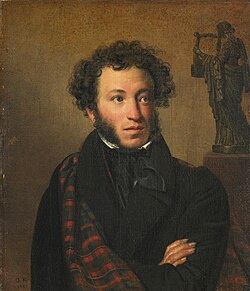
The Russian poet Alexander Pushkin (1799–1837), who was influenced by the romantic-Highlands writings of Walter Scott,[1024][1025] posed for one of the most famous paintings in Russia, the 1827 portrait by Orest Kiprensky. Pushkin wears what looks at first like a Scottish-style tartan shoulder plaid, but is more probably a sleeveless "Almaviva" cape/cloak, a style in fashion at the time and known to have been worn by Pushkin.[762]
Tartan was commented on in the Moscow Telegraph in 1826 as being in broad fashion in the city for all sorts of garments (often as a decorative accent).[762] Scottish-style plaids apparently did come into some fashion in Russia as women's wear for a space during the mid-to-late 19th century, a style picked up from stage productions; some 19th-century Russian paintings illustrate use of plaids as shawls.[762] Tartan (and plain-striped) shawls were also common among the Volga Germans and Bessarabia Germans in Russia; a mixture of hand-woven (originally as bedclothes and other household goods) and mass-produced in Russia, the shawls became emblematic of the German-from-Russia diaspora in North and South America from the nineteenth century to the mid-20th.[1026][1027]
Around the end of the 19th century, the Russian equivalent of Regency and Victorian British tartanware objects, such as decorative Fedoskino boxes with tartan accents in a style called ShotlandkaШотландка (literally 'Scotlandish'), were produced by companies like the Lukutin Manufactory on the outskirts of Moscow.[1028]
Today, shotlandka or shotlandkiшотландки are simply Russian words for 'tartan/plaid' generally.[1029]
 1839 portrait of Maria Arkadievna Bek by Pimen Orlov may illustrate one of the Russian plaids with silver thread
 Posthumous portrait of Alexander Pushkin by Carl Peter Mazer, 1839, shows him in a red and green tartan dressing gown[762]
 Tatyana Petrovna Musina-Pushkina, Princess Kropotkina (1800–1865), portrait c. 1840s by unknown artist
Oceania
Adoption durch die Māori
Pōtatau Te Wherowhero , der erste Māori- König , wählte ein besonderes Haustartanmuster mit Designelementen, die seine Abstammung symbolisierten, wie beispielsweise die inneren Streifen, die die einst in Aotearoa Neuseeland ankommenden Migrationskanus darstellten. Dieses Tartanmuster wurde von seinem Nachkommen Tūheitia Paki an Karl III. bei dessen Besuch im Buckingham Palace im Mai 2023 überreicht. [ 1030 ] Auch die nachfolgenden Stämme, die sich vor allem in Northland konzentrierten , führten grüne Tartanmuster. [ 1031 ]
Siehe auch
- Drugget , ein grober und oft linear gestreifter Stoff, der auf den schottischen westlichen Inseln verbreitet war.
- Flanell ist eine Art flauschiger Stoff, der oft in einem Karomuster hergestellt wird.
- Hodden , ein nicht-tartanartiges Tuch aus ungefärbter Wolle, das manchmal auch für Kilts verwendet wird, insbesondere von Dudelsackkapellen, die nicht aus Schottland stammen.
- Liste der Tartans
- Mackinaw-Stoff , ein dichter Wollstoff, der oft in Tartanmustern hergestellt wird.
- Madras (Stoff) , Baumwollstoff aus Indien, oft in Tartanmustern gewebt.
- Der Tartan Day ist ein Feiertag in Kanada, Australien, den USA und einigen anderen Ländern, der den Einfluss der schottischen Einwanderung würdigt.
- Tartanerei
Muster
- Argyle (Muster)
- Battenburg-Markierungen , ein Karomuster, das auf britischen Einsatzfahrzeugen verwendet wird
- Border-Tartan
- Schachbrettmuster oder Karomuster
- Vichy -Karo
- Glen-Plaid
- Harlekin-Muster
- Fischgrätmuster (Stoff)
- Hahnentrittmuster
- Sillitoe-Tartan , ein Karomuster (eigentlich kein Tartan), das häufig auf Polizeikopfbedeckungen verwendet wird
- Tattersall (Stoff)
Anmerkungen
- Die Verwendung des Begriffs „Plaid “ im Sinne von „Tartan“ ist nicht ausschließlich nordamerikanisch ; bereits 1808erwähnte die Londoner Publikation „La Belle Assemblée“ „Plaid Scarfs“ [ 14 ] . Zudem wurde mitunter behauptet, „Plaid“ beziehe sich allgemein auf alle derartigen Muster, während „Tartan“ sich nur auf Muster schottischer Clans beziehe [ 15 ] , doch findet diese Annahme in der Tartanforschung keine Unterstützung.
- ^ MacBain (1911) , S. 277. Verwandte Wörter in anderen Sprachen sind das luwische pldtmn und das spätere lateinische paludamentum für „Mantel“. Der Paludamentum war ein Mantel, den römische Offiziere in Kriegszeiten trugen. [ 17 ]
- ^Solid-colour, non-tartan kilts were often thought to be an Irish invention of the late 19th century, but an example of a belted plaid or "great kilt" from Scotland was found in a 1635 portrait of Sir Duncan Campbell of Loch Awe,[18] among other Scottish examples.
- ^The two Scarlett sources provide two exact formulas which seem at first to be contradictory, but one is for number of blends and the other for number of colours total.
- ^The term mirroring can be ambiguous, because the longer phrase mirror pattern may refer to "one in which ... two alternating ground motifs are the same size and arrangement but in different colours."[31]
- ^The term repeating[26] has also been used, as distinct from mirroring, but is so ambiguous that sometimes the same patterns are referred to as non-repeating.[32] Neither term will be used further in this article.
- ^A well-known example is the main Buchanan tartan.[33]
- ^ abAn example is the most popular MacMillan tartan, in which the warp and weft are different, though similar; the largest blocks of colour are green rectangles instead of squares.[35]
- ^Early collectors of tartan, like Logan in 1831, recorded setts by measuring the width of each stripe in eighths of an inch.[36][37] A persistent legend that tartans were originally recorded on little "pattern sticks" has been dispelled as a "telephone game"–style progressive, willful misunderstanding of an early description of the warp as wrapped on a warp beam/roller for the loom. It was poorly described by Martin Martin in 1703 as "an exact Pattern of the Plad on a piece of Wood", which Logan (1831) misunderstood as a small stick used as a perpetual "record" of the tartan pattern on it, after which the "Sobieski Stuarts" in 1842 blatantly falsified a supposed 16th-century description of "pattern sticks", and Archibald Campbell (1890) repeated the story again as factual. No such artefact has ever been found by modern researchers, and the idea has been described as impractical because the threads would not stay put indefinitely, and it would make much more sense to simply write or draw the pattern on paper, or keep a strip of the woven material.[38][39] Mackay (1924) claimed he had seen some examples and appeared to describe warp beams, but then claimed they were used as a long-term record of "clan tartans" of the area.[40] Eslea MacDonald (2015) points out that Mackay had a tendency toward "manipulating the evidence" when advancing his ideas about very old clan tartans, and that he made up a fake-Gaelic name for the alleged pattern sticks.[39]
- ^For example, Stewart, D. C. (1974), Scarlett (1990), and Scottish Register of Tartans (2009–) all use full-count-at-pivots "bare" thread counts, without slash or bold notation, while Eslea MacDonald (2012) uses them to represent half-count-at-pivots, but states this explicitly.
- ^Ground in this sense dates to at least 1895. Telfer Dunbar (1979), pp. 112–113, quoting 1895 letter: "... dress Stuart tartan on a white instead of on a red ground .... the 'Stuart hunting-tartan' on a green ground". However, ground has a different meaning at the thread-dyeing stage, where it refers to a first layer of colour which is then over-dyed with another, either to deepen the hue or make a new ones, e.g. purple from blue over red.[48]
- ^Wilsons, the near-exclusive producer of Georgian through Victorian regimental tartan, produced different grades of cloth for officers, sergeants, and enlisted.[55]
- ^Scarlett (1990) provided a reconstruction of what 17th- to early 18th-century arisaid tartans probably basically looked like, based on the appearance of later wider-banded "bar blanket" tartans which evolved from the arisaid setts. His sample is modernised in being simplified, symmetrical, mirroring, and not having a decorative selvedge.[76]
- ^The French term écru has also been applied,[86] but is ambiguous, as it technically refers to the colour of undyed linen not wool, and has been taken to indicate a richer, sandy range of hues in English usage than in French.[87]
- ^The Lord Lyon's colour-coding system actually had three reds: "gules/scarlet", "red" (a dull red), and "crimson".[44] But it is not entirely clear what the difference between them is.
- ^Multiple hues of pink appear in Wilsons' colour lists around the early 19th century, which included colours for wool and other weaving, but orange does not.[86]
- ^For lists of such natural dye materials and their preparation, see: Kok, Annette (1979) [1962]. "Appendix: Early Scottish Highland Dyes"". In Dunbar, John Telfer (ed.). History of Highland Dress. London: B. T. Batsford Ltd. pp. 222–240. Some additional such information is available in: Mackay (1924), pp. 59–64; and Eslea MacDonald (2012), pp. 76–77. See also: Campbell, J. F. (1893), p. 335.
- Eine romantische Legende darüber reicht jedoch weit zurück. Laut Innes of Learney (1971): „Der verstorbene J. G. Mackay behauptete, ähnlich wie Lord Archibald Campbell, dass Clan-Tartans nicht nur bewusst angeordnet, sondern ein ausgeklügeltes System der Identifizierung durch Kleidung bildeten, so technisch wie Wappen … Tartans sollten nie die präzisen Unterscheidungsmerkmale und die leichte Erkennbarkeit von Wappen aufweisen und taten dies auch nicht. Herr Mackay liefert viele interessante Informationen …; es gelingt ihm jedoch nicht, Beweise für ein wissenschaftliches Anordnungssystem vorzulegen, und die Umstände sprechen gegen die Existenz einer solchen Wissenschaft .“ [ 127 ] Zusammenfassend glaubte Mackay, dass Linien in verschiedenen Farben ein heraldisches System der Kadenz (Unterscheidung) zwischen verwandten Familienzweigen bildeten. [ 128 ] Dieses Argument beruht auf der Annahme, dass die Clan-Tartans der viktorianischen Ära im 17. und 18. Jahrhundert verwendet wurden, doch die gesamte moderne Tartanforschung belegt, dass diese Vorstellung weitgehend falsch ist.
- ^ Ein Foto eines der Tarim-Stofffragmente sowie eine Reproduktion, wie der Stoff ursprünglich ausgesehen haben könnte, finden Sie in: Spada (2019). [ 137 ]
- ^ Ein Foto eines der Salzburger Stofffragmente finden Sie hier: Belfrage, Anna (30. April 2016). „Of mummies in tartan“ . AnnaBelfrage.com . Abgerufen am 10. Juni 2023 .
- ^ Ein Foto des Falkirk-Stofffragments finden Sie unter: „Record: Cloth (Fragment) – found at Falkirk Stirlingshire“ . NMS.Scran.ac.uk . National Museums Scotland . 2015. Abgerufen am 3. Juni 2023 .
- ^ Ein Foto des Caracalla-Statuenfragments finden Sie (etwa ein Drittel der Seite nach unten): Lamley, Hamish (21. Februar 2022). „Pictish Fashion“ . PictaviaLeather.co.uk . Abgerufen am 10. Juni 2023 .
- ^ Auch keine Verwandtschaft zum heutigen tatarischen Volk .
- ^ Dieser historische Glen Affric Tartan darf nicht mit verschiedenen konkurrierenden modernen Bezirks-Tartans namens "Glen Affic" verwechselt werden, die bei einigen Anbietern wie Clan/Scotweb, Stevens & Graham und Spoonflower erhältlich sind.
- ^There are possible mentions earlier, to the 14th century, in both Early Scots and Middle English using the French-borrowed terms tiretain and tartarin in various spellings, but they do not clearly refer to tartan, either the cloth or the pattern, but rather seem to refer to valued cloth in general.[4]
- ^There is a legend that during some period there was a "caste" system by which chiefs were entitled to up to seven colours in a tartan, fewer colours were allowed for clansmen according to position in the social hierarchy, and just single-coloured cloth for servants. Barnes & Allen (1956)[92] attributed the idea to Frank Adam (1908). He did indeed write that "it is said" there was such a system, but cited no evidence.[142] The fancy is from Logan (1831), who cites nothing but an ancient "Achy Edgathach" of Ireland.[177] That was a legendary ancient Irish king in the Lebor Gabála Érenn, said to have passed a sumptuary law limiting clothing colours by social status, during his very short reign of only four years (some time between 1537 and 1155 BC).[178] It is old Irish folklore and nothing to do with history of Scottish tartan. Scarlett (1990): "it is difficult to allow such a tale any credibility".[144] No modern Highland-dress scholars repeat it seriously (the last one to do so seems to have been Mackay (1924) who said it applied to "Druidical times"),[179] and the idea is contradicted by existence of old regional tartans of complexity, and by chiefs adopting tartans of marked simplicity. Practically, the extra dye and weaving-labour expenses of complicated tartans meant that they cost more and so were more often worn by monied persons,[144] as clearly reported by John Lesley (1578)[180] and Robert Heron (1799).[181]
- ^ Buchanan (1582): „Sie erfreuen sich an marmorierten Stoffen, besonders solchen mit Streifen in verschiedenen Farben; sie lieben vor allem Purpur und Blau; ihre Vorfahren trugen kurze Mäntel oder Plaids in verschiedenen Farben, die auf unterschiedliche Weise gekleidet waren, und bei einigen wird dieser Brauch bis heute gepflegt, aber zumeist sind sie braun, am ehesten der Farbe des Heidekrauts ähnlich, sodass die leuchtende Farbe ihrer Plaids sie nicht verrät , wenn sie im Heidekraut liegen .“ [ 191 ] ( Buchanans Formulierung wurde 1603 in dem anonymen Werk „Certayn Mattere Concerning Scotland“ wiederverwendet .) [ 192 ]
- Der Versuch, Tartan darzustellen, ist recht grob und besteht aus geteilten Streifen anstatt eines versetzten Musters aus ineinander übergehenden Rechtecken. Es ist jedoch möglich, dass es sich um eine Webart mit unterschiedlichen Kett- und Schussfäden handelt , die ein stärker gestreiftes Muster erzeugen könnte. Die genauen Details der Abbildung sind fraglich, da der Künstler ein fantasievolles Schwert darstellt, das eine Kombination aus dem Griff eines schottischen Claymore und der Klinge sowie den Parierstangen eines deutschen Landsknechts ist – eines Typs, der dem deutschen ( schlesischen ) Künstler vertrauter war. Zudem bezeichnete Telfer Dunbar (1979) die Farben als Gelb, Blau und Rot (nicht Grün, Blau und Rot), sodass die Farbgenauigkeit des Fotos zweifelhaft sein könnte. [ 194 ] Das Original befindet sich in der Huntington Library MSS: HM 25863, f. 28r.
- ^ In viktorianischen Werken über Tartan kursiert die Legende, dass der Tartanstoff für jeden Highland-Mann üblicherweise von seiner Frau oder Mutter zu Hause einzeln angefertigt wurde, [ 197 ] doch erweist sich dies als unpraktische Vorstellung, [ 198 ] für die es keine Beweise gibt, im Gegenteil, es gibt zahlreiche Belege dagegen, darunter eine reiche Volkstradition der (meist weiblichen) Gruppenarbeit.
- Innes of Learney (1938/1971) glaubte, dass die Highlander mehrere Tartans trugen, weil einige persönlich (möglicherweise vererbt), andere geografisch und wieder andere clanspezifisch waren [ 203 ] , legte jedoch keine stichhaltigen Beweise für diese Hypothese vor. Die Idee lässt sich auf Lord Archibald Campbell (1890) zurückführen, der (völlig ohne Beweise) behauptete, dass ein Highlander, der mehrere Tartans gleichzeitig trug, das Muster seines Kommandanten, seines väterlichen und mütterlichen Clans trug [ 197 ] .
- Auch diese Interpretation ist jedoch mehrdeutig und könnte bedeuten, dass die Hochländer gestreifte Mäntel trugen, schlimmer noch, dass sie ihre Mäntel auf dieselbe Weise trugen wie die Iren ihre, ob gestreift oder nicht. Und „gestreift“ bedeutet nicht zwangsläufig Tartan. Das Material aus Camden stammt zudem aus der Zeit der Besiedlung Ulsters.
- ^ Taylor : „… alle und jeder Mann im Allgemeinen in einer Tracht … Denn einmal im Jahr … kommen viele des Adels und des Landadels des Königreichs (zu ihrem Vergnügen) in diese Hochlandgebiete zur Jagd, wo sie sich der Tracht der Hochländer anpassen, die zumeist nichts anderes als Irisch [d. h. Gälisch] sprechen … Ihre Tracht besteht aus Schuhen mit jeweils nur einer Sohle; Strümpfen (die sie kurze Strümpfe nennen) aus einem warmen Stoff in verschiedenen Farben, den sie Tartan nennen; was die Hosen betrifft, so trugen viele von ihnen, noch ihre Vorfahren, jemals welche, sondern eine Weste aus demselben Stoff wie ihre Strümpfe; ihre Strumpfbänder sind Bänder oder Kränze aus Heu oder Stroh; mit einem Schal um die Schultern, der ein Mantel in verschiedenen Farben ist, aus viel feinerem und leichterem Stoff als ihre Strümpfe; mit blauen Schirmmützen auf dem Kopf …“ [ 228 ]
- Adam (1908/1970) behauptet überraschenderweise, dass zu Taylors Zeiten „jeder, der das Tartanmuster seines Clans trug, unter dem besonderen Schutz dieses Clans stand“ und unterstellt, Taylor habe dies gesagt. [ 189 ] Diese Behauptung ist frei erfunden, da sich in Taylors Originaltext nichts Vergleichbares findet. Taylor sagte lediglich, dass Besucher in schottischer Tracht „freundlich empfangen würden und reichlich Unterhaltung geboten wäre“.
- So findet sich beispielsweise in der überarbeiteten Ausgabe von Rev. James Bromes Reisebericht über England, Schottland und Wales aus dem Jahr 1707 Material, das teilweise von Buchanan (1582) übernommen wurde: „Sie tragen Mäntel, die an den Schultern gestreift oder mit verschiedenen Farben durchzogen sind, die sie Plodden nennen , dazu einen eng am Körper gegürteten Mantel. Üblicherweise sind ihre Beine oben nackt, aber sie tragen Sandalen an den Fußsohlen, und ihre Frauen kleiden sich in ähnlicher Weise.“ [ 238 ] Dies deutet darauf hin, dass die Mode der Highlands in einem Zeitraum von mindestens 1582 bis 1707 recht einheitlich und geschlechtsneutral war.
- ^ Derselbe Künstler malte bereits 1675 ein dreiteiliges Porträt des Schauspielers und Dramatikers John Lacy , auf dem er eine Hose und einen Gürtel mit Schottenmuster zu sehen ist, [ 249 ] wobei das Schottenmuster dort sehr beiläufig als einfache rote und blaue Linien auf Weiß dargestellt ist.
- ^Martin Martin (1703) wrote: "each Isle differs from the other in their fancy of making Plaids, as to the Stripes in Breadth and Colours. This Humour is as different thro the main Land of the Highlands, in-so-far that they who have seen these Places are able, at the first view of a Man's Plaid to guess the Place of his Residence ...."[254] Scarlett (1990) says some earlier writers used this to just assume "a fully organised system of District tartans at that time" though Martin said nothing of the sort.[255] Scarlett considered Martin's account to have "a rather sweeping style that suggests some exaggeration", but generally plausible on other evidence of particular patterns, with minor variations, being common across wide areas.[255]
- ^These tartan jackets are not to be confused with the later short regimental Highland doublet styles, borrowed directly from the military Highland regiments starting in the late 18th century; these are also of plain colour, not tartan.
- ^Sources conflict sharply on the date. Telfer Dunbar (1979), relying on Mackay Scobie, says 1717-1739;[270] while Eslea MacDonald (2016), relying on R. W. Munro's Highland Clans & Tartans (1977), says 1754.[175]
- ^Banks & de La Chapelle (2007) give an implausible 1724 date for the founding of Wilsons,[275] which does not agree with other scholarship, and they cite no source for the assertion.
- ^Scarlett (2008): "Red, blue and green have been recorded as the first colours to appear in all primitive art, so there may be some deep physiological or psychological reason for the predominance of these colours."[6]
- ^Britain has many native plants that can produce at least a thin yellow, but they seem not to have been favoured, except as a ground-colour for over-dyeing with blue to create green.[277]
- Ein kleines Stück Tartan , das vermutlich von einem Plaid von Bonnie Prince Charlie stammt und 1746 Lady Anne Mackintosh vom Clan Farquharson geschenkt wurde , ist in den National Records of Scotland erhalten . [ 168 ] Der Prinz hatte offenbar die Angewohnheit, Plaids als Dank für Gastfreundschaft zu verschenken, und mehrere aufgezeichnete (aber recht unterschiedliche) Tartans sollen von diesen Plaids abstammen, z. B. SRT 4220, [ 287 ] 4421, [ 288 ] 4422, [ 289 ] und 4423. [ 290 ] Laut Telfer Dunbar (1979) bewahren verschiedene Museen und andere Sammlungen mindestens 40 Tartanstücke auf, die angeblich vom „Jungen Prätendent“ getragen wurden, acht davon in der Schlacht von Culloden, und es kann nicht sein, dass alle echt sind. [ 291 ] Ein bestimmtes Exemplar gilt als wahrscheinlicher authentisch als die anderen. [ 63 ]
- ^ Es gibt mehrere weitere Tartans, die als „Jakobiten-Tartan“ bezeichnet werden. Einer stammt aus der Zeit um 1850 [ 66 ] , könnte aber etwas älter sein und ist wahrscheinlich ein Entwurf von Wilsons [ 31 ] , die anderen sind neuere kommerzielle Erfindungen aus der Zeit um 1930 [ 299 ] und dem späten 20. Jahrhundert [ 300 ] .
- ^ Telfer Dunbar (1979) gibt das korrekte Jahr 1725 an und behauptet, 1729 sei ein Fehler, der von Stewart of Garth (1822) eingeführt und von späteren Autoren übernommen wurde. [ 223 ]
- ^ Genauer gesagt, wie in einem früheren Parlamentsgesetz definiert, nördlich der „Highland-Linie“, die von Perth im Osten nach Dumbarton im Westen verläuft. [ 309 ]
- ^ Der Kleiderordnungsakt selbst enthielt keine Ausnahmen für den Adel, wohl aber der beigefügte Verbotsakt.
- Oberstleutnant Sir John MacGregor Murray , der frischgebackene Clan-Chef von Gregor und spätere Vizepräsident der Highland Society of London, schrieb 1803 über die Schwierigkeit, ein neues Regiment aufzustellen: „Es wird viel erfordern, den Kampfgeist unserer Vorfahren wiederzuerwecken, der leider systematisch gebrochen wurde – wir wurden so lange durch den Mangel an Waffen und Uniformen erniedrigt und so sehr entmannt, indem wir zu Fabrikanten umgewandelt wurden.“ [ 322 ]
- ^Not to be confused with the second Seaforth's Highlanders, also raised as the 78th, in 1793. The original Seaforth's Highlanders were amalgamated with other units under the Childers Reforms to become the 1881 Seaforth Highlanders.
- ^Not to be confused with the earlier 74th Regiment of (Highland) Foot, raised 1777.
- ^The commercial tartan weaver D. C. Dalgliesh provides a list of those that they supply, and it includes a mix of obscure tartans from defunct regiments, ones still used today for surviving regiments, tartans of overseas units that were "Highland" only in name, some that are now only associated with clans, and a number that are/were reserved for military pipe-band use and were not used in regular dress or undress uniforms.[403]
- ^As one example, in The Lockhart Papers, first published in 1714, is a passage describing how opposing battatlions of MacDonalds from different places could only tell each other apart by colour of bonnet cockade. D. W. Stewart (1893) leapt to the conclusion they must have worn the same tartan, despite the material saying nothing of the sort[417] (they could have been wearing whatever tartans they happened to have, not uniforms, making tartan meaningless for distinguishing units of men).[140]
- ^D. W. Stewart (1893) sometimes leaned toward the uniform interpretation: "It appears from the regulations issued to the retainers of the Clan Grantanent the wearing of a uniform tartan that distinctive patterns were in use, at least for military purpose, or on occasion of great gatherings".[260] The Grant case is covered in detail later.
- ^D. W. Stewart (1893) again came down on the "uniform" side, despite otherwise being a booster of the idea of early clan tartans;[252] so did Scarlett (1990).[253]
- ^Adam (1908/1970) confirmed that there were two different grades of tartan worn,[189] as did Logan (1831), but both are sources of dubious quality. Scarlett (1990, 2008) also observes that there were once at least two kinds of tartan weave, a coarse, dense sort in which the weft threads were thicker than the warp,[6] and a finer equal-twill weave, seen often in portraits, that is more like the kilt cloth produced today.[271] (But he does not describe one as being specially intended for war.) Such a fineness split seems to have continued for a long time; Wilsons of Bannockburn manufactured regimental tartan in both coarse ("hard tartan") and fine qualities as late as 1819,[419] perhaps as an undress and dress distinction, or enlisted and officer.
- ^Innes of Learney's motte-and-bailey tactic when it comes to what "clan tartan" means is exemplified by his supposition that similar tartans used in lands of Murray, Murray of Athol, and Sutherland must mean they went back to a common tribal tartan "from the twelfth century" (which is not attested), and that: "It was no doubt 'the Murrays' tartan' without being 'The Murray tartan'".[161]
- ^E.g., the district tartan of Huntly[314] was sometimes called Brodie, sometimes associated instead with Forbes or Gordon, while Forbes did not have a distinct clan tartan until the key date of 1822, nor Brodie until the beginning of the 19th century.[428] The several tartans named Gordon all date to 1798 or later (and that earliest one was adopted from a 1793 regimental tartan).[429]
- ^However, not only is it not certain that a single cloth of mixed colours was intended, rather than three cloths of distinct colours, Stewart contradicted himself: When the lands in question were restored to the MacLeans in 1630, the grey did not revert to green but remained gras, i.e. grey. Nevertheless, Stewart asserted: "The explanation is simple enough. White and black and green are the only colours in the oldest authenticated Mac Lean tartan."[433] But that design dates only to the fraudulent 1842 Vestiarium Scoticum and is not "authenticated" by anything;[434] several other (red-based) MacLean tartans date to at least 1819 (STR reference nos. 2603, 2605, and 2606).
- ^The Scottish Tartans Society seemed to think it was something very similar to Black Watch, with the red-and-white-striped Murray of Pulrossie version somehow, despite its 1618 prohibition, eventually becoming the primary Sutherland tartan.[435] Innes of Learney also supported the interpretation that it was a dark Black Watch-style tartan, related to others used in the region.[404] On the other hand, House of Gordon USA, a clan society, proclaims: "It was a Red Gordon!",[436] referring to a primarily red and teal tartan, also known as old Huntly, recorded in 1819,[437] and appearing in a "stripey" variant, with differing warp and weft, in the 1766 painting of William Gordon. The society does not publish any basis for their assertion.
- ^The piper's name was William Cumming. Telfer Dunbar (1979) describes this tartan, and that of a companion portrait of Alastair Grant Mòr "the Champion", as also showing thin yellow over-checks which are not really visible in this photo. He also describes the green as "grey".[439]
- ^This problem of no consistent tartans in old family portraits recurs in other clans, such as Murray and MacDonald, going back to the 18th century.[406] Trevor-Roper (1983) also notes this inconsistency among Highland portraits,[184] as does Haswell Miller (1956).[408]
- ^Willie Scobie, in 2012, railed against "an influential and determined body of opinion set against the idea of clan tartans having existed prior to the late 18th century", analysed the Tartana lines in light of known clan tartans, found no correspondences aside from the Royal Company of Archers (supposedly using a Stuart tartan, which in reality they did not,[256] and not being a clan anyway) having green edging on their jackets, and nevertheless decided: "we have in this piece of literature strong (one is almost tempted to say irrefutable) evidence of the existence of clan tartans in the year 1718."[449]
- ^Thompson (1992)[140] said none of them survive; but the coat of the older boy is in what is now known as "MacDonald, Lord of the Isles", though the sett was reconstructed from the painting.[468]
- ^A legend started by Lord Archibald Campbell (1890), who was working from a copy of the painting not the original, is that in his words: "No more conclusive proof of distinctive clan colours has been exhibited and it silences all dispute on the question at once and for all time."[475] Modern researchers do not take this seriously. E.g., J. Telfer Dunbar's evaluation: "This is an extraordinary claim as the tartans are clearly and accurately shown and not one of them agree with any clan tartans as known when Lord Archibald was writing or even to-day."[197] Scarlett (1990) pointed out that Campbell himself claimed, later in 1899, that the models for the painting were Jacobite prisoners.[476] If that were the case, they could be wearing whatever they were told to put on, even material supplied by the painter; i.e. the tartans depicted would be accurate representations of the cloth of the period but could not signify anything, even if they did match. The Jacobite Relics and Rare Scottish Antiquities Exhibition of 1946 agreed that the models were prisoners.[477]
- James Ray, der in der Schlacht von Culloden auf Seiten der Regierungstruppen diente, schrieb 1752: „Auf ihrer Flucht begegnete ich einem hübschen jungen Highlander, der mir zurief: ‚Halt deine Hand, ich bin ein Campbell!‘ Worauf ich ihn fragte: ‚Wo ist deine Mütze?‘ Er antwortete: ‚Jemand hat sie mir vom Kopf gerissen.‘ Ich erwähne dies nur, um zu zeigen, wie wir unsere loyalen Clans von den Rebellen unterschieden; sie waren alle auf dieselbe Weise gekleidet und ausgerüstet, außer der Mütze; unsere hatte ein rotes oder gelbes Kreuz aus Stoff oder Band; ihre eine weiße Kokarde.“ [ 478 ] Telfer Dunbar (1979): „Wenn es möglich gewesen wäre, einen Campbell an einem ‚Clan Campbell‘-Tartan zu erkennen, hätte Ray dies entweder getan oder zumindest bemerkt, dass der Mann keinen erkennbaren Tartan trug.“ [ 479 ]
- ^ Das Tagebuch der Expedition von Prinz Charles Edward im Jahr 1745, verfasst von einem Offizier der Highlands, berichtet Folgendes: „Wir MacDonalds waren sehr ratlos, wie wir uns im Falle einer Verhaftung von unseren Brüdern und Nachbarn, den MacDonalds of Sky, unterscheiden sollten, da wir beide Hochländer waren und beide Heidekraut in unseren Mützen trugen. Nur unsere weißen Kokarden ermöglichten eine gewisse Unterscheidung.“ [ 417 ] Telfer Dunbar (1979): „Wenn alle MacDonalds denselben Tartan getragen hätten, hätte der Verfasser dies sicherlich erwähnt, anstatt des Heidekrauts, das sie in ihren Mützen trugen. Ein gemeinsamer Tartan wäre viel verwirrender gewesen als ein Heidekrautzweig.“ [ 480 ] Außerdem beweist dieser spezielle Fall nicht, dass alle Clans unterschiedliche Symbolpflanzen hatten. Clanpflanzen wurden, ähnlich wie Clan-Tartans, Anfang des 19. Jahrhunderts von der Highland Society of London bei den Clanführern angefordert, und es gibt keine Hinweise auf eine weitverbreitete Zuteilung davor – nur diese eine Erwähnung eines einzelnen Clans in einer Quelle aus dieser Zeit.
- ^ Und weil insbesondere das karierte Hemd mit Gürtel, das zwar für das Tragen im Freien sehr praktisch, aber nicht als Arbeitskleidung geeignet war, als förderlich für ein Leben in Müßiggang und regelrechter Bandenkriminalität galt. [ 483 ]
- ^ Selbst im Brief Sutherland/Pulrossie aus dem Jahr 1618 ist ausdrücklich von „den Plaids seiner Männer“ die Rede [ 404 ] , was eher auf seine Miliz als auf seinen gesamten Clan hindeutet.
- ^ Manchmal wird behauptet, es handele sich um Jean „Jenny“ Cameron , jedoch ohne schlüssige Beweise; es gibt fünf weitere mögliche Identitätskandidaten. [ 493 ]
- ^Another legend, started by James Grant (1886), has it that the tartan goes back to "Charles, first Earl of Dunmore, second son of the first Marquis of Tullibardine", but this was just a bad mis-reading of the Smith brothers (1850), from whom Grant plagiarised, referring to the then-current Earl of Dunmore.[326][7]
- ^E.g., Telfer Dunbar (1979) provides this example: Wilsons' popular "Gordon" was green, purple, and black with over-checks of seven colours, and "unlike the present clan pattern".[441]
- ^One example is today's Macpherson, adopted in 1817, which was originally "Caledonia" then "No. 43", "No. 155", or "Kidd" in Wilsons' pattern books.[398][502] (There is no "Clan Kidd"; the Kidd in question was a bulk orderer who used the tartan to clothe slaves in the West Indies.[503] Confusion seems to have arisen when Wilson also assigned the pattern the name "Macpherson" after another West Indies customer by that name.[504] Another is Campbell of Cawdor, originally "No. 230" or "Argyll", after the county.[505][506] A complex example is the case of Abercrombie or Abercromby.[507] Logan (1831) first published the tartan usually used for this name, but he modified it[508] from an 1805 Wilsons tartan record for "No. 64" or "Abercrombie", named for Sir Ralph Abercrombie not an entire family.[509] The design first popular for "Abercrombie" in the early 18th century changed names somehow[508] to Graham then later became today's Graham of Montrose tartan.[510] Wilsons' "Abercromby with yellow"[508] is today's Campbell of Breadalbane[511] after also being used by a fencible regiment.[512] The main Buchanan tartan, famous for being asymmetric, originated as a Wilsons fashion tartan around 1800 and was not adopted as a clan tartan until the 1830s.[33] "Logan" was invented by Wilsons, named after a merchant, and changed several times until it sold well.[513] "Drummond" was originally Wilsons' "Perth".[513] Wilson's 1819 pattern "Regent" turned into the MacLaren clan tartan by 1830, with a shift from purple to blue.[95] Scarlett (1990) and the Scottish Register of Tartans provide numerous other examples of modern "clan" tartans actually just being renamed generic/fashion/fancy, regimental, and famous-individual tartans from Wilsons, when they were not taken from the later forgery Vestiarium Scoticum.
- ^A prime example is the Black Watch tartan, which Cockburn collected four times and assigned the names "Campbell Argyll", "Grant", "Munro" and "Sutherland".[518][516]
- ^According to a documentary, Clan Gregor, the Gordons, and a MacDonald branch might also have had early informal clan tartans around this period.[182] However, the chief of the MacDonalds indicated not knowing of a clan tartan in 1815, and the tartan that was the subject of the 1618 Gordon/Murray/Sutherland letter is uncertain.
- ^Stewart of Garth may have had financial motivations for promoting an aristocratic "tartanry" or "Highlandism" and attaching his name to it prominently – like many other Scottish lairds, he was in dire fiscal shape.[532]
- ^At least six at once claimed the Black Watch regimental tartan,[516][533] and "Several chiefs were asked to resubmit a different tartan in order to be seen to be different and thus support the idea of historical clan tartans."[516] In some cases, minor alterations were made, e.g. Forbes was devised in 1822 by adding a white over-check to Black Watch.[539]
- ^There are numerous examples, but a prominent case is that two of the Lord of the Isles tartan variants were taken from portraits dating to the third quarter of the 18th century.[540] This practice, incidentally, has contributed to confusion about the age of clan tartans; a tartan adopted officially by a clan in 1850 from a painting dating to 1750 might misleadingly be said to be "a clan tartan dating to 1750".
- ^The authenticated samples bore seals of clan chiefs, while submissions received without such authentications were sealed by society secretary George Wedderburn.[55] The society collected tartans in general as well, and amassed 586 by 1987.[533]
- ^Some faulty (according to Wilsons) clan patterns included in Logan (1831) were those for Abercrombie, Douglas, and Graham, but there were more.[563]
- ^In fairness, only most of the tartans in Vestiarium were made up; almost a dozen had previously appeared in collections like those of Cockburn and Wilson.[572] Telfer Dunbar (1979) also considered that the Sobieski Stuarts' more general material on the history and then-present of Highland dress was of considerable value, at least when its sources could be traced.[573] Of the tartans material, Walter Scott fairly charitably wrote that the brothers had "an exaggerating imagination, which possibly deceives even themselves".[574]
- ^R. Martin (1988): "I would like to excuse the prevarications of the Sobieski-Stuart brothers with a nod to Baudrillard; they lied and they cheated, but they did something quite extraordinary in ascribing a meaning to textile design that has more or less stuck: false as it is, the Sobieski-Stuarts fostered a myth of textile identification and implication that has served a continuing and compelling social need for well over a hundred years. They may have been factually wrong, but culturally very right."[580]
- ^E.g., the usual tartan of Clan Home dates to Clans Originaux.[589] Another is Brodie hunting;[590] it was also later included in Old & Rare Scottish Tartans. A third is MacBean.[113]
- ^See Scarlett (1990), chapter "The Setts of the Tartans", for numerous examples of names with 5 or even 10 "clan tartans", most of them traceable to Wilsons, Logan, or the Sobieski Stewarts.[602] For a quick visual example of conflicting claimed clan tartans, many of them dating to the Victorian to Edwardian periods, see the "MacDougal" search results in the Scottish Register of Tartans;[82] the list for that name is not much polluted by recent individual and "fashion" entries.
- ^Revised in 1974, D. C. Stewart's The Setts of the Scottish Tartans has been further updated and expanded by James D. Scarlett in 1990 as Tartan: The Highland Textile,[606] perhaps the most definitive work on tartan published so far (though by no means the largest in terms of number of tartans illustrated; it is a book of research not of pictures).
- ^E.g. the red variant of the 1975 MacGregor dance tartan dates to 2005.[608]
- ^Electric Scotland published an annotated list of clans and their tartans' Lord Lyon registration status. The list is much shorter than some other clan lists, because it omits clans that have not applied to the Lord Lyon for tartan registry at all; it lists only those with Lyon-recorded tartans or those then in process of such registration.[610]
- ^Example: The Clan Watson tartan dates to c. 1932 and appears to have been created by one of two ministers (sources disagree), based on the MacRae hunting and Gordon tartans.[611]
- ^The Highland MacLennans use the same tartan as the Lowland Logans. Clan Logan is without a chief.
- ^Eslea MacDonald (2022) defines this "Highland Revival" period as the 1782 end of the Dress Act to the beginning of Victoria's reign in 1837.[31] The utility and accuracy of this term when constratined to Victoria's accession is questionable, because revivalism of Highland cultural trappings did not abate during her reign but actually intensified markedly. Also, the term tartan revival has been used, with essentially the same meaning, though without closely prescribed dates.[635]
- ^In this era, soldiering, especially as an officer, was the "aristocratic profession par excellence",[637] and this had a strong effect on fashion. In Highland dress of the period, sometimes civilian and military styles were commingled.[638]
- ^Not to universal approval. The chief of Clan MacDonell of Glengarry wrote of a Celtic Society of Edinburgh gathering: "I never saw so much tartan before in my life, with so little Highland material ... they have no right to burlesque the national character or dress of the Highlands."[538]
- ^David Wilkie's portrait of George IV depicts the king as being much slimmer than he actually was. Wilkie covered up the fact that the king's kilt was too short – sitting well above the knees – and also left out the pink tights the king wore to hide his bare legs.[652]
- ^A detailed summary of the 19th-century tartan books can be found in D. W. Stewart (1893), pp. 57–61.
- ^Queen Victoria wrote of her time in Scotland: "... I feel a sort of reverence in going over these scenes in this most beautiful country, which I am proud to call my own, where there was such devoted loyalty to the family of my ancestors – for Stuart blood is in my veins, and I am now their representative, and the people are as devoted and loyal to me as they were to that unhappy race".[705]
- ^There were "tartanitis"-infused travel books of the era to go along with the tourism, e.g. A Tour in Tartan-land by Rev. Edward "Cuthbert Bede" Bradley (1863).[712]
- ^As examples, modern tartans have been created for Chinese, Jewish,[868]Muslim,[869] and Sikh[870] communities, as well as Italian Scots.[871]
- ^Wilsons of Bannockburn created several of the comparatively old ones – Aberdeen, Crieff, Dundee, Glasgow, and Perth – simply by naming patterns after the places in which they were the most popular.[441]
- ^Cornish "national" examples:[880][881][882][883][884][885]
- ^Welsh national examples:[879][886][887][888][889]
- ^Manx national examples:[891][892][893][894][895][896][897][898][899][900][901] The last of these is inexplicably assigned a date of 1863 in SRT, but with a note that seems to indicate it was designed by D. G. Teall of STS in 1981.
- ^Breton "national" examples:[780][902][903]
- ^Galician "national" examples:,[904][905][906]
- ^For example, Bruce County has an official tartan.[908] An example of a Canadian municipality with an official tartan is Beauport, Quebec City.[909]
- ^E.g., Matheson dress[916] is also known simply as Matheson, and is distinguished from a Matheson hunting tartan.[917] As with many Scottish names, there are an accumulation of other fashion and individual tartan designs named "Matheson",[918] but the only two recognised by the Clan Matheson Society are Matheson [dress] and Matheson hunting.[919] Similarly, Shaw of Tordarroch dress[617] is the main tartan, and is distinguished from a hunting variant,[618] with the old, erroneous "Shaw" tartan being retained only as a memorial tartan for a particular family figure.[616]
- ^A photo in Adam (1908/1970) confirms that tartans with white stripes were used for Highland dance outfits at least as far back as the Edwardian period, though the style of female dance-competition dress has notably changed toward kilt-length instead of mid-calf skirts since then.[923]
- ^Some writers have confused them as late as the 1980s (which suggests that dance tartans as a conventional category unto themselves may date to the 1990s and later, though some specific dance tartans date to at least the mid-1970s).[924] E.g., J. C. Thompson (1989) conflates dance and dress tartans and treats all dress tartans as if they were white-bearing,[100] despite the clear fact that some dress tartans of considerable age do not have white in them, e.g. Matheson dress from c. 1850.[916]
- ^The white-heavy MacGregor dance tartan (in three colour variants dating to 1975–2005) is confusingly listed in the Scottish Register of Tartans as both dance and dress,[924] but the chief of Clan Gregor insists it is for dancers only,[613] so it is demonstrably not a general dress-wear tartan. Several other dance tartans are listed also as dress tartans in the SRT, but most appear to be "fashion" inventions by individuals or by woollen mills and are not associated with clans or districts.[925]
- ^Possibly as early as 1850, and based on the Hay Stewart tartan or on royal Stewart, both probably by the Sobieski Stuarts.[699] It is often misdated to 1853.[926]
- ^An example of a writer uncritically perpetuating the story can be found in M. B. Paterson (2001).[928]
- ^As noted above, an early regimental tartan of 1787 was for a while called "Mackenzie–MacLeod" after two commanders, but this was a troop uniform tartan, not one for the named individuals.
- ^The sett actually survives in two variants in the SRT, created for an 1880 wedding; they are now sometimes used as Wilson family tartans.[931][932]
- Der Lord Lyon akzeptierte formelle Registrierungen von Clan-Tartans nur von Clan-Häuptlingen. Dies schloss häuptlingslose, wappenführende Clans von der Tartan-Registrierung beim Lord Lyon aus, unabhängig davon, ob sie später Clanvereinigungen oder -vereine hatten. Viele Clans, die nun wieder wappenführend waren, konnten jedoch Tartans beim Lord Lyon registrieren lassen, bevor sie häuptlingslos wurden. Diese Registrierungen sind in den Lyon Court Books erhalten. Der Lord Lyon schien einen Clan, der einen Häuptling hatte , weiterhin als Clan und nicht nur als Familie/Nachname zu betrachten (der Lord Lyon registrierte keine Familientartans, d. h. solche für nicht-Clan-Nachnamen). Eine entsprechende Stellungnahme des Lord Lyon aus dem Jahr 2002 ist allerdings nicht so eindeutig formuliert, wie sie hätte sein können. [ 610 ]
- ^ Im Jahr 2003 forderte Burberry von Vertretern der Tartanindustrie, den Handel mit einem bestimmten Thomson Camel-Tartan einzustellen. [ 954 ] Burberry behauptete, dieser Tartan sei dem eigenen Burberry-Karomuster zum Verwechseln ähnlich und verletze somit die eingetragene Marke. [ 955 ] 2013 ging Burberry erneut gerichtlich gegen die Tartanindustrie vor, um seine Tartanmarke in China zu schützen. [ 956 ]
- ^ Auf der Website der Clan Cameron Association heißt es beispielsweise, dass der Cameron of Lochiel-Tartan „der persönliche Tartan des Clan-Chefs und seiner engsten Familie ist; in der Regel sollte er nicht von Clanmitgliedern getragen werden“. [ 982 ]
- Seit 1937 dürfen nur der persönliche Dudelsackspieler des Monarchen und die Dudelsackspieler auf dem königlichen Anwesen Balmoral den Balmoral-Tartan tragen. Auch Mitglieder der königlichen Familie tragen ihn nur mit Erlaubnis des Monarchen. [ 699 ] Auf der offiziellen Website der britischen Monarchie heißt es , der Tartan sei nicht käuflich zu erwerben. [ 984 ] [ 985 ]
- Oyange -Ngando (2018): „Die bewusste und spezifische Anordnung von Farben, wobei jede Farbe eine bestimmte Bedeutung trägt; beispielsweise kann eine Farbanordnung das Alter, den Clan oder den Familienstand einer Person repräsentieren.“ Oyange-Ngandos Arbeit zitiert zahlreiche Quellen, jedoch keine einzige für diese Behauptung. Moderne Fotos von Massai zeigen Angehörige desselben Stammes/Clans, die eine große Vielfalt an Shúkà- Mustern tragen, scheinbar nach persönlichem Geschmack.
- ^ In den dichter besiedelten Gebieten ist die Kleidung vorgeschrieben. Abgelegene Gebiete, die überwiegend von ethnischen Minderheiten bewohnt werden, weisen nach wie vor lokale traditionelle Kleidungsnormen auf, die sich von Gebiet zu Gebiet unterscheiden. [ 1004 ]
- ^Just Bumthang by itself is a term for a type of woolen cloth, regardless of pattern.[1006]
- ^Not to be confused with the Mongols, who were called "Ta[r]tars" by medieval Europeans, and supplied patterned cloth among other trade goods .
References
Citations
- ^ abHarper, Douglas. "tartan (n.)". Online Etymology Dictionary. Archived from the original on 5 August 2017. Retrieved 4 March 2018.
- ^ abcdBanks & de La Chapelle (2007), p. 57.
- ^ abScarlett (1990), p. 3.
- ^ abc"Tartan(e), Tertan(e), n. Also: (tartain)". A Dictionary of the Older Scottish Tongue (up to 1700). Dictionaries of the Scots Language SCIO / University of Glasgow. 2001. Archived from the original on 15 July 2023. Retrieved 14 July 2023.
- ^Scarlett (1990), p. 11
- ^ abcdefghijklmnopqrstuvwxyzScarlett, James D. (2008). "Submission from James D. Scarlett"(PDF). Scottish Parliament. Archived from the original(PDF) on 19 December 2008. Retrieved 12 October 2008.
- ^ abcdefghiEslea MacDonald, Peter (November 2010). "The Murray of Tullibardine Tartan – A Re-appraisal"(PDF). ScottishTartans.co.uk. Archived(PDF) from the original on 25 June 2023. Retrieved 25 June 2023.
- ^Tuckett (2016), p. 2, citing: Scarlett, James D. (1997). "Tartan: The Highland cloth and Highland art form". In Butt, John; Ponting, Kenneth (eds.). Scottish Textile History. Aberdeen University Press. p. 71.
- ^ abcdefghijklmNewsome, Matthew Allan C. (1994). "Introduction to Tartan". Franklin, North Carolina: Scottish Tartans Museum. Archived from the original on 10 February 2006. Retrieved 31 May 2010.
- ^Cheape (2012), pp. 15–16.
- ^Griest, Terry L. (1986). Scottish Tartans and Family Names. Harp & Lion Press. p. 2.
The words tartan and plaid have come to be used synonymously, particularly in North America. This usage is incorrect when referring to Scottish tartan
- ^ abc"Frequently Asked Questions". ScottishTartans.org. Archived from the original on 17 April 2000. Retrieved 16 October 2008.
- ^Cheape (2012), p. 15.
- ^Tuckett (2016), p. 10.
- ^ abBlack (1959), p. 3.
- ^Telfer Dunbar (1979), p. 2.
- ^Ramsay, William (1875). "Paludamentum". In Smith, William (ed.). A Dictionary of Greek and Roman Antiquities. London: John Murray. pp. 853–854. Retrieved 28 May 2023 – via University of Chicago.
- ^ abcdefghijklNewsome, Matthew; Wilkinson, Todd (2010). "Hibernean Dress, Caledonian Custom: A brief history of Irish kilts and tartan". ScottishTartans.org. Scottish Tartans Museum. Archived from the original on 30 May 2023. Retrieved 30 May 2023.
- ^ abSee, e.g., Mackay (1924), p. 94, quoting: Burt (1726).
- ^ abcdTelfer Dunbar (1979), p. 40, quoting: Tucker, Thomas (1824) [1655]. Murray, John Archibald (ed.). Report upon the Settlement of the Revenues of Excise and Customs in Scotland. Bannatyne Club Press. Archived from the original on 15 July 2023. Retrieved 8 July 2023 – via Google Books.
- ^ ab"Frequently Asked Questions". TartanRegister.gov.uk. Scottish Register of Tartans. 2017. Archived from the original on 1 July 2023. Retrieved 20 June 2023.
- ^ abScarlett (1990), p. 55.
- ^ abcBanks & de La Chapelle (2007), p. 61.
- ^Scarlett (1990), p. 46.
- ^ abScarlett (1990), p. 23.
- ^ abcdefghij"Threadcount". TartanRegister.gov.uk. Scottish Register of Tartans. 2020. Archived from the original on 3 April 2019. Retrieved 10 June 2023.
- ^ abcdeScarlett (1990), p. 62
- ^"Berwick-upon-Tweed (symmetric)". TartanRegister.gov.uk. Scottish Register of Tartans. 2009. Archived from the original on 21 June 2023. Retrieved 20 June 2023.
- ^"Tartan Details - Campbell of Lochnell Dress)". TartanRegister.gov.uk. Scottish Register of Tartans. 2009. Archived from the original on 21 June 2023. Retrieved 20 June 2023.
- ^"Tartan Details - Unnamed C18th - Cf 4445". TartanRegister.gov.uk. Scottish Register of Tartans. 2009. Archived from the original on 21 June 2023. Retrieved 20 June 2023.
- ^ abcdefEslea MacDonald, Peter (April 2022). "The Jacobite Tartan"(PDF). ScottishTartans.co.uk. Archived(PDF) from the original on 23 June 2023. Retrieved 23 April 2023.
- ^ abcEslea MacDonald, Peter (October 2018). "Tartan from Isabella Fraser's Wedding Dress 1785"(PDF). ScottishTartans.co.uk. Archived(PDF) from the original on 30 November 2023. Retrieved 20 June 2023.
- ^ ab"Tartan Details - Buchanan – 1800". TartanRegister.gov.uk. Scottish Register of Tartans. 2009. Archived from the original on 10 June 2023. Retrieved 10 June 2023.
- ^Scarlett (1990), p. 53.
- ^ ab"Tartan Details - MacMillan Anc (Clans Originaux)". TartanRegister.gov.uk. Scottish Register of Tartans. 2009. Archived from the original on 10 June 2023. Retrieved 10 June 2023.
- ^ abcde"What's a Threadcount". TartansAuthority.com. Scottish Tartans Authority. Archived from the original on 4 June 2004. Retrieved 16 October 2008.
- ^Scarlett (1990), p. 17.
- ^Scarlett (1990), pp. 6–7.
- ^ abEslea MacDonald, Peter (2015). "Pattern Sticks – Fact or Fiction?"(PDF). ScottishTartans.co.uk. Archived(PDF) from the original on 24 June 2023. Retrieved 23 June 2023.
- ^Mackay (1924), p. 46.
- ^Scarlett (1990), p. 51.
- ^ abcdBlakely (2015), p. 13.
- ^Urquhart, Blair; Cruickshank, Kris (2006). Textile32 (Windows software) (v3.2 ed.). Comrie, Perthshire: Tartan Software / Scottish Tartans Authority International Tartan Index. "Ticket" menu.
- ^ abcdScarlett (1990), p. 63.
- ^See "complaint" about this in: Scarlett (1990), pp. 55–56.
- ^ abTelfer Dunbar (1979), p. 88.
- ^See usage at, e.g.: "Tartan Details - Edmonton Scottish Society". TartanRegister.gov.uk. Scottish Register of Tartans. 2021. Archived from the original on 10 June 2023. Retrieved 10 June 2023.
- ^ abTelfer Dunbar (1979), p. 227.
- ^ abcdefScarlett (1990), p. 47.
- ^Banks & de La Chapelle (2007), p. 65.
- ^ Anwendungsbeispiel: Scarlett (1990) , S. 33, Fußnote 6.
- ^ a b Siehe Verwendung z. B.: „Tartan Details - Rankin (Dalgleish) #2“ . TartanRegister.gov.uk . Scottish Register of Tartans. 2009. Archiviert vom Original am 10. Juni 2023. Abgerufen am 10. Juni 2023 .
- ^ Scarlett (1990) , S. 52.
- ^ Telfer Dunbar (1979) , S. 145, 151.
- ^ a b c d e Eslea MacDonald, Peter (Januar 2012). „Der ursprüngliche Cameron von Erracht Cloth?“ (PDF) . ScottishTartans.co.uk . Archiviert (PDF) vom Original am 25. Juni 2023. Abgerufen am 24. Juni 2023 .
- ^ a b c d e Eslea MacDonald, Peter (Februar 2019). „Traditionelle Webkantenverzierung auf Tartanstoff“ (PDF) . ScottishTartans.co.uk . Abgerufen am 23. Juni 2023 .
- ^ Scarlett (1990) , S. 52–53.
- ^ a b Eslea MacDonald, Peter (April 2020). „Die Verwendung einer Webkante auf frühen Militärtartanstoffen“ (PDF) . ScottishTartans.co.uk . Archiviert (PDF) vom Original am 3. Juli 2023. Abgerufen am 3. Juli 2023 .
- ^ a b Eslea MacDonald (2012) , S. 18.
- ^ Eslea MacDonald, Peter (September 2018). „Ein Plaid aus dem 18. Jahrhundert, das den Maclaines von Lochbuie gehörte“ (PDF) . ScottishTartans.co.uk . Archiviert (PDF) vom Original am 19. Januar 2023. Abgerufen am 23. Juni 2023 .
- ^ Eslea MacDonald, Peter (2004). „Zwei Tartan-Plaids aus Antigonish County, Nova Scotia“ (PDF) . ScottishTartans.co.uk . Archiviert (PDF) vom Original am 19. Januar 2023. Abgerufen am 23. Juni 2023 .
- ^ a b c d Eslea MacDonald, Peter (Januar 2016). „Ein Teil des verbundenen Plaids auf Schloss Glamis – Prinz-Charles-Edward-Tartan“ (PDF) . ScottishTartans.co.uk . Archiviert (PDF) vom Original am 29. Juni 2023. Abgerufen am 28. Juni 2023 .
- ^ a b c Eslea MacDonald, Peter (November 2014). „Ein unbenanntes Karomuster aus der Jakobitenzeit des 18. Jahrhunderts – Carlisle Museum“ (PDF) . ScottishTartans.co.uk . Archiviert (PDF) vom Original am 30. November 2023. Abgerufen am 28. Juni 2023 .
- ^ Eslea MacDonald (2012) , S. 17.
- ^ a b Scarlett (1990) , S. 42.
- ^ a b Siehe Verwendung z. B.: „Tartan Details - Jacobite, Old“ . TartanRegister.gov.uk . Scottish Register of Tartans. 2009. Archiviert vom Original am 30. Mai 2023. Abgerufen am 10. Juni 2023 .
- ^ Telfer Dunbar (1979) , S. 49–50.
- ^ Scarlett (1990) , S. 49–53, 181–183.
- ^ Tilson Davis, Linda (2018). Weaving Tartans: A Guide for Contemporary Handweavers . Amazon Digital Services LLC - Kdp. ISBN 9781723818028Die
- ^ Black (1959) .
- ^ a b Telfer Dunbar (1979) , S. 146–147.
- ^ Eslea MacDonald (2012) , S. 16–17.
- ^ Scarlett (1990) , S. 46–48.
- ^ Mackay (1924) , S. 49.
- ^ a b c Scarlett (1990) , S. 40.
- ^ Scarlett (1990) , S. 40, Tafel 5(b).
- ^ Scarlett (1990) , S. 185.
- ^ Zum Beispiel: „Tartan Details - Dundee Wallace“ . TartanRegister.gov.uk . Scottish Register of Tartans. 2009. Archiviert vom Original am 12. Juni 2023. Abgerufen am 11. Juni 2023 .
- ^ a b Scarlett (1990) , S. 45.
- ^ a b Scarlett (1990) , S. 7.
- ^ a b c „Tartan Details - Mar Dress“ . TartanRegister.gov.uk . Scottish Register of Tartans. 2009. Abgerufen am 10. Juni 2023 .
- ^ a b "Suchergebnisse [MacDougal]" . TartanRegister.gov.uk . 2023. Abgerufen am 13. Juni 2023 .
- ^ „Tartan Details - Innes of Learney Hunting (Personal)“ . TartanRegister.gov.uk . Scottish Register of Tartans. 2009. Archiviert vom Original am 10. Juni 2023. Abgerufen am 10. Juni 2023 .
- ^ Scarlett (1990) , S. viii.
- ^ „Damenkleidung“ . TartansAuthority.com . Scottish Tartans Authority . 2010. Archiviert vom Original am 6. Juli 2022. Abgerufen am 9. Juli 2023 .Zitiert nach: Logan, James ; McIan, Robert Ronald (1845–1847). Clans of the Scottish Highlands . London: Ackermann & Co.
- ^ a b Eslea MacDonald (2012) , S. 10.
- ^ Maerz, Aloys John; Paul, Morris Rea (1930). Ein Wörterbuch der Farbe . New York: McGraw-Hill . P. 149. LCCN 30016563 . OCLC 1150631 – über Internet Archive. Es gibt eine neuere zweite Auflage von 1950, aber beide Versionen sind Sammlerstücke, die nur schwer zu finden sind, außer über die Fernleihe .
- ^ Scarlett (1990) , S. 67–68.
- ^ „Tartan Details - Prince of Orange“ . TartanRegister.gov.uk . Scottish Register of Tartans. 2009. Archiviert vom Original am 9. Juni 2023. Abgerufen am 9. Juni 2023 .
- ^ a b „Tartan Details - Hello Kitty“ . TartanRegister.gov.uk . Scottish Register of Tartans. 2009. Archiviert vom Original am 1. Juni 2023. Abgerufen am 9. Juni 2023 .
- ^ „Tartan Register colours“ (PDF) . TartanRegister.gov.uk . Scottish Register of Tartans. 2022. Archiviert (PDF) vom Original am 23. Dezember 2022. Abgerufen am 9. Juni 2023 .
- ^ a b c d e f Barnes & Allen (1956) : p. 266.
- ^ a b c Stewart, D. W. (1893) , S. 33.
- ^ a b c d e Telfer Dunbar (1979) , S. 222–224.
- ^ a b Eslea MacDonald (2012) , S. 9.
- ^ Telfer Dunbar (1979) , S. 225.
- ^ Telfer Dunbar (1979) , S. 227–229.
- ^ Telfer Dunbar (1979) , S. 226, 228, 231, 239–240.
- ^ Eslea MacDonald, Peter. „Die Verwendung von Farbe im Tartan“ . TartansAuthority.com . Scottish Tartans Authority. Archiviert vom Original am 4. Juni 2004. Abgerufen am 22. Oktober 2008 .
- ^ a b c d e f g Thompson, J. Charles (1989). „Farbschemata“. So You're Going to Wear the Kilt (3. überarbeitete Auflage). Arlington, Virginia: Heraldic Art. S. 34–37 . ISBN 0862280176Die
- ^ a b Telfer Dunbar (1979) , S. 145.
- ^ Dieser Begriff wurde tatsächlich in folgendem Kontext verwendet: Urquhart, Blair; Cruickshank, Kris (2006). Textile32 (Windows-Software) (Version 3.2). Comrie, Perthshire: Tartan Software / Scottish Tartans Authority International Tartan Index. Menü „Farben für Muster auswählen“.
Wählen Sie eine Farbkombination aus…
- ^ a b c d Eslea MacDonald, Peter (2014). „Die Verwendung von Farbe im Tartan“ . ScottishTartans.co.uk . Abgerufen am 16. Mai 2023 .
- ^ a b c d e f g h i j k Newsome, Matthew Allan C. (2006). „Tartan Colors — A Photo Essay“ . Albanach . Abgerufen am 16. Mai 2023 .
- ^ Telfer Dunbar (1979) , S. 238.
- ^ Telfer Dunbar (1979) , S. 50.
- ^ a b Scarlett (1990) , S. 43. Scarlett sagt „gegen Ende des Ersten Weltkriegs“, während Newsome (2006) sagt „einige Zeit nach dem Zweiten Weltkrieg“.
- ^ Die Geschichte der Reproduktion von Tartans (Broschüre). Selkirk, Schottland: DC Dalgliesh Ltd. ca. 1990er Jahre.
- ^ Eslea MacDonald (2012) , S. 8.
- ^ a b c „Tartan Details - Stewart, Prince Charles Edward“ . TartanRegister.gov.uk . Scottish Register of Tartans. 2009. Abgerufen am 25. Juni 2023 . SRT's entry on this tartan attempts to illustrate it in the original regimental version with azure and olive green, but mis-renders it in tones that are nearly grey and do not agree with SRT's own colour codes.
- ^"Tartan Details - Balmoral (Original)". TartanRegister.gov.uk. Scottish Register of Tartans. 2009. Archived from the original on 1 April 2017. Retrieved 8 June 2023.
- ^"Tartan Details - Akins Clan (Personal)". TartanRegister.gov.uk. Scottish Register of Tartans. 2009. Archived from the original on 12 June 2023. Retrieved 11 June 2023.
- ^ ab"Tartan Details - MacBean (Clan)". TartanRegister.gov.uk. Scottish Register of Tartans. 2009. Retrieved 8 June 2023.
- ^Illustrated, but with an incorrect "Childers (Gurkha Rifles)" name, here: "Tartan Details - Childers (Gurkha Rifles)". TartanRegister.gov.uk. Scottish Register of Tartans. 2009. Archived from the original on 20 June 2023. Retrieved 14 June 2023. On the naming confusion, see: Scarlett (1990), pp. 32–33.
- ^"Tartan Details - Gordon Red". TartanRegister.gov.uk. Scottish Register of Tartans. 2009. Archived from the original on 13 June 2023. Retrieved 19 June 2023.
- ^"Tartan Details - Galloway Hunting". TartanRegister.gov.uk. Scottish Register of Tartans. 2009. Archived from the original on 13 June 2023. Retrieved 8 June 2023.
- ^"Tartan Details - Galloway Green (yellow line)". TartanRegister.gov.uk. Scottish Register of Tartans. 2009. Archived from the original on 13 June 2023. Retrieved 8 June 2023.
- ^"Tartan Details - US Air Force Reserve Pipe Band". TartanRegister.gov.uk. Scottish Register of Tartans. 2009. Archived from the original on 13 June 2023. Retrieved 8 June 2023.
- ^"Tartan Details - McCandlish Red". TartanRegister.gov.uk. Scottish Register of Tartans. 2009. Archived from the original on 15 May 2023. Retrieved 9 June 2023.
- ^"Tartan Details - Hunting Green". TartanRegister.gov.uk. Scottish Register of Tartans. 2009. Archived from the original on 10 June 2023. Retrieved 9 June 2023.
- ^"Tartan Details - McCandlish Dress Grey". TartanRegister.gov.uk. Scottish Register of Tartans. 2009. Archived from the original on 10 June 2023. Retrieved 9 June 2023.
- ^"Tartan Details - Isle of Skye". TartanRegister.gov.uk. Scottish Register of Tartans. 2009. Archived from the original on 13 June 2023. Retrieved 8 June 2023.
- ^"Tartan Details - Chisholm Colonial". TartanRegister.gov.uk. Scottish Register of Tartans. 2009. Archived from the original on 13 June 2023. Retrieved 8 June 2023.
- ^ ab"Tartan details - LOVERBOY". TartanRegister.gov.uk. Scottish Register of Tartans. 2018. Archived from the original on 30 December 2021. Retrieved 1 January 2022.
- ^Scarlett (1990), p. 48.
- ^ abcdMacDonald, M. (1995) p. 48.
- ^Innes of Learney (1971), p. 6. Citing: Mackay (1924); and: Campbell, A. (1890).
- ^Mackay (1924), pp. 37–38, 40–41, 45–46.
- ^Martin, R. (1988), pp. 60–61 and throughout.
- ^ abcdMair, Victor H. (2016). "Ancient Mummies of the Tarim Basin: Discovering Early Inhabitants of Eastern Central Asia". Expedition Magazine. Vol. 58, no. 2. Philadelphia: Penn Museum. Archived from the original on 28 September 2023. Retrieved 10 June 2023.
- ^Mallory, J. P.; Mair, Victor H. (2000). The Tarim Mummies: Ancient China and the Mystery of the Earliest Peoples from the West. London: Thames & Hudson. p. 237. ISBN 9780500051016.
- ^"The genomic origins of the Bronze Age Tarim Basin mummies". European Nucleotide Archive. School of Life Sciences, Jilin University. 20 August 2021. Archived from the original on 16 February 2022. Retrieved 10 June 2023.
- ^ abcSeenan, Gerard (24 January 1999). "Preserved with the mummies, clues to an ancient mystery: Tattered fabric that could hold the key to early history". The Guardian. Retrieved 10 June 2023.
- ^Mallory & Mair (2000), p. 191.
- ^Shuicheng, Li (2003). "Ancient Interactions in Eurasia and Northwest China: Revisiting J. G. Andersson's Legacy". Bulletin of the Museum of Far Eastern Antiquities. 75. Stockholm: Fälth & Hässler: 13.
- ^Coonan, Clifford (28 August 2006). "A meeting of civilisations: The mystery of China's Celtic mummies". The Independent. Archived from the original on 3 April 2008. Retrieved 11 October 2008.
- ^ abSpada, Gianfranco (31 October 2019). "Qizilchoqa Tartan Tissue – Anonymous". Geometricae. Valencia / London: Center for International Research on Concrete Art. ISSN 2605-5309. Archived from the original on 10 June 2023. Retrieved 10 June 2023.
- ^Fortson, Benjamin W. (2004). Indo-European Language and Culture: An Introduction. Blackwell Publishing. p. 352. ISBN 1405103167.
- ^Newsome, Matthew Allan C. (2005). "Who Says Tartan Is Just for Scots?". Albanach.org. Retrieved 14 July 2023. Quoting: Wayland Barber, Elizabeth J. (2000) [1999]. The Mummies of Ürümchi. London: W. W. Norton & Co. ISBN 9780393320190.
- ^ abcdefghiThompson (1992), p. iv.
- ^Scarlett (1990), pp. 9–10.
- ^ abAdam (1908/1970), p. 385.
- ^ abStewart (1893), p. 8, citing: Lesley, John (1885) [1571]. Cody, E. G. (ed.). The Historie of Scotland. Vol. 1. Edinburgh: Scottish Text Society.
- ^ abcdScarlett (1990), p. 10.
- ^Delamarre, Xavier (2008). Dictionnaire de la langue gauloise: Une approche linguistique du vieux-celtique continental (in French). Errance. ISBN 9782877723695.
- ^"Tartan Details - Falkirk". TartaRegister.gov.uk. Scottish Register of Tartans. 2009. Archived from the original on 1 February 2024. Retrieved 2 February 2024.
- ^ abChen, Min (7 April 2023). "A Tattered Scrap of Fabric, Unearthed From a Peat Bog in the Scottish Highlands, Is the World's Oldest Piece of Tartan". Artnet News. Archived from the original on 18 May 2023. Retrieved 18 May 2023.
- ^"Who wore Scotland's oldest piece of tartan?". The Scotsman. Retrieved 11 February 2020.
- ^"Earliest depiction of Scottish tartan discovered on Roman statue". The Scotsman. 4 December 2012. Archived from the original on 8 June 2023. Retrieved 8 June 2023. A newswire story, essentially the same article is repeated at The HeraldArchived 8 June 2023 at the Wayback Machine and in shorter form at BBC NewsArchived 8 June 2023 at the Wayback Machine.
- ^Scarlett (1990), pp. ix–x.
- ^Brown (2012), p. 2.
- ^"Tartan – Shepherd / Falkirk". Scottish Tartans World Register. Archived from the original on 4 October 2011. Retrieved 8 October 2008.
- ^"Falkirk tartan". Search Results. National Museums Scotland. Archived from the original on 23 August 2017. Retrieved 8 October 2008.
- ^Wild, J. P. (2002). "The Textile Industries of Roman Britain". Britannia. 33: 1–42. doi:10.2307/1558851. JSTOR 1558851.
- ^Wild, J. P. (1964). "The Textile Term Scutulatus". The Classical Quarterly. New Series. 14 (2): 263–266. doi:10.1017/S0009838800023818. JSTOR 637730. S2CID 170603077.
- ^Harrison, Mark (1993). Anglo-Saxon Thegn, 449–1066 A.D. Osprey Publishing. p. 17. ISBN 1855323494.
- ^Telfer Dunbar (1979), p. 48.
- ^ abBanks & de La Chapelle (2007), pp. 66, 68.
- ^Stewart, D. W. (1893), p. 1 [A].
- ^Innes, Cosmo (1860). Scotland in the Middle Ages: Sketches of Early Scottish History and Social Progress. Edinburgh: Edmonston and Douglas. p. 227 – via Google Books. Also cited in: Campbell, J. F. (1893), p. 335.
- ^ abcInnes of Learney (1971), p. 10.
- ^Stewart, D. W. (1893), p. 2.
- ^Telfer Dunbar (1979), p. 14; quoting an article in The Scotsman, 7 December 1948, summarizing a Grant presentation the night before at the Celtic Union of Edinburgh.
- ^Richardson, Alan (27 March 2023). "Oldest tartan found to date back to 16th Century". BBC. Archived from the original on 28 March 2023. Retrieved 28 March 2023.
- ^"Scotland's oldest tartan discovered by Scottish Tartans Authority". V&A Dundee. Archived from the original on 23 May 2024. Retrieved 22 May 2023.
- ^Killgrove, Kristina (1 April 2023). "Oldest Scottish tartan ever found was preserved in a bog for over 400 years". Live Science. Future US. Archived from the original on 22 May 2023. Retrieved 22 May 2023.
- ^Maria Hayward, Stuart Style: Monarchy, Dress and the Scottish Male Elite (Yale, 2020), p. 39 citing National Records of Scotland E21/34 f.63v: Rosalind K. Marshall, "To be the Kingis Grace ane Dowblett: The Costume of James V, King of Scots", Costume, 28:1 (2014), p. 16: James Balfour Paul, Accounts of the Treasurer, 6 (Edinburgh, 1905), pp. 79–80, 436–437.
- ^ abc"Sources in the National Records of Scotland". TartanRegister.gov.uk. Scottish Register of Tartans. 2020. Archived from the original on 19 May 2023. Retrieved 28 May 2023.
- ^Stewart, D. W. (1893), pp. 4–5.
- ^Dunbar, William (1834). Laing, David (ed.). The Poems of William Dunbar(PDF). Vol. II. Edinburgh: Laing & Forbes. p. 38. Archived(PDF) from the original on 6 June 2023. Retrieved 6 June 2023. Also quoted in: Mackay (1924), p. 53.
- ^Telfer Dunbar (1979), pp. 51–52, and plate 7.
- ^"Tartan Details - Lennox". TartanRegister.gov.uk. Scottish Register of Tartans. 2009. Archived from the original on 30 May 2023. Retrieved 30 May 2023.
- ^"Tartan & Symbols". ClanLennox.org. Clan Lennox Council of Commissioners. 2019. Archived from the original on 22 June 2023. Retrieved 22 June 2023.
- ^ abcdeSmith, Philip D. Jr. (2020). "History of Tartan". ClanChiefs.org.uk. Standing Council of Scottish Chiefs. Archived from the original on 30 May 2023. Retrieved 30 May 2023. (Article first published on PanAlba.)
- ^ abcdefghijEslea MacDonald, Peter (2016). "Musings on the Arisaid and Other Female Dress"(PDF). ScottishTartans.org.uk. Archived(PDF) from the original on 22 June 2023. Retrieved 21 June 2023.
- ^ Siehe Galerie im Douglas-Archiv, wo die Geschichte des Tartans von 1575 ebenfalls nicht wiederholt wird: „Margaret, Countess of Lennox“ . Das Douglas-Archiv: Eine Sammlung historischer und genealogischer Forschung . Clan Douglas Society. 30. September 2021. Archiviert vom Original am 22. Juni 2023. Abgerufen am 22. Juni 2023 .
- ^ Logan, James (1831). The Scottish Gaël; Or, Celtic Manners, as Preserved Among the Highlanders: Being an Historical and Descriptive Account of the Inhabitants, Antiquities and National Peculiarities of Scotland . Cornhill, Aberdeen: Smith, Elder & Co. S. 231. Archiviert vom Original am 8. September 2023. Abgerufen am 19. August 2023 – via Google Books.
- ^ Macalister, R. A. Stewart ; Murphy, Michael (Hrsg.). (2008). Lebor Gabála Érenn: The Book of the Taking of Ireland (PDF) . Band VI: Index D–F. University College Cork. Eintrag „Eochu Édgathach“. Archiviert (PDF) vom Original am 11. Juni 2023. Abgerufen am 10. Juni 2023 – via CELT: Corpus of Electronic Texts .
- ^ Mackay (1924) , S. 35.
- ^ a b c Stewart, D. W. (1893) , S. 7.
- ^ Adam (1908/1970) , S. 385, unter Bezugnahme auf: Heron, Robert (1799). Geschichte Schottlands . Edinburgh/London: T. Cadell Jun. & W. Davies.
- Neil , Tim ( Regie ) (2013). Spinning a Yarn : The Dubious History of Scottish Tartan (Fernsehproduktion). BBC Television . Archiviert vom Original am 18. Mai 2023. Abgerufen am 17. Mai 2023 – via YouTube .
- ^ Stewart, D. W. (1893) , S. 3–4.
- ^ a b c Trevor-Roper (1983) , S. 23.
- ^ Telfer Dunbar (1979) , S. 234.
- ^ Telfer Dunbar (1979) , S. 27–33, 35; zitiert zahlreiche zeitgenössische Quellen.
- ^ Caldwell, David; Oleksy, Vicky; Rhodes, Bess (2023). Die Schlacht von Pinkie, 1547: Die letzte Schlacht zwischen den unabhängigen Königreichen Schottland und England . Oxford: Oxbow Books . S. 85. ISBN 9781789259735Die
- ^ Telfer Dunbar (1979) , S. 27.
- ^ a b c Adam (1908/1970) , S. 387.
- ^ Stewart, D. W. (1893) , S. 9.
- ^ Stewart, D. W. (1893) , S. 9. Erscheint auch in Banks & de La Chapelle (2007), S. 68, mit folgendem Zitat: Grant, IF; Cheape, Hugh (1997). Periods in Highland History . New York: Barnes & Noble. S. 8. ISBN 9780760717158Die; und (im ursprünglichen frühneuenglischen) in Mackay (1923) , S. 67.
- ^ Campbell, J. F. (1893) , S. 336.
- ^ Telfer Dunbar (1979) , S. 32–33, 92. Dieser Auszug wurde in späteren Neuauflagen weggelassen und findet sich nur bei Dunbar unter den späteren Autoren; er spürte das Originalbuch von 1617 auf.
- ^ a b Telfer Dunbar (1979) , S. 53, und Tafel 8.
- ^ Scarlett (1990) , S. 4, 6–7.
- ^ Telfer Dunbar (1979) , S. 224, 229, 239.
- ^ a b c Telfer Dunbar (1979) , S. 72, zitiert: Campbell, A. (1890) .
- ^ Scarlett (1990) , S. 5, 239.
- ^ Banks & de La Chapelle (2007) , S. 68, 70.
- ^ Banks & de La Chapelle (2007) , S. 65–66.
- ^ Campbell, J. F. (1893) , S. 336: „Tartan wurde schon in der Antike getragen, und … in bestimmten Gegenden wurden bestimmte Muster getragen.“ Siehe auch S. 335 über Naturfarbstoffe.
- ^ Hinderks (2014) , S. 2, zitiert nach: Nicholson, Robin (November 2005). „From Ramsay’s Flora MacDonald to Raeburn’s MacNab : The Use of Tartan as a Symbol of Identity“. Textile History . 36 (2): 149. doi : 10.1179/004049605x61546 . S2CID 192109063 .
- ^ Innes of Learney (1971) , S. 8–9.
- ^ Hinderks (2014) , S. 3.
- ^ Stewart, D. W. (1893) , S. 9–10.
- ^ Telfer Dunbar (1979) , S. 91.
- ^ a b Stewart, D. W. (1893) , S. 10–11.
- ^ Stewart, D. W. (1893) , S. 14. Auch zitiert mit einer leicht abweichenden Übersetzung in Telfer Dunbar (1979) , S. 32.
- ^ Stewart, D. W. (1893) , S. 15.
- ^ Henshall, Audrey S. ; Seaby, Wilfred A. (1961–1962). „The Dungiven Costume“. Ulster Journal of Archaeology . 3. Serie. 24–25 . Ulster Archaeological Society: 119–142 . JSTOR 20627382 .
- ^ „Irischer Tartan und der irische Kilt“ . Donaldsons.scot . Donaldsons of Scotland. 2023. Abschnitt „Die Ursprünge der irischen Tartans“. Archiviert vom Original am 21. Mai 2023. Abgerufen am 30. Mai 2023 .
- ^ a b Wilton, Brian (1. August 2019). „Die Geschichte der Bezirks-Tartans“ . History Scotland . Warners Group Publications. Archiviert vom Original am 30. Mai 2023. Abgerufen am 30. Mai 2023 .
- ^ a b c Paterson, M. B. (2001) , S. 182.
- ^ a b c Smith, Clifford (2004). „Tartan and Kilts“ . UlsterScotsAgency.com . Ulster-Scots Agency . Archiviert vom Original am 14. August 2009. Abgerufen am 30. Mai 2023 .
- ^ a b c d e Newsome, Matthew (18. November 2005). „Irische Tartans: Schottische Tartans in Verkleidung?“ . Albanach . Archiviert vom Original am 23. Mai 2024 . Abgerufen am 30. Mai 2023 .
- ^ Dickson, Leslie (1995). „Ulster Tartan“ . Ullans: The Magazine for Ulster-Scots (3). Ulster-Scots Academy. Archiviert vom Original am 30. Mai 2023. Abgerufen am 30. Mai 2023 .
- ^ „Tartan Details - Ulster (Original)“ . TartanRegister.gov.uk . Scottish Register of Tartans. 2009. Archiviert vom Original am 30. Mai 2023. Abgerufen am 30. Mai 2023 .
- ^ „Tartan Details - Ulster (Red (Reconstruction))“ . TartanRegister.gov.uk . Scottish Register of Tartans. 2009. Archiviert vom Original am 30. Mai 2023. Abgerufen am 30. Mai 2023 .
- ^ a b Newsome, Matthew (16. März 2008). „Rethinking Irish Tartans“ . Albanach . Archiviert vom Original am 23. Mai 2024. Abgerufen am 30. Mai 2023 .
- ^ a b Stewart, D. W. (1893) , S. 15. Stewart las die lateinische Ausgabe von 1607.
- ^ Telfer Dunbar (1979) , S. 33. Dunbar las die gekürzte englische Ausgabe von 1617.
- ^ Working, Laura (25. Oktober 2016). „Humanismus in der Wüste: Transkulturalität in der Huntington Library“ . TIDE: Reisen, Transkulturalität und Identität in England, ca. 1500–1700 . Universität Oxford. Archiviert vom Original am 17. Juni 2023. Abgerufen am 16. Juni 2023 .
- ^ a b c d e Telfer Dunbar (1979) , S. 155.
- ^ a b c d e f g h i j Newsome, Matthew Allan C. (17. Juli 2016). „Das ursprüngliche Militärtartan – die Black Watch“ . Albanach . Archiviert vom Original am 23. Mai 2024. Abgerufen am 10. Juni 2023 .Zitiert nach: Scarlett, James D. (2003). Die Ursprünge und Entwicklung militärischer Tartans: Eine Neubewertung . Partizan Press. ISBN 1858185009Die
- ^ a b Anderson, Donald (Frühjahr 1939). „Das früheste Auftreten der Black Watch“. Journal of the Society for Army Historical Research . 18 (69): 16–20 . JSTOR 44219779 .
- ^ a b Scarlett (1990) , S. 26–27. Das Material aus dieser Zeit wird auch ausführlich zitiert in: Telfer Dunbar (1979) , S. 157.
- ^ Paterson, James (1847). Geschichte der Grafschaft Ayr . Band 1. S. 380–382 .
- ^ Telfer Dunbar (1979) , S. 33–34. Auch zitiert in: Banks & de La Chapelle (2007) , S. 70. Und: Stewart, D. W. (1893) , S. 15–16.
- ^ Telfer Dunbar (1979) , S. 93.
- ^ Telfer Dunbar (1979) , S. 94–95.
- ^ Telfer Dunbar (1979) , S. 37.
- ^ Campbell, J. F. (1893) , S. 369–370.
- ^ a b c d Scarlett (1990) , S. 12.
- ^ Banks & de La Chapelle (2007) , p. 63.
- ^ Telfer Dunbar (1979) , S. 35.
- ^ Telfer Dunbar (1979) , S. 53 und Titelseite. Dunbar datiert die Karte fälschlicherweise auf 1643, obwohl sie eindeutig mit 1653 in römischen Ziffern gekennzeichnet ist.
- ^ a b c Telfer Dunbar (1979) , S. 38–39.
- ^ Telfer Dunbar (1979) , S. 39–40.
- ^ Telfer Dunbar (1979) , S. 37–38.
- ^Telfer Dunbar (1979), p. 41, quoting: Franck, Richard (1821) [1658]. Northern Memoirs. Edinburgh/London: Archibald Constable & Co. / Hurst, Robinson & Co. Dunbar gives a date of 1656, but the book was written and first published in 1658.
- ^Telfer Dunbar (1979), p. 41, quoting: Ray, John (1846) [1662]. Memorials of John Ray. London: Ray Society.
- ^Telfer Dunbar (1979), pp. 91–92.
- ^Telfer Dunbar (1979), pp. 41–42.
- ^Telfer Dunbar (1979), p. 42, quoting: Hume Brown, Peter, ed. (1891). Early Travellers in Scotland, 1295–1689. Edinburgh: David Douglas – via Internet Archive.
- ^Telfer Dunbar (1979), pp. 43–44.
- ^ abTelfer Dunbar (1979), p. 97.
- ^Telfer Dunbar (1979), pp. 55–56, and plate 9. When Dunbar was writing, the portrait was thought to date to c. 1660 and to depict either an unknown Highland chieftain or the actor-playwright John Lacy.
- ^Wright, John Michael. "Lord Mungo Murray [Am Morair Mungo Moireach], 1668–1700. Son of 1st Marquess of Atholl". NationalGalleries.org. National Galleries of Scotland. Archived from the original on 29 January 2023. Retrieved 16 June 2023.
- ^Telfer Dunbar (1979), p. 56.
- ^ abStewart, D. W. (1893), p. 24. Also quoted in: Telfer Dunbar (1979), pp. 44, 96.
- ^ abPhilip of Almerieclose, James (1888) [1691]. The Grameid: An Heroic Poem Descriptive of the Campaign of Viscount Dundee in 1689. Translated by Murdoch, Alexander D. Edinburgh: Scottish Historical Society. Retrieved 8 June 2023 – via Internet Archive.
- ^ abStewart, D. W. (1893), pp. 22–23: "The Grameid, written in 1691, contains many references to the clothing and uniforms of the Highland army serving under Viscount Dundee."
- ^ abcdefgScarlett (1990), p. 13.
- ^ abScarlett (1990), p. 12. Also quoted in: Stewart, D. W. (1893), p. 25; and: Telfer Dunbar (1979), p. 45.
- ^ abcdScarlett (1990), p. 34.
- ^ abEslea MacDonald, Peter (19 January 2012). "Tartans of the Royal Company of Archers"(PDF). ScottishTartans.co.uk. Archived(PDF) from the original on 24 June 2023. Retrieved 23 June 2023.
- ^ abcdeStewart, D. W. (1893), pp. 26–28.
- ^ abcMackay (1924), p. 50, at footnote.
- ^See sources cited in the § Clan tartans section.
- ^ abcdStewart, D. W. (1893), p. 29.
- ^Stewart, D. W. (1893), pp. 31–32.
- ^Campbell, J. F. (1893), p. 347.
- ^Telfer Dunbar (1979), pp. 62–66, plates 16–19, 23–24, 28–29, 30, 33–35, 44.
- ^MacBain (1911), p. 151. Also quoted in: Telfer Dunbar (1979), pp. 92–93.
- ^Stewart, D. W. (1893), p. 25–26.
- ^ abcScarlett (1990), pp. 39–40.
- ^Brown (2012), p. 6; citing: Stiùbhart, Domnhall Uilleam (2009). "Highland rogues and roots of Highland romanticism". In MacLachlan, Christopher (ed.). Crossing the Highland Line. Glasgow: Association for Scottish Literary Studies.
- ^Stewart, D. W. (1893), pp. 30–31. Also quoted in: Telfer Dunbar (1979), p. 99.
- ^Telfer Dunbar (1979), p. 100.
- ^Telfer Dunbar (1979), p. 172.
- ^ abcScarlett (1990), p. 22
- ^Telfer Dunbar (1979), pp. 57–58.
- ^Telfer Dunbar (1979), pp. 55–58.
- ^ abcdTelfer Dunbar (1979), p. 144.
- ^ abcdBanks & de La Chapelle (2007), p. 100.
- ^Telfer Dunbar (1979), p. 229.
- ^Telfer Dunbar (1979), pp. 231–234.
- ^Telfer Dunbar (1979), pp. 39, 49.
- ^ abInnes of Learney (1971), pp. 10–11.
- ^ abBanks & de La Chapelle (2007) p. 75.
- ^Stewart, D. W. (1893), p. 35.
- ^ Banks & de La Chapelle (2007) , S. 17, 24.
- ^ a b Armstrong (2017) , S. 17.
- ^ Trevor-Roper (1983) , S. 20–21.
- ^ Hinderks (2014) , S. 5, zitiert (u. a.): MacInnes, Allan (2007). „Jakobitismus in Schottland: Episodische Ursache nationaler Bewegungen?“. The Scottish Historical Review . 86 (2): 229–251 . doi : 10.3366/shr.2007.86.2.225 . S2CID 154561509 .
- ^ Banks & de La Chapelle (2007) , S. 24, 78.
- ^ „Tartan Details - Unnamed C18th - Prince Charles Edward“ . TartanRegister.gov.uk . Scottish Register of Tartans. 2009. Archiviert vom Original am 28. Mai 2023. Abgerufen am 28. Mai 2023 .
- ^ „Tartan Details - Unnamed C18th - Prince Charles Edward #2“ . TartanRegister.gov.uk . Scottish Register of Tartans. 2009. Archiviert vom Original am 28. Mai 2023. Abgerufen am 28. Mai 2023 .
- ^ „Tartan Details - Prince Charles Edward (Edinburgh)“ . TartanRegister.gov.uk . Scottish Register of Tartans. 2009. Archiviert vom Original am 28. Mai 2023. Abgerufen am 28. Mai 2023 .
- ^ „Tartan Details - Unnamed C18th - Prince Charles Edward #4“ . TartanRegister.gov.uk . Scottish Register of Tartans. 2009. Archiviert vom Original am 28. Mai 2023. Abgerufen am 28. Mai 2023 .
- ^ Telfer Dunbar (1979) , S. 87–89.
- ^ Telfer Dunbar (1979) , S. 82–86, 90.
- ^ Telfer Dunbar (1979) , S. 76, Tafeln 25, 27.
- ^ Stewart, D. W. (1893) , S. 32–33.
- ^ Eslea MacDonald, Peter (September 2021). „Culloden Tartan“ (PDF) . ScottishTartans.co.uk . Archiviert (PDF) vom Original am 19. Januar 2023. Abgerufen am 26. Juni 2023 .
- ^ „Tartan Details - Culloden 1746 - Original“ . TartanRegister.gov.uk . Scottish Register of Tartans. 2009. Archiviert vom Original am 27. Juni 2023. Abgerufen am 26. Juni 2023 .
- ^ Drysdale, Neil (13. November 2019). „Wertvoller Culloden-Plaid dem National Museum of Scotland gespendet“ . The Press and Journal . Archiviert vom Original am 15. Juli 2023. Abgerufen am 15. Juli 2023 .
- ^ „Tartan Details - Jacobite - 1850“ . TartanRegister.gov.uk . Scottish Register of Tartans. 2009. Archiviert vom Original am 30. Mai 2023. Abgerufen am 10. Juni 2023 .
- ^ „Tartan Details - Jacobite #2“ . TartanRegister.gov.uk . Scottish Register of Tartans. 2009. Archiviert vom Original am 23. Mai 2024. Abgerufen am 10. Juni 2023 .
- ^ „Tartan Details - Jacobite Dress #1“ . TartanRegister.gov.uk . Scottish Register of Tartans. 2009. Archiviert vom Original am 10. Juni 2023. Abgerufen am 10. Juni 2023 .
- ^ Innes of Learney (1971) , S. 10–11: „Zweifellos wurden der ‚Jakobiten‘ (politische) Tartan und eine Reihe älterer Lowland-Tartans in dieser Zeit [1840er Jahre] erfunden.“
- ^ a b Cowan, Paul (2021). „Kurzanleitung zu den schottischen Regimentern“ . Scottish Military Disasters . Archiviert vom Original am 23. Mai 2024. Abgerufen am 18. Mai 2023 .Dies ist die aktualisierte Website-Version des Buches: Cowan, Paul (2008). Scottish Military Disasters . Neil Wilson Publishing.
- ^ a b c Groves (1893) : S. 2.
- ^ a b c d Campbell of Airds, Alastair (2000). A History of Clan Campbell; Volume 1, From Origins to the Battle of Flodden . Edinburgh: Edinburgh University Press . pp. 259– 261. ISBN 1902930177Die
- ^ Telfer Dunbar (1979) , S. 158.
- ^ Armstrong (2017) , S. 196.
- ^ Hinderks (2014) , S. 5.
- ^ a b c Hinderks (2014) , S. 5–7, unter Berufung auf (unter anderem): Cheape, Hugh (2012) [2010]. „Gheibhte breacain charnaid“. In Brown, Ian (Hrsg.). Von Tartan zu Tartanry: Schottische Kultur, Geschichte und Mythos . Edinburgh University Press. ISBN 9780748664641Die
- ^ a b Eslea MacDonald (2012) , S. 3.
- ^ a b Eslea MacDonald, Peter (März 2021). „Act of Proscription 1746: The Tartan Ban – Fact or Myth?“ (PDF) . ScottishTartans.co.uk . Archiviert (PDF) vom Original am 23. Mai 2024. Abgerufen am 13. Mai 2023 .
- ^ a b Telfer Dunbar (1979) , S. 3.
- ^ a b c Banks & de La Chapelle (2007) p. 84.
- ^ „Tartan Details - MacKintosh“ . TartanRegister.gov.uk . Scottish Register of Tartans. 2009. Archiviert vom Original am 11. Juni 2023. Abgerufen am 11. Juni 2023 .
- ^ a b c „Tartan Details - Marchioness of Huntly's“ . TartanRegister.gov.uk . Scottish Register of Tartans. 2009. Archiviert vom Original am 19. Juni 2023. Abgerufen am 20. Juni 2023 .Der Eintrag von SRT trägt den falschen Titel „Marchioness of Huntly’s“ anstatt „Huntly“. Im separaten Eintrag zum Marchioness-Tartan (archiviert am 19. Juni 2023 in der Wayback Machine) wird er korrekt als solcher bezeichnet. SRT gibt außerdem fälschlicherweise an, dieser Tartan sei in Wilsons’ Key Pattern Book von 1819 veröffentlicht worden; dies trifft ebenfalls auf den Eintrag zum Marchioness-Tartan zu.
- ^ „Tartan Details - Gordon, Red (1819)“ . TartanRegister.gov.uk . Scottish Register of Tartans. 2009. Archiviert vom Original am 3. Juli 2023. Abgerufen am 19. Juni 2023 .
- ^ a b c Tuckett (2016) , S. 6.
- ^ Banks & de La Chapelle (2007), S. 84–85.
- ^ a b c Gardiner, Karen (29. März 2023). „Die wahre Geschichte des Tartans, von den schottischen Highlands bis zu den Straßen Tokios“ . National Geographic . Archiviert vom Original am 29. März 2023.
- ^ Scarlett (1990) , S. 15, Fußnote 9.
- ^ Hinderks (2014) , S. 10, zitiert nach: Cheape, Hugh (1991). Tartan: The Highland Habit . Edinburgh: National Museums Scotland, S. 49.
- ^ Hinderks (2014) , S. 6–7, unter Bezugnahme auf: Faiers, Jonathan (2008). Tartan . Oxford: Berg / Victoria & Albert Museum. S. 107–108 .
- ^ Armstrong (2017) , S. 34, 36–37.
- ^ Telfer Dunbar (1979) , S. 9.
- ^ Trevor-Roper (1983) , S. 24.
- ^ Banks & de La Chapelle (2007) , p. 24.
- ^ a b c d e f g h Eslea MacDonald, Peter (November 2010). „Die frühe Verwendung des Murray of Tullibardine Tartans“ (PDF) . ScottishTartans.co.uk . Abgerufen am 24. Juni 2023 .
- ^ Hinderks (2014) , S. 9, zitiert nach: Tuckett, Sally JS (2009). „National Dress, Gender and Scotland: 1745–1822“ . Textile History . 40 (2: Researching the Garment Industry): 22. doi : 10.1179/004049609x12504376351308 . S2CID 161283151 .
- ^ Hinderks (2014) , S. 9, zitiert nach: Coltman, Viccy (2010). „Party-coloured Plaid? Portraits of Eighteenth-century Scots in Tartan“ . Textile History . 41 (2: Researching the Garment Industry): 189. doi : 10.1179/174329510X12798919710635 . S2CID 154382977 .
- ^ Banks & de La Chapelle (2007) , S. 85; zitiert nach: Cheape, Hugh (2005). The Changing Image of the Highlands After 1745. Benjamin West in Focus. National Galleries of Scotland.
- ^ Brown (2012) , S. 3.
- ^ Eslea MacDonald, Peter (Mai 2014). „Murray of Ochtertyre“ (PDF) . ScottishTartans.co.uk . Abgerufen am 21. Juni 2023 .
- ^ Armstrong (2017) , S. 22, unter Bezugnahme auf die Collins Encyclopaedia .
- ^ a b Banks & de La Chapelle (2007) , p. 87.
- ^ Stewart, D. W. (1893) , S. 40, 42.
- ^ Trevor-Roper (1983) , S. 24–25.
- ^ Hinderks (2014) , S. 9, zitiert nach: Nicholson (2005) , S. 158.
- ^ a b Martin, R. (1988) , S. 53.
- ^ a b c Scarlett (1990) , S. 14.
- ^ a b c d Tuckett (2016) , S. 19.
- ^ Tuckett (2016) , S. 4–5, 7.
- ^ a b c Hinderks (2014) , p. 10, unter Berufung auf: Dziennik (2012) , S. 127–129.
- ^ Campbell, J. F. (1893) , S. 172.
- ^ Telfer Dunbar (1979) , S. 149–150.
- ^ Tuckett (2016) , S. 6–7, 12–13.
- ^ Telfer Dunbar (1979) , S. 145–146.
- ^ Armstrong (2017) , S. 5, 19, 24.
- ^ a b Trevor-Roper (1983) , S. 25.
- ^ a b c d e Scarlett (1990) , S. 35.
- ^ Banks & de La Chapelle (2007) p. 85.
- ^ a b c Tuckett (2016) , S. 10–11.
- ^ Telfer Dunbar (1979) , S. 8–10.
- ^ Tuckett (2016) , S. 18–19.
- ^ Armstrong (2017) , S. 10, 14, 17, 55–56.
- ^ a b c Eslea MacDonald, Peter (Oktober 2020). „Ein Tartan-Kleidermantel aus dem 18. Jahrhundert der Ancient Caledonian Society“ (PDF) . ScottishTartans.co.uk . Abgerufen am 30. Juni 2023 .
- ^ Armstrong (2017) , S. 32; führt den Begriff „Tory Highlandism“ auf Cookson, J. E. (1999) zurück. „The Napoleonic Wars, military Scotland and Tory Highlandism in the early nineteenth century“. Scottish Historical Review . 78 (1): 60–75 . doi : 10.3366/shr.1999.78.1.60 .
- ^ Armstrong (2017) , S. 14, 18, 44, 55–56, 196–197.
- ^ Brown (2012) , S. 5; zitiert nach: Pittock, Murray (2009). „To see ourselves as other see us“. European Journal of English Studies . 13 (3): 298.Die
- ^ a b c Telfer Dunbar (1979) , S. 102.
- ^ Telfer Dunbar (1979) , S. 10.
- ^ Simpson, Peter (1996). The Independent Highland Companies, 1603–1760 . Edinburgh: J. Donald. S. 116–117 . ISBN 9780859764322Die
- ^ „Empire: 1815–1915“ . TheBlackWatch.co.uk . Archiviert vom Original am 17. Mai 2016. Abgerufen am 8. Mai 2016 .
- ^ Telfer Dunbar (1979) , S. 180–181, zitiert nach: Sumner, Percy (1948). „[Titel in der Quelle nicht angegeben]“. Journal of the Society for Army Historical Research . XXVI (106).Er beruft sich wiederum auf die eigenen Befehlsbücher des Regiments, die ursprünglich im Oktober 1935 in The Red Hackle abgedruckt wurden.
- ^ Campbell, J. F. (1893) , S. 343.
- ^ a b c d Telfer Dunbar (1979) , S. 178, unter Bezugnahme auf Mackay Scobie.
- ^ a b Groves (1893) : S. 3.
- ^ Scarlett (1990) , S. 29–30.
- ^ Scarlett (1990) , S. 26–28.
- ^ Eslea MacDonald, Peter (Oktober 2015). „42nd Regiment Band or Musicians' Tartan“ (PDF) . ScottishTartans.co.uk . Abgerufen am 24. Juni 2023 .
- ^ „Tartan Details - 42nd Regiment (Musicians)“ . TartanRegister.gov.uk . Scottish Register of Tartans. 2009. Abgerufen am 8. Juni 2023 .
- ^ „Tartan Details - 42nd Regt - Drummers' Plaid“ . TartanRegister.gov.uk . Scottish Register of Tartans. 2009. Abgerufen am 26. Juni 2023 .
- ^ Armstrong (2017) , S. 112.
- ^ Armstrong (2017) , S. 20.
- ^ Tuckett (2016) , S. 9–10.
- ^ a b Hinderks (2014) , S. 8, zitiert nach: Dziennik, Matthew P. (2012). „Whig Tartan: Material Culture and Its Use in the Scottish Highlands, 1746–1815“ . Past & Present (217): 125, 136. doi : 10.1093/pastj/gts025 .
- ^ „Tartan Details - Loudoun's Highlanders“ . TartanRegister.gov.uk . Scottish Register of Tartans. 2009. Abgerufen am 20. Juni 2023 .
- ^ Beschrieben und illustriert in: Scarlett (1990) , S. 27, 29, Tafel 2(a).
- ^ Telfer Dunbar (1979) , S. 159, 184. Telfer Dunbar nennt sie unter ihren zusammengelegten Namen nach den Childers-Reformen, aber es handelt sich um die gleichen ursprünglichen Regimenter, das 71. MacLeod's und das 72. Seaforth's.
- ^ a b c Barnes & Allen (1956) : S. 84–86.
- ^ „Tartan Details - 78th Highlanders Regiment“ . TartanRegister.gov.uk . Scottish Register of Tartans. 2009. Abgerufen am 20. Juni 2023 .
- ^ „Tartan Details - MacLeod, Green“ . TartanRegister.gov.uk . Scottish Register of Tartans. 2009. Abgerufen am 6. August 2023 .
- ^"Tartan Details - 74th Regiment of Foot". TartanRegister.gov.uk. Scottish Register of Tartans. 2009. Retrieved 19 May 2023.
- ^Eslea MacDonald (2012), p. 20.
- ^Barnes & Allen (1956): pp. 86–87.
- ^"Tartan Details - 92nd Regiment (Gordon)". TartanRegister.gov.uk. Scottish Register of Tartans. 2009. Retrieved 19 June 2023.
- ^ abTelfer Dunbar (1979), pp. 159–160.
- ^"Tartan Details - Gordon Clan". TartanRegister.gov.uk. Scottish Register of Tartans. 2009. Retrieved 19 June 2023.
- ^"Tartans". HouseOfGordonUSA.org. House of Gordon USA. 2020. Retrieved 24 June 2023.
- ^Telfer Dunbar (1979), pp. 185–186.
- ^"Tartan Details - Cameron of Erracht". TartanRegister.gov.uk. Scottish Register of Tartans. 2009. Retrieved 7 June 2023.
- ^"Tartan Details - 79th Regiment". TartanRegister.gov.uk. Scottish Register of Tartans. 2009. Retrieved 21 June 2023. This version is a slightly different setting as to hues, going a bit darker, but is clearly the same tartan as Cameron of Earracht.
- ^Barnes & Allen (1956): p. 86.
- ^Browne, James (1854). History of the Highlands and of the Highland Clans: With an Extensive Selection from the Hitherto Inedited Stuart Papers. Vol. 4. A. Fullarton & Co. p. 377 – via Google Books.
- ^"Tartan Details - Inverness Fencibles". TartanRegister.gov.uk. Scottish Register of Tartans. 2009. Retrieved 1 July 2023. This source incorrectly lists this as the Inverness Fencibles tartan and conflates the two units; the Inverness-shire Fencibles, as they were properly named, was a completely different unit, raised the same year, and their tartan is unknown.
- ^"Tartan Details - 42nd Regiment". Scottish Register of Tartans. Retrieved 8 June 2023.
- ^Scarlett (1990), p. 31, says that Robert Bain's The Clans and Tartans of Scotland (1953 ed.) confirms this lightened Black Watch for the 93rd.
- ^ „Tartan Details - Sutherland #2“ . TartanRegister.gov.uk . Scottish Register of Tartans . Abgerufen am 8. Juni 2023 .
- ^ „Tartan Details - Sutherland 42nd“ . TartanRegister.gov.uk . Scottish Register of Tartans . Abgerufen am 22. Juni 2023 .
- ^ a b c d e f g h i j k l m n o p q r s t u v w x y z aa Newsome , Matthew Allan C. (2005). „Sources of the Tartans“ . Albanach . Abgerufen am 16. Mai 2023 .
- ^ Moncreiffe of That Ilk, Iain (1962) [1954]. Die Robertsons (Clan Donnachaidh von Atholl) . Edinburgh: W. & AK Johnston & GW Bacon Ltd. p. 9 (Abb. gegenüber).
- ^ a b Banks & de La Chapelle (2007) , p. 87; unter Berufung auf: Stewart, D. C. (1974) , S. 2.
- ^ Carman, WY (1957). Britische Militäruniformen nach zeitgenössischen Abbildungen . London: Leonard Hill. S. 146, 152.
- ^ „Militaria Dictionary and Beginner's Guide“ . KellyBadge.co.uk . Ellesmere, Shropshire: Ian G. Kelly (Militaria). 2000. Abschnitt „Tartan Numbering System“ . Abgerufen am 8. Juni 2023 .
- ^ „Regimental Tartans“ . DCDalgliesh.co.uk . DC Dalgliesh Ltd. 2023. Abgerufen am 19. Mai 2023 .
- ^ a b c d Innes of Learney (1971) , S. 9–10.
- ^ a b Paterson, M. B. (2001) , S. 155.
- ^ a b c Ward, Philip; Edwards, Julia (2012) [1978]. The Book of Common Fallacies . Skyhorse Publishing. S. 422. ISBN 9781616083366Abgerufen am 29. Mai 2023 .
- ^ Trevor-Roper (1983) , S. 28–30.
- ^ a b c d e f Haswell Miller, AE (1956). Donaldson, Gordon (Hrsg.). Häufige Irrtümer in der schottischen Geschichte . London: Historical Association / George Philip & Son.Ausführlich zitiert in: Telfer Dunbar (1979) , S. 17–18; auch zitiert in: McGann, Kass (2003). „The Question of Clan Tartans“ . ReconstructingHistory.com . Reihe „The Evolution of the Kilt“. Archiviert vom Original am 22. April 2008. Abgerufen am 10. Juni 2023 .
- ^ a b Eslea MacDonald (2012) , S. 2.
- ^ a b Mackay Scobie, Iain Hamilton (Juni 1942). "Tartan and Clan Tartan". Chambers Journal .Zitiert in: Telfer Dunbar (1979) , S. 14–15; und McGann (2003) .
- ^ a b Telfer Dunbar (1979) , S. 15–16, zitiert: Haldane, MM (1931). „The Great Clan Tartan Myth“. The Scots Magazine . 16 (1): 44–51 .(Haldane wird auch in Innes von Learney (1971) als Debattengegner erwähnt.)
- ^ Martin, R. (1988) , S. 51; in Bezug auf Behauptungen in: Lurie, Alison (1981). Die Sprache der Kleidung . Random House. ISBN 9780394513027Die
- ^ Telfer Dunbar (1979) , S. 57.
- ^ Trevor-Roper (1983) , S. 28 ff.
- ^ a b Paterson, M. B. (2001) , S. 161, zitiert nach: Campbell of Airds, Alastair (1998) [1994]. „Tartan and the Highland dress“. In: Way of Plean, George ; Squire, Romily (Hrsg.). Collins Scottish Clan & Family Encyclopedia . HarperCollins / Standing Council of Scottish Chiefs. S. 37–38 . ISBN 9780760711200– via Internet Archive.
- ^ a b c d „Offizielle Position zu Clan Campbell Tartans“ . CCSNA.org . Clan Campbell Society (Nordamerika). 2018. Abgerufen am 13. Mai 2023 .Der Brief von Polizeichef Ian Campbell wird ausführlich zitiert.
- ^ a b Stewart, D. W. (1893) , S. 36, zitiert: Lockhart, George (1817). „A Journal of the Expedition of Prince Charles Edward in 1745, by a Highland Officer“. In: Aufrère, Anthony (Hrsg.). Lockhart Papers . Bd. II, S. 505.
- ^ Armstrong (2017) , S. 23, zitiert die folgende Quelle sowohl für die Aussagen von Campbell of Islay als auch von Haldane: Haldane (1931) .
- ^ Scarlett (1990) , S. 27–28.
- ^ a b Thompson (1992) , p. iii.
- ^ Scarlett (1990), S. 9
- ^ a b Telfer Dunbar (1979) , S. 57, zitiert: Stewart, Donald William (August 1892). „Tartans in Family Portraits“. The Scottish Antiquary, or, Northern Notes and Queries . Anmerkung 455.
- ^ Wagner, Paul; Reynolds, Wayne (2002). Pictish Warrior: AD 297–841 . "Warrior" series. Vol. 50. Osprey. S. 28.
- ^ a b Telfer Dunbar (1979) , S. 23.
- ^ a b Paterson, M. B. (2001) , S. 162, zitiert Hugh Cheape aus einem Interview von 1999.
- ^ Innes of Learney (1971) , S. 8, 10.
- ^ Innes of Learney (1971) , S. 8, zitiert: Fraser of Reelig, Charles Ian (1930). Some Notes on Highland Tartans . Inverness: The Northern Chronicle Office.
- ^ Stewart, D. W. (1893) , bei "Brodie" und "Huntley".
- ^ „Suchergebnisse [Gordon]“ . TartanRegister.gov.uk . Scottish Register of Tartans. 2023. Abgerufen am 24. Mai 2023 .
- ^ Innes of Learney (1971) , S. 8.
- ^ a b Innes of Learney (1971) , S. 9.
- ^ Stewart, D. W. (1893) , S. 12–13.
- ^ Stewart, D. W. (1893) , S. 13.
- ^ „Tartan Details - MacLean of Duart Hunting“ . TartanRegister.gov.uk . Scottish Register of Tartans. 2009. Abgerufen am 11. Juni 2023 .
- ^ „Tartan Details - Sutherland“ . TartanRegister.gov.uk . Scottish Register of Tartans. 2009. Abgerufen am 20. Mai 2023 .
- ^ „Tartans“ . HouseOfGordonUSA.org . House of Gordon USA. 2020. Abgerufen am 20. Mai 2023 .
- ^ „Tartan Details - Gordon, Red (1819)“ . TartanRegister.gov.uk . Scottish Register of Tartans. 2009. Abgerufen am 20. Mai 2023 .
- ^ Telfer Dunbar (1979) , Tafel 13.
- ^ Telfer Dunbar (1979) , S. 58–60.
- ^ a b Telfer Dunbar (1979) , S. 62.
- ^ a b c Telfer Dunbar (1979) , S. 146.
- ^ „Tartan Details - Grant (1819 #1)“ . TartanRegister.gov.uk . Scottish Register of Tartans. 2009. Abgerufen am 22. Mai 2023 .
- ^ „Tartan Details - Grant (1838)“ . TartanRegister.gov.uk . Scottish Register of Tartans. 2009. Abgerufen am 22. Mai 2023 .
- ^ Zaczek & Phillips (2013) , p. 153.
- ^ „Tartan Details - Grant (Vestiarium Scoticum)“ . TartanRegister.gov.uk . Scottish Register of Tartans. 2009. Abgerufen am 22. Mai 2023 .
- ^ Telfer Dunbar (1979) , S. 58–62.
- ^ Telfer Dunbar (1979) , S. 191–192; zitiert nach: Drummond-Norie, William (1898). Loyal Lochaber and Its Associations Historical, Genealogical, and Traditionary . Glasgow: Morison Bros.
- ^ Siehe z. B.: Telfer Dunbar (1979) , S. 173.
- ^ Scobie, Willie (2012). „Ein Plädoyer für Clan-Tartans“ . TartansAuthority.com . Scottish Tartans Authority. Archiviert vom Original am 23. Juni 2021. Abgerufen am 24. Mai 2023 .
- ^ „Tartan Details - Campbell of Armaddie“ . TartanRegister.gov.uk . Scottish Register of Tartans. 2009. Abgerufen am 5. Juli 2023 .
- ^ „Tartan Details - Campbell of Lochlane“ . TartanRegister.gov.uk . Scottish Register of Tartans. 2009. Abgerufen am 5. Juli 2023 .
- ^ „Tartan Details - Campbell, Red“ . TartanRegister.gov.uk . Scottish Register of Tartans. 2009. Abgerufen am 5. Juli 2023 .
- ^ „Tartan Details - Stewart of Ardshiel“ . TartanRegister.gov.uk . Scottish Register of Tartans. 2009. Abgerufen am 5. Juli 2023 .
- ^ „Tartan Details - Stewart of Atholl“ . TartanRegister.gov.uk . Scottish Register of Tartans. 2009. Abgerufen am 5. Juli 2023 .
- ^ „Tartan Details - Stewart, Hunting #1“ . TartanRegister.gov.uk . Scottish Register of Tartans. 2009. Abgerufen am 5. Juli 2023 .
- ^ „Tartan Details - Stewart, Old“ . TartanRegister.gov.uk . Scottish Register of Tartans. 2009. Abgerufen am 5. Juli 2023 .
- ^ „Tartan Details - Stewart of Appin Hunting“ . TartanRegister.gov.uk . Scottish Register of Tartans. 2009. Abgerufen am 5. Juli 2023 .
- ^ „Tartan Details - Stewart, Hunting #1“ . TartanRegister.gov.uk . Scottish Register of Tartans. 2009. Abgerufen am 5. Juli 2023 .
- ^ „Tartan Details - Stewart, Hunting #3“ . TartanRegister.gov.uk . Scottish Register of Tartans. 2009. Abgerufen am 5. Juli 2023 .
- ^ „Tartan Details - Stewart, Green“ . TartanRegister.gov.uk . Scottish Register of Tartans. 2009. Abgerufen am 5. Juli 2023 .
- ^ „Tartan Details - Ramsay Blue Hunting“ . TartanRegister.gov.uk . Scottish Register of Tartans. 2009. Abgerufen am 5. Juli 2023 .
- ^ Grant, James (1884). Cassell's Old and New Edinburgh . Band II. London: Cassell & Co. S. 235 – via Google Books.
- ^ Kay, John ; Paton, Hugh (1842). „Nr. LXIV: Der Reverend Joseph Robertson MacGregor, Erster Pfarrer der Edinburgh Gaelic Chapel“ . Eine Reihe von Originalporträts und Karikaturen . Band I, Teil I. Edinburgh: Hugh Paton. S. 152–153 . Abgerufen am 29. Mai 2023 – via Google Books.
- ^ Telfer Dunbar (1979) , S. 130.
- ^ Telfer Dunbar (1979) , S. 44.
- ^ Stewart, D. W. (1893) , S. 28–29.
- ^ Telfer Dunbar (1979) , S. 17.
- ^ „Tartan Details - MacDonald, Lord of The Isles“ . TartanRegister.gov.uk . Scottish Register of Tartans. 2009. Abgerufen am 24. Juni 2023 .
- ^ Telfer Dunbar (1979) , S. 61, 64, 71, 75, 88 Tafeln 11–12, 35. „Das Tartanmuster entspricht einem typischen Tartanmuster aus der Zeit vor den Clans.“
- ^ Telfer Dunbar (1979) , S. 57–60, 69, 71.
- ^ Scarlett (1990) , S. 13, 22.
- ^ Trevor-Roper (1983) , S. 23, unter Bezugnahme auf: McClintock, HF (1943). Old Highland Dress and Tartans (2. Aufl.). Dundalk: Dundalgan Press.Und: Telfer Dunbar (1979) .
- ^ Telfer Dunbar (1979) , S. 73–75.
- ^ Telfer Dunbar (1979) , S. 75.
- ^ Campbell, A. (1890) , S. vi.
- ^ Scarlett (1990) , S. 23, zitiert nach: Campbell, Archibald (1899). Highland Dress, Arms and Ornament . Westminster: Constable & Co. – via Internet Archive.
- ^ Telfer Dunbar (1979) , S. 73.
- ^ Ray, James (1752). Vollständige Geschichte der Rebellion, von ihrem ersten Aufstand im Jahr 1745 bis zu ihrer vollständigen Niederschlagung in der glorreichen Schlacht von Culloden im April 1746. S. 344 – via Google Books.
- ^ Telfer Dunbar (1979) , S. 19.
- ^ a b Telfer Dunbar (1979) , S. 20.
- ^ Telfer Dunbar (1979) , S. 19, 163–164, zitiert zwei Artikel (von Dunbar ohne Titel) von IH Mackay Scobie im Journal of the Society for Army Historical Research , 1941 und 1946.
- ^ Telfer Dunbar (1979) , S. 90.
- ^ a b Telfer Dunbar (1979) , S. 4; Zitiert die gesamte Passage aus Burt (1727–37, veröffentlicht 1754).
- ^ Telfer Dunbar (1979) , S. 19–20.
- ^ Telfer Dunbar (1979) , S. 4–6; zitiert den gesamten Brief von Forbes of Culloden an den Lord Lyon (1746).
- ^ a b Lawson, Cecil CP (1967) [1941]. Geschichte der Uniformen der britischen Armee . Band II. London: Norman Military Publications. S. 61.Zitiert in: Telfer Dunbar (1979) , S. 15.
- ^ Telfer Dunbar (1979) , S. 15.
- ^ Telfer Dunbar (1979) , S. 47, 50: „Hervorragende Exemplare von Tartans aus der Zeit vor dem 19. Jahrhundert mit ihren reizvollen Farbkombinationen und interessanten Webarten unterscheiden sich deutlich von den Clan-Tartans späterer Epochen. … Eine Reihe alter, hartgesponnener Karostoffe, die tatsächlich vor 1745 entstanden sind, unterscheiden sich grundlegend von allen modernen Clan-Tartanmustern.“
- ^ a b Telfer Dunbar (1979) , S. 16–17.
- ^ Trevor-Roper (1983) , S. 25–26.
- ^ a b Telfer Dunbar (1979) , S. 159.
- ^ Hinderks (2014) , S. 8, zitiert nach: Bolton, Andrew (2003). Bravehearts: Men in Skirts . Victoria & Albert Museum. S. 99. ISBN 9780810965584Die
- ^ Eslea MacDonald, Peter (November 2010). „Eine Jakobitin enthüllt ihre wahren Farben“ (PDF) . ScottishTartans.co.uk . Abgerufen am 25. Juni 2023 .
- ^ a b „Tartan Details - Huntly“ . TartanRegister.gov.uk . Scottish Register of Tartans. 2009. Abgerufen am 19. Juni 2023 .Unter Bezugnahme auf bisher unveröffentlichte Forschungsergebnisse von James D. Scarlett (2005). Der SRT-Eintrag ist verwirrenderweise als „Huntly“ (was sich auf mehrere Tartans beziehen kann) anstatt des präziseren Namens „Marchioness of Huntly's“ bezeichnet, den SRT fälschlicherweise auf einen anderen Tartan angewendet hat .
- ^ a b Stewart, D. W. (1893) , S. 36. Auch [falsch] zitiert in: Trevor-Roper (1983) , S. 23.
- ^ Tuckett (2016) , S. 16.
- ^ Telfer Dunbar (1979) , S. 14.
- ^ a b Eslea MacDonald (2012) , S. 3–4.
- ^ Tuckett (2016) , S. 9.
- ^ Mills, NJ; Carswell, AL (1998). „Wilson of Bannockburn and the Clothing of the Highland Regiments“. Journal of the Society for Army Historical Research . 76 (307): 177. JSTOR 44230132 .
- ^ a b c Banks & de La Chapelle (2007) p. 104.
- ^ a b c d Tuckett (2016) , S. 17.
- ^ a b c Trevor-Roper (1983) , S. 30.
- ^ a b c d e Eslea MacDonald (2012) , S. 5.
- ^ Tuckett (2016) , S. 29, Fußnote 92.
- ^ „Tartan Details - Campbell of Cawdor“ . TartanRegister.gov.uk . Scottish Register of Tartans . Abgerufen am 6. Juni 2023 .
- ^ „Tartan Details - Abercrombie (Wilsons' No.2/64)“ . TartanRegister.gov.uk . Scottish Register of Tartans. 2009. Abgerufen am 9. Juni 2023 .
- ^ a b c d Scarlett (1990) , S. 64.
- ^ „Tartan Details - Abercrombie“ . TartanRegister.gov.uk . Scottish Register of Tartans. 2009. Abgerufen am 9. Juni 2023 .
- ^ „Tartan Details - Graham of Montrose #2“ . TartanRegister.gov.uk . Scottish Register of Tartans. 2009. Abgerufen am 9. Juni 2023 .
- ^"Tartan Details - Campbell of Breadalbane #2". TartanRegister.gov.uk. Scottish Register of Tartans. 2009. Retrieved 9 June 2023.
- ^"Tartan Details - Campbell of Breadalbane". TartanRegister.gov.uk. Scottish Register of Tartans. 2009. Retrieved 9 June 2023.
- ^ abcdTelfer Dunbar (1979), p. 149.
- ^"Tartan". Scottish National Dictionary (1700–). Dictionaries of the Scots Language SCIO / University of Glasgow. 2005 [1974]. Retrieved 10 July 2023.
- ^Eslea MacDonald (2012), pp. 5–6.
- ^ abcdefgEslea MacDonald, Peter (February 2023). "The Cockburn Collection"(PDF). ScottishTartans.co.uk. Retrieved 24 June 2023.
- ^Cockburn, William (c. 1820). A collection of old hard tartans made by William Cockburn of Cockburn, Bart. between the years 1810–1820.
- ^"Tartan Details - Black Watch (Government)". TartanRegister.gov.uk. Scottish Register of Tartans. 2009. Retrieved 19 May 2023.
- ^Paterson, M. B. (2001), p. 157, quoting Stewart of Garth letter to Andrew Robertson, from biography: Robert, James Ervine (1998). The First Highlander: Major-General David Stewart of Garth CB, 1768–1829. East Linton: Tuckwell. ISBN 1862320500.
- ^Paterson, M. B. (2001), p. 158, quoting from letters in J. I. Robertson's The First Highlander (1998) again.
- ^Telfer Dunbar (1979), p. 119.
- ^Telfer Dunbar (1979), p. 124.
- ^This is reported as fact by the US-based House of Gordon society, which also makes other unsupportable assertions: "Tartans". HouseOfGordonUSA.org. House of Gordon USA. 2020. Retrieved 11 July 2023.
- ^Scarlett (1990), p. 35. For "confluence of district ... and ... regimental", see entire chapters running pp. 9–36; wherein the arguments are made in stages.
- ^Haswell Miller, A. E. (November 1947). "[title not given in source]". Scotland's Magazine. Cited in: Telfer Dunbar (1979), p. 17.
- ^"Tartan Details - Campbell of Argyll". TartanRegister.gov.uk. Scottish Register of Tartans. 2009. Retrieved 19 May 2023.
- ^ abcTuckett (2016), p. 15.
- ^Armstrong (2017), pp. 36, 283–284.
- ^ abc"Major-General David Stewart of Garth". TheBlackWatch.org. Perth: Black Watch Museum / Scottish Tourist Board. 27 November 2019. Retrieved 21 May 2023.
- ^Tuckett (2016), p. 28, footnote 88.
- ^ abTrevor-Roper (1983), pp. 28–29.
- ^Armstrong (2017), pp. 107, 172.
- ^ abcdefgPaterson, M. B. (2001), pp. 158–159.
- ^Armstrong (2017), p. 21.
- ^Trevor-Roper (1983), p. 26.
- ^ abcUrquhart (1994), p. 18.
- ^Scarlett (1990), p. 19: "the Clan Chiefs of the time appear to have been singularly lacking in knowledge of the tartans that they and their forbears should have been wearing since the Celtic mists parted – at least in what was fast becoming the popular imagination", as late as the 1850s.
- ^ abcArmstrong (2017), p. 37.
- ^Telfer Dunbar (1979), p. 160.
- ^Eslea MacDonald, Peter (March 2020). "The Lord of the Isles Tartans"(PDF). ScottishTartans.co.uk. Retrieved 24 May 2023.
- ^ abEslea MacDonald (2012), p. 4.
- ^Armstrong (2017), p. 40.
- ^Telfer Dunbar (1979), p. 139.
- ^Eslea MacDonald (2012), p. 7.
- ^Trevor-Roper (1983), pp. 30, 32.
- ^Banks & de La Chapelle (2007) p. 104; citing: Prebble (2000), p. 105.
- ^Scarlett (1990), pp. 19–20, citing archived correspondence between Stewart of Garth and Robertson of Struan.
- ^Scarlett (1990), p. 19, quoting: Smibert, Thomas (1850). The Clans of the Highlands of Scotland. J. Hogg.
- ^"Tartan Details - Murray of Atholl". TartanRegister.gov.uk. Scottish Register of Tartans. 2009. Retrieved 19 May 2023.
- ^Tuckett (2016), pp. 15–17.
- ^ abThompson (1992), p. v.
- ^Tuckett (2016), pp. 16–17.
- ^ abcMoncreiffe of that Ilk 1967: p. 24.
- ^Armstrong (2017), p. 57.
- ^ abcScarlett (1990), p. 36.
- ^ abcMartin, R. (1988), p. 54.
- ^Martin, R. (1988), p. 55.
- ^ abArmstrong (2017), p. 148, citing quotation from: Webster, David (2011). The World History of Highland Games. Edinburgh: Luath. p. 65.
- ^Trevor-Roper (1983), p. 33. Also quoted with different punctuation in: Telfer Dunbar (1979), p. 116.
- ^ abTelfer Dunbar (1979), p. 116.
- ^Telfer Dunbar (1979), p. 118.
- ^"Tartan Details - Scott". TartanRegister.gov.uk. The Scottish Register of Tartans. 16 April 2010. Retrieved 7 June 2023.
- ^ abTelfer Dunbar (1979), p. 153.
- ^Scarlett (1990), pp. 64, 188–193.
- ^ abcdBanks & de La Chapelle (2007) pp. 106–108. They actually get publication date of The Costume of the Clans off by one year; it was 1845 as confirmed in all other sources, like Telfer Dunbar (1979).
- ^ abArmstrong (2017), pp. 60–61.
- ^Banks & de La Chapelle (2007) p. 107.
- ^ abTelfer Dunbar (1979), p. 151.
- ^Telfer Dunbar (1979), p. 142.
- ^Stewart, Donald Calder; Thompson, J. Charles (1980). Scarlett, James (ed.). Scotland's Forged Tartans: An Analytical Study of the Vestiarium Scoticum. Edinburgh: Paul Harris Publishing. ISBN 0904505677.
- ^ abcArmstrong (2017), p. 61.
- ^Scarlett (1990), p. 195, quoting: Stewart, D. C. (1974).
- ^Telfer Dunbar (1979), pp. 103, 107, 111.
- ^Telfer Dunbar (1979), p. 131.
- ^ abcdEslea MacDonald, Peter. "A Short History of Tartan". ScottishTartans.co.uk. Retrieved 7 October 2008.
- ^ abBanks & de La Chapelle (2007) p. 108.
- ^Armstrong (2017), pp. 11, 61–62.
- ^Scarlett (1990), p. 18.
- ^Armstrong (2017), pp. 4, 11, 49, 57, 157, 236.
- ^Martin, R. (1988), p. 56.
- ^ abcTrevor-Roper (1983), p. 39.
- ^Telfer Dunbar (1979), pp. 116–117.
- ^Telfer Dunbar (1979), pp. 138–139.
- ^Scarlett (1990), pp. 195–196, quoting: Stewart, D. C. (1974).
- ^Telfer Dunbar (1979), pp. 140–141.
- ^ abcdeBanks & de La Chapelle (2007) p. 26.
- ^ abScarlett (1990), p. 196, quoting: Stewart, D. C. (1974).
- ^Telfer Dunbar (1979), p. 129.
- ^"Tartan Details - Home (Clans Originaux)". TartanRegister.gov.uk. Scottish Register of Tartans. 2009. Retrieved 13 May 2023.
- ^"Tartan Details - Brodie Hunting". TartanRegister.gov.uk. Scottish Register of Tartans. 2009. Retrieved 10 June 2023.
- ^Telfer Dunbar (1979), p. 103.
- ^Scarlett (1990), p. 197, quoting: Stewart, D. C. (1974).
- ^ abDuncan of Sketraw, John A. (4 April 2009). "The Romantic Myth of Scottish Clan Septs". ScotsHistoryOnline.co.uk. Archived from the original on 12 March 2022. Retrieved 13 May 2023.
- ^Scarlett (1990), pp. 37–38.
- ^Scarlett (1990), pp. 196–197, quoting: Stewart, D. C. (1974).
- ^ abScarlett (1990), pp. 20, 197–198, quoting: Stewart, D. C. (1974).
- ^Scarlett (1990), p. 19: "what was fast becoming the popular imagination" by about 1850.
- ^ abcScarlett (1990), p. 37.
- ^ abScarlett (1990), p. 198, quoting: Stewart, D. C. (1974).
- ^Scarlett (1990), pp. 198–199, quoting: Stewart, D. C. (1974).
- ^ abScarlett (1990), p. ix.
- ^Scarlett (1990), pp. 64–180.
- ^"Tartan Details - MacFarlane Dress". TartanRegister.gov.uk. Scottish Register of Tartans. 2009. Retrieved 10 June 2023.
- ^"Tartan Details - MacFarlane Hunting". TartanRegister.gov.uk. Scottish Register of Tartans. 2009. Retrieved 10 June 2023.
- ^Stewart, D. C. (1974).
- ^Scarlett (1990).
- ^Scarlett (1990), p. 21.
- ^"Tartan Details - MacGregor Dress Red (Dance)". TartanRegister.gov.uk. Scottish Register of Tartans. 2005. Retrieved 13 May 2023.
- ^Scarlett (1990), p. 24.
- ^ abMcIntyre, Alastair, ed. (2023) [2002]. "Official Scottish Clans and Families". ElectricScotland.com. Retrieved 15 May 2023. This list appears to be regularly maintained, at least as of 2023.
- ^"Tartan Details - Watson". TartanRegister.gov.uk. Scottish Register of Tartans. 2009. Retrieved 19 June 2023.
- ^Campbell, A. (1890), p. 55.
- ^ abMacGregor of MacGregor, Malcolm (28 April 2012). "Our Tartan". ACGSUS.org. American Clan Gregor Society. Retrieved 13 May 2023.
- ^Way of Plean; Squire (2000), p. 214.
- ^"Tartan Details - Davidson". TartanRegister.gov.uk. Scottish Register of Tartans. 2009. Retrieved 18 June 2023.
- ^ ab"Tartan Details - Shaw". TartanRegister.gov.uk. Scottish Register of Tartans. 2009. Retrieved 11 June 2023.
- ^ ab"Tartan Details - Shaw of Tordarroch Red (Dress)". TartanRegister.gov.uk. Scottish Register of Tartans. 2009. Retrieved 11 June 2023.
- ^ ab"Tartan Details - Shaw of Tordarroch Green (Hunting)". TartanRegister.gov.uk. Scottish Register of Tartans. 2009. Retrieved 11 June 2023.
- ^Scarlett (1990), p. 19.
- ^"Tartan Details - Mar Tribe". TartanRegister.gov.uk. Scottish Register of Tartans. 2009. Retrieved 10 June 2023.
- ^"Tartan Details - MacLeod Red". TartanRegister.gov.uk. Scottish Register of Tartans. 2009. Retrieved 30 May 2023.
- ^"Tartan Details: Lumsden Hunting". TartanRegister.gov.uk. Scottish Register of Tartans. 2009. Retrieved 3 October 2023.
- ^ ab"Tartan Details - MacTavish Dress". TartanRegister.gov.uk. Scottish Register of Tartans. 2009. Retrieved 10 June 2023.
- ^"Tartan Details - Lumsden". TartanRegister.gov.uk. Scottish Register of Tartans. 2013. Retrieved 19 June 2023.
- ^"Tartan Details - Lumsden (Waistcoat)". TartanRegister.gov.uk. Scottish Register of Tartans. 2009. Retrieved 19 June 2023.
- ^"Tartan Details: Duncan of Sketraw". TartanRegister.gov.uk. Scottish Register of Tartans. 2009. Retrieved 2 October 2023.
- ^"Tartan Details - MacDowall". TartanRegister.gov.uk. Scottish Register of Tartans. 2008. Retrieved 13 June 2023.
- ^"Clan MacDowall Tartans". MacDowall.wixsite.com. Clan MacDowall Society. 2013. Retrieved 13 June 2023.
- ^"Tartan Details - Cochrane Hunting". TartanRegister.gov.uk. Scottish Register of Tartans. 2015. Retrieved 10 June 2023.
- ^"Tartan Details: Carruthers". TartanRegister.gov.uk. Scottish Register of Tartans. 2017. Retrieved 2 October 2023.
- ^ abcMilne, N. C. (2010). Scottish Culture and Traditions. Paragon Publishing. p. 138. ISBN 9781899820795. Retrieved 28 May 2023 – via Google Books.
- ^Armstrong (2017), pp. 15–16.
- ^Tuckett (2016), p. 8.
- ^Armstrong (2017), p. 32.
- ^Banks & de La Chapelle (2007), p. 92.
- ^Armstrong (2017), p. 147.
- ^Armstrong (2017), p. 31, quoting: Burke, John Bernard (1914). A Genealogical and Heraldic Dictionary of the Peerage and Baronetage of the British Empire (106th ed.). London: Harrison. p. 1803.
- ^Telfer Dunbar (1979), p. 80.
- ^Armstrong (2017), pp. 14, 20.
- ^ abcMcNeil, Kenneth (2007). "Britain's 'imperial man': Walter Scott, David Stewart, and Highland Masculinity". Scotland, Britain, Empire. Ohio State University Press. pp. 83–84. Retrieved 29 May 2023.
- ^Armstrong (2017), p. 117, 155.
- ^Armstrong (2017), pp. 1, 3–5, ff.
- ^Armstrong (2017), p. 56.
- ^Armstrong (2017), pp. 5, 14–16, 18–19, 24–26, 56.
- ^Armstrong (2017), pp. 110–111, 150, 197.
- ^Scarlett (1990), pp. 36–37.
- ^Telfer Dunbar (1979), p. 147.
- ^Armstrong (2017), pp. 36–37.
- ^Paterson, M. B. (2001), p. 160.
- ^Hinderks (2014), pp. 8–9, citing: Dziennik (2012), p. 136. And: Nicholson (2005), p. 160. And: Harvie, Christopher (1977). Scotland and Nationalism: Scottish Society and Politics 1707 to the Present. London: Routledge. pp. 13–14.
- ^ abcBanks & de La Chapelle (2007), pp. 99–100; quoting: Clyde, Robert (1995). From Rebel to Hero: The Changing Image of the Highlander, 1745–1830. Tuckwell Press. p. 129. ISBN 9781862320277.
- ^"An incident during the visit of George IV to Edinburgh, 1822". National Galleries Scotland. Retrieved 9 January 2017.
- ^Telfer Dunbar (1979), pp. 12, 18.
- ^ abcdTuckett (2016), p. 18.
- ^Telfer Dunbar (1979), pp. 3, 9.
- ^ abcdMagnusson, Magnus (2003). Scotland: The Story of a Nation. Grove Press. pp. 653–654. ISBN 0802139329.
- ^Duncan, Ian (2007). Scott's Shadow: The Novel in Romantic Edinburgh. Princeton University Press. pp. 7–8. ISBN 9780691043838.
- ^ abcBrown, Angie (13 August 2022). "How the king's visit saw kilts become Scotland's national dress". BBC News. Retrieved 7 July 2023.
- ^Armstrong (2017), pp. 48–52.
- ^Banks & de La Chapelle (2007) p. 105.
- ^Armstrong (2017), p. 54, quoting: Prebble, John (1988). The King's Jaunt: George IV in Scotland, August 1822, "One and Twenty Daft Days". London: Collins. p. 364.
- ^Armstrong (2017), pp. 52–53, 57, 283.
- ^Calder, Angus (1994). Revolving Culture: Notes from the Scottish Republic. London & New York: I.B. Tauris. p. 103. Quoted in: Porter (1998), p. 2.
- ^Trevor-Roper (1983), p. 31.
- ^ abArmstrong (2017), p. 54.
- ^Scarlett (1990), p. 15.
- ^Paterson, M. B. (2001), p. 159, footnote 13.
- ^Armstrong (2017), pp. 43–44. The term "synthetic Gaelicism" is attributed to: Morton, H. V. (1937) [1929]. In Search of Scotland. New York: Dodd, Mead and Company. p. 132.
- ^Armstrong (2017), p. 42.
- ^Hinderks (2014), p. 9, quoting: Cheape (1991), p. 49.
- ^Hinderks (2014), p. 9, quoting: Bolton (2003), p. 100.
- ^ Hinderks (2014) , S. 10. Zitiert nach: Hobsbawm & Ranger (1983), S. 24. Und: Thorburn, WA (1976). „Military Origins of Scottish National Dress“ . Costume . 10 (1): 29, 33. doi : 10.1179/cos.1976.10.1.29 .
- ^ Paterson, M. B. (2001) , S. 78, 160–161
- ^ Trevor-Roper (1983) , S. 28.
- ^ Tuckett (2016) , S. 11.
- ^ Armstrong (2017) , S. 126.
- ^ Telfer Dunbar (1979) , S. 11.
- ^ Telfer Dunbar (1979) , S. 175.
- ^ Tuckett (2016) , S. 17–18.
- ^ a b c Telfer Dunbar (1979) , S. 150.
- ^ Telfer Dunbar (1979) , S. 117.
- ^ Telfer Dunbar (1979) , S. 147–149.
- ^ a b Tuckett (2016) , S. 7–9.
- ^ a b c Tuckett (2016) , S. 20.
- ^ Banks & de La Chapelle (2007) p. 109; unter Berufung auf: Zacek & Phillips (2013) , S. 74.
- ^ Siehe ausführliche Behandlung in: von Fürstenberg, Prinzessin Ira ; Nicolls, Andrew (1996). Tartanware: Souvenirs aus Schottland . Trafalgar Square Press. ISBN 9781857935141Die
- ^ Banks & de La Chapelle (2007) , S. 21–22.
- ^ Armstrong (2017) , S. 84.
- ^ „Schottischer Kitsch des 19. Jahrhunderts ist heute ein Sammlerstück . “ CoastalAntiques.com . Sammeln von Tartanware. Archiviert vom Original am 16. September 2004. Abgerufen am 25. Oktober 2008 .
- ^ Paterson, M. B. (2001) , S. 168, Fußnote 30.
- ^ a b Martin, R. (1988) , S. 57.
- ^ Armstrong (2017) , S. 83–84.
- ^ Armstrong (2017) , S. 112–113.
- ^ Wilton, Brian. „Geschichte des Tartans“ . TartansAuthority.com . Crieff, Schottland: Scottish Tartans Authority . Archiviert vom Original am 22. März 2004. Abgerufen am 6. Oktober 2008 .
- ^ Telfer Dunbar (1979) , S. 127, zitiert eine Rezension aus dem Jahr 1847.
- ^ Armstrong (2017) , S. 67, 198.
- ^ Armstrong (2017) , S. 68–70, 88–89.
- ^ Armstrong (2017) , S. 74, 98, 102.
- ^ a b c d Eslea MacDonald, Peter (Juni 2019). „The Balmoral Tartan“ (PDF) . ScottishTartans.co.uk . Abgerufen am 30. Juni 2023 .
- ^ Armstrong (2017) , S. 74–76, 85, 95.
- ^ „Tartan in königlicher Kleidung“ . Royal Collection Trust . Abgerufen am 3. Februar 2020 .
- ^ Banks & de La Chapelle (2007) , S. 34, 108.
- ^ Armstrong (2017) , S. 83–84, 99.
- ^ Armstrong (2017) , S. 62.
- ^ Königin Victoria (1885). Weitere Blätter aus dem Tagebuch eines Lebens in den Highlands, von 1862 bis 1882 (Neue Ausgabe). London: Smith, Elder & Co., S. 173.
- ^ a b Armstrong (2017) , S. 207.
- ^ a b Armstrong (2017) , S. 101.
- ^ a b Banks & de La Chapelle (2007) , S. 108–109.
- ^ Armstrong (2017) , S. 93, 205.
- ^ Armstrong (2017) , S. 93–94, 104, 107, 148–150, 236.
- ^ Armstrong (2017) , S. 19, 59, 65, 87–88, 192.
- ^ Paterson, M. B. (2001) , S. 161.
- ^ Armstrong (2017) , S. 6, 57, 87.
- ^ Armstrong (2017) , S. 12, 272.
- ^ Armstrong (2017) , S. 93.
- ^ Armstrong (2017) , S. 87, zitiert: Brown, Ivor JC (1955). Balmoral: Die Geschichte eines Heims . London: Collins. S. 15.
- ^ Armstrong (2017) , S. 84, zitiert nach: Monod, Paul ; Pittock, Murray GH ; Szechi, Daniel ( Hrsg.) (2010). Loyalty and Identity: Jacobites at Home and Abroad . Basingstoke: Palgrave Macmillan, S. 43.
- ^ Armstrong (2017) , S. 84, zitiert nach: Thompson, Dorothy (1990). Queen Victoria: The Woman, the Monarch and the People . London: Virago. S. 54.
- ^ Armstrong (2017) , S. 88, zitiert nach: Devine, TM (2000). The Scottish Nation, 1700–2000 . London: Allen Lane, S. 231.
- ^ Armstrong (2017) , S. 82, 87, 91.
- ^ abArmstrong (2017), pp. 6, 16, 58, 72, 77–79, 81, 92, 150, 167, 204–206, 271–272. The term "Balmorality" is attributed to: Scott-Moncrieff, George (1932). "Balmorality". In Thomson, David Cleghorn (ed.). Scotland in Quest of Her Youth: A Scrutiny. London: Oliver & Boyd. pp. 69–86.
- ^Armstrong (2017), pp. 58, 65, 85, 95, 99–100, 103, 109, 237, 262.
- ^Armstrong (2017), pp. 6, 11, 59, 78, 204, 241.
- ^Armstrong (2017), pp. 99–100, 119–121, 237, 262.
- ^Armstrong (2017), pp. 95–96, 103, 167, 176, 212–213, 245.
- ^Armstrong (2017), pp. 6, 59, 78, 103, 285.
- ^Armstrong (2017), pp. 167, 254.
- ^Armstrong (2017), p. 259, quoting: Withers, C. W. J. (1992). "The historical creation of the Scottish Highlands". In Donnachie, Ian; Whatley, Christopher (eds.). The Manufacture of Scottish History. Edinburgh: Polygon. p. 155.
- ^Armstrong (2017), pp. 254, 259.
- ^Scarlett (1990), p. 16.
- ^Macaulay, Thomas Babington (1848). "Chapter XIII". . § 284–285.
- ^Armstrong (2017), p. 272.
- ^Armstrong (2017), pp. 251–252, quoting: Scott-Moncrieff (1932), p. 75.
- ^Armstrong (2017), p. 81, quoting: Devine (2000), p. 231.
- ^Armstrong (2017), pp. 108–109, 125, 275.
- ^Telfer Dunbar (1979), p. 141.
- ^Armstrong (2017), p. 243.
- ^Armstrong (2017), pp. 124–125, 237, 254, 262.
- ^Armstrong (2017), pp. 178–184.
- ^Martin, R. (1988), pp. 57–58.
- ^Armstrong (2017), p. 84, citing: Faiers (2008), p. 193.
- ^ abcdMartin, R. (1988), p. 58.
- ^Jacobson, Ralph E; Ray, Sidney F.; Attridge, Geoffrey G.; Axford, Norman R. (2000). The Manual of Photography: Photographic and Digital Imaging. Focal Press. p. 228. ISBN 0240515749.
- ^Martin, R. (1988), pp. 56–57.
- ^Brown (2012), pp. 6–7.
- ^Armstrong (2017), passim; much of this work is an analysis of the "symbiotic" Highlandism relationship between Victoria and the Atholls.
- ^Dorrian, Mark (2006). "The King and the City: On the Iconology of George IV in Edinburgh"(PDF). Edinburgh Architecture Research. 30: 32. ISSN 0140-5039. Retrieved 10 July 2023.
- ^"King George IV". Undiscovered Scotland. 2007. Retrieved 10 July 2023.
- ^Campbell, Jeannie (17 June 2022). "Royal visit to Edinburgh 1822 – The Background, Part One". Bagpipe News. Retrieved 10 July 2023.
- ^Armstrong (2017), p. 63; see especially footnote 33.
- ^Armstrong (2017), p. 185.
- ^Armstrong (2017), pp. 209–221. The "as they now are" quote is on p. 219.
- ^"Wearing of Sashes by Ladies in Evening Dress"(PDF). Court of the Lord Lyon. 2009 – via Society of Scottish Armigers. SSA indicates this was originally published by the Lord Lyon, and the text seems to indicate this, but the LL website no longer provides such a document.
- ^Armstrong (2017), p. 198.
- ^Falke, Jacob (1872). "National Domestic Industry"(PDF). The Workshop. 5 (3): 33–36. doi:10.2307/25586655. JSTOR 25586655. Retrieved 13 July 2023.
- ^Armstrong (2017), pp. 239, 242, 279.
- ^Armstrong (2017), pp. 190–191.
- ^Armstrong (2017), p. 125.
- ^Martin, R. (1988), pp. 58, 60.
- ^See detailed treatment in: Dwyer-McNulty, Sally (2014). Common Threads: A Cultural History of Clothing in American Catholicism. University of North Carolina Press. ISBN 9781469614106.
- ^Paterson, M. B. (2001), pp. 174–175.
- ^ abcdeKirsanova, Raisa (September 2016). "Scottish tartans and Russian Romanticism". Clothing Cultures. 3 (3): 237–245. doi:10.1386/cc.3.3.237_1. Retrieved 26 May 2023.
- ^"All you need to know about Walkers Shortbread". The Scotsman. Retrieved 18 October 2021.
- ^ abBanks & de La Chapelle (2007), pp. 26–27.
- ^Mackay (1924), p. 21.
- ^Paterson, M. B. (2001), pp. 81–82, 130.
- ^Armstrong (2017), pp. 236, 256.
- ^Paterson, M. B. (2001), p. 27, footnote 24.
- ^Armstrong (2017), pp. 3, 277.
- ^Armstrong (2017), p. 256.
- ^Armstrong (2017), p. 283.
- ^ abArmstrong (2017), p. 264.
- ^Paterson, M. B. (2001), p. 190.
- ^Armstrong (2017), pp. 260, 273.
- ^Paterson, M. B. (2001), p. 218.
- ^Paterson, M. B. (2001), pp. 195, 218.
- ^Armstrong (2017), pp. 253–254, 280.
- ^"National Tartan Day". Channel 39 Southern Television. 1 July 2008. Retrieved 9 April 2023.
- ^Gilchrist, Jim (15 December 2008). "Stories of Homecoming: We're on the march with Argentina's Scots". The Scotsman. p. 18.
- ^ ab"Tartan Details - Brittany National". TartanRegister.gov.uk. Scottish Register of Tartans. 2009. Retrieved 13 June 2023.
- ^"About Us". NYCTartanWeek.org. National Tartan Day New York Committee. 2023. Retrieved 3 June 2023.
- ^Brown (2012), p. 7.
- ^Armstrong (2017), p. 256, quoting: Maitland Hume, Ian (2001). The contemporary role of the kilt and tartan in the construction and expression of Scottish American identity (PhD). University of Edinburgh.
- ^"About Us". ScottishTartansMuseum.org. Franklin, North Carolina: Scottish Tartans Museum and Heritage Center. 2020. Retrieved 28 May 2023.
- ^Paterson, M. B. (2001), p. 180.
- ^Paterson, M. B. (2001), p. 131.
- ^Wylie, James (2022). "The People's Tartan: Ba part of reinventing tartan". VAM.ac.uk. V&A Dundee. Retrieved 29 May 2023.
- ^"Exhibition: Tartan – on until Sunday 14 January 2024". VAM.ac.uk. V&A Dundee. 2023. Retrieved 26 May 2023.
- ^Bamford, Abbey (3 April 2023). "Plaid weaves grid concept into V&A Dundee Tartan exhibition space". Design Week. Retrieved 26 May 2023.
- ^Paterson, M. B. (2001), p. 154, quoting Teall of Teallach's foreword in Blair Urquhart's Identifying Tartans.
- ^Brancaz (2016), paras. 9–10, 12, 14–15. Citing: Ray, Celeste (May 2010). Ancestral Clanscapes and Transatlantic Tartaneers. Symposium on Return Migration. Edinburgh: Scottish Centre for Diaspora Studies. pp. 6–7. Republished as: Ray, Celeste (2012). "Ancestral clanscapes and transatlantic tartaneers". In Varricchio, Mario (ed.). Back to Caledonia: Scottish Homecomings from the Seventeenth Century to the Present. Birlinn. pp. 168–188. ISBN 9781906566449. Also citing: McArthur, Colin (2003). Brigadoon, Braveheart and the Scots: Distortions of Scotland in Hollywood Cinema. "Cinema and Society" series. London: I. B. Tauris. ISBN 9781860649271.
- ^Brancaz (2016), para. 15.
- ^ ab"What's New". TartanRegister.gov.uk. Scottish Register of Tartans. 2009. Archived from the original on 12 April 2009. Retrieved 13 March 2020.
- ^ abcMather, Jim; MacKenzie, George (9 July 2007). "National Tartan Register to be set up". Gov.scot. Government of Scotland. Archived from the original on 16 November 2020. Retrieved 27 May 2023.
- ^Armstrong (2017), p. 2275.
- ^Fisher, Alice (10 April 2010). "Why the world has gone mad for plaid". "Fashion" department. The Observer. Retrieved 28 May 2020.
- ^Pittock, M. G. H. (2013) [2008]. The Road to Independence? Scotland in the Balance (2nd ed.). London: Reaktion Books. p. 150.
- ^ abcPaterson, M. B. (2001), p. 172.
- ^ abArmstrong (2017), p. 274.
- ^ abCheape (2012), p. 14.
- ^This is much of the theme of Paterson, M. B. (2001), "Chapter 5: Tartan (Case Study 1)", pp. 152–188.
- ^Armstrong (2017), pp. 238, 268.
- ^Armstrong (2017), p. 268.
- ^Watson, Nicola (8 March 2019). "Tartan Is the Next Big Thing: 5 Standout Fall/Winter 2019 Trends That You Need to Know of". Her World. SPH Magazines. Retrieved 10 July 2023.
- ^Armstrong (2017), pp. 12, 280–281.
- ^Armstrong (2017), pp. 12, 269, 291.
- ^Armstrong (2017), p. 276.
- ^Armstrong (2017), p. 278, quoting: Pittock, Murray G. H. (2002). "The Jacobite Cult". In Cowan, Edward J.; Finlay, Richard J. (eds.). Scottish History: The Power of the Past. Edinburgh University Press. p. 208.
- ^Brancaz (2016), paras. 17–21.
- ^ abBanks & de La Chapelle (2007), p. 33.
- ^ abArmstrong (2017), p. 259.
- ^"Our Brands". Clan.com. Scotweb Marketing Ltd. 2023. Retrieved 15 July 2023.
- ^Johnston, Kevin (dir.) (4 April 2021). "Clans and Tartans". Men in Kilts: A Roadtrip with Sam and Graham. Season 1. Episode 7. Starz.
- ^"Tartan Weaving Mill & Exhibition". Gazetteer for Scotland. University of Edinburgh / Royal Scottish Geographical Society. 2022. Retrieved 12 July 2023.
- ^ abcPaterson, M. B. (2001), p. 175.
- ^"Tartans". MacDougall.org. Clan MacDougall Society of North America. 2021. Retrieved 13 June 2023.
- ^Paterson, M. B. (2001), p. 153.
- ^Paterson, M. B. (2001), p. 174. (PV was imprecisely referred to as "vinyl viscose" here.)
- ^Example manufacturer specs: "Polyviscose Plaid Fabric Made to Order in 91 Tartans". ScotlandShop.com. 2021. Retrieved 30 May 2023.
- ^Example manufacturer specs: "Poly Viscose Tartan Swatches". Kilts-n-Stuff.com. Celtic Croft. Retrieved 30 May 2023.
- ^ abExample marketing: Moloney, Eve (22 December 2021). "What Is Polyviscose Fabric?". TheScotlandKiltCompany.co.uk. Retrieved 30 May 2023.
- ^ abExample marketing: Fiddes, Nick (2020). "Spotlight on Poly-viscose fabric – its uses, nature, benefits and drawbacks". Clan.com. Retrieved 30 May 2023.
- ^Example marketing: "Everything You Need to Know About Poly-Viscose Fabric". Kils-n-Stuff.com. Celtic Croft. 20 October 2020. Retrieved 30 May 2023.
- ^Example marketing: "11 – 12 oz. Poly Viscose Tartan Cloth". USAKilts.com. 2020. Retrieved 30 May 2023.
- ^Example marketing: "Poly-Viscose". AtlantaKilts.com. 2022. Retrieved 30 May 2023.
- ^Paterson, M. B. (2001), pp. 176–177.
- ^Armstrong (2017), p. 269, quoting: Craig, Carol (2003). The Scots' Crisis of Confidence. Edinburgh: Big Thinking. p. 27.
- ^Paterson, M. B. (2001), pp. 184–186.
- ^"Brigadoon". The Monthly Film Bulletin. 22 (258): 99. July 1955.
- ^Beatty, John (Summer 2003). "Scotland and Its Image: The Brigadoon Syndrome". The Scotia News. 2 (3 [total issue no. 7]). Saltire Society of New York. Retrieved 29 May 2023 – via City University of New York.
- ^ a b „Kilt-Filme zahlen Hollywood-Aufschwung für schottischen Tourismus aus“ . The Herald . Glasgow. 25. August 1996. Abgerufen am 29. Mai 2023 .
- ^ Roberts, David (2006). British Hit Singles & Albums (19. Aufl.). London: Guinness World Records. S. 45. ISBN 1904994105Die
- ^ Ash, Juliet; Wright, Lee (1988). Komponenten der Kleidung: Design, Herstellung und Imagebildung in der Modeindustrie . Routledge. S. 63. ISBN 0415006473Die
- ^ a b c d Martin, R. (1988) , S. 59.
- ^ Norwich, William (5. März 2004). „Stephen Sprouse, Designpionier, stirbt mit 50 Jahren“ . The New York Times . Abgerufen am 6. Juli 2023 .
- ^ Mehrere Beispiele für McQueens kühne Tartanmuster werden etwa in der Mitte dieses langen Artikels abgebildet: Truong, Alain (3. Mai 2011). „Alexander McQueens ikonische Designs in der Retrospektive des Costume Institute im Metropolitan Museum“ . Eloge de l'Art . Abgerufen am 23. Juni 2023 .
- ^ Paterson, M. B. (2001) , S. 152–153.
- ^ Milligans, Lauren (15. Mai 2012). „Designerbriefmarken – Great British Fashion Stamps“ . British Vogue . Abgerufen am 24. September 2022 .
- ^ „Schachbrettmuster und Tartan: Wie sich die Bedeutung zweier Muster im Laufe der Jahrhunderte veränderte“ . One Block Down . 2021. Abgerufen am 12. Juli 2023 .
- ^ Komar, Marlen (30. März 2016). „Die Entwicklung der androgynen Mode im 20. Jahrhundert“ . Bustle . Abgerufen am 28. Mai 2023 .
- ^ Elan, Priya (13. April 2016). „Wie A$AP Rocky, Rihanna und Kanye West den Grunge-Stil neu erfunden haben“ . The Guardian . Abgerufen am 28. Mai 2023 .
- ^ Kobel, Peter (2. April 1993). „Riecht nach viel Geld“ . Entertainment Weekly . Archiviert vom Original am 14. Oktober 2007. Abgerufen am 28. Mai 2023 .
- ^ Paterson, M. B. (2001) , S. 285, 289.
- ^ a b Armstrong (2017) , S. 262.
- ^ abDoran, Tom (May 2015). "Tartans Made for the Movies". The Scotia News. 9 (5 [total issue 50]). Saltire Society of New York. Archived from the original on 25 January 2022. Retrieved 29 May 2023 – via City University of New York.
- ^Paterson, M. B. (2001), pp. 64, 287.
- ^ abPaterson, M. B. (2001), pp. 285–287, 304.
- ^Greig, Finlay (4 September 2020). "10 Braveheart inaccuracies: historical blunders in the Mel Gibson film about the Wars of Scottish Independence". The Scotsman. Retrieved 29 May 2023.
- ^ abShattuck, Kathryn (21 May 1995). "If That's His Wallace Kilt, Who Stole The Yellow Stripes?". "Film" section. The New York Times. Retrieved 29 May 2023.
- ^Armstrong (2017), p. 30.
- ^Butson, Mackenzi (6 May 2020). "Disney/Pixar's Brave: 10 Aspects of Scottish Culture Explored in the Film". Screen Rant. Retrieved 29 May 2023.
- ^Armstrong (2017), pp. 11, 237, 259, 262, 280, 290.
- ^ abMartin, Carol A. L. (2020). "Film & Television: When authenticity is important, some costumers go as far as designing a special tartan". CuriousAndUnusualTartans.com. Retrieved 29 May 2023.
- ^Nicol, Danny (2018). Doctor Who: A British Alien?. Springer. p. 93.
- ^Delgado, Gabriela (11 September 2021). "Doctor Who: Every Doctor's Signature Outfit, Ranked from Worst to Best". Comic Book Resources. Retrieved 10 July 2023.
- ^Behind The Lens - The Time of the Doctor - Doctor Who: Christmas Special 2013 - BBC – YouTube, official BBC channel, 26 December 2013. Received 14 July 2018.
- ^"Claire Brown". Doctor Who World. 2021. Retrieved 18 June 2023.
- ^"Doctor Who: Jodie Whittaker's regeneration reveals a new Doctor". BBC News. 23 October 2022. Retrieved 26 October 2022.
- ^"The stories behind 7 of Scotland's most popular tartans". The Scotsman. 8 February 2018. Retrieved 8 June 2023.
- ^ ab"Tartan Details - Caledonia No 3". TartanRegister.gov.uk. Scottish Register of Tartans. 2009. Retrieved 3 July 2023.
- ^"Tartan Details - Caledonia". TartanRegister.gov.uk. Scottish Register of Tartans. 2009. Retrieved 3 July 2023.
- ^"Tartan Details - MacPherson #5". TartanRegister.gov.uk. Scottish Register of Tartans. 2009. Retrieved 16 July 2023.
- ^"Tartan Details - Rob Roy Macgregor". TartanRegister.gov.uk. Scottish Register of Tartans. 2009. Retrieved 3 July 2023.
- ^"buffalo plaid in American English". CollinsDictionary.com. HarperCollins. 2023. Retrieved 12 July 2023.
- ^Garton, Christine (16 December 2019). "A Brief History of Buffalo Plaid". PieceWork Magazine. Long Thread Media. Retrieved 12 July 2023.
- ^ abSchlueter, Preston (12 January 2020). "Grids, Plaids, and Windowpanes: Checked Patterns in Menswear and How to Wear Them". Gentleman's Gazette.
- ^"Tartan Details - Pride, The Tartan of". TartanRegister.gov.uk. Scottish Register of Tartans. 2009. Retrieved 30 May 2023.
- ^Schwartzapfel, Beth (17 July 2008). "Scots design Jewish tartan". The Jewish Daily Forward. Sound the Bagpipes. Retrieved 10 May 2009.
- ^"Tartan Details - Scottish Islamic". TartanRegister.gov.uk. Scottish Register of Tartans. 2012. Retrieved 13 November 2023.
- ^"Tartan Details - Sikh". TartanRegister.gov.uk. Scottish Register of Tartans. 2009. Retrieved 13 November 2023.
- ^Paterson, M. B. (2001), p 127.
- ^"Search Results [rainbow]". TartanRegister.gov.uk. Scottish Register of Tartans. 2023. Retrieved 18 June 2023. More can be found with keyword searches "LGBT" and "pride" (though most of the latter are false-positives).
- ^Hutcheson, Colin W. "Regimental Tartans". TartansAuthority.com. Scottish Tartans Authority. Retrieved 1 May 2010.
- ^Scarlett (1990), pp. 43–44.
- ^ abcNewsome, Matthew Allan C. (2008). "Purveyors of 'Tartan Tat' Taken to Task". Albanach.org. Retrieved 14 July 2023. Originally published in The Scottish Banner, September 2008.
- ^"Check out our new tartan". The Scotsman. 17 September 2008. Retrieved 24 September 2008.
- ^"Tartan Details - Maple Leaf". TartanRegister.gov.uk. Scottish Register of Tartans. 2009. Retrieved 7 June 2023.
- ^ ab"Tartans". Department of Canadian Heritage. Archived from the original on 16 August 2002. Retrieved 24 September 2008.
- ^ ab"Tartan Details - Welsh National". TartanRegister.gov.uk. Scottish Register of Tartans. 2009. Retrieved 13 June 2023.
- ^"Tartan Details - Cornish National". TartanRegister.gov.uk. Scottish Register of Tartans. 2009. Retrieved 13 June 2023.
- ^"Tartan Details - Cornish National #2". TartanRegister.gov.uk. Scottish Register of Tartans. 2009. Retrieved 13 June 2023.
- ^"Tartan Details - Cornish Hunting". TartanRegister.gov.uk. Scottish Register of Tartans. 2009. Retrieved 13 June 2023.
- ^"Tartan Details - Cornish National Day". TartanRegister.gov.uk. Scottish Register of Tartans. 2009. Retrieved 13 June 2023.
- ^ „Tartan Details - St. Piran Cornish Flag“ . TartanRegister.gov.uk . Scottish Register of Tartans. 2009. Abgerufen am 13. Juni 2023 .
- ^ „Tartan Details - St. Piran Dress“ . TartanRegister.gov.uk . Scottish Register of Tartans. 2009. Abgerufen am 13. Juni 2023 .
- ^ „Tartan Details - Welsh National #2“ . TartanRegister.gov.uk . Scottish Register of Tartans. 2009. Abgerufen am 13. Juni 2023 .
- ^ „Tartan Details - Welsh National #3“ . TartanRegister.gov.uk . Scottish Register of Tartans. 2009. Abgerufen am 13. Juni 2023 .
- ^ „Tartan Details - Welsh Assembly“ . TartanRegister.gov.uk . Scottish Register of Tartans. 2009. Abgerufen am 13. Juni 2023 .
- ^ „Tartan Details - Spirit of Wales“ . TartanRegister.gov.uk . Scottish Register of Tartans. 2009. Abgerufen am 13. Juni 2023 .
- ^ a b Newsome, Matthew Allan C. (15. April 2005). „Welsh Tartans“ . Albanach.org . Abgerufen am 13. Juni 2023 .
- ^ „Tartan Details - Manx National“ . TartanRegister.gov.uk . Scottish Register of Tartans. 2009. Abgerufen am 14. Juni 2023 .
- ^ „Tartan Details - Manx National #2“ . TartanRegister.gov.uk . Scottish Register of Tartans. 2009. Abgerufen am 14. Juni 2023 .
- ^ „Tartan Details - Manx Centenary“ . TartanRegister.gov.uk . Scottish Register of Tartans. 2009. Abgerufen am 14. Juni 2023 .
- ^ „Tartan Details - Ellan Vannin“ . TartanRegister.gov.uk . Scottish Register of Tartans. 2009. Abgerufen am 14. Juni 2023 .
- ^ „Tartan Details - Ellan Vannin (1958)“ . TartanRegister.gov.uk . Scottish Register of Tartans. 2009. Abgerufen am 14. Juni 2023 .
- ^ „Tartan Details - Manx Dress“ . TartanRegister.gov.uk . Scottish Register of Tartans. 2009. Abgerufen am 14. Juni 2023 .
- ^"Tartan Details - Manx Ellan Vannin". TartanRegister.gov.uk. Scottish Register of Tartans. 2009. Retrieved 14 June 2023.
- ^"Tartan Details - Manx Heritage". TartanRegister.gov.uk. Scottish Register of Tartans. 2009. Retrieved 14 June 2023.
- ^"Tartan Details - Manx Hunting". TartanRegister.gov.uk. Scottish Register of Tartans. 2009. Retrieved 14 June 2023.
- ^"Tartan Details - Isle of Man". TartanRegister.gov.uk. Scottish Register of Tartans. 2009. Retrieved 14 June 2023.
- ^"Tartan Details - Manx Mannin Plaid". TartanRegister.gov.uk. Scottish Register of Tartans. 2009. Retrieved 14 June 2023.
- ^"Tartan Details - Brittany National Walking". TartanRegister.gov.uk. Scottish Register of Tartans. 2009. Retrieved 13 June 2023.
- ^"Tartan Details - Grey Breton". TartanRegister.gov.uk. Scottish Register of Tartans. 2009. Retrieved 13 June 2023.
- ^"Tartan Details - Galicia". TartanRegister.gov.uk. Scottish Register of Tartans. 2009. Retrieved 13 June 2023.
- ^"Tartan Details - Gallaecia - Galicia National". TartanRegister.gov.uk. Scottish Register of Tartans. 2009. Retrieved 13 June 2023.
- ^"Tartan Details - Gallaecia (Unofficial)". TartanRegister.gov.uk. Scottish Register of Tartans. 2009. Retrieved 13 June 2023.
- ^"The Government of Canada Invites Canadians to Celebrate Tartan Day". Department of Canadian Heritage. 5 April 2008. Archived from the original on 8 June 2011. Retrieved 24 September 2008.
- ^"Tartan Details – Bruce County". The Scottish Register of Tartans. Retrieved 9 January 2017.
- ^"Tartan Details – Ville de Beauport". The Scottish Register of Tartans. Retrieved 9 January 2017.
- ^Scarlett (1990), p. 38.
- ^"Hunting Tartans". Tartans.Scotland.net. Archived from the original on 17 April 2020. Retrieved 12 June 2023.
- ^"Mourning Tartans". Tartans.Scotland.net. Archived from the original on 7 August 2020. Retrieved 20 October 2008.
- ^Innes of Learney (1971), p. 69.
- ^"Tartan Details - Stewart, Dress #1". TartanRegister.gov.uk. Scottish Register of Tartans. 2009. Retrieved 13 May 2023. Stuart dress exists in two other variants in the same database.
- ^"Hunting Stewart". StewartSociety.org. Stewart Society. 2016. Retrieved 13 May 2023.
- ^ ab"Tartan Details - Matheson Dress". TartanRegister.gov.uk. Scottish Register of Tartans. 2009. Retrieved 10 June 2023.
- ^"Tartan Details - Matheson Hunting". TartanRegister.gov.uk. Scottish Register of Tartans. 2009. Retrieved 10 June 2023.
- ^"Search Results [Matheson]". TartanRegister.gov.uk. Scottish Register of Tartans. 2023. Retrieved 10 June 2023.
- ^"Information". ClanMatheson.org. Clan Matheson Society. 2022. "Heraldry" pop-up. Retrieved 10 June 2023.
- ^"Tartan Details - MacMillan Dress". TartanRegister.gov.uk. Scottish Register of Tartans. 2009. Retrieved 10 June 2023.
- ^E.g.: "Tartan Details - Wallace Dress". TartanRegister.gov.uk. Scottish Register of Tartans. 2009. Retrieved 10 June 2023.
- ^"Tartan Details - Fraser Arisaid". TartanRegister.gov.uk. Scottish Register of Tartans. 2009. Retrieved 10 June 2023.
- ^Adam (1908/1970), plate XIV, after p. 384.
- ^ ab"Tartan Details - MacGregor Dress Burgundy (Dance)". TartanRegister.gov.uk. Scottish Register of Tartans. 2009. Retrieved 13 May 2023."Tartan Details - MacGregor Dress Green (Dance)". TartanRegister.gov.uk. Scottish Register of Tartans. 2009. Retrieved 13 May 2023."Tartan Details - MacGregor Dress Red (Dance)". TartanRegister.gov.uk. Scottish Register of Tartans. 2009. Retrieved 13 May 2023.
- ^ abSee: "Search Results [dance]". TartanRegister.gov.uk. Scottish Register of Tartans. 2023. Retrieved 13 May 2023. Nearly all dance tartans that have a clan or district association (i.e. are not recent creations by individuals or commercial weavers for fashion purposes) use white as a major colour.
- ^"The Queen's Tartans". MacGregorAndMacDuff.co.uk. 13 September 2022. Retrieved 14 May 2023.
- ^"Tartans of Clan Donnachaidh". Donnachaidh.com. Pitlochry, Scotland: Clan Donnachaidh Society. 2018. Archived from the original on 20 May 2023. Retrieved 19 May 2023.
- ^Paterson, M. B. (2001), pp. 182–183.
- ^"Tartan Details - Cian of Ely". TartanRegister.gov.uk. Scottish Register of Tartans. 2009. Retrieved 30 May 2023.
- ^"Tartan Details - Thomas of Wales". TartanRegister.gov.uk. Scottish Register of Tartans. 2009. Retrieved 13 June 2023.
- ^"Tartan Details - Wilson (Janet)". TartanRegister.gov.uk. Scottish Register of Tartans. 2009. Retrieved 22 May 2023.
- ^"Tartan Details - Wilson (Janet) #2". TartanRegister.gov.uk. Scottish Register of Tartans. 2009. Retrieved 22 May 2023.
- ^"Tartan Details - Ancient Caledonian Society". TartanRegister.gov.uk. Scottish Register of Tartans. 2009. Retrieved 14 May 2023.
- ^"Ancient Caledonian Society Dress Coat (Circa 1786)"(PDF). HighlandSocietyOfLondon.org. Highland Society of London. 2020. Retrieved 14 May 2023.
- ^"How this brand has outsold Coke in Scotland for over a century". CBC.ca. Canadian Broadcasting Company. Retrieved 18 October 2021.
- ^"Tartan Details - Irn Bru". TartanRegister.gov.uk. Scottish Register of Tartans. 2009. Retrieved 30 June 2023.
- ^"Search Results [Loganair]". TartanRegister.gov.uk. Scottish Register of Tartans. 2017. Retrieved 14 May 2023.
- ^"Tartan Details - Racing Stewart". TartanRegister.gov.uk. Scottish Register of Tartans. 2009. Retrieved 30 June 2023.
- ^ abcPaterson, M. B. (2001), p. 168.
- ^Martin, Carol A. L. (2012). "Jun 22: The Premiere of the Film Brave". CuriousAndUnusualTartans.com. Retrieved 14 May 2023.
- ^"Burberry Check". BurberryPLC.com. Burberry. 2022. Archived from the original on 14 May 2023. Retrieved 14 May 2023.
- ^Banks & de La Chapelle (2007), pp. 33–34.
- ^"Heraldry & Tartan – The Fitzpatrick – Mac Giolla Phádraig Clan Society". FitzpatrickSociety.com. Retrieved 9 November 2021.
- ^"Consultation on the Creation of a Register of Tartan"(PDF). Scottish-Parliament.uk. Scottish Parliament. Archived from the original(PDF) on 27 October 2005. Retrieved 9 September 2008.
- ^"Scottish Tartans Society". Scottish Tartans World Register. Archived from the original on 4 October 2011. Retrieved 15 July 2023.
- ^ abcNewsome, Matthew A. C. (2004). "What's the 'Official' Word on Tartans?". Albanach.org. Retrieved 15 July 2023. Originally published in The Scottish Banner, December 2004.
- ^"Scottish Register of Tartans Bill"(PDF). Scottish-Parliament.uk. Scottish Parliament. Archived from the original(PDF) on 19 December 2008. Retrieved 8 September 2008.
- ^"About us". TartansAuthority.com. Scottish Tartans Authority. Archived from the original on 24 March 2004. Retrieved 12 September 2008.
- ^"About the Scottish Tartan World Register". Scottish Tartans World Register. Retrieved 7 September 2008.
- ^ ab"[Homepage]". TartanRegister.gov.uk. Scottish Register of Tartans. 2009. Retrieved 4 November 2020.
- ^"About Us". TartanRegister.gov.uk. Scottish Register of Tartans. Retrieved 8 February 2009.
- ^"Guidance". TartanRegister.gov.uk. Scottish Register of Tartans. 2009. Retrieved 8 February 2009.
- ^Haig, Matt (2004). Brand Royalty: How the World's Top 100 Brands Thrive and Survive. Kogan Page Publishers. p. 143. ISBN 0749442573.
- ^"Tartan Details - Thomson Camel". TartanRegister.gov.uk. Scottish Register of Tartans. 2009. Retrieved 31 May 2023.
- ^McDougall, Liam (18 May 2003). "Fashion giant Burberry tries to kill off traditional tartan rival". Sunday Herald. Archived from the original on 10 March 2007. Retrieved 7 May 2009 – via FindArticles.com.
- ^"Burberry moves to protect iconic tartan in China". Reuters.com. 28 November 2013. Retrieved 13 July 2023.
- ^Blakely (2015), pp. 9, 11.
- ^Blakely (2015), pp. 12–13.
- ^"Scotland Act 1998 – Section C4: Intellectual Property". Legislation.gov.uk. The National Archives (United Kingdom). 1998. Retrieved 28 May 2023.
- ^ ab"Guidance – Copyright and design right". TartanRegister.gov.uk. Scottish Register of Tartans. 2020. Retrieved 28 May 2023.
- ^"Guidance – Restrictions". TartanRegister.gov.uk. Scottish Register of Tartans. 2020. Retrieved 28 May 2023.
- ^"Guidance – Unique and 'sufficiently different' designs". TartanRegister.gov.uk. Scottish Register of Tartans. 2020. Retrieved 15 May 2023.
- ^"United Kingdom – House of Lords Gives Expansive View of Copyright Protection". Ladas.com. Ladas & Parry LLP. February 2002. Archived from the original on 16 June 2013. Retrieved 28 May 2023.
- ^MacQueen, H. (5 July 2008). "Pass off in the Royal Mile?". Scots Law News. University of Edinburgh School of Law.
- ^Boag-Thomson, Jonanna; Carlyle, Paul (13 August 2008). "Tartan possibly from over the sea by certain not from Skye ends up in court". Lexology.com. Retrieved 15 July 2023.
- ^Robertson, John (3 July 2008). "Ban on 'Queen's tartan' sales over breach of copyright law". The Scotsman – via TapaTalk Kilt Forum.
- ^Swan, Charles (20 November 2012). "Fabric Ticket Stamps are Copyright Artistic Works: Abraham Moon & Sons Ltd v Thornber and Others". SwanTurton.com. London: Swan Turton LLP. Retrieved 28 May 2023.
- ^Clark, Simon; Sefton, Sara; Linsner, Marc (November 2020). "A Fabric Design Has Been Found to be a Work of Artistic Craftsmanship: Will Response Clothing Cause a Shift in How UK Copyright is Assessed?"(PDF). European Intellectual Property Review (9). Reuters: 617–618. Retrieved 28 May 2023.
- ^Blakely (2015), pp. 1–3, 13.
- ^Blakely (2015), pp. 13–16.
- ^Paterson, M. B. (2001), p. 186.
- ^"Royal Tartans". Tartans.Scotland.net. Archived from the original on 7 August 2020. Retrieved 18 October 2008.
- ^Hutcheson, Colin W. "Royal Tartans". TartansAuthority.com. Scottish Tartans Authority. Retrieved 9 January 2017.
- ^Campbell, A. (1890), p. 55: "No [Campbell of] Argyll has any right to the red stripe or the light blue as worn by this [Campbell of Cawdor] branch of the Campbell Clan."
- ^"Universal Tartans". Tartans.Scotland.net. Archived from the original on 4 January 2018. Retrieved 18 October 2008.
- ^Scarlett 1990, pp. 38, 44
- ^Telfer Dunbar (1979), pp. 144–154.
- ^Paterson, M. B. (2001), pp. 172–173.
- ^The Scottish Clans and Their Tartans (2005) p. 14.
- ^"Information Leaflet No.2 – Scottish Crest Badges"(PDF). ScotArmigers.net. Court of the Lord Lyon. Retrieved 27 December 2011.
- ^"Tartans". Court of the Lord Lyon. Archived from the original on 14 January 2008. Retrieved 16 October 2008.
- ^"The 'Basics' of Clan Cameron". Clan-Cameron.org. Retrieved 18 October 2008.
- ^"Tartan – FAQ". TartansAuthority.com. Scottish Tartans Authority. Archived from the original on 4 June 2004. Retrieved 18 October 2008.
- ^"Piping in the Balmoral Tartan". Royal.gov.uk. Archived from the original on 4 December 2008. Retrieved 20 October 2008.
- ^"Royals 'banned' public from wearing official Balmoral tartan". The Scotsman. 25 August 2016. Retrieved 15 July 2023.
- ^"Tartans". ClanChiefs.org. Standing Council of Scottish Chiefs. 2016. Retrieved 30 May 2023.
- ^Telfer Dunbar (1979), pp. 17–18, quoting Haswell Miller's "The Truth About Tartan", Scotland's Magazine (November 1947), and summarising his material in Common Errors in Scottish History (1956).
- ^ abCampbell, J. F. (1893), pp. 333–334.
- ^ abcOyange-Ngando (2018), p. 5
- ^ abLast, Joseph Thomas (1883). "A visit to the Masai people living beyond the borders of the Nguru country". Proceedings of the Royal Geographical Society. 5 (9): 530–531. Retrieved 27 May 2023.
- ^Waller, Richard (October 1976). "The Maasai and the British 1895–1905: The Origins of an Alliance". The Journal of African History. 17 (4). Cambridge University Press: 529–553. doi:10.1017/S002185370001505X. S2CID 154867998. Retrieved 27 May 2023.
- ^ abcHuang, Nellie (8 September 2016). "Cultural Fabric: The Maasai's Shuka". GAdventures.com. Retrieved 27 May 2023.
- ^Oyange-Ngando (2018), p. 4
- ^Oyange-Ngando (2018), p. 12.
- ^ abMastamet-Mason, Anne; Müller, Karla; van der Merwe, Nicolette (2017). History of African indigenous costumes and textiles: Towards decolonising a fashion design curriculum(PDF). 14th National Design Education Conference. Tshwane University of Technology: Design Education Forum of South Africa. p. 147. Retrieved 27 May 2023.
- ^"Maasai". Junior Worldmark Encyclopedia of World Cultures. 1999.
{{cite encyclopedia}}: CS1 maint: deprecated archival service (link) - ^Klumpp, Donna Rey (18 July 2013). "An Historical Overview of Maasai Dress". The Journal of the Costume Society of America. 7 (1): 95. doi:10.1179/036121181803657846. Retrieved 27 May 2023.
- ^Oyange-Ngando (2018), pp. 1, 2, 4, 7 ff.
- ^ Spring, Chris (2020). „Textilien Ost- und Südafrikas“. In: Harris, Jennifer (Hrsg.). A Companion to Textile Culture . Wiley. S. 145–163 . doi : 10.1002/9781118768730.ch8 . ISBN 9781118768907S2CID 225574795. Abgerufen am 27. Mai 2023 .
- ^ Altmann (2015) , S. 21–22, 27–28.
- ^ Altmann (2015) , S. 22–23.
- ^ Altmann (2015) , S. 21–22, 29–30, 35–36.
- ^ Altmann (2015) , S. 19.
- ^ Altmann (2015) , S. 47–83 ff.
- ^ Altmann (2015) , S. 63, 67, 257 ff.
- ^ Altmann (2015) , S. 63.
- ^ Altmann (2015) , S. 332.
- ^ Altmann (2015) , S. 257.
- ^ Altmann (2015) , S. 258, 380.
- ^ Altmann (2015) , S. 257–258, 337, 380.
- ^ Altmann (2015) , S. 349.
- ^ Altmann (2015) , S. 139, 257–258, 337, 349.
- ^ Lynch, Anette; Mitchell, D. Strauss (2014). Ethnic Dress in the United States: A Cultural Encyclopedia . Rowman and Littlefield. S. 189. ISBN 9780759121508Die
- ^ a b c d e f g h German, Deb (9. Juni 2015). „Checkered Past: A Brief History of the Madras Plaid Shirt“ . Orvis News . Archiviert vom Original am 3. Dezember 2020. Abgerufen am 26. Mai 2023 .
- ^ Schneider, Sven Raphael (21. Juni 2019). „Madras Guide – Wie Hemd, Hose und Jacke populär wurden“ . Gentleman's Gazette . Archiviert vom Original am 2. Juni 2017. Abgerufen am 26. Mai 2022 .
- ^ a b Coo, Stéphanie Marie R. (3. Oktober 2014). Kleidung und die koloniale Kultur des Erscheinungsbildes im spanischen Philippinen des 19. Jahrhunderts (1820–1896) (Dissertation). Université Nice Sophia Antipolis. Archiviert vom Original am 26. Oktober 2022. Abgerufen am 26. Mai 2023 .
- ^ Paterson, M. B. (2001) , S. 171, Fußnote 36.
- ^ a b c d e „Utagawa Kunisada (Toyokuni III)“ . Scholten japanische Kunst. 2022.Als eigene Quelle wird das „Waseda University Theatre Museum, ref. no. 002-1384“ angegeben.
- ^"Japanese checkered fabric by the yard, Futasuji-koushi (forked grid)". Bansyo-Fabric.com. 2023. Retrieved 15 May 2023.
- ^"Koshi (Plaid)". Japanese Futon Glossary. Futon Tokyo. 2019. Retrieved 15 May 2023.
- ^"Meaning of 格子縞 in Japanese". Japanese Dictionary. Nihongo Master. 2023. Retrieved 15 May 2023.
- ^"Tartan Details - MacMillan/Isetan". TartanRegister.gov.uk. Scottish Register of Tartans. 2012. Retrieved 7 June 2023.
- ^Wylie, James (2022). "The People's Tartan: Be part of reinventing tartan". VAM.ac.uk. V&A Dundee. Retrieved 29 May 2023.
- ^Greene, Militsa (July 1965). "Pushkin and Sir Walter Scott". Forum for Modern Language Studies. I (3): 207–215. doi:10.1093/fmls/I.3.207.
- ^Hoisington, Sona Stephan (1981). "Pushkin's Belkin and the Mystifications of Sir Walter Scott". Comparative Literature. 33 (4): 342–357. doi:10.2307/1770468. JSTOR 1770468.
- ^Braaten, Ann Wiley; DeLong, Marilyn R. (3 December 2013). "Shawls of the Germans from Russia". Textile History. 44 (2): 197–213. doi:10.1179/0040496913Z.00000000028. S2CID 161759277.
- ^Braaten, Ann Wiley (November 2005). German from Russia Immigrants' Shawls Brought to the U.S.A.: A Material Culture Study (PhD). University of Minnesota. Retrieved 13 July 2023. This URL provides a partial preview without subscription, which contains the text for which it is cited here.
- ^Example: "233: An Exceptional Russian Red Tartan Ground Lacquer Casket after Geftler's Sphinxes on the Neva Embankment". Philadelphia: Freeman's Auctioneers & Appraisers. 29 November 2018. Retrieved 26 May 2023.
- ^Seitova, F. Z. (2022). "Peculiarities of Teaching the Terminology of the Textile Industry in English". In Muldagalieva, A. A.; Kulzhanbekova, G. K.; Baymuratova, I. A.; Tleulinova, M. B. (eds.). Materials of Scientific and Methodological Articles: Current Trends in Interdisciplinary Issues. Almaty: Al-Farabi Kazakh National University. p. 364. ISBN 9786010459557. Retrieved 13 July 2023.
- ^Symons, Todd (6 May 2023). "Māori King presents King Charles III with coronation gifts, will join royals in royal box for coronation concert". Newshub. Archived from the original on 6 May 2023. Retrieved 11 December 2023.
- ^Muru-Lanning, Charlotte (9 December 2020). "From fedoras to fascinators: A history of Māori and hats". The Spinoff. Retrieved 3 September 2023.
Sources
- The Scottish Clans and Their Tartans. Kessinger Publishing. 2005. ISBN 141796815X. (Originally published by W. & A. K. Johnston & G. W. Bacon Ltd, Edinburgh and London, 1939.)
- Adam, Frank (1970) [1908]. Innes of Learney, Thomas (ed.). The Clans, Septs, and Regiments of the Scottish Highlands (8th ed.). Clearfield. ISBN 9780717945009 – via Internet Archive.
- Altmann, Karin (2015). Fabric of Life: Textile Arts in Bhutan – Culture, Tradition and Transformation. Berlin / Boston: De Gruyter. ISBN 9783110428612 – via Google Books.
- Armstrong, Fiona Kathryne (31 August 2017). Highlandism: Its value to Scotland and how a queen and two aristocratic women promoted the phenomenon in the Victorian age (PhD). University of Strathclyde. doi:10.48730/2m47-md74. Retrieved 28 May 2023.
- Banks, Jeffrey; de La Chapelle, Doria (2007). Tartan: Romancing the Plaid. New York: Rizzoli. ISBN 9780847829828. Retrieved 4 June 2023 – via Internet Archive.
- Barnes, R. Money; Allen, C. Kennedy (1956). The Uniforms & History of the Scottish Regiments. Seeley, Service & Co.
- Black, Mary E. (1959). "Tartan Study". The Sett and Weaving of Tartans(PDF). Shelby, North Carolina: Shelby Mills. Retrieved 14 May 2023. This source appears to be reliable on weaving technique, but not on history of tartan.
- Blakely, Megan Rae (November 2015). "Pattern Recognition: Governmental Regulation of Tartan and Commodification of Culture"(PDF). International Journal of Cultural Property. 22 (4): 487–504. doi:10.1017/s0940739115000284. S2CID 152102254. Retrieved 28 May 2023. (URL is to full-text pre-print copy; page numbers cited refer to this copy.) For a more detailed treatment of ICH and trade-regulation issues, see also: Blakely, Megan Rae (2018). Intellectual property and intangible cultural heritage in Celtic-derived countries(PDF) (PhD). University of Glasgow. pp. 3, 78–103. Retrieved 28 May 2023.
- Brancaz, Lauren Ann-Killian (2016). "The Homecoming of Tartan: How Scotland and North America Collaborate in Shaping Tartan". Études écossaises. 18 (18): 69–87. doi:10.4000/etudesecossaises.1074. S2CID 131473903.
- Brown, Ian (2012). "Introduction: Tartan, Tartanry and Hybridity". From Tartan to Tartany: Scottish Culture, History and Myth. Edinburgh University Press. ISBN 9780748664641.
- Campbell, Archibald (1890). The Children of the Mist: Or, the Scottish Clansmen in Peace and War. Edinburgh/London: W. & A. K. Johnston – via Internet Archive.
- Campbell, John Francis (1893) [1862]. Popular Tales of the West Highlands. Vol. IV (new [2nd] ed.). Paisley / London: Alexander Gardner – via Internet Archive.
- Cheape, Hugh (2012). "Gheibhte Breacain Charnaid ('Scarlet Tartans Would Be Got ...'): The Re-invention of Tradition". In Brown, Ian (ed.). From Tartan to Tartanry: Scottish Culture, History and Myth. Edinburgh University Press. ISBN 9780748664641.
- Cheape, Hugh (2006) [1991]. Tartan: The Highland Habit (3rd ed.). Edinburgh: National Museums of Scotland. ISBN 9781905267026.
- Eslea MacDonald, Peter, ed. (2012) [1997]. The 1819 Key Pattern Book: One Hundred Original Tartans (2nd ed.). J. J. Munro Trust. ISBN 9780957186507.
- Groves, John Percy (1893). History of the 42nd Royal Highlanders – "The Black Watch" now the first battalion "The Black Watch" (Royal Highlanders) 1729–1893. Edinburgh: W. & A. K. Johnston – via Internet Archive.
- Hinderks, Victoria (2014). "The Politicization of Scottish Dress: A Study of Highland Garb". Constellations. 5 (2). University of Alberta. doi:10.29173/cons22033. Retrieved 3 June 2023.
- Innes of Learney, Thomas (1971) [1938]. The Tartans of the Clans and Families of Scotland (8th ed.). Edinburgh: Johnston and Bacon. ISBN 9780717945016 – via Internet Archive.
- MacBain, Alexander (1911). An Etymological Dictionary of the Gaelic language. Stirling: Eneas Mackay – via Internet Archive.
- MacDonald, Micheil (1995). The Clans of Scotland: The History and Landscape of the Scottish Clans. London: Grange Books. ISBN 1856277496.
- Mackay, J. G. (1924). The Romantic Story of the Highland Garb and the Tartan. Stirling: Eneas Mackay – via Internet Archive.
- Martin, Richard (16–18 September 1988). "Transmutations of the Tartan: Attributed Meanings to Tartan Design". Textiles as Primary Sources: Proceedings. First Textile Society of America Symposium. Textile Society of America / Minneapolis Institute of Art. No. 646. Archived from the original on 19 May 2022. Retrieved 6 July 2023.
- Moncreiffe of that Ilk, Iain (1967). The Highland Clans. London: Barrie & Rocklif.
- Oyange-Ngando, Elizabeth (2018). "Fashion as property in traditional culture: A Maasai case study". Journal of Intellectual Property Law & Practice. 13 (11): 878–883. doi:10.1093/jiplp/jpy119. Retrieved 27 May 2023. The PDF available here has different page numbering (starting 1, not 878); page numbers cited here refer to this PDF version.
- Paterson, Michael Bennis (2001). Selling Scotland: Towards an intercultural approach to export marketing involving differentiation on the basis of 'Scottishness'(PDF) (PhD). University of Glasgow. Retrieved 29 May 2023.
- Porter, James (1998). "The Folklore of Northern Scotland: Five Discourses on Cultural Representation". Folklore. 109 (1–2). Taylor & Francis: 1–14. doi:10.1080/0015587X.1998.9715956. Archived from the original on 29 May 2023.
- Scarlett, James D. (1990). Tartan: The Highland Textile. London: Shepheard-Walwyn. ISBN 9780856831201.
- Stewart, Donald C. (1974) [1950]. The Setts of the Scottish Tartans with Descriptive and Historical Notes (revised ed.). London: Shepheard-Walwyn. ISBN 9780442278854.
- Stewart, Donald William (1893). Old & Rare Scottish Tartans. Edinburgh: George P. Johnson.
- Telfer Dunbar, John (1979) [1962]. History of Highland Dress (2nd ed.). London: B. T. Batsford. ISBN 071341894X. The original edition is actually superior; it has the same text but more colour plates; it is available online: Telfer Dunbar, John (1962). History of Highland Dress (1st ed.). Philadelphia: Doufour Editions – via Internet Archive.
- Thompson, J. Charles (1992). "Introduction". Scottish Tartans in Full Color. New York: Dover. ISBN 9780486270463 – via Google Books. A collection of illustrations from James Grant's The Tartans of the Clans of Scotland (1886), without Grant's dubious text.
- Trevor-Roper, Hugh (1983). "The Highland Tradition of Scotland". In Hobsbawm, Eric; Ranger, Terence (eds.). The Invention of Tradition. Cambridge University Press. ISBN 0521246458 – via Internet Archive.
- Tuckett, Sally J. S. (2016). "Reassessing the romance: Tartan as a popular commodity, c. 1770–1830"(PDF). Scottish Historical Review. 95 (2): 182–202. doi:10.3366/shr.2016.0295. (URL is to full-text pre-print copy; page numbers cited refer to this copy.)
- Urquhart, Blair, ed. (1994). Identifying Tartans. London: The Apple Press/Book Sales. ISBN 1850764999 – via Internet Archive. (Also known by the title Tartans: The New Compact Study Guide and Identifier.)
- Way of Plean, George; Squire, Romilly (2000) [1995]. Clans & Tartans. Collins Pocket Reference. Glasgow: HarperCollins. ISBN 0004725018 – via Internet Archive.
- Zaczek, Iain; Phillips, Charles (2013) [2004]. The Illustrated Encyclopedia of Tartan. Wigston, Leicestershire: Southwater/Anness. ISBN 9781780192758.
- Merriam-Webster's collegiate dictionary: America's best-selling dictionary; new ways to find the words you need today. Springfield, Mass: Merriam-Webster. 2014. ISBN 0-87779-809-5.
External links
- McIan, Robert Ranald (2013) [1843]. "Clans of the Scottish Highlands Fashion Plates". Metropolitan Museum of Art Libraries – via OCLC.org. A collection of illustrations from James Logan's The Clans of the Scottish Highlands (1843) without Logan's dubious text.
- "The Scottish Register of Tartans". TartanRegister.gov.uk. – the Scottish government's official tartan registry


