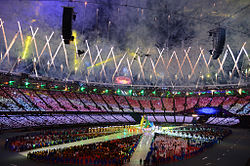
The opening ceremony of the 2012 Summer Olympics took place on the evening of Friday 27 July 2012 in the Olympic Stadium, London, during which the Games were formally opened by Queen Elizabeth II. As mandated by the Olympic Charter, the proceedings combined the ceremonial opening of this international sporting event (including welcoming speeches, hoisting of the flags and the parade of athletes) with an artistic spectacle to showcase the host nation's culture. The spectacle was entitled Isles of Wonder[1] and directed by the Academy Award-winning British film director Danny Boyle, with Paulette Randall as associate director.
Prior to London 2012, there had been considerable apprehension about Britain's ability to stage an opening ceremony that could reach the standard set at the BeijingSummer Games of 2008.[2][3][4] The 2008 ceremony had been noted for its scale, extravagance and expense, hailed as the "greatest ever",[5] and had cost £65m. In contrast, London spent an estimated £27m (out of £80m budgeted for its four ceremonies), which was nevertheless about twice the original budget.[6] Nonetheless, the London opening ceremony was immediately seen as a tremendous success, widely praised as a "masterpiece" and "a love letter to Britain".[7][8][9]
The ceremony began at 21:00 BST and lasted almost four hours.[10] It was watched by an estimated worldwide television audience of 900 million, falling short of the IOC's 1.5 billion viewership estimate for the 2008 ceremony,[11][12] but becoming the most viewed in the UK and US.[13][14] The content had largely been kept secret before the performance, despite involving thousands of volunteers and two public rehearsals. The principal sections of the artistic display represented Britain's Industrial Revolution, National Health Service, literary heritage, popular music and culture, and were noted for their vibrant storytelling and use of music. Two shorter sections drew particular comment, involving a filmed cameo appearance of the Queen with James Bond as her escort, and a live performance by the London Symphony Orchestra joined by comedian Rowan Atkinson. These were widely ascribed to Britain's sense of humour.[15] The ceremony featured children and young people in most of its segments, reflecting the "inspire a generation" aspiration of London's original bid for the Games.[16]
The BBC released footage of the entire opening ceremony on 29 October 2012, edited by Danny Boyle and with background extras, along with more than seven hours of sporting highlights and the complete closing ceremony.[17]
Preparations
The London Organising Committee of the Olympic and Paralympic Games (LOCOG) approached Danny Boyle to be the director of the ceremony in June 2010, and he immediately accepted.[18][19] Boyle explained that there had been four things that made him take the job: he was a big Olympics fan, he lived a mile from the Stadium and so felt invested in the area, his late father's birthday was on the ceremony's date, and he felt his "Oscar clout" would enable him to push through what he wanted to do.[20] He said it "felt weirdly more like a ... civic or national responsibility" to take the job.[21]

Boyle acknowledged that the extravagance of the 2008 opening ceremony was an impossible act to follow — "you can't get bigger than Beijing" — and that this realisation had in fact liberated his team creatively. He said "..obviously I'm not going to try and build on Beijing, because how could you? We can't, and you wouldn't want to, so we're going back to the beginning. We're going to try and give the impression that we're rethinking and restarting, because they've (opening ceremonies) escalated since Los Angeles in 1984. They've tried to top themselves each time and you can't do that after Beijing."[22][23] Beijing's budget had been £65m, whereas London's final budget was £27m, which was twice the original provision.[6][24] The London stadium had the same number of seats as Beijing's, but was half the size; this intimacy of scale meant that Boyle felt he could achieve something personal and connecting.[22][25]
The different sections of the ceremony were designed to reflect aspects of British history and culture, with the title Isles of Wonder partly inspired by Shakespeare's play The Tempest (particularly Caliban's 'Be not afeard' speech[26]), and partly by the G. K. Chesterton aphorism: "The world shall perish not for lack of wonders, but for lack of wonder."[25][27]
In July 2010, Boyle started brainstorming ideas with designer Mark Tildesley, writer Frank Cottrell-Boyce and costume designer Suttirat Anne Larlarb. They considered "what was essentially British", with the non-British Larlarb able to offer a view of what the world thought Britain meant. Cottrell-Boyce had given Boyle a copy of Pandaemonium, (named after the capital of Hell in Paradise Lost) by Humphrey Jennings, which collated contemporary reports from the Industrial Revolution.[18][27][28] It had become traditional during the opening ceremony to "produce" the Olympic rings in a spectacular manner. Cottrell-Boyce commented: "Danny had a very clear idea that in the first 15 minutes you had to have a great, startling image that could go around the world; it had to climax with something that made people go 'Oh my God!'" Boyle decided that "the journey from the pastoral to the industrial, ending with the forging of the Olympic rings" would be that image.[18]
The ten distinct chapters on which the team started work were gradually compressed into three principal movements: the violent transition from "Green and Pleasant Land" to the "Pandemonium" of industrial revolution, a salute to the NHS and children's literature, and a celebration of pop culture, technology and the digital revolution.[18]
"At some point in their histories, most nations experience a revolution that changes everything about them. The United Kingdom had a revolution that changed the whole of human existence.
1709 schmolz Abraham Darby Eisen in einem Hochofen mithilfe von Koks . Damit begann die Industrielle Revolution . Aus Abrahams Hochofen in Shropshire floss flüssiges Metall. Seinem Genie entsprangen Mühlen, Webstühle, Maschinen, Waffen, Eisenbahnen, Schiffe, Städte, Konflikte und der Wohlstand, die die Welt, in der wir leben, prägten.
Im November 1990 entfachte ein anderer Brite eine weitere, ebenso weitreichende Revolution, die bis heute anhält. Die digitale Revolution wurde durch Tim Berners-Lees bahnbrechende Erfindung – das World Wide Web – ausgelöst . Es, so sagte er, sei für alle da.
Wir heißen Sie herzlich willkommen zu einer Olympischen Eröffnungsfeier für alle. Eine Feier, die die Kreativität, Exzentrik, Kühnheit und Offenheit des britischen Genies zelebriert, indem sie das Genie, die Kreativität, die Exzentrik, die Kühnheit und die Offenheit des modernen Londons vereint.
Sie hören die Worte unserer großen Dichter – Shakespeare , Blake und Milton . Sie erleben den mitreißenden Sound unserer unvergleichlichen Popkultur. Sie sehen Figuren aus unserer großartigen Kinderliteratur – Peter Pan und Captain Hook , Mary Poppins , Voldemort , Cruella de Vil . Sie sehen ganz normale Familien und außergewöhnliche Sportler. Tanzende Krankenschwestern, singende Kinder und atemberaubende Spezialeffekte.
Doch wir hoffen auch, dass Sie inmitten all des Lärms und der Aufregung einen einzigen roten Faden erkennen werden – die Idee von Jerusalem – von einer besseren Welt, einer Welt wahrer Freiheit und echter Gleichheit, einer Welt, die durch den Wohlstand der Industrie, durch die fürsorgliche Nation, die den Wohlfahrtsstaat geschaffen hat, durch die mitreißende Energie der Popkultur und durch den Traum von universeller Kommunikation aufgebaut werden kann. Der Glaube, dass wir Jerusalem bauen können. Und dass es für alle da sein wird.
When Boyle returned to work on the ceremony in the spring of 2011 he asked Rick Smith of Underworld, with whom he had worked on several film projects as well as his theatrical production of Mary Shelley's Frankenstein, to be the musical director.[18][30] At the same time the team moved to the Three Mills studio complex in east London, where a 4x4 metre scale model of the stadium was built. For security reasons, a single CGI-assisted version of the ceremony was kept on editor Sascha Dhillon's laptop; anyone needing it had to come to the studio.[18]
The cast included professional performers and 7,500 volunteers.[31] Boyle considered the volunteers to be "the most valuable commodity of all". In November 2011 they auditioned at Three Mills, and rehearsals began in earnest in spring 2012 at an open-air site at Dagenham (the abandoned Ford plant), often in foul weather. Although key contributors had to sign non-disclosure agreements and some elements were codenamed, Boyle placed immense trust in the volunteers by asking them simply to "save the surprise" and not leak any information.[18][21] Further volunteers were recruited to help with security and marshalling, and to support the technical crew.[23][32] Three weeks before the ceremony, Mark Rylance, who was to have taken a leading part, pulled out after a family bereavement and was replaced by Kenneth Branagh.[33][34]
The Olympic Bell, the largest harmonically tuned bell in the world,[35] weighing 23 tonnes, had been cast in brass under the direction of the Whitechapel Bell Foundry by Royal Eijsbouts of the Netherlands, and hung in the Stadium.[36] It was inscribed with a line from Caliban's speech in The Tempest: "Be not afeard, the isle is full of noises".[37]
Boyle legte großen Wert auf das Londoner Motto „Eine Generation inspirieren“ für die Olympischen Spiele 2012 und entwickelte ein Programm, das stark auf Kinder und Jugendliche setzte und sich um Themen drehte, die junge Menschen ansprachen. 25 Schulen in den sechs ursprünglichen Londoner Austragungsorten rekrutierten Kinder als freiwillige Helfer für die Aufführung, und 170 Schüler der Oberstufe (16–18 Jahre), die zusammen über 50 Sprachen sprachen, wurden von ihren Colleges und Schulen gewonnen.
Am 12. Juni 2012 hatte Boyle auf einer Pressekonferenz ein riesiges Bühnenbild des ländlichen Großbritanniens angekündigt , das unter anderem eine Dorf- Cricketmannschaft, Nutztiere, ein Modell des Glastonbury Tor sowie einen Maibaum und eine Regenwolke umfassen sollte. Er wollte damit die ländliche und städtische Landschaft Großbritanniens darstellen. Geplant war an beiden Enden des Bühnenbildes jeweils ein Moshpit: einer mit Besuchern eines Rockfestivals und der andere mit der „ Last Night of the Proms“ .
Boyle versprach eine Zeremonie, an der sich jeder beteiligt fühlen würde; er sagte: „Ich hoffe, sie wird zeigen, wie eigenwillig und widersprüchlich wir sind – und wie warmherzig wir hoffentlich auch sind.“ Teile des Bühnenbildes wurden mit echtem Gras und Erde gestaltet. [ 38 ] [ 39 ] Der Einsatz von Tieren (40 Schafe, 12 Pferde, 3 Kühe, 2 Ziegen, 10 Hühner, 10 Enten, 9 Gänse und 3 Hütehunde, betreut von 34 Tierpflegern) stieß bei der Tierrechtsorganisation PETA auf Kritik. Boyle, der von der RSPCA beraten wurde , versicherte PETA, dass die Tiere gut versorgt würden. [ 40 ] Nach der Pressekonferenz fielen die Kommentare in der britischen Presse überwiegend negativ aus und zogen „Hunderte von Kommentaren im Internet nach sich, die die Ansicht, die Eröffnungszeremonie würde ein Desaster werden, voll und ganz unterstützten.“ [ 41 ]
The overwhelming majority of the music used was British. The team worked next door to the office of the musical director for the closing ceremony, David Arnold, and so hearing each other's music there was a scramble to claim a particular song first.[42]A.R. Rahman, who worked with Boyle on Slumdog Millionaire and 127 Hours, composed a Punjabi song "Nimma Nimma" to showcase Indian influence in the UK, according to Boyle's wishes.[43] More Indian music was also scheduled for inclusion in the medley including a Tamil song from the 1989 Bollywood film Ram Lakhan titled "Naanthaan Ungappanda".[44][45]Paul McCartney was to be the ceremony's closing act.[46]
Sebastian Coe was instrumental in asking the Queen to take part, responding positively when Boyle first pitched the Happy and Glorious film sequence featuring the Queen. Boyle suggested that the Queen be played either by a lookalike, or by a world-class actress such as Helen Mirren, in a location to double as Buckingham Palace. Coe asked Princess Anne, a British member of the IOC and LOCOG, what she thought, and she told him to ask the Queen. Coe presented the idea to the Queen's Deputy Private Secretary.[47] Boyle was surprised to hear that the Queen would be happy to play herself, and wanted a speaking part.[21] Filming took place in late March 2012, and Happy and Glorious was produced by the BBC, as was the opening film sequence Journey along the Thames.[48]
Changes were still being made to the programme in the final days before the ceremony: a BMX bike section was dropped due to time constraints, and the "Pandemonium" and "Thanks..Tim" sections were edited down.[18] In 2016 Boyle recounted how he had come under pressure from Jeremy Hunt, then the Olympics and Culture Secretary, to cut back the NHS section, which he had saved only by threatening to resign and take the volunteers with him.[49]
Two full dress and technical rehearsals took place in the Olympic stadium, on 23 and 25 July, in front of an audience of 60,000 comprising volunteers, cast members' families, competition winners, and others connected to the Games. Boyle asked them not to "spoil the surprise" by using the hashtag #savethesurprise on social media, keeping the performance a secret for the hundreds of millions who would watch on the Friday night.[27][50]
Officials and guests
Royal Box
Seated in the Royal Box were the Queen and the Duke of Edinburgh, the Prince of Wales, and other members of the British royal family. They were accompanied by Archbishop of CanterburyRowan Williams, Prime MinisterDavid Cameron, Spouse of the Prime MinisterSamantha Cameron, former Prime Ministers John Major, Tony Blair and Gordon Brown and Mayor of LondonBoris Johnson. Officials of the Olympic movement included President of the IOCJacques Rogge, LOCOG Chairman Sebastian Coe and members of the IOC.
International dignitaries
The ceremony was the largest gathering of world leaders for an Olympic and sporting event in history, surpassing that of 2008. Three multilateral leaders, more than ninety-five heads of state and government and representatives from five organisations and one hundred and twenty countries attended.[51][52]
Proceedings
Schedule
| Time (BST) | Section title |
|---|---|
| 27 July 2012 | |
| 21:00–21:04 | Countdown |
| 21:04–21:09 | Green and Pleasant Land |
| 21:09–21:25 | Pandemonium |
| 21:25–21:35 | Happy and Glorious |
| 21:35–21:47 | Second to the right, and straight on till morning |
| 21:47–21:52 | Interlude |
| 21:52–22:09 | Frankie and June say...thanks Tim |
| 22:09–22:20 | Abide with Me |
| 22:20–00:00 | Welcome |
| 28 July 2012 | |
| 00:00–00:07 | Bike a.m. |
| 00:07–00:24 | Let the Games Begin |
| 00:24–00:38 | There Is a Light That Never Goes Out |
| 00:38–00:46 | And in the end |
Prologue

Um genau 20:12 Uhr BST flogen die Red Arrows über das Olympiastadion und anschließend über das Konzertgelände im Hyde Park . [ 53 ] Bei diesem Konzert traten Künstler auf, die die vier Nationen des Vereinigten Königreichs repräsentierten: Duran Duran , Stereophonics , Snow Patrol und Paolo Nutini . [ 54 ]
Zu Beginn enthielt das Stadion eine ländliche Szene mit einem Modell des Glastonbury Tor , einem Modelldorf und einem Wasserrad, komplett mit lebenden Tieren (die kurz vor Beginn der Zeremonie entfernt wurden) sowie Schauspielern, die arbeitende Dorfbewohner, Fußball- und Cricketspieler darstellten.
Frank Turner spielte drei Lieder („Sailor’s Boots“, „Wessex Boy“ und „ I Still Believe “) auf dem nachgebauten Glastonbury Tor, begleitet von Emily Barker , Ben Marwood und Jim Lockey sowie seiner regulären Begleitband The Sleeping Souls. [ 55 ] Anschließend spielte LSO On Track (ein Orchester aus 80 jungen Musikern aus zehn ostlondoner Bezirken und 20 Mitgliedern des LSO) Edward Elgars „ Nimrod “ aus den Enigma-Variationen , untermalt von Ausschnitten aus dem BBC- Seewetterbericht und maritimen Bildern auf Großbildleinwänden, während das Publikum blaue Laken hochhielt, um den Anblick des Ozeans zu simulieren. [ 56 ] Diese Aufführung würdigte Großbritanniens maritimes Erbe und seine geografische Insellage. [ 57 ]
Countdown (21:00–21:04 BST)
Die Zeremonie begann um 21:00 Uhr nach einem einminütigen Countdown-Film mit dem Titel „60 bis 1“, der aus Aufnahmen von Zahlen bestand, beispielsweise von Haustüren, Straßenschildern, Londoner Bussen , Bahnsteigen und Marktschildern. Die Zahl 39 ist am Fuße einer Treppe zu sehen – eine Anspielung auf John Buchans Roman „ Die neununddreißig Stufen“ –, während die 10 die Hausnummer von Downing Street Nr. 10 ist .

A two-minute film, Journey along the Thames, directed by Boyle and produced by the BBC, opened the ceremony.[58] To the sound of "Surf Solar" by Fuck Buttons, it followed the River Thames from its source to the heart of London, juxtaposing images of contemporary British life with pastoral shots and flashes of scenes from the stadium. The characters Ratty, Mole and Toad from The Wind in the Willows were briefly seen, as was a "Monty Python hand" pointing towards London on umbrellas, an InterCity 125 train passing the Olympic rings as crop circles in a field, and a rowing race (to the tune of the "Eton Boating Song").
At Battersea Power Station a Pink Floyd pig was flying between the towers; the clock sound from another Pink Floyd song "Time" was heard passing Big Ben. The soundtrack included clips from the theme tune of The South Bank Show, "Caprice No. 24" (as composed by Andrew Lloyd Webber in his Variations fusion album), and the Sex Pistols' "God Save the Queen" as the film followed the route of the band's cruise down the River Thames during the Silver Jubilee.[59][60]
After lifting to an aerial view of East London mirroring the title sequence of the BBC soap opera EastEnders, to the sound of the drum beats from the closing theme, the film flashed down through the Thames Barrier. The view progressed into Bow Creek, and then below surface through a London Underground train and station, including historic footage of Isambard Kingdom Brunel's Thames Tunnel, and through the Rotherhithe Tunnel, accompanied by clips of an orchestral rendition of Elgar's Pomp and Circumstance Marches, "London Calling" by The Clash, the London Underground's Mind the Gap public address warning, and "Smile" by Lily Allen. It then switched to a sequence filmed outside the stadium shortly before the ceremony, superimposed with posters from previous Summer Olympics (all of them except 1900 Paris, 1936 Berlin, 1984 Los Angeles, and 1996 Atlanta), to a recording of "Map of the Problematique" by Muse. This ended with a live shot of three cast members holding the posters for the 2012 competition.
There was then a ten-second countdown in the stadium, with children holding clusters of balloons that burst simultaneously, with the audience shouting out the numbers. Bradley Wiggins, who had won the Tour de France five days earlier, opened the ceremony by ringing the Olympic Bell that hung at one end of the stadium. Four upper-atmosphere balloons were released, each expected to carry a set of Olympic rings and a camera up to the mid-stratosphere.
Green and Pleasant Land (21:04–21:09)
Be not afeard: the isle is full of noises, Sounds, and sweet airs, that give delight, and hurt not. Sometimes a thousand twangling instruments Will hum about mine ears; and sometimes voices, That, if I then had wak'd after long sleep, Will make me sleep again: and then, in dreaming, The clouds methought would open and show riches Ready to drop upon me; that, when I wak'd, I cried to dream again.
Die Darstellung des ländlichen Lebens in der Arena wurde als „Erinnerung und Versprechen eines besseren Lebens in der Vergangenheit und Zukunft“ angekündigt. Jugendchöre begannen mit A-cappella- Aufführungen der inoffiziellen Hymnen der vier Nationen des Vereinigten Königreichs: „ Jerusalem “ (für England , gesungen von einem Live-Chor im Stadion), „ Danny Boy “ (vom Giant’s Causeway in Nordirland ), „ Flower of Scotland “ (vom Edinburgh Castle in Schottland ) und „ Bread of Heaven “ (vom Rhossili Beach in Wales ). [ 61 ] Diese wurden mit Aufnahmen von bemerkenswerten Versuchen der Rugby-Union-Nationen der Home Nations , Englands siegbringendem Dropgoal aus dem Finale der Rugby-Weltmeisterschaft 2003 und Live-Bildern aus dem Stadion kombiniert .
Nach dem letzten Chorauftritt fuhren historische Postkutschen der London General Omnibus Company ein, besetzt mit Geschäftsleuten und frühen Industriellen in viktorianischer Kleidung und Zylindern , angeführt von Kenneth Branagh als Isambard Kingdom Brunel . Die 50 Männer stiegen aus den Kutschen und betrachteten die Landschaft anerkennend. Nachdem sie den Glastonbury Tor betreten hatten, hielt Brunel Calibans Rede „Fürchtet euch nicht“, die Boyles Einleitung zur Zeremonie im Programmheft [ 62 ] aufgriff und die Sehnsucht nach neuer Industrie oder einer neuen Ära in Großbritannien symbolisierte. Dies kündigte den nächsten Teil der Zeremonie an.
Pandemonium (21:09–21:25)
Dieser Abschnitt fasst die wirtschaftliche und soziale Entwicklung Großbritanniens von der ländlichen Wirtschaft über die Industrielle Revolution bis in die 1960er Jahre zusammen.

Proceedings were suddenly interrupted by a loud shout, recorded by volunteers during the rehearsals, followed by drumming (the pre-recorded drumming amplified by 965 cast members drumming on inverted household buckets and bins),[63] led by Evelyn Glennie.[64] The three-tonne oak tree on top of the Glastonbury Tor lifted, and industrial workers emerged from both the Tor's brightly lit interior and the entrances to the stadium, to swell the cast to a total of 2,500 volunteers.[18] So began what Boyle had called the "biggest scene change in theatre history" and something he had been advised against attempting.[65]Underworld's "And I Will Kiss" began to play, as the cast rolled away the grass and other rural props.
Seven smoking chimney stacks with accompanying steeplejacks rose from the ground, along with other industrial machinery: five beam engines, six looms, a crucible and a water wheel (one of the few items left from the rural scene). Boyle said that this section celebrated the "tremendous potential" afforded by the advancements of the Victorian era.[61] It also included a minute's silence in remembrance of the loss of life of both world wars, featuring British "Tommies" and shots of poppies, during which the names of the Accrington Pals were shown on the stadium screens. Unprompted, members of the audience stood in respect during this segment.[66][67]
Volunteers paraded around the stadium representing some of the groups that had changed the face of Britain: the woman's suffrage movement, the Jarrow Crusade, the first Caribbean immigrants arriving in 1948 on board the Empire Windrush, a 1970s DJ float, the Nostalgia Steel Band, and the Beatles as they appeared on the cover of Sgt. Pepper's Lonely Hearts Club Band. Also included were real-life Chelsea Pensioners, the Grimethorpe Colliery Band, and a group of Pearly Kings and Queens.

Workers began casting an iron ring. As the noise level and tension built, driven by the relentless rhythm of the music and the drumming, participants mimed repetitive mechanical movements associated with industrial processes such as weaving. Four glowing orange rings gradually began to be carried high above the stadium toward its centre on overhead wires, and then the ring seemingly being cast and forged in the arena began to rise. The five rings converged, still glowing and accompanied by steam and firework effects to give the impression that they were of hot metal. When the five rings formed the Olympic symbol above the stadium, they ignited and rained fire in silver and gold. The image of the Olympic rings in flame became the iconic image of the ceremony, reproduced in newspapers and web stories around the world.[59][68]
Happy and Glorious (21:25–21:35)
A short film directed by Boyle and produced by the BBC, called Happy and Glorious (after a line in the national anthem), featured the character James Bond, played by then-Bond actorDaniel Craig, entering the front gate of Buckingham Palace in a London black cab. His entrance (accompanied by an arrangement of Handel's "Arrival of the Queen of Sheba") is noticed by Brazilian children (a nod to Rio de Janeiro, which was to be the next summer Games host city) in the throne room. Bond meets Elizabeth II (who played herself, acknowledging Bond with the words, "Good evening, Mr Bond") in her audience room at the palace, walks with her out of the building and into a waiting AgustaWestland AW139 helicopter. The film followed the helicopter across London, with shots of a cheering crowd on The Mall, Nelson's Column, the Palace of Westminster with an animated Winston Churchill statue in Parliament Square, and of the Thames past the London Eye, St Paul's Cathedral, the financial district City of London.
Der Hubschrauber überflog anschließend die Tower Bridge , begleitet vom Dambusters-Marsch . Der Film endete damit, dass Bond und die Queen scheinbar live über dem Stadion aus einem echten Hubschrauber sprangen, untermalt von der „ James Bond-Titelmelodie “. [ 59 ] [ 69 ] Die Queen und der Herzog von Edinburgh wurden zusammen mit Rogge dem Publikum vorgestellt. Die Queen trug dasselbe Kleid wie im Film, als wäre sie gerade mit Bond eingetroffen.
Die Idee des königlichen Hubschraubersprungs wurde erstmals von Regisseur Danny Boyle Sebastian Coe vorgestellt . Dieser war so begeistert, dass er sie im Sommer 2011 Edward Young , dem Privatsekretär der Königin, im Buckingham Palace präsentierte. Young hörte aufmerksam zu, lachte und versprach, die Chefin zu fragen. Coe erfuhr, dass die Königin gerne teilnehmen würde. Young, Boyle und Coe vereinbarten, den Plan geheim zu halten, um die Überraschung nicht zu verderben. Am 19. September 2022, dem Morgen der Beerdigung der Königin , erzählte Coe BBC News, er habe das Konzept ursprünglich Prinzessin Anne vorgestellt, deren einzige Frage gewesen sei: „Was für ein Hubschrauber?“ [ 70 ] Bereits 2014, während eines Staatsbesuchs des irischen Präsidenten Michael Higgins , hatte die Königin selbst den Humor der Idee teilweise Boyles irischen Wurzeln zugeschrieben und gesagt: „Es brauchte jemanden irischer Abstammung, Danny Boyle, um mich dazu zu bringen, aus einem Hubschrauber zu springen.“ [ 71 ]
Für die Szenen mit dem Hubschrauber wurde die Königin von der Schauspielerin Julia McKenzie gedoubelt . [ 72 ] Den Fallschirmsprung absolvierte der Basejumper und Stuntman Gary Connery in Kleid, Hut, Schmuck und Handtasche. [ 73 ] [ 74 ] Bond wurde von Mark Sutton gespielt . [ 75 ] Der Hubschrauber war vom Flugplatz Stapleford in Essex zum Stadion geflogen und wurde von Marc Wolff gesteuert .
Anschließend wurde die britische Flagge von Mitgliedern der britischen Streitkräfte gehisst , während die erste und dritte Strophe der Nationalhymne a cappella vom Kaos Signing Choir for Deaf and Hearing Children vorgetragen wurden . [ 61 ]
Zweite Straße rechts, dann immer geradeaus bis zum Morgen (21:35–21:47)
Der erste Teil dieser Sequenz feierte den Nationalen Gesundheitsdienst (NHS ) („die Institution, die unsere Nation wie keine andere vereint“, so das Programm), der im Jahr der vorangegangenen Olympischen Spiele 1948 in London gegründet worden war. Die Musik stammte von Mike Oldfield . Sechshundert Tänzer, darunter auch NHS-Mitarbeiter, sowie 1.200 Freiwillige, teils aus britischen Krankenhäusern rekrutiert, betraten zusammen mit Kindern auf 320 Krankenhausbetten, von denen einige als Trampoline dienten , die Bühne. Sie begannen mit einer kurzen Jive-Choreografie. Vom Tor aus beobachteten speziell eingeladene Krankenhausmitarbeiter und neun Kinderpatienten des Great Ormond Street Hospital das Geschehen . [ 76 ] Die Decken auf den Betten waren beleuchtet, und die Betten waren so angeordnet, dass sie das Gesicht eines Kindes mit einem Lächeln und einer Träne darstellten (das Logo der Hospital Children's Charity). Das Akronym „GOSH“ verwandelte sich dann in die Initialen „NHS“ und nahm die Form einer Mondsichel an, während die Kinder von den Krankenschwestern in den Schlaf gewiegt und ihnen vorgelesen wurden.
Anschließend wurde die britische Kinderliteratur gefeiert . J.K. Rowling begann mit einer Lesung aus J.M. Barries „ Peter Pan“ (dessen Urheberrechte an das Great Ormond Street Hospital übertragen wurden). Der Kinderfänger erschien unter den Kindern, gefolgt von riesigen Puppen, die Schurken aus der britischen Kinderliteratur darstellten: die Herzkönigin , Captain Hook , Cruella de Vil und Lord Voldemort . Wenige Minuten später schwebten 32 Frauen, die Mary Poppins spielten , mit ihren Regenschirmen herab, während die Schurken in sich zusammenfielen und die Schauspieler wieder tanzten. [ 59 ] Die Musik dieser Sequenz enthielt teilweise neu arrangierte Abschnitte aus „Tubular Bells“ (mit einem riesigen Glockenspiel im Hintergrund), „ Tubular Bells III “ und, nachdem die Schurken von den Mary-Poppins-Figuren vertrieben worden waren, „ In Dulci Jubilo“ . [ 77 ] Während dieser Aufführung sprangen die Kinder in ihren Pyjamas auf ihren hell erleuchteten Betten auf und ab und schufen so ein unvergessliches Bild inmitten der Dunkelheit des Stadions.
Die Sequenz endete mit dem blassen, riesigen Kopf eines Babys, dessen Körper von einem sich wellenden Laken dargestellt wurde, in der Mitte der Arena. Damit wurden die schottischen Pioniere der geburtshilflichen Ultraschallbildgebung geehrt . [ 78 ]
Zwischenspiel (21:47–21:52)
Simon Rattle was then introduced to conduct the London Symphony Orchestra in a performance of Vangelis's "Chariots of Fire", as a tribute to the British film industry with Rowan Atkinson reprising his role as Mr. Bean, comically playing a repeated note on a synthesiser. He then lapsed into a filmed dream sequence in which he joined the runners from the film Chariots of Fire, beating them in their iconic run along West Sands at St Andrews by riding in a car, rejoining the race and tripping the front runner. Danny Boyle later said: "It wasn't actually Mr. Bean. Strictly speaking, the name of his character was Derek." In 2021's Happy Birthday Mr Bean documentary, Atkinson also stated that the performance was not actually intended to be the character Mr. Bean.[79][80]
Frankie and June say...thanks Tim (21:52–22:09)
This sequence celebrated British popular music and culture, paying homage to each decade since the 1960s.[81] To the accompaniment of the BBC newsreel theme "Girls in Grey" and the theme tune from The Archers, a young mother and son arrive in a Mini Cooper at a full-size replica of a modern British house. The 1987 "don't worry about a hurricane" weather forecast by Michael Fish was shown on the big screens as rain suddenly poured on the house, followed by "Push the Button", by Sugababes. In the centre of the arena the sides of another house, three times larger, were used as screens to show clips from various TV programmes, music videos and films, including A Matter of Life and Death (June is named for its protagonist), as well as Gregory's Girl, Kes, Bedknobs and Broomsticks, The Snowman, The Wicker Man, Modern Family, Four Weddings and a Funeral, British soap operas Coronation Street and EastEnders, Spanish TV show Cuéntame cómo pasó, and Boyle's own Trainspotting on the top and the inside of the house on the bottom.[82] A large group of dancers, centred around Frankie and June (19-year-old Henrique Costa and 18-year-old Jasmine Breinburg) on a night out, performed to an assortment of British popular songs arranged broadly chronologically, beginning with "Going Underground" by The Jam, suggesting a ride on the London Underground. During this track images of the Underground were projected onto the house and former London Mayor Ken Livingstone was briefly seen driving the train. Throughout the sequence cast members were texting each other or placing social networking status updates on the Internet. Frankie and June first notice each other as a snippet from "Wonderful Tonight" by Eric Clapton plays, but when Frankie saw that June had dropped her phone on the Tube, he set off to return it (communicating using last number redial to her sister's phone).

An extended dance sequence followed, with songs including "My Generation" by The Who, "(I Can't Get No) Satisfaction" by the Rolling Stones, "My Boy Lollipop" sung by Millie Small, "All Day and All of the Night" by the Kinks, "She Loves You" by the Beatles (with footage of the band performing the song), "Trampled Under Foot" by Led Zeppelin, "Starman" by David Bowie, "Bohemian Rhapsody" by Queen (during which the sound of the TARDIS from Doctor Who could be heard), "Pretty Vacant" by the Sex Pistols (during which dancers on power jumpers wearing large heads with Mohawk hairstyles performed a pogo dance, and the lyrics to the song were spelt out in LED lights around the stadium), "Blue Monday" by New Order, "Relax" by Frankie Goes to Hollywood (during which Frankie, asked by June for his name, replied by revealing one of the band's "Frankie say..." T-shirts), "Back to Life (However Do You Want Me)" by Soul II Soul, "Step On" by Happy Mondays, "Sweet Dreams (Are Made of This)" by Eurythmics, "Firestarter" by The Prodigy, and "Born Slippy .NUXX" by Underworld, ending with the cast singing "I'm Forever Blowing Bubbles" as Frankie and June walked towards each other. A sequence from the film Four Weddings and a Funeral was projected behind them; when they kissed, a montage of memorable kisses from film, TV and real life was shown (including one of the first interracial kisses on British television in Emergency Ward 10 and the first lesbian kiss from Brookside, which in some countries, including Saudi Arabia, then became the first lesbian kiss ever shown on pre-watershed television),[59] while "Song 2" by Blur was played. A live performance of "Bonkers" by Dizzee Rascal (who grew up in the host borough of Tower Hamlets)[83 ] folgte eine weitere Sequenz, in der die gesamte Besetzung (unddas Tanzduo Signature aus „Britain’s Got Talent “) an einer Party in Junes Haus teilnimmt, während Amy Winehouses „ Valerie “, Muses „ Uprising “ und Tinie Tempahs „ Pass Out “ gespielt werden. [ 77 ]
Zum Abschluss, während Emeli Sandés „ Heaven “ erklang, wurde die Tribüne hochgefahren und gab den Blick auf Tim Berners-Lee frei , der an einem NeXT-Computer arbeitete – demselben, mit dem er das World Wide Web erfunden hatte . Er twitterte: „Das ist für alle“ [ 84 ] , was sofort in LED-Lichtern im ganzen Stadion projiziert wurde. [ 59 ] [ 85 ] Im Programmheft hieß es: „Musik verbindet uns miteinander und mit den wichtigsten Momenten unseres Lebens. Eine der Voraussetzungen für diese Verbindungen ist das World Wide Web.“ Boyle wollte Berners-Lee dafür ehren, dass er das World Wide Web kostenlos und für alle zugänglich gemacht hatte (daher der Tweet), anstatt damit kommerziellen Gewinn zu erzielen. [ 86 ]
Bleibt bei mir (22:09–22:20)
Eine gefilmte Sequenz zeigte Ausschnitte des Fackellaufs durch Großbritannien, untermalt von David Holmes' Musik „I Heard Wonders“ . Anschließend wurde live zu sehen, wie David Beckham in einem dramatisch beleuchteten Motorboot die Themse hinunter und unter der Tower Bridge hindurchfuhr , begleitet von einem Feuerwerk, während die Fußballerin Jade Bailey die Fackel im Boot hielt. Dieser Abschnitt war am 24. Juli 2012 geprobt worden, wobei die Nahaufnahmen vorab aufgezeichnet wurden [ 87 ] , und wurde von Stephen Daldry inszeniert .
There was then a tribute to "..friends and family of those in the stadium who cannot be here tonight", including the victims of the "7/7" 2005 London bombings (on the day after London had been awarded the Games).[88] Photos of people who had died were displayed on screens as a memorial, accompanied by an excerpt from Brian Eno's ambient work "An Ending (Ascent)". The hymn "Abide with Me" was then sung by Emeli Sandé[59][77] while a group of dancers choreographed by and including Akram Khan performed a contemporary dance on the theme of mortality.[89][90]
Welcome (22:20–00:00)

The Parade of Nations of athletes (drawn from the 10,490 competing) and officials from 204 nations (and also the "Independent Olympic Athletes") was led, according to custom, by the Greek team, followed by other competing countries in alphabetical order, and finally the host nation Great Britain. Each of the 205 teams entered the stadium led by their flagbearer, accompanied by a child volunteer carrying a copper petal (later revealed to be part of the cauldron) and a young woman carrying a sign with the country's name in English (and wearing a dress made from fabric printed with photos of people who had applied to be Olympic volunteers).[91]
The parade was accompanied by mainly British dance tracks and popular songs, including "Galvanize" by Chemical Brothers, "West End Girls" by Pet Shop Boys, "Rolling in the Deep" by Adele, "Stayin' Alive" by the Bee Gees and both "Where the Streets Have No Name" and "Beautiful Day" by Irish band U2, with Great Britain entering to David Bowie's song "'Heroes'".[61] Welsh drum and bass DJ High Contrast mixed and sequenced the music for the athletes' parade.[42]
Music with a fast rhythm of 120 bpm[18] was used in an attempt to keep the teams walking quickly around the stadium, and this was reinforced by the drummers in the stadium; nevertheless the parade part of the programme took 1 hour 40 minutes to complete, compared to the 1 hour 29 minutes estimated in the official media guide. Once all of the athletes were inside the stadium, seven billion small pieces of paper were dropped from a Westland helicopter, each piece representing one person on Earth. Each nation's flag was planted on the Glastonbury Tor.
Bike a.m. (00:00–00:07 BST 28 July)

Once the athletes had gathered in the centre of the stadium, Arctic Monkeys performed "I Bet You Look Good on the Dancefloor" and The Beatles' "Come Together", the latter while 75 cyclists circled the stadium with wings lit by LEDs representing Doves of Peace. Doves were traditionally released at Olympic opening ceremonies, although real birds have not been used since 1992. A single dove cyclist, his beak painted yellow in honour of Bradley Wiggins, appeared to fly out of the stadium.
Let the Games Begin (00:07–00:24)

The formal part of the ceremony was introduced by Sebastian Coe, speaking from the Tor and surrounded by flags of the participating nations. He welcomed the watching world to London. He expressed pride in being British and part of the Olympic movement, and said that the Olympics "brings together the people of the world...to celebrate what is best about mankind".[59] He continued to speak of the "truth and drama" of sport, and then thanked Britain for "making all this possible". Rogge responded by thanking London, stating that it was the third time that London had held the Games, following 1908, held at short notice when Rome was unable to do so (after a volcanic eruption), and 1948 three years after the end of World War II. Rogge thanked the thousands of volunteers, to huge cheers. He announced that for the first time in Olympic history, every team had female participants. Rogge acknowledged the important role the UK had played as "the birthplace of modern sport", codifying its "fair play" ethos and building sport into the school curriculum. He appealed to athletes to play fairly and be drug-free, according to the values of Baron de Coubertin, reminding them that they were role models who would "inspire a generation". After expressing these sentiments again briefly in French, he invited the Queen to open the Games.[59]
The Queen declared the competition officially open, immediately followed by a trumpet fanfare based on a theme from Tubular Bells by Mike Oldfield and then a fireworks display.[59] The 2012 ceremony was the second time the Queen had opened an Olympic Games, the first being the 1976 Summer Olympics in Montreal in her capacity as Queen of Canada. It was also the first time any individual had opened a Summer Olympics twice (two more Olympiads had been opened on her behalf, with a further two Winter Games opened on her behalf).
The Olympic Flag was carried by eight people chosen from around the world to embody the Olympic values: Doreen Lawrence (chosen for her "tireless thirst for justice"), Haile Gebrselassie (for his "fight against poverty"), Sally Becker (for her "courage"), Ban Ki-moon (as UN secretary-general), Leymah Gbowee (as "a great peacemaker"), Shami Chakrabarti (for "her integrity"), Daniel Barenboim (for bringing "harmony in place of discord"), and Marina Silva (as UN Champion of the Earth).[92] The flag paused in front of Muhammad Ali (invited to represent "respect, confidence, conviction, dedication, generosity and spiritual strength"), who held it for a few moments. The flag was received by a colour guard of Her Majesty's Armed Forces[93] and hoisted to the Olympic Anthem, performed by the LSO and the Grimethorpe Colliery Band. A brief reprise of "And I will Kiss" commenced the Olympic Oaths, taken by taekwondo athlete Sarah Stevenson on behalf of the athletes, by British AIBA Referee Mik Basi on behalf of the officials, and by Eric Farrell on behalf of the coaches.[94][95]
There Is a Light That Never Goes Out (00:24–00:38)

This section was named after the song of the same name by The Smiths. The motorboat driven by David Beckham arrived with the Olympic Flame via the Limehouse Cut and the Lee Navigation. Steve Redgrave lit his torch from that on the boat, and carried it into the stadium through an honour guard of 500 of the construction workers who had built the Olympic Park. He passed the flame on to a team of seven young people, each nominated by a famous British Olympian to convey the Games' aim to "inspire a generation".[96] Six of the team were athletes, and the seventh was a volunteer young ambassador.[97]
The teenagers made a lap of the stadium, each carrying the torch in turn, while Alex Trimble, lead singer of Two Door Cinema Club, performed "Caliban's Dream"[98] with the Dockhead Choir, Only Men Aloud, Elizabeth Roberts, and Esme Smith. This had been written especially for the ceremony by Rick Smith of Underworld.[98]
Each young athlete was greeted by their nominating Olympian (watched by 260 British medallists from previous summer and winter Games since London 1948) and presented with their own torch, which was then lit from the flame. They jogged through a corridor between assembled athletes to the centre of the stadium, where the 204[99] copper petals (each inscribed with the name of the team it accompanied during the parade) were now seen in a circular formation attached to long pipes (the petals were to accompany each team home after the competition, as a souvenir).[100] The young athletes lit some of the petals, and when the flame had spread to all of them, the pipes rose slowly from the floor of the stadium and converged to form the cauldron.[101] The cauldron lighters were (nominator in brackets):[102]
- Callum Airlie (Shirley Robertson)
- Jordan Duckitt (Duncan Goodhew)
- Desiree Henry (Daley Thompson)
- Katie Kirk (Mary Peters)
- Cameron MacRitchie (Steve Redgrave)
- Aidan Reynolds (Lynn Davies)
- Adelle Tracey (Kelly Holmes)
The cauldron designed by Thomas Heatherwick was described as "one of the best-kept secrets of the opening ceremony": until this point, its design, location, and who would light it had not been revealed.[103][104]
And in the end (00:38–00:46)
Ein spektakuläres Feuerwerk, untermalt von Pink Floyds Song „ Eclipse “, wurde von Bildern unvergesslicher Olympiasiege auf Großbildleinwänden begleitet. Auf den Stadionpixeln war Jesse Owens beim Laufen zu sehen. [ 66 ] Höhepunkt dieses Abschnitts war die Live-Übertragung der Olympischen Ringe 34 Kilometer über der Erde, übertragen von einem der dreieinhalb Stunden zuvor gestarteten Ballons. Anschließend erhellten Suchscheinwerfer den Rauch des Feuerwerks (ein weiteres ikonisches Londoner Bild), und der Orbit Tower wurde beleuchtet. Paul McCartney und seine Band spielten den Schlussteil von „ The End “ und danach „ Hey Jude “, dessen Refrain vom Publikum mitgesungen wurde, um die Zeremonie um 00:46 Uhr BST zu beenden. [ 59 ]
Musik

Das vielseitige Musikprogramm präsentierte fast ausschließlich britische Musik [ 105 ] [ 106 ] mit Stücken, die die vier Nationen des Vereinigten Königreichs repräsentierten . [ 107 ] Es umfasste klassische Werke britischer Komponisten wie Hubert Parry sowie Aufführungen britischer Chöre und Orchester. Der Schwerpunkt lag hauptsächlich auf Musik ab den 1960er Jahren , was einen chinesischen Journalisten zu der Frage veranlasste: „Wird das die rockigste Eröffnungsfeier aller Zeiten?“ [ 108 ]
Rick Smith und Underworld komponierten Stücke für die Zeremonie, darunter „ And I Will Kiss “ [ 109 ], das während des „Pandemonium“-Abschnitts verwendet wurde, und „ Caliban’s Dream “ [ 110 ], das beim Entzünden des Kessels zu hören war. Diese Stücke erhielten positive Kritiken; Michael Hann schrieb im Guardian : „Underworld … errang einen kleinen Triumph: Die in der Welt der Tanzmusik erlernten Auf- und Abschwächungen verliehen dem mitunter überwältigenden visuellen Spektakel eine gewisse Struktur.“ [ 111 ]
Musikalische Motive wurden verwendet, um das Zeremonienprogramm zusammenzuhalten: zum Beispiel das „Pfeifen“-Thema, das erstmals während der Schweigeminute in „And I Will Kiss“ zu hören war, kehrte immer wieder zurück – hinter der Wut, als der Ring geschmiedet wurde, triumphierend, als die fünf Ringe zusammenkamen, und später erneut als Hauptthema von „Caliban's Dream“, während die Flamme durch das Stadion getragen wurde.

Bells were a theme of the opening day of the Olympics, starting at 8:12 am with artist Martin Creed's Work No. 1197: All the Bells, when bells were rung across the UK including forty strikes of Big Ben.[112] "The sound of bells is the sound of England", Boyle had told volunteers during rehearsal.[41] Much of the music for the ceremony contained "bell" references, linking to the large bell forged for the ceremony and evoking bells as "the sound of freedom and peace". Modified sequences based on the traditional British eight-bell peal underlaid "And I Will Kiss" and carried through into the "Tubular Bells"/NHS section, with handbells and a tolling large bell featured on "Caliban's Dream" and at key points in the ceremony. A handbell chime also played after the close, as the stadium emptied.
Boyle approached many of the artists personally, to see if they would be interested in performing, and he also flew to Barbados for an hour-long meeting with Mike Oldfield. A few turned him down, including Elvis Costello and David Bowie.[21] The performing artists were paid a nominal £1 fee to make their contracts legally binding.[42]
The pre-recorded soundtrack Isles of Wonder was released on iTunes at midnight of 28 July 2012, with a two-disc CD set released on 2 August.[113] Within two days, the download album had topped the iTunes album charts in Britain, France, Belgium and Spain, and reached No. 5 in the United States, as well as being No. 5 in the British album charts.[106] Rick Smith's concluding comment in the CD cover notes was: "The isle is full of noises. The soundtrack writes itself."
| Piece | Artist | Written by | Notes | Start time (BBC iPlayer)[116] |
|---|---|---|---|---|
| "Sailor's Boots" | Frank Turner | Frank Turner | Played during the prologue, not on iPlayer | |
| "Wessex Boy" | Frank Turner | Frank Turner, Nigel Powell | Played during the prologue, not on iPlayer | |
| "I Still Believe" | Frank Turner | Frank Turner, Nigel Powell | Played during the prologue, not on iPlayer | |
| "Nimrod" (from the Enigma Variations) | LSO On Track Jugendorchester, Dirigent: François-Xavier Roth, Assistenzdirigent: Matthew Gibson | Edward Elgar, Bearbeitung: Gareth Glyn | Gespielt während des Prologs (ein Ausschnitt aus einem Schifffahrtswetterbericht von BBC Radio 4 wurde über einen Teil gelegt) und auch während Kenneth Branaghs Rede "Fürchtet euch nicht" im Pandemonium- Abschnitt. | 00:00:00; 00:12:00 |
| „The Road Goes on Forever“ (One Minute to Midnight Mix) (mit einem Sample von „ Baba O'Riley “ von The Who ) | Hoher Kontrast | Gespielt während des einminütigen Countdowns bis zur Live-Übertragung der Zeremonie an die Welt | 00:03:10 | |
| "Surf Solar" | Fuck Buttons (im Abspann als "F Buttons") | Andrew Hung und Benjamin John Power | Green and Pleasant Land (Filmsegment) | 00:04:11 |
| " Eton Boating Song " | Eton College Schulkonzertchor und Orchester | William Johnson Cory, Kapitän Algernon Drummond, Evelyn Wodehouse | Green and Pleasant Land (Filmsegment) | 00:05:25 |
| " Zeit " | Pink Floyd | Roger Waters , David Gilmour , Nick Mason , Richard Wright | Filmsequenz von „Green and Pleasant Land“ (Ticken der Uhr/Herzschlag-Sequenz, während die Houses of Parliament und Big Ben gezeigt werden). Dann schlägt Big Ben . | 00:05:43 |
| Variationen (Thema der South Bank Show ) | Julian Lloyd Webber | Niccolò Paganini Arr. Julian Lloyd Webber | Green and Pleasant Land (Filmsegment) | 00:05:48 |
| " Gott schütze die Königin " | Sex Pistols | Lydon/Matlock/Jones/Cook | Green and Pleasant Land (Filmsegment) | 00:05:53 |
| Titelmelodie von EastEnders | Simon May und Leslie Osborne | Green and Pleasant Land (Filmsegment) | 00:06:05 | |
| "Unter dem Haus" | PIL | John Lydon , Martin Atkins , Keith Levene | Green and Pleasant Land (Filmsegment) | 00:06:09 |
| " London Calling " | The Clash | Joe Strummer , Mick Jones , Paul Simonon , Topper Headon | Green and Pleasant Land (Filmsegment) | 00:06:16 |
| „ Pomp and Circumstance “ Op. 39: Marsch Nr. 1 in D | London Symphony Orchestra | Edward Elgar | Green and Pleasant Land (Filmsegment) | 00:06:22 |
| " Lächeln " | Lily Allen | L. Allen, Iyiola Babalola , Darren Lewis | Green and Pleasant Land (Filmsegment) | 00:06:28 |
| " Karte der Problematique " | Muse | Matthew Bellamy | Der gefilmte Beitrag von Green and Pleasant Land wurde während der Plakatausstellung der Olympischen Spiele gezeigt und geht nahtlos in den Beginn der Live-Übertragung aus dem Stadion mit dem Countdown der Ballons von 10 auf 1 über. | 00:06:31 |
| " Jerusalem " | Der Dockhead-Chor, Chorleitung: Mag Shepherd | Gedicht: William Blake Musik: Hubert Parry | Englischer Chor, live im Stadion gesungen. | 00:08:16; 00:10:53 |
| " Londonderry Air " (" Danny Boy ") | Der Belfast Philharmonic Phil Kids Choir und die JAM Junior Academy of Music | Traditioneller Text: Frederic Weatherly | Gefilmter Ausschnitt: Nordirischer Chor auf dem Giant's Causeway | 00:09:08 |
| " Blume Schottlands " | Das große Projekt | Roy Williamson ( The Corries ) Arr. Kim Edgar | Filmausschnitt: Schottischer Chor auf Schloss Edinburgh | 00:09:40 |
| " Brot des Himmels " | Only Kids Aloud, Only Vale Kids Aloud und der WNO Singing Club | Melodie: Cwm Rhondda von John Hughes, Text: William Williams, Arrangement : Tim Rhys- Evans | Filmsequenz: Walisischer Chor in der Rhossili-Bucht | 00:10:15 |
| " Und ich werde küssen " | Underworld , Evelyn Glennie , The 1000 Pandemonium Drummers, LSO on Track, dirigiert von François-Xavier Roth, Assistenzdirigent: Matthew Gibson, The Grimethorpe Colliery Brass Band, orchestriert und dirigiert von Sandy Smith Steelband: Nostalgie plus zusätzliche Sänger | Smith/Hyde | Speziell für die Eröffnungsfeier komponiert und live aufgeführt. Der Abschnitt „Pandemonium“ handelt von der Industriellen Revolution ; eine Orchesterfassung wurde später in der Zeremonie kurz vor und nach den Olympischen Eiden gespielt. | 00:13:15; 03:30:01; 03:32:31 |
| „Ankunft der Königin von Saba“ von Salomo | London Symphony Orchestra unter der Leitung von Geoffrey Alexander | Georg Friedrich Händel | Happy and Glorious (Filmsegment) | 00:29:00 |
| " Musik für das königliche Feuerwerk ": IV. La Rejouissance | London Symphony Orchestra unter der Leitung von Geoffrey Alexander | Georg Friedrich Händel | Happy and Glorious (Filmsegment) | 00:30:28 |
| " Dambustermarsch " | London Symphony Orchestra unter der Leitung von Geoffrey Alexander | Eric Coates | Happy and Glorious (Filmsegment) | 00:31:08 |
| " James Bond Theme " (aus Dr. No ) | Das John Barry Orchester | Monty Norman | Happy and Glorious (Filmsegment) | 00:33:31 |
| "Fanfare of the Common Welshman" | London Symphony Orchestra | Karl Jenkins | Ertönt beim Einzug von Königin Elizabeth II. ins Stadion; später kurz vor der offiziellen Eröffnung der Spiele durch die Königin: eine Fanfare, dann eine weitere beim Eintreffen der olympischen Flagge. | 00:34:32; 03:22:37 |
| "Sundowner" | Blanck Masse | Benjamin John Power | Gespielt, während der Union Jack von Angehörigen der Streitkräfte eingeholt wurde. | 00:35:08 |
| "God Save the Queen" (National Anthem) | The Kaos Signing Choir for Deaf and Hearing Children Signductor: Ali Wood | Composer uncertain | Sung live while the Union Flag was raised | 00:37:04 |
| "Tubular Bells" | Mike Oldfield Alistair Mulloy, Luke Oldfield, Ash SoanMusical Director: Robin Smith | Mike Oldfield | Second to the right, and straight on till morning segment (NHS/Great Ormond Street Hospital); second time in this section while J. K. Rowling is reading; the monsters and villains arrive.[117] | 00:38:37; 00:43:10 |
| "Tubular Bells (Part One - Swing)"[118] | Mike Oldfield | Mike Oldfield | Second to the right, and straight on till morning segment (NHS/Great Ormond Street Hospital) jitterbugging nurses bit | 00:40:09 |
| "Secrets / Far Above the Clouds" (from Tubular Bells III) | Alistair Mulloy, Luke Oldfield, Ash SoanMusical Director: Robin Smith | Mike Oldfield | Second to the right, and straight on till morning segment (NHS/Great Ormond Street Hospital) putting the children to bed, moon shape made with beds, Mary Poppinses/Poppi arrive and vanquish the monsters | 00:42:18 |
| "In Dulci Jubilo" | Mike Oldfield Recorder: Andy Findon | Traditional 14th-century song | Second to the right, and straight on till morning segment (NHS/Great Ormond Street Hospital) Children dance again | 00:47:19 |
| "Olympic Tubular Bells Coda"[118] | Mike Oldfield | Mike Oldfield | Second to the right, and straight on till morning segment (NHS/Great Ormond Street Hospital) Piano music then orchestral as children put back to bed (again); giant baby arrives | 00:48:48 |
| "Chariots of Fire" | The London Symphony Orchestra conducted by Simon Rattle Pianist: Iain Farrington Additional singers featuring Mr. Bean (Rowan Atkinson) | Vangelis Arr. Howard Goodall Orchestrated by David Butterworth | Mr. Bean live and filmed segment | 00:51:11 |
| "Girls in Grey" | Charles Williams and His Concert Orchestra | Charles Williams | Frankie and June say ... Thanks Tim segment. This track is preceded by the pips. | 00:56:27 |
| Theme to The Archers ("Barwick Green") | Arthur Wood | Frankie and June say ... Thanks Tim segment. The Archers theme tune is followed by Michael Fish's weather forecast downplaying the potential impact of the great storm of 1987. | 00:56:36 | |
| "Black and White Rag" | Winifred Atwell | George Botsford | Frankie and June say ... Thanks Tim segment | 00:57:09 |
| "Push the Button" | Sugababes | Dallas Austin, Mutya Buena, Keisha Buchanan, Heidi Range | Frankie and June say ... Thanks Tim segment | 00:57:18 |
| "Enola Gay" | Orchestral Manoeuvres in the Dark | Andy McCluskey | Frankie and June say ... Thanks Tim segment | 00:57:49 |
| "Food Glorious Food" | from the original soundtrack recording of Oliver! | Lionel Bart Arr. Green | Frankie and June say ... Thanks Tim segment | 00:58:18 |
| "When I Was a Youngster" | Rizzle Kicks | Alexander-Sule/ Stephens/Street/Dring/Edwards/Ray | Frankie and June say ... Thanks Tim segment | 00:58:52 |
| "Going Underground" | The Jam | Paul Weller | Frankie and June say ... Thanks Tim segment | 00:59:40 |
| "Wonderful Tonight" | Eric Clapton | Eric Clapton | Frankie and June say ... Thanks Tim segment | 01:00:48 |
| ? | ? | Frankie and June say ... Thanks Tim segment orchestral piece – part of the Charlie Chaplin film score? | 01:01:08 | |
| "My Generation" | The Who | Pete Townshend | Frankie and June say ... Thanks Tim segment | 01:01:18 |
| "(I Can't Get No) Satisfaction" | The Rolling Stones | Mick Jagger, Keith Richards | Frankie and June say ... Thanks Tim segment | 01:01:38 |
| "My Boy Lollipop" | Millie Small | Robert Spencer, Morris Levy, Johnny Roberts | Frankie and June say ... Thanks Tim segment | 01:02:00 |
| "All Day and All of the Night" | The Kinks | Ray Davies | Frankie and June say ... Thanks Tim segment | 01:02:17 |
| "She Loves You" | The Beatles | Lennon-McCartney | Frankie and June say ... Thanks Tim segment | 01:02:28 |
| "Tiger Feet" | Mud | Nicky Chinn, Mike Chapman | Frankie and June say ... Thanks Tim segment | 01:02:51 |
| "Trampled Under Foot" | Led Zeppelin | Jimmy Page, Robert Plant, John Paul Jones, John Bonham | Frankie and June say ... Thanks Tim segment | 01:03:15 |
| "A Message to You, Rudy" | The Specials | Dandy Livingstone | Frankie and June say ... Thanks Tim segment | 01:03:33 |
| "Starman" | David Bowie | David Bowie | Frankie and June say ... Thanks Tim segment | 01:03:42 |
| "Bohemian Rhapsody" | Queen | Freddie Mercury | Frankie and June say ... Thanks Tim segment | 01:03:59 |
| "Pretty Vacant" | Sex Pistols | Johnny Rotten, Steve Jones, Paul Cook, Glen Matlock | Frankie and June say ... Thanks Tim segment | 01:04:55 |
| "Blue Monday" | New Order | Gillian Gilbert, Peter Hook, Stephen Morris, Bernard Sumner | Frankie and June say ... Thanks Tim segment | 01:06:02 |
| "Relax" | Frankie Goes To Hollywood | Peter Gill, Holly Johnson, Brian Nash, Mark O'Toole | Frankie and June say ... Thanks Tim segment | 01:06:26 |
| "Back to Life (However Do You Want Me)" | Soul II Soul (featuring Caron Wheeler) | Jazzie B, Caron Wheeler, Nellee Hooper, Simon Law | Frankie and June say ... Thanks Tim segment | 01:06:35 |
| "Step On" | Happy Mondays | John Kongos, Christos Demetriou | Frankie and June say ... Thanks Tim segment | 01:06:54 |
| "Sweet Dreams (Are Made of This)" | Eurythmics | Annie Lennox, Dave Stewart | Frankie and June say ... Thanks Tim segment | 01:06:58 |
| "Firestarter" | The Prodigy Contains samples of "SOS" by The Breeders | Kim Deal, Anne Dudley, Keith Flint, Trevor Horn, Liam Howlett, J.J. Jeczalik, Gary Langan, Paul Morley | Frankie and June say ... Thanks Tim segment | 01:07:29 |
| "Born Slippy .NUXX" | Underworld | Rick Smith, Karl Hyde, Darren Emerson | Frankie and June say ... Thanks Tim segment | 01:07:57 |
| "I'm Forever Blowing Bubbles" | Music: John KelletteLyrics: James Kendis, James Brockman and Nat Vincent | Frankie and June say ... Thanks Tim segment | 01:08:17 | |
| "Song 2" | Blur | Damon Albarn, Graham Coxon, Alex James, Dave Rowntree | Frankie and June say ... Thanks Tim segment. Montage of kisses including the ground-breaking Brookside pre-watershed lesbian kiss in 1994. | 01:09:00 |
| "Bonkers" | Dizzee Rascal | Dylan Kwabena Mills, Armand Van Helden | Played live during the Frankie and June say ... Thanks Tim segment. | 01:09:12; 01:10:20; 01:11:42 |
| "Nimma Nimma" | A. R. Rahman | A. R. Rahman | Frankie and June say ... Thanks Tim segment | 01:10:05 |
| "Valerie" | Amy Winehouse and Mark Ronson | Dave McCabe, Abi Harding, Sean Payne, Russell Pritchard, Boyan Chowdhury | Frankie and June say ... Thanks Tim segment | 01:10:42 |
| "Uprising" | Muse | Matthew Bellamy | Frankie and June say ... Thanks Tim segment | 01:10:56 |
| "Random Antics" | Mikey J feat. Kano | Asante/Robinson | ||
| "Pass Out" | Tinie Tempah | Patrick Chukwuemeka Okogwu, McKenzie | Frankie and June say ... Thanks Tim segment | 01:11:29 |
| "Heaven" | Emeli Sandé | Sandé/Spencer/Khan/Chegwin/Craze | Frankie and June say ... Thanks Tim segment | 01:11:57 As the house lifts up and reveals Tim Berners-Lee |
| "I Heard Wonders"[119] | David Holmes | There Is A Light That Never Goes Out filmed segment: recap of 1948 London Olympics, merging to the Olympic torch being lit in the Temple of Hera at Olympia in Greece and its progress throughout the UK on the Olympic torch relay,[120] ending with David Beckham and Jade Bailey in the speedboat on the Thames with the Olympic torch | 01:13:35 | |
| "An Ending (Ascent)" | Brian Eno | Brian Eno | Played during the display of memorial photographs | 01:18:29 |
| "Abide With Me" | Emeli Sandé | Henry Francis Lyte Tune: "Eventide" by William Henry Monk | Preceded by a single bell toll; sung live | 01:19:14 |
| "Welcome" | Produced by Lincoln Barrett, John Harris and Rick Smith Mixed by Simon Gogerly | Medley of various songs played during the Athletes' Parade | ||
| "I Bet You Look Good on the Dancefloor" | Arctic Monkeys | Lyrics by: Alex Turner Music by: Arctic Monkeys | Played live | 03:04:46 |
| "Come Together" | Arctic Monkeys | Lennon-McCartney | Played live | 03:07:36 |
| "Sundowner" | London Symphony Orchestra | Benjamin John Power Arr. Rick Smith Orchestrated by Geoffrey Alexander | Played as the Olympic Flag is being paraded | 03:23:06 |
| "Olympic Anthem" | London Symphony Orchestra conducted by Geoffrey Alexander Brass band: The Grimethorpe Colliery Band conducted by Sandy Smith | Lyrics: Kostis Palamas Music: Spyridon Samaras Arr. Kirsty Whalley and Guy Barker | Played as the Olympic flag is raised | 03:26:12 |
| "Sundowner" | Blanck Mass | Benjamin John Power | Played as David Beckham and Jade Bailey come up the Limehouse Cut in the speedboat with the Olympic torch and hand over to Steve Redgrave, who runs with it into the Olympic Stadium | 03:28:14 |
| "Caliban's Dream" | Underworld, the Dockhead Choir, Evelyn Glennie, Only Men Aloud, Elizabeth Roberts, Esme Smith and Alex Trimble London Symphony Orchestra LSO orchestrated and conducted by Geoffrey Alexander | Rick Smith Soprano lead and choral score written and arranged by Rick and Esme Smith Drum score arranged by Rick Smith and Paul Clarvis Smith | Written specially for the opening ceremony, and played live. The music that accompanied the arrival of the torch into the Olympic Stadium and the lighting of the cauldron, ending with the soprano solo | 03:33:31 |
| "Eclipse" | Pink Floyd | Roger Waters | Played during the final fireworks display | 03:40:53 |
| "The End" | Paul McCartney | Lennon-McCartney | A brief excerpt was played live, followed by the single toll of a bell. | 03:42:42 |
| "Hey Jude" | Paul McCartney | Lennon-McCartney | Played live | 03:43:42 |
Anthems
 National Anthem of the United Kingdom – Kaos Signing Choir for Deaf and Hearing Children
 Olympic Anthem – London Symphony Orchestra
Technical aspects
The main loading of the stadium started on 10 May and took ten weeks of what was the wettest summer for a hundred years, posing considerable challenges.[121][122] Dismantling the staging took just sixty hours.[121] The infield staging area was 2.5 metres high, and had to accommodate the elements revealed during the ceremony, such as the chimneys and beam engines from "Pandemonium", and the cauldron. To ensure that it remained secret, the cauldron was code-named "Betty", and installed and tested at night.[121]
The stadium was rigged with a one million watt sound system and more than 500 speakers.[123] Some 15,000 square metres (3.7 acres) of staging and 12,956 props were used,[124] as well as 7,346 square metres (1.815 acres) of turf including crops.[125] 70,799[123] 25 centimetre (10 inch) pixel panels were placed around the stadium, including between every seat. Each panel connected to a central computer and was fitted with nine full-colour LED pixels by Tait Technology.[121] These enabled images to be broadcast during the performance, such as of a 1960s go-go dancer, a London Underground train, and a representation of the birth of the internet. The audience was also able to participate by waving the paddles to create a twinkling effect. These animations were designed by 59 Productions and the video animations were produced by Chinese company Crystal CG.[126] The 2D to 3D transformation and mapping of video content onto the panels were done by Avolites Mediamedia server consoles.[127][128]

Technical director Piers Shepperd masterminded the complex change from rural to industrial during "Pandemonium".[68] The seven inflatable chimneys were made by Airworks, and varied in height (three were 22-metre (72 ft), two were 23-metre (75 ft) and two were 30-metre (98 ft) high). They were made of soft fabric, with an outer layer of printed brick pattern. Each contained four industrial fans at the base to inflate them, and a smoke machine near the top, and were hoisted into the air from the overhead rigs.[121] Life-size beam engines were constructed onstage by teams of stage hands and members of the Volunteer Staging Team.[68] At the climax of "Pandemonium", in the Olympic ring forging scene, amber lights lit in sequence created the illusion of a 30-metre (98 ft) molten steel river, with pyrotechnic smoke and dry ice as steam. The original grass floor surface had been removed to reveal a giant stylised map of London.[129]
Working alongside the professional crew were more than 800 volunteers; some were production arts students from British drama schools. Many had been working on the Olympic and Paralympic ceremonies since early 2012 at the Three Mills Studios and Dagenham rehearsal sites, before moving to the Stadium on 16 June. The thousands of cast were cued and co-ordinated by directions received through earphones ("in-ear monitors"), and adjustments were made during the performance: for example, during Pandemonium extra volunteers were sent to make sure all the turf was cleared on time. The earphones also carried a continuous electronic metronomic four-beat to keep everyone walking and moving in time with the music.[130]
In July 2013 it was revealed that on the morning of the ceremony, Britain's surveillance headquarters GCHQ had detected a credible cyber attack threat that could have killed the lighting system in the stadium. Counter-measures were taken, and in the afternoon contingency plans were discussed with government ministers at a meeting in the Cabinet Office briefing room. However, this attack never materialised.[131]
Ceremony key team
- Artistic director: Danny Boyle[132]
- Producer: Tracey Seaward
- Designers: Suttirat Anne Larlarb and Mark Tildesley
- Writer: Frank Cottrell-Boyce[27]
- Music director: Rick Smith (Underworld)
- Associate director: Paulette Randall[133][134]
- Movement director: Toby Sedgwick
- Head of mass movement choreography: Steve Boyd[135]
- Choreographers: Temujin Gill, Kenrick "H2O" Sandy and Akram Khan
- Video editor: Sascha Dhillon[136]
- Visual effects supervisor: Adam Gascoyne[136]
- Executive producer, production design: Mark Fisher[137]
- Executive producer, creative: Stephen Daldry
- Lighting designer: Patrick Woodroffe
- Associate lighting designer: Adam Bassett
- Lead lighting programmer: Tim Routledge[138]
- Soundscape designer: Gareth Fry
- Technical director: Piers Shepperd[139]
- Technical manager (technical design and staging): Jeremy Lloyd
- Technical manager (aerial): James Lee
- Technischer Leiter (Beleuchtung, Audio/Video, Stromversorgung): Nick Jones
- Technischer Leiter (Services und Sonderprojekte): Scott Buchanan
- Leitender Produktionsmanager (Audio und Kommunikation): Chris Ekers
- Ausführender Produzent, Ausstrahlung: Hamish Hamilton [ 140 ]
- Ausführende Produzentin, Produktion: Catherine Ugwu
- Presse & Öffentlichkeitsarbeit: Christopher Mitchell
- Fahrradchoreograf: Bob Haro
- Fahrradprojektleiter: Paul Hughes [ 141 ]
- Ansager: Marc Edwards und Layla Anna-Lee
- Tongestaltung der Zeremonie: Bobby Aitken
- Zeremonien RF-Spektrumplanung und -management: Steve Caldwell
- Zeremonienüberwachungsingenieur: Steve Watson
- Tontechniker für den Empfangsbereich: Richard Sharratt
- Produktionsleiterin Funkmikrofone und In-Ear-Monitore: Alison Dale
- Sicherheitsbeauftragter für Künstler: Richard Barry
- Produktionsleitung: Sam Hunter
- Anruferin: Julia Whittle
Fernsehberichterstattung

The BBC's coverage started at 19:00 and continued uninterrupted until 00:50.[142] The BBC audience averaged about 24.46 million viewers and peaked at approximately 26.9 million.[143] This was the largest average audience for any broadcast since 1996 and one of the top 20 most-watched UK television broadcasts of all time.[143] David Stringer of Associated Press described the coverage as "a success...so far, the BBC's ambitious – and technically tricky – Olympic plan has worked almost without a flaw."[144] Euan Ferguson of The Observer commented that "Coverage of the Olympics so far ... has been near perfect".[145] However, Clive James was critical of the build-up programme, presented by Gary Lineker and Sue Barker.[146] Commentators for the BBC were Huw Edwards, Hazel Irvine and Trevor Nelson, the latter criticised by Andy Dawson of the Daily Mirror as floundering "like a ventriloquist's dummy pumped full of low-grade ketamine".[7][147][148][149][150][151] Private talks were held between Boyle and BBC commentators in the run-up to the ceremony. Boyle was unhappy with a voiceover being imposed on the ceremony, which he wanted viewers to be able to enjoy without commentary. The BBC offered several options including "no commentary" coverage for both its TV and online transmissions.[152][153]Audio description was also provided with commentary by Nick Mullins.[154]
Nearly 41 million US viewers watched NBC's coverage of the event. Criticism was levelled at its decision to tape-delay this broadcast, and not make a live version available even to cable and web users. There were frequent interruptions by commercial breaks.[155] Many US viewers looked for other ways to watch (such as the live BBC feed),[156] despite both NBC and the IOC vowing to crack down on unauthorised streams.[157] More significant criticism was levelled at NBC for cutting to a Ryan Seacrest interview with Michael Phelps during the "memorial wall" tribute including commemoration of the victims of the 7/7 London bombings, which was seen as disrespectful and insensitive.[158] An NBC spokesman said the network had left out that segment because its programming was "tailored for the US audience".[159] There was also criticism of commentators Matt Lauer and Meredith Vieira for suggesting that the Queen had actually jumped out of a helicopter.[160] Vieira and Lauer admitted to not knowing that Tim Berners-Lee was the inventor of the World Wide Web,[161] as she commented "If you haven't heard of him, we haven't either", before Lauer told the audience to Google him.[162] These failings were picked up on Twitter during the broadcast with the hashtag #nbcfail.[163]
The ceremony was recorded by three separate broadcasters: the BBC, the Olympic Broadcasting Services (directed by the Finnish state broadcaster YLE on behalf of the OBS), and by independent production company Done and Dusted, hired by LOCOG and working under Boyle's direction. This was the first time that an independent production company had been used for an Olympic ceremony.[140] This situation led to some tension, as Boyle wanted more artistic control and felt he was getting no co-operation from the OBS.[153][164][165] He criticised the OBS coverage during his commentary for the BBC DVD.[66] In addition, the BBC filmed some of the pre-recorded parts of the ceremony.[153] The filming was directed for television by Hamish Hamilton, who described it as "easily the most difficult job of my life".[166]
The BBC released footage of the entire ceremony on 29 October 2012, edited by Danny Boyle and with background extras, filling more than one disc of a five DVD or Blu-ray disc set, which also contained more than seven hours of sporting highlights as well as the complete closing ceremony.[17] A "BBC commentary-free" option for the opening ceremony is available on the DVD, as well as a commentary track by Danny Boyle and Frank Cottrell-Boyce.[165]
Reception
The Times described the ceremony as "a masterpiece", with The Daily Telegraph saying it was "brilliant, breathtaking, bonkers and utterly British".[9] The BBC's chief sports writer Tom Fordyce called it "eccentric" and "tongue-in-cheek", saying "no-one expected ... it would be quite so gloriously daft, so cynicism-squashingly charming and, well, so much pinch-yourself fun."[167] Two weeks after the ceremony Jonathan Freedland of The Guardian wrote that "Boyle's spectacular, so beautifully executed and ingeniously conceived it lingers in the mind even as the closing draws near, stood apart from its predecessors thanks not only to its humour and eccentricity, but also because it had something to say."[168] Writing in The Observer, Jackie Kay commented that "it seemed that Boyle had invented a new kind of opening ceremony, a concept ceremony, one that embraces big ideas as passionately as it does technical flamboyancy".[169]The Stage said that "Danny Boyle's spectacular and moving Olympics Opening Ceremony was undoubtedly the theatrical highlight of 2012".[170]
"Maybe you shouldn't have been able to interpret it that much, because it was about wonder. The theme of the show was to take things that we're very familiar with, and make them seem again wonderful to us: the things that you know about the industrial revolution and the internet, and say 'Aren't these things astonishing, that we live in the middle of?' and to kind of re-polish the pattern of life. So maybe it's alright that you were a little bit bewildered."
Although praise came from across the political spectrum, a few on the British political right were unhappy. Aidan Burley, a ConservativeMP, denounced the ceremony on Twitter as "leftie multicultural crap".[172][173] Burley's comments were dismissed by many fellow Conservatives, including David Cameron and Boris Johnson.[173][174]
Foreign reaction was overwhelmingly positive. The New York Times said the ceremony was "hilariously quirky ... a wild jumble of the celebratory and the fanciful; the conventional and the eccentric; and the frankly off-the-wall".[9][175]Forbes called it Boyle's "love song to Britain",[14] while Sports Illustrated noted its political aspects, calling it "a celebration of protest and dissent".[176]The Sydney Morning Herald said it was "an unforgettable start ... at once subversive and sublime"[9] and The Times of India said that "London presented a vibrant picture of Great Britain's rich heritage and culture".[9][177] The Chinese news agency Xinhua described the ceremony as "dazzling" and an "eccentric and exuberant celebration of British history, art and culture".[178] Chinese artist Ai Weiwei praised the ceremony for its "human touch", saying "In London, they really turned the ceremony into a party ... such a density of information about events and stories and literature and music; about folktales and movies."[169]
Russian President Putin said the ceremony was "wonderful and unforgettable".[179]Dmitry Medvedev said "It was an exceptional spectacle, very well prepared and quite rich ... it succeeded in creating a very British atmosphere ... they managed to find the right language ... to communicate."[180] Panos Samaras of Greece's NET said "it was more like a big musical, a rock opera ... than an Olympics ceremony". French sports newspaper L'Équipe wrote that the ceremony "took the classic from such events and had fun with them", while Le Parisien said it "was magnificent, inventive and offbeat drawing heavily on the roots of British identity". Germany's Die Welt hailed it as "spectacular, glitzy but also provoking and moving".[181]
Chinese news CCTV-4 said the ceremony was a "stunning feast for the eyes".[182] South Korea's Yonhap said it was "by turns dramatic, imaginative, humorous and solemn" and "weaved the story of the country's past, present and future". Singapore's Straits Times said it was a "grand show" noteworthy for both "scale" and "authenticity". The Australian praised a "glorious pandemonium devoted to London's thriving, chaotic energy ... deliberately revelling in the chaos of Britain's free society and popular culture". France's Le Figaro said the ceremony reflected "the best contributions that Britain has given to the world ... its sense of humour, its music, and of course sport". The Canadian Broadcasting Corporation said it was a "rocking, rollicking, sometimes quiet and brooding ceremony". Qatar's The Peninsula said that London did a "spectacular job" making the ceremony a "memorable event".[9]
In an end of the year review, British magazine Q said "It could all have been so different. As the London 2012 Summer Olympics approached, the tide of scepticism seemed almost irreversible. There was the heavy-handed sponsorship, the draconian security, the ticketing problems, the ballooning budget, and the lurking fear that the Opening Ceremony might be, in director Danny Boyle's pungent description, 'shite'. It took less than four hours on the night of Friday 27 July to turn the whole country around. Not only was the ceremony demonstrably not shite, it was the most surprising, moving, spectacular cultural event this country had ever seen...modern Britain, in all its berserk, multi-faceted glory."[18]
The writer of the ceremony, Frank Cottrell-Boyce, said: "People around us thought it might need defending, so I was told to do press the next morning. I was completely surprised [by the positive response]. A lot of people were surprised. But I don't think Danny was surprised. Danny never blinked. At no point did he show any feeling that it was going to be anything but amazing. And he was right."[18]
In December 2012 the culture critic of The Guardian picked the ceremony as "best art event of the year".[183] A British public survey by Samsung voted it the second most inspiring television moment of all time, second only to the 1969 Apollo 11 Moon landing.[184] A Digital Spy survey of more than 25,000 overwhelmingly voted the ceremony as the entertainment highlight of 2012.[185] The ceremony was the second most-mentioned entertainment event on the internet in 2012, with just over six million mentions, coming second to the Grammy Awards.[186] The BBC reported that it was the most requested item from 2012 on its iPlayer on-demand service, with 3.3 million requests.[187]
Boyle was offered a knighthood in late 2012, but turned it down, saying: "I'm very proud to be an equal citizen and I think that's what the Opening Ceremony was actually about."[188]
Awards and accolades
Legacy
The ceremony was identified by some commentators as precipitating a new mood in the United Kingdom: it "had barely finished before it had become a byword for a new approach, not only to British culture but to Britishness itself. Politicians would soon be referring to it, using it as shorthand for a new kind of patriotism that does not lament a vanished Britain but loves the country that has changed. Boyle's ceremony was hailed from (almost) all sides...for providing a nation that had grown used to mocking its myriad flaws with a new, unfamiliarly positive view of itself ... It was, perhaps, this lack of cynicism that people responded to ... So used to British irony and detachment, it felt refreshing to witness an unembarrassed, positive case for this country.[21] Boyle himself says this was the most important thing he took away from the Olympic experience: "How important it is to believe in something. You might make a fool of yourself and people will go, 'How can you believe in that, you stupid idiot?' But if you believe in something, you carry people with you."
Business leaders also took inspiration from the event, admiring its risk-taking[207] and creative freedom, as well as the trust placed in and loyalty inspired from the workers and volunteers.[208] In February 2013, the BBC's Head of Drama Ben Stephenson told an audience of writers, commissioners and producers that he "wanted them to seek inspiration from the opening ceremony of the London Olympics" which, he said, "had scale and brilliance and, above all, had succeeded not in spite of its Britishness but because of its Britishness, delighting viewers here and around the world by rooting itself in the authentic stories and spirit of these islands."[21]Steve Coogan told Frank Cottrell-Boyce that he felt it was "like the emperor's new clothes in reverse ... it made irony and postmodernism feel tired and past its sell-by date", and Russell T Davies told Boyce: "It changed my idea of the possible."[209]
Reviewing the 2014 Winter Olympics opening ceremony at Sochi, Russia, Owen Gibson of The Guardian observed that with his "complex, intimate snapshot of 'who we were, who we are and who we wish to be'", Boyle "rewrote the rule book for opening ceremonies".[210]
See also
- 2012 Summer Olympics closing ceremony
- 2012 Summer Paralympics opening ceremony, which was also themed on The Tempest
- 2012 Summer Paralympics closing ceremony
Further reading
- Cottrell-Boyce, Frank; Jennings, Humphrey; Jennings, Marie-Louise (2012). Pandaemonium 1660-1886: The Coming of the Machine as Seen by Contemporary Observers. Icon Books. ISBN 9781848315853.
- Moon, Russell (2012). Days of Wonders: Inside the 2012 Opening Ceremony. The Oak House Partnership. ISBN 978-095747310-2.
- Raphael, Amy (21 March 2013). Danny Boyle: Creating Wonder. London: Faber & Faber. ISBN 9780571301867. Archived from the original on 1 April 2013. Retrieved 17 March 2013.
References
- ^"Isles of Wonder". 27 July 2012. Retrieved 29 July 2012.
- ^Harris, Stephen (23 August 2012). "Engineering the London 2012 Olympics opening ceremony". The Engineer. Archived from the original on 28 September 2015. Retrieved 24 August 2012.
- ^Spencer, Richard (25 August 2012). "London 2012 cannot match Beijing Olympics opening ceremony 'because of trade unions'". The Daily Telegraph. Archived from the original on 12 January 2022. Retrieved 24 August 2012.
- ^Hepple, Philip (16 February 2012). "Five Ways for London to Top the Beijing Olympics Opening Ceremony". Huffington Post. Retrieved 24 August 2012.
- ^"Press hails 'greatest ever' Olympic opening show". Agence France-Presse. 9 August 2008. Archived from the original on 11 May 2013. Retrieved 13 March 2013.
- ^ abKortekaas, Vanessa (5 December 2011). "Cameron doubles budget for Olympic ceremonies". FT.com. Retrieved 29 June 2012.
- ^ abDawson, Andy (28 July 2012). "Boyle Command Performance is hampered by not-so-clever Trevor". Daily Mirror. Retrieved 31 July 2012.
- ^Goldsmith, Harvey; Phillips, Arlene; Quantick, David; Brown, Mick; Beard, Mary (29 July 2012). "London 2012: the experts' view of the Olympic opening ceremony". The Daily Telegraph. Archived from the original on 12 January 2022. Retrieved 5 August 2012.
- ^ abcdef"Media reaction to London 2012 Olympic opening ceremony". BBC. 28 July 2012. Retrieved 1 August 2012.
- ^Fowler, Scott (27 July 2012). "Brits show their knack for theater, humor". The Kansas City Star. Retrieved 31 July 2012.
- ^Sponsorship Intelligence (September 2009). Games of the XXIX Olympiad, Beijing 2008: Global Television and Online Media Report(PDF) (Report). International Olympic Committee. p. 3. Retrieved 27 August 2018.
- ^Ormsby, Avril (7 August 2012). "London 2012 opening ceremony draws 900 million viewers". Retuers. Archived from the original on 8 August 2016. Retrieved 13 March 2013.
- ^Douglas, Torin (28 July 2012). "Olympics ceremony: 27m UK viewers watched opening". BBC. Retrieved 29 July 2012.
- ^ abPomerantz, Dorothy (28 July 2012). "Olympics Opening Most Watched Non-U.S. Ceremony Ever (And Pretty Good)". Forbes. Retrieved 29 July 2012.
- ^"A "noisy, busy, witty, dizzying production": What the world thought of London 2012's opening ceremony". Daily Mirror. 28 July 2012. Retrieved 22 August 2012.
- ^"Case Study – LONDON 2012: How We Won The Bid"(PDF). Higher Education Academy Oxford Brookes University. February 2010. Archived from the original(PDF) on 3 August 2012. Retrieved 24 August 2012.
- ^ abLondon 2012 Olympic Games, BBC Shop, London, October 2012. Retrieved 28 October 2012.
- ^ abcdefghijklLynskey, Dorian (January 2013) [published November 2012], "Oblivion with Bells", Q, 318: 82–88
- ^"Danny Boyle to direct London 2012 opening ceremony". Gov.uk. 22 June 2010. Retrieved 24 August 2012.
- ^"Danny Boyle's journey from truck driving to the Olympics". BBC. 11 March 2013. Retrieved 13 March 2013.
- ^ abcdefFreedland, Jonathan (9 March 2013). "Danny Boyle: champion of the people". The Guardian. Retrieved 13 March 2013.
- ^ abCalhoun, Dave. "How Danny Boyle followed up 'Slumdog Millionaire'". Time Out. Archived from the original on 26 May 2019. Retrieved 16 March 2013.
- ^ abGibson, Owen (27 July 2012). "Olympics opening ceremony: Danny Boyle credits late father for inspiration". The Guardian. Retrieved 27 July 2012.
- ^Mower, Jane; Hirst, Michael (27 January 2012). "London 2012: Isles of Wonder theme for Olympic ceremony". BBC News. Retrieved 29 July 2012.
- ^ abBoyle, Danny; Cottrell-Boyce, Frank (10 October 2012). "Danny Boyle and Frank Cottrell-Boyce - Words of Wonder". Liverpool Hope University. Retrieved 14 March 2013.
- ^"London 2012 Olympics: Shakespeare's Caliban the inspiration for 'Isles of Wonder' opening ceremony". The Daily Telegraph. 27 July 2012. Archived from the original on 13 December 2013. Retrieved 21 March 2013.
- ^ abcdCottrell-Boyce, Frank (29 July 2012). "The night we saw our mad, fantastical dreams come true". The Guardian. Retrieved 29 July 2012.
- ^Lezard, Nicholas (20 October 2012). "Pandæmonium by Humphrey Jennings – review The book behind the Olympic opening ceremony". The Guardian. Retrieved 25 November 2012.
- ^Adams, Ryan (27 July 2012). "Danny Boyle's intro on Olympics programme". Awards Daily. Archived from the original on 6 February 2013. Retrieved 7 December 2012.
- ^Baltin, Steve (8 December 2011). "Underworld Named Music Directors of 2012 Olympics". Rolling Stone. Retrieved 29 July 2012.
- ^"Volunteers"(PDF), London 2012, 19 July 2019
- ^Johnson, Wesley (27 January 2012). "Danny Boyle hails 15,000 Olympics opening ceremony volunteers". The Independent. Archived from the original on 1 May 2022. Retrieved 29 July 2012.
- ^Shea, Julian (27 July 2012). "Young British athletes light cauldron at Olympics Opening Ceremony". Metro. Retrieved 30 July 2012.
- ^Branagh, Kenneth (23 December 2012). "Kenneth Branagh recalls the opening ceremony of London 2012". The Observer. Retrieved 23 December 2012.
- ^"London 2012: Bradley Wiggins rings bell to start Olympic ceremony". BBC Sport. 27 July 2012. Retrieved 24 August 2012.
{{cite web}}CS1-Wartung: Veralteter Archivierungsdienst ( Link ) - ^van der Veen, Bram (13 July 2012). "Dutch technology shines gold at London Olympics". Holland UK Trade. Archived from the original on 18 May 2013. Retrieved 28 July 2012.
- ^Magnay, Jacquelin (27 January 2012). "London 2012 Olympics: Shakespeare theme to lead 'Isles of Wonder' Olympic opening ceremony". The Telegraph. Archived from the original on 12 January 2022. Retrieved 31 July 2012.
- ^Gibson, Owen (12 June 2012). "Olympic opening ceremony will recreate countryside with real animals". The Guardian. Retrieved 27 July 2012.
- ^Higgins, Charlotte (12 June 2012). "London 2012 opening ceremony promises spectacle and surprises". The Guardian. Retrieved 27 July 2012.
- ^"London 2012 Olympics: Campaigners fear for opening ceremony animals". The Daily Telegraph. 4 July 2012. Archived from the original on 12 January 2022. Retrieved 27 July 2012.
- ^ abMoon, Russell (2012). Days of Wonders. Oak House Partnership. ISBN 978-095747310-2.
- ^ abc"It's the Rock and Roll Olympics!", Q, 315: 82–88, October 2013 [published August 2012]
- ^"A.R Rahman to compose a song for the Olympics | Filmfare.com". www.filmfare.com. Retrieved 19 August 2025.
- ^Reshmi, AR (30 June 2012). "AR Rahman's punjabi track to rock Olympics inaugural". The Times of India. Archived from the original on 18 May 2013. Retrieved 27 July 2012.
- ^Rajan, M. C. (25 June 2012). "Ilaiyaraaja's composition to open 2012 London Games". India Today. Retrieved 19 August 2025.
- ^"2012: Olympics: Paul McCartney closes London's opening ceremony". CBS News. 27 July 2012. Archived from the original on 28 July 2012. Retrieved 28 July 2012.
- ^Our Queen, documentary film, first broadcast on ITV on 17 March 2013.
- ^Brown, Nicolas (27 July 2012). "How James Bond whisked the Queen to the Olympics". BBC News. Retrieved 19 October 2012.
- ^Osborne, Samuel (10 July 2016). "Danny Boyle claims Tories tried to axe NHS celebration in London 2012 Olympics opening ceremony". The Independent. Archived from the original on 1 May 2022. Retrieved 22 July 2019.
- ^"Apply now for free London 2012 Olympic Games Opening Ceremony rehearsal tickets". Podium.ac.uk. 16 July 2012. Archived from the original on 17 July 2012. Retrieved 25 November 2012.
- ^Corera, Gordon (27 July 2012). "Securing the heads of state". BBC News.
- ^Taylor, Jerome; Cahal Milmo; Nigel Morris (23 July 2012). "London 2012: Red carpet and a hard sell for biggest ever gathering of". The Independent. Archived from the original on 28 July 2012.
- ^"London 2012: Red Arrows Perform Stunning Fly-By Before Olympic Opening Ceremony". Huffington Post. 28 July 2012. Retrieved 28 July 2012.
- ^"Hyde Park show kicks off Olympics". BBC News. 27 July 2012. Retrieved 10 August 2012.
- ^Turner, Frank (27 December 2012). "THE BEST OF 2012: AN OLYMPIC STORY BY FRANK TURNER!". Rock Sound. Archived from the original on 7 May 2013. Retrieved 8 August 2012.
- ^"Classical music at the Olympic Opening Ceremony 2012". Classic FM. Retrieved 19 August 2025.
- ^"Definitively the greatest classical music moments in Olympics history". Classic FM. Retrieved 19 August 2025.
- ^Gibson, Owen (27 July 2012). "Danny Boyle's Olympic opening ceremony: madcap, surreal and moving". The Guardian. Retrieved 28 July 2012.
- ^ abcdefghijkBrooks, Xan (27 July 2012). "London 2012 Olympics opening ceremony – as it happened". The Guardian. Retrieved 28 July 2012.
- ^Lewis, Luke (27 July 2012). "Olympics Opening Ceremony – The Playlist". NME. Archived from the original on 30 July 2012. Retrieved 28 July 2012.
- ^ a b c d Koreen, Eric (27. Juni 2012). „Live-Übertragung der Eröffnungsfeier der Olympischen Spiele 2012 in London“ . The National Post . Archiviert vom Original am 6. August 2012. Abgerufen am 28. Juli 2012 .
- ^ Boyle, Danny (28. Juli 2012). „Danny Boyle begrüßt die Welt in London“ . The Descrier . Abgerufen am 28. Juli 2012 .
- ^ Hollands, Laura (28. August 2012). „Freiwilligenarbeit für die größte Show der Welt“ . Incorporated Society of Musicians. Archiviert vom Original am 21. Februar 2013. Abgerufen am 4. September 2012 .
- ^ „Evelyn Glennie über die Eröffnungsfeier der Olympischen Spiele“ . Tom Tom Magazine. 14. Februar 2013. Abgerufen am 13. März 2013 .
- ^ McManus, Sean. „Unter diesen dunklen satanischen Mühlen“ . Abgerufen am 24. August 2012 .
- ^ a b c Danny Boyle und Frank Cottrell-Boyce, Audiokommentar zur BBC-DVD der Eröffnungszeremonie
- ^ Reade, Brian (28. Juli 2012). „Unberechenbar und einfallsreich wie die Briten selbst – dies war die Eröffnungsfeier des Volkes . “ Daily Mirror . Abgerufen am 28. Juli 2013 .
- ^ a b c Sawer, Patrick (28. Juli 2012). „London 2012: Wie die Macht der industriellen Revolution auf der Bühne inszeniert wurde“ . The Daily Telegraph . Archiviert vom Original am 12. Januar 2022. Abgerufen am 7. Februar 2013 .
- ^ Brown, Nic (27. Juli 2012). „Wie James Bond die Queen zu den Olympischen Spielen entführte“ . BBC News . Abgerufen am 28. Juli 2012 .
- ^ „Elizabeth II. erhält ein prunkvolles Staatsbegräbnis, Tausende strömen auf die Straßen Londons, um Abschied zu nehmen“ . Variety . 19. September 2022.
- ^ "„Eine neue Ära der Freundschaft“: Higgins hält historische Rede im Vereinigten Königreich . Channel 4 News . 8. April 2014. Abgerufen am 20. März 2024 .
- ^McVeigh, Tracy; Gibson, Owen (28 July 2012). "London 2012: Danny Boyle thrills audiences with inventive Olympics opening ceremony". Guardian. Retrieved 4 March 2013.
- ^"London 2012 remembered: Gary Connery loved his Olympic skydiving entrance for opening ceremony". BBC News. 27 July 2013. Archived from the original on 12 January 2022. Retrieved 27 July 2013.
- ^"London 2012: 'Amazing' to be Queen's stunt double". BBC News. 28 July 2012. Retrieved 29 July 2012.
- ^"Olympic Bond parachutist Mark Sutton killed". BBC News. 15 August 2014. Retrieved 15 August 2013.
- ^"Incredible honour for Great Ormond Street Hospital at London 2012 Olympic Opening Ceremony". Great Ormond Street Hospital Charity. 27 June 2012. Retrieved 28 July 2012.
- ^ abc"Dizzee Rascal, Emeli Sandé, Mike Oldfield perform at Olympics opening ceremony". NME. 27 June 2012. Retrieved 28 July 2012.
- ^Northover, Alice (12 August 2012). "The Oxford Companion to the London 2012 Opening Ceremony". Oxford University Press Blog. Retrieved 3 September 2012.
- ^"Happy Birthday Mr. Bean". www.itv.com. ITV. Retrieved 2 February 2021.
- ^Raphael, Amy; Boyle, Danny (2013). Danny Boyle: Creating Wonder. Faber & Faber. ISBN 978-0-571-30187-4.
- ^"London 2012 Olympics: opening ceremony star describes her 'surreal' night". The Telegraph. 28 July 2012. Archived from the original on 28 July 2012. Retrieved 1 August 2012.
- ^Bradshaw, Peter (27 June 2012). "Olympic opening ceremony: Peter Bradshaw's review". The Guardian. Retrieved 28 July 2012.
- ^Matthew McKinnon: Grime Wave. CBC.ca, 5 May 2005. Online at the Internet Archive
- ^Berners-Lee, Tim (27 July 2012). "This is for everyone". Twitter. Retrieved 28 July 2012.
- ^Friar, Karen (28 July 2012). "Sir Tim Berners-Lee stars in Olympics opening ceremony". ZDNet. Retrieved 28 July 2012.
- ^Edgecliffe-Johnson, Andrew (7 September 2012). "Lunch with the FT: Tim Berners-Lee". Financial Times. Retrieved 13 March 2013.
- ^Baynes, Mark (24 July 2012). "Olympics 2012 Opening Ceremony - fireworks rehearsal Tower Bridge". YouTube. Archived from the original on 14 November 2021. Retrieved 8 March 2013.
- ^Heald, Claire (6 August 2012). "London Olympics: Ceremony cathartic for 7/7 medic". BBC. Retrieved 6 August 2012.
- ^Amy Raphael, Danny Boyle: Creating Wonder, London: Faber & Faber, published 21 March 2013, ISBN 9780571301867, page 434.
- ^Khan, Akram (27 July 2013). "Dancer Akram Khan reckons he can never top role in London Olympics opening ceremony". The Daily Telegraph. Archived from the original on 12 January 2022. Retrieved 27 July 2013.
- ^"London 2012 Olympic Games Opening Ceremony Media Guide"(PDF). 27 July 2012. p. 33. Archived from the original(PDF) on 31 July 2012. Retrieved 1 August 2012.
- ^"The Olympic flag is carried by Daniel Barenboim, Sally Becker, Shami Chakrabati CBE, Leymah Gbowee, Haile Gebrselassie, Doreen Lawrence OBE, Ban Ki-moon and Marina Silva during the Opening Ceremony of the 2012 Olympic Summer Games at the Olympic Stadium in London, Saturday, July 28, 2012. (AP Photo/Ezra Shaw, Pool) | View photo – Yahoo!7 Sport". Au.sports.yahoo.com. 20 April 2011. Archived from the original on 31 July 2012. Retrieved 31 July 2012.
- ^"Members of the Armed Forces to raise the Union and Olympic flags at Opening Ceremony". Government Olympic Communication Newsroom. 27 July 2012. Archived from the original on 28 July 2012. Retrieved 13 March 2013.
- ^Ramirez, S (28 July 2012). "Sarah Stevenson takes Olympic oath at the ceremony". masTaekwondo. Archived from the original on 12 November 2013. Retrieved 13 March 2013.
- ^"Boxing stalwart takes centre stage at greatest show on earth". GB Boxing. 3 August 2012. Archived from the original on 5 October 2013. Retrieved 13 March 2013.
- ^Holton, Kate; Maidment, Neil (28 July 2012). "Seven teenagers light Games' cauldron". Reuters. Archived from the original on 23 September 2020. Retrieved 28 July 2012.
- ^"London 2012 remembered: the cauldron lighters". The Daily Telegraph. 27 July 2013. Archived from the original on 12 January 2022. Retrieved 27 July 2013.
- ^ ab"Singer 'thought invite was dream'". The Belfast Telegraph. 28 July 2012. Retrieved 27 July 2012.
- ^Gibson, Owen (28 July 2012). "Olympic cauldron lit by sport stars of future". The Guardian. Retrieved 10 December 2012.
The independent athletes had a petal for the Athletes' Parade, but this was not attached to the cauldron.
- ^"Olympic Cauldron". Heatherwick Studio. Archived from the original on 17 February 2013. Retrieved 13 March 2013.
- ^"The Cauldron Lighting Segment (Full)". Olympic YouTube Channel. 27 July 2012. Archived from the original on 14 November 2021. Retrieved 27 July 2012.
- ^"Heatherwick Olympic cauldron lit by young hopefuls". BBC News. 28 July 2012. Retrieved 3 August 2012.
- ^Nikkhah, Roya (28 July 2012). "London 2012: Thomas Heatherwick, the designer behind the Olympic cauldron that stunned viewers". The Daily Telegraph. Archived from the original on 12 January 2022. Retrieved 28 July 2012.
- ^ „Olympischer Kessel symbolisiert Frieden, sagt Designerin Heatherwick“ . BBC . 28. Juli 2012. Abgerufen am 30. Juli 2012 .
- ^ Jonze, Tim (27. Juli 2012). „Olympische Eröffnungsfeier würdigt britische Popmusik“ . The Guardian . Abgerufen am 29. Juli 2012 .
- ^ a b „London 2012: Soundtrack-Album zur Eröffnungsfeier der Olympischen Spiele führt die Download-Charts an“ . The Hollywood Reporter . 29. Juli 2012. Abgerufen am 13. März 2013 .
- ^ Sawer, Patrick (28. Juli 2012). „London 2012: Eröffnungszeremonie begeistert Königin und Welt mit Witz und Dramatik“ . The Daily Telegraph . Archiviert vom Original am 12. Januar 2022. Abgerufen am 31. Juli 2012 .
- ^ Topping, Alexandra (27. Juli 2012). „Olympische Eröffnungsfeier: Die Sicht aus dem Ausland“ . The Guardian . Abgerufen am 29. Juli 2012 .
- ^ „Underworld – And I Will Kiss (Edit) (Eröffnungsfeier der Olympischen Spiele London 2012)“ . YouTube. 27. Juli 2012. Archiviert vom Original am 14. November 2021. Abgerufen am 29. Juli 2012 .
- ^ „Underworld – Calibans Traum (Eröffnungsfeier der Olympischen Spiele London 2012)“ . YouTube. 27. Juli 2012. Archiviert vom Original am 14. November 2021. Abgerufen am 29. Juli 2012 .
- ^ Hann, Michael (27. Juli 2012). „Olympische Eröffnungsfeier: Die Musik im Überblick“ . The Guardian . Abgerufen am 29. Juli 2012 .
- ^ Carrell, Severin; Higgins, Charlotte (27. Juli 2012). „Glocken läuten in ganz Großbritannien, als Martin Creeds Glockenspieler-Armee die Olympischen Spiele begrüßt“ . The Guardian . Abgerufen am 30. Juli 2012 .
- ^ „Inseln der Wunder“ . Amazon . Abgerufen am 29. Juli 2012 .
- ^ „Und am Ende …“ Musikangaben auf der Website der Eröffnungsfeier der Olympischen Spiele 2012 in London . Abgerufen am 30. Juli 2012 .
- ^ Heath, Sophia (19. Juni 2012). „Olympische Spiele London 2012: Die vollständige Musikliste für die Eröffnungsfeier“ . The Daily Telegraph . Archiviert vom Original am 12. Januar 2022. Abgerufen am 30. Juli 2012 .
- ^ „Eröffnungszeremonie mit Fernsehkommentar“ . BBC . 28. Juli 2012. Abgerufen am 3. August 2012 .
- ^ „Mike Oldfield – Eröffnungsfeier der Olympischen Spiele 2012 in London – Alasdair Malloy Percussion Camera“ . YouTube. 29. Juli 2012. Archiviert vom Original am 14. November 2021. Abgerufen am 13. März 2013 .
- ^ a b „Mike Oldfield – Musik für die Eröffnungszeremonie der Olympischen Spiele 2012 in London“ . Discogs . Abgerufen am 13. März 2013 .
- ^ Martens, Todd (28. Juli 2012). „Olympische Spiele in London: Eröffnungsfeier feiert Popmusik“ . Los Angeles Times . Abgerufen am 1. August 2012 .
- ^ „Medienleitfaden zur Eröffnungsfeier der Olympischen Spiele London 2012“ (PDF) . 27. Juli 2012. S. 36. Archiviert vom Original (PDF) am 31. Juli 2012. Abgerufen am 1. August 2012 .
- ^ a b c d e „Hinter den Kulissen der Olympischen Spiele 2012 in London“ . Lsionline . 12. September 2012. Abgerufen am 15. März 2013 .
- ^ „Sommer ‚nassester seit 100 Jahren‘, zeigen Zahlen des Met Office“ . BBC News . 30. August 2012. S. 15. Abgerufen am 15. März 2013 .
- ^ a b „Medienleitfaden zur Eröffnungsfeier der Olympischen Spiele London 2012“ (PDF) . 27. Juli 2012. S. 15. Archiviert vom Original (PDF) am 31. Juli 2012. Abgerufen am 1. August 2012 .
- ^ „Olympische Eröffnungsfeier: 27 Millionen Zuschauer in Großbritannien sahen die Eröffnung“ . BBC News . 28. Juli 2012. Abgerufen am 2. August 2012 .
- ^ „Medienleitfaden zur Eröffnungsfeier der Olympischen Spiele London 2012“ (PDF) . 27. Juli 2012. S. 21. Archiviert vom Original (PDF) am 31. Juli 2012. Abgerufen am 1. August 2012 .
- ^Desmarais, Christina (30 July 2012). "HOW THE LONDON 2012 OLYMPICS OPENING CEREMONY AUDIENCE BECAME A GIANT TV SCREEN". Digitalartsonline.co.uk. Retrieved 31 July 2012.
- ^"Tait's Landscape Video System Engulfs Entire Olympic Stadium With Moving Images". tpiMagazine.com. Total Production International. Archived from the original on 8 January 2014. Retrieved 23 July 2013.
- ^"Interview - Dave Green". Lighting and Sound International: 82. July 2013. Retrieved 16 July 2013.
- ^Papworth, Andrew (4 January 2013). "Review of the Year 2012: July-September". Hunts Post. Archived from the original on 6 November 2013. Retrieved 7 January 2013.
- ^"Olympic Opening Ceremony Hidden Camera with performers in ear monitor". YouTube. 11 December 2012. Archived from the original on 14 November 2021. Retrieved 27 July 2013.
- ^Corera, Gordon (8 July 2013). "The 'cyber-attack' threat to London's Olympic ceremony". BBC News. Retrieved 10 July 2013.
- ^Topping, Alexandra; Gibson, Owen (29 July 2012). "How Danny Boyle put together the show that wowed the world". The Observer. p. 8.
- ^"Paulette Randall sets the Jamaican Olympic stage". Jamaica Observer. 1 September 2012. Retrieved 14 March 2025.
- ^Iqbal, Nosheen (9 July 2013). "Paulette Randall interview: 'You never know what's around the corner, do you?'". The Guardian. Retrieved 14 March 2025.
- ^"LONDON 2012 HEAD OF MASS MOVEMENT CHOREOGRAPHY OPENING & CLOSING CEREMONIES OLYMPIC AND PARALYMPIC GAMES". Steve Boyd. Archived from the original on 26 January 2013. Retrieved 7 February 2013.
- ^ abLondon 2012 Olympic Games Opening Ceremony Official Programme, p. 49
- ^"Mark Fisher Studio | |Stufish Staff | Creative Team |". Stufish. Retrieved 31 July 2012.
{{cite web}}CS1-Wartung: Veralteter Archivierungsdienst ( Link ) - ^Routledge, Tim (27 July 2012). "Lighting Designer | Lighting Director | Lighting Programmer – Tim Routledge, lighting design, programming". Timroutledge.co.uk. Retrieved 31 July 2012.
- ^Shepperd, Piers (27 July 2012). "Technical Director". Wonder.co.uk. Retrieved 31 July 2012.
- ^ abHamilton, Hamish (12 February 2013). "FILMING THE LONDON 2012 OLYMPIC OPENING CEREMONY". YouTube. Retrieved 21 March 2013.
- ^Xtreme Action Events (1 August 2012). "Event Director – Paul Hughes". xtremeaction.co.uk. Archived from the original on 17 December 2012. Retrieved 1 August 2012.
- ^Heritage, Stuart (27 July 2012). "How to watch the London Olympic opening ceremony". The Guardian. Retrieved 14 March 2013.
- ^ abPlunkett, John (28 July 2012). "Olympic opening ceremony watched by nearly 27m". The Guardian. Retrieved 24 August 2012.
- ^Stringer, David (3 August 2012). "London Olympics offers a boost to beleaguered BBC". ESPN. The Walt Disney Company. Retrieved 14 June 2014.
- ^Ferguson, Euan (29 July 2012). "Olympic coverage sees the BBC's female anchors take an early lead". The Observer. Retrieved 5 August 2012.
- ^James, Clive (31 July 2012). "Clive James on... the London 2012 opening ceremony and the BBC coverage". The Daily Telegraph. Archived from the original on 31 July 2012. Retrieved 5 August 2012.
- ^Furness, Hannah (1 August 2012). "London 2012: viewers' verdicts on BBC sports presenters". The Daily Telegraph. Archived from the original on 12 January 2022. Retrieved 5 August 2012.
- ^Purnell, Gareth (28 July 2012). "Olympic opening ceremony view from the sofa: Sue, Gary and Team BBC whipped us into a frenzy – Olympic News – Olympics". The Independent. Archived from the original on 1 May 2022. Retrieved 5 August 2012.
- ^Donaghy, James (31 July 2012). "Olympic sporting commentary: why more is often less". The Guardian. Retrieved 5 August 2012.
- ^Wollaston, Sam (27 July 2012). "Olympic opening ceremony: the TV review". The Guardian. Retrieved 5 August 2012.
- ^Purnell, Gareth (30 July 2012). "Grace Dent's Olympics: The BBC red button should come with a health warning – Comment – Olympics". The Independent. Archived from the original on 1 May 2022. Retrieved 5 August 2012.
- ^"Danny Boyle unhappy over plans for commentary over the Olympic opening ceremony". The Daily Telegraph. 24 July 2012. Archived from the original on 12 January 2022. Retrieved 25 November 2012.
- ^ abcBurrell, Ian (24 July 2012). "Danny Boyle in private talks with Huw Edwards on Olympic Opening Ceremony". The Independent. Archived from the original on 1 May 2022. Retrieved 3 August 2012.
- ^"BBC - The Ouch! Blog: Blind people to get their own special channel for the Olympic opening ceremony". The Ouch! Blog. Retrieved 24 July 2021.
- ^"NBC Olympics Opening Ceremony Coverage Criticized For Tape Delay". Huffington Post. 27 July 2012. Retrieved 29 July 2012.
- ^Burke, Timothy (27 July 2012). "How To Watch The London Olympics Opening Ceremony Live (And Give The Finger To NBC)". Deadspin. Retrieved 29 July 2012.
- ^Ernesto, Ernesto (25 July 2012). "NBC and IOC Ready to Crackdown [sic] on Olympic Pirates". TorrentFreak. Retrieved 29 July 2012.
- ^Hills, David (28 July 2012). "Row after NBC drop opening ceremony '7/7 tribute'". The Guardian. Retrieved 14 March 2013.
- ^Hiestand, Michael (28 July 2012). "NBC elects to skip tribute to victims at opening ceremony". USA Today. Retrieved 14 March 2013.
- ^Holmes, Linda (28 July 2012). "The Opening Ceremonies in London: From The Industrial Revolution To Voldemort". NPR. Retrieved 28 July 2012.
- ^Murray, Noel (28 July 2012). "Review: Olympic opening ceremony". The AV Club. Retrieved 28 July 2012.
- ^Harris, Paul (28 July 2012). "NBC's opening ceremony mess: the top six cringeworthy moments". The Guardian. Retrieved 29 July 2012.
- ^Moore, Heidi (30 July 2012). "NBC fail shows network's commitment to 'the last great buggy-whip Olympics'". The Guardian. Retrieved 30 July 2012.
- ^Hopkins, Nick; Gibson, Owen (18 July 2012). "Olympic opening ceremony: a feast of drama … and that's just the rehearsals". The Guardian. Retrieved 21 March 2013.
- ^ abMoss, Stephen (1 November 2012). "Your next box set: London 2012 Olympic Games". The Guardian. Retrieved 25 November 2012.
- ^"Television Craft - Special Award in 2013". BAFTA. 29 April 2013. Retrieved 1 May 2013.
- ^Fordyce, Tom (28 July 2012). "Olympics 2012 opening ceremony: 'A Britain as never seen before'". BBC Sport. Retrieved 28 July 2012.
- ^Freedland, Jonathan (10 August 2012). "London 2012: we've glimpsed another kind of Britain, so let's fight for it". The Guardian. Retrieved 11 August 2012.
- ^ ab"London 2012: Opening ceremony – reviews". The Observer. 29 July 2012. Retrieved 25 November 2012.
- ^ „The Stage 100 2013: Nummern 3 bis 6“ . The Stage . 3. Januar 2013. Abgerufen am 3. Januar 2013 .
- ^ Cottrell-Boyce, Frank (28. Juli 2012). „Eröffnungszeremonie London 2012: Isles of Wonder – 27. Juli 2012“ . Andrew Burdett . Abgerufen am 14. März 2013 .
- ^ „Abgeordneter greift ‚linke Zeremonie‘ an“" . ITV News. 27. Juli 2012 . Abgerufen am 28. Juli 2012 .
- ^ a b „London 2012: Boris Johnson weist Beschwerde der ‚Linken‘ zurück“ . BBC News . 28. Juli 2012. Abgerufen am 28. Juli 2012 .
- ^ Watt, Nicholas (28. Juli 2012). „Olympische Eröffnungsfeier war ‚multikultureller Mist‘, twittert ein Tory-Abgeordneter“ . The Guardian . Abgerufen am 28. Juli 2012 .
- ^ Lyall, Sarah (27. Juli 2012). „Ein Fünf-Ringe-Eröffnungszirkus, seltsam und unverhohlen britisch“ . The New York Times . Abgerufen am 14. März 2013 .
- ^ Wolff, Alex (28. Juli 2012). „Eröffnungszeremonie – eine Feier des Protests und des Widerstands“ . Sports Illustrated . Archiviert vom Original am 28. Juli 2012. Abgerufen am 12. März 2013 .
- ^ „Die Eröffnungsfeier der Olympischen Spiele 2012 in London begeistert die Weltmedien“ . BBC News . 28. Juli 2012. Abgerufen am 28. Juli 2012 .
- ^ „Eröffnungsfeier der Olympischen Spiele in London beginnt“ . Xinhua-Nachrichtenagentur. 28. Juli 2012. Archiviert vom Original am 1. August 2012. Abgerufen am 28. Juli 2012 .
- ^ Hanna, Laurie (2. August 2012). „Voller Energie: Wladimir Putin fand Rowan Atkinsons Olympia-Sketch „urkomisch“, weigert sich aber, über Menschenrechte zu sprechen“ . Daily Mirror . Abgerufen am 14. März 2013 .
- ^ Bonar, John (30. Juli 2012). „Vollständiger Text des Interviews von Premierminister Dmitri Medwedew mit der Zeitung The Times“ . BSR Russland . Abgerufen am 14. Juni 2014 .
- ^"London 2012: What the world thought of the opening ceremony". The Daily Telegraph. 28 July 2012. Archived from the original on 12 January 2022. Retrieved 7 August 2012.
- ^"Chinese News CCTV4 said London 2012 opening ceremony was "a stunning feast for the eyes."". CCTV4. 28 July 2012. Archived from the original on 14 November 2021. Retrieved 14 March 2013.
- ^Higgins, Charlotte (5 December 2012). "The Olympics opening ceremony: my cultural highlight of 2012". The Guardian. Retrieved 6 December 2012.
- ^Dex, Robert (19 December 2012). "Olympic opening ceremony 'most inspiring' 2012 television moment". The Independent. Archived from the original on 1 May 2022. Retrieved 20 December 2012.
- ^Nissim, Mayer (22 December 2012). "Olympics Opening Ceremony named Digital Spy readers' 2012 highlight". Digital Spy. Retrieved 23 December 2012.
- ^Konrad, Alex (19 December 2012). "The Web Votes: The Most Important Stories of 2012". Forbes. Retrieved 22 December 2012.
- ^"Olympic opening ceremony most requested on iPlayer". BBC. 24 January 2013. Retrieved 24 January 2013.
- ^Legg, James (16 December 2012). "Honours refusenik Danny Boyle joins illustrious roll call of rebels..."The Independent. Archived from the original on 1 May 2022. Retrieved 17 December 2012.
- ^Bowie-Sell, Daisy (26 November 2012). "Tears for Victoria Pendleton as Danny Boyle accepts Evening Standard Award". The Daily Telegraph. Archived from the original on 12 January 2022. Retrieved 26 November 2012.
- ^Masters, Tim (18 February 2013). "Sheridan Smith and Rupert Everett shine at theatre awards". BBC. Retrieved 18 February 2013.
- ^ „Whatsonstage.com-Awards: Danny Boyle tritt gegen Shakespeare um den Theaterpreis an“ . BBC . 7. Dezember 2012. Abgerufen am 7. Dezember 2012 .
- ^ Furness, Hannah (7. Dezember 2012). „Danny Boyle: Ritterschlag ‚nicht mein Fall‘“" . The Daily Telegraph . Archiviert vom Original am 12. Januar 2022 . Abgerufen am 7. Dezember 2012 .
- ^ Furness, Hannah (28. Februar 2013). „Olympische Eröffnungsfeier schlägt Bowie und wird zum NME-Musikmoment des Jahres gekürt“ . The Daily Telegraph . Archiviert vom Original am 12. Januar 2022. Abgerufen am 4. März 2013 .
- ^ „RTS gibt die Gewinner der Programme Awards 2012 bekannt“ . Royal Television Society Awards. 20. März 2013. Abgerufen am 20. März 2013 .
- ^ Halliday, Josh (20. März 2013). „Clare Balding und die BBC gewinnen Auszeichnungen für ihre Olympia-Berichterstattung“ . The Guardian . Abgerufen am 20. März 2013 .
- ^ „Sean Bean für seine Rolle als Frau in ‚Accused‘ ausgezeichnet“ . BBC . 20. März 2013. Abgerufen am 20. März 2013 .
- ^ „RTS gibt Gewinner der Craft & Design Awards 2012 bekannt“ . The Royal Television Society . Abgerufen am 16. Juni 2021 .
- ^ „Fernsehen im Jahr 2013“ . BAFTA . Abgerufen am 12. Mai 2013 .
- ^ „Olympische Eröffnungsfeier unter den BAFTA-Nominierungen“ . BBC . 2. April 2013. Abgerufen am 2. April 2013 .
- ^ „Der Radio Times Audience Award bei den Television BAFTAs 2013“ . BAFTA . Abgerufen am 2. April 2013 .
- ^ „Fernsehregisseur – Mehrkamera im Jahr 2013“ . BAFTA . 29. April 2013. Abgerufen am 1. Mai 2013 .
- ^ „BAFTA-Auszeichnung für Olympia-Programme“ . BBC . 29. April 2013. Abgerufen am 29. April 2013 .
- ^Andreeva, Nellie (15 September 2013). "HBO, 'Behind The Candelabra' Lead Creative Arts Emmy Awards; Bob Newhart, Dan Bucatinsky, Melissa Leo, Carrie Preston, Heidi Klum & Tim Gunn, 'Undercover Boss', 'South Park' & Tony Awards Among Winners". Deadline Hollywood. PMC. Retrieved 29 September 2013.
- ^"London 2012 Olympic Games Opening Ceremony". Emmys.com. Retrieved 20 July 2013.
- ^"Emmy Awards: Hugh Bonneville fights Damian Lewis for acting award". BBC News. BBC. 18 July 2013. Retrieved 18 July 2013.
- ^"Emmys 2013: Complete list of nominees". Los Angeles Times. 18 July 2013. Retrieved 18 July 2013.
- ^Hanft, Adam (1 August 2012). "What Every CEO Can Learn From The Olympics' Wacky Opening Ceremony". Fast Company. Retrieved 14 March 2013.
- ^Altman, Louise (2 August 2012). "Team Danny Boyle: 5 Lessons in Leadership". The Intentional workplace. Archived from the original on 28 February 2013. Retrieved 14 March 2013.
- ^Boyce, Frank Cottrell (13 July 2013). "We created the hope of a better Britain. But what remains of the Olympic magic?". The Guardian. Retrieved 14 July 2013.
- ^Gibson, Owen (7 February 2014). "Sochi 2014 opening ceremony: Ernst delivers disco-led paean to the past". The Guardian. Retrieved 8 February 2014.
External links


 Media related to 2012 Summer Olympics opening ceremony at Wikimedia Commons
- Official website
- "London 2012 Olympic Games Opening Ceremony Media Guide"(PDF) (Press release). London 2012. Archived from the original(PDF) on 31 July 2012. Retrieved 21 December 2018.
- Video of Jacques Rogge, President of the International Olympic Committee speech
- Jacques Rogge, President of the International Olympic Committee's speech
- London Olympics Opening Ceremony Explorer